Key Points
- For multiplying by 1-digit numbers, an area model splits 2,346 into 2,000, 300, 40 and 6, multiplies each part by 7 and adds the results to make 16,422.
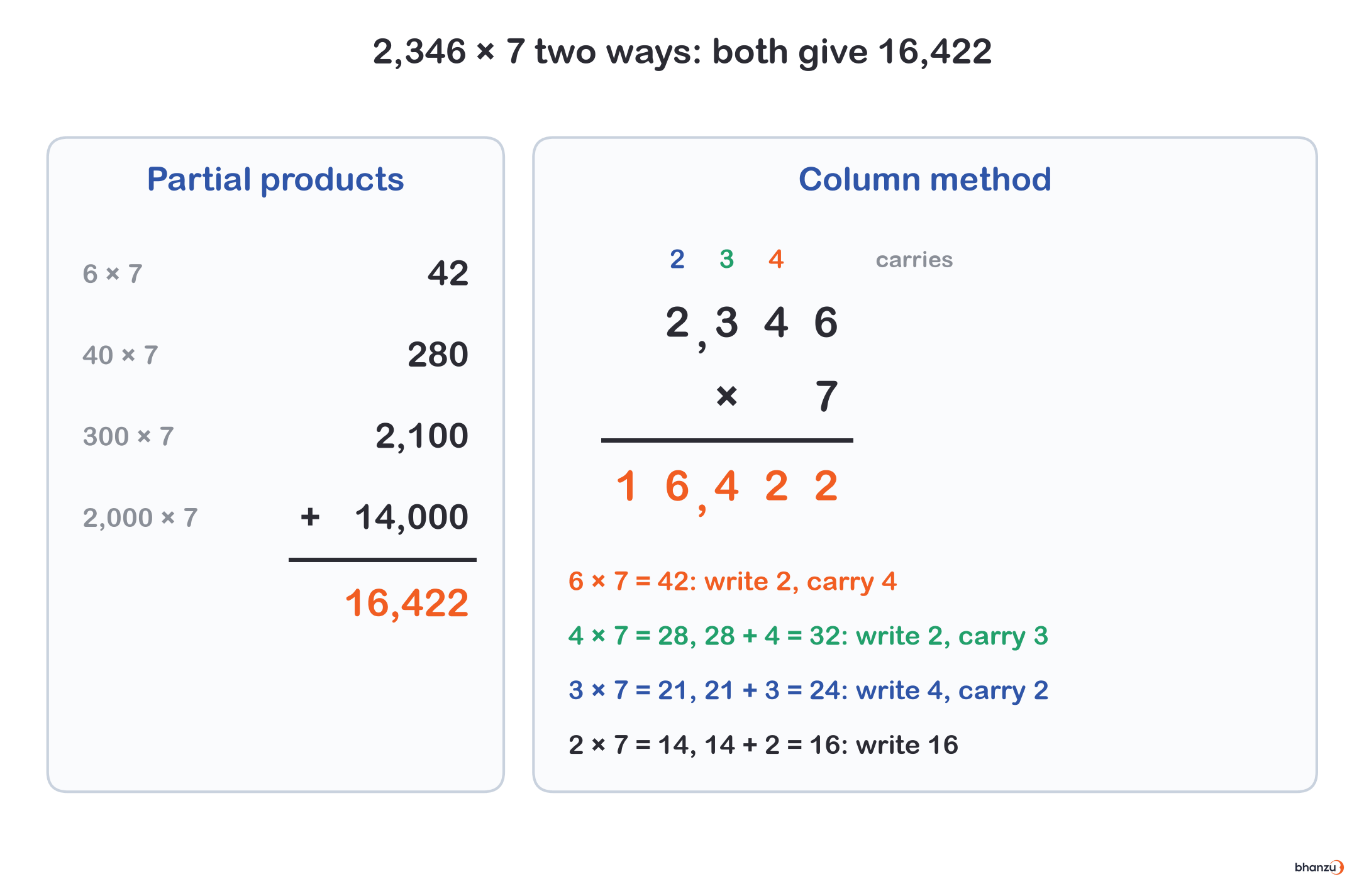
- In the column method, each carried digit is a regrouped place value, so 6 times 7 makes 42 ones and the 4 tens move to the tens column.
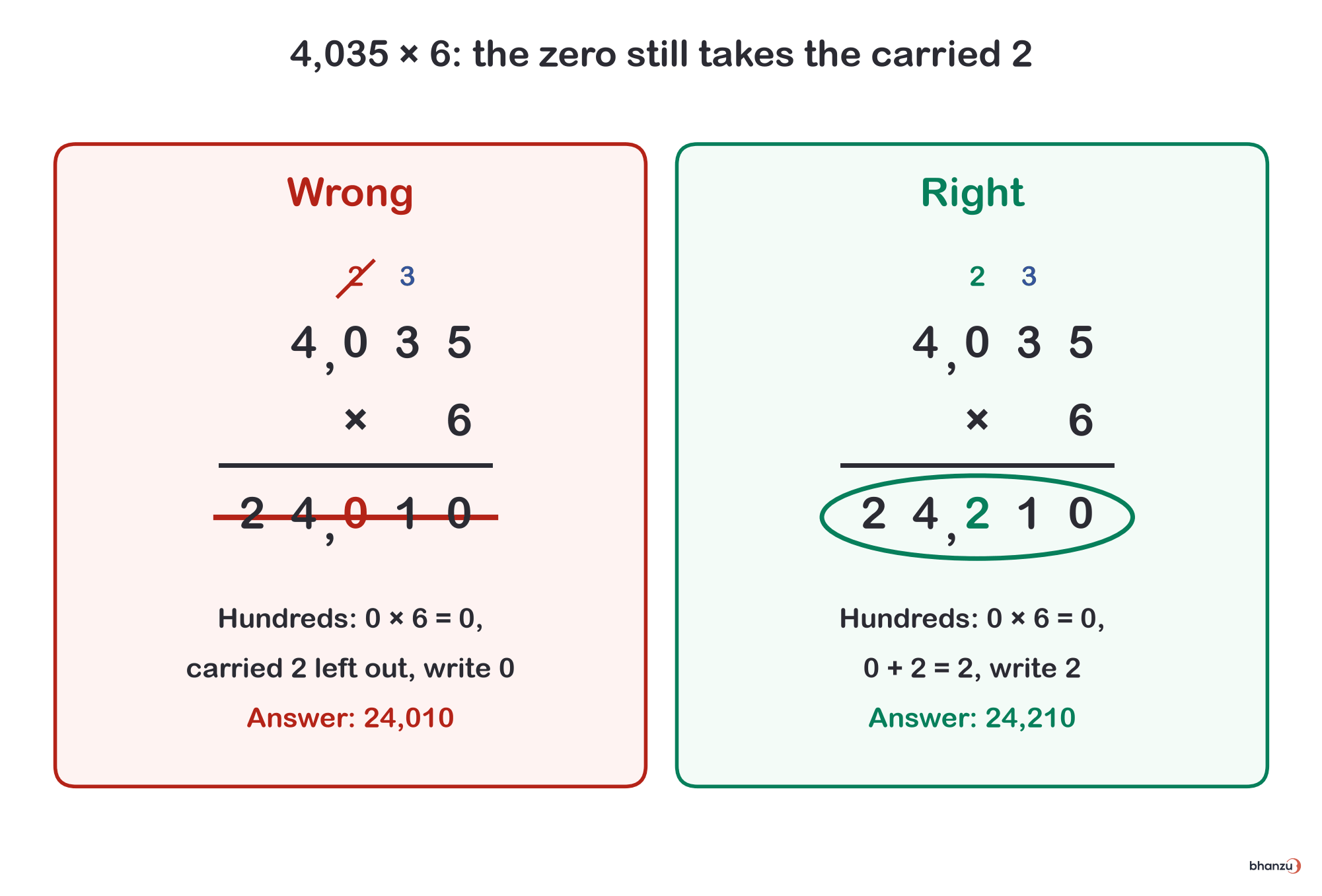
- A zero in the top number still takes the carry, so 4,035 times 6 is 24,210, not the 24,010 that comes from dropping the carried 2.
Three miles hiding in one multiplication
Every mile you walk or bike is exactly 5,280 feet long. That length is listed in the official US conversion tables kept by the National Institute of Standards and Technology.
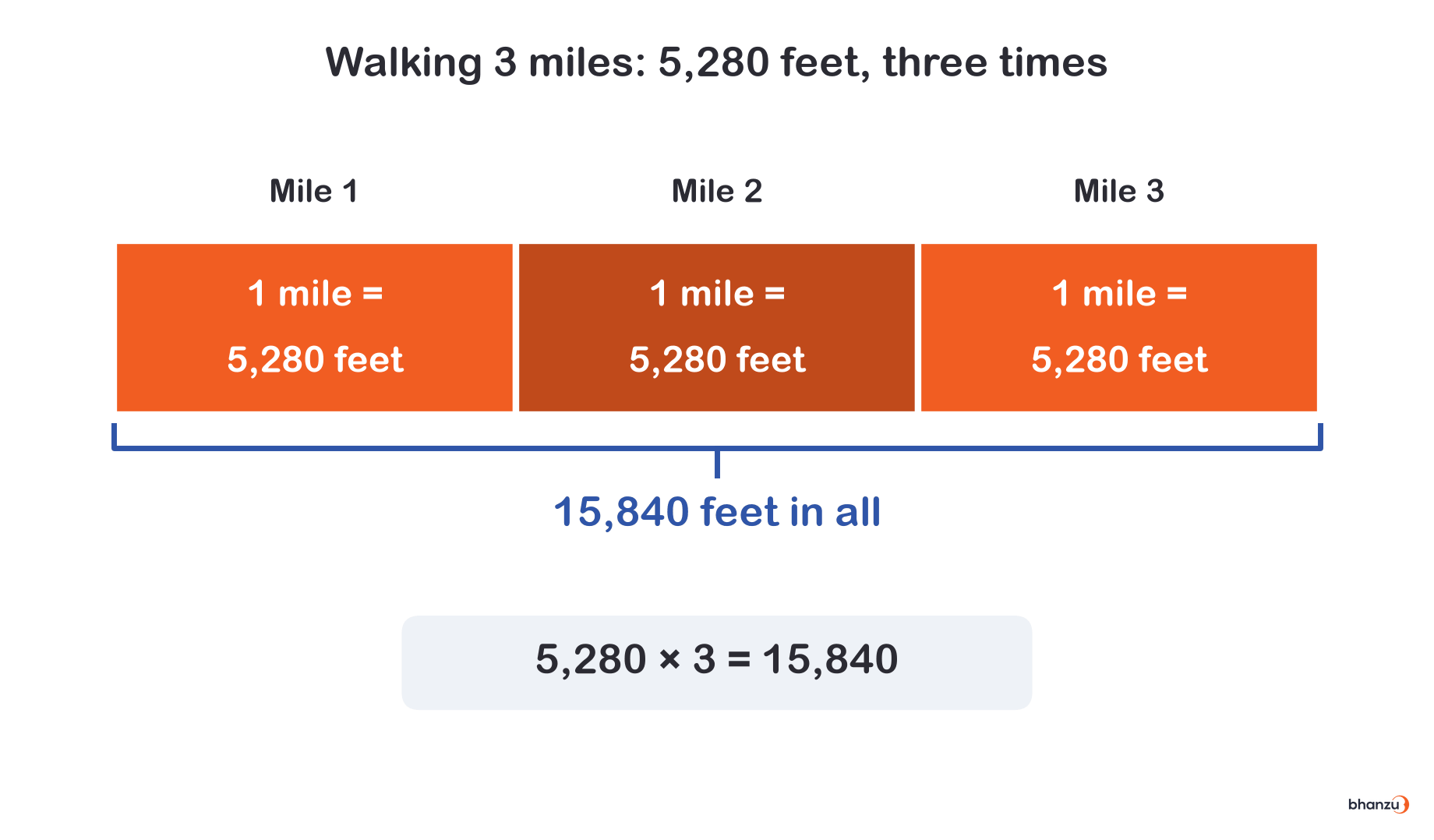
Walk 3 miles and you have covered 5,280 feet three times, one 4-digit number times one 1-digit number. The answer is 15,840 feet. It looks like a big problem, yet every step inside it is a fact you already know.
In 5th grade, the same moves work when both numbers have several digits.
How do you multiply by a 1-digit number?
Multiplying by 1-digit numbers works one place value at a time: multiply the thousands, hundreds, tens and ones of the bigger number separately, then add the results. The answer to a multiplication is called the product. Writing 2,346 as 2,000 + 300 + 40 + 6 is its expanded form, and an area model draws that split as a rectangle with one box per place value.
This is Common Core standard 4.NBT.B.5, which asks 4th graders to multiply a whole number of up to four digits by a one-digit whole number using strategies based on place value.
In NAEP's 2025 long-term trend results, 40% of US 9-year-olds scored at or above the level where students can find the product of a two-digit and a one-digit number. Your child's 4th grade work stretches that skill to four-digit numbers.
How does area model multiplication work?
Draw a rectangle 7 units tall and split its long side into four parts, 2,000, 300, 40 and 6.
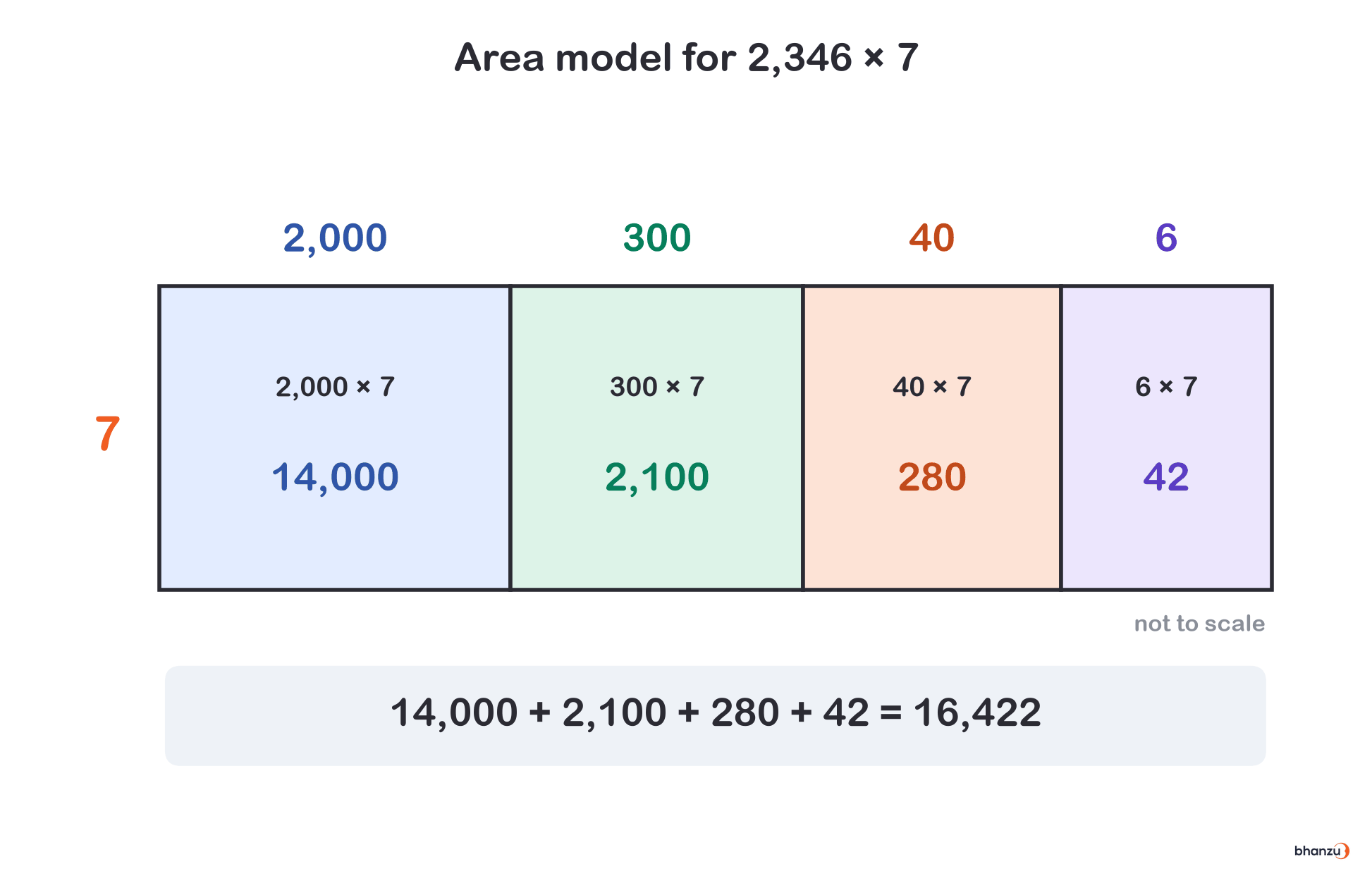
Each box answer is a partial product, one place-value piece of the full product. Apart from the ones box, each is a basic fact with zeros attached, the same idea as multiplying by 10, 100 and 1,000, so is 21 hundreds, or 2,100.
| Box | Multiply by 7 | Partial product |
|---|---|---|
| 6 ones | 42 | |
| 4 tens | 280 | |
| 3 hundreds | 2,100 | |
| 2 thousands | 14,000 | |
| Total | 16,422 |
The area model works because a whole rectangle's area equals its boxes' areas added together. That fact is the distributive property: multiplying a sum gives the same answer as multiplying each part and adding.
The 4th grade standard itself names area models as one way to illustrate and explain the calculation. In 3rd grade you split a rectangle into two parts in area and the distributive property, and 4th grade uses up to four.
Listing the partial products in a column, with no drawing, is the partial products method. Some textbooks call the picture a box method, which genuinely confuses parents who learned only the column method. The boxes are not to scale (the 6 box would be a sliver beside the 2,000 box), and redrawing a rectangle for every problem gets slow. Later in 4th grade, the same picture handles 2-digit times 2-digit problems.
Try It Yourself
Change the digits of the top number and the 1-digit number, and watch the area model split by place value. Each box shows its partial product, and the total updates as you go. Tap Hide a box, then type the missing partial product to check yourself.
How does regrouping work in multiplication?
Regrouping means renaming 10 of one place value as 1 of the next place up, so 42 ones become 4 tens and 2 ones, just as in regrouping whole numbers. The column method, also called the standard algorithm (a fixed list of steps that works for every problem of its kind), does all four partial products in one row. Multiply each column first, then add the carry, as the OpenStax Prealgebra textbook teaches.
- ones. Write 2, carry 4 tens.
- tens, plus 4 is 32 tens. Write 2, carry 3 hundreds.
- hundreds, plus 3 is 24 hundreds. Write 4, carry 2 thousands.
- thousands, plus 2 is 16 thousands. Write 16.
The answer, 16,422, matches the boxes.
To check, estimate. Since 2,346 sits between 2,000 and 3,000, the product must land between 14,000 and 21,000, and 16,422 does.
The column method is the fastest of the three, but it hides the place values. A child can carry correctly for weeks and still call the small carried 4 "just a 4", repeating the steps without knowing it means 4 tens. Saying "4 tens" out loud while writing it fixes that habit.
Examples of multiplying by 1-digit numbers
Example 1
Use an area model to find 46 times 3.
Split 46 into 40 and 6, with 3 down the side.
So .
Example 2
Find 1,357 times 4.
The tempting move is to multiply each digit by 4 and write 4, 12, 20 and 28 side by side, which reads as 4,122,028.
That can't be right. Since 1,357 sits between 1,000 and 2,000, the product must sit between 4,000 and 8,000. Writing 12, 20 and 28 whole skips the regrouping.
- ones. Write 8, carry 2 tens.
- tens, plus 2 is 22 tens. Write 2, carry 2 hundreds.
- hundreds, plus 2 is 14 hundreds. Write 4, carry 1 thousand.
- thousands, plus 1 is 5 thousands. Write 5.
So , inside that range.
Example 3
Find 608 times 7 with partial products, then with regrouping.
With regrouping, , so write 6 and carry 5. At the 0, , plus the carry is 5, so write 5. Then , so write 42.
Both ways give 4,256.
Example 4
Find 4,786 times 9.
| Column | Multiply | Total with carry | Write | Carry |
|---|---|---|---|---|
| Ones | 54 | 4 | 5 | |
| Tens | 77 | 7 | 7 | |
| Hundreds | 70 | 0 | 7 | |
| Thousands | 43 | 43 | none |
Reading the Write column from the bottom up gives 43,074, a 5-digit answer.
Example 5
Find the missing hundreds digit if 3,?48 times 5 is 17,240.
Multiply the parts you know.
The hundreds part makes up the rest.
Since , the missing digit is 4.
Example 6
Leo runs his 1,320-foot school loop 4 times on Monday and 3 times on Tuesday. How many feet is that in all, and is it more than a mile?
Add the loops first, . Then multiply with regrouping.
One mile is 5,280 feet, and , so Leo ran 3,960 feet more than a mile.
Why does multiplying by 1-digit numbers matter?
Multiplying by a 1-digit number exists so you never have to add the same big number over and over.
- It shortens long addition. Adding 1,375 six times takes five additions, but takes one step.
- It totals equal prices. Four bikes at $365 each cost $1,460.
- It turns big units into small ones. Two miles is feet.
- It runs division backward. Since , sharing 8,250 equally among 6 gives 1,375 each, and dividing by a 1-digit number comes next.
Each of those jobs is one multiplication instead of a long chain of adding, and the same idea later splits into plus .
The pattern hiding inside multiplying by 1-digit numbers
Two patterns let you check an answer before anyone marks it.
- The carry ceiling. When you multiply by a 1-digit number, a carried digit is never more than 8. The biggest fact is , and adding the biggest carry, 8, makes 89, which still carries 8. A carry of 9 means a fact slipped.
- The size window. A 4-digit number times a number from 1 to 9 lands between 1,000 and 89,991 (that's ), so the answer has 4 or 5 digits. That is how the 7-digit 4,122,028 in Example 2 gave itself away.
For parents, the order is deliberate. Common Core asks 4th graders for place-value strategies and saves fluency with the standard algorithm for 5th grade, in standard 5.NBT.B.5. A 2018 study of 221 fourth graders in Germany, in the journal Mathematical Thinking and Learning, linked leaning on digit-by-digit written methods with less use of whole-number strategies. Much of the gap between Common Core math and traditional math is that order, models first and the shortcut later.
What are the most common mistakes with multiplying by 1-digit numbers?
Mistake 1: Forgetting the carried digit
Where it slips in: Any column that receives a carry. Children who rush, or who write the carried digit tiny and high, often skip it on the very next step because their eyes jump to the big digit below.
Don't do this: Working out without adding the carries, so the digits come out 1, 8, 2 and 6, for 6,281.
The correct way: Add each carry after multiplying the next digit, so the columns make , then , then , then . The answer is 7,401.
Rounding catches this mistake, since 2,467 is close to 2,500, and , so 6,281 is far too small.
Mistake 2: Letting a zero swallow the carry
Where it slips in: A zero inside the top number, as in Example 3. The zero looks like a place with nothing to do, so the carried digit waiting above it gets dropped.
Don't do this: In , writing 0 under the zero and losing the carried 2, which gives 24,010.
The correct way: , plus the carried 2 is 2, so write 2 in the hundreds place. Then , and the answer is 24,210.
Mistake 3: Dropping the zeros in a partial product
Where it slips in: Partial products and area models. The basic fact feels like the whole job, so gets written as 15.
Don't do this: Finding as .
The correct way: Keep every place value, so . The thousands part alone is 15,000, so 39 could never be right.
Key Takeaways
- Every method for multiplying by 1-digit numbers breaks the work into thousands, hundreds, tens and ones.
- When the top number has a zero inside, as in 608 times 7, the digit you write in that place is the carry, 5, not 0.
- Compare each answer with the easy products on either side, such as 14,000 and 21,000 for 2,346 times 7.
- For more practice carrying through zeros in problems like 4,035 times 6, explore Bhanzu's 4th grade math tutor or math programs for kids.
Read More
- Estimating Products and Quotients
- Multi-Digit Multiplication
- Multiplying by Multiples of 10
- Dividing Multiples of 10, 100 and 1,000
- How to Teach Multiplication
Research Behind This Article
- Common Core State Standards Initiative, Grade 4 Number and Operations in Base Ten (2010). thecorestandards.org
- National Center for Education Statistics, NAEP Long-Term Trend Assessment Results: Mathematics Performance-Level Results, Age 9 (2026). nationsreportcard.gov
- OpenStax, Prealgebra 2e, 1.4 Multiply Whole Numbers (2020). openstax.org
- Common Core State Standards Initiative, Grade 5 Number and Operations in Base Ten (2010). thecorestandards.org
- Andreas Schulz, Relational Reasoning about Numbers and Operations: Foundation for Calculation Strategy Use in Multi-Digit Multiplication and Division, Mathematical Thinking and Learning 20(2) (2018). eric.ed.gov
Quick Quiz: Check Yourself
Three levels, new numbers every time: a 2-digit number times a 1-digit number, 3- and 4-digit numbers with regrouping and zeros, then 5-digit products, missing digits and loop distances.
Was this article helpful?
Your feedback helps us write better content
Frequently Asked Questions
How can I help my child with multiplication at home?
Why is it important to learn different ways to multiply by a 1-digit number?
Where do you write the carried digit in multiplication?
Do you always have to regroup when multiplying 3-digit numbers by 1 digit?
How can my child get faster with multiplication facts?