Key Points
- Halves, thirds and fourths come from cutting one whole into 2, 3 or 4 equal shares, and all the shares together rebuild that whole.
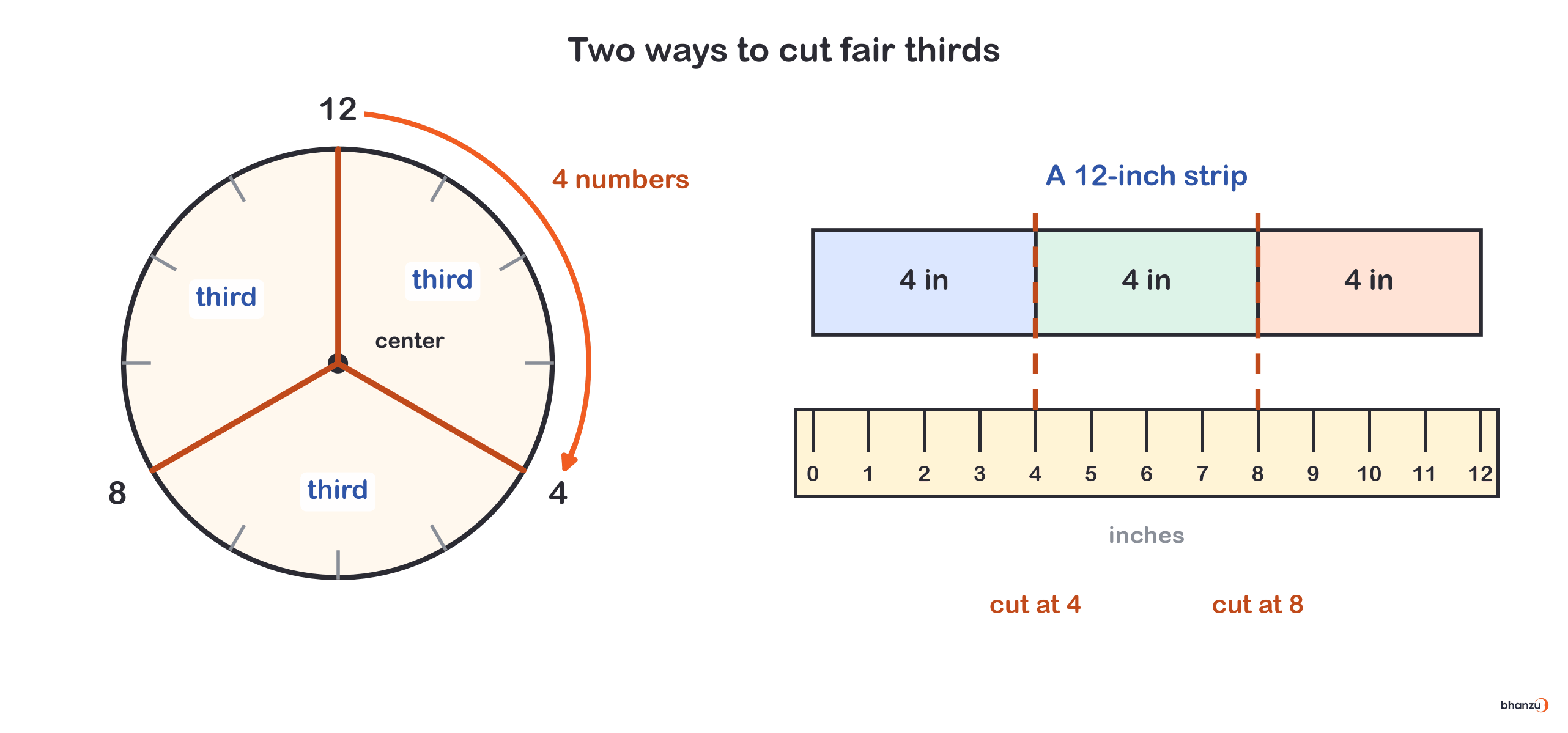
- A circle splits into thirds with lines from its center to where 12, 4 and 8 sit on a clock, so each share spans 4 of the 12 numbers.
- Equal shares of identical wholes can differ in shape, as when a 16-square sandwich cut corner to corner gives triangle halves of 8 squares each.
Three friends and one round pancake
Two cuts that cross in the middle like a plus sign make four fair pieces. Two friends need only one cut. Now Priya, Omar and Lucia share one pancake.
Halving never gives three fair pieces, yet a fair cut for three exists. Pieces of one whole that are all the same size are called equal shares. Before long, you'll find halves, thirds and fourths on clock faces and in measuring cups.
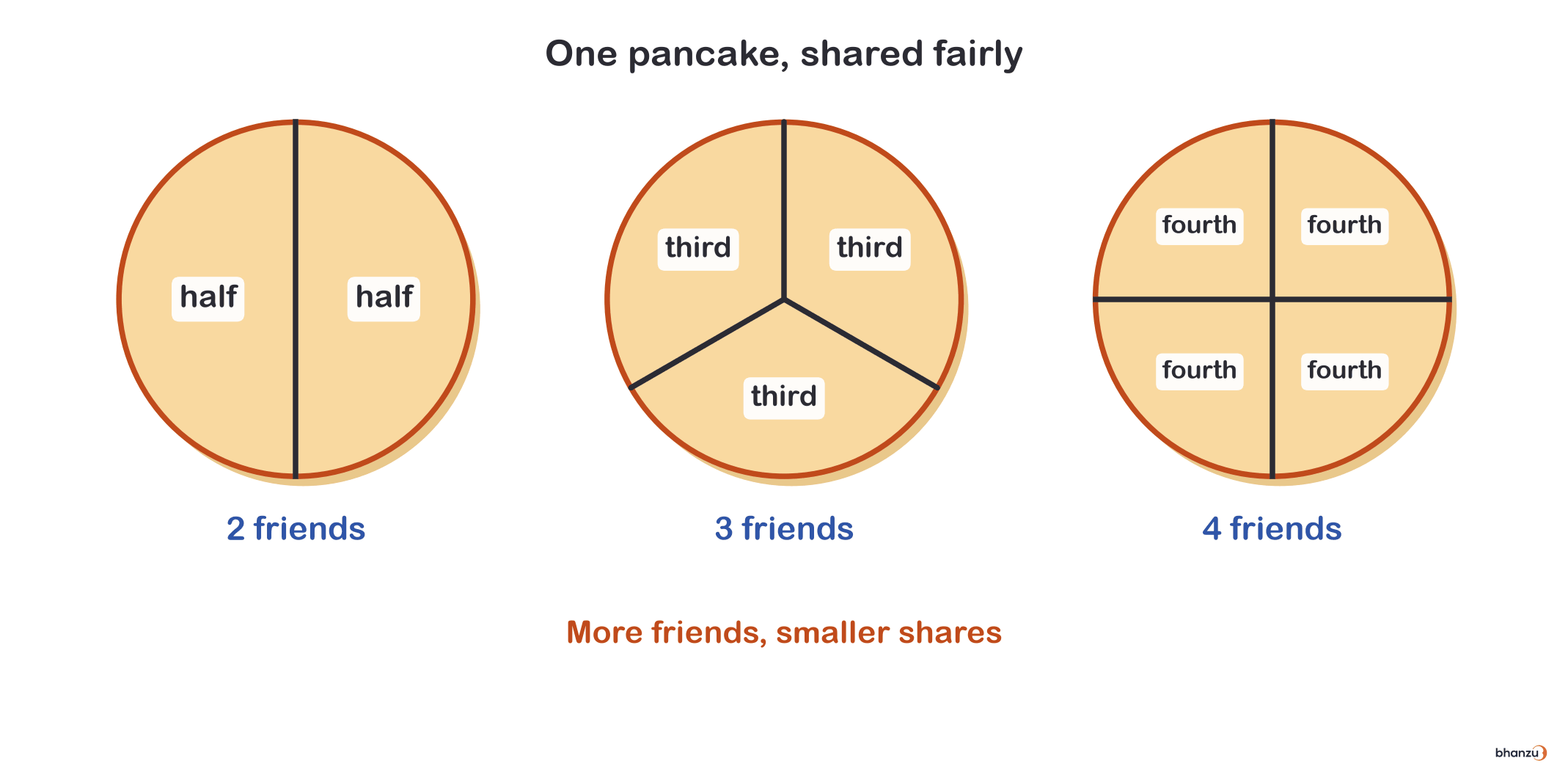
What are halves, thirds and fourths?
Halves, thirds and fourths name the equal shares of one whole, with 2 shares making halves, 3 making thirds and 4 making fourths. The whole is the full shape before any cut, and these share names are your first fractions, words for parts of a whole. Circles and rectangles are flat shapes, so equal shares cover the same amount of flat space.
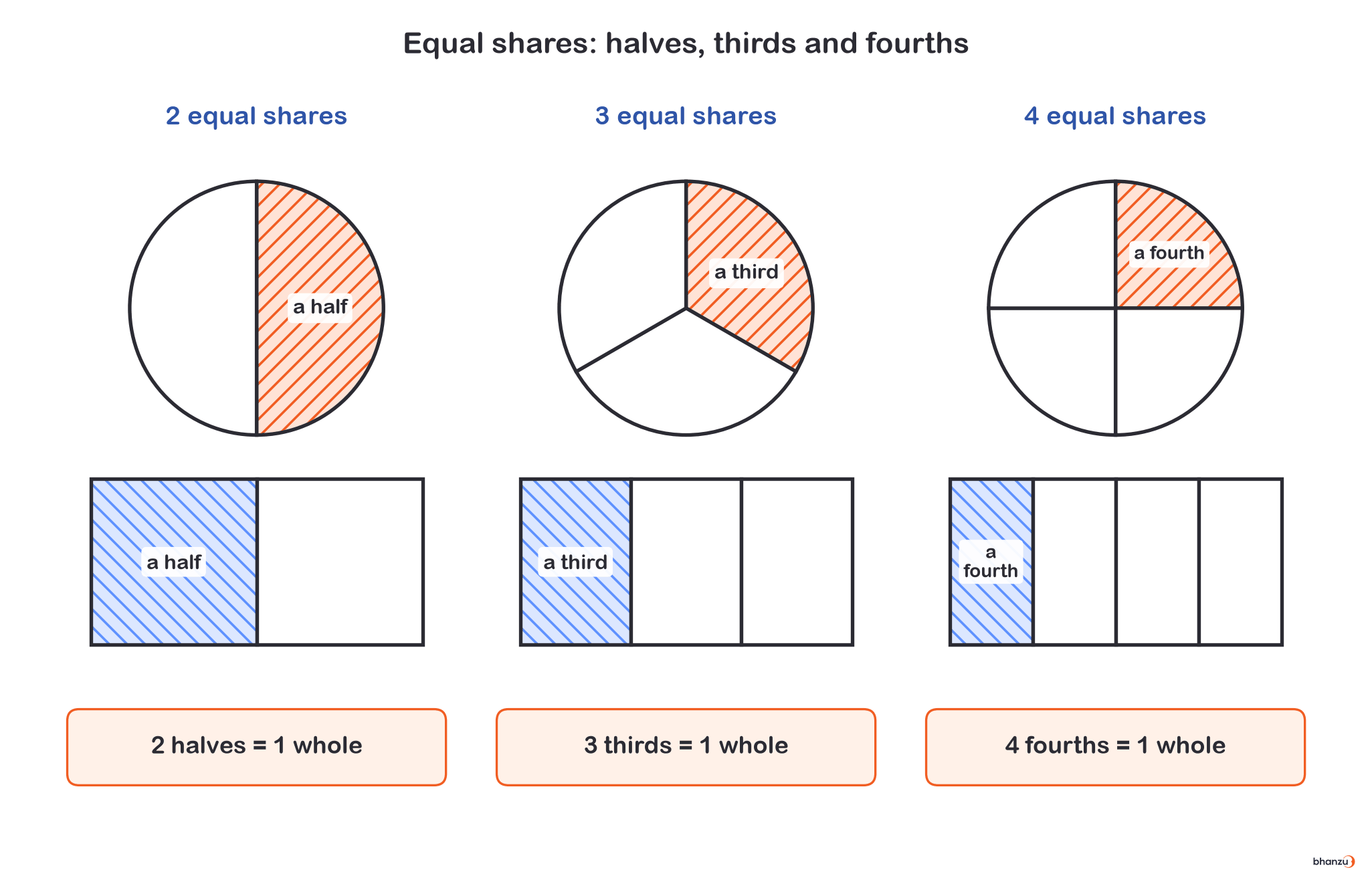
| Equal shares | One share is called | The whole is |
|---|---|---|
| 2 | a half | 2 halves |
| 3 | a third | 3 thirds |
| 4 | a fourth, also called a quarter | 4 fourths |
Two identical pancakes hold thirds. In 1st grade you cut shapes into halves and fourths, and 2nd grade adds thirds. This is Common Core standard 2.G.A.3.
During 2nd grade, your child is expected to cut circles and rectangles into 2, 3 or 4 equal shares and to name each share in words.
How do you divide a circle into thirds?
Cut from the center out to where the 12, the 4 and the 8 sit on a clock face.
- Find the center of a circle. Fold a paper circle in half twice, and the creases cross at the center.
- Mark where the 12, the 4 and the 8 would sit on a clock.
- Draw a straight line from the center to each mark.
- Check that each share spans 4 of the 12 clock numbers.
A rectangle needs 2 cuts for 3 equal strips. On a 12-inch strip, mark 4 inches and 8 inches.
The clock uses the same 4 and 8, since both have 12 equal steps.
Folding in half and folding again makes 2 or 4 equal shares, never 3. A child who halves well still reaches for a fold first. A 2010 What Works Clearinghouse guide suggests placing sticks on the shape to plan the cuts instead.
A shape cut into equal shares with some shaded is an area model. In a 2022 study of 195 first and second graders, watching shapes split one cut at a time helped most with matching written fractions to pie pictures.
Are equal shares always the same shape?
No. Equal shares of identical wholes can have different shapes, as long as each covers the same amount. Take a square sandwich drawn as 4 rows of 4 same-size squares, 16 in all.
| Cut | Shape of each half | Squares in each half |
|---|---|---|
| Down the middle | rectangle | 8 |
| Corner to corner | triangle | 6 whole and 4 half squares, so 8 |
The corner-to-corner line is a diagonal of a rectangle (a square counts as one). It slices 4 squares exactly in half, and 2 half squares make 1 whole, so each triangle holds .
Turn one triangle around and it fits on the other. A triangle half never fits on a rectangle half, yet both hold 8 squares (that looks wrong at first). Counting squares settles it, and in 3rd grade this counting gets a name, area.
Is a third bigger than a half?
No. A half of a pancake is bigger than a third of the same pancake, and a third is bigger than a fourth. More friends sharing one whole means a smaller share each.
| Friends sharing one pancake | Each friend gets |
|---|---|
| 2 | a half |
| 3 | a third |
| 4 | a fourth |
That order is only guaranteed for identical wholes, because half a small cookie can be less than a third of a giant pizza. Later, 3rd grade looks at fractions of different-sized wholes.
In 3rd grade, a third gets written as . Lining up shares by size leads to comparing fractions with the same numerator.
Try It Yourself
Choose the circle or the rectangle, set 2, 3 or 4 equal shares, then tap shares to shade the goal and press Check. With the circle in 3 shares, try the halving cut to see why its pieces are not thirds. On the rectangle, the readout counts grid squares in each share.
Examples of halves, thirds and fourths
Example 1
Priya's pancake has 3 equal shares. What is each share called?
Each share is a third, and 3 thirds make the whole pancake.
Example 2
Omar folds a 12-inch strip in half, folds one half again, and cuts on the folds. Are his 3 pieces thirds?
Three pieces sounds like thirds, so the tempting answer is yes.
Check the lengths. The first fold makes two 6-inch halves, and the second splits one half into two 3-inch pieces.
No, these unequal pieces are one half and two fourths. Real thirds are 4 inches each.
Example 3
Lucia cuts a square sandwich of 4 rows of 4 squares into 4 strips. Mateo cuts an identical one into 4 square blocks. Are both sets fourths?
Each strip is 1 row of 4 squares, and each block is 2 rows of 2, so .
Every piece holds 4 squares, so both sets are fourths, even with different shapes.
Example 4
Priya gets a third of a waffle, and Ben gets a fourth of an identical waffle. Who gets more?
Three sharers get bigger pieces than 4 sharers. Priya gets more.
Example 5
Priya splits a clock face into thirds at the 12, the 4 and the 8. How many minutes does the minute hand need for one third?
From the 12 to the 4 is 4 numbers, at 5 minutes each.
One third takes 20 minutes, and 3 thirds make minutes.
Example 6
Mateo's family cuts 2 identical pans of cornbread into fourths and eats 5 pieces. How many fourths are left?
Each pan holds 4 fourths.
There are 3 fourths left.
Halves, thirds and fourths beyond the textbook
Halves, thirds and fourths exist so one whole can be shared fairly, even by 3 people.
- Clocks use them. The minute hand sweeps half the clock in 30 minutes and a fourth in 15, hence "half past" and "quarter past".
- Measuring cups use them. A common US set has a fourth cup, a third cup and a half cup.
- They start fractions, which stay tricky for years. The National Mathematics Advisory Panel's 2008 report noted that 27% of 8th graders on the Nation's Report Card could not shade one third of a rectangle.
Fair cuts now give your child a firm base, and a parent guide explains why fractions are so hard.
Tripping points to avoid with halves, thirds and fourths
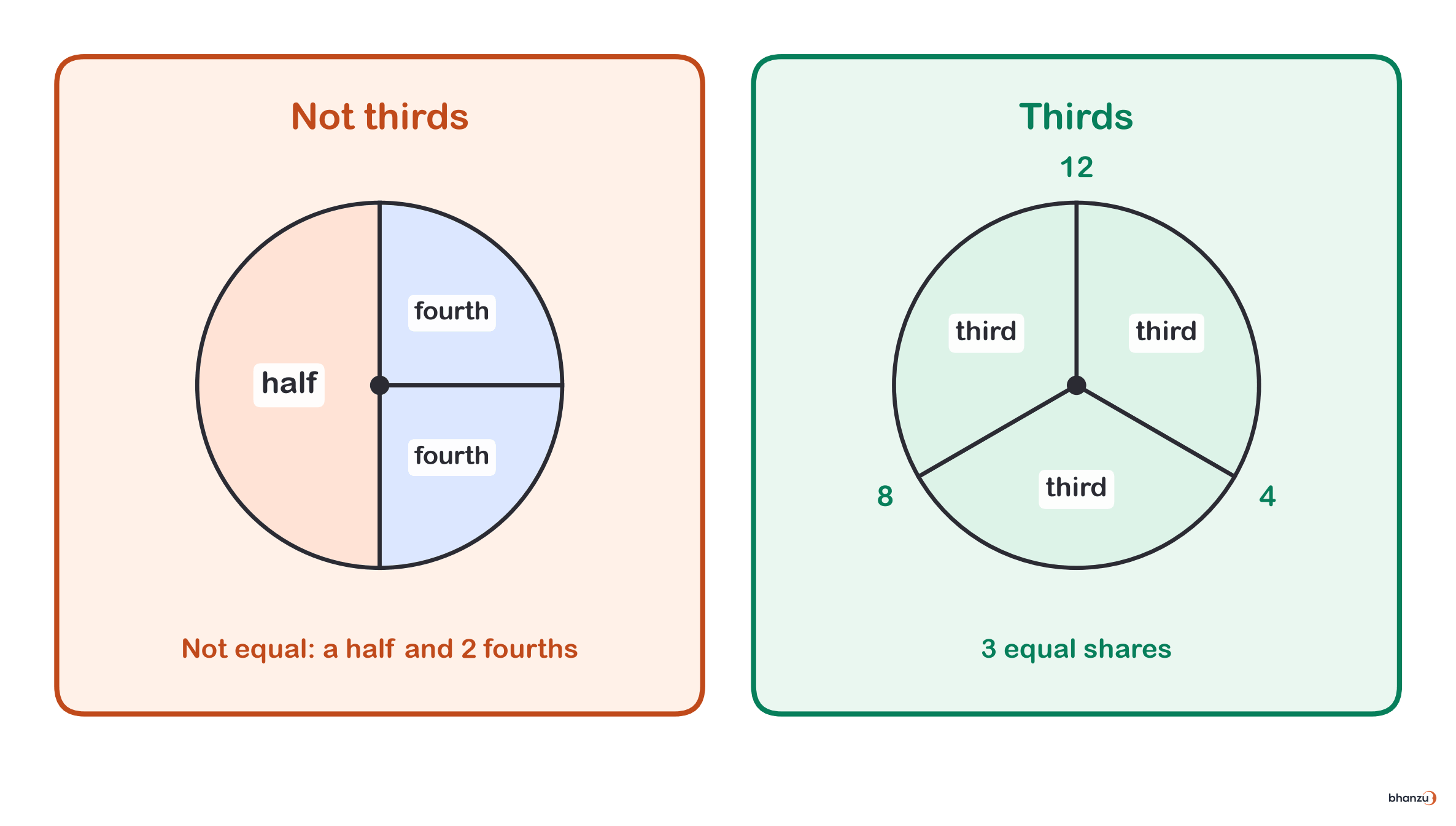
Mistake 1: Halving twice to make thirds
Where it slips in: Making thirds by folding, as in Example 2. A child's first try is often the halving cut, trusted since 1st grade.
Don't do this: Cut a pancake in half, cut one half again, and call the 3 pieces thirds. They are one half and two fourths.
The correct way: Cut from the center to the 12, the 4 and the 8 on a clock, so each share spans 4 numbers.
Mistake 2: Saying differently shaped pieces cannot be halves
Where it slips in: Corner-to-corner cuts. A child stacks a triangle on a rectangle half, sees corners poke out, and calls them unequal. In everyday talk, "the same" means "looks the same".
Don't do this: Calling the triangles "not halves" because they look different.
The correct way: Count squares. Each triangle holds 6 whole and 4 half squares, which make 8, like each rectangle half.
Mistake 3: Calling a fourth bigger because 4 is more than 3
Where it slips in: Who-gets-more questions like Example 4. A child who answers fast picks the fourth, because a bigger number has always meant more.
Don't do this: Saying Ben's fourth of the waffle is more than Priya's third.
The correct way: Read the 4 as how many friends share. Four friends sharing an identical waffle get smaller pieces than 3 friends, so a third is bigger.
What most guides miss about halves, thirds and fourths
Naming shares comes quickly. Cutting them equal takes far longer. A 2025 study of first and second graders found most could cut the right number of parts, but not equal parts that fill the whole.
The study found no real difference between the two grades, which suggests age alone does not even out the cuts. Three checks catch a lopsided cut:
- The shares are equal. Fold, stack, turn or count squares.
- Nothing is left over.
- The count matches the name.
If your child names thirds easily but cuts lopsided pieces, that is the usual 2nd grade picture and the exact thing to practice.
Key Takeaways
- Check that every share is the same size before calling pieces halves, thirds and fourths.
- Thirds need their own cut, at 12, 4 and 8 on a clock or 4 and 8 inches on a 12-inch strip.
- When shares look different, count grid squares instead of trusting a fold.
- Before comparing two shares, ask how many friends shared each whole.
- For more practice cutting fair thirds with a teacher who checks each cut, explore Bhanzu's 2nd grade math curriculum or join math classes for kids.
Read More
Research Behind This Article
- Common Core State Standards Initiative, Grade 2 Geometry (2.G) (2010). thecorestandards.org
- What Works Clearinghouse, Developing Effective Fractions Instruction for Kindergarten Through 8th Grade (2010). ies.ed.gov
- Hurst, Butts and Levine, Connecting Symbolic Fractions to Their Underlying Proportions Using Iterative Partitioning (2022). eric.ed.gov
- Common Core State Standards Initiative, Grade 3 Number and Operations, Fractions (3.NF) (2010). thecorestandards.org
- National Mathematics Advisory Panel, Foundations for Success: The Final Report of the National Mathematics Advisory Panel (2008). files.eric.ed.gov
- Zolfaghari, Examining Fragmenting Knowledge in First and Second Grade Students: Insights into Fragmenting Developmental Trajectory (2025). eric.ed.gov
Quick Quiz: Check Yourself
Three levels, fresh questions each time: name and count shares, then spot real thirds, compare shares and count squares, then solve pan and clock problems.
Was this article helpful?
Your feedback helps us write better content
Frequently Asked Questions
How many thirds make a whole pizza?
What does one third look like?
Are fourths and quarters the same thing?
Do second graders learn fractions?
Where can I find math help for 2nd grade fractions?