Key Points
- In equivalent fractions with models, two fractions cover equal shares of same-size wholes, like 1/2 and 4/8 of two matching strips.
- Cutting every part into 2 equal pieces doubles both the parts and the shaded parts, so 2/3 becomes 4/6.
- On a number line marked in sixths, 1/3 sits on the second mark after 0, 2/6, though children counting marks often pick the first.
- Common Core sets this in 3rd grade with denominators 2, 3, 4, 6 and 8, before the multiplying rule of 4th grade.
Fold it again and nothing changes
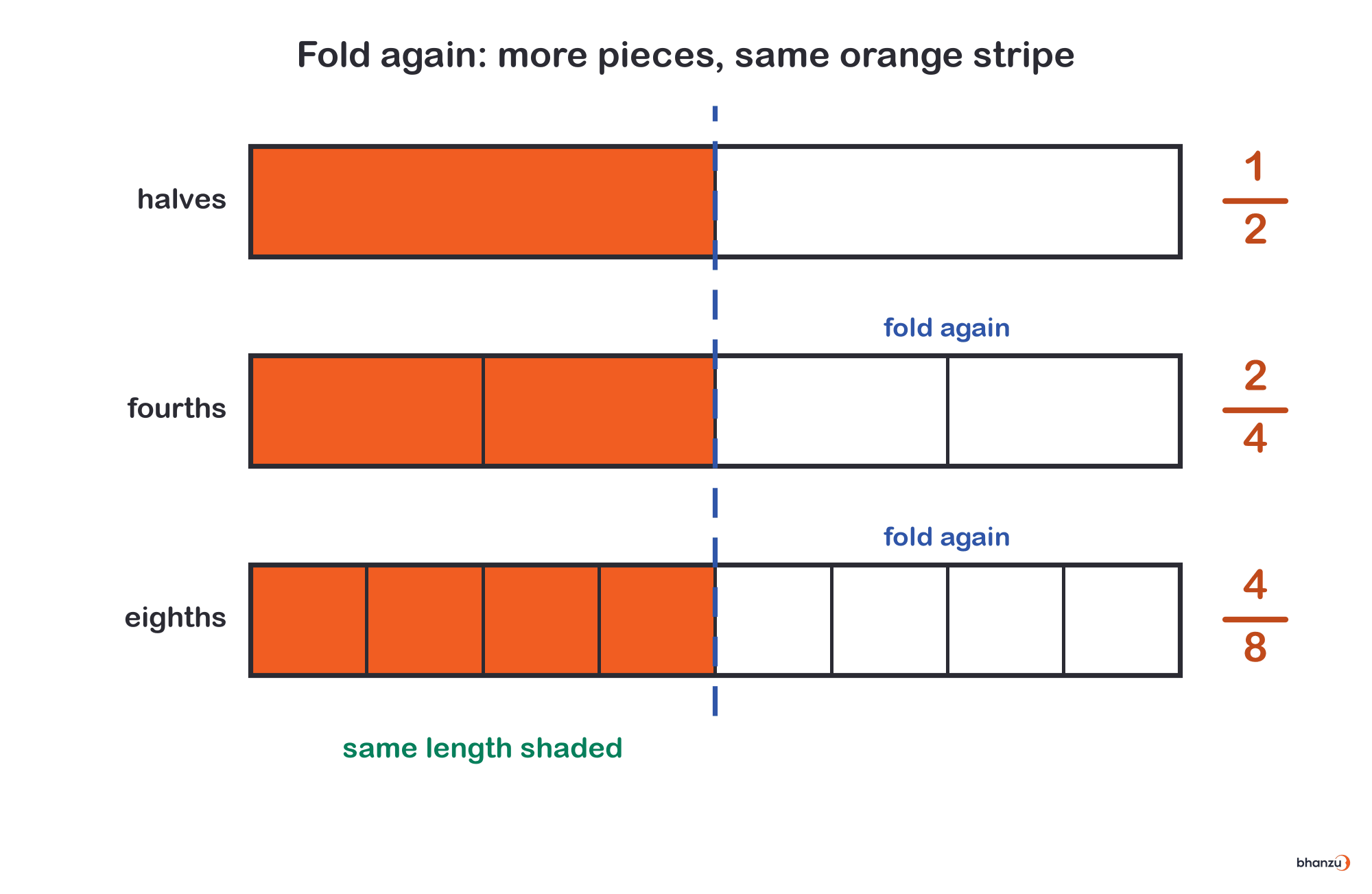
Fold a paper strip in half and color one half orange.
Fold it in half again, then open it. Now there are 4 equal parts, and 2 are orange. One more fold gives 8 parts with 4 orange.
The count keeps changing, yet the orange stripe stays the same size. Different fractions can name the very same amount, and that is what equivalent fractions are about.
In a few months you'll use this to compare fractions. By 4th grade you'll find them without folding a thing.
How do you find equivalent fractions with models?
To find equivalent fractions with models, draw one fraction, cut every part into equal smaller pieces, and count the shaded pieces again. Equivalent fractions are fractions that name the same amount of the same whole. In , the numerator 2 counts shaded parts and the denominator 4 counts the equal parts in the whole.
- Draw a strip or rectangle in equal parts for the first fraction.
- Shade the parts the numerator names.
- Cut every part into the same number of equal pieces.
- Count shaded pieces and total pieces for the new fraction.
On the folded strip, each cut turned one orange half into 2 orange fourths, then 4 orange eighths.
This is Common Core standard 3.NF.A.3, which asks 3rd graders to explain why two fractions are equal, for example with a visual fraction model. For your child, that means the picture matters as much as the answer, and the standards (written in 2010) keep 3rd grade fractions to denominators 2, 3, 4, 6 and 8.
Which models show equivalent fractions?
Fraction strips, area models and number lines all work for one shared reason. Cut every part of a whole into 2 equal pieces and you get twice as many parts, each half as big. The shaded amount stays exactly where it was.
- Fraction strips. A fraction strip is a long rectangle cut into equal parts (stack several and you have a fraction wall). OpenStax's Prealgebra calls them fraction tiles.
- Area models. To find equivalent fractions using area models, cut a rectangle the other way. A rectangle in 3 columns with 2 shaded gets one cut across and becomes 6 parts with 4 shaded.
- Number lines. Equivalent fractions land on the same point between 0 and 1.
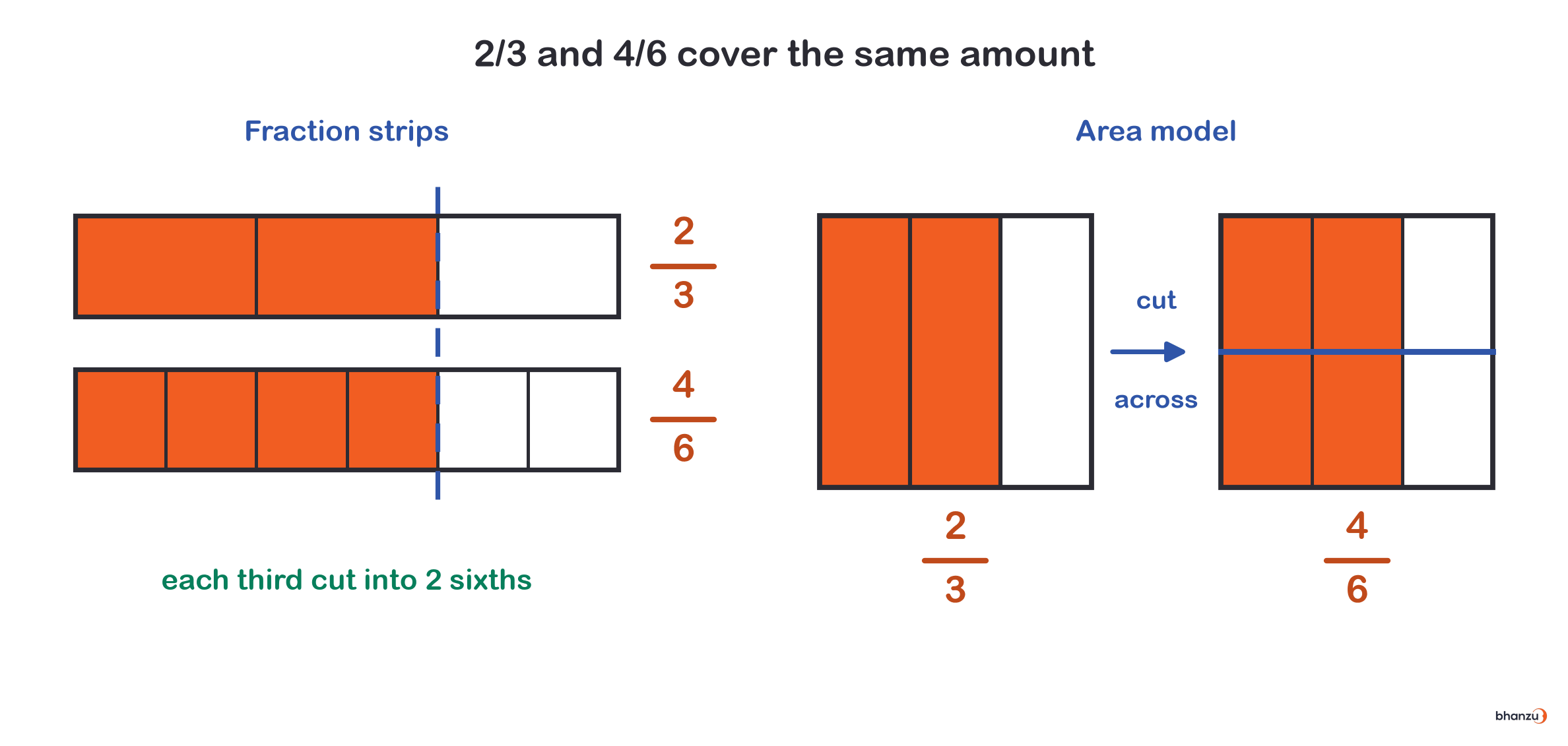
Folded paper or grid paper keeps the pieces equal. A child who sketches fast often draws parts of different sizes, then counts 2 of 4 uneven parts as two fourths. Pie pictures are the confusing case, since a circle is hard to cut into 3 or 6 equal slices by hand.
Every equivalent pair below 1 with 3rd grade denominators fits into five families.
| Family | Equivalent fractions | Cut each part into |
|---|---|---|
| One half | 2, 3 or 4 | |
| One third | 2 | |
| Two thirds | 2 | |
| One fourth | 2 | |
| Three fourths | 2 |
Fractions such as and have no partner with these denominators. The cut also runs backward, so joining eighths in pairs turns back into .
How do you find equivalent fractions on a number line?
Two fractions are equivalent when they land on the same point of the same number line. You already place fractions on a number line by cutting the space from 0 to 1 into equal parts. Stack three lines of the same length, cut into halves, fourths and eighths.
A ruler laid straight down from touches and . Slide it to and it touches . A 2010 What Works Clearinghouse guide on teaching fractions puts number lines at the center of fraction lessons, with stacked lines like these.
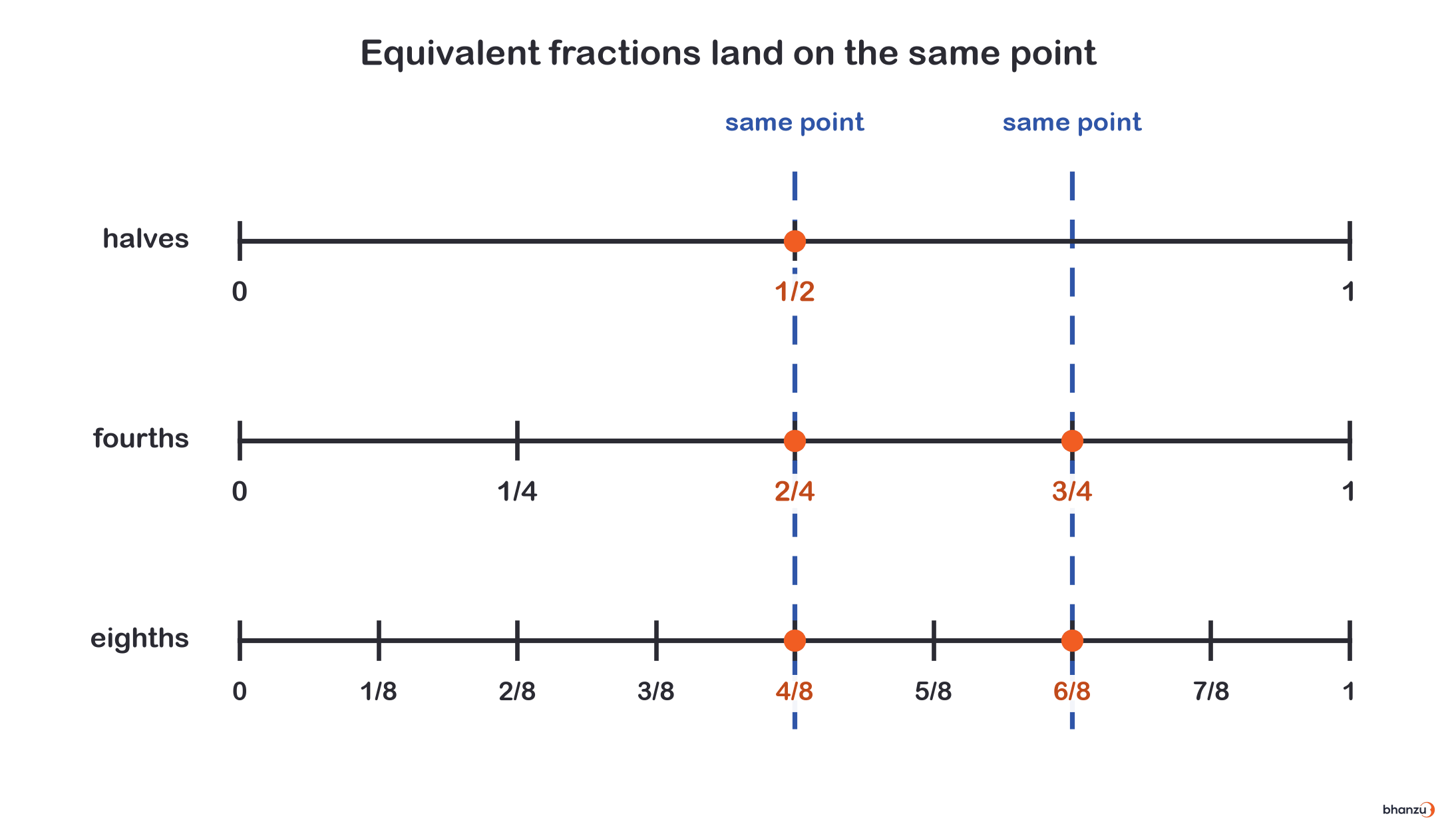
A line cut into smaller parts than your fraction takes one extra thought. Each third holds 2 sixths, so sits on the second mark after 0 on a sixths line, at (count spaces from 0, not tick marks).
Which fractions are equal to whole numbers?
A fraction equals 1 when its numerator and denominator match, like or , because every part of the whole is shaded. Eight fourths fill 2 whole strips, so .
Going the other way, any of the whole numbers can sit over a denominator of 1, where each whole is one part.
On a number line marked in fourths, lands on the same point as 1 and lands on 2. In 4th grade, fractions like also get written as mixed numbers.
Try It Yourself
Drag the orange edge on any row of the fraction wall until it meets the blue target line. The readout says when a row matches, such as 3 sixths lining up with one half. Press New target and look for rows that can never land on the line.
Examples of equivalent fractions with models
Example 1
A strip has 4 equal parts with 1 part shaded. Cut every part into 2 equal pieces. What fraction is shaded now?
The strip now has pieces.
The 1 shaded part became pieces.
Example 2
How many eighths are the same as ? Use fraction strips.
The bottom number went from 4 to 8, so the tempting move is to keep the 3 and write .
Lay the strips side by side. Three fourths covers more than half its strip, but three eighths covers less than half, since half of 8 is 4. They can't be equal.
Cut each fourth into 2 eighths instead. The 3 shaded fourths become shaded eighths.
Example 3
A number line from 0 to 1 is marked in thirds on top and sixths underneath. Which sixths mark sits at the same point as ?
Each third holds 2 sixths.
Two thirds hold sixths.
It is the fourth mark after 0.
Example 4
Sam says and are equivalent because both are small pieces. Use area models to check.
Draw two same-size rectangles. Cut one into 6 equal parts with 2 shaded and the other into 4 equal parts with 1 shaded.
Join the sixths in pairs. That makes 3 bigger parts with 1 shaded, so .
Thirds are bigger than fourths, so the shading is wider.
Sam is not right, because is more than .
Example 5
Write 2 as a fraction with a denominator of 4.
One whole strip cut into fourths has 4 fourths.
Two wholes have fourths.
Example 6
Leo walks mile, Mia walks mile, and Noor walks mile. Who walks as far as Leo, and how much farther does Noor walk?
Each half holds 3 sixths, so . Mia walks as far as Leo.
Each half holds 4 eighths, so .
Noor's is 1 more eighth than , so Noor walks mile farther.
The real reason equivalent fractions exist
Equivalent fractions let people who cut things into different-sized pieces tell when their shares match, even when the numbers look nothing alike.
- It makes sharing fair. A sandwich cut in halves and a same-size sandwich cut in fourths give equal lunches for 1 half or 2 fourths.
- It helps you read a ruler. On a ruler marked in halves and fourths of an inch, the half-inch mark is also the two-fourths mark.
- It works in the kitchen. Two scoops with the 1/4 cup fill the 1/2 cup exactly.
A 2012 study in Psychological Science followed 3,677 children in the UK from age 10 to 16. Fraction knowledge at 10 predicted their algebra at 16 better than four other math skills did.
Tripping points to avoid with equivalent fractions
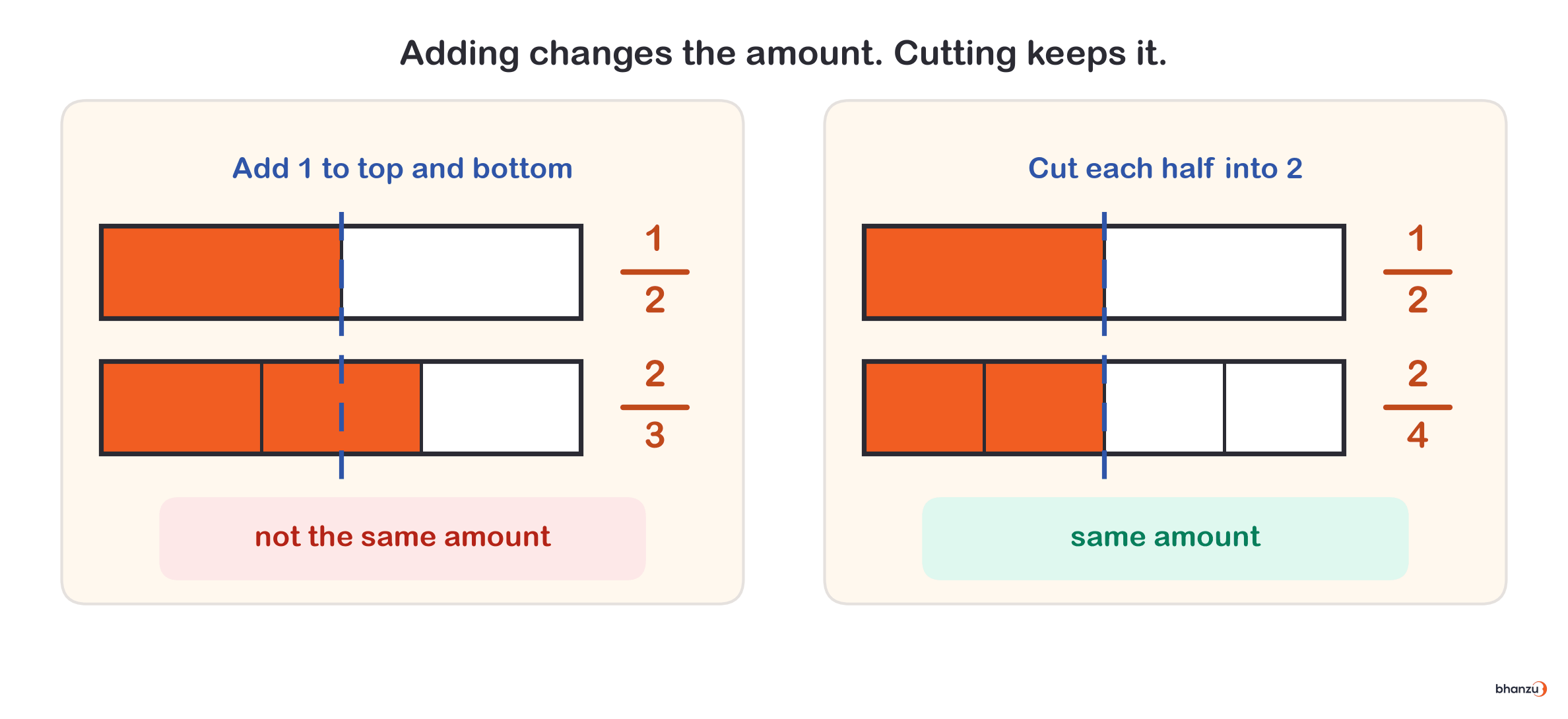
Mistake 1: Adding the same number to the top and bottom
Where it slips in: Tasks that ask you to make an equivalent fraction. A child who wants to change both numbers fairly often reaches for adding, the first operation they learned.
Don't do this: Add 1 to the top and bottom of to get .
The correct way: Cut each half into 2 pieces to get . On equal strips, leaves one third empty while leaves half empty, so the amounts differ.
Mistake 2: Thinking bigger numbers mean a bigger fraction
Where it slips in: Comparing pairs like and . Whole-number habits say 4 and 8 beat 1 and 2, a roadblock the What Works Clearinghouse guide names. A child who just found correctly may even doubt it, because bigger numbers feel like more.
Don't do this: Say is more than because its numbers are bigger.
The correct way: Put both on one number line. They share a point, and the numbers grew only because the pieces got smaller.
Mistake 3: Putting one third on the first mark of a sixths line
Where it slips in: Number lines marked in smaller parts than the fraction, as in Example 3. A child counting tick marks often drops on the first mark after 0, because it is the first stop. The 2010 guide lists this exact case as one students find hard.
Don't do this: Mark on the first tick, which is .
The correct way: Each third holds 2 sixths, so belongs on the second tick, . A thirds line laid above it shows the marks lining up.
What most guides get wrong about equivalent fractions
Most guides skip the two ideas that make the models trustworthy.
- The model comes before the rule. Many pages jump straight to multiplying the top and bottom by the same number, yet 3rd grade asks for a model that explains the match. The rule arrives in 4th grade as equivalent fractions by multiplying, once the picture can explain why it works.
- The wholes must match. A model proves two fractions equal only when both wholes are the same size. Half of a 6-inch strip is 3 inches, but two fourths of a 12-inch strip is 6 inches. Comparing fractions of different-sized wholes starts with checking the wholes.
Key Takeaways
- Before calling two fractions equivalent, check that both models use same-size wholes.
- Cutting every part into equal pieces changes the numbers but never the shaded amount.
- Equivalent fractions with models share one point on a number line, so a ruler across stacked lines is a quick check.
- A fraction like 6/6, with a matching top and bottom, is another name for 1.
- For practice with a teacher who catches 1/3 on the wrong sixths mark, explore Bhanzu's 3rd grade math tutor or math programs for kids.
Read More
- Comparing Fractions with the Same Numerator or Denominator
- Improper Fractions
- Why Are Fractions So Hard
- Mental Math with Fractions
- Equivalent Ratios
Research Behind This Article
- Common Core State Standards Initiative, Grade 3: Number and Operations, Fractions (2010). thecorestandards.org
- Common Core State Standards Initiative, Common Core State Standards for Mathematics (2010). thecorestandards.org PDF
- OpenStax, Prealgebra 2e, 4.1 Visualize Fractions (2020). openstax.org
- What Works Clearinghouse, Institute of Education Sciences, Developing Effective Fractions Instruction for Kindergarten Through 8th Grade (2010). ies.ed.gov
- Siegler and others, Psychological Science, Early Predictors of High School Mathematics Achievement (2012). eric.ed.gov
- National Mathematics Advisory Panel, Foundations for Success: The Final Report of the National Mathematics Advisory Panel (2008). files.eric.ed.gov
Quick Quiz: Check Yourself
Three levels, new numbers every time: count pieces after cutting, find a matching top number or number line mark, then write whole numbers as fractions or compare walks.
Was this article helpful?
Your feedback helps us write better content
Frequently Asked Questions
What fraction is equivalent to one third?
What grade do you learn equivalent fractions?
How do you explain equivalent fractions to kids?
How can I help my child with equivalent fractions in 3rd grade?
Can you use a fraction wall to find equivalent fractions?
Can two fractions with different numbers be equal?