Key Points
- Fractions of different wholes describe parts of two things of unequal size, such as a small pizza and a large one.
- Line the two wholes up first, then compare the fractions if they match, or count the unit squares in each piece if they don't.
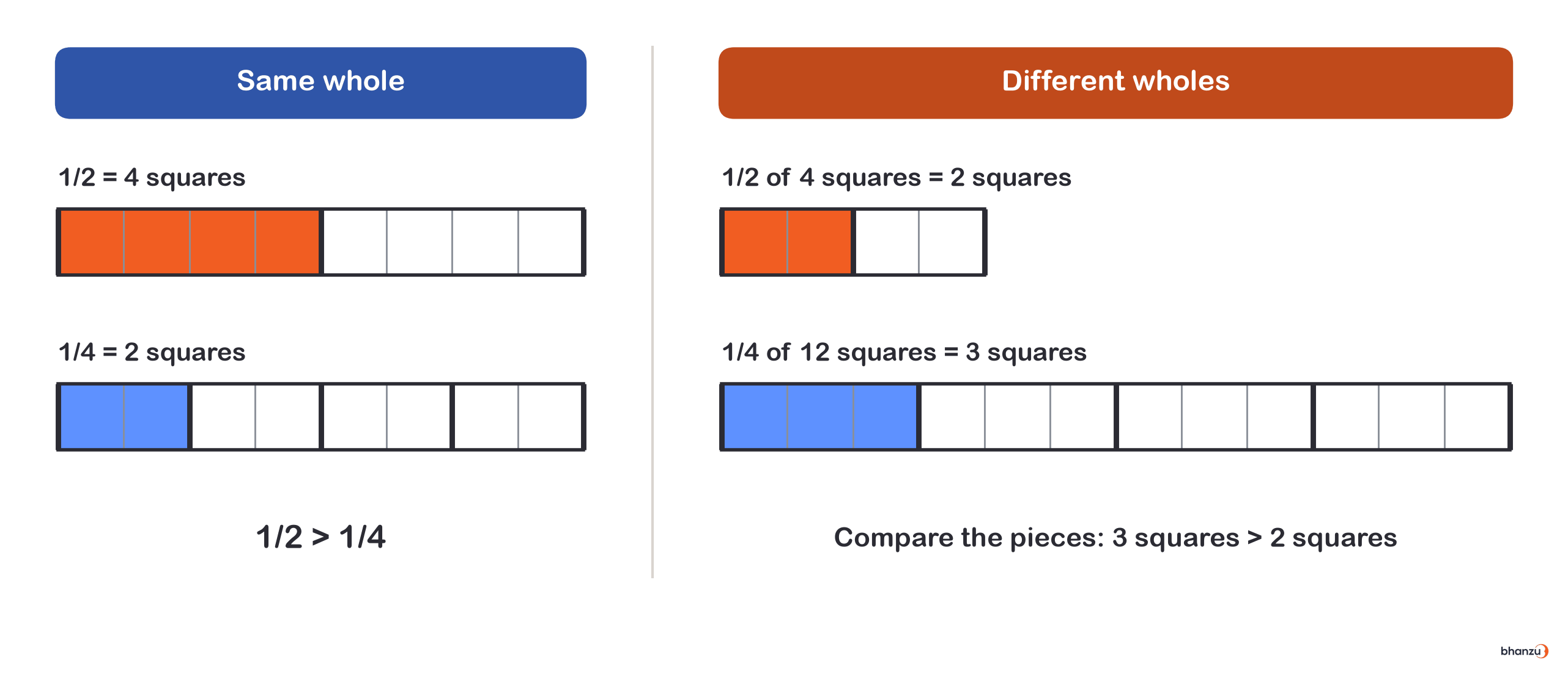
- One fourth of a 12-square bar covers 3 squares, but one half of a 4-square bar covers only 2, so the smaller fraction wins.
Half a pizza that loses to a quarter
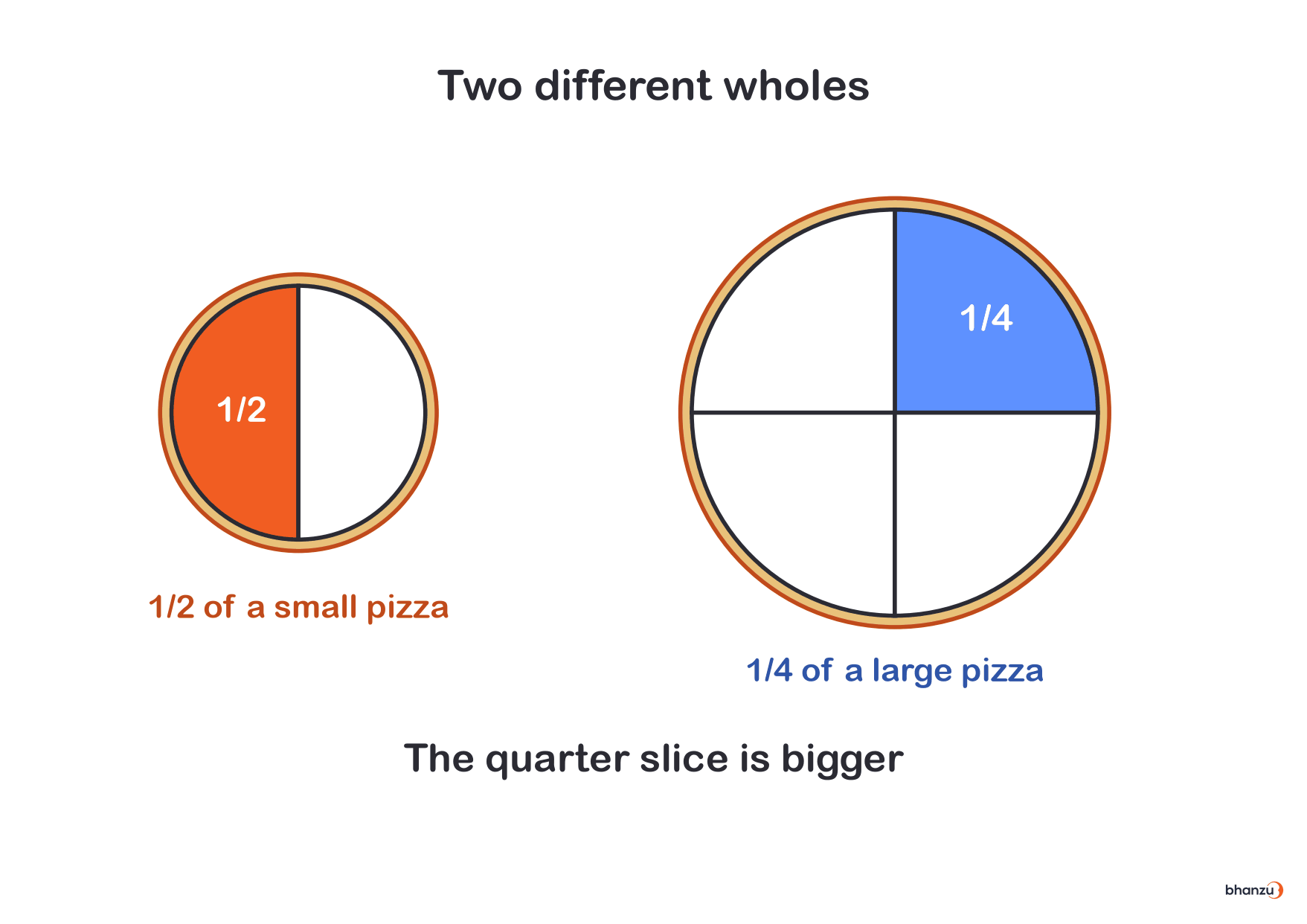
A quarter of a large pizza can be more food than half of a small one. That sounds backward, since one half beats one quarter. It does, but only when both pizzas are the same size.
The large pizza's 4 slices are cut from far more pizza (more slices, but much more dough), so each one can outgrow the small half. That is how fractions of different wholes work.
You'll use this check soon, whenever you share a snack or measure a ribbon. In 4th grade it returns when you compare two thirds with three fourths, where the top and bottom numbers both differ.
What are fractions of different wholes?
Fractions of different wholes name parts of two things of different sizes, such as a 4-square bar and a 12-square bar. With two different wholes, the fractions alone can't show which piece is bigger. Each square is a unit square, one grid-paper box with sides 1 unit long.
What is a whole in fractions? The whole is the one shape, strip or length that a fraction is a part of. Don't mix it up with whole numbers, which are 0, 1, 2, 3 and so on.
This is Common Core standard 3.NF.A.3.d, which says two fractions compare fairly only when they refer to the same whole. Comparing is harder than naming. A 2022 study of 1,036 fourth graders in China found most could match fractions to pictures, but few could tell which of two written fractions was larger.
In 3rd grade, your child compares halves, thirds, fourths, sixths and eighths of shapes and lengths, and is asked to explain each answer, often with a picture. Comparing fractions of different wholes in 4th grade uses the same check on fractions with different tops and bottoms.
How can you tell if two wholes are the same?
Two wholes are the same when they match in size. Strips and number lines need the same length, and shapes need the same area, the number of unit squares they cover. Run these steps before you write , or .
- Line up the two wholes side by side, starting at the same left edge.
- Check that each whole is cut into equal parts, meaning parts with the same area.
- If the wholes match, use the rules to compare fractions with the same numerator or denominator, the top or bottom number.
- If they don't match, compare the real pieces.
Step 2 trips up older kids too. Equal shares of one whole don't need the same shape, an idea Common Core starts in 2nd grade. Yet Cadež and Kolar's 2018 study of 90 fifth graders in Slovenia found some still treated only same-shape parts as equal.
Step 4 works three ways.
- Count unit squares, which works when the bars are fraction strips (paper strips cut into equal parts) drawn on grid paper.
- Measure each piece in inches with a ruler.
- Cut both pieces out (scissors help) and lay them side by side.
Counting squares gets stuck when a piece isn't a whole number of squares, such as one third of a 4-square bar. Use the ruler then.
Why can one fourth be more than one half?
A fraction tells how big a piece is compared with its own whole, so the same fraction of a bigger whole is a bigger piece. Cut a 12-square bar into 4 equal parts and a 4-square bar into 2 equal parts.
Each fourth of the long bar covers 3 squares, and each half of the short bar covers 2, so the fourth wins. A child who has just learned that halves beat fourths may recount those squares, sure the count is off. The count is right, because the wholes changed.
On one shared whole, one half still beats one fourth. The same fraction can also mean different amounts, since half of a 4-square bar is 2 squares and half of an 8-square bar is 4. One piece can even get a different name for each whole.
| The piece | The whole | Its fraction name |
|---|---|---|
| 2 squares | 4-square bar | |
| 2 squares | 6-square bar | |
| 2 squares | 8-square bar |
A bigger whole gives the same piece a smaller fraction name.
Try It Yourself
Drag the end of each bar to stretch or shrink its whole, then pick a fraction for each bar. The box under the bars counts each shaded piece in squares and says which one is really bigger. Press Make the wholes match to stretch Bar B to the length of Bar A, and the fractions then compare fairly.
When can you say which fraction is bigger?
You can compare two fractions by their numbers when they share one whole you can see, or when the problem names no whole at all. With no whole named, both fractions count as parts of the same whole, so a bare question like has one answer.
"Half of my sandwich and a quarter of yours" names two real things, so ask "of what?" first. The tricky part, even for grown-ups, is noticing which kind of question you have.
How do you know if fractions are equal? They cover the same amount of the same whole. On one 8-square bar, two fourths and one half both cover 4 squares, so they are equivalent fractions.
Every fraction on one 0 to 1 number line shares a single whole, which is why fractions on a number line compare fairly.
Examples of fractions of different wholes
Example 1
Two bars are each 8 squares long. Which is bigger, of one bar or of the other?
Both wholes are 8 squares, so they match.
Half of 8 squares is 4 squares, and one fourth is 2 squares.
Example 2
Which piece is bigger, of a 12-square bar or of a 4-square bar?
"One half always beats one fourth," so it's tempting to pick the half piece.
Count the squares.
The half piece covers only 2 squares and the fourth covers 3, so the shortcut picked the smaller piece. It failed because the wholes, 12 squares and 4 squares, differ.
Check the wholes first, then compare the real pieces. The piece is bigger, 3 squares to 2.
Example 3
Maya eats of a 6-square sandwich, and Leo eats of a 9-square sandwich. Did they eat the same amount?
Maya's 3 equal parts are 2 squares each, so her 2 parts make 4 squares.
Leo's 3 equal parts are 3 squares each, so his 2 parts make 6 squares.
Same fraction, different amounts. Leo ate 2 more squares.
Example 4
Is of a 6-inch ribbon shorter than of a 4-inch ribbon?
Draw each ribbon as a number line from 0 to 1, both starting at the same left edge.
On the 6-inch line, sits at 3 inches.
On the 4-inch line, each fourth is 1 inch, so sits at 3 inches.
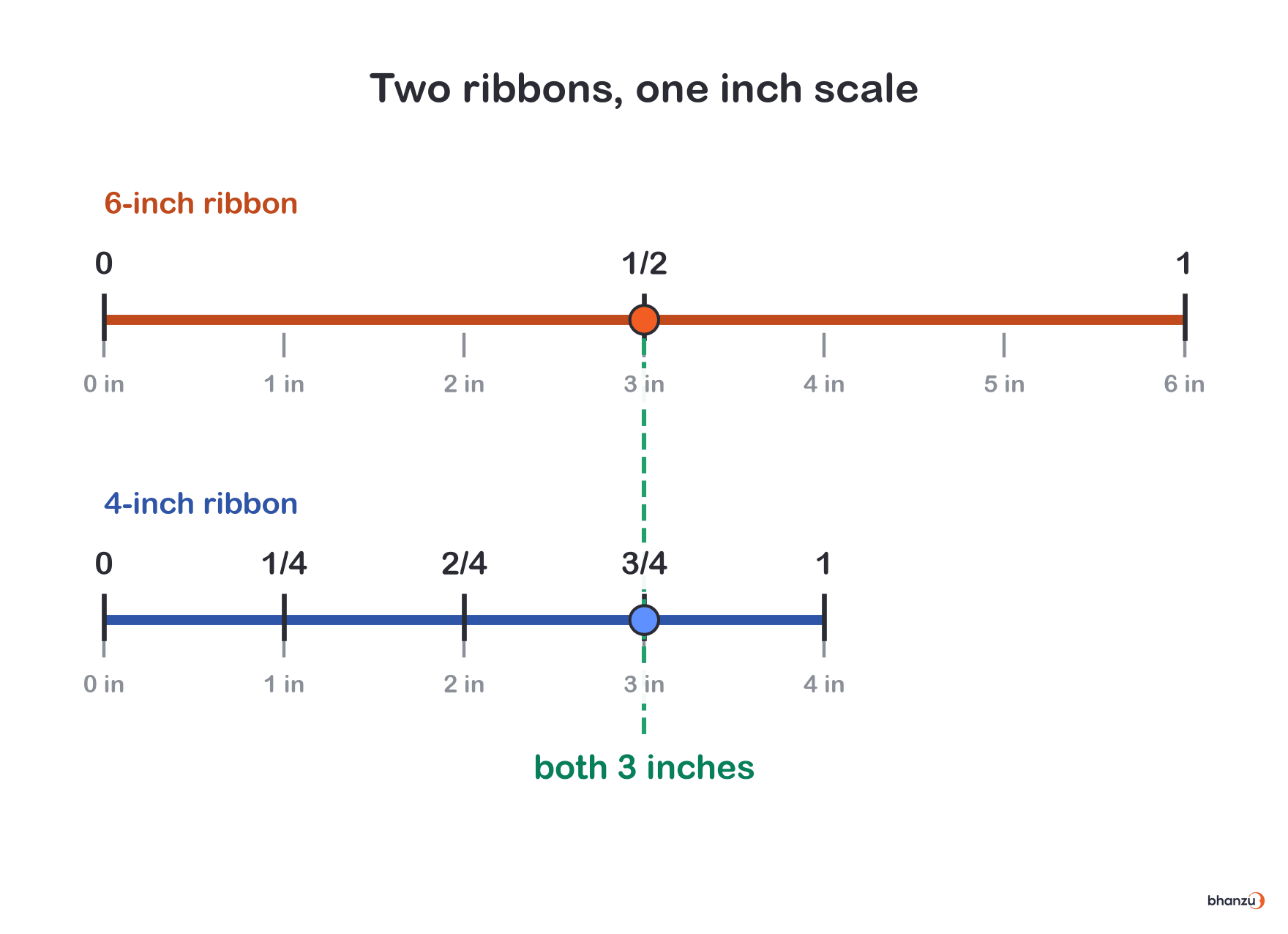
Neither is shorter. Both pieces are 3 inches, even though on one whole.
Example 5
Jo eats of an 8-square pan of cornbread. Max eats of a 24-square pan. Who ate more, and by how many squares?
The wholes, 8 and 24 squares, don't match, so count squares.
Jo's fourths are 2 squares each, and she eats 3 of them.
Max's eighths are 3 squares each, and he eats 3 of them.
Max ate 3 more squares, even though on one pan.
Why does the same-whole rule matter?
The same-whole rule matters because a fraction is never a size on its own. It is a piece measured against its own whole.
- It keeps sharing fair. The 2010 What Works Clearinghouse fractions guide sets up its apple-sharing problem with apples of the same size, so equal shares really are equal.
- It gives "half" a meaning. Otherwise half a grape and half a watermelon would count as equal.
- It sits under every comparison rule. Same numerators, same denominators and, later, different denominators all assume one whole.
Checking the whole takes one glance. Skipping it can flip the answer.
What teachers watch for in fractions of different wholes
Teachers watch when a child checks the whole, more than the final symbol. Two habits tell them the most.
- Asking "of what?" on real things, such as two pizzas or two ribbons.
- Pointing at the half piece by habit. Some children who know one half beats one quarter still point to the half piece in a picture, even one cut from a tiny bar. Counting squares out loud (one finger per square) helps break that habit.
Watching the whole matters past 3rd grade, too. A 2022 study of 246 US teachers in grades 3 to 7 linked closer attention to the whole with stronger fraction knowledge. If your child reads one fourth as bigger because 4 is bigger than 2, that whole-number habit is one reason why fractions feel so hard at first.
Fractions of different wholes: where intuition breaks
Mistake 1: Drawing the two fractions on wholes of different sizes
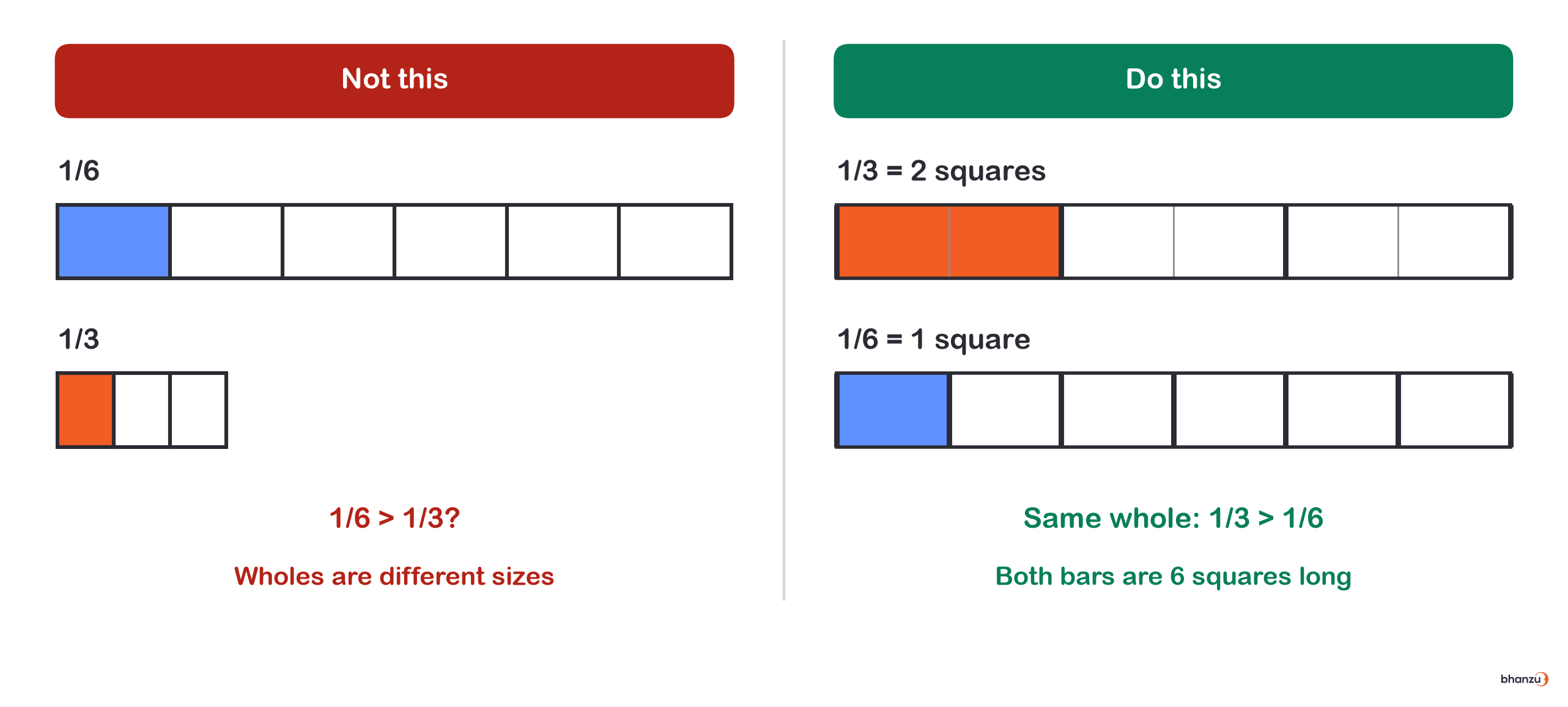
Where it slips in: Drawing a picture to prove which fraction is bigger. Children draw each fraction as they remember it, often stretching the first bar to fit more parts, so the picture "proves" the wrong symbol.
Don't do this: Draw on a long bar and on a short bar, then write because the sixth looks bigger.
The correct way: Use two 6-square bars. Then covers 2 squares and covers 1, so .
A child who rushes to finish the drawing often skips lining up the bars.
Mistake 2: Forgetting that fractions are part of a whole
Where it slips in: Naming a piece shown without its whole, such as a strip cut from a bar. Children count the pieces they see instead of the equal parts that make the whole.
Don't do this: Call each of two 2-square pieces because there are two of them.
The correct way: Find the whole first. If the bar was 8 squares, each piece is , the same as , and together they make half the bar.
Mistake 3: Asking "of what?" when no whole is named
Where it slips in: Right after this lesson, on a bare question such as . A brand-new rule tends to get used everywhere, which is really a sign the idea landed.
Don't do this: Answer "you can't tell" because no wholes are drawn.
The correct way: With no whole named, both fractions share one whole, so . Save "of what?" for two real things, like two pizzas.
Key Takeaways
- Before you write , or , ask whether both fractions come from the same whole.
- With fractions of different wholes, trust the square count or the ruler instead of the fraction numbers.
- For practice with a teacher who asks "same whole?" before any symbol, explore Bhanzu's 3rd grade math tutor or the Common Core math curriculum.
Read More
- Comparing Fractions With Unlike Denominators
- Equivalent Fractions by Multiplying
- What Is a Denominator
- Mental Math With Fractions
- Fractions, Decimals and Percentages
Research Behind This Article
- Common Core State Standards Initiative, Grade 3: Number and Operations, Fractions (2010). thecorestandards.org
- Di Lonardo Burr and others, Fraction Mapping and Fraction Comparison Skills among Grade 4 Chinese Students: An Error Analysis (2022). eric.ed.gov
- Common Core State Standards Initiative, Grade 2: Geometry (2010). thecorestandards.org
- Cadež and Kolar, How Fifth-Grade Pupils Reason about Fractions: A Reliance on Part-Whole Subconstructs (2018). eric.ed.gov
- Institute of Education Sciences, Developing Effective Fractions Instruction for Kindergarten Through 8th Grade (2010). ies.ed.gov
- Copur-Gencturk and Ölmez, Teachers' Attention to and Flexibility with Referent Units (2022). eric.ed.gov
Quick Quiz: Check Yourself
Three levels, new numbers every time: compare pieces of one whole, compare pieces of two different wholes, then find how many more squares of cornbread one child ate.
Was this article helpful?
Your feedback helps us write better content
Frequently Asked Questions
Which is bigger, 1/2 or 1/4?
What grade do kids learn fractions?
How can I explain fractions to my 3rd grader?
Is 1/2 bigger than 2/4?
Is a fraction part of one thing or part of a group?