Key Points
- Comparing fractions with the same numerator or denominator only works when both fractions describe the same whole, such as two strips of equal length.
- When the denominators match, every piece is the same size, so the bigger numerator wins, as in .
- When the numerators match, the smaller denominator wins, because fewer equal pieces share the whole and each piece is larger.
- A common slip is deciding that one eighth beats one fourth because 8 is bigger than 4, a habit carried over from whole numbers.
The smaller number that wins
One eighth of a granola bar is smaller than one fourth, even though 8 is bigger than 4. That surprises plenty of 3rd graders (grown-ups too). For years, a bigger number has meant more.
Cut one bar into 4 equal pieces and a same-size bar into 8, and each eighth comes out half as long as a fourth. The 8 is telling you the pieces got smaller. In 4th grade, you'll build on that idea to compare fractions like three fourths and five sixths, which share no number at all.
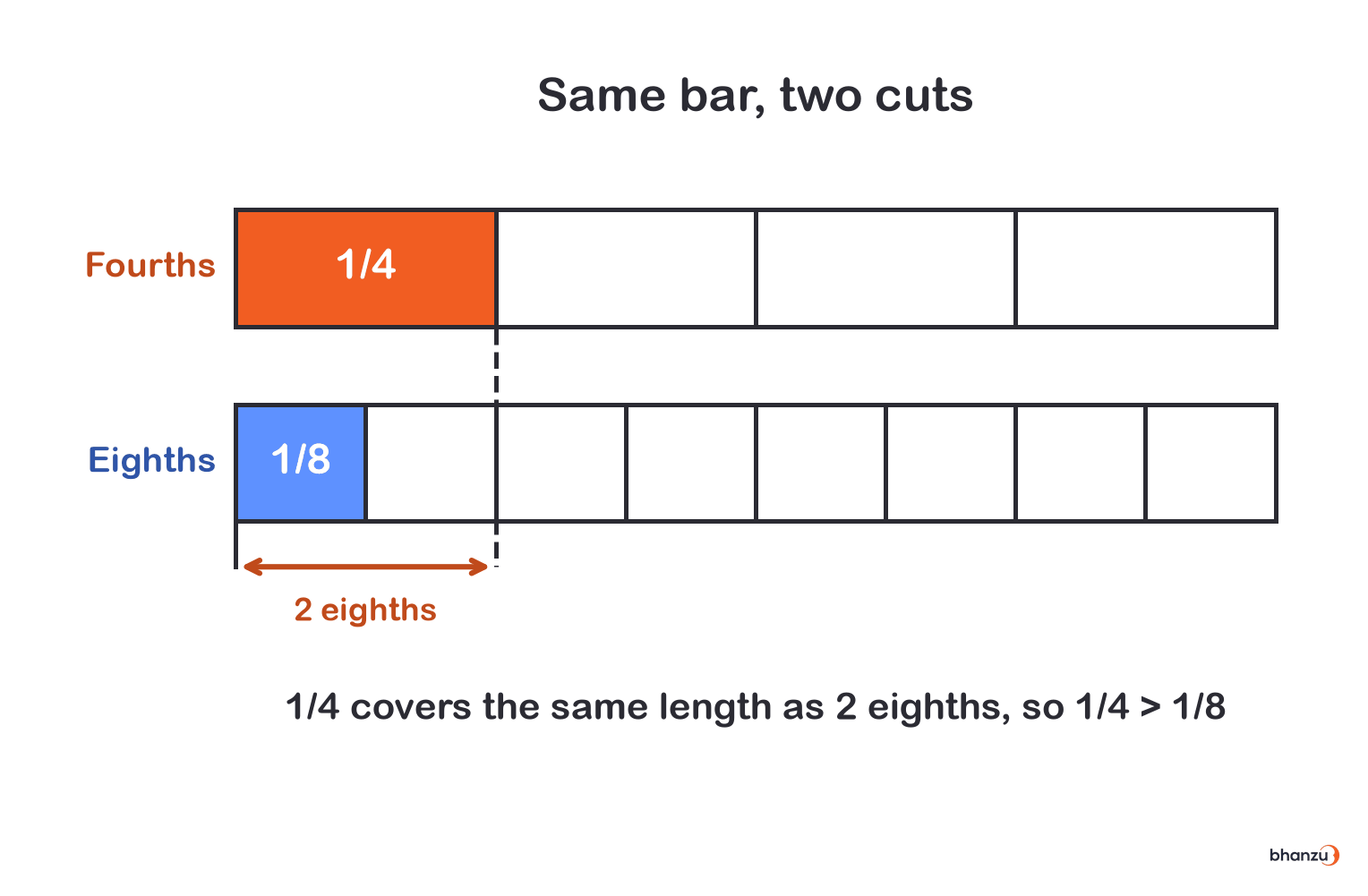
What does comparing fractions with the same numerator or denominator mean?
Comparing fractions with the same numerator or denominator means finding the bigger fraction when the top numbers or the bottom numbers match. Two equal-length fraction strips show it.
The top number is the numerator, and it counts the shaded pieces. The bottom number is the denominator, the number of equal pieces in one whole. You record each result with (greater than), (less than) or (equal to).
| Fraction | Say it | What the strip shows |
|---|---|---|
| three eighths | 3 of 8 equal parts shaded | |
| five eighths | 5 of 8 equal parts shaded | |
| two thirds | 2 of 3 equal parts shaded |
Both fractions must describe the same whole. Halves of a small pizza and a large pizza are a different puzzle, covered in fractions of different-sized wholes. This is Common Core standard 3.NF.A.3.d, which uses only halves, thirds, fourths, sixths and eighths.
Your child is also expected to justify each comparison with a strip, a number line or a drawing, so a quick sketch beside the symbol is part of a complete answer.
How do you compare fractions with the same denominator?
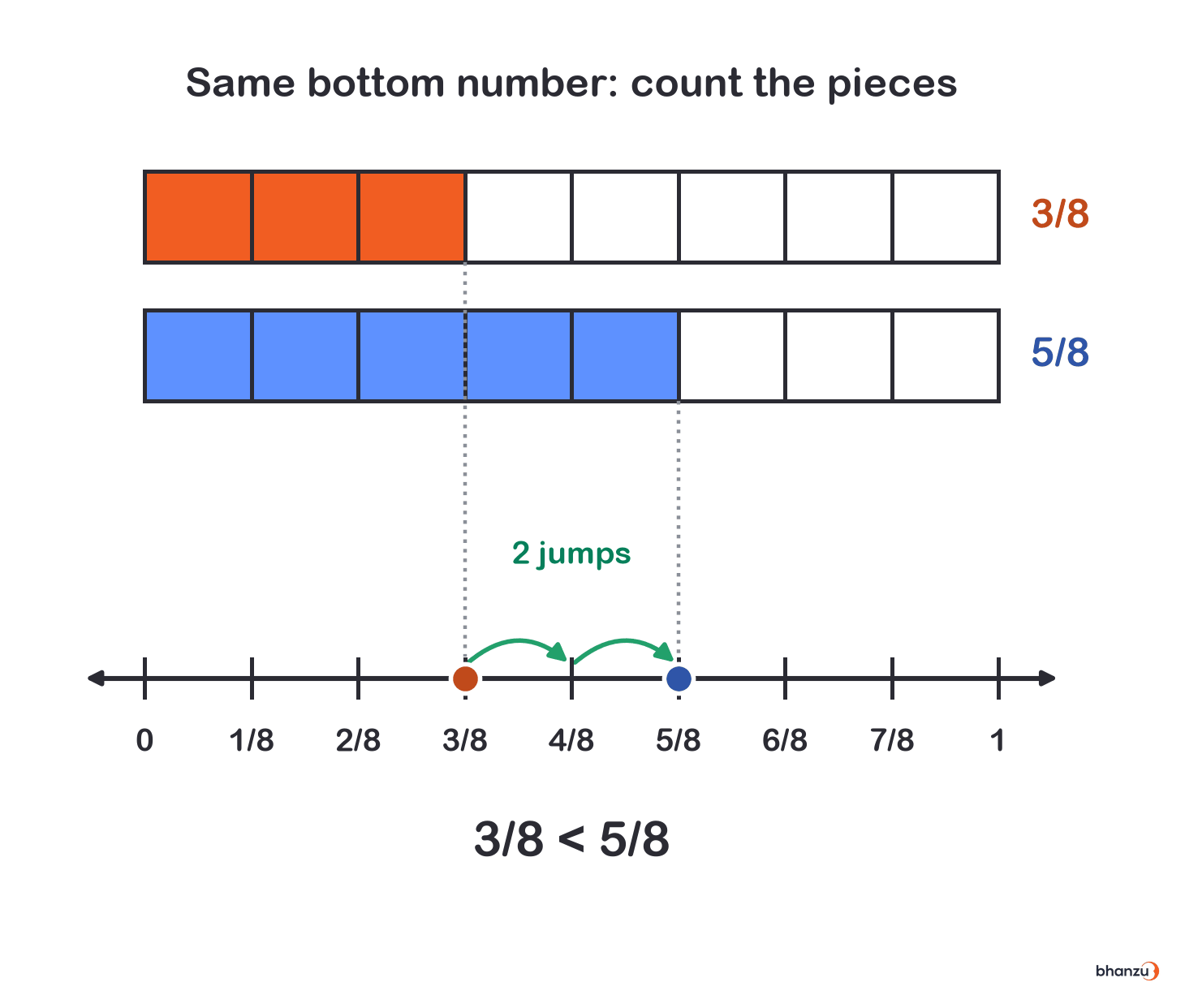
When the denominators match, count the pieces. Every piece is the same size, so more pieces means a bigger fraction.
- Check that both fractions describe the same whole.
- Check that the bottom numbers match.
- Compare the top numbers.
- Write the symbol so its open side faces the bigger fraction.
| Symbol | Read it as | Example |
|---|---|---|
| is greater than | ||
| is less than | ||
| is equal to |
A number line shows the same comparison as distance. Each fraction is a count of equal jumps from 0, so lands 2 jumps to the right of .
The line keeps going past 1, where sits farther right than . Marking fractions on a number line uses exactly these equal jumps.
Why does a bigger bottom number make smaller pieces?
The bottom number tells how many equal pieces share one whole, so more pieces means each one is smaller. A 2010 fractions guide from the US Institute of Education Sciences explains it with sharing. One candy bar split among 3 children gives bigger shares than the same bar split among 4.
A unit fraction has 1 on top, so it names exactly one piece. A fraction wall (a stack of equal strips cut into different numbers of parts) lines the unit fractions up in order.
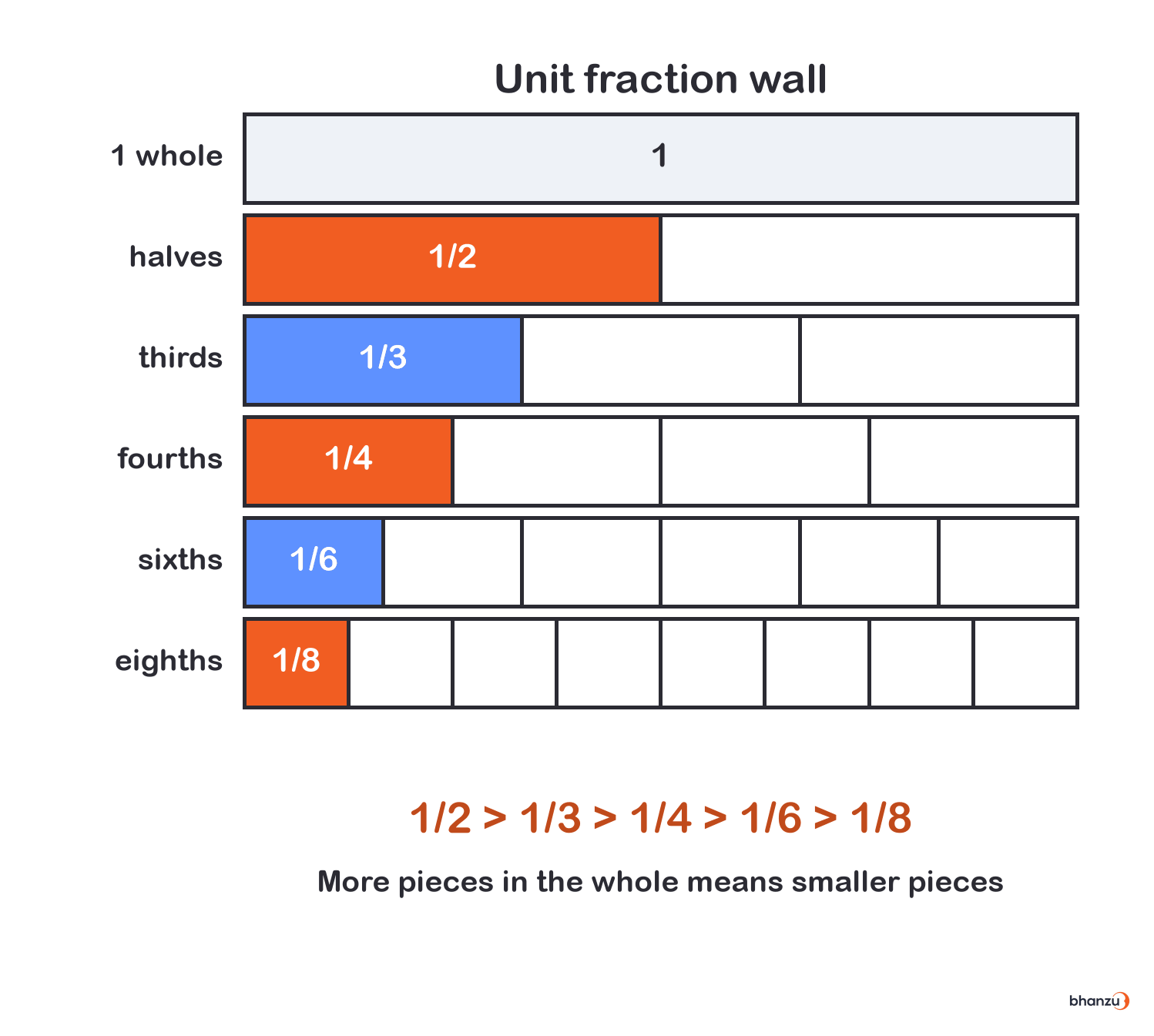
The same reasoning works for any matching top number: and both have 3 pieces, but fourths are the bigger pieces.
A child who gets right will sometimes erase it, because the numbers still look backward. The wall settles that doubt faster than repeating the rule.
Same-top-number pairs tend to take more work. A 2026 study of 94 fifth and sixth graders had them compare fraction pairs with no strategy taught first. Same-denominator pairs were solved faster and more accurately than same-numerator pairs, so give the second kind extra practice.
Which rule do you use, and when does it stop working?
Find the number that matches first, then decide whether you are counting pieces or sizing them up.
| What matches | Ask yourself | Bigger fraction | Example |
|---|---|---|---|
| Bottom number | How many pieces? | More pieces | |
| Top number | How big is each piece? | Smaller bottom number | |
| Both numbers | Nothing to decide | Equal |
The routine stops working when neither number matches. and have different tops and different bottoms, so comparing fractions with unlike denominators needs 4th grade tools like common denominators and benchmark fractions.
One distinction confuses plenty of adults too. and match in neither place, yet they cover the same length of strip.
Try It Yourself
Pick Same bottom number or Same top number, then drag a strip's handle or use the arrow keys to change it. Choose , or , and the readout says whether you're right and which question fits, counting pieces or sizing them.
Examples of comparing fractions with the same numerator or denominator
Example 1
Compare and using , or .
The bottom numbers match, so every piece is one sixth.
Count the pieces. 2 is less than 5.
Example 2
Which is bigger, or of the same strip?
The tempting move is to compare the bottom numbers. 6 is bigger than 3, so looks like the winner.
On a strip, two sixths fit exactly under one third. One sixth is only half of one third, so it can't be bigger.
The top numbers match, so compare piece size instead. Thirds are bigger pieces than sixths.
Example 3
Compare and , and explain why.
Both fractions have 2 pieces, so the top numbers match.
A whole cut into 3 equal parts has bigger parts than a whole cut into 4. Two thirds cover more of the strip than two fourths.
Example 4
On a number line marked in sixths, which is farther right, or ?
The bottom numbers match, so every jump from 0 is one sixth.
is 7 jumps from 0, past 1 (which is 6 jumps). is only 5 jumps.
The point for is farther right.
Example 5
Put , , and in order from least to greatest.
All four top numbers are 2, so compare piece sizes.
The biggest bottom number makes the smallest pieces. The order starts with eighths and moves up through sixths, fourths and thirds.
Example 6
Maya, Leo and Aisha each have a same-size granola bar. Maya eats of hers, Leo eats and Aisha eats . Who eats the most?
Maya and Aisha have the same bottom number, and 3 pieces beat 1 piece.
Maya and Leo have the same top number, and fourths are bigger pieces than eighths.
Maya's fraction beats both others, so Maya eats the most.
Why does comparing fractions matter?
Comparing fractions tells you which share or which length is bigger before you choose.
- It keeps sharing fair. Each of 3 friends splitting a pizza gets , more than the each gets when a fourth friend joins.
- It helps you read a ruler. A ribbon inch wide is wider than one inch wide, because both count fourths of an inch.
- It's a habit worth fixing early. In a 2026 study, Fan and colleagues found that 14% of 90 university students still mostly picked the fraction with bigger numbers.
Fraction sense keeps paying off for years. A 2012 study using US and UK data found that fraction knowledge in elementary school predicted high school algebra 5 or 6 years later.
The mistakes kids make most often with comparing fractions
Mistake 1: Thinking a bigger bottom number makes a bigger fraction
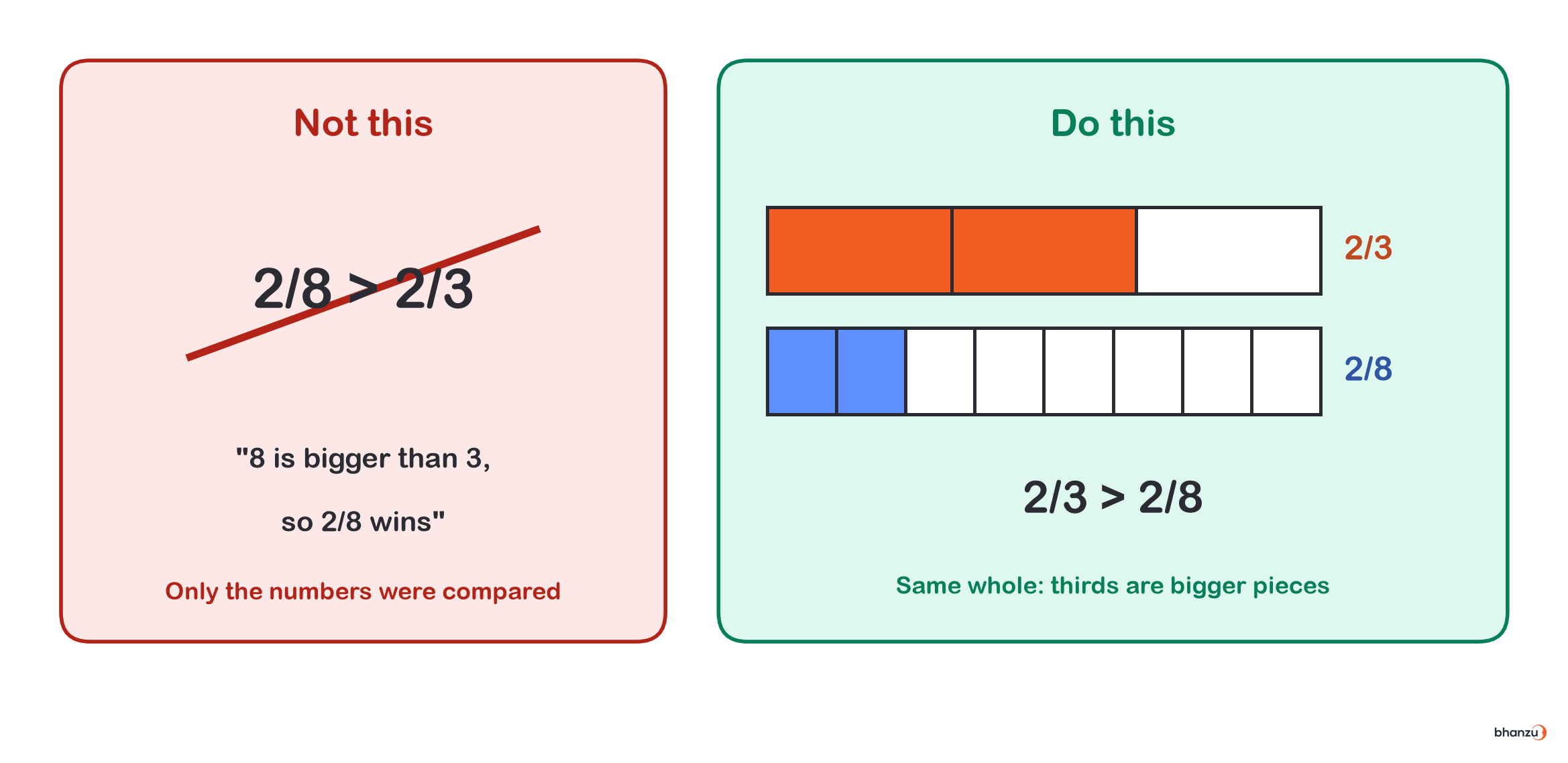
Where it slips in: Same-numerator pairs such as and , where the whole-number habit says 8 beats 3.
Don't do this: Writing because 8 is bigger than 3.
The correct way: Both fractions have 2 pieces, and eighths are much smaller than thirds, so .
Children who have just gotten comfortable with "bigger number wins" often say one eighth beats one fourth for exactly that reason. Two strips side by side settle it in seconds.
Mistake 2: Using the smaller-bottom rule when the bottoms match
Where it slips in: Right after learning the same-numerator rule, on pairs like and . The new rule feels fresh, so it gets used everywhere.
Don't do this: Deciding "smaller wins" and writing .
The correct way: The bottoms match, so the pieces are the same size, and 5 pieces beat 3. That makes .
This reversal often catches a child who rushes.
Mistake 3: Comparing fractions of two different wholes
Where it slips in: Word problems about a small pizza and a large one. The numbers look like a normal same-denominator pair, so the sizes get ignored.
Don't do this: Sam ate of a small pizza and Priya ate of a large one, so Sam ate more.
The correct way: Priya's two fourths of the large pizza could be more food. With two sizes, the fractions alone can't decide.
The part of comparing fractions nobody explains
Most pages stop at the symbol, but Common Core also asks 3rd graders to justify each comparison. A full answer has two parts.
- The symbol, with its open side facing the bigger fraction.
- The reason, naming what matches, as in "both have 2 pieces, and thirds are bigger than eighths."
The other skipped part: the flip in Mistake 2 is a step forward. A 2017 study followed 394 children from 4th to 6th grade. Children who picked the fraction with smaller numbers were more likely to reach correct strategies early than children who kept picking bigger numbers.
So when your child swaps "8 beats 3" for "smaller always wins," treat it as progress. Whole-number habits are a big part of why fractions feel so hard at first.
Key Takeaways
- Before comparing fractions with the same numerator or denominator, check that both come from wholes of the same size.
- Matching bottom numbers turn the job into counting, so 7 eighths beat 4 eighths.
- Matching top numbers turn it into sizing, where fewer pieces in the whole means bigger ones.
- A flip to "smaller always wins" is progress, and asking what matches fixes it.
- For more practice with the "8 beats 3" slip and a teacher who catches it early, explore Bhanzu's 3rd grade math tutor or math programs for kids.
Read More
- Equivalent Fractions With Models
- Comparing Fractions of Different Wholes
- Equivalent Fractions by Multiplying
- Mental Math With Fractions
- Fractions, Decimals and Percentages
Research Behind This Article
- Common Core State Standards Initiative, Grade 3 Number and Operations, Fractions (2010). thecorestandards.org
- Siegler, R. et al., Institute of Education Sciences, Developing Effective Fractions Instruction for Kindergarten Through 8th Grade (2010). ies.ed.gov
- Zhang, R. and Deng, C., Interpreting Congruency Effects in Fraction Comparison: Implications of Item Structure and Strategy Affordances (2026). eric.ed.gov
- Fan, A., Abreu-Mendoza, R. A., Van Hoof, J., Van Dooren, W. and Rosenberg-Lee, M., From Whole Number Bias to Gap Thinking: University Students' Strategy Choices in Fraction Comparison and Relations to Math and Cognitive Abilities (2026). eric.ed.gov
- Siegler, R. S., Duncan, G. J., Davis-Kean, P. E. et al., Early Predictors of High School Mathematics Achievement (2012). eric.ed.gov
- Rinne, L. F., Ye, A. and Jordan, N. C., Development of Fraction Comparison Strategies: A Latent Transition Analysis (2017). eric.ed.gov
Quick Quiz: Check Yourself
Three levels, new numbers every time: same bottom numbers, then same top numbers and the greatest of three, then granola bar stories and number lines.
Was this article helpful?
Your feedback helps us write better content
Frequently Asked Questions
Which is bigger, 1/4 or 3/4?
Is 2/3 bigger than 1/2?
If the numerators are the same, which fraction is bigger?
If one fraction has a smaller numerator and a larger denominator, is it always smaller?
How do I teach comparing fractions in 3rd grade?
How can I help my child who keeps saying 1/8 is bigger than 1/4?