Key Points
- Elapsed time measures the gap between two clock times, so 3:40 to 4:25 is 45 minutes, an amount rather than a clock reading.
- On an open number line, jump from the start time to the next o'clock, then jump the leftover minutes, and add the jumps together.
- An hour holds 60 minutes, not 100, so 815 minus 750 gives 65, while 7:50 to 8:15 is really 25 minutes.
The minutes hiding between two clocks
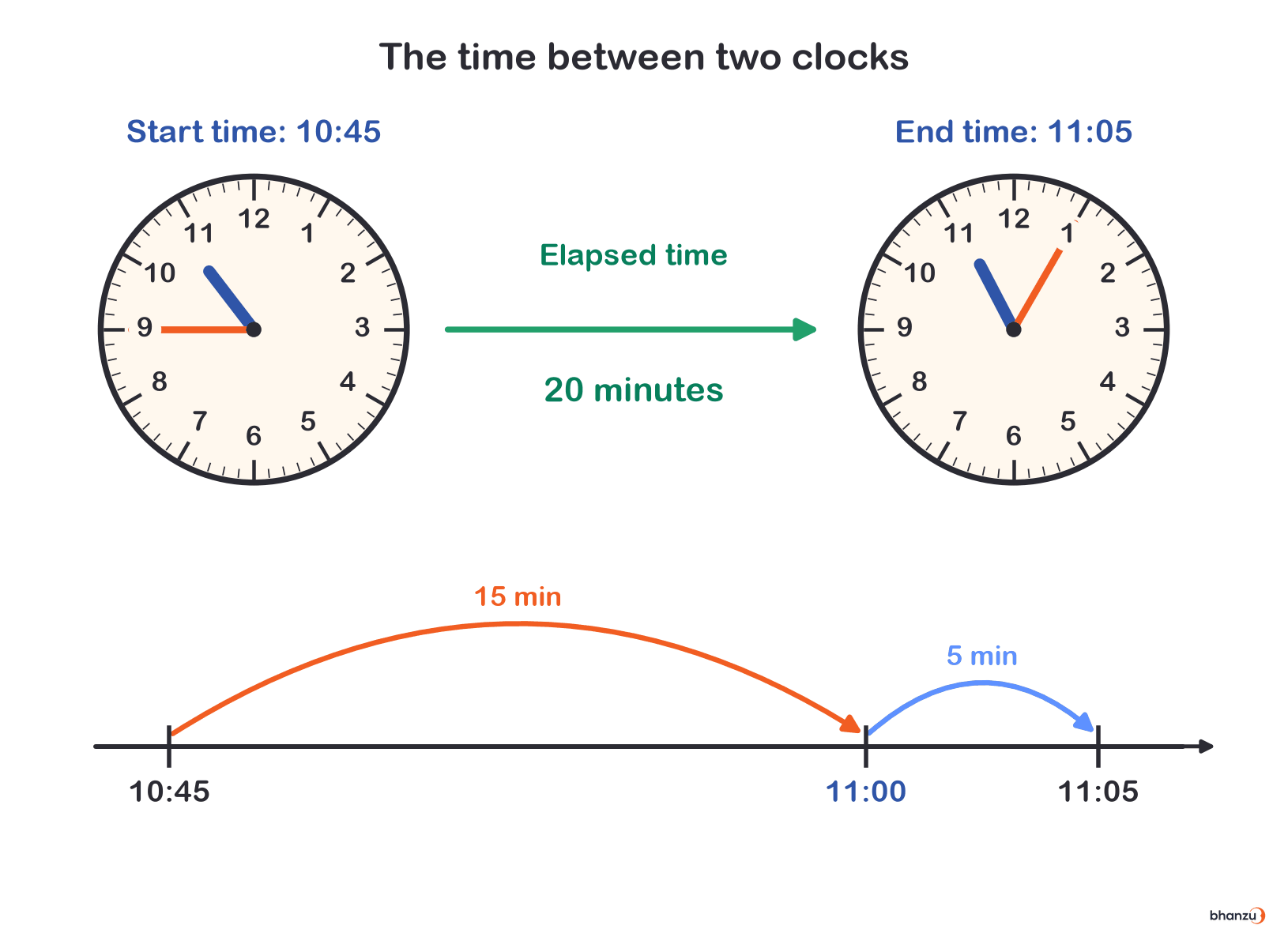
Two looks at a clock can tell you exactly how long recess lasted. The first says 10:45 as you run outside. The second says 11:05 when the bell rings.
Neither look shows the 20 minutes in between (15 up to 11:00, then 5 more), and that hidden amount is the elapsed time. Yellowstone's park rangers use the same idea, a clock time plus a wait, to tell visitors when the Old Faithful geyser should erupt next. In 4th grade, you'll use these jumps on longer problems that mix hours and minutes.
What is elapsed time?
Elapsed time measures an interval, the stretch of time from a start time, when an activity begins, to an end time, when it stops. It is the difference between those two times, found with jumps on an open number line. That line has no fixed scale and marks only the start time, any o'clock in between and the end time.
How do you write elapsed time? Write an amount: minutes, or hours and minutes, never a clock time. Some books write 1 hour 20 minutes as 1:20, which looks like a clock time, so words are safer.
| Question | The answer looks like |
|---|---|
| When does recess start? | 10:45 |
| How long does recess last? | 20 minutes |
This is Common Core standard 3.MD.A.1: tell and write time to the nearest minute, then measure time intervals in minutes and solve word problems with them, for example on a number line. By the end of 3rd grade, your child should be able to read a clock to the minute, say how long something took, and work out when it ends or began.
How do you read a clock to the nearest minute?
Take the hour from the short hand, then count the long hand in 5s and finish in 1s. Here it is on an analog clock (a clock with hands) showing 8:37.
- Find the last number the short hour hand has passed. It has passed the 8, so this is the 8 o'clock hour.
- Start at the 12 and use skip counting by 5s on the long minute hand, up to 35 at the 7.
- Count the small marks after the 7 by 1s, saying 36 and 37.
- Write 8:37, then add a.m. or p.m. from what is happening (breakfast or dinner).
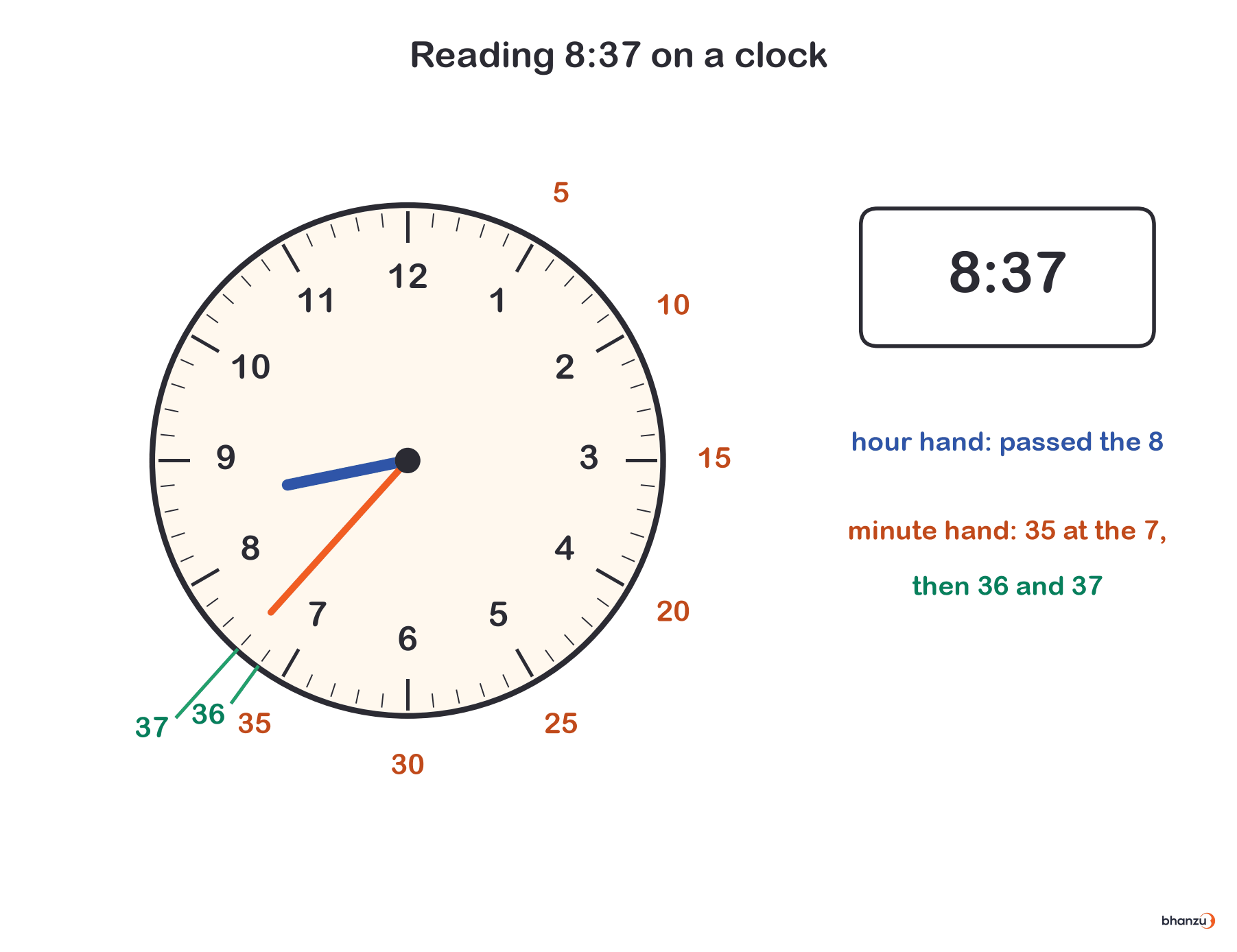
Late in the hour, the hour hand sits close to the next number, so read the number it has already passed. At 2:50 it almost touches the 3, but the hour is still 2. A child who reads the hour correctly may still second-guess it when the hand nearly touches the next number.
Children who count the minute hand by 1s from the 12 often lose their place partway around the clock. Counting by 5s first keeps the count short.
How do you find elapsed time on a number line?
To find elapsed time on a number line, jump to the next o'clock, jump any whole hours, jump the leftover minutes, then add. Take 3:40 to 4:25.
- Mark 3:40, 4:00 and 4:25 on an open number line.
- Jump from 3:40 to 4:00, which is 20 minutes.
- Jump from 4:00 to 4:25, which is 25 minutes.
- Add the jumps.
The elapsed time is 45 minutes.
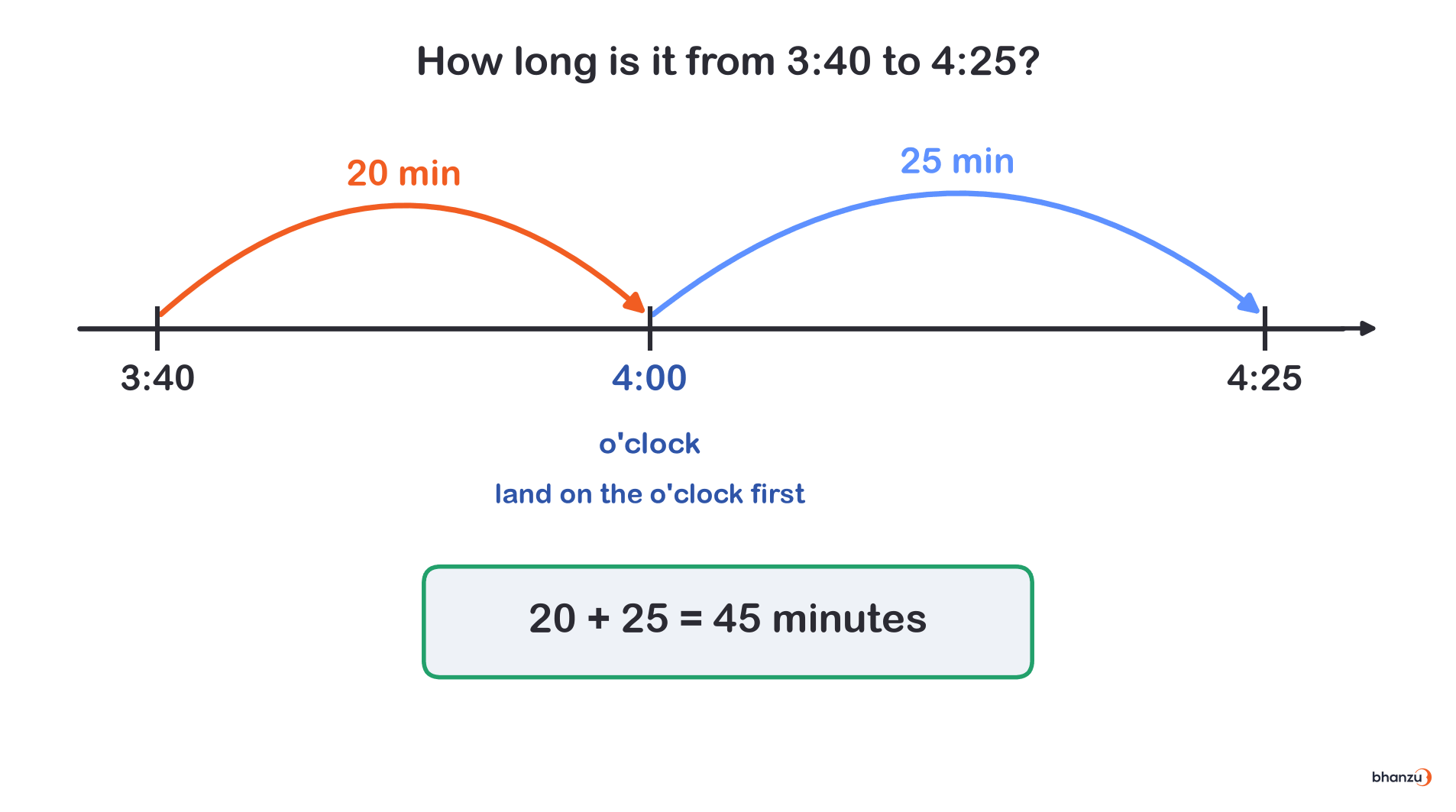
Each jump stops at an o'clock, so no minute count goes past 59. That matters because of one clock fact:
Counting as if minutes ran up to 99 gives impossible times like 4:70. These are the moves from adding and subtracting on a number line, with o'clocks where the tens used to be. When the end time is past the next o'clock, the first jump is 60 minus the minutes showing.
| Minutes on the clock | Minutes to the next o'clock |
|---|---|
| :05 | 55 |
| :15 | 45 |
| :20 | 40 |
| :30 | 30 |
| :45 | 15 |
| :50 | 10 |
Is there a formula for elapsed time? End time minus start time works when the end minutes are bigger, so 4:10 to 4:50 is minutes. Otherwise you'd trade 1 hour for 60 minutes, not 100, so habits from subtracting within 1000 can mislead you.
Number line jumps are one of four methods.
- Number line jumps. They work for any interval and show every step.
- Clock-face counting. A finger moving in 5s suits gaps under an hour.
- A T-chart. Each jump gets its own row and a running total.
- Subtraction. It is fastest when the end minutes are bigger.
Jumps get slow across several hours, so jump whole hours at once (1:00 to 4:00 is one jump). Noon works the same way. From 11:45 a.m. to 12:00 is 15 minutes, and 35 more reaches 12:35 p.m., for 50 minutes.
How do you find a start time or an end time?
If you know when something starts, jump forward to find when it ends. If you know when it ends, jump back to find when it started.
| You know | You want | Which way you jump |
|---|---|---|
| Start time and how long | End time | Forward |
| End time and how long | Start time | Back |
| Start time and end time | How long | Count the jumps |
As of January 2025, the National Park Service listed Old Faithful's median, or middle, wait between eruptions as 102 minutes, give or take 10. If it erupts at 1:15 p.m., jump 45 minutes to 2:00, then 57 more.
The next eruption should come at about 2:57 p.m. Backward jumps work the same way. School starts at 8:20 and the walk takes 25 minutes, so jump back 20 minutes to 8:00, then 5 more to 7:55.
Leave by 7:55. Jumping forward and back is counting on and counting back, done in minutes instead of ones.
Story problems hide these jumps in their words. A story that asks two questions in a row is one of the two-step word problems 3rd graders solve.
| Words in the problem | Math it means |
|---|---|
| starts at, begins at | the start time |
| ends at, comes out at | the end time |
| how long, how many minutes | count the jumps |
| lasts, baked for | the elapsed time is given |
| before, earlier | jump back |
Try It Yourself
Drag the end clock's minute hand or tap the buttons, and the number line adds up its jumps to each o'clock. The challenge buttons ask how long something lasts, when it ends or when it started. When you set a clock, you'll see how many minutes short or too far you are.
Elapsed time beyond the textbook
A clock tells you when, but a plan also needs how long. Elapsed time connects the two.
- It gets you places on time. Jumping back from an 8:20 bell to 7:55 is how a family leaves home at the right minute.
- It rests on very old choices. About 5,000 years ago, the Sumerians split the day into 12 periods, each as long as 2 of our hours.
- It turns a day into minutes you can compare. The 2025 American Time Use Survey works by asking people how long each activity lasted. People 15 and older read for about 16 minutes a day, or 0.27 hours, on average.
Hours still don't come in tens, and that is exactly why the o'clock jump matters.
Examples of elapsed time
Example 1
Maya's soccer practice runs from 9:10 a.m. to 9:50 a.m. How long is it?
Both times are in the 9 o'clock hour, so one jump does it.
Practice lasts 40 minutes.
Example 2
Maya's muffins bake for 25 minutes and come out at 11:05 a.m. When did they go in?
The tempting move is to add, which gives 11:30. That can't be right, because the muffins went in before they came out.
Jump back instead. From 11:05 back to 11:00 is 5 minutes, and 20 more lands on 10:40.
The muffins went in at 10:40 a.m. Jumping forward 20 minutes and then 5 from 10:40 reaches 11:05.
Example 3
Maya visits the library from 1:45 p.m. to 2:20 p.m. Is that more or less than half an hour?
From 1:45 to 2:00 is 15 minutes, and from 2:00 to 2:20 is 20 minutes.
Maya spends 35 minutes there, which is 5 minutes more than half an hour.
Example 4
A 95-minute movie starts at 6:35 p.m. When does it end?
Jump 25 minutes from 6:35 to 7:00, leaving 70 minutes. One full hour takes you to 8:00 with 10 minutes still to go, and those last 10 land on 8:10.
The movie ends at 8:10 p.m.
Example 5
Maya reads for 40 minutes from 2:40 p.m. and leaves for a party at 3:50 p.m. How many minutes does she have after reading?
Jump 20 minutes from 2:40 to 3:00 and 20 more to 3:20, so reading ends at 3:20.
From 3:20 to 3:50 is 30 minutes, so Maya has half an hour after reading.
The part of elapsed time nobody explains
The words in a time problem can change a child's answer, even when the numbers stay the same. A 2015 study gave time problems to 292 second graders and 205 fourth graders in six New England schools. They did better with "thirty minutes" than with "half an hour," and some turned half an hour into an hour and a half.
- "Half past 3" is a time on the clock, 3:30.
- "Half an hour" is an amount of time, 30 minutes.
Saying each amount both ways ("half an hour, that's 30 minutes") clears up the mix. You'll meet half an hour again in fractions, as of an hour.
Elapsed time: where intuition breaks
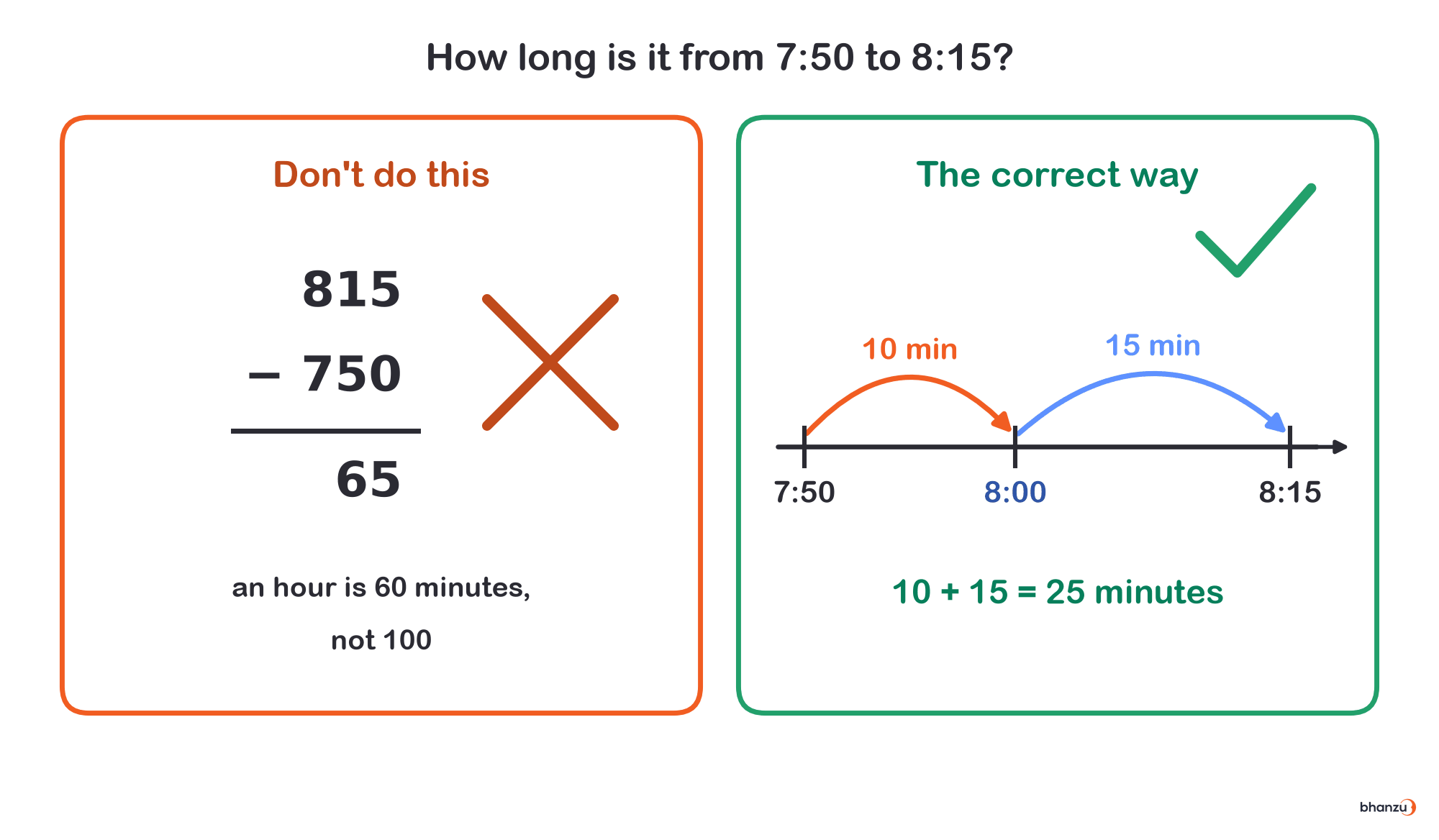
Mistake 1: Subtracting clock times like ordinary numbers
Where it slips in: "How long" problems where the end minutes are smaller than the start minutes.
Don't do this: Finding 7:50 to 8:15 as minutes.
The correct way: Jump 10 minutes from 7:50 to 8:00 and 15 more to 8:15, making minutes.
A child who sees 815 and 750 often lines them up in columns out of habit. Column subtraction treats the hour like a hundred, so 40 extra minutes sneak in.
Mistake 2: Starting the count at the next o'clock
Where it slips in: Adding minutes to a start time that is not an o'clock, such as 1:30.
Don't do this: Art class starts at 1:30 and lasts 30 minutes, so you say it ends at 2:30.
The correct way: Start counting at 1:30, the real start time. Thirty minutes after 1:30 is 2:00.
A child who rushes to the next o'clock treats 2:00 as the starting line. The 2015 study saw answers a full hour after the start most often when the start ended in :30.
Key Takeaways
- Land on the o'clock before counting on, and the minutes never spill into impossible times like 4:70.
- Column subtraction comes out 40 minutes too big for each o'clock it crosses, so use jumps when the end minutes are smaller.
- Half an hour and 30 minutes are the same elapsed time, so say both before you jump.
- For practice with jumps across the hour, like 7:50 to 8:15, explore Bhanzu's 3rd grade math tutor or math programs for elementary students.
Read More
- Elapsed Time and Time Word Problems
- Converting Units of Time
- Counting Money and Making Change
- Area of Composite Shapes
- Reading a Calendar
Research Behind This Article
- National Park Service, Old Faithful, Yellowstone National Park (2025). nps.gov
- Common Core State Standards Initiative, Grade 3 Measurement and Data (2010). thecorestandards.org
- Darrell Earnest, Alicia C. Gonzales and Anna M. Plant, Time as a Measure: Elementary Students Positioning the Hands of an Analog Clock (2017). eric.ed.gov
- National Institute of Standards and Technology, A Walk Through Time: Ancient Calendars (2026). nist.gov
- US Bureau of Labor Statistics, American Time Use Survey, Table 11A: Time Spent in Leisure and Sports Activities, 2025 Annual Averages (2026). bls.gov
- Darrell Earnest, When "Half an Hour" Is Not "Thirty Minutes": Elementary Students Solving Elapsed Time Problems (2015). eric.ed.gov
Quick Quiz: Check Yourself
Every round brings new times. Easy stays inside one hour, Medium crosses an o'clock or finds a start time, and Hard runs past an hour or takes two steps.
Was this article helpful?
Your feedback helps us write better content
Frequently Asked Questions
What is estimated elapsed time?
How do you change elapsed time in minutes into hours and minutes?
Is elapsed time a 3rd grade skill?
How can I help my child practice elapsed time at home?
Is there an elapsed time worksheet on this page?