Key Points
- Reading a calendar uses one month's grid, where each row is a week of 7 days and each column is one day of the week.
- To count days inside one month, subtract the earlier date from the later one, so October 14 to October 20 is 6 days.
- A common counting error is calling the start date day 1, which adds an extra day. A question that says "through" counts both days.
Twelve months that refuse to match
Some months stop at 30, some run to 31, and February usually stops at 28. Leo's class has a science fair on Tuesday, October 5, 2027. Today is Sunday, September 26, so counting the days left means crossing the end of a month.
You may already know the days of the week and months of the year in order. Next year, the same counting measures elapsed time on a clock.
What does reading a calendar mean?
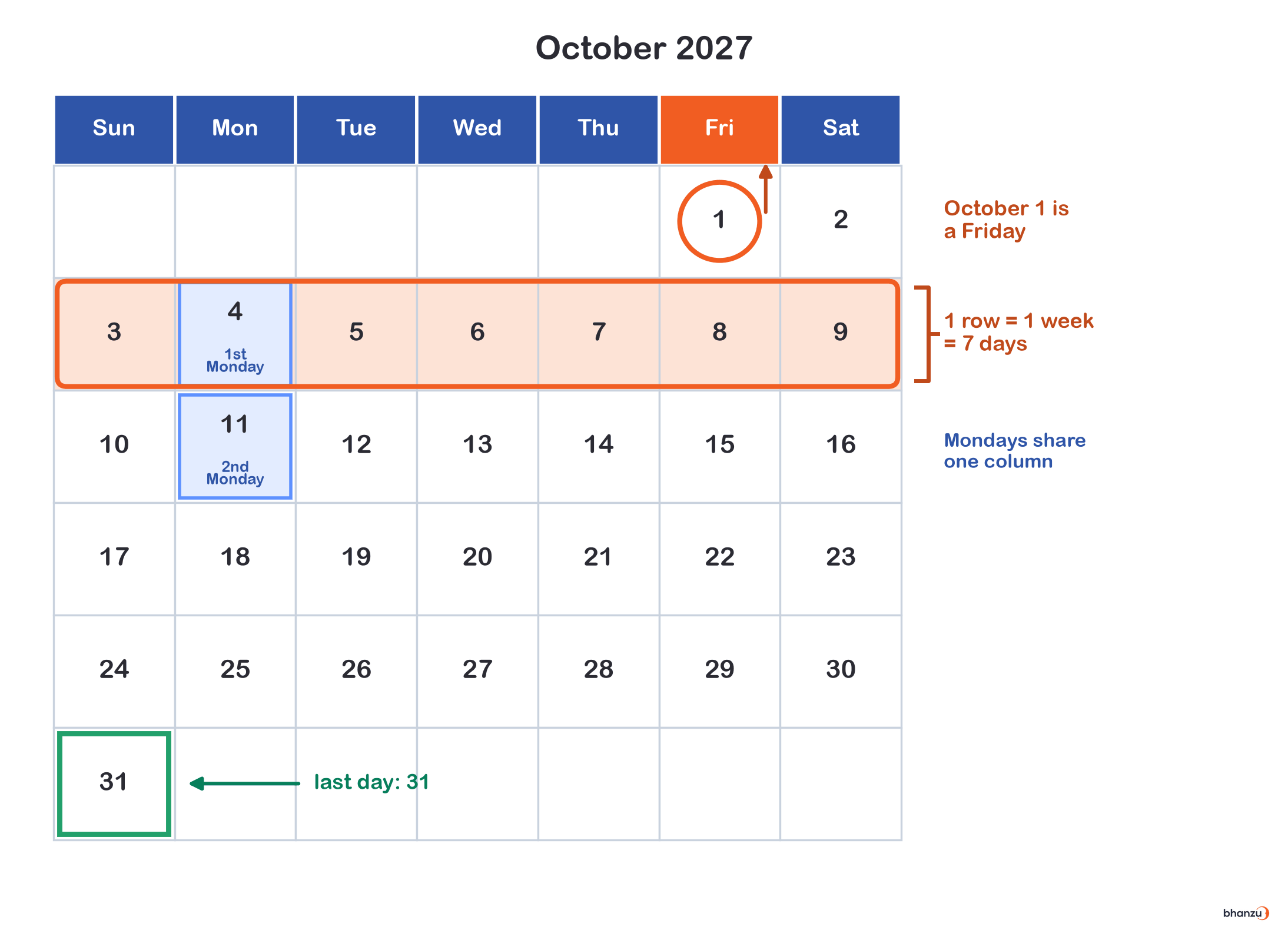
Reading a calendar starts with one month's page, a grid in which each row is one week and each column is one day of the week. A week has 7 days, a year has 12 months, and a month has 28 to 31 days.
Each square holds a date, the number of a day inside its month. Days, weeks and months are each a unit of time. Finding a date's day takes three steps.
- Read the month and year at the top.
- Find your date's square.
- Slide straight up its column to the day name.
On the October 2027 page, October 1 sits under Friday. Its Mondays run down one column, and the second is October 11.
Rows start on Sunday here, as on many US calendars (some start on Monday). US dates go month, day, year, so October 1, 2027 is 10/1/2027, and many countries put the day first.
Common Core doesn't list reading a calendar as a 2nd grade standard. Its closest one, 2.MD.C.7, covers clock time, and counting days uses the grade's adding and subtracting within 100.
If your child recites the months from January to find the one before October, that is normal, since a 1986 study by William Friedman found backward month order stays hard until the teen years.
How many days are in each month?
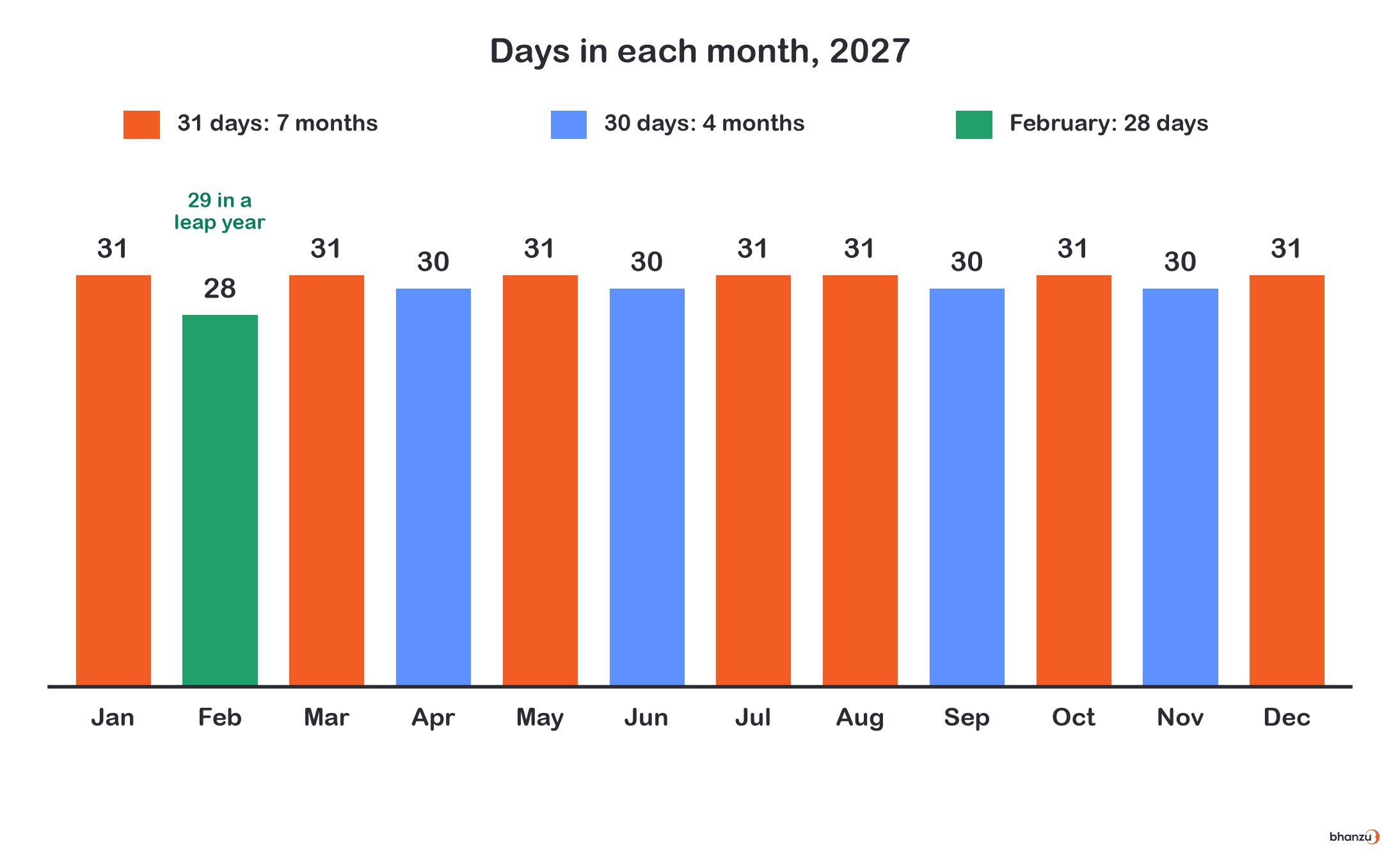
Seven months have 31 days, four have 30, and February has 28, or 29 in a leap year.
| Days | Months |
|---|---|
| 31 | January, March, May, July, August, October, December |
| 30 | April, June, September, November |
| 28 or 29 | February |
The knuckle trick for months reads these lengths off your hands.
- Make two fists side by side, knuckles up.
- Start on the first knuckle on the left and say the months in order, knuckle, dip, knuckle (a dip is the low spot between knuckles).
- July ends the first fist, so August starts the second.
- Knuckle months have 31 days and dip months have 30, except February.
An old rhyme starts with the four 30-day months, "Thirty days hath September, April, June and November" (hath means has).
NASA's Space Place explained in 2020 that Earth takes about 365 days and 6 hours to circle the Sun. Four 6-hour leftovers make 24 hours, one whole day, so February gets a 29th day about every 4 years. In 4th grade, you'll change hours into minutes.
How do you count days between two dates?
Inside one month, subtract the earlier date from the later date. October 14 to October 20 is 6 days.
The start date is where you stand, so in a "to" or "until" count it gets no number. Children counting days often touch the start square and say "one," the way they count blocks. That adds an extra day.
Each row works like a short number line, the same hop counting as adding and subtracting on a number line. One square straight down is 7 days later, with the same day name.
| Weeks | Days |
|---|---|
| 1 | 7 |
| 2 | 14 |
| 3 | 21 |
| 4 | 28 |
Going back, 28 days make 4 rows of 7, which is 4 weeks. In 3rd grade, you'll write that as 4 times 7.
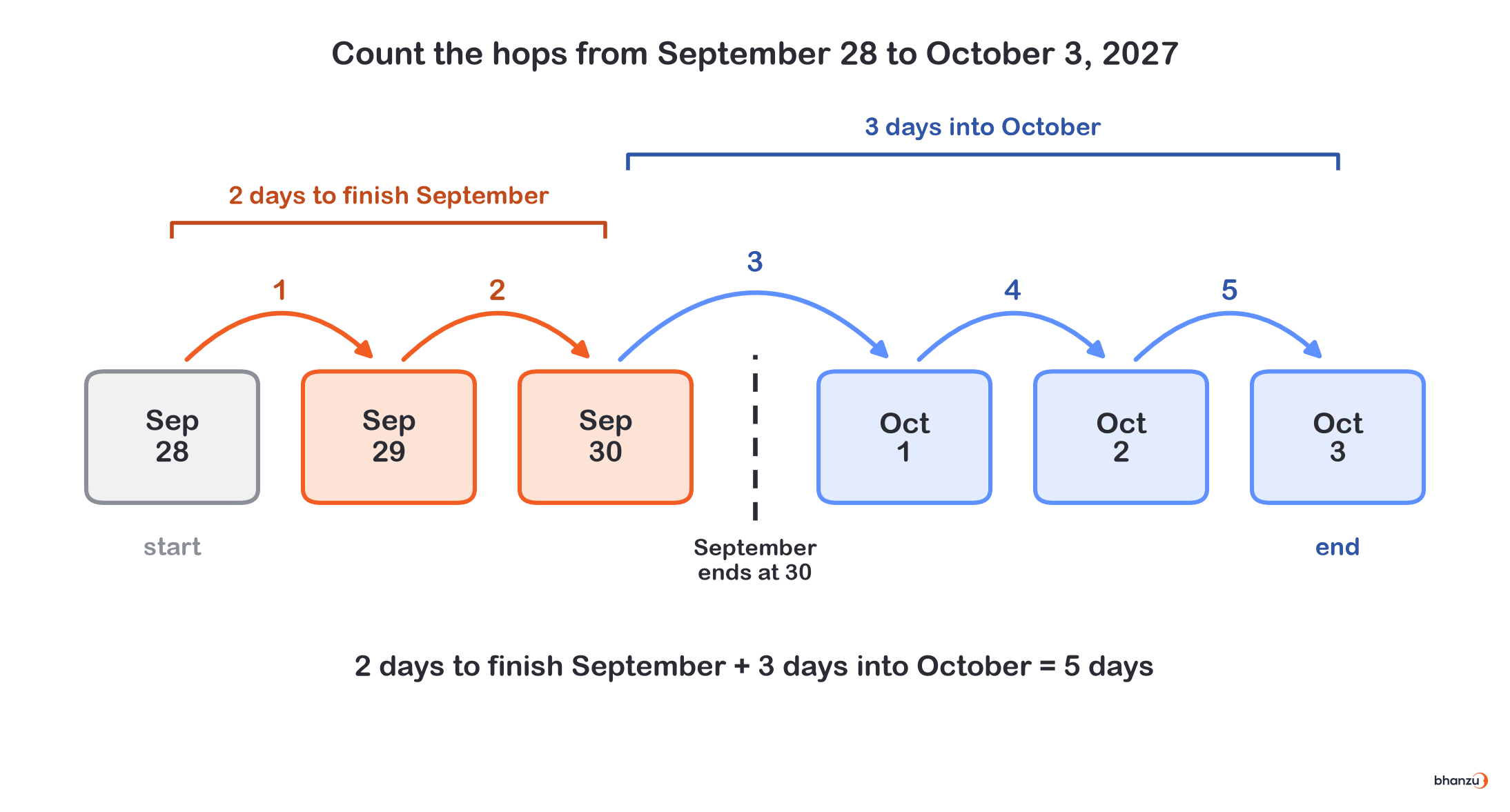
Counting across two months takes two steps.
- Subtract the start date from the number of days in its month.
- Add the date in the new month.
From September 28 to October 3, 2027, September's 30 days leave 2 hops. Then 3 more hops reach October 3.
A month-end count is one of the two-step word problems you already solve. In calendar word problems, the words pick the move.
| Words in the problem | Math it means |
|---|---|
| days until, or date to date | later date minus earlier date |
| N days after or later | add N |
| N days before or ago | subtract N |
| date through date | subtract, then add 1 |
Try It Yourself
Tap a start date, then an end date, and each hop gets a number. Turn on Count both days to see why October 12 through October 19 is one more day than October 12 to October 19. Month buttons carry your hops past a month's end.
Examples of reading a calendar
Example 1
What date is one week after Tuesday, October 5, 2027?
One week is 7 days, one square straight down.
It is Tuesday, October 12.
Example 2
Leo's bean seed goes in on Tuesday, October 12 and sprouts on Tuesday, October 19. How many days did that take?
A fast count lists the squares 12, 13, 14, 15, 16, 17, 18 and 19 and gets 8 days.
But 12 and 19 are both Tuesdays, one row apart, and one row is 7 days. So 8 can't be right.
Count hops instead, with 13 as hop 1.
The seed took 7 days.
Example 3
Mei's library book is due Friday, October 22. She had it for 2 weeks. On what date did she borrow it?
Go back 2 weeks, which is 14 days.
She borrowed it on Friday, October 8, two rows above the 22.
Example 4
Aisha's invitation says Friday, September 31, 2027. What is wrong, and which date does she likely mean?
September is a dip month with 30 days, so there is no September 31. The Friday right after Thursday, September 30 is October 1.
Example 5
It is Sunday, September 26, 2027. How many days until Leo's science fair on Tuesday, October 5?
First hop to the end of September, which has 30 days.
Then 5 more hops reach October 5.
There are 9 days until the fair.
Example 6
Diego leaves on Friday, October 29, 2027 and returns 5 days later. On what date and day does he return?
October has 31 days, so 2 hops reach October 31.
The other hops carry into November.
Counting Saturday as 1, the 5th day after a Friday is a Wednesday. Diego returns on Wednesday, November 3.
The real reason months have different lengths
A year is the time Earth takes to go around the Sun, and its 365 days don't split into 12 equal months.
- It has to reach 365. Twelve 30-day months make only 360, so seven months get a 31st day and February gets 28.
- It is very old. An Egyptian calendar of 365 days seems to have started more than 5,000 years ago, around 3100 BCE, according to NIST.
- Its names count from March. The oldest Roman year had ten months starting in March, so September, named for seven, sat seventh.
- It keeps summer in summer. Without leap days, NASA says, July would slide into the cold winter months in a few hundred years.
Seven 31s, four 30s and one 28 make exactly 365, a long number line folded into rows of 7.
Reading a calendar: where intuition breaks
Mistake 1: Adding past the last day of the month
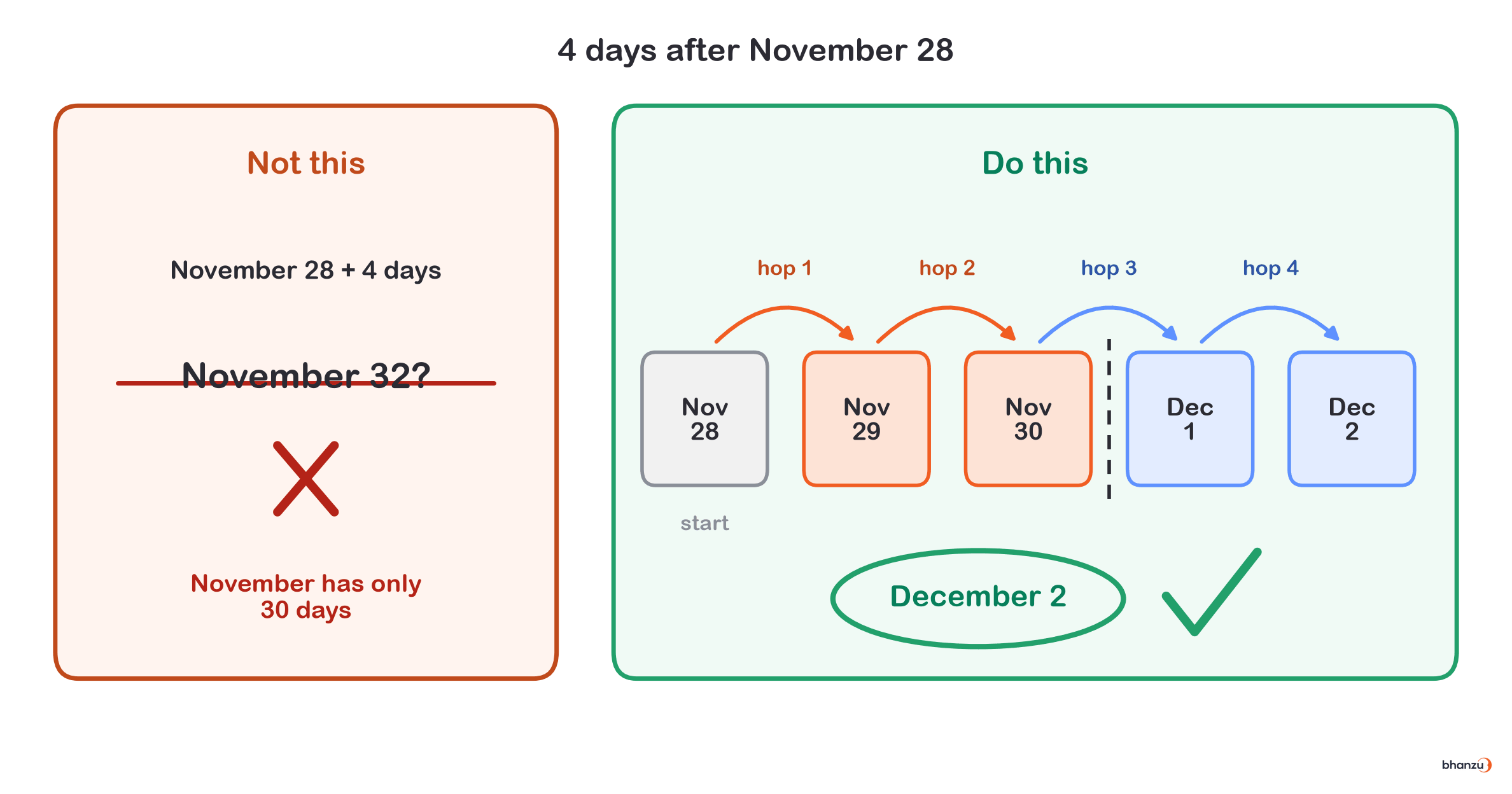
Where it slips in: Adding days near a month's end, as in Example 6. A child can write November 32 without a pause, since 28 plus 4 gives no warning that November stops at 30.
Don't do this: Saying 4 days after November 28 is November 32.
The correct way: Hop 2 days to November 30, then 2 more to December 2.
Mistake 2: Counting the gap between your fists
Where it slips in: The knuckle trick, right after July, because children expect knuckle and dip to keep taking turns.
Don't do this: Count the gap between the fists as a dip, which gives August 30 days.
The correct way: Jump from the last knuckle to the other fist's first knuckle, so August gets 31 days.
July and August are the only back-to-back 31-day months inside one year (December and January pair up across the new year).
Mistake 3: Subtracting when both days count
Where it slips in: "From ... through" questions. Once children learn to count hops, they subtract for every how-many-days question, even when camp's first day counts.
Don't do this: Saying camp from Monday, July 12 through Friday, July 16, 2027 lasts days.
The correct way: Campers go on July 12, 13, 14, 15 and 16, so subtract, then add 1.
What most guides miss about reading a calendar
Most guides skip why a date usually lands on a different weekday next month. Twenty-eight days is exactly 4 weeks, so every month is 4 weeks plus 0 to 3 extra days.
Those extra days push each date later in the week. October's 31 days are 4 weeks and 3 days, so October 5, 2027 is a Tuesday and November 5, 2027 is a Friday.
Key Takeaways
- Count hops, not squares, when a question asks how many days until a date.
- Before adding days near a month's end, check its last date with the knuckle trick.
- When reading a calendar question that says through, add 1 after you subtract.
- For more practice counting days across a month's end with a teacher who spots the extra counted day, explore Bhanzu's 2nd grade math curriculum or math programs for elementary students.
Read More
- A.M. and P.M.
- Counting Money and Money Word Problems
- Converting Units of Time
- Mental Subtraction
- Math at Home
Research Behind This Article
- Common Core State Standards Initiative, Grade 2 Measurement and Data (2.MD) (2010). thecorestandards.org
- Friedman, William J., The Development of Children's Knowledge of Temporal Structure (1986). pubmed.ncbi.nlm.nih.gov
- NASA Space Place, What Is a Leap Year? (2020). spaceplace.nasa.gov
- National Institute of Standards and Technology, A Walk Through Time: Ancient Calendars (2026). nist.gov
- Smith, William, A Dictionary of Greek and Roman Antiquities: Calendarium (1875). penelope.uchicago.edu
Quick Quiz: Check Yourself
Three levels, new dates every time: add or subtract days, count with to or through or name a month's length, then cross a month's end.
Was this article helpful?
Your feedback helps us write better content
Frequently Asked Questions
How many days are there in a leap year?
How many days until my birthday?
Are there 27 days in a month?
What should a second grader know in math?
How do I teach my child to read a calendar?