Key Points
- To get the area of composite shapes, split the shape into separate rectangles, multiply length by width for each one, and add the products.
- Any cut works if each square sits in just one rectangle, so one L-shaped floor gives or , both 33 square feet.
- An 8 by 6 rectangle missing a 5 by 3 corner covers 33 square feet, not 48, yet its perimeter stays 28 feet.
One carpet, two ways to cut it
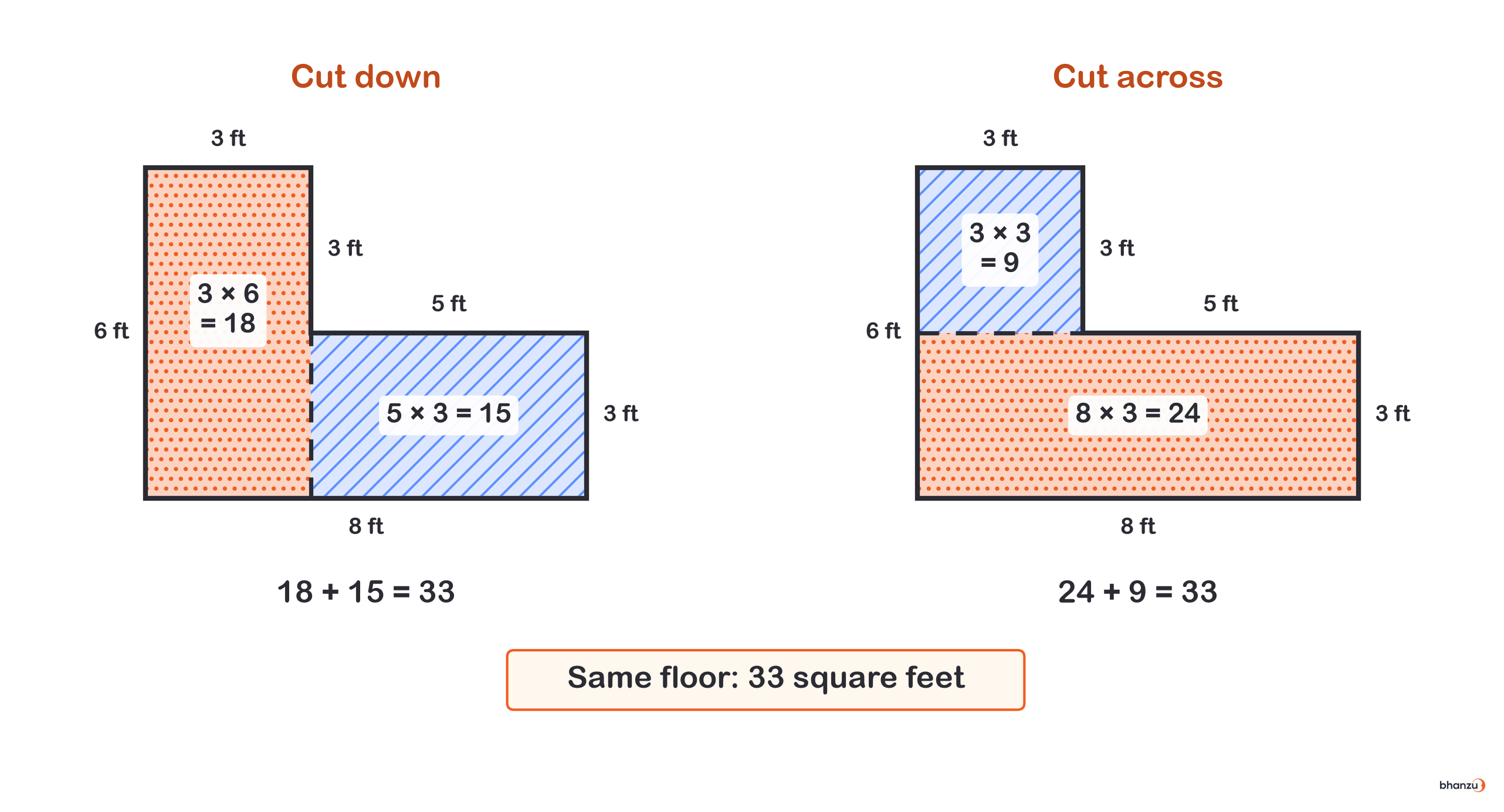
Leo's class wants to carpet a reading corner shaped like a capital L. The carpet comes in squares, 1 foot on each side, but an L has no single length and width to multiply. So the class cuts it.
Leo cuts straight down from the inside corner, and Aisha cuts straight across, so their multiplications look nothing alike. Both land on the same number of squares. In 5th grade, this cut-and-add idea measures the space inside stacked boxes.
How do you find the area of a composite shape?
You find the area of composite shapes by cutting the shape into rectangles, finding each area and adding. A composite shape joins two or more simpler shapes, and its area is the number of unit squares that cover it. Area is a flat, 2D measure, written in square units such as square feet.
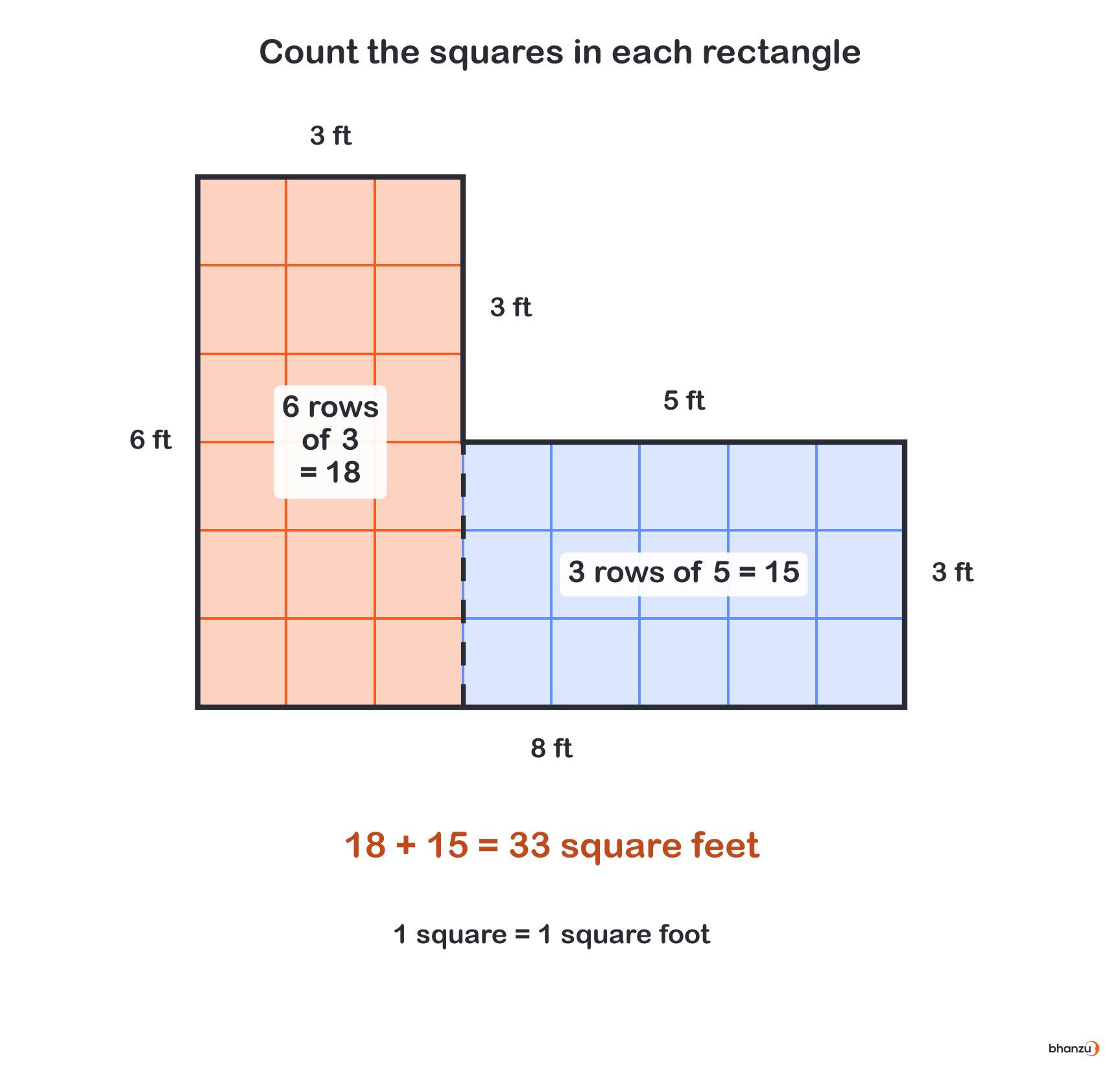
In 3rd grade, every composite shape is rectilinear: straight sides and square corners only. This is Common Core standard 3.MD.C.7.d, which begins "Recognize area as additive" and asks students to decompose, or break apart, such shapes into non-overlapping rectangles.
Each grid square is a unit square (here, 1 foot on every side). The left rectangle is 6 rows of 3 squares, or 18, and the right one is 3 rows of 5, or 15. Length times width counts those equal rows in one step.
- Cut from the inside corner straight to the far side.
- Label each rectangle's length and width, working out any missing side.
- Multiply length by width for each rectangle.
- Add the areas and write square units.
Homes are measured this way too. The median new single-family home completed in 2025 covered 2,142 square feet, so half were bigger and half smaller (US Census Bureau, 2026).
By the end of 3rd grade, your child is expected to cut shapes like these into rectangles with whole-number sides, multiply, and add, with triangles and circles left for later grades. Composite numbers, which arrive in 4th grade, share the name but not the idea, a clash that can trip up adults too.
Which way should you cut an L-shape?
Any straight cut from the inside corner works if every square lands in exactly one rectangle. The reading corner proves it.
| Cut | First piece | Second piece | Whole L |
|---|---|---|---|
| Down | |||
| Across |
Both give 33 square feet. A child new to L-shapes often multiplies the two longest sides, 8 times 6, because every earlier area problem was a rectangle. That 48 counts the empty corner too.
No single formula covers every composite shape, so you build one.
| Symbol | Meaning | Units |
|---|---|---|
| area of the whole shape | square units | |
| , | area of each rectangle, | square units |
| , | length and width of a rectangle | feet or other units |
It works because length times width counts a rectangle's equal rows of squares, and adding counts every square once. The same cut powers area and the distributive property, but here the shape never started as a rectangle.
How do you find a missing side length?
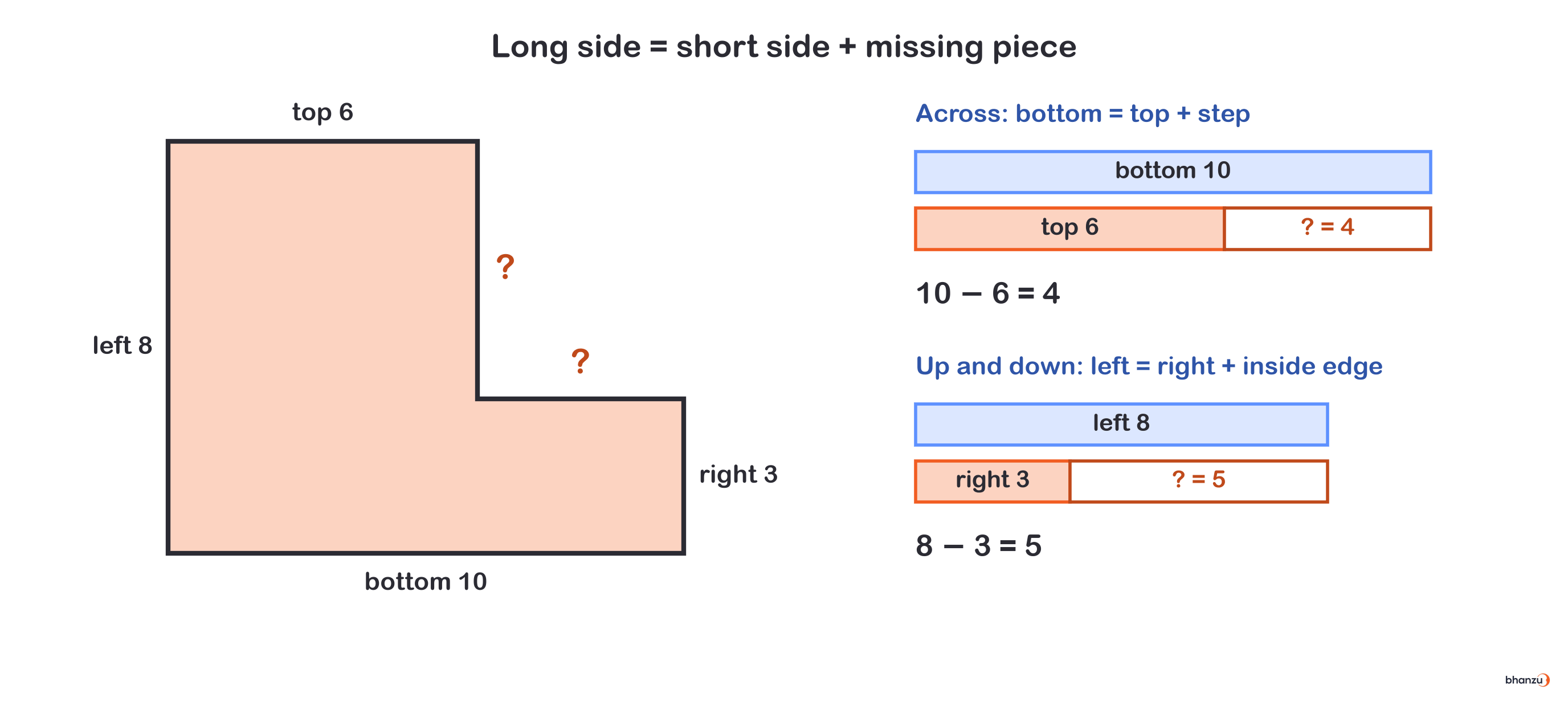
A long side equals the shorter sides across from it put together, so a missing piece is the long side minus the piece you know. The rule comes from the properties of a rectangle, whose opposite sides match.
Take an L with a bottom of 10, a left side of 8, a top of 6 and a right side of 3.
- Across, the step is .
- Up and down, the inside edge is .
- Label both before you multiply.
A side can also come from a known area. If a rectangle covers 12 square feet and one side is 4 feet, divide 12 by 4 to get 3 feet. In 4th grade, you'll find a room's width from its floor area this way.
When is subtracting easier than adding?
Subtracting saves steps when the empty part is one rectangle but adding would need three or more pieces. On the reading corner, the whole box minus the gap gives 33 again.
A U-shape shows the payoff. Cut a 4 by 4 gap from the top middle of an 8 by 6 box. Adding then takes three pieces (a bottom strip 8 by 2 and two posts 2 by 4).
Subtracting takes only two multiplications.
Each method has a limit. Counting squares gets slow past a few dozen, and subtracting needs the whole box's sides. Slanted or curved sides need other tools (triangles join composite shapes in 6th grade).
Try It Yourself
Drag the orange dot to change the L-shape, then tap Cut down, Cut across or Cut out to find its area three ways. Every way gives the same total area, and Show squares numbers each unit square so you can count them. Watch the edge as you drag, because the area changes but the perimeter does not.
Examples of area of composite shapes
Example 1
An L-shape is made of a 4 by 3 rectangle and a 2 by 5 rectangle. What is its area?
The area is 22 square units.
Example 2
Sam's L-shaped patio is 9 feet across the bottom, 3 feet up the right, 4 feet across the top and 7 feet up the left. What is its area?
The tempting move multiplies the bottom strip and the tall left strip, then adds.
That 55 is too big. The patio is a 9 by 7 box of 63 square feet minus an empty 5 by 4 corner of 20, or . The extra 12 came from the 4 by 3 corner, which sat inside both strips and was counted twice.
Cut so the pieces don't overlap. The top piece is only feet tall.
The patio covers 43 square feet.
Example 3
Mei writes and Noah writes for the same L-shape. It is 6 units across the bottom, 9 up the left, 2 across the top and 5 up the right. Who is right?
Mei cut down.
Noah cut across.
Both are right, 38 square units.
Example 4
A sticker sheet is 8 inches by 7 inches. Diego has used a 3-inch by 2-inch corner. How many square inches are left?
That leaves 50 square inches.
Example 5
An L-shaped garden covers 30 square feet. One part is 6 feet by 3 feet, and the other part is 4 feet wide. How long is the other part?
The other part covers 12 square feet, so divide 12 by 4.
The other part is 3 feet long.
Example 6
Leo's class is covering an L-shaped art corner with 1-foot carpet squares. It is 9 feet across the bottom, 6 up the left, 4 across the top and 3 up the right. How many squares do they need if a 2 by 2 spot under the sink stays bare?
The inside edge is feet.
The bare spot is square feet.
They need 35 carpet squares.
Why splitting into rectangles works
Area adds up. Every unit square inside an L belongs to exactly one rectangle, so adding counts each square once, never twice.
- It keeps the count fair. Overlapping pieces count shared squares twice, which is why the standard says "non-overlapping" rectangles.
- It tells you how much to buy. A 2024 NAEP question asked fourth graders for the area of a 25-foot by 6-foot bulletin board, then for 50-square-foot paper rolls to cover it. Nationally, 27 percent of those who saw it got both parts fully right.
- It turns carpet stories into two-step word problems, two multiplications and an addition.
Without the cut, an L-shaped floor has no length times width. With it, one shape you couldn't measure becomes two you can.
The mistakes kids make most often with composite shapes
Mistake 1: Guessing a missing side instead of working it out
Where it slips in: An unlabeled inside edge, as on an L with bottom 8, left 9, top 3 and right 4.
Don't do this: Call the inside edge 4, the same as the right side, then work out .
The correct way: The inside edge is , so square units.
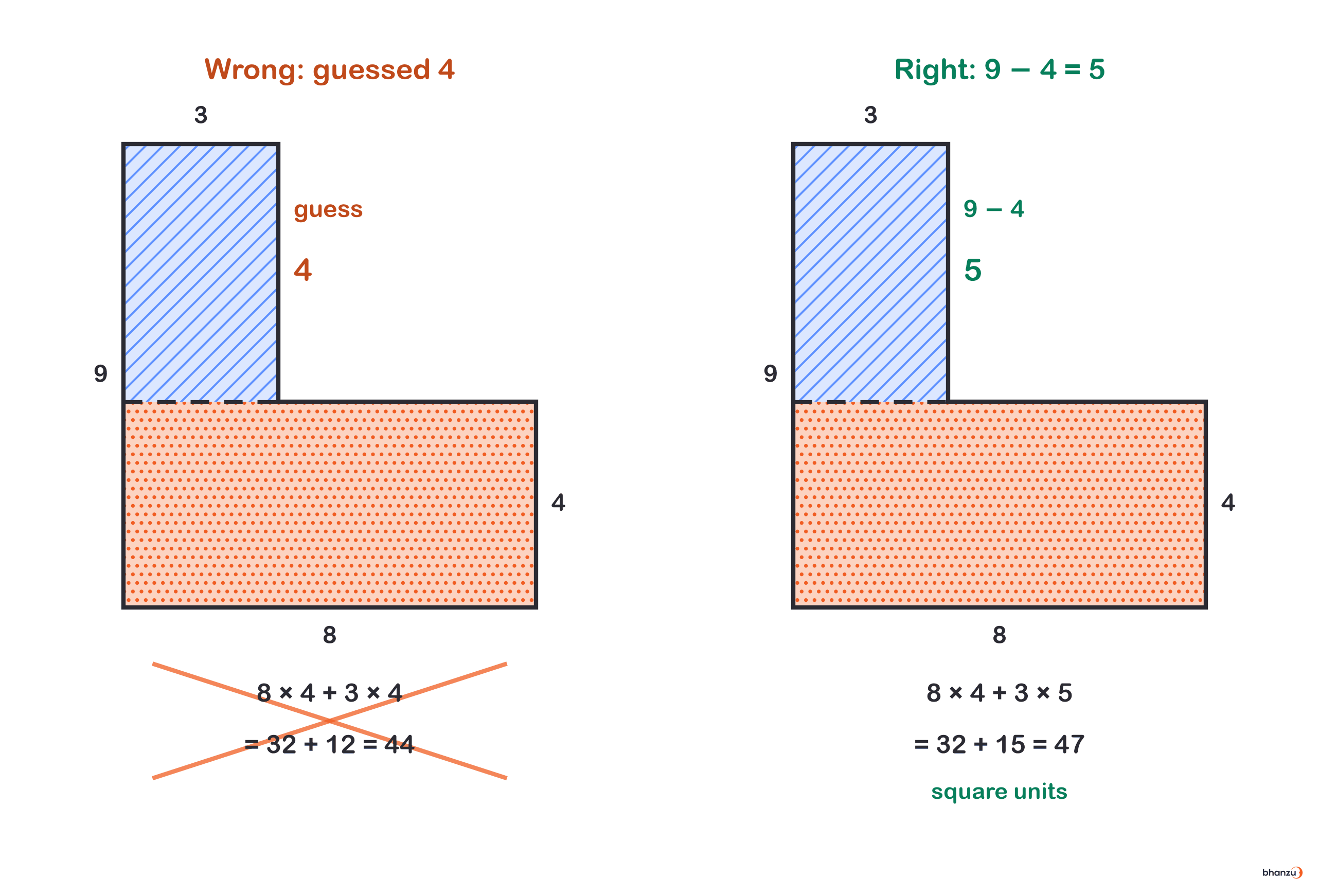
Children who see an unlabeled side often copy the nearest number, because the picture looks right and drawings are not always to scale.
Mistake 2: Finding the pieces but forgetting to add them
Where it slips in: Shapes with three or more pieces, and story problems with a bare spot like Example 6.
Don't do this: For an L made of a 4 by 6 rectangle and a 3 by 2 rectangle, write and stop.
The correct way: Add both pieces, square units, because the question asks about the whole shape.
A child who rushes finishes the first multiplication, sees a number and moves on. In a 2023 study of 31 Year 8 students in Australia, 95.7 percent of composite-area answers were right. Of the 16 wrong answers, 7 were pieces that students found but never added together.
Mistake 3: Writing feet when the answer is square feet
Where it slips in: The last line of every area answer.
Don't do this: Write that the reading corner is 33 feet.
The correct way: Write 33 square feet. Feet measure a line, like the 28-foot edge, while square feet count the squares covering the floor.
Every side on the drawing says feet, so that label gets copied as is.
What teachers watch for in composite shapes
Teachers watch two habits. The first is keeping area and perimeter apart, where perimeter is the distance around the outside edge.
The full 8 by 6 box covers 48 square feet. Its perimeter is 28 feet. Remove the 5 by 3 corner and the area drops to 33, yet the edge still adds to 28 feet.
The two new inside edges, 5 and 3 feet, replace the two outside pieces that left with the corner. A child who finds 28 may still doubt it, because the floor got smaller.
The second habit is checking by counting squares.
- Draw the shape on graph paper and count. The reading corner should give 33.
- Ask "What does 33 count?" and listen for "squares."
That check matters. In 2006, Constance Kamii and Judith Kysh interviewed 220 students in grades 4, 6, 8 and 9. Apart from eighth and ninth graders in advanced classes, the students did not yet treat a square as the unit of area.
Key Takeaways
- Before multiplying, check that every square lands in exactly one rectangle, and any cut gives the same area of composite shapes.
- An unlabeled side is never a guess, so subtract the short side from the long side across from it.
- When the gap is one rectangle, the whole box minus the gap needs just two multiplications, even for a U-shape.
- Area answers count squares, so they end in square units.
- For more practice finding a missing side before you multiply, explore Bhanzu's 3rd grade math curriculum or its math programs for elementary students.
Read More
- Elapsed Time
- Basic Area Concepts
- Volume of Composite Figures
- Area of Rectangles with Fractional Side Lengths
- Polygons on the Coordinate Plane
Research Behind This Article
- Common Core State Standards Initiative, Grade 3: Measurement and Data (2010). thecorestandards.org
- US Census Bureau, Highlights of 2025 Characteristics of New Housing (2026). census.gov
- OpenStax, Prealgebra 2e: Solve Geometry Applications: Circles and Irregular Figures (2020). openstax.org
- National Center for Education Statistics, NAEP Questions Tool: 2024 Mathematics, Grade 4 (2025). nationsreportcard.gov
- Timothy H. Lehmann, Learning to Measure the Area of Composite Shapes (2023). link.springer.com
- Constance Kamii and Judith Kysh, The Difficulty of "Length x Width": Is a Square the Unit of Measurement? (2006). eric.ed.gov
Quick Quiz: Check Yourself
Three levels, new numbers every time. Add two rectangles, then find a missing side or an L-shape's area, then subtract a corner, split a U-shape or solve a carpet story.
Was this article helpful?
Your feedback helps us write better content
Frequently Asked Questions
How do you find the perimeter of a composite shape?
What kind of paper helps with the area of rectilinear shapes?
Do composite shapes have to be made of rectangles?
How do you find the area of irregularly shaped land?
What grade do kids learn area?
How can I explain area to my child?