Key Points
- Most elapsed time word problems give two of three facts (the start time, the end time or the length) and ask for the third.
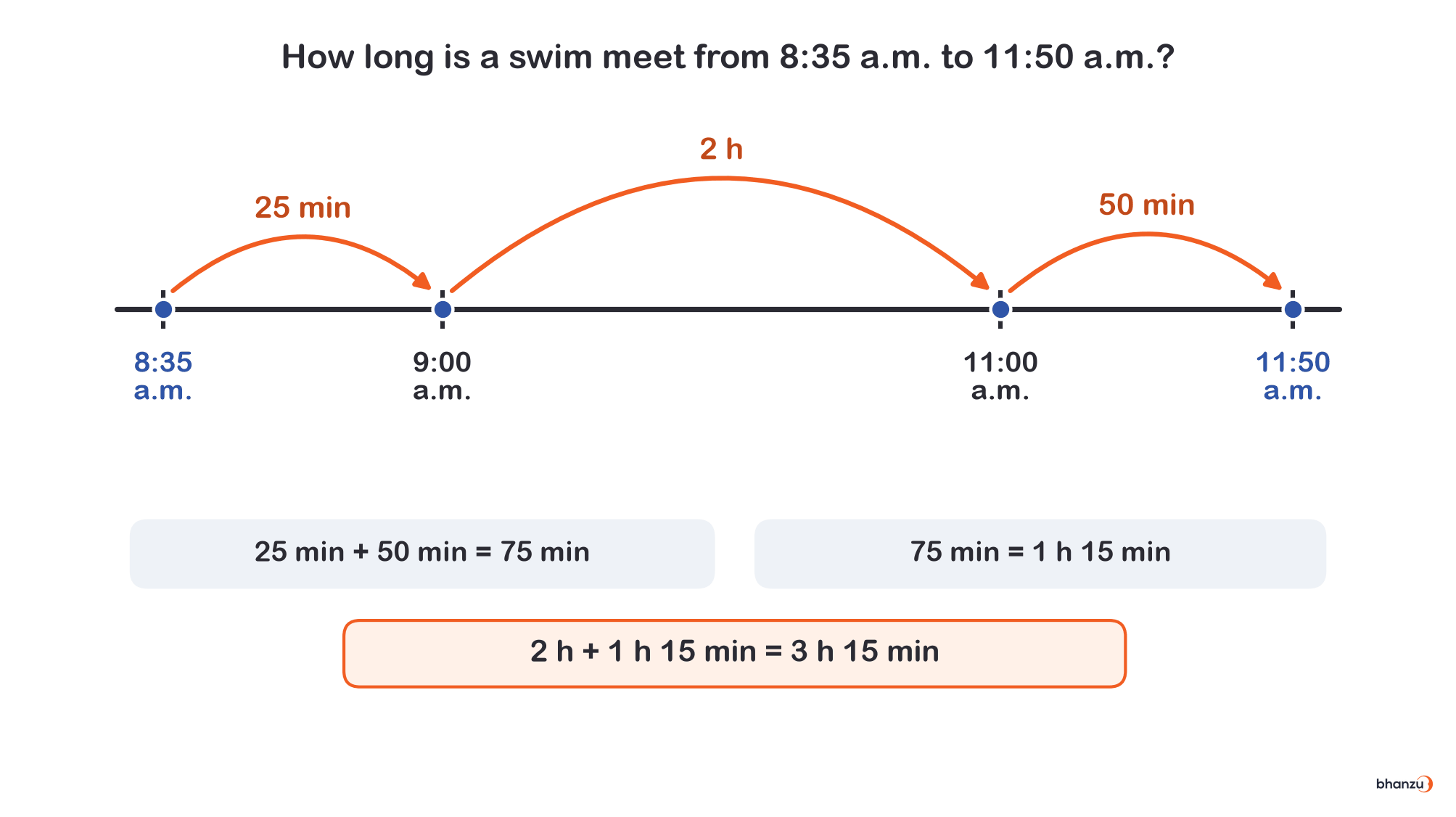
- On an open number line, jump to the next o'clock, then whole hours, then leftover minutes, so 8:35 a.m. to 11:50 a.m. is 3 hours 15 minutes.
- An hour holds 60 minutes, so when the top minutes are too few, trade 1 hour for 60 minutes, not 100, and regroup 60 or more minutes into an hour.
The clock that starts over at 12
A clock face only counts to 12, but your day keeps on going.
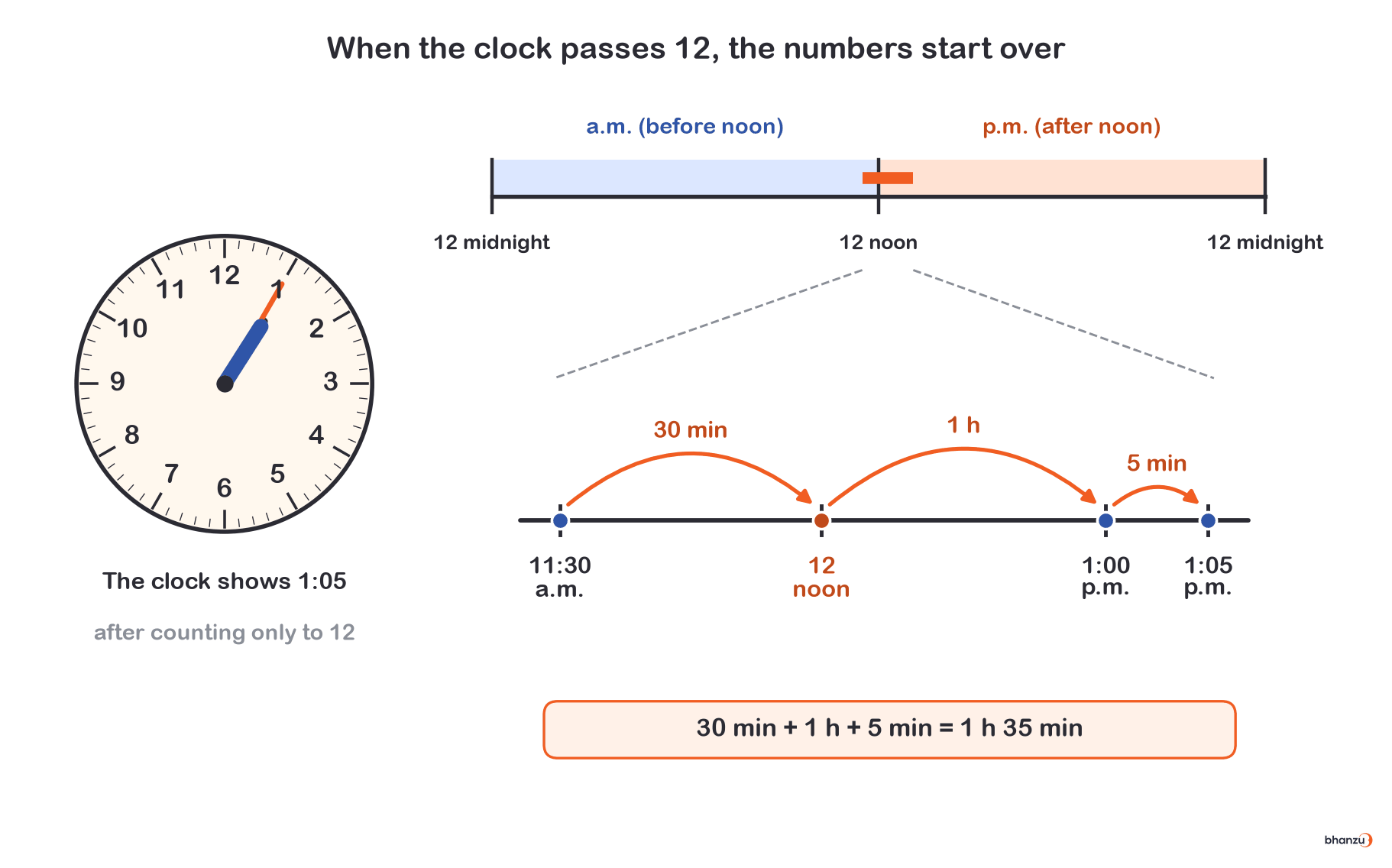
A movie from 11:30 a.m. to 1:05 p.m. runs 1 hour 35 minutes, yet 1:05 looks smaller than 11:30. The clock started over at 12. It looks tricky, and you can work it out.
Make 12 noon a stop on the way. That's 30 minutes to noon, 1 hour to 1:00 and 5 more minutes. In 5th grade, you'll stretch these jumps across whole days too.
What are elapsed time word problems?
Elapsed time word problems are story problems about an interval, a stretch of time between a start time and an end time, and most give two facts and ask for the third. Elapsed time is the time that passes from start to end. Hours and minutes are each a unit of time.
| Words in the problem | Math it means |
|---|---|
| "starts at", "left at" | the start time |
| "returned at", "must end by" | the end time |
| "lasts", "takes" | the length: add it to a start time or subtract it from an end time |
| "how long", "in all" | the missing length: count on from start to end, or add the lengths |
This is Common Core standard 4.MD.A.2, which asks 4th graders to solve word problems about intervals of time with the four operations and number line diagrams with a measurement scale. In 3rd grade, your child measured intervals in minutes, and 4th grade stretches them into hours and minutes and across noon or midnight, as one kind of measurement and money word problems.
How do you find how long something takes?
To find how long something takes, count on from the start time to the next o'clock, jump the whole hours, then add the leftover minutes. The model is an open number line, a quick sketch of a scaled time line that marks only the start, the o'clock stops and the end. Juli Dixon's 2008 NCTM article uses this open timeline to count up or back between two times.
A swim meet runs from 8:35 a.m. to 11:50 a.m.
- Jump 25 minutes from 8:35 to 9:00.
- Jump 2 hours from 9:00 to 11:00.
- Jump 50 minutes from 11:00 to 11:50.
- Add the minute jumps, then the hours.
Stopping on o'clocks keeps each minute jump under 60, so hours and minutes stay apart until the end.
Is there a formula for elapsed time?
End time minus start time finds the gap, hours from hours and minutes from minutes, so 11:50 minus 8:35 gives 3 hours 15 minutes. It works when the hour numbers count up without passing 12, unlike 12:15 p.m. to 2:40 p.m., which needs a stop at 1:00. If the end minutes are smaller, trade 1 hour for 60 minutes first. Four methods find a length.
- Counting on. It works for any interval.
- Hour jumps, or the jump strategy. Count 8:35, 9:35, 10:35, 11:35, then 15 more minutes, which gets slow over many hours.
- Subtracting. It's fastest when the hours don't pass 12.
- A T-chart. Each row holds a jump and a running total.
A child counting hour jumps on fingers often counts the starting hour too (8, 9, 10, 11) and gets 4 hours instead of 3. Count the jumps, not the numbers.
How do you find elapsed time across noon or midnight?
Make 12 noon or 12 midnight its own stop. The label switches from a.m. to p.m. at noon and back at midnight, as in a.m. and p.m. from 2nd grade. The National Institute of Standards and Technology calls 12 a.m. and 12 p.m. ambiguous and writes "8 a.m. to noon" instead (many clocks still show 12:00 p.m. at noon).
On June 21, 2026, the US Naval Observatory's sun table for Chicago lists sunrise at 5:16 a.m. and sunset at 8:29 p.m. The jumps run 44 minutes to 6:00, 6 hours to noon, 8 hours to 8:00 and 29 minutes more.
The sun is up for 15 hours 13 minutes.
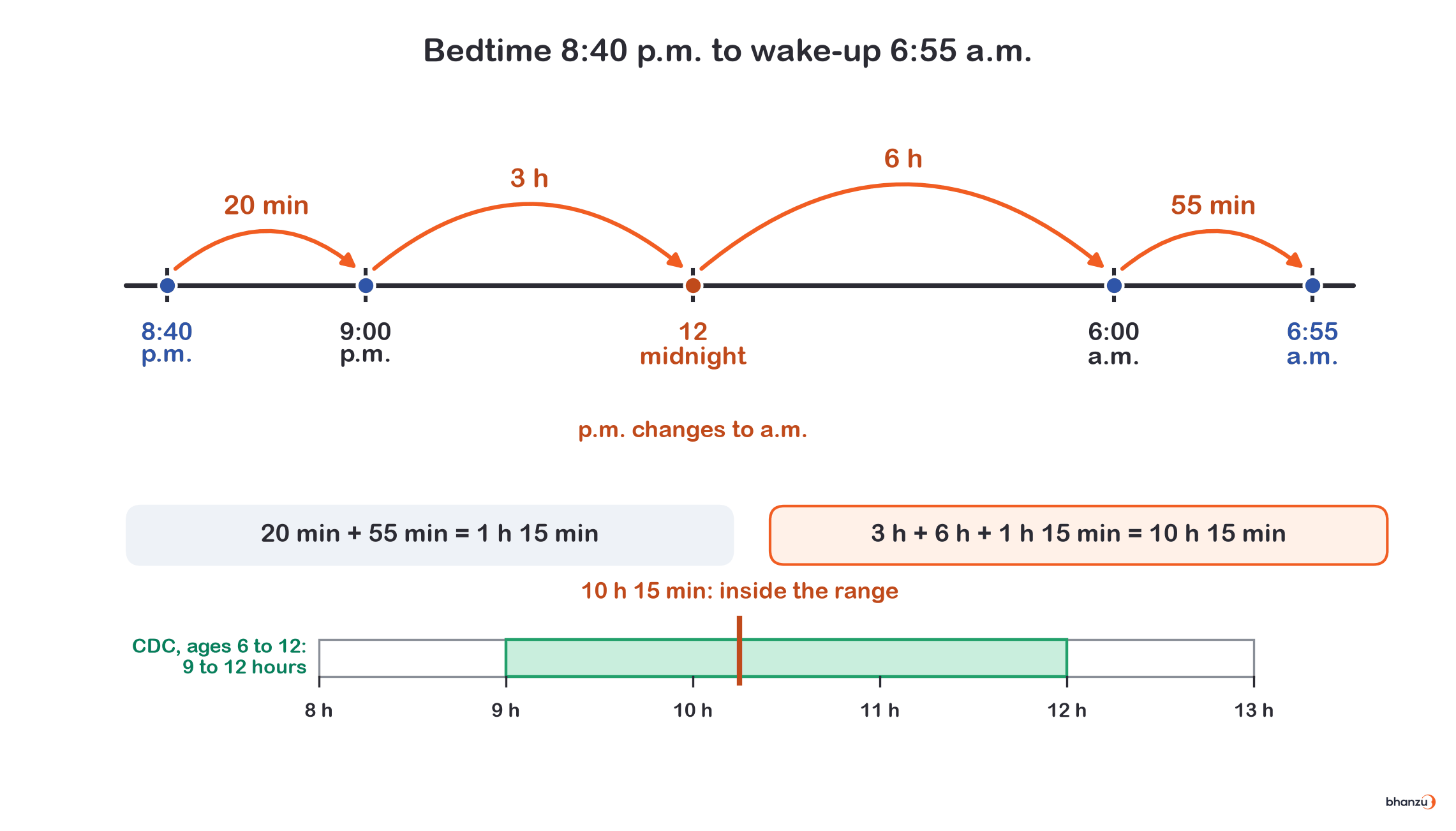
The CDC's sleep guidance, dated May 15, 2024, lists 9 to 12 hours a day for ages 6 to 12. Bedtime at 8:40 p.m. and waking at 6:55 a.m. jump 20 minutes, 3 hours, 6 hours and 55 minutes.
That night fits the CDC's range.
Try It Yourself
Drag the clock's minute hand or tap the buttons to move the end time (the start time in a start challenge), and the number line redraws its jumps through noon or midnight. The readout adds the jumps and regroups 60 minutes into an hour. Challenge buttons ask for an end time, a start time or how long, hide the total until you answer, and say how far off you are.
Adding and subtracting elapsed time in hours and minutes
Line up hours with hours and minutes with minutes. After adding, turn 60 or more minutes into 1 hour, and before subtracting, trade 1 hour for 60 minutes if the top minutes run short. When the hours reach 12, the label switches, and past 12 they start over at 1.
A piano recital starts at 2:35 p.m. and lasts 1 hour 40 minutes.
It ends at 4:15 p.m. Bread must leave the oven by 6:10 p.m. after baking 2 hours 35 minutes, so subtract, the reverse of adding, and trade first.
The bread goes in at 3:35 p.m. It's the trade from multi-digit subtraction, with 1 hour breaking into 60 minutes where 1 ten breaks into 10 ones.
Regrouping runs both ways, as in converting units of time. Multiply to get minutes, so 1 h 50 min is minutes. Divide to go back by taking out groups of 60, so 125 minutes is , or 2 h 5 min.
| Minutes | Hours and minutes |
|---|---|
| 75 | 1 h 15 min |
| 90 | 1 h 30 min |
| 110 | 1 h 50 min |
| 125 | 2 h 5 min |
Examples of elapsed time word problems
Example 1
A planetarium show runs from 10:15 a.m. to 10:50 a.m. How long is it?
Same hour, so subtract the minutes.
The show lasts 35 minutes.
Example 2
Priya's class visits a museum from 9:50 a.m. to 1:15 p.m. How long is the visit?
The tempting move treats the times as whole numbers, so 950 minus 115 gives 835, or 8 hours 35 minutes.
That can't be right, since 9:50 a.m. plus 8 hours is already 5:50 p.m.
Count on with noon as a stop instead, jumping 10 minutes to 10:00, 2 hours to noon, 1 hour to 1:00 and 15 minutes to 1:15.
The visit lasts 3 hours 25 minutes.
Example 3
Lunch starts at 11:40 a.m. and lasts 45 minutes. When does it end?
11:40 to noon is 20 minutes.
Lunch ends at 12:25 p.m.
Example 4
The bus ride back takes 55 minutes and must end by 2:10 p.m. When must the bus leave?
The start is unknown, so subtract the ride and trade 1 hour first.
The bus must leave by 1:15 p.m.
Example 5
Priya's group spends half an hour, 40 minutes and 55 minutes in three halls. How long is that in all?
Half an hour is 30 minutes.
That's 2 hours 5 minutes.
Example 6
The bus left at 8:55 a.m., returned at 2:10 p.m. and rode 55 minutes each way. How long was the class off the bus?
- Time away. 5 minutes to 9:00, 3 hours to noon, 2 hours to 2:00 and 10 minutes to 2:10 make 5 hours 15 minutes.
- Riding time. minutes, or 1 hour 50 minutes.
- Off the bus. Trade 1 hour, then subtract.
The class spent 3 hours 25 minutes off the bus.
What makes elapsed time worth learning?
A clock tells you when, but nearly every plan also needs how long, which no clock face shows.
- It turns two readings into one amount. Two clock times can't be added, but 1 hour 20 minutes and 45 minutes can.
- It holds a plan together. A day is a chain of lengths, so one wrong length shifts every later time.
- It makes goals checkable. Reading for 30 minutes is a length goal, so elapsed time tells you when you've met it.
- It sees past the clock's restart. The face starts over at 12, but time keeps going, so a length stays true across noon and midnight.
Once you can find how long, a list of clock times becomes a plan you can check.
The pattern hiding inside elapsed time
Every time problem runs on two counters at once. Minutes roll over at 60, hours roll over at 12, and the a.m. or p.m. label flips each time the hour reaches 12.
- Keep the counters apart, minutes in one set of jumps and hours in another.
- Say the label change out loud at every 12.
A 2012 study of 126 students in grades 2 to 5 found that coordinating hours and minutes is the main reason elapsed time feels hard. Its authors, Constance Kamii and Kelly Russell, recommended letting children reason about real durations from daily life rather than teaching them procedures.
Later, when you meet speed in miles per hour, elapsed time becomes the bottom number of a rate.
Common errors when working with elapsed time
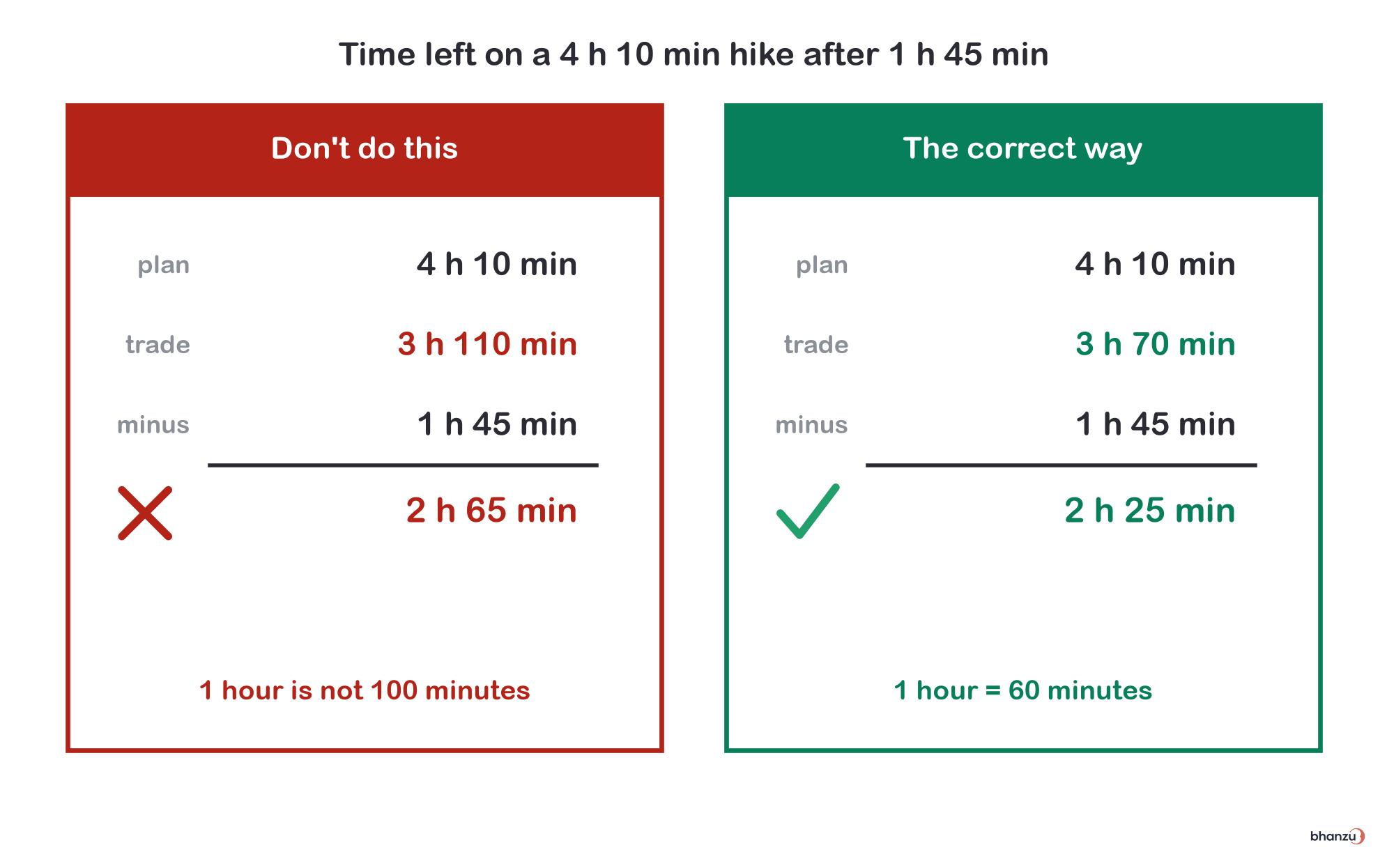
Mistake 1: Trading 1 hour for 100 minutes
Where it slips in: Subtracting hours and minutes when the top minutes run short.
Don't do this: Noah has walked 1 h 45 min of a planned 4 h 10 min hike. Trading 1 hour as 100 minutes gives 3 h 110 min minus 1 h 45 min, or 2 h 65 min left.
The correct way: Trade 1 hour as 60 minutes, so 3 h 70 min minus 1 h 45 min is 2 h 25 min.
A child fresh from multi-digit subtraction trades out of habit, since every earlier trade was worth 10, 100 or 1,000. The 100-minute version adds 40 minutes that never happened (65 minus 25).
Mistake 2: Leaving 60 or more minutes in the answer
Where it slips in: Adding a length to a start time when the minutes pass 59.
Don't do this: Practice starts at 3:50 p.m. and lasts 1 hour 25 minutes, so it "ends at 4:75 p.m."
The correct way: minutes, or 1 hour 15 minutes, so it ends at 5:15 p.m.
The column habit says to write what you get. No clock ever shows 75 minutes.
Mistake 3: Keeping a.m. after crossing noon
Where it slips in: End-time problems that start in the morning and pass 12.
Don't do this: A trip leaves at 10:30 a.m. and takes 3 hours 20 minutes, so it "arrives at 1:50 a.m."
The correct way: The trip passes noon, so the label switches, and it arrives at 1:50 p.m.
A child who copies the start time's label, without looking for a 12, makes this one, though 1:50 a.m. is the middle of the night.
Key Takeaways
- Before you pick an operation, name the missing fact, whether it's the start, the end or how long.
- Make 12 noon or 12 midnight its own stop, and switch the label right there.
- In elapsed time word problems, keep hours and minutes apart until the last line.
- When minutes run short in a subtraction, break 1 hour into 60 minutes, never 100.
- For more practice with schedules that cross noon, with a teacher who checks each jump, explore Bhanzu's 4th grade math tutor or math classes for kids.
Read More
- Elapsed Time
- Time Unit Conversion Word Problems
- Estimating and Choosing Units of Measurement
- Order of Operations
- Multi-Step Word Problems
- Reading a Calendar
Research Behind This Article
- Common Core State Standards Initiative, Grade 4 Measurement and Data (2010). thecorestandards.org
- Juli K. Dixon, Tracking Time: Representing Elapsed Time on an Open Timeline (2008). eric.ed.gov
- National Institute of Standards and Technology, Times of Day FAQs (2024). nist.gov
- US Naval Observatory, Complete Sun and Moon Data for One Day: Chicago, IL, June 21, 2026 (2026). aa.usno.navy.mil
- Centers for Disease Control and Prevention, About Sleep (2024). cdc.gov
- Constance Kamii and Kelly A. Russell, Elapsed Time: Why Is It So Difficult to Teach? (2012). eric.ed.gov
Quick Quiz: Check Yourself
Three levels, new times every time: find how many minutes pass, choose an end or start time that regroups 60 minutes, then cross noon or midnight or work out a multi-step schedule.
Was this article helpful?
Your feedback helps us write better content
Frequently Asked Questions
Is elapsed time the same as duration?
Are elapsed time word problems 4th grade or 3rd grade math?
How can I teach elapsed time to my 4th grader at home?
Are there elapsed time word problems worksheets on this page?
Do time word problems ever use seconds?