Key Points
- In length word problems every length uses one unit, and the question picks the move, adding to find a whole and subtracting to find a piece or a gap.
- A number line drawn like a ruler starts at 0, so a 38-inch chalk line plus 46 more inches ends at the 84 mark.
- A ribbon cut into a 27-inch piece and a 46-inch piece was 73 inches long before the cut, though "cut" and "left" sound like subtracting.
Eleven inches between two long jumps
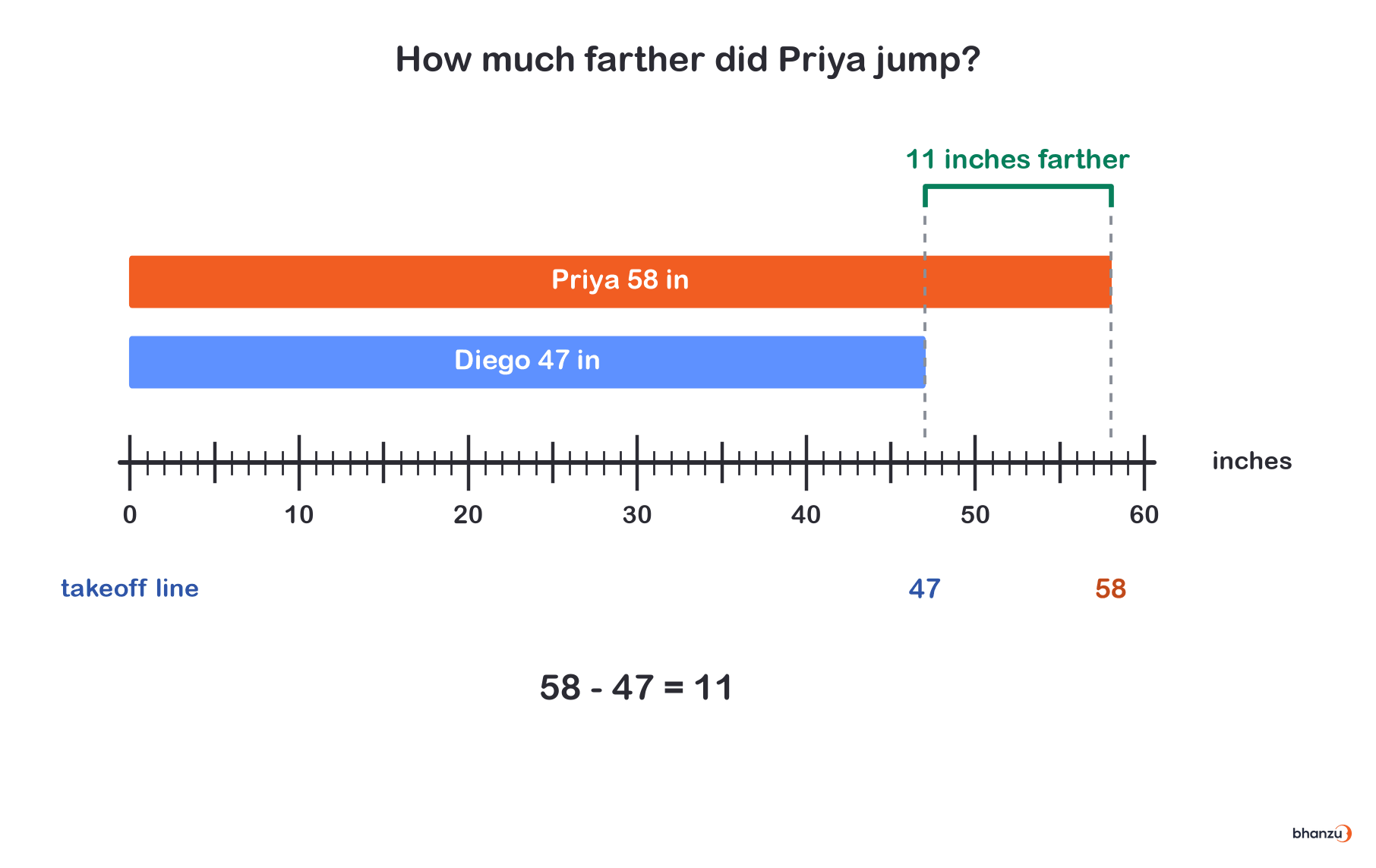
On field day, Diego's long jump lands at 47 inches and Priya's at 58. Everyone wants to know how much farther Priya went.
Both jumps start at the same takeoff line, so the answer is the space between the 47 and 58 marks, 11 inches. The numbers tell you where things end, and the story tells you which space to find. In 3rd grade, you'll add side lengths this way to find a shape's perimeter.
What are length word problems?
Length word problems give lengths in one unit and ask you to add or subtract to find a whole, a piece or a gap. A length is how far something reaches from one end to the other. A unit is one fixed step of length, such as one inch, that you count again and again.
This is Common Core standard 2.MD.B.5, which asks 2nd graders to add and subtract lengths "given in the same units" within 100. Its partner, 2.MD.B.6, adds the number line diagram. By the end of 2nd grade, your child is expected to solve these stories, usually with a ruler drawing, a number line or an equation with a box for the unknown.
How do you solve a length word problem?
Draw the story on a number line that looks like a ruler, and let the drawing choose plus or minus.
- Read the story and retell it in your own words.
- Circle the unit and check that every length uses it.
- Draw a ruler-style number line from 0 (a yardstick or meter stick works too).
- Decide whether the question wants the whole, a piece or the gap.
- Write an equation with a box for the unknown length.
- Add or subtract, and write the answer with its unit.
A child who grabs both numbers and adds before reading the question skips step 4, and often gets cut and compare stories wrong.
Leo draws a chalk line 38 inches long, then keeps going for 46 more inches. The second piece starts at the 38 mark, where the first one stops, so add.
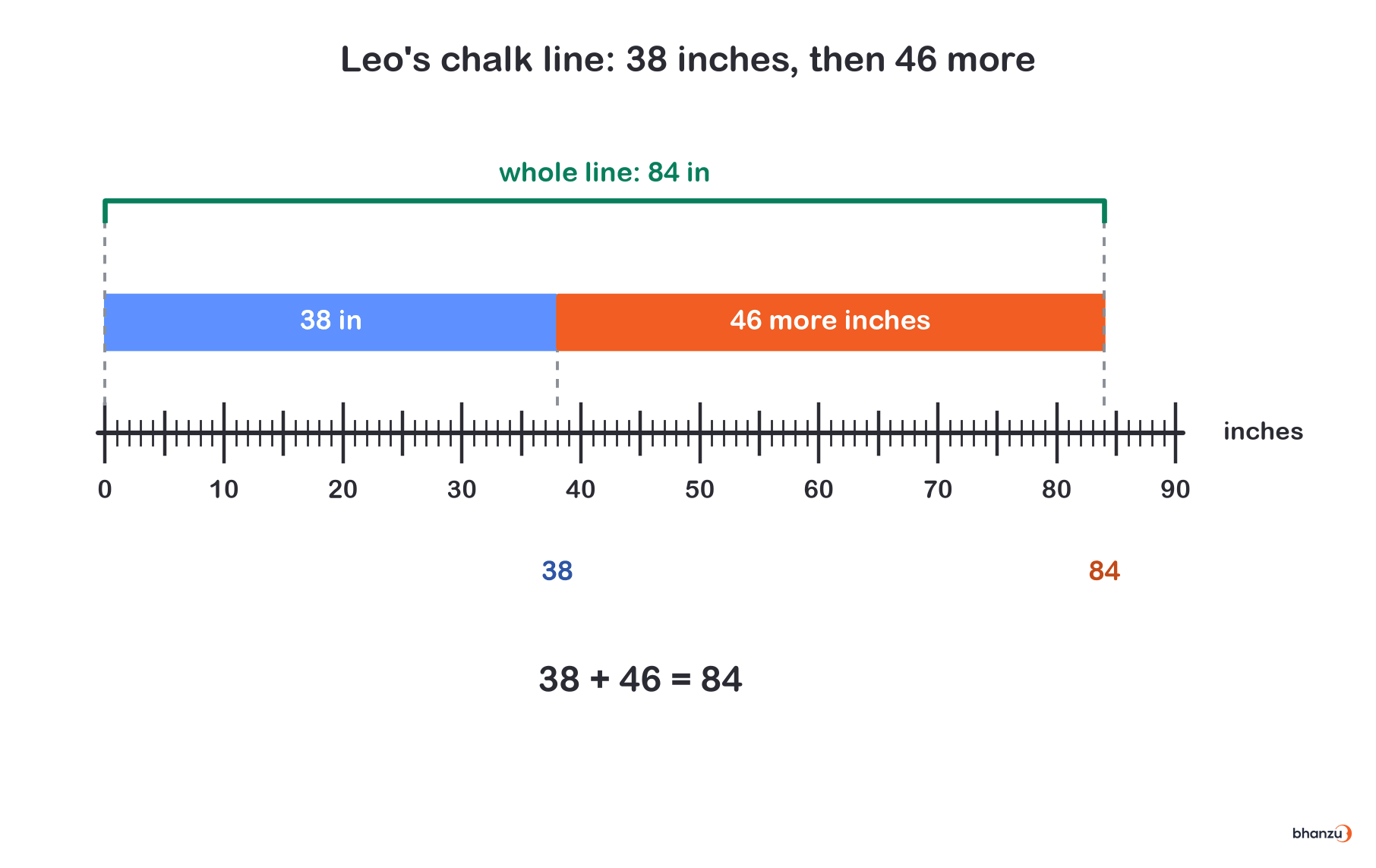
The chalk line is 84 inches long. The jumps follow the same rules as adding and subtracting on a number line. A cut story such as needs a ten opened up, as in subtracting two-digit numbers with regrouping.
Drawing every inch gets slow past about 20, so sketch an open line with jumps of 10. When a story mixes inches and centimeters, measure both lengths again in one unit before drawing.
Is it a join, cut or compare story?
Every one-step length story is a join, a cut or a compare. The unknown can be the whole, a piece, the gap or the starting length. Common Core's table of addition and subtraction situations sorts stories in a similar way, with four types.
"Longer than" stories are genuinely confusing, because "longer" sits right next to the lane you need, the shorter one. That table's footnote calls versions whose words point the other way more difficult.
| Words in the problem | Math it means |
|---|---|
| Two ropes laid end to end | add |
| How much shorter is Noah's streamer? | longer minus shorter |
| Was 36 inches, now 81 inches | count up from 36 to 81 |
| 25 meters longer than the other lane | the other lane is shorter, so subtract |
| Cut off 27 inches, 46 left, how long before? | add the pieces back together |
The box in an equation stands for the length you don't know yet, as in missing number problems. Compare stories grow out of comparing lengths, now told in words. In 4th grade, you'll change 4 feet into 48 inches before adding.
Try It Yourself
In Join, drag the end of the orange strip to match the story, and the readout adds the two lengths. In Compare, stretch the green gap from the shorter jump to the longer one. In Cut, slide the cut mark along the ribbon and watch both pieces add back to the whole.
Examples of length word problems
Example 1
Mei lays two jump ropes end to end. One is 34 inches long and the other is 45 inches long. How long is the line of rope?
Put the ropes together, so add.
The rope line is 79 inches long.
Example 2
Sam cuts 27 inches of ribbon off a roll for the finish line. Now 46 inches are left on the roll. How long was the ribbon before the cut?
"Cuts" and "left" sound like subtracting, so a first try gives inches.
That can't be right. Before the cut, the roll held the 46 inches still there plus Sam's 27 inches, so it was longer than 46 inches.
The box stands for the ribbon before the cut, so . Put the pieces back together, so add.
The ribbon was 73 inches long.
Example 3
Aisha's paper streamer is 63 centimeters long, and Noah's is 38 centimeters long. How much shorter is Noah's streamer?
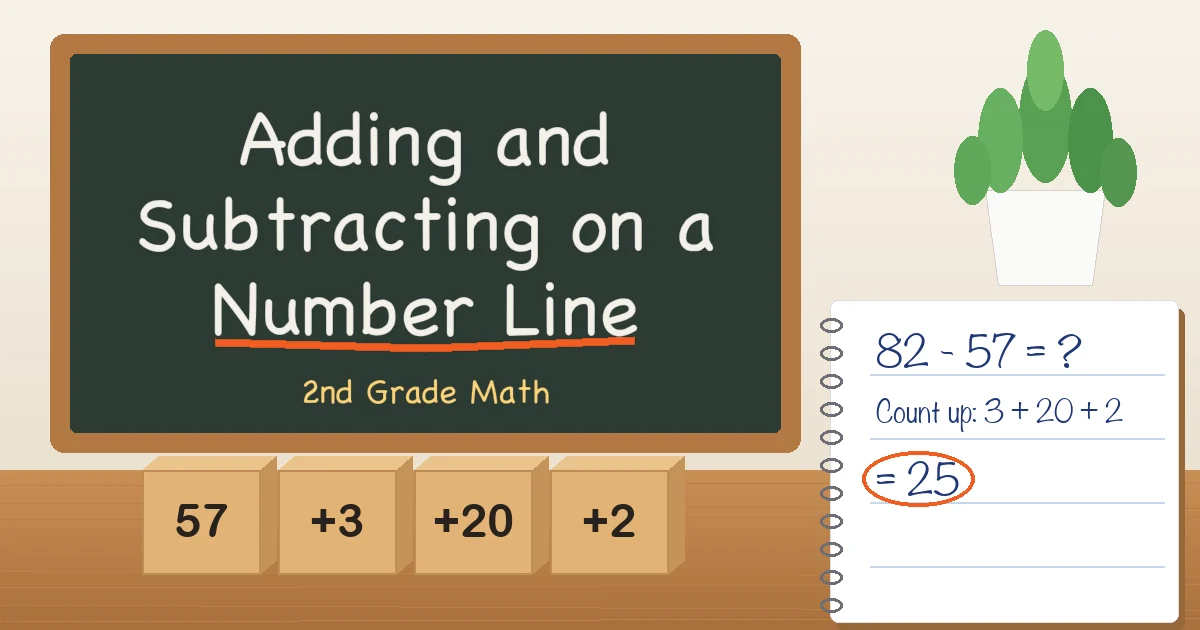
Find the gap by counting up from 38 to 63, with jumps of 2, 20 and 3.
Noah's streamer is 25 centimeters shorter.
Example 4
The three-legged race lane is 73 meters long, 25 meters longer than the egg-and-spoon lane. How long is the egg-and-spoon lane?
The egg-and-spoon lane is the shorter one, so take away the extra 25 meters.
The egg-and-spoon lane is 48 meters long.
Example 5
The class paper chain was 36 inches long on Monday and 81 inches long on Friday. How many inches did the class add?
The box stands for the inches added, so . Count up from 36 with jumps of 4, 40 and 1.
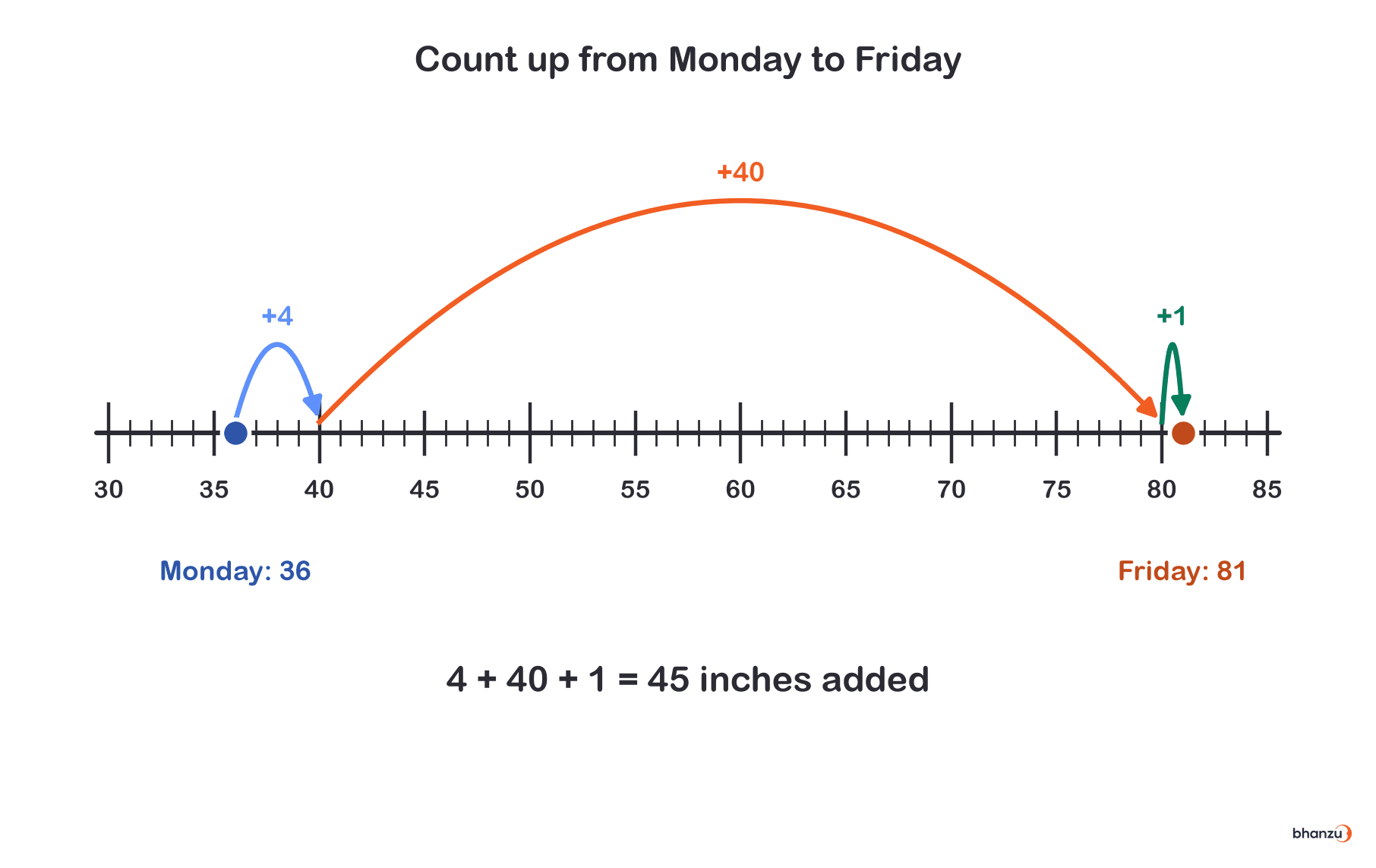
The class added 45 inches of chain.
Example 6
The relay path has 26 feet of grass, 18 feet of sand and 37 more feet of grass. The sack race path is 64 feet long. How much longer is the relay path?
Join the three parts, so add.
Compare the two paths, so subtract.
The relay path is 17 feet longer.
Why does adding and subtracting lengths matter?
Lengths add and subtract like counts, because every length is a row of equal units.
- It lets you plan before you cut. A gift needs 60 inches of ribbon and the roll has 48 inches, so you're 12 inches short.
- It shows how much you grew. Pencil marks on a door frame at 41 inches and 47 inches mean 6 inches of growing.
- It still counts in 4th grade. In the 2024 NAEP math assessment, 41 percent of US fourth graders chose the right length estimate for a bent path on a grid. Another 34 percent chose one that was too short.
A bent path is a join story with corners.
The mistakes kids make most often with length word problems
Mistake 1: Adding the two heights in a growing story
Where it slips in: Change stories with a "before" height and an "after" height.
Don't do this: A sunflower was 28 inches tall in June and 65 inches tall in August, so it grew inches.
The correct way: The growing is the gap between the heights. Count up 2, then 30, then 5, so inches.
The word "grew" sounds like adding, so a child who reads only that word adds both numbers. Growing 93 inches from 28 inches would make the sunflower 121 inches tall (taller than a basketball hoop), not 65.
Mistake 2: Starting the second piece back at 0
Where it slips in: Join stories drawn on a number line, such as a two-piece toy train track.
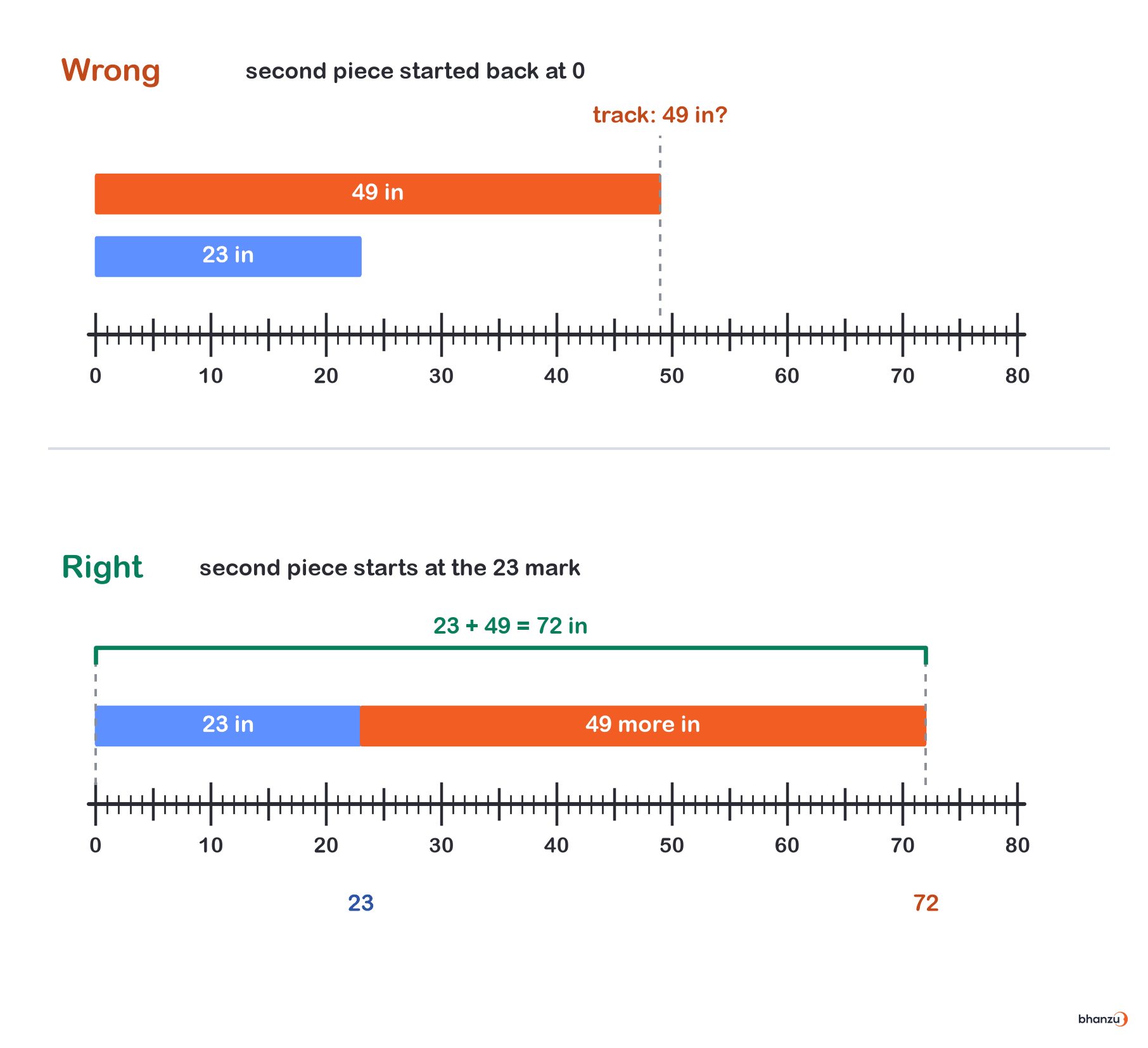
Don't do this: Maya's track is 23 inches long, and she snaps on 49 more inches. Both pieces get drawn from 0, so the track looks 49 inches long.
The correct way: Start the second piece at the 23 mark, where the first one stops. It ends at the 72 mark, and inches.
Most lengths a child has measured began at the end of the ruler, so the second piece goes back there too. A 2023 study of 32 first graders and 37 third graders found that children often said an object should start at one on a ruler. On paper, the giveaway is two bars stacked from 0.
What do most guides miss about length word problems?
Adding two lengths gives the whole only when the pieces sit end to end, with no gap and no overlap. Careful story problems say "end to end" for exactly this reason.
Two 30-inch paper strips taped with a 4-inch overlap make a 56-inch strip, because the overlap gets counted twice (once in each strip).
A gap works the other way. Two 20-inch chalk lines with a 5-inch gap between them reach 45 inches from end to end.
Key Takeaways
- Decide whether the question wants the whole length, one piece or the gap before you pick plus or minus.
- Keep every number in length word problems in one unit, and carry that unit into the answer.
- When a story cuts a piece off but asks about the length before the cut, add the pieces back together.
- On a number line, a second piece starts where the first one stops.
- For more practice turning stories into ruler drawings, explore Bhanzu's 2nd grade math curriculum or an elementary math tutor.
Read More
- Estimating Length
- Picture Graphs
- Two-Step Word Problems Within 100
- Measurement and Money Word Problems
- What Is Perimeter
- Math Word Problems
Research Behind This Article
- Common Core State Standards Initiative, Grade 2: Measurement and Data (2010). thecorestandards.org
- Common Core State Standards Initiative, Mathematics Glossary: Table 1, Common Addition and Subtraction Situations (2010). thecorestandards.org
- National Center for Education Statistics, NAEP Questions Tool: Estimate the Length of a Path in Context, 2024 Mathematics, Grade 4 (2025). nationsreportcard.gov
- Bofferding, Haiduc, Aqazade, Chen and Kocabas, Using Incorrect Worked Examples to Investigate the Consistency of First and Third Graders' Measurement Conceptions (2023). eric.ed.gov
- National Institute of Standards and Technology, SI Units: Length (2025). nist.gov
Quick Quiz: Check Yourself
Three levels, new numbers each time: join or cut, compare lengths or find what was added, then undo a cut or compare a three-part path.
Was this article helpful?
Your feedback helps us write better content
Frequently Asked Questions
How can I help my child with length word problems at home?
Do 2nd graders change feet into inches in word problems?
Does my child have to write the unit in every answer?
My child can add and subtract, so why are word problems involving length in 2nd grade hard?
Are length word problems the same as measurement word problems in 2nd grade?