What Are Two-Step Equations?
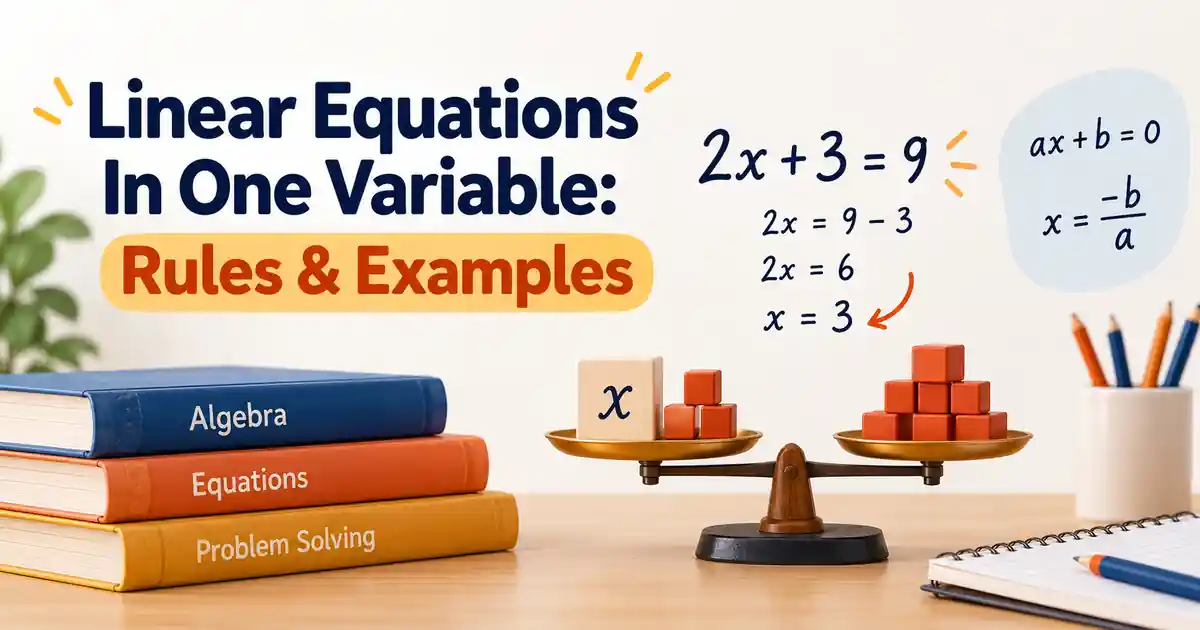
A two-step equation is a linear equation in one variable that requires two inverse operations to isolate the variable. Its standard shape is , where , , and are real numbers and .
The name is literal. A one-step equation like needs a single operation (subtract 7). A two-step equation stacks one more operation on top, so it needs two. Once you can clear two, three- and four-step equations are the same idea repeated — the linear equation family scales up from here.
The two operations are always inverse operations: addition undoes subtraction, multiplication undoes division. You apply each one to both sides of the equation at once, which keeps the two sides balanced — the same balance principle behind every equation you solve for x.
How Do You Solve a Two-Step Equation?
Two steps, in this order. The order is the whole game.
Undo the constant first. Add or subtract to move the lone number () off the variable side. This isolates the term .
Undo the coefficient second. Multiply or divide to strip the number attached to the variable (). This isolates .
Why undo addition before multiplication?
A real reader question, and worth answering head-on. When you build , the order of operations multiplies before it adds. To take the expression apart you run that order backwards — addition and subtraction come undone first, multiplication and division last. Solving is order of operations in reverse.
The constant-first order isn't a law of nature; it's the efficient choice. You can divide first, but you'd have to divide every term — including the constant — and you'd be dragging fractions through the whole problem for no reason. Undo the constant first and the arithmetic stays clean.
After both steps, substitute your answer back into the original equation. If both sides match, the solution is correct. This check is not optional padding — it catches the single most common error before it costs you anything.
Examples of Two-Step Equations
The six below move from clean integers to fractions, decimals, a negative coefficient, and a word problem. Watch the order hold across every one.
Example 1
Solve .
Undo the constant. Subtract 6 from both sides:
Undo the coefficient. Divide both sides by 2:
Final answer: . Check: . Correct.
Example 2
Solve , with a tempting shortcut shown first.
Wrong attempt. The 4 sits right next to the , so it feels natural to divide by 4 first: . But the left side is not — it is . Dividing only the term while leaving untouched changes the equation. The student who does this gets , which is wrong.
Why it breaks. Division has to hit every term: gives , and only now adding gives . It works, but you carried fractions the whole way for nothing.
The clean route. Undo the constant first. Add 1 to both sides:
Divide both sides by 4:
Final answer: . Same answer, no fractions. That is why the constant comes off first.
Example 3
Solve .
Here the variable is divided by 6, so the second step will multiply. Undo the constant first — add 7 to both sides:
Undo the division. Multiply both sides by 6:
Final answer: . Check: . Correct.
Example 4
Solve .
Subtract from both sides:
The coefficient is a fraction, so undo it by multiplying by its reciprocal, :
Final answer: . Multiplying by the reciprocal is how you "divide by a fraction" in one move.
Example 5
Solve .
A negative coefficient changes nothing about the order — only the arithmetic. Subtract 3 from both sides:
Divide both sides by :
Final answer: . Check: . Correct. (Dividing by a negative flips the sign of the answer; for inequalities it would also flip the relation symbol — a distinction worth filing away.)
Example 6
A phone plan charges a flat 0.20 per gigabyte. A month's bill was $23. How many gigabytes were used?
Let be the gigabytes used. The cost equation is:
This is a two-step equation in disguise. Undo the constant — subtract 15:
Undo the coefficient — divide by :
Final answer: 40 gigabytes. The translation from words to is the hard part; the solving is the routine two steps.
Why Two-Step Equations Show Up Everywhere
Almost every real formula that mixes a rate with a starting amount is a two-step equation waiting to be solved.
Money with a fixed fee. A taxi's "base fare plus per-mile rate," a phone plan's "monthly fee plus per-gigabyte charge" — both are the moment you know the total and want the usage.
Temperature and motion. Converting a known Celsius reading, or finding how long an object falls to reach a given speed, lands on the same two operations.
The gateway to multi-step algebra. Once two steps are automatic, equations with variables on both sides, with parentheses, or with three and four steps are just the same reverse-the-operations habit applied more times. This is the rung that makes the rest of the solving-equations ladder climbable.
The reason this form is taught early is that the world hands children "starting amount plus a rate times something" constantly — allowance plus chores, a savings balance plus weekly deposits, a game score plus points per level. The two-step equation is the first tool that turns those sentences into an answer.
Where Students Trip Up on Two-Step Equations
Mistake 1: Dividing by the coefficient before undoing the constant
Where it slips in: Solving , a student divides every term by as the first move.
Don't do this: Divide by the coefficient while the constant is still on the variable side — it forces fractions through the whole problem and, if you forget to divide the constant too, gives a wrong answer.
The correct way: Move the constant first (add or subtract), then divide. The arithmetic stays in whole numbers as long as possible.
Mistake 2: Adding or subtracting the wrong way across the equals sign
Where it slips in: Moving the constant, a student adds when they should subtract — treating "move it over" as a vague shove rather than a precise inverse operation.
Don't do this: Solve by adding 6 to the left (getting ) or by subtracting 6 from only one side.
The correct way: Apply the same operation to both sides. To clear , subtract 6 from each side; the equation stays balanced.
Mistake 3: Forgetting the negative sign on the coefficient
Where it slips in: Solving , a student divides by 5 instead of .
Don't do this: Drop the sign of the coefficient when you divide. divided by gives , which fails the check.
The correct way: Divide by the coefficient with its sign. divided by gives . The second-guesser who distrusts the negative answer should substitute it back — confirms it.
Key Takeaways
A two-step equation has the form and needs two inverse operations to solve.
Undo the constant first (add or subtract), then undo the coefficient (multiply or divide) — solving is order of operations run backwards.
Apply every operation to both sides to keep the equation balanced.
Keep the coefficient's sign when you divide; a dropped negative is a frequent wrong answer.
Always substitute your solution back into the original equation to confirm it.
Practice These Problems
Solve .
Solve .
Solve . (Mind the sign when you divide.)
A gym charges a 10 per month. After paying $85, how many months were covered? Set up and solve the two-step equation.
Answer to Question 1: . Answer to Question 2: . Answer to Question 3: . Answer to Question 4: , so months.
If Question 3 gave you , return to Mistake 3 above and divide by the full .
Want a live Bhanzu trainer to walk through more two-step equations with your child? Book a free demo class — online globally.
Was this article helpful?
Your feedback helps us write better content