Key Points
- In 2nd grade, comparing lengths asks how many inches or centimeters longer one object is, and that number is the difference.
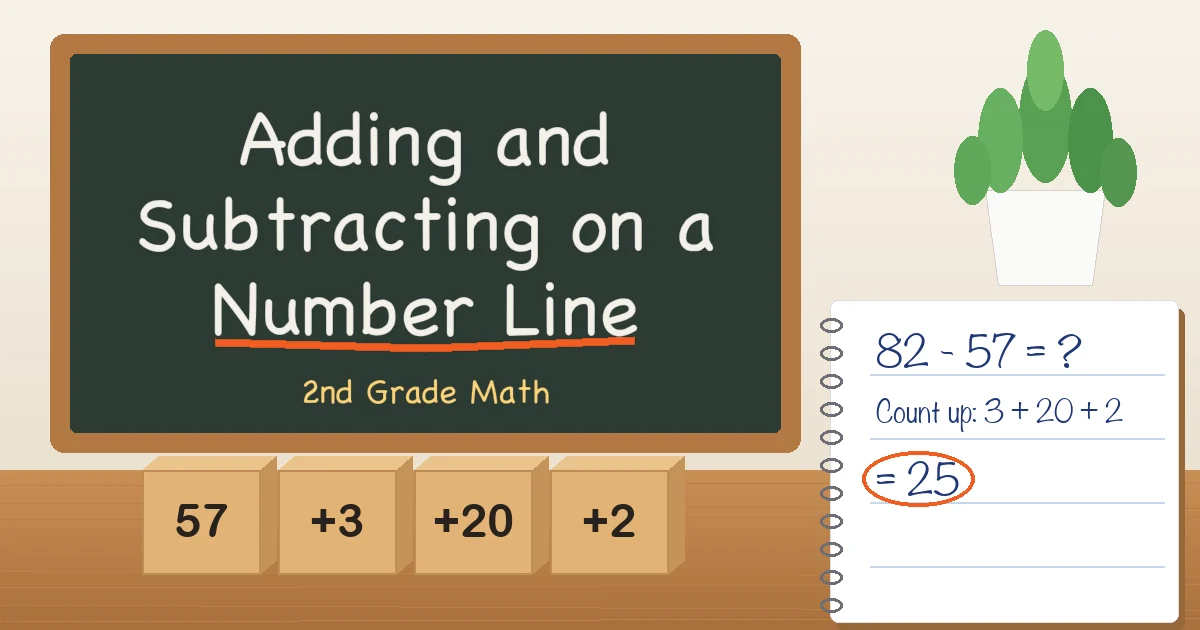
- Subtracting and counting up give the same difference, so matches counting up from 18 to 25.
- Ruler numbers count spaces, not marks, so an object lying from the 3 mark to the 9 mark is 6 units long.
The answer is the part sticking out
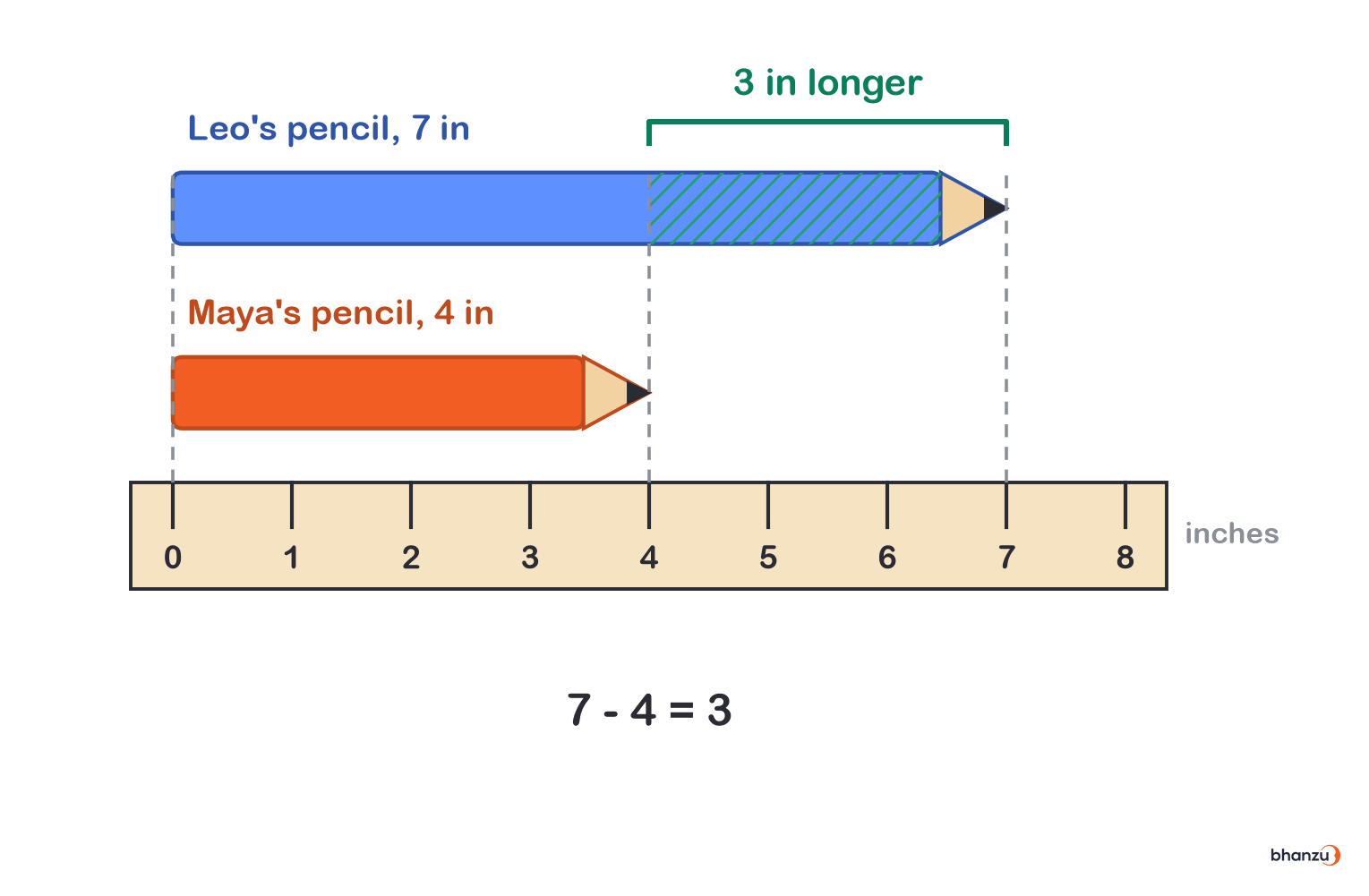
Lay two pencils side by side, and one pokes out past the other. Leo's pencil is 7 inches long. Maya's is 4 inches.
Line up their flat ends at the 0 on a ruler. Maya's pencil stops at the 4 and Leo's runs on to the 7, so the part sticking out is 3 inches. Soon you'll use this idea in story problems about ribbons and ropes.
How do you find how much longer something is?
Comparing lengths takes two moves, measuring both objects with a ruler in one unit and then taking the smaller number away from the bigger one.
- An object's length is how far it stretches from one end to the other.
- A standard unit is a size everyone agrees on, like an inch or a centimeter.
- The difference is how many units longer one object is.
This skill is Common Core standard 2.MD.A.4. Every measured length here is a whole number (half-inch rulers come in 3rd grade). By the end of 2nd grade, your child is expected to measure two objects, find how many inches or centimeters longer one is, and name the unit.
How do you measure two objects to compare them?
Measure both objects from the 0 mark, in one unit, before comparing.
- Pick one unit for both objects, inches or centimeters.
- Line up one end with the 0 mark (not the 1, and not the edge of the ruler).
- Read the number where the other end stops, and write it with its unit.
- Compare the numbers, as in comparing two-digit numbers, where 64 beats 37 because 6 tens beat 3 tens.
- Subtract the smaller length from the bigger one.
Lots of rulers have a blank strip before the 0. Pushing an object against that end gives a reading too short, since part of it sits before the 0.
Which is faster, counting up or subtracting?
Counting up and subtracting always land on the same difference. Counting up suits close lengths, and subtracting suits far-apart ones.
Maya's paper snake is 18 inches long and Leo's is 25 inches long. With counting on, start at 18, hop 2 to reach 20, then hop 5 more to reach 25.
Subtracting gets there in one line.
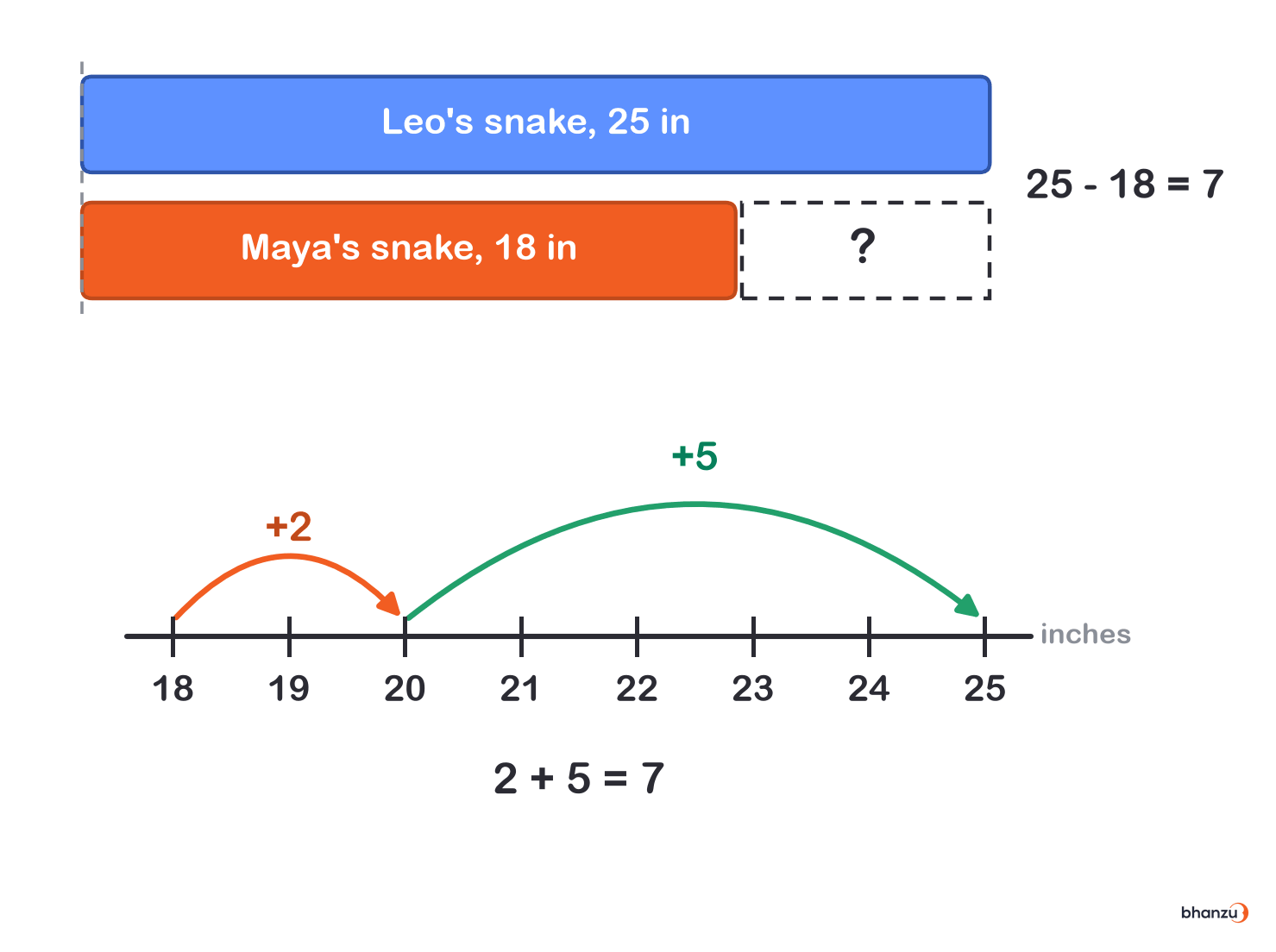
The two bars form a tape diagram, one bar per length. Asking how much shorter Maya's snake is gives the same 7 inches, since the difference between two lengths works both ways.
| Words in the problem | Math it means |
|---|---|
| how much longer | subtract the shorter length from the longer one, |
| how much shorter | the same subtraction, |
| longer than, shorter than | compare the numbers first, 25 is greater than 18 |
| difference | the answer to the subtraction, 7 inches |
Counting by ones gets slow past a gap of about 10. For 38 and 61, hop 2 to 40 and 21 more to 61, which makes 23, or use subtracting two-digit numbers with regrouping.
What if an object does not start at 0?
When an object starts past 0, subtract its start from its end, or count the spaces between. A crayon lies on a centimeter ruler from the 4 mark to the 11 mark.
The crayon is 7 centimeters long, and its 7 spaces agree.
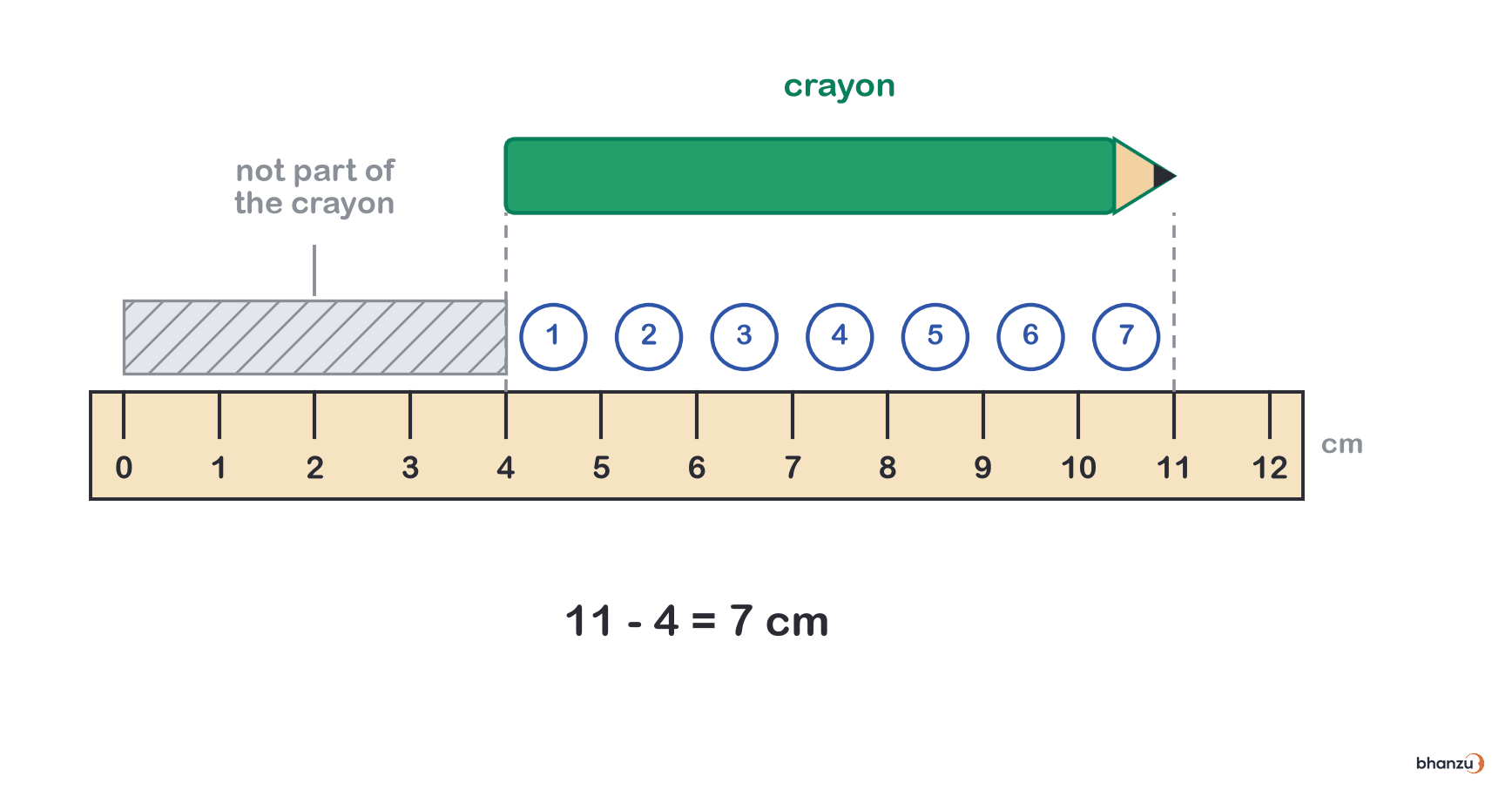
To read a ruler from the middle, treat it as a number line for length. The 11 means 11 spaces from 0, and the first 4 sit before the crayon starts. The jumps from adding and subtracting on a number line work here too.
A child who reads only the far end will call that crayon 11 centimeters. A 2015 study of kindergartners and 2nd graders found that 2nd graders measured well when a crayon lined up with the start of the ruler. Once the crayon was shifted, their answers were no better than guessing.
Try It Yourself
Slide the ribbon and the pencil along the ruler, and drag an end to stretch either one. Watch the readout subtract each start from each end, then press Line up at 0 to see the extra piece. Switch to centimeters and compare two new lengths.
Why does subtracting find how much longer?
The longer object holds a piece as long as the shorter one, plus an extra piece. Subtracting removes the matching piece.
- It needs one unit. The US standards agency, NIST, dates the modern inch to July 1, 1959, when became exact. So 5 inches is longer than 11 centimeters, even though 5 is smaller.
- It works anywhere on the ruler. End minus start gives the length (even on a ruler with its end snapped off).
- It checks itself. The shorter length plus the difference gives back the longer one, as shows.
A 26-inch box is too wide for a 24-inch gap under a bed, by inches. Later, the same end minus start move finds how much time passes between two times on a clock.
Examples of comparing lengths
Example 1
A green crayon is 9 centimeters long and a blue one is 6 centimeters long. How much longer is the green crayon?
Subtract the shorter length.
So the green crayon is 3 centimeters longer than the blue one.
Example 2
A ribbon lies on an inch ruler from the 3 mark to the 9 mark. A straw lies from 0 to the 7 mark. Which is longer, and by how much?
Reading the end numbers, 9 and 7, makes the ribbon look 2 inches longer.
That cannot be right, because the ribbon starts at 3 and the 9 counts spaces from 0.
So the ribbon is 6 inches, and the straw is 7.
The straw is longer, by 1 inch.
Example 3
A scarf is 64 centimeters long and a ribbon is 37 centimeters long. How much shorter is the ribbon?
Count up from 37, which is 3 to reach 40 and 24 more to 64.
The ribbon is 27 centimeters shorter.
Example 4
Aisha's three ribbons are 46, 29 and 38 centimeters long. How much longer is the longest than the shortest?
The longest is 46 and the shortest is 29, so skip the 38.
The longest is 17 centimeters longer.
Example 5
On a meter stick, a toy train runs from the 12 mark to the 47 mark. A toy bus runs from the 20 mark to the 41 mark. Which is longer, and by how much?
Subtract each start from its end, then compare.
The train is longer, by 14 centimeters.
The pattern hiding inside comparing lengths
Slide two objects along a ruler by the same amount, and their difference stays the same. The crayons from Example 1, slid to start at 2, run from 2 to 11 and from 2 to 8.
Both sides equal 3, so end minus start works anywhere on a ruler. The same slide is a mental subtraction move: add 2 to both numbers, and 38 becomes a round 40.
Building a paper ruler square by square makes the spaces visible.
In a 2025 study in Spain, 19 children aged 5 and 6 built a paper ruler one unit at a time. A week later, the share who answered correctly on an object not starting at 0 had risen from 10.5% to 89.5%. The 17 children taught the usual way went from 0% to 5.9%.
Comparing lengths: where intuition breaks
Mistake 1: Counting the marks instead of the spaces
Where it slips in: Objects that do not start at 0, as in Examples 2 and 5. A child taps each line and says "one" at the starting mark, before any inch has gone by.
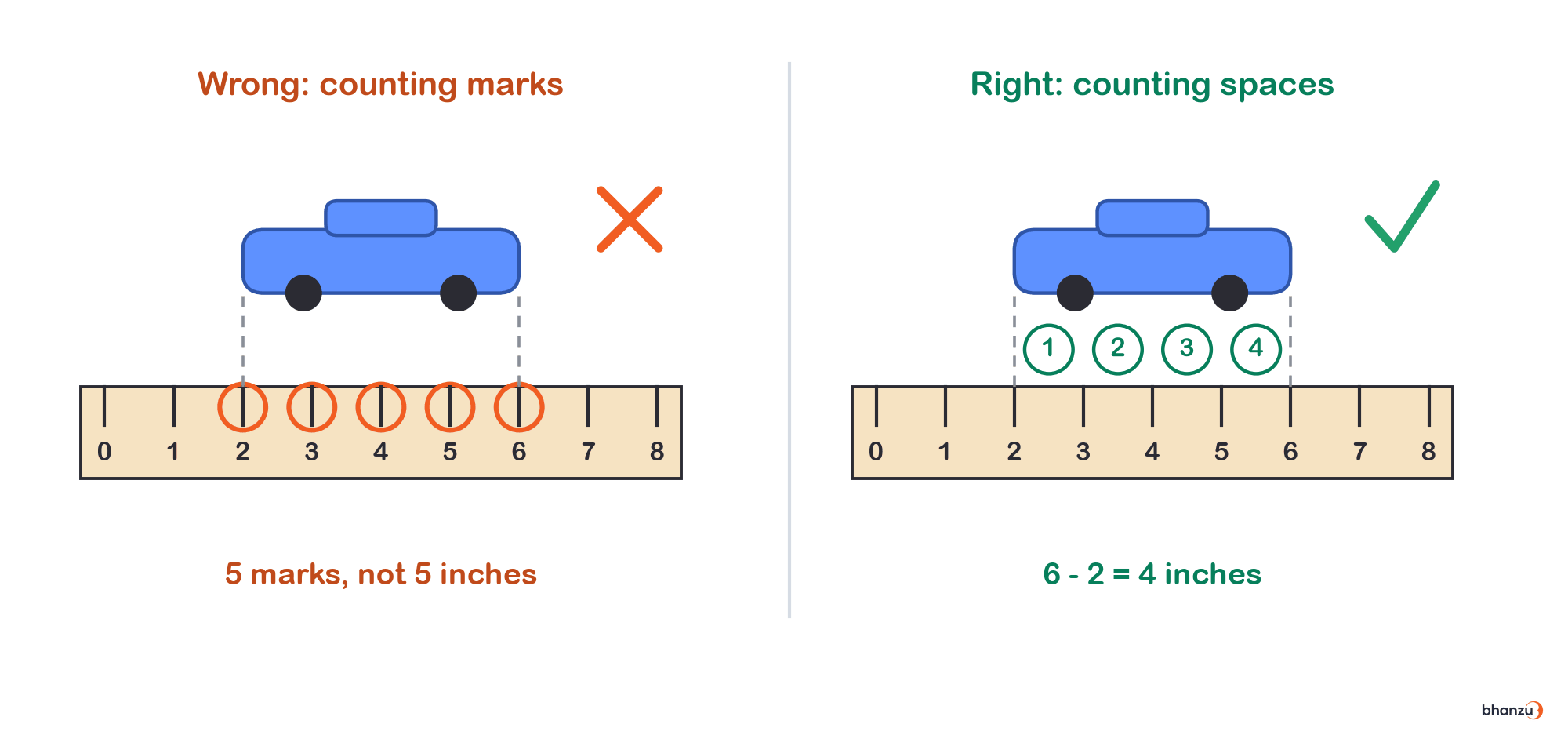
Don't do this: A toy car runs from the 2 mark to the 6 mark. Counting the marks 2, 3, 4, 5 and 6 gives 5 inches.
The correct way: Count the spaces between the marks. There are 4, and agrees, so the car is 4 inches long.
Counting marks always comes out one too big: the starting mark is not an inch. In the 2015 ruler study, 2nd graders picked that answer 52% of the time on one shifted problem.
Mistake 2: Comparing numbers in two different units
Where it slips in: One length in inches and one in centimeters. The big numbers catch the eye, and the small unit labels do not.
Don't do this: Leo's pencil is 5 inches and Maya's crayon is 11 centimeters, so the crayon is called 6 longer.
The correct way: Measure both in centimeters. The pencil reaches about 13 centimeters, so the pencil is longer, by about 2 centimeters.
Mistake 3: Adding because the question says "longer"
Where it slips in: Story problems that ask how much longer. The word "longer" is genuinely confusing, because it sounds like more, and more sounds like adding.
Don't do this: A green rope is 14 inches and a red rope is 9 inches, so inches.
The correct way: Subtract, , so the green rope is 5 inches longer. A 23-inch difference would be longer than either rope.
Key Takeaways
- Check where an object starts before you read where it ends.
- Comparing lengths only works when both lengths share one unit.
- A difference is always smaller than the longer length, so 23 inches for ropes of 14 and 9 inches is wrong.
- For more practice checking where an object starts on the ruler and counting the spaces, explore Bhanzu's 2nd grade math curriculum or elementary math tutor.
Read More
- Estimating Length
- Length Word Problems
- Measurement and Money Word Problems
- What Is a Unit in Math
- What Is Difference in Math
Research Behind This Article
- Common Core State Standards Initiative, Grade 2: Measurement and Data (2010). thecorestandards.org
- OpenStax, Prealgebra 2e: Systems of Measurement (2020). openstax.org
- Tracy L. Solomon and colleagues, Minding the Gap: Children's Difficulty Conceptualizing Spatial Intervals as Linear Measurement Units (2015). eric.ed.gov
- National Institute of Standards and Technology, SI Units: Length (2025). nist.gov
- Ariadna Gómezescobar, Ruler by Steps (RbySteps): Exploring Length Measurement with Young Children Through a Sequential Ruler Construction (2025). doi.org
Quick Quiz: Check Yourself
Three levels, new numbers every time: find how much longer, measure objects that start past 0, then solve two-digit and three-object problems.
Was this article helpful?
Your feedback helps us write better content
Frequently Asked Questions
Is a centimeter bigger than an inch?
What measurement does a 2nd grader learn?
What are good measurement activities for 2nd graders?
Should my child write the unit in every step?
How can my child practice with a broken ruler?