Key Points
- To find what percent one number is of another, write the part over the whole and scale it to hundredths, so 18 out of 24 becomes 75 out of 100.
- Dividing the part by the whole and multiplying by 100 works for any nonzero whole, even 3, where 2 out of 3 is .
- A frequent mistake is dividing the whole by the part, which turns 9 out of 36 into 400% instead of the correct 25%.
Two quiz scores, one fair comparison
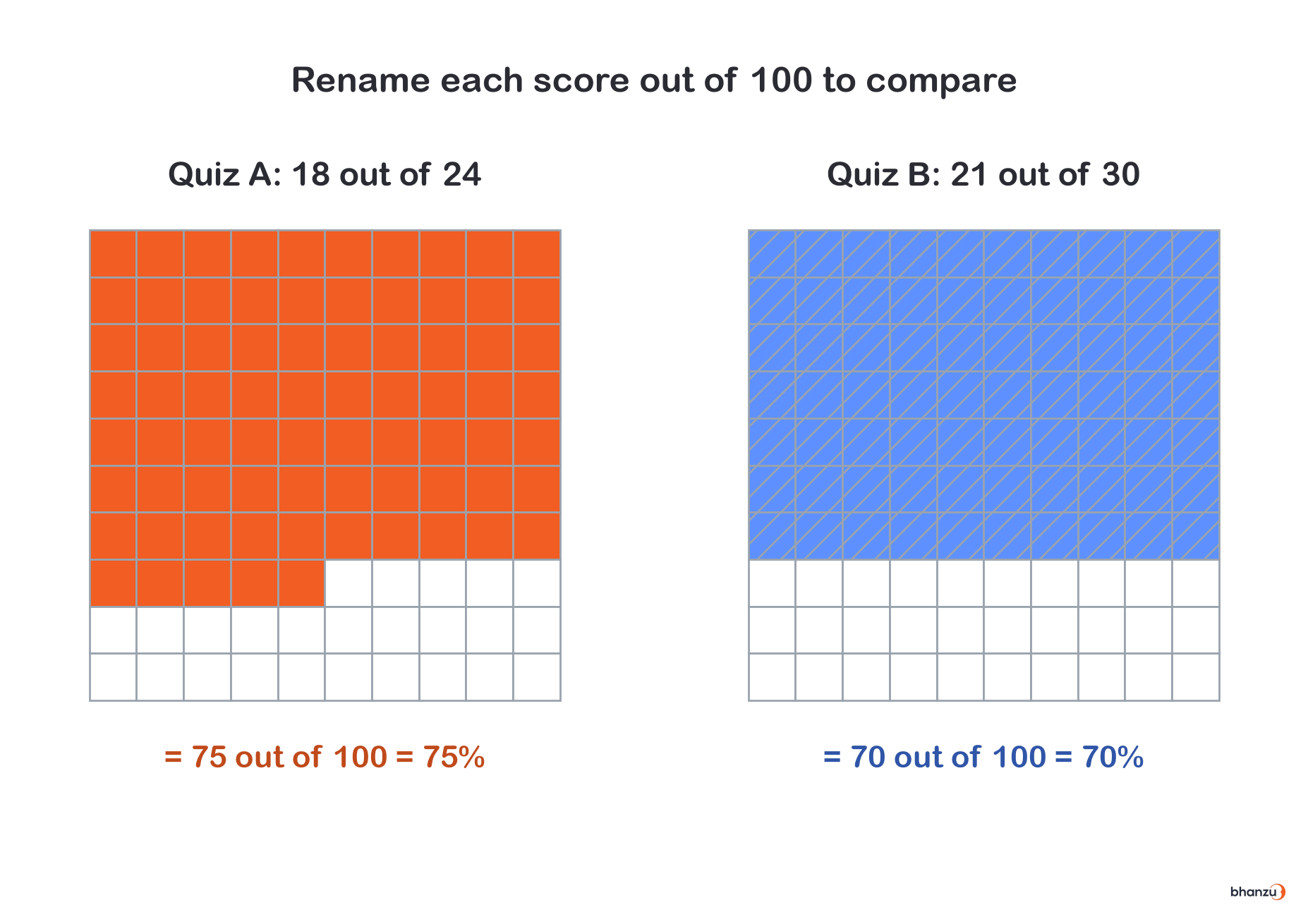
Maya scored 21 on one quiz and only 18 on another, yet the 18 is better. The first quiz had 24 questions and the second had 30, so the raw points sit on different scales. Rename both out of 100, and 18 out of 24 matches 75 out of 100 while 21 out of 30 matches 70 out of 100. Seventy-five wins.
Food companies print that out-of-100 share on every Nutrition Facts label. Basketball statisticians use it to compare a player who took 40 shots with one who took 400, and astronomers use it to size up a moon next to its planet.
How do you find what percent one number is of another?
To find what percent one number is of another, put the part over the whole and rename that fraction as hundredths, since a percent is a number out of 100. The part is the amount the question asks about, and the whole is the amount you compare it with. On a 10 by 10 grid, 45% is 45 of the 100 squares shaded. In the 2024 NAEP mathematics results, 39 percent of fourth graders scored at or above Proficient, meaning 39 out of every 100.
Here is the method for a player who made 13 free throws and missed 7.
- Find the whole. Add the two groups, 13 + 7 = 20 shots.
- Write the part over the whole, , which also means (the idea behind fractions as division).
- Rename it out of 100 by multiplying both numbers by 5, which gives .
- Write 65% and check the size. 13 is a bit more than half of 20, and so is 65%.
In 6th grade, your child is expected to treat a percent as a rate per 100 (Common Core standard 6.RP.A.3.c) and to reason with ratio tables, tape diagrams and double number lines.
How does a fraction become a percent?
Scale the fraction until its whole is 100, doing the same thing to the part at every step. A ratio table tracks the scaling, because each column holds an equivalent part to whole ratio. For Maya's 18 out of 24, divide both numbers by 6 to get 3 out of 4, then multiply both by 25 to get 75 out of 100.
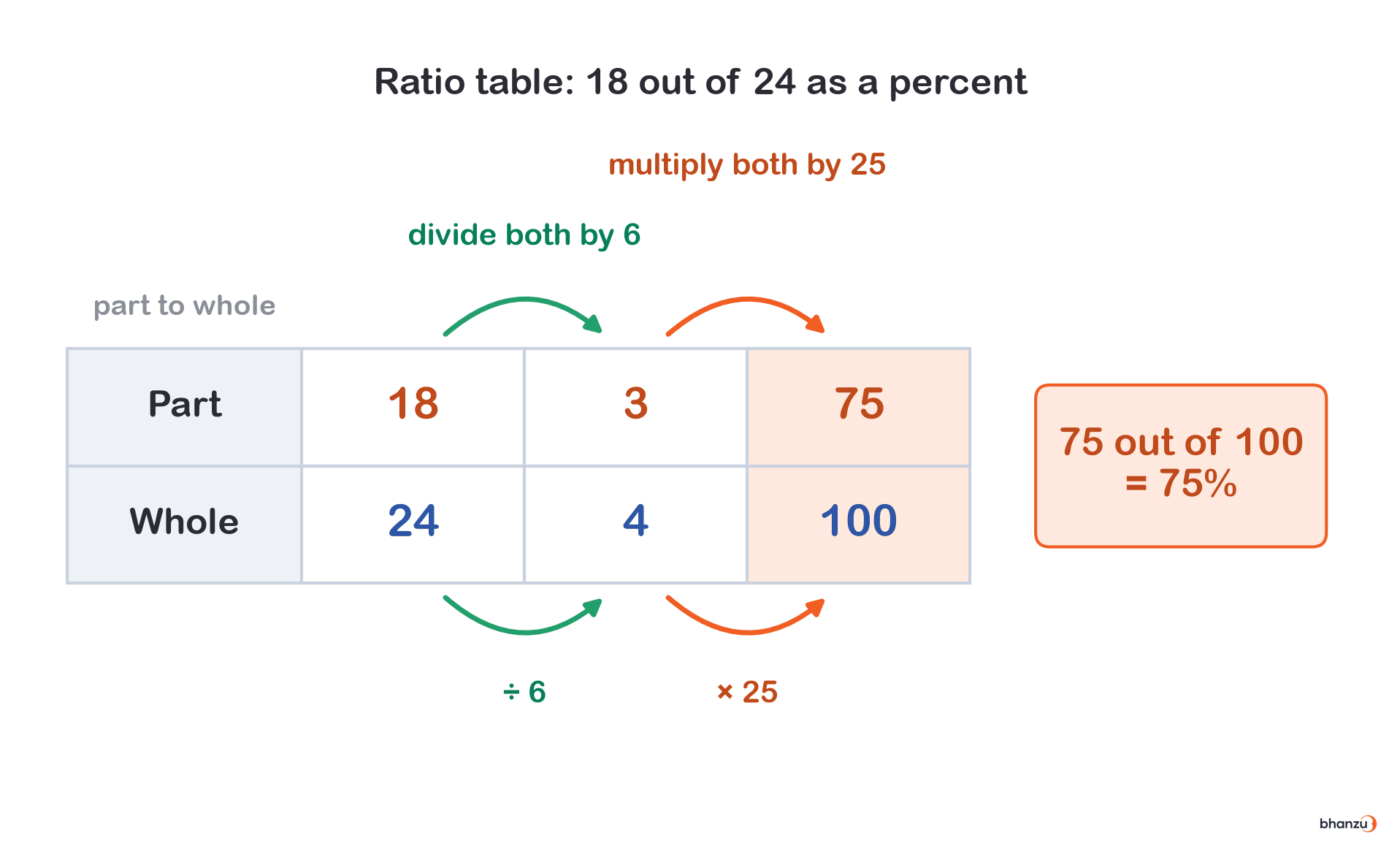
Scaling is quick when the simplest fraction's bottom number divides 100 (1, 2, 4, 5, 10, 20, 25, 50 or 100), so becomes in one step. When it doesn't, as with , no whole number scales it to 100, so divide the part by the whole and multiply by 100. Children who hear "make the bottom 100" often try adding instead, because adding looks like the shortest road there. The habit that holds up is multiplying the part by whatever multiplied the whole.
With standing for the percent number, the method becomes one formula.
| Symbol | Meaning | Units |
|---|---|---|
| The percent number, the amount out of 100 | Read with a % sign | |
| part | The amount the question asks about | Same unit as the whole |
| whole | The amount you compare the part with | Any count or measure |
Part divided by whole gives the share for each 1 of the whole, and multiplying by 100 gives the share for each 100, which is what the % sign means. For Maya, is her score per point possible, and is her score per 100 points, so 75%.
OpenStax's Prealgebra 2e writes the same idea as a percent proportion, where the amount over the base equals the percent over 100. With part for amount and whole for base, , so gives . Here is the percent number, and is that amount as a fraction. To check, run it backward with finding the percent of a number, since 75% of 24 is .
One number as a percentage of another on a double number line
A double number line shows a percent as two scales sharing tick marks, amounts on top and percents below. Reading one number as a percentage of another takes five moves.
- Draw two lines that start together at 0.
- Write the whole on the top line, above 100%.
- Split both lines into 10 equal jumps, so each jump is worth 10% below and the whole divided by 10 above.
- Find the part on the top line.
- Read straight down.
With a whole of 40, each top jump is . The part 14 sits halfway between 12 (30%) and 16 (40%), so it lines up with 35%.
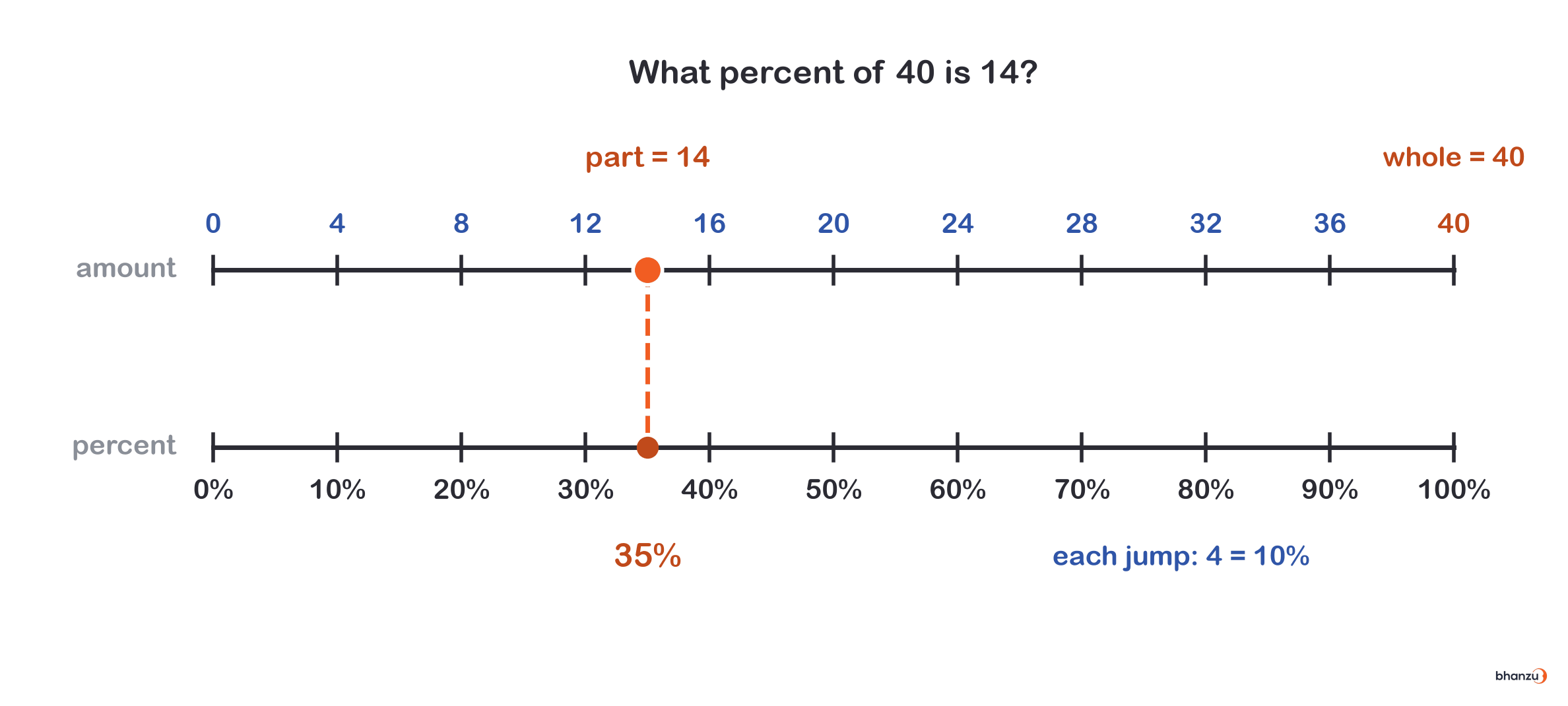
Even between ticks, the line tells you the answer lies between 30% and 40% before you divide anything. It gets slow with an awkward whole. A whole of 7 makes every jump 0.7, so divide instead.
Try It Yourself
Drag the orange dot along the top line to pick the part, and tap the arrows to change the whole. The table under the lines rescales your two numbers to an amount out of 100 and shows the percent. Push the part past the whole and watch the percent climb above 100%.
What if the answer is bigger than 100% or never ends?
Both happen, and both answers are correct. A part bigger than the whole gives more than 100%, because it holds more than one full whole. A class with a food drive goal of 36 cans that collects 45 has reached this share of its goal.
That is 125% of the goal. A child who has only seen quiz scores sometimes erases a correct 125%, sure that percents stop at 100. They stop there only when the part is a piece of the whole (in 7th grade, Common Core standard 7.RP.A.3 uses the same idea for percent increase and decrease).
The other surprise is a decimal that never stops. Two out of 3 starts like this.
Multiplying by 100 gives . Write it exactly as , or round to about 66.7% at the last step. In 8th grade you'll turn repeating decimals like this one back into fractions.
| Part to whole | Simplest fraction | Decimal | Percent |
|---|---|---|---|
| 9 out of 20 | |||
| 18 out of 24 | |||
| 2 out of 3 | |||
| 45 out of 36 |
Examples of what percent one number is of another
Example 1
What percent of 20 is 9?
The whole is 20, and , so multiply the part by 5 too.
So 9 is 45% of 20.
Example 2
What percent of 40 is 16?
The tempting move is to reach 100 by adding. Since , add 60 to the part as well.
That says 76%, and it can't be right. 16 is less than half of 40, so the answer must be under 50%, and 76% of 40 is , not 16. Adding kept the gap the same (24 in both fractions), but a percent must keep the share the same, and only multiplying or dividing does that.
Divide both numbers by 8, then multiply both by 20.
So 16 is 40% of 40, and confirms it.
Example 3
On a double number line, the amounts 0 to 60 sit above 0% to 100%. What percent lines up with 39?
Each of the 10 jumps is , worth 10%.
Six jumps reach 36, which lines up with 60%. The extra 3 is half a jump, worth 5%.
So 39 is 65% of 60.
Example 4
Is 42 more or less than all of 35? Then find what percent of 35 is 42.
42 is more than the whole, so the answer is above 100%.
So 42 is 120% of 35.
Example 5
Leo's soccer team won 5 of its 6 games. What percent of its games did the team win?
Six does not divide 100, so divide and multiply by 100.
The 3s never stop, so the team won exactly of its games, or about 83.3%.
Example 6
Aisha's drink has 12 grams of added sugars and her snack bar has 8. What percent of the 50 gram Daily Value for added sugars do the two give together?
Add the two amounts to get the part.
The whole is the 50 gram Daily Value. Multiply both numbers by 2.
Together they give 40% of the Daily Value.
Where a part-to-whole percent shows up in real life
Percents exist because wholes come in every size, and renaming each part out of 100 puts them all on one shared scale.
- It lets you compare different wholes. Maya's two quizzes can't be ranked by raw points, but 75% and 70% can.
- It turns a label into a judgment. The FDA's Daily Value guide (current as of 2024) sets 28 grams of dietary fiber and 2,300 milligrams of sodium as Daily Values, so a serving with 7 grams of fiber gives 25%, while one with 230 milligrams of sodium gives 10%.
- It gives everyone the same yardstick. The FDA counts 5% DV or less per serving as low and 20% DV or more as high, so that 25% serving is high in fiber.
- It makes huge sizes easy to picture. NASA's Earth facts page, updated in December 2025, lists Earth's equatorial diameter as 7,926 miles and the Moon's radius as 1,080 miles, so the Moon is 2,160 miles across and about 27% as wide as Earth.
Every one of those numbers came from the same move, part over whole, renamed out of 100.
What most guides get wrong about spotting the whole
Two shortcuts for spotting the whole are popular. Pick the bigger number, or pick the number right after "of". Both break on ordinary 6th grade problems.
- "Mei's team won 11 games and lost 9. What percent of its games did it win?" No number follows "of", and the whole, 20 games, is never printed, so add first to get , or 55%.
- "Diego read 18 books this year and 12 last year. This year's count is what percent of last year's?" The whole is 12, the smaller number, so , or 150%.
A better habit is to ask "compared with what?" before dividing, because the answer is the whole. Children who learned "is over of" as a rule often stall on a question like that one about games, because no number sits next to either clue word.
| Words in the problem | Math it means |
|---|---|
| "out of 24" | 24 is the whole, so divide by it |
| "what percent of 40" | 40 is the whole |
| "what percent of last year's" | last year's 12 books are the whole |
| "12 boys and 18 girls" | add the groups, 12 + 18 = 30 |
Once spotting the whole feels solid, the reverse question is next, finding the whole from a percent.
Where students trip up on what percent problems
Mistake 1: Dividing the whole by the part
Where it slips in: Questions where the part is much smaller than the whole. Years of division facts trained children to put the bigger number first.
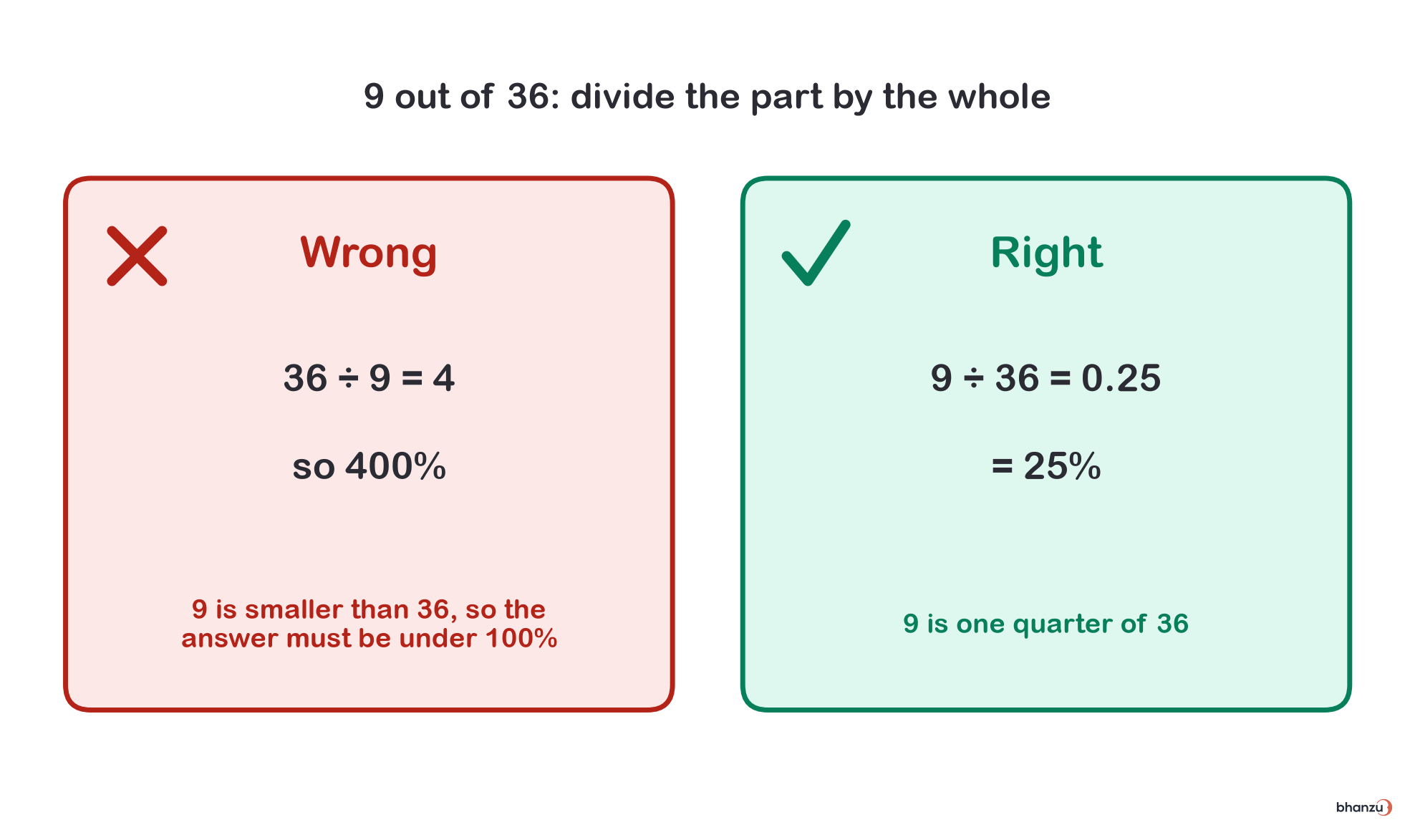
Don't do this: Work out 9 as a percent of 36 with and write 400%.
The correct way: Divide the part by the whole, , so the answer is 25%. A part smaller than the whole must give under 100%, and 9 is one quarter of 36.
Mistake 2: Stopping at the decimal
Where it slips in: Right after dividing on a calculator. A child who sees 0.65 on the screen often adds a % sign and stops, because the number looks finished.
Don't do this: Work out 26 out of 40 as and write 0.65%.
The correct way: Read 0.65 as 65 hundredths, then multiply by 100, so 26 out of 40 is 65%.
The gap between 0.65 and 0.65% confuses adults too. The decimal 0.65 is 65 hundredths, while 0.65% is 65 ten-thousandths, less than 1 out of every 100.
Mistake 3: Using one part as the whole
Where it slips in: Stories with two groups and no printed total. The whole never appears as a number, so children grab the other number they can see.
Don't do this: For 12 boys and 18 girls, find the percent of girls as and write 150%.
The correct way: Add the groups first, 12 + 18 = 30, then divide, , so 60% are girls. Girls are more than half the group, and so is 60%.
Key Takeaways
- Ask "compared with what?" before you divide, because that answer is the whole on the bottom.
- Scale both numbers when the simplest fraction's bottom number divides 100, and otherwise divide, then multiply by 100.
- A part bigger than the whole gives more than 100%, and a never-ending answer can stay as .
- Size-check every answer for what percent one number is of another before you write the % sign.
- For more practice with what percent problems, especially catching the 400% that comes from dividing 36 by 9, explore Bhanzu's 6th grade math curriculum or a middle school math tutor.
Read More
- Part-Part-Whole Ratio Problems
- Equivalent Ratios
- Fractions, Decimals and Percentages
- Equivalent Fractions by Multiplying
- Dividing Whole Numbers to Get a Decimal
- Simple Interest
Research Behind This Article
- National Center for Education Statistics, NAEP Mathematics: Mathematics Results, 2024 (2025). nationsreportcard.gov
- Common Core State Standards Initiative, Grade 6 Ratios and Proportional Relationships (2010). thecorestandards.org
- OpenStax, Prealgebra 2e, 6.5 Solve Proportions and their Applications (2020). openstax.org
- Common Core State Standards Initiative, Grade 7 Ratios and Proportional Relationships (2010). thecorestandards.org
- US Food and Drug Administration, Daily Value on the Nutrition and Supplement Facts Labels (2024). fda.gov
- NASA Science, Facts About Earth (2025). science.nasa.gov
Quick Quiz: Check Yourself
Three levels, new numbers every time: find the percent when the whole divides 100, then when it doesn't (including answers above 100%), then solve a word problem where you add two amounts before you divide.
Was this article helpful?
Your feedback helps us write better content
Frequently Asked Questions
What percent is 16 out of 20?
Is a ratio the same as a percentage?
How do you calculate the percentage difference between two numbers?
How do I teach percentages to my 6th grader?
How can I help my child with percentage word problems in 6th grade?