Key Points
- Fractions as division means a fraction such as is the answer to , the share each of 5 people gets from 3 equal wholes.
- To share fairly, cut every whole into as many equal pieces as there are people, and each person takes one piece from every whole.
- A frequent mistake puts the number of people on top, and multiplying the share by the number of people exposes it.
- With more wholes than people, the remainder stays over the same bottom number, so equals .
A bread puzzle from ancient Egypt
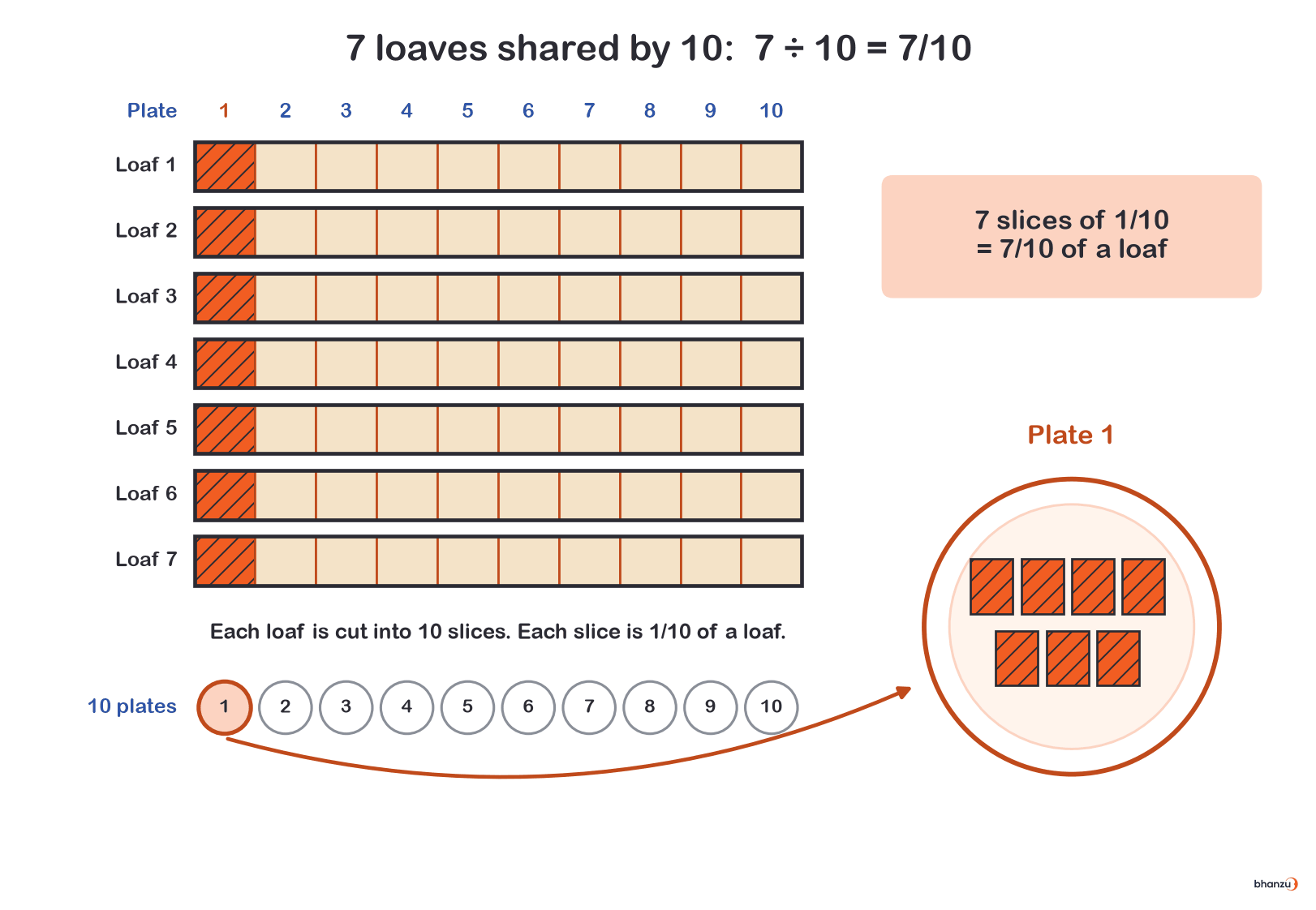
About 3,700 years ago, a scribe in Egypt copied out how to share 7 loaves among 10 men. The scroll is the Rhind papyrus, written around 1650 BC by a scribe named Ahmes, and 81 of its 87 problems use fractions. Its first six problems all share loaves among 10 men.
Seven loaves and ten people means nobody gets a whole loaf. The sharing still works. Cut every loaf into 10 equal slices, and each person collects one slice from each loaf, 7 slices in all, or seven tenths of a loaf.
Next year you'll use the same idea to write ratios as fractions and to divide one fraction by another.
What does fractions as division mean?
Fractions as division means the fraction bar, the line in a fraction, works as a division sign. So is one person's share when equal wholes are split among people. The top number, the numerator, counts the wholes. The bottom number, the denominator, counts the people.
| Symbol | Meaning | Units |
|---|---|---|
| numerator, the equal wholes being shared | wholes | |
| denominator, the people sharing | people | |
| one fair share | wholes per person |
The rule works because each whole gives every person one piece, and of those pieces make . The order is always numerator divided by denominator, so means , never .
One name causes honest confusion, because some classrooms also call a strip model a "fraction bar." Here the drawings are strips and the fraction bar is only the line.
The numbers in also carry the names dividend, divisor, quotient and remainder.
- Dividend. The amount being shared, .
- Divisor. How many share it, .
- Quotient. One share.
- Remainder. Anything left when sharing stops at whole numbers.
In 3rd grade, division facts such as came out even. For parents, 5th grade lets the answer be a fraction, and Common Core standard 5.NF.B.3 asks your child to interpret fractions as division and solve sharing word problems with fraction or mixed-number answers.
How do you share wholes to find a fraction?
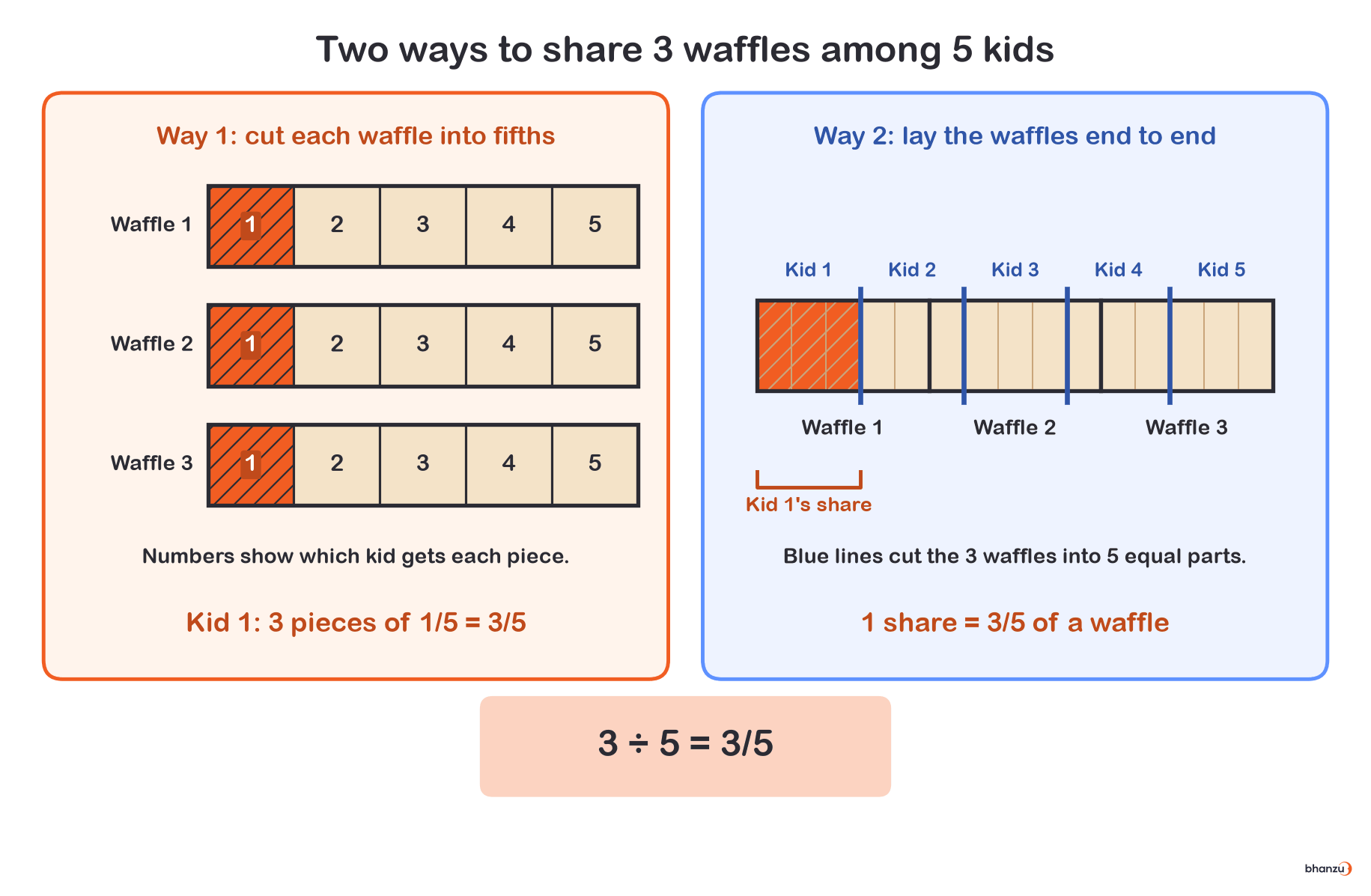
Cut every whole into as many equal pieces as there are people, then give each person one piece from every whole. Take 3 waffles shared equally by 5 kids.
- Cut each waffle into 5 equal pieces, called fifths, for 15 pieces in all.
- Give each kid one piece from each waffle, so every kid gets 3 pieces.
- Name the share. One piece is , a unit fraction (1 on top), so 3 pieces make of a waffle.
A second picture agrees. Lay the 3 waffles end to end as one strip and cut it into 5 equal parts, and one part covers 3 fifths of a waffle.
With fewer wholes than people, every share is less than 1 whole. That is a fast first check.
Fractions as division word problems hide the top and bottom numbers inside everyday words.
| Words in the problem | Math it means |
|---|---|
| "2 pizzas" (what is shared) | the top number, 2 |
| "shared equally by 5 friends" | divide by 5, the bottom number |
| "shared by 6, each gets 5/6 of a pan. How many pans?" | |
| "4 bags of 5 pounds each" | multiply first, |
| "between what two whole numbers?" | the whole-number part and the next one |
Try It Yourself
Choose how many wholes and how many people, then tap pieces to shade what one person should get. Press Check to see if your share matches the division, or Show me to watch one piece from every whole go to the same person. Add more wholes than people to see the share as a mixed number or a whole number.
What happens when there are more wholes than people?
Each person gets more than 1 whole, so the share starts as an improper fraction, with the top number at least as big as the bottom (unlike a proper fraction such as ). You then rewrite it as a mixed number, a whole number plus a fraction. Cut 11 feet of ribbon into 4 equal pieces, and each piece is feet long.
How to write a remainder as a fraction
- Divide with whole numbers. , so each piece gets 2 whole feet, with 3 feet left over.
- Share the remainder. The 3 leftover feet are still shared by 4, so each piece gets of a foot more.
- Write the mixed number, feet, which sits between 2 and 3 on a number line.
- Check by multiplying a fraction by a whole number. feet, the full ribbon.
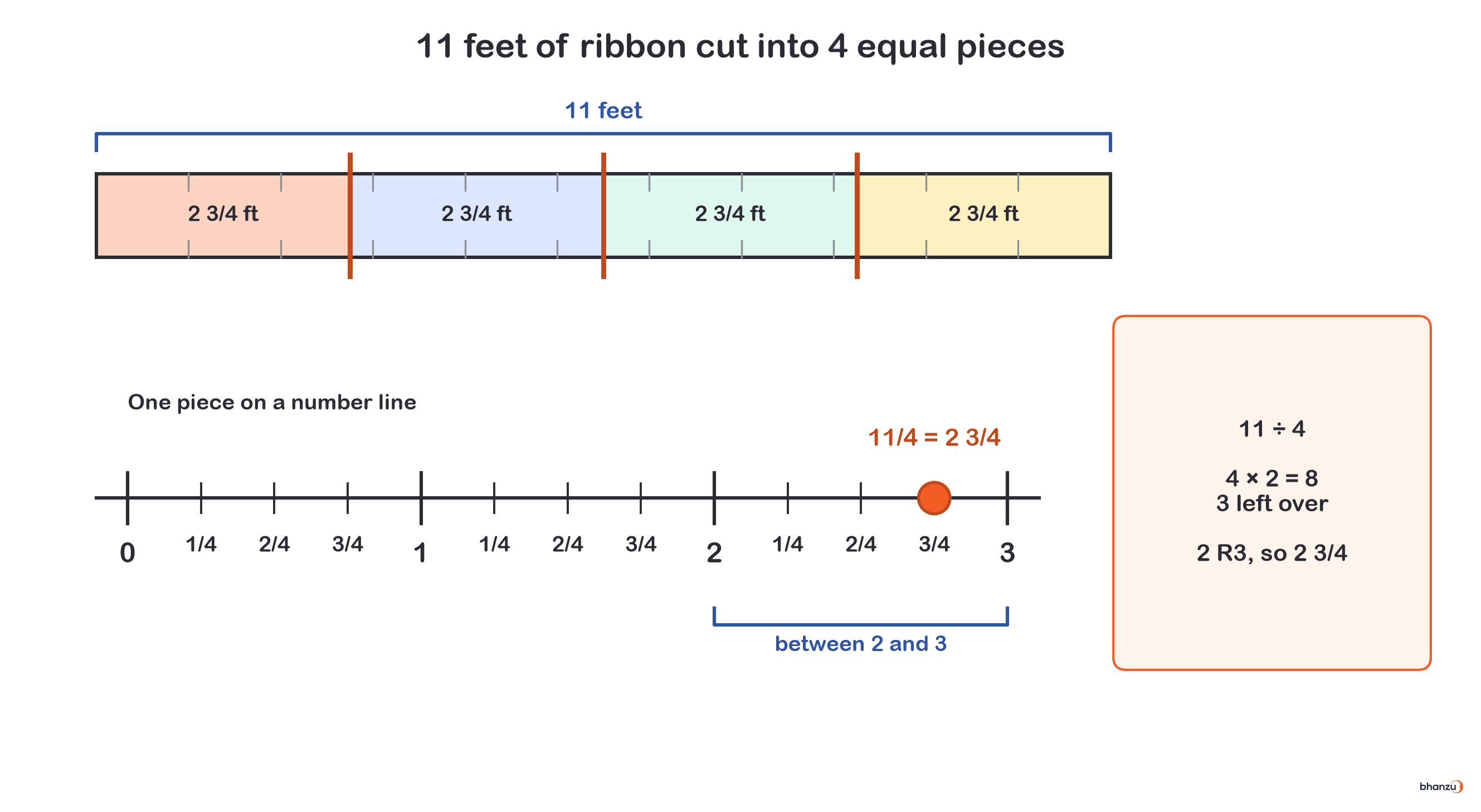
The remainder in step 1 is the one long division leaves. A child who rushes often stops at "2 R3" even when the story asks how long each piece is, but 5th grade finishes the sharing.
Drawing gets slow with bigger numbers (47 wholes cut into sixths is 282 pieces), so then you skip the picture and divide.
Examples of fractions as division
Example 1
Write as a fraction.
The 4 wholes are shared, so 4 goes on top.
Example 2
Five friends share 2 pizzas equally. How much pizza does each friend get?
A tempting first move puts the bigger number first, pizzas each.
That cannot be right. Five friends with pizzas each would eat pizzas, and there are only 2. The pizzas are what gets shared, so 2 goes on top.
Each friend gets of a pizza.
Example 3
What division does show, and between which two whole numbers is it?
Since , the quotient is 3 with a remainder of 1.
It lies between 3 and 4.
Example 4
Divide 17 by 5 and write the answer as a mixed number.
Since , the remainder is 2, and it stays over 5.
Example 5
Some pans of cornbread are shared equally by 6 students, and each student gets of a pan. How many pans were there?
The box stands for the number of pans.
Multiply by 6 to undo dividing by 6.
There were 5 pans of cornbread.
Example 6
Four bags of trail mix weigh 5 pounds each, and 7 hikers share all of it equally. How many pounds does each hiker get, and between which two whole numbers is it?
Find the total first.
Since with 6 left over, each hiker gets pounds, between 2 and 3.
Why does sharing turn into a fraction?
Sharing is division, and when the wholes run out before everyone has one, the only fair finish is to cut what is left. A fraction names the size of each cut share.
- It finishes the sharing. Whole numbers leave at 3 R1, while cutting the last whole into fourths gives everyone .
- It has a long history. The Rhind papyrus opens with six loaf-sharing problems, so fair sharing sits at the start of one of the oldest known math books.
- It predicts later math. A 2012 study in Psychological Science used large US and UK data sets that followed students for years. Elementary students' knowledge of fractions and of division predicted their algebra knowledge and overall math achievement in high school, 5 or 6 years later.
A 5th grader who can write any whole-number division as a fraction already holds a tool that 6th grade ratios lean on.
The pattern hiding inside fractions as division
The top number is what gets shared and the bottom number is how many share it, in every fractions as division problem. That pattern explains the remainder step too, because leftover wholes are still shared by the same people, so the bottom number never changes. A 2010 What Works Clearinghouse practice guide on fractions for kindergarten through 8th grade lists building on children's informal understanding of sharing first among its five recommendations.
Keep dividing past the decimal point and the same division gives a decimal, the next skill in dividing whole numbers to get a decimal.
| Division | Fraction | Mixed number | Decimal | Between |
|---|---|---|---|---|
| none | 0.6 | 0 and 1 | ||
| 2.75 | 2 and 3 | |||
| 3.4 | 3 and 4 |
Some divisions never finish, such as , and you will meet those repeating decimals in middle school.
Fractions as division: spot the trap before you fall in
Mistake 1: Putting the number of people on top
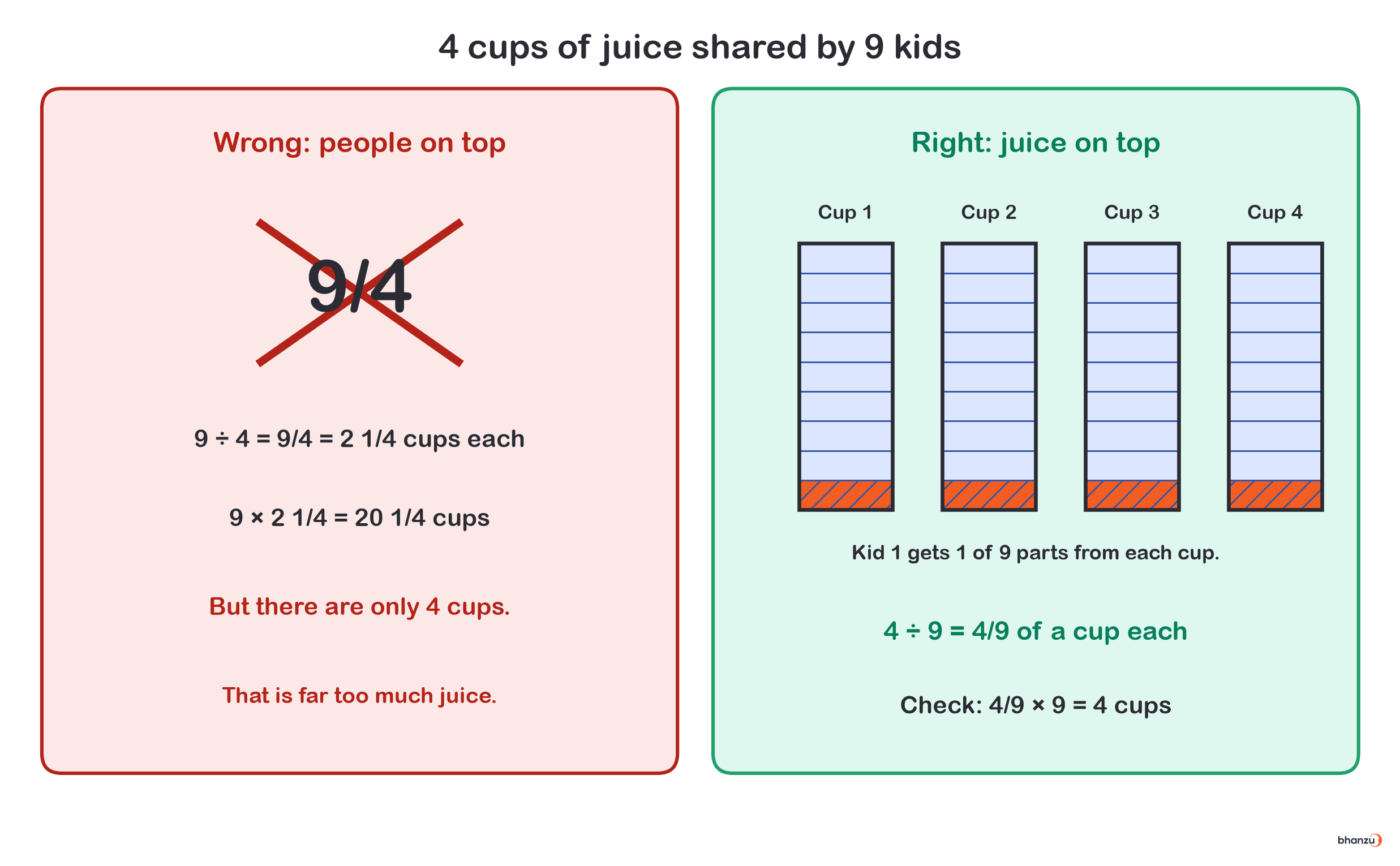
Where it slips in: Sharing stories with fewer wholes than people, such as 4 cups of juice for 9 kids. A child who learned division as "bigger number first" puts the 9 on top without asking what is being shared.
Don't do this: cups each, which would need cups when there are only 4.
The correct way: The juice is shared, so it goes on top, of a cup each, and cups.
Mistake 2: Putting the remainder over the wrong number
Where it slips in: Turning a remainder into a fraction, such as 14 pounds of clay shared by 3 artists. Children often put the remainder over 14 because it is the starting number and the biggest one on the page.
Don't do this: Write as 4 R2 and then as pounds.
The correct way: The 2 leftover pounds are still shared by 3 artists, so each gets pounds, and .
Mistake 3: Reading 10 thirds as "10 out of 3"
Where it slips in: Improper fractions, after years of reading as 3 out of 8 slices, so 10 out of 3 sounds impossible.
Don't do this: Decide is a typo and quietly swap it to .
The correct way: Read the fraction bar as "shared by," so . "Out of" names part of one whole, but a fair share can be bigger than 1.
Key Takeaways
- Reading fractions as division turns any fair-share question into one number, even when the wholes run out first.
- Before writing the fraction, ask which amount is being shared, because that amount sits on top.
- A remainder is still shared by the same people, so it keeps the same bottom number.
- Multiplying the share by the number of people should give back the starting amount.
- For more practice turning remainders into fair shares with a teacher who catches the upside-down fraction, explore Bhanzu's 5th grade math tutor or math programs for kids.
Read More
- Multiplying Fractions Word Problems
- Dividing Fractions and Whole Numbers Word Problems
- Fractions on a Number Line
- Fractions, Decimals and Percentages
- Why Are Fractions So Hard
Research Behind This Article
- J J O'Connor and E F Robertson, MacTutor History of Mathematics, An overview of Egyptian mathematics (2000). mathshistory.st-andrews.ac.uk
- NGA Center and CCSSO, Common Core State Standards for Mathematics, Grade 5 Number and Operations: Fractions (2010). thecorestandards.org
- OpenStax (Lynn Marecek and colleagues), Prealgebra 2e, 4.1 Visualize Fractions (2020). openstax.org
- Robert S. Siegler and colleagues, Psychological Science, Early predictors of high school mathematics achievement (2012). pubmed.ncbi.nlm.nih.gov
- Institute of Education Sciences, What Works Clearinghouse, Developing Effective Fractions Instruction for Kindergarten Through 8th Grade (2010). ies.ed.gov
Quick Quiz: Check Yourself
Three levels, new numbers every time: write a division or a sharing story as a fraction, write a mixed number, then find a missing amount or solve a two-step sharing problem.
Was this article helpful?
Your feedback helps us write better content
Frequently Asked Questions
Do fractions indicate division?
What is the difference between division and a fraction?
How do I explain fractions as division to my child?
Why do some students struggle so much with fractions?
Is there a fractions as division worksheet for 5th grade?
How do you turn a division into a fraction?