Key Points
- Dividing whole numbers to get a decimal keeps long division going past the ones place, since 9 and 9.00 are equal.
- Each leftover one trades for 10 tenths and each leftover tenth for 10 hundredths, so 9 divided by 4 gives 2.25.
- A frequent mistake writes the remainder as the decimal, so 27 divided by 4 becomes 6.3 instead of 6.75, and multiplying back exposes it.
- A whole number divided by 2, 4, 5, 8, 10, 20 or 25 always ends, while dividing by 3, 6, 7 or 9 can repeat forever and is usually rounded to hundredths.
A family of 2.47 people
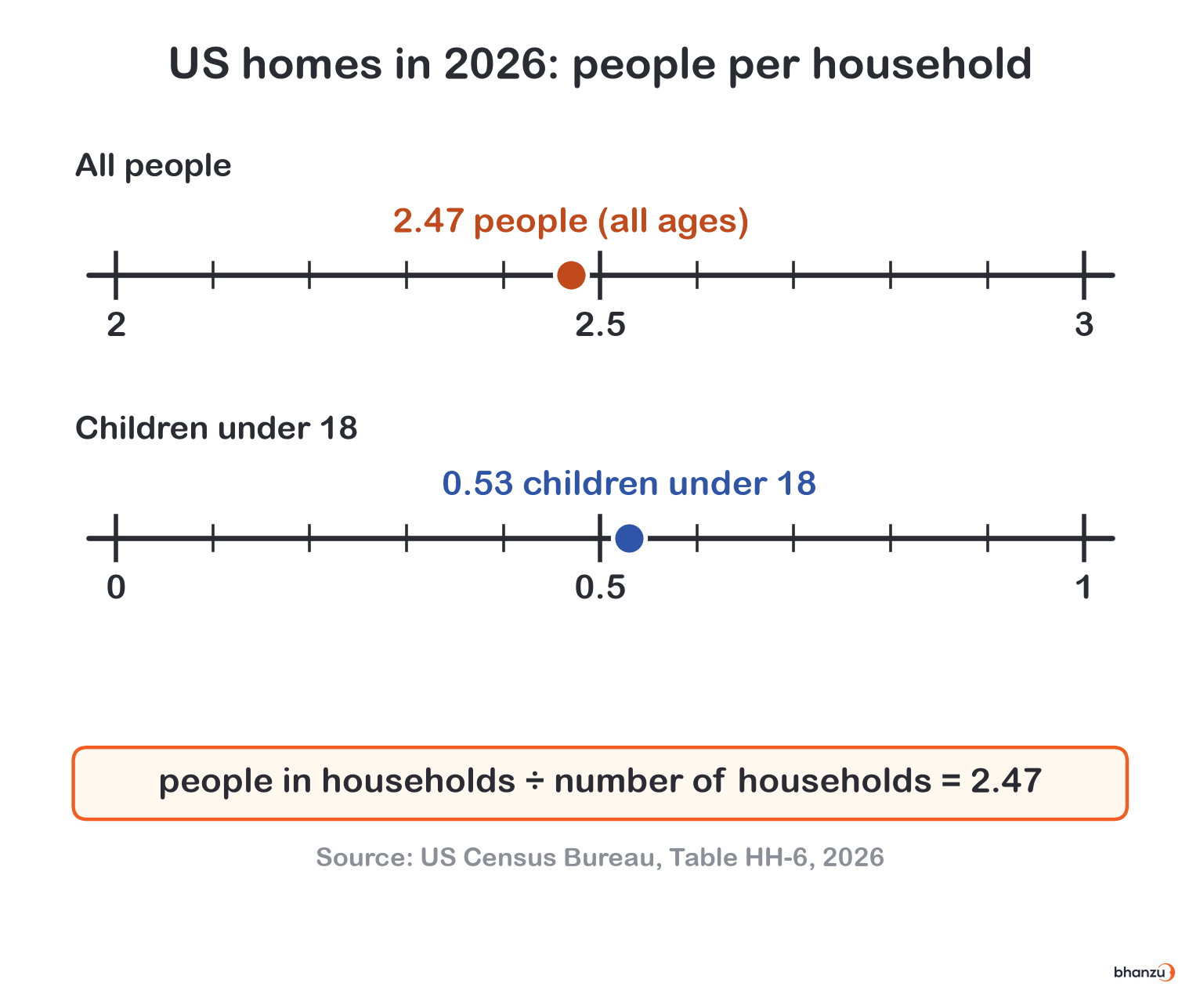
No home in the United States has exactly 2.47 people living in it. Yet the U.S. Census Bureau's 2026 household estimates give 2.47 as the average number of people per household. That average is the number of people in households divided by the number of households, one whole number by another.
The answer didn't come out even, and nobody wrote "2 remainder something." The leftover got shared out in tenths and hundredths instead. Later this year, the same steps will let you divide decimals too, and soon you'll use them to find unit prices and speeds.
What does dividing whole numbers to get a decimal mean?
Dividing whole numbers to get a decimal means you keep sharing the leftover as tenths and hundredths instead of stopping at a remainder (the part that can't be shared in whole ones).
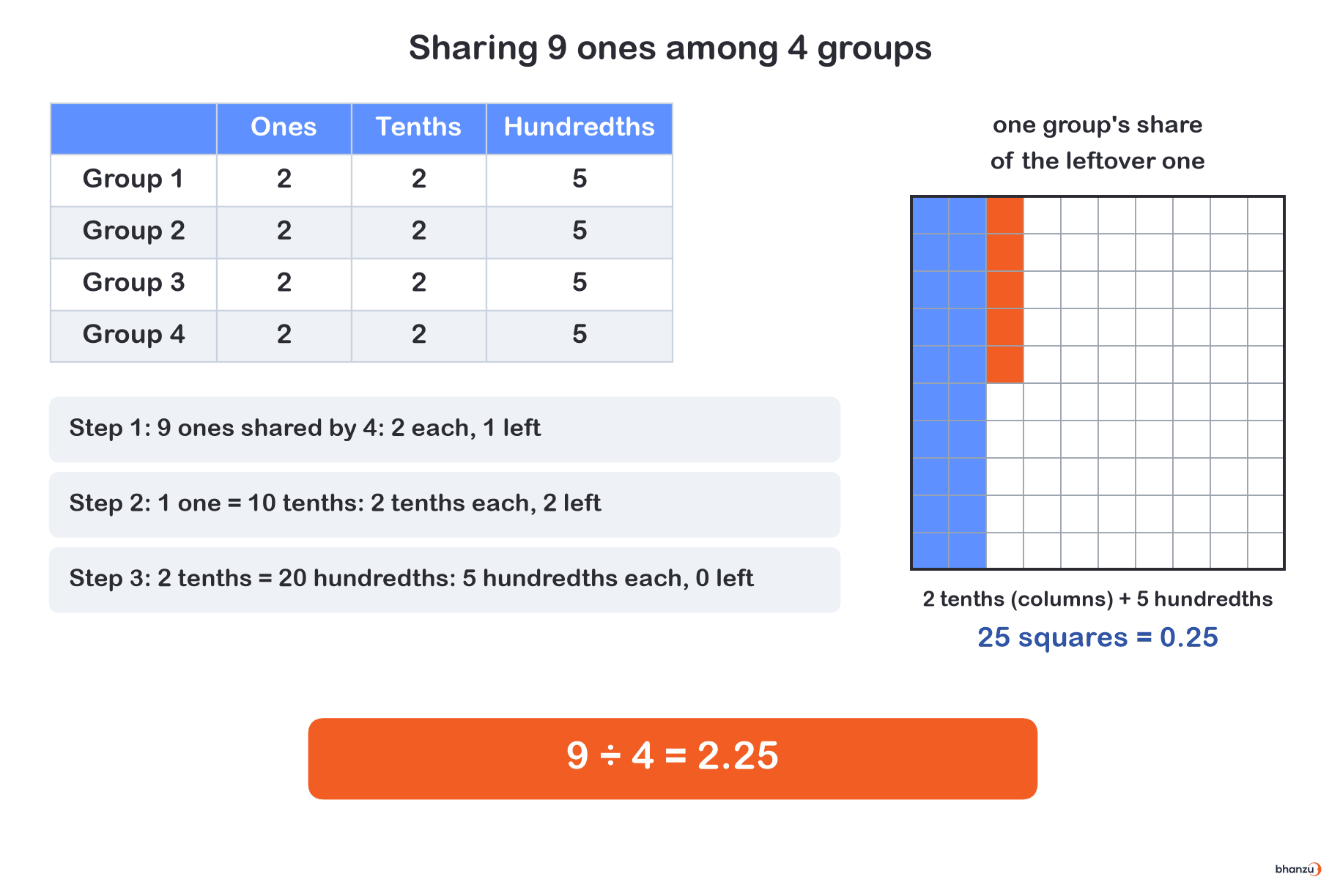
Every division has four parts, the dividend, divisor, quotient and remainder. In , the dividend 9 is the amount shared, the divisor 4 is the number of equal groups, and the quotient is one group's share. A place-value chart with ones, tenths and hundredths shows the sharing one place at a time.
- Share 9 ones among 4 groups. Each gets 2 ones, with 1 one left.
- Trade that 1 one for 10 tenths. Each gets 2 tenths, with 2 tenths left.
- Trade the 2 tenths for 20 hundredths. Each gets 5 hundredths, with nothing left.
So . The remainder in 2 R1 was 1 whole still waiting to be shared, and 4 groups sharing it get 0.25 each.
In your child's class, this skill sits under Common Core standard 5.NBT.B.7, which asks 5th graders to divide with decimals to hundredths using models and place value, then explain the written steps. It differs from dividing by decimals, as in , where the divisor is a decimal.
How do you keep dividing past the decimal point?
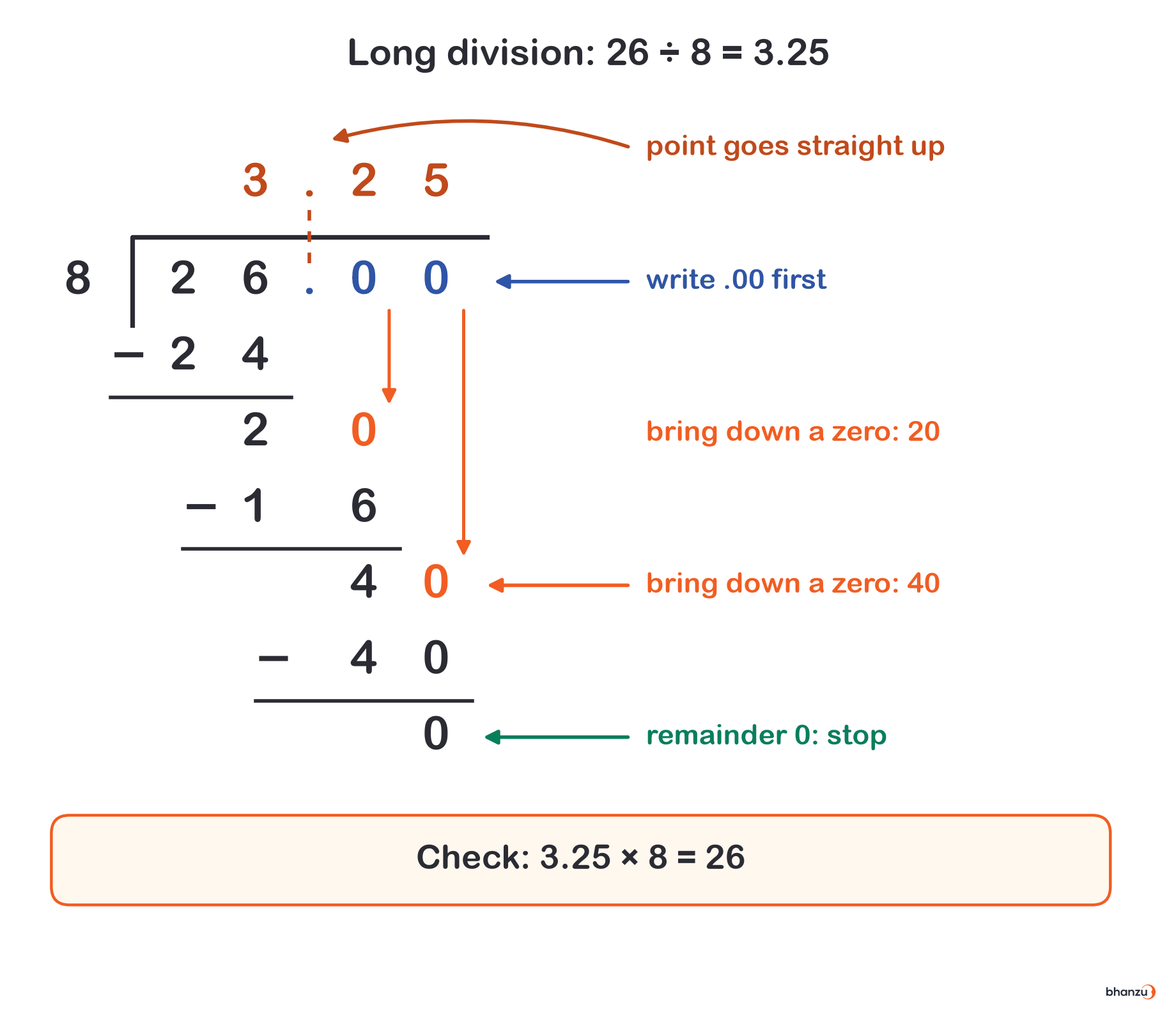
To keep dividing past the decimal point, put a point and a zero after the dividend, then bring the zero down like any other digit. Here are the six steps with .
- Estimate. Since , the answer is a little more than 3 (the skill from estimating multi-digit products and quotients).
- Divide the whole-number part with long division, the standard algorithm (the usual written method). R2.
- Write a point after 26 and another straight above it in the quotient, then add a zero, so 26 becomes 26.0.
- Bring down the zero and keep dividing. If the divisor doesn't fit, write 0 in that place and bring down another zero.
- Stop when the remainder is 0 or you reach the place the question asks for.
- Multiply back. The quotient times the divisor should land on the dividend.
After 3 R2, the 2 leftover ones become 20 tenths.
So , and .
Why can you add zeros after the decimal point? They stand for 0 tenths and 0 hundredths and add nothing, the same way $26 and $26.00 are the same money.
OpenStax's Prealgebra 2e textbook uses the same extra zeros to keep dividing until no remainder is left. Children who already know long division often stop the moment the dividend runs out of digits, and writing .00 first gives them digits to bring down.
The same steps work when the dividend already has a point, as in , and dividing by 10 just shifts each digit one place right.
When does a decimal quotient stop?
A decimal quotient stops when a remainder of 0 comes up, and the divisor tells you before you start whether that can happen.
- Ending divisors. Dividing a whole number by 2, 4, 5, 8, 10, 20 or 25 always ends, because each of those divisors fits evenly into 10, 100 or 1,000.
- Repeating divisors. Dividing by 3, 7 or 9 goes on forever unless the division comes out even, as in , and dividing by 6 usually repeats too.
The 6 is the confusing one. It sits on the repeating list, yet ends neatly, because 3 sixths is 1 half.
In , every step leaves a remainder of 1, so the 3s never stop. A repeating decimal has a digit or group of digits that repeats forever, shown with a bar.
In 5th grade, a repeating answer usually gets rounded to the nearest hundredth. Check the thousandths digit, the third place after the point, and use the usual rule from rounding decimals that 5 or more rounds up. Here it's 3, so the answer is . Repeating decimals get a full lesson of their own later, in repeating decimals and fractions.
Try It Yourself
Press Share to split the ones in the place-value chart equally, then press Trade to turn what is left into 10 times as many tenths or hundredths. Watch the grid shade one group's share while the answer grows one digit at a time. When nothing is left, type the quotient and press Check.
Examples of dividing whole numbers to get a decimal
Example 1
Divide 9 by 2.
The leftover 1 one is 10 tenths.
So , and .
Example 2
Divide 15 by 4 and write the answer as a decimal.
Trade the 3 leftover ones for 30 tenths.
Trade the 2 leftover tenths for 20 hundredths.
The quotient is . Multiplying back, .
Example 3
Divide 161 by 20.
The tempting move is to bring down a 0 to make 10, then another to make 100, and write the 5 right after the point. That gives 8.5.
Multiplying back shows the problem. , which is 9 more than 161, so 8.5 can't be the answer. The remainder of 1 already said the answer is only a little more than 8.
The missing piece is the tenths place. Ten tenths shared by 20 gives 0 tenths each, so a 0 holds that place.
So , and .
Example 4
What number divided by 8 gives 2.5?
The dividend equals the quotient times the divisor, so multiply back.
Dividing confirms it.
So , and the missing number is 20.
Example 5
Does 11 divided by 3 ever stop? Round the answer to the nearest hundredth.
The remainder is 2 at every step, so the division never stops and .
The thousandths digit is also 6, which is 5 or more, so the answer rounds up to .
Example 6
Maya, Leo, Aisha and Diego split a $38 pizza bill and a $9 tip equally. How much does each friend pay?
Add the two amounts first.
$$$38 + $9 = $47$$
Each friend pays $11.75, and $$11.75 \times 4 = $47$.
Why does dividing to a decimal answer matter?
A leftover in real life is a real amount of something, and a decimal quotient says how much each share gets.
- Sharing money fairly. Cents are hundredths of a dollar, so a quotient to hundredths is an exact amount, like the $11.75 each friend paid in Example 6.
- Cutting equal lengths. A 9-foot ribbon cut into 4 equal pieces gives 2.25 feet per piece, a length a tape measure can find.
- Reading averages. In fall 2021, US public schools had 15.4 students for every teacher, according to the National Center for Education Statistics (the ratio counts all teachers, including specialists, so it isn't a class size).
In each case a remainder alone would leave the question half answered.
Dividing whole numbers to get a decimal: common confusions cleared up
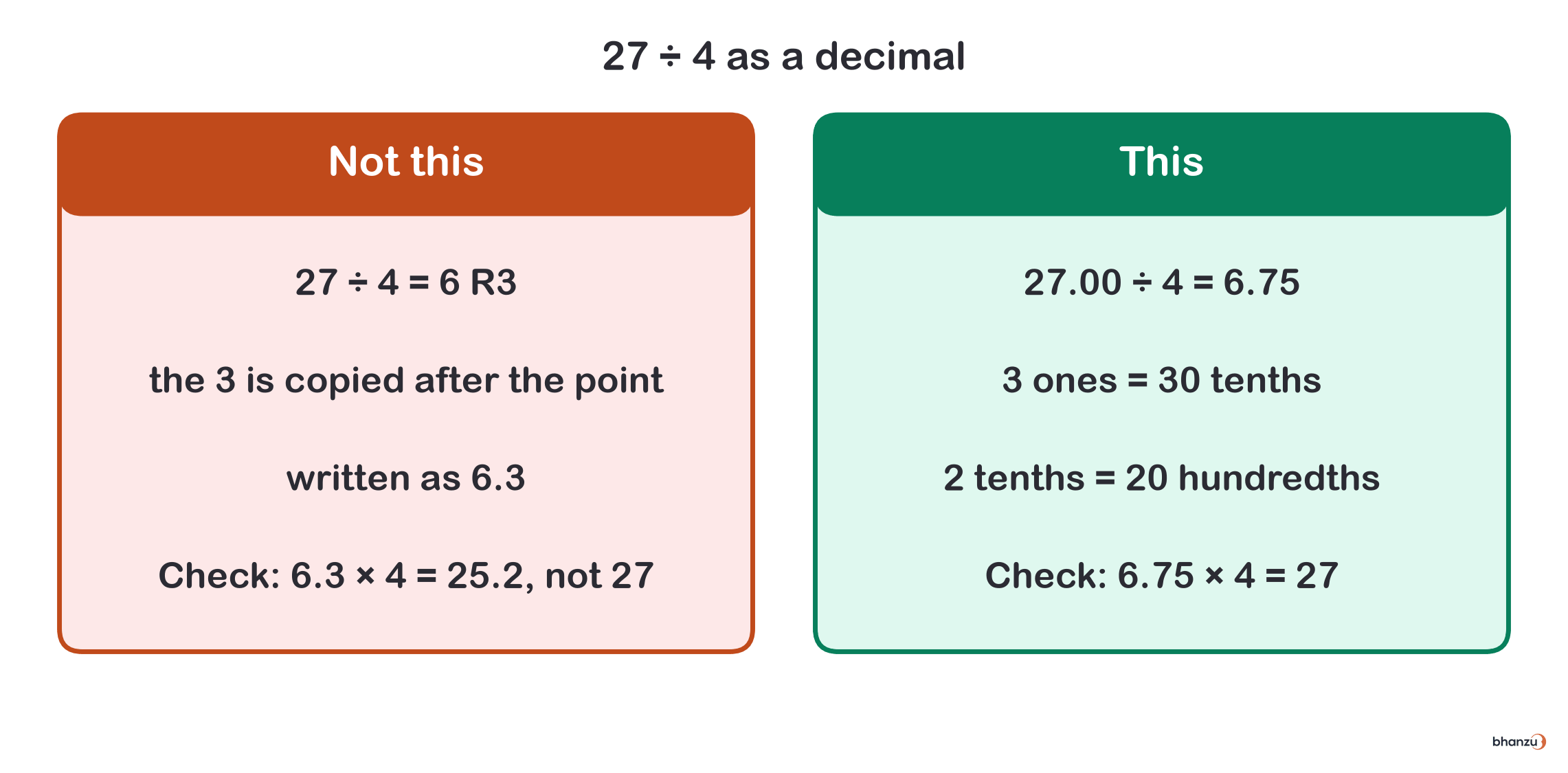
Mistake 1: Reading the remainder as a decimal
Where it slips in: Right after the whole-number part, as in R3. Children who have just learned remainders often copy the 3 straight after the point, because both feel like the leftover part.
Don't do this: Writing , even though , not 27.
The correct way: Trade the 3 leftover ones for 30 tenths, share them, then trade the 2 tenths left for 20 hundredths. The answer is , and .
Mistake 2: Losing the point when the zeros come down
Where it slips in: The first zero you bring down, as in . Once a zero comes down, the page looks like ordinary long division, so the point gets forgotten.
Don't do this: Working R3, bringing down a 0, dividing and writing 55.
The correct way: Write the point after 33 and straight above it before the zero comes down, which gives . The estimate of about 5 agrees, and .
Mistake 3: Chopping a repeating answer instead of rounding
Where it slips in: Answers that repeat, such as . A child who rushes to the answer stops at the hundredths digit and writes down whatever is there.
Don't do this: Writing as .
The correct way: Look one place further, at the thousandths digit. It's 6, which is 5 or more, so round up to .
The part of decimal quotients nobody explains
A remainder, a mixed number and a decimal are three ways to write the same leftover, and the story decides which one fits. Guides usually teach them in separate lessons, so they look like three different answers.
| Division | Quotient and remainder | Mixed number | Decimal |
|---|---|---|---|
| 3 R3 | |||
| 8 R1 | |||
| 3 R2 | , about |
A fraction bar means divide, so the remainder goes over the divisor to make a mixed number, a whole number plus a fraction. The lesson on fractions as division builds that middle column.
- Remainder, when only whole things make sense. 26 students in cars that hold 4 need 7 cars, because 2 students are left after 6 full cars.
- Decimal, for money and measurements. $15 shared by 4 is $3.75 each.
- Mixed number, for things cut by hand. 15 pizzas shared by 4 is pizzas each.
The Census Bureau's 2026 average of 0.53 children under 18 per household is a quotient smaller than 1, though no home has 0.53 of a child.
Key Takeaways
- Place the quotient's point straight above the dividend's point before any zero comes down.
- When you're dividing whole numbers to get a decimal, trade each leftover down to tenths, then hundredths, instead of leaving it as a remainder.
- A divisor that doesn't fit into the tenths means a 0 holds that place, as in .
- Landing back on the dividend after multiplying by the divisor proves the point is placed right.
- For more practice trading leftovers into tenths and hundredths with a teacher who spots 6 R3 written as 6.3, explore Bhanzu's 5th grade math curriculum or math programs for kids.
Read More
- Dividing Decimals by Whole Numbers
- Multiplying Decimals
- Dividing Decimals
- Fractions With Denominators of 10 and 100
- Fractions, Decimals and Percentages
Research Behind This Article
- U.S. Census Bureau, Historical Households Tables, Table HH-6: Average Population Per Household and Family, 1940 to Present (2026). census.gov
- NGA Center and CCSSO, Common Core State Standards for Mathematics: Grade 5, Number and Operations in Base Ten (2010). thecorestandards.org
- Marecek, Anthony-Smith and Honeycutt Mathis, OpenStax, Prealgebra 2e, 5.2 Decimal Operations (2020). openstax.org
- Marecek, Anthony-Smith and Honeycutt Mathis, OpenStax, Prealgebra 2e, 5.3 Decimals and Fractions (2020). openstax.org
- National Center for Education Statistics, Fast Facts: Teacher Trends (2023). nces.ed.gov
- NGA Center and CCSSO, Common Core State Standards for Mathematics: Grade 6, The Number System (2010). thecorestandards.org
Quick Quiz: Check Yourself
Three levels, new numbers every time: divide by 2 or 5 for tenths, divide by 4 or 20 or find a missing dividend, then split a money total or round a repeating answer.
Was this article helpful?
Your feedback helps us write better content
Frequently Asked Questions
What grade do kids learn decimal division in?
How do I teach dividing decimals to my child?
What is the first step in dividing decimals?
Does this page have a long division with decimal answers worksheet?
Why does long division work?