Key Points
- Part-part-whole ratio problems split a whole into two parts in a fixed ratio, such as 5 beginners for every 4 advanced players at a 36-player soccer camp.
- To share a total, add the ratio numbers to count equal boxes, divide the total by that count, then multiply each part's ratio number by the value of one box.
- The most common error reads a ratio as of the whole, when the first part is really .
- Common Core places this work in 6th grade under standards 6.RP.A.1 and 6.RP.A.3, which name tape diagrams and tables of equivalent ratios.
The coin that is mostly copper
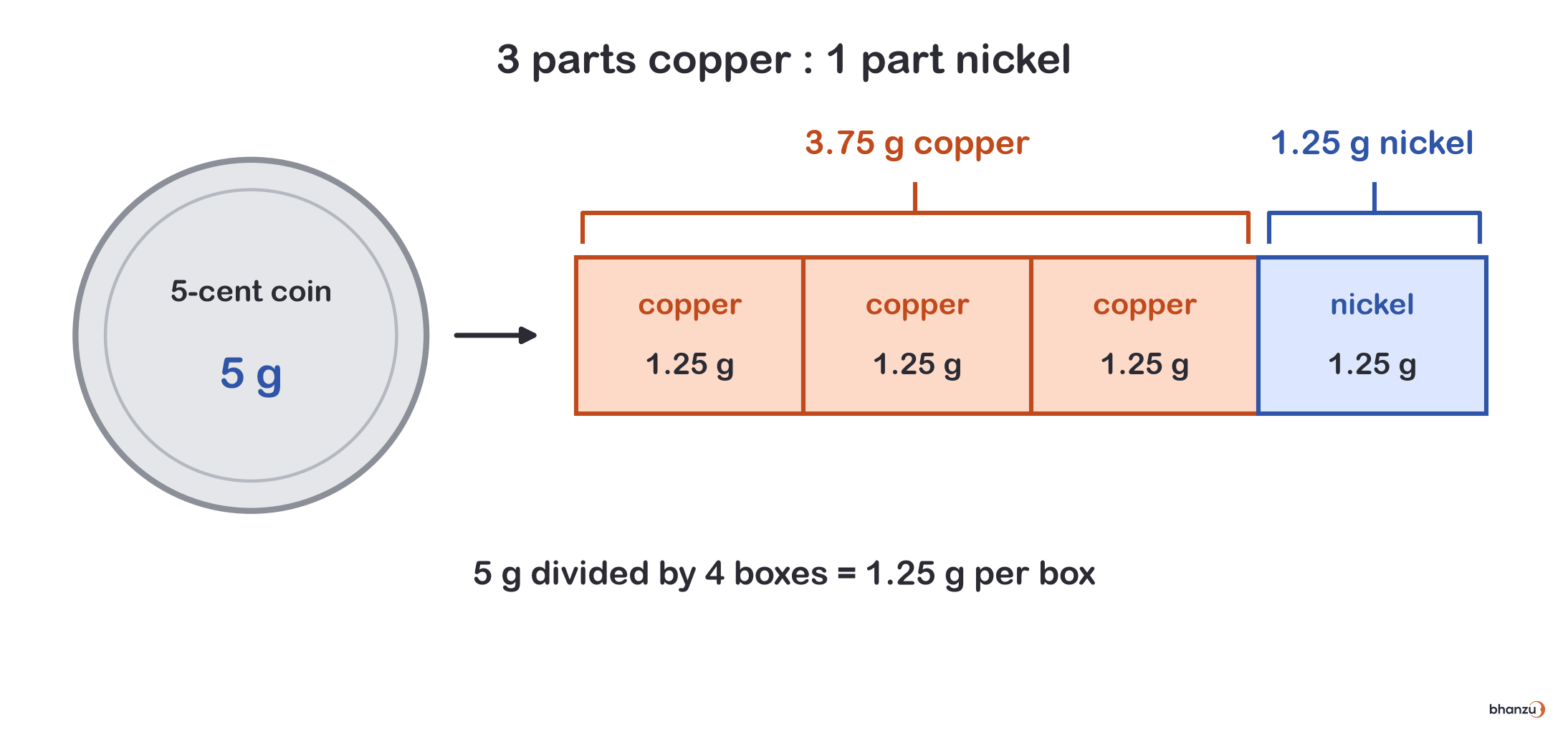
A US nickel is three parts copper for every one part nickel. The coin is named after the metal it has less of. Every nickel also weighs the same 5 grams, so the copper and the nickel are two parts of one fixed whole. Finding the grams of copper inside one coin is a part-part-whole ratio problem, and it takes three short steps once you can draw it.
The same reasoning shows up far from coins. Pharmacists use it to mix a medicine to a set recipe, and builders use it to mix concrete from fixed parts of cement, sand and gravel, at any batch size.
What is a part-part-whole ratio problem?
Part-part-whole ratio problems are word problems where two parts make a whole in a fixed ratio and you know only one amount, which can be the whole, one part, or the gap between the parts. A ratio compares two amounts in order, so (read "5 to 4") means 5 of the first thing for every 4 of the second.
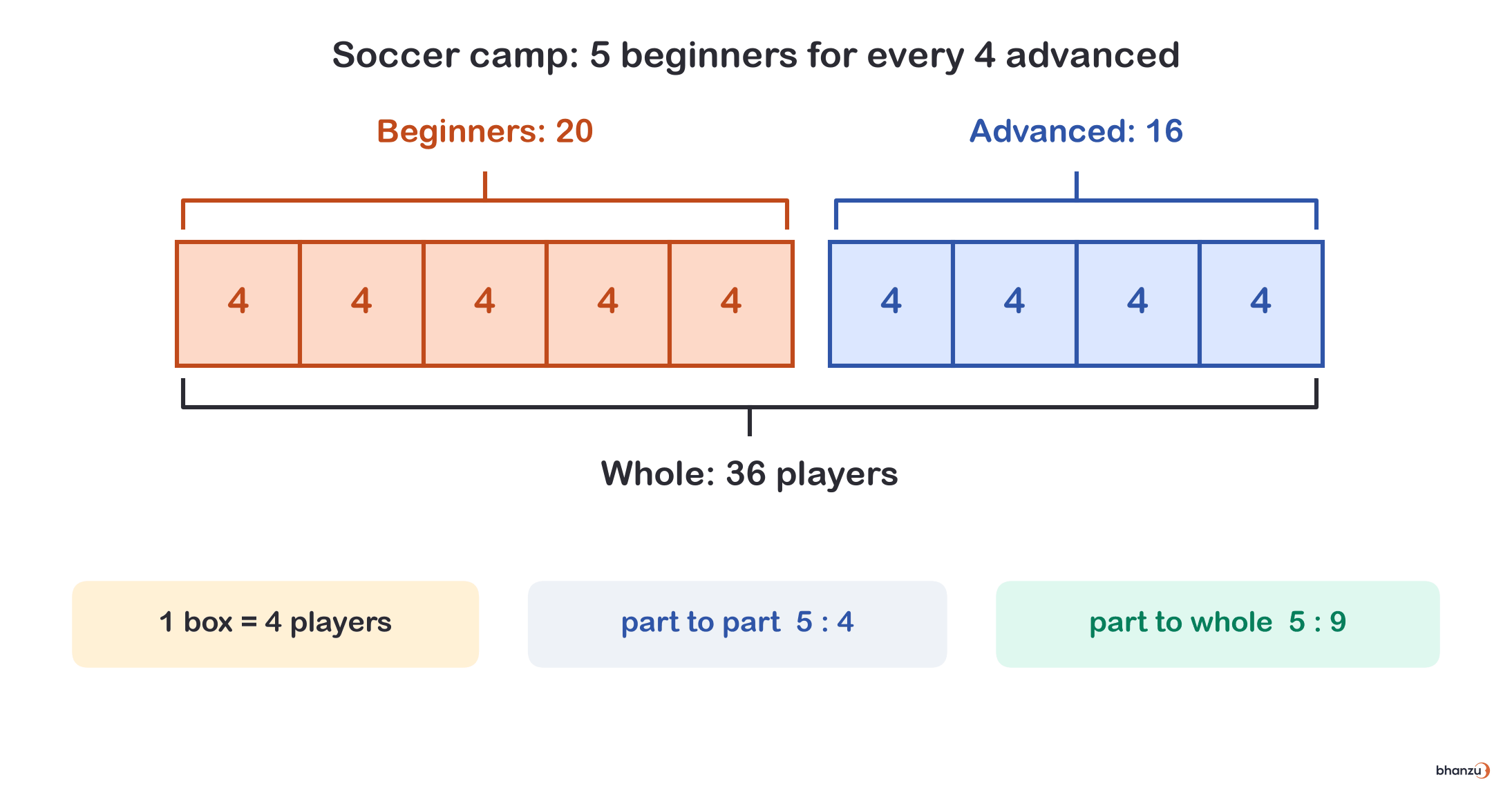
A soccer camp has 5 beginners for every 4 advanced players, 36 players in all. Beginners to advanced, , is a part-to-part ratio because it compares the two parts. A part-to-whole ratio compares one part with the whole group, so beginners to all players is . A tape diagram, a strip of equal boxes with one box per ratio number, shows both at once.
The nickel works the same way. Federal coin law, in its current text amended through 2021, sets the 5-cent coin at 5 grams, 75 percent copper and 25 percent nickel. Dividing both percents by 25 gives a ratio of 3 to 1.
| Comparison | Soccer camp | Nickel coin | Type |
|---|---|---|---|
| First part to second part | part to part | ||
| First part to the whole | part to whole |
Your child meets this in 6th grade under Common Core standards 6.RP.A.1 and 6.RP.A.3, and 6.RP.A.3 names tape diagrams and tables of equivalent ratios as the tools your child is expected to use. Expect homework that asks for a drawing as well as an answer.
How do you use a tape diagram for ratios?
Draw one strip of equal boxes for each part, one box per ratio number, then share the known amount among all the boxes. The same drawing is also called a bar model or a strip diagram, and a 2012 federal practice guide rated teaching such visual representations as backed by strong evidence from six middle school studies. Here is the soccer camp, solved step by step.
- Draw 5 boxes for the beginners and 4 boxes of the same size for the advanced players.
- Add the boxes to count the whole, .
- Divide the total by the boxes, players per box.
- Multiply each part's boxes by 4, giving 20 beginners and 16 advanced players.
- Check that and that divided by 4 is , so the answer and the start are equivalent ratios.
The rule works because every box is the same size, so 36 players over 9 equal boxes put 4 in each. A child who draws the beginners' boxes wider, because beginners is the bigger group, ends up with a drawing that no longer matches the math. Draw every box the same width first.
Sharing money in a ratio uses the same steps. Maya and Leo share $45 in the ratio , so their tape has 9 boxes.
$$$45 \div 9 = $5 \text{ per box}$$
$$\text{Maya gets } 2 \times $5 = $10$$
$$\text{Leo gets } 7 \times $5 = $35$$
Tape diagrams get slow with big ratio numbers such as . Nobody wants to draw 40 boxes, so draw one long box per part with its number written inside, or switch to a ratio table.
Which number does the problem give you?
Twenty beginners, 36 players and "4 more beginners than advanced players" each give enough to solve the whole camp. Almost every part-part-whole ratio problem hands you one of those three amounts, and that amount tells you which boxes to divide by.
| The problem gives | Divide it by | Camp example | One box |
|---|---|---|---|
| The total, 36 players | all 9 boxes | 4 players | |
| One part, 20 beginners | that part's 5 boxes | 4 players | |
| The difference, 4 more beginners | the 1 extra box | 4 players |
To find the total in a ratio from one part, find one box from that part and multiply by the sum of the ratio numbers. Twenty beginners fill 5 boxes, so one box is 4 players and the camp is players. Difference problems look the strangest at first (they are subtraction, but of boxes), and the 4 extra beginners fill exactly the 1 extra box.
| Words in the problem | Math it means |
|---|---|
| "5 beginners for every 4 advanced players" | the ratio , part to part |
| "in all", "altogether" | the whole, all the boxes |
| "15 more dogs than cats" | the difference, the extra boxes |
| "share $45 in the ratio 2 to 7" | 9 equal boxes |
| "what fraction of the class" | part to whole |
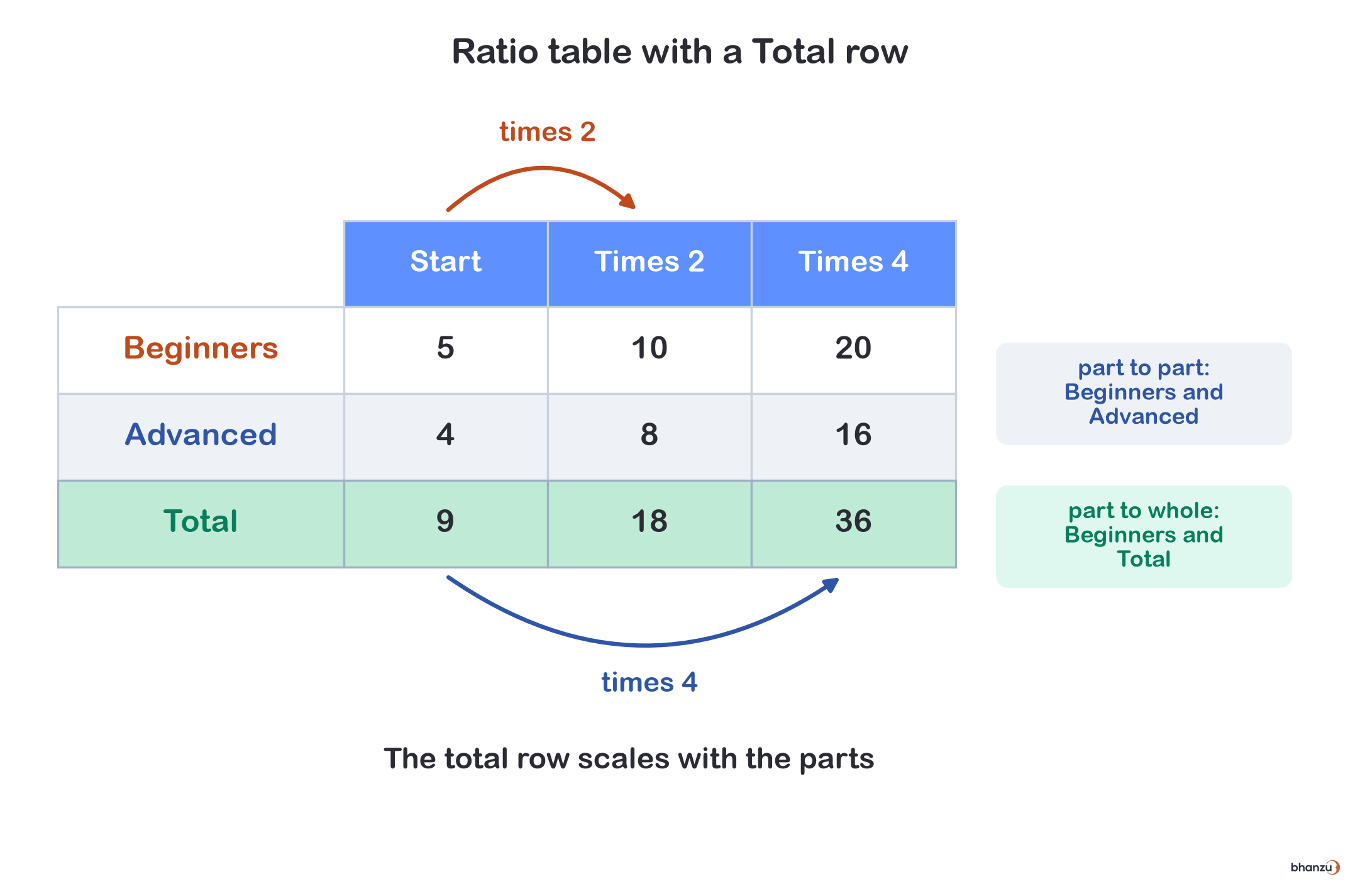
A ratio table, whose columns are all equivalent ratios, does the same job without a drawing, and a total row makes it fit these problems.
| Row | Start | Times 2 | Times 4 |
|---|---|---|---|
| Beginners | 5 | 10 | 20 |
| Advanced | 4 | 8 | 16 |
| Total | 9 | 18 | 36 |
The total row grows by the same factor as the parts, so a total of 36, which is 9 times 4, means 20 beginners and 16 advanced players. The Beginners and Advanced rows give the part-to-part ratio, and the Beginners and Total rows give the part-to-whole ratio.
Try It Yourself
Use the plus and minus buttons to set the two ratio numbers, then drag the slider to change what one box is worth. Pick whether the problem gives the total, one part or the difference, and watch the tape diagram, the readout and the table's total row update together. The two parts always add up to the whole.
Part-part-whole ratio problems beyond the textbook
Part-part-whole ratio problems exist because real mixes and shares keep a fixed ratio while the total changes. Equal boxes let you rescale them without guessing.
- It keeps a mix identical at any size. Every 5-gram nickel holds copper and nickel at , whether the mint strikes 10 coins or 10,000.
- It splits money and work fairly. Two friends who rake leaves for 1 hour and 3 hours can split $60 as $15 and $45.
- It turns a ratio into a share. A class vote of 12 to 18 means the smaller side holds 12 of the 30 votes, or of the votes.
- It leads into algebra. The same boxes return in equations with tape diagrams, where one box becomes a letter such as .
The habit has been checked at scale. A 2019 study of 1,492 seventh graders tested schema-based instruction, which teaches students to sort ratio, proportion and percent problems by type and draw each type as a diagram. Those classes solved problems significantly better than comparison classes taught the usual way.
Examples of part-part-whole ratio problems
Example 1
A jar holds red and blue beads in the ratio . There are 21 beads in all. How many blue beads are there?
There are 12 blue beads, and the 9 red beads bring the total back to 21.
Example 2
A trail mix uses raisins and peanuts in the ratio . How many ounces of raisins are in 48 ounces of mix?
The tempting move treats as if three fifths of the mix were raisins.
That leaves 19.2 ounces of peanuts, and simplifies to . The mix would have more raisins than peanuts, the opposite of the recipe. The 5 was never the whole.
Start again with boxes.
The mix needs 18 ounces of raisins, and .
Example 3
In a class, the ratio of girls to boys is . There are 12 boys. How many students are in the class?
The 12 boys fill the 3 boy boxes.
There are 28 students, 16 girls and 12 boys.
Example 4
At an animal shelter, the ratio of dogs to cats is , and there are 15 more dogs than cats. How many dogs and cats are there?
The dogs have extra boxes, and those boxes hold the 15 extra dogs.
The shelter has 25 dogs and 10 cats.
Example 5
Federal law says a 5-cent coin weighs 5 grams and is 75 percent copper and 25 percent nickel. How many grams of copper are in one coin?
Divide both percents by 25 to simplify, then share the 5 grams among the boxes.
One nickel holds 3.75 grams of copper and 1.25 grams of nickel.
Example 6
A school sold 210 tickets to its play, in the ratio of 2 adult tickets to 5 student tickets. Adult tickets cost $8 and student tickets cost $3. How much money did the school collect?
$$60 \times $8 = $480$$
$$150 \times $3 = $450$$
$$$480 + $450 = $930$$
The school collected $930.
The part of part-part-whole ratio problems nobody explains
The value of one box is a built-in check on the numbers. If 50 people split , one box is 6.25 people (nobody is a quarter of a person), so the ratio was rounded or the total is wrong. A child who second-guesses the 1.25 grams per box in Example 5 can keep it, because grams split into decimals.
The same colon can mean part to part in one problem and part to whole in the next, and that confuses adults too. A part-to-part ratio becomes a fraction only after you add the parts, as the trail mix shows.
| Part | Part to whole | Fraction | Decimal | Percent |
|---|---|---|---|---|
| Raisins | ||||
| Peanuts |
Taking of 48 ounces gives the same 18 ounces, which is the bridge to finding the percent of a number. In 7th grade, the same move handles discounts and sales tax.
Part-part-whole ratio problems: spot the trap before you fall in
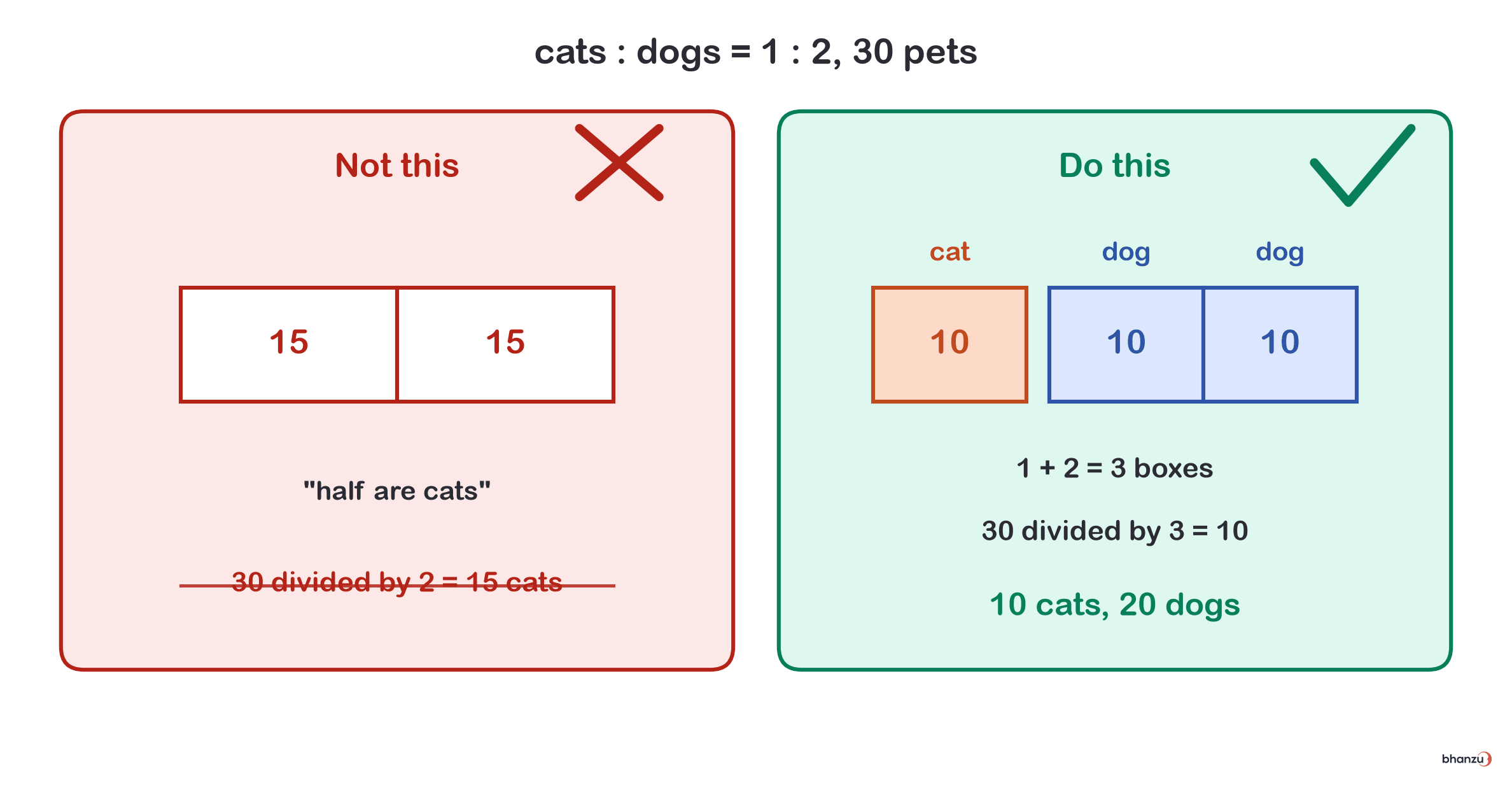
Mistake 1: Reading the ratio as a fraction of the whole
Where it slips in: Any problem that gives the total, as in Example 2.
Don't do this: Cats to dogs is with 30 pets, so "half are cats" and there are 15 cats.
The correct way: Add the parts, boxes, so one box is 10. That makes 10 cats and 20 dogs, and the cats are of the pets.
A ratio written looks like the fraction , so children read "1 out of 2" when it means "1 for every 2".
Mistake 2: Dividing the total by one part's number
Where it slips in: Problems that give the total, such as Examples 1 and 6.
Don't do this: Red to green marbles is with 35 marbles, so red marbles.
The correct way: Divide by all boxes, so one box is 5, giving 20 red and 15 green marbles.
A child who rushes grabs the 4 because it belongs to the red marbles the question names. A decimal number of marbles is the giveaway that the adding step went missing.
Mistake 3: Putting the given number on the wrong strip
Where it slips in: One-part problems where the sentence names the other part first, as in Example 3.
Don't do this: Girls to boys is with 12 boys, but the 12 goes on the 4 girl boxes, which gives 3 per box and only 9 boys.
The correct way: The 12 boys belong on the 3 boy boxes, so one box is 4, giving 16 girls and 28 students.
The ratio's order often differs from the order of facts in the sentence, so label each strip before writing a number. A 2009 study of 151 Primary 5 children in Singapore found that misrepresenting one piece of information in a bar drawing could produce a wrong answer.
Key Takeaways
- Add the ratio numbers before dividing a total, because the total spreads across every box.
- Match the divisor to the amount you were given, so a total uses all the boxes and a difference uses only the extra ones.
- A part-to-part ratio such as becomes a fraction of the whole, , only after you add the parts.
- Check part-part-whole ratio problems by adding the parts back to the whole and simplifying back to the starting ratio.
- For more practice sorting total, part and difference problems with a teacher who catches the 3/5 versus 3/8 trap, explore Bhanzu's 6th grade math tutor or math programs for kids.
Read More
- Double Number Lines
- Finding the Whole From a Percent
- Fraction Times Whole Number
- Ratio Formula
- Math Word Problems
Research Behind This Article
- Legal Information Institute, Cornell Law School, 31 U.S. Code 5112, Denominations, specifications, and design of coins (2021). law.cornell.edu
- Common Core State Standards Initiative, Ratios and Proportional Relationships, Grade 6 (2010). thecorestandards.org
- Ding (Teaching Children Mathematics), Modeling with Tape Diagrams (2018). eric.ed.gov
- Institute of Education Sciences, What Works Clearinghouse, Improving Mathematical Problem Solving in Grades 4 Through 8 (2012). ies.ed.gov
- Jitendra, Harwell, Im and others (Journal of Educational Psychology), Improving Student Learning of Ratio, Proportion, and Percent: A Replication Study of Schema-Based Instruction (2019). eric.ed.gov
- Ng and Lee (Journal for Research in Mathematics Education), The Model Method: Singapore Children's Tool for Representing and Solving Algebraic Word Problems (2009). eric.ed.gov
Quick Quiz: Check Yourself
Three levels, new numbers every time: split a total in a ratio, find a part or the whole from one part or a difference, then solve multi-step problems with ticket prices or grams of metal.
Was this article helpful?
Your feedback helps us write better content
Frequently Asked Questions
Is the ratio 1 : 2 the same as the fraction 1/2?
How do you explain ratios to kids?
What ratio word problems do 6th graders solve?
Can you solve ratio word problems without algebra?
How do you find the total in a ratio using fractions?
How can I help my child with part-part-whole ratio problems at home?