Key Points
- Equivalent ratios compare two amounts in the same way, so punch mixed 3 cups of orange juice to 2 cups of pineapple tastes the same at 6 to 4.
- A tape diagram shows the scaling, since a 3 to 5 ratio with each box worth 4 becomes 12 to 20.
- The classic slip adds the same number to both parts, turning 2 to 3 into 4 to 5, when two real batches make 4 to 6.
- Two ratios are equivalent exactly when their simplest forms match, found by dividing both parts by their greatest common factor.
Eleven official flags, five matching shapes
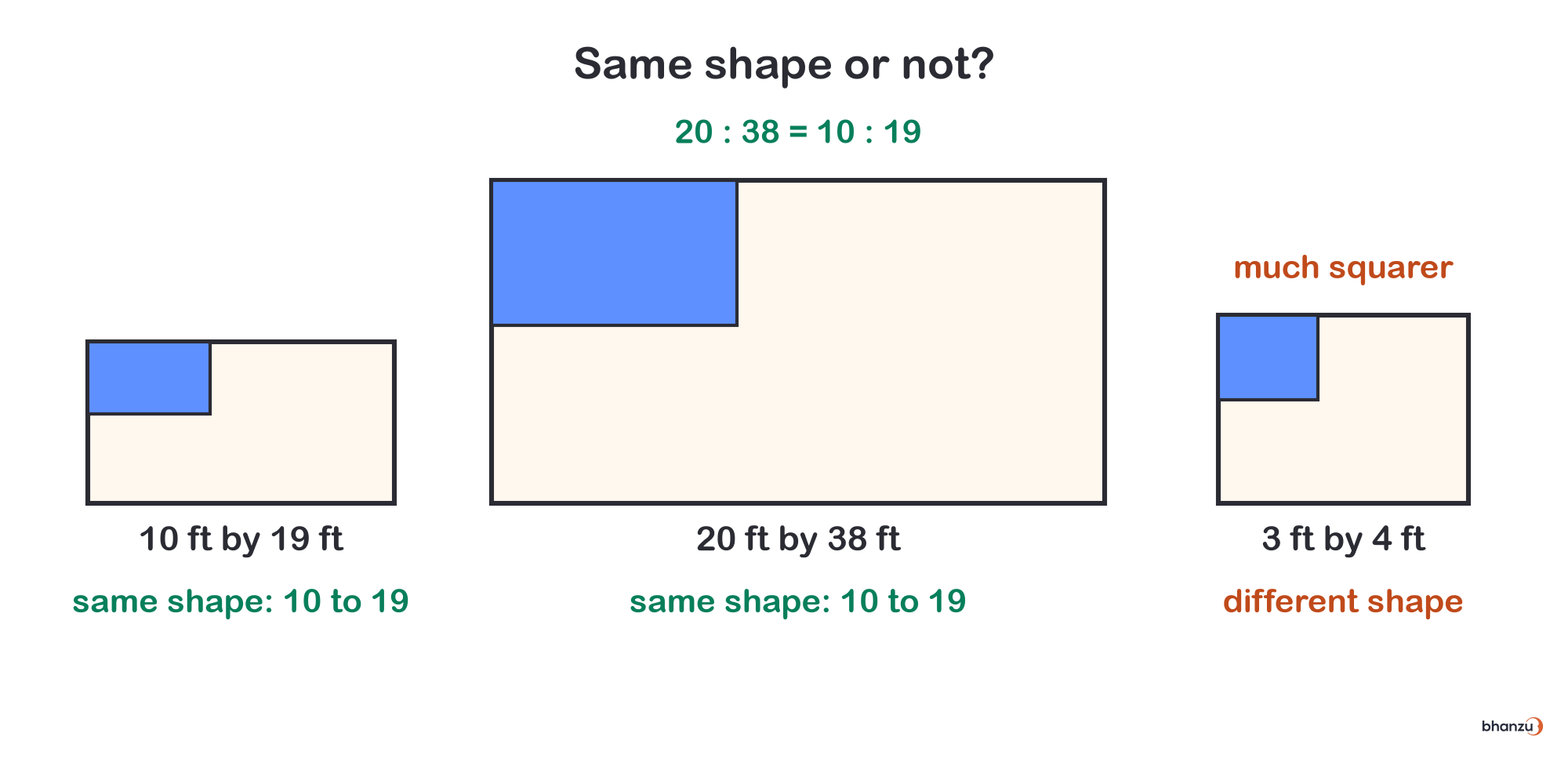
In 1959 a presidential order listed 11 official flag sizes, and they aren't all one shape. A flag 20 feet tall and 38 feet long sits on that list beside one 10 feet tall and 19 feet long, and those two match exactly. A 3 by 4 foot flag on the same list is much squarer.
Telling which sizes share a shape takes no ruler. It takes one idea about ratios, the same idea that keeps a recipe tasting right when you make more. Five of the 11 sizes are exact copies of one shape.
Mapmakers use that idea to shrink a city onto one page. Bakeries use it to turn a family recipe into hundreds of loaves, and film crews use it to keep a movie the same shape on a phone and on a cinema screen.
What are equivalent ratios?
Equivalent ratios are ratios, or comparisons of two amounts, that describe the same relationship, because multiplying or dividing both amounts of one by the same number (never zero) gives the other. A ratio can be written as 3 to 2, or , with the numbers in the order the words give.
One batch of fruit punch uses 3 cups of orange juice and 2 cups of pineapple juice. That's a part-to-part ratio. Orange juice to all 5 cups, 3 to 5, would be part to whole. Two batches use 6 and 4 cups, and three batches use 9 and 6, so , and are equivalent ratios.
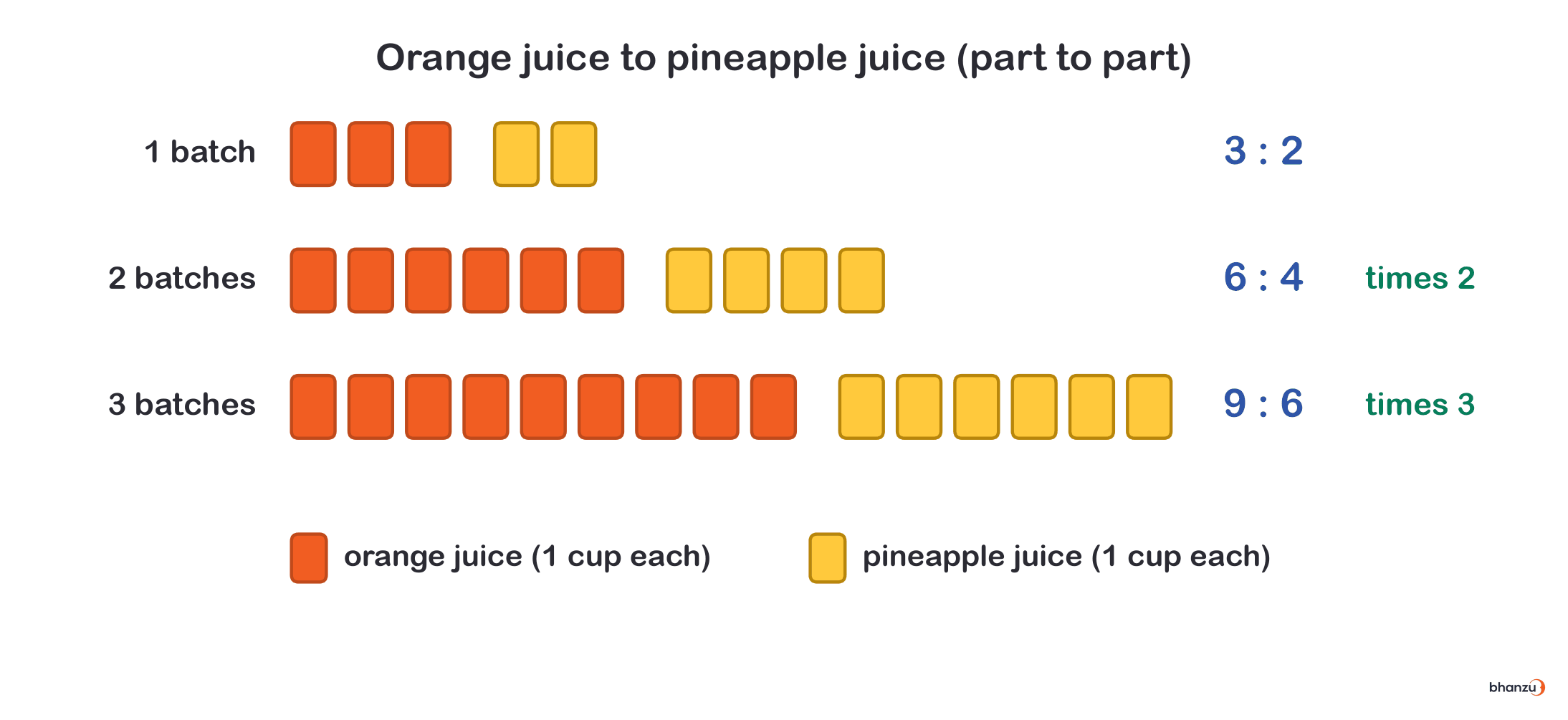
Your child meets this skill in 6th grade under Common Core standard 6.RP.A.3. That standard names tables of equivalent ratios, tape diagrams (bars split into equal boxes) and double number line diagrams (two lined-up number lines) among its tools, so expect drawings before shortcuts this year.
How do you find equivalent ratios?
Multiply or divide both parts of the ratio by the same number. Four steps keep the order straight.
- Write the ratio in the order the words give, with a label over each number.
- Decide how many batches you need, or what one box of a tape diagram is worth.
- Multiply or divide both parts by that number.
- Check that both parts changed by the same multiplier.
A tape diagram makes step 2 visible. A gym closet holds soccer balls and basketballs in the ratio 3 to 4, with 12 basketballs. Draw 3 equal boxes for soccer balls and 4 for basketballs, every box worth the same number of balls. The 4 basketball boxes hold 12, so divide 12 by 4.
The 3 soccer-ball boxes hold balls, so is equivalent to . A double number line shows the same pairs with soccer balls at 0, 3, 6 and 9 above basketballs at 0, 4, 8 and 12, and a ratio table holds them in columns.
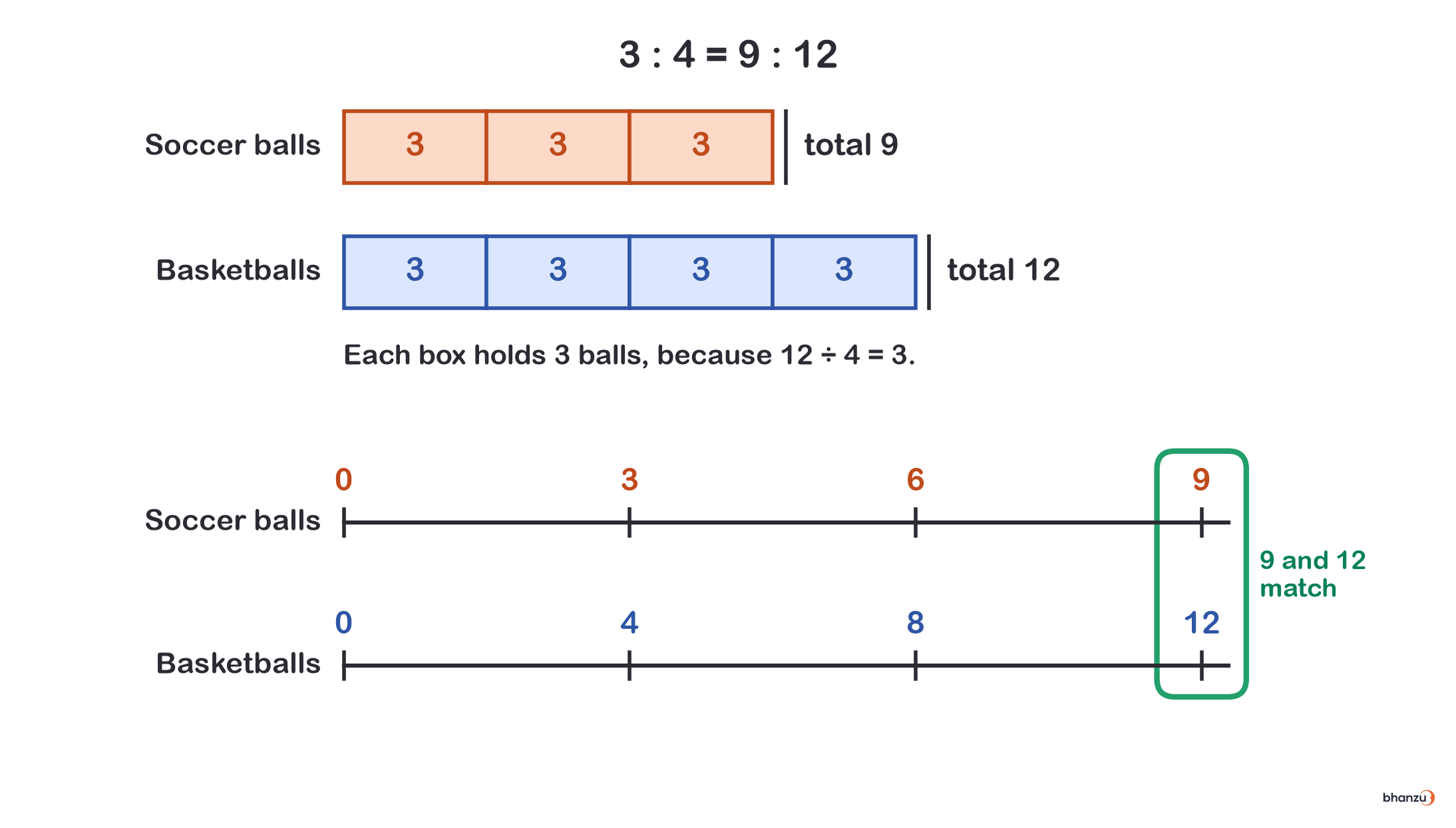
To tell if two ratios are equivalent, look for one number that turns both parts of the first into the second, as 3 does for and . A child who rushes straight to multiplying often skips step 1, and the labels catch a flipped ratio early.
The method slows down when no whole number links two ratios. Children who scale 3 to 4 up to 9 to 12 with ease often stall at 6 to 4 and 9 to 6, where the multiplier is . Divide down to the simplest form, , then multiply both parts by 3.
| Words in the problem | Math it means |
|---|---|
| "3 soccer balls for every 4 basketballs" | the ratio , in that order |
| "boys to girls" | boys first, girls second |
| "the same recipe" or "the same shape" | an equivalent ratio |
| "how many boys go with 20 girls" | a missing value, found with a tape diagram |
How do you simplify a ratio?
Divide both parts by their greatest common factor, the largest number that divides both evenly. The result is the simplest form, where the two parts share no factor except 1.
- List the factors. The factors of 18 are 1, 2, 3, 6, 9 and 18, and the factors of 24 are 1, 2, 3, 4, 6, 8, 12 and 24.
- Find the greatest factor they share, which is 6.
- Divide both parts by 6.
Simplest form is also the fastest yes-or-no check. Two ratios are equivalent exactly when they simplify to the same pair, so matches , since dividing both parts by 7 gives .
The flag sizes from Executive Order 10834, signed in 1959, pass the same check. Dividing both parts of by 2 gives , and 10 and 19 share no factor except 1.
Try It Yourself
Set a starting ratio with the plus and minus buttons, then drag the batches slider and watch the tape diagram and the double number line grow together. Press Simplest form to divide both parts of the starting ratio by their greatest common factor, so 6 to 4 shrinks to 3 to 2.
Examples of equivalent ratios
Example 1
What are two ratios equivalent to 3 to 4?
Multiply both parts by 2.
Multiply both parts by 3.
Two equivalent ratios are and .
Example 2
A rice recipe uses 2 cups of rice for every 3 cups of water. Maya adds 2 cups to each amount and cooks 4 cups of rice in 5 cups of water. Did she keep the recipe?
Adding 2 to both parts looks fair, so 4 to 5 seems to match 2 to 3.
That can't be right. Four cups of rice is 2 batches of rice, and 2 batches need cups of water. With only 5 cups, every cup of rice gets less water than the recipe gives.
Multiply both parts by 2 instead.
No. Maya needs 6 cups of water for 4 cups of rice.
Example 3
The ratio of boys to girls in a chess club is 3 to 5. There are 20 girls. How many boys are there?
Draw 3 equal boxes for boys and 5 for girls. The 5 girl boxes hold 20 girls, so divide by 5.
The 3 boy boxes hold boys.
There are 12 boys, and dividing both parts of by 4 gives back .
Example 4
Why are 15 to 6 and 10 to 4 equivalent ratios?
The greatest common factor of 15 and 6 is 3.
The greatest common factor of 10 and 4 is 2.
Both ratios simplify to , so they are equivalent.
Example 5
The 1959 flag list includes flags of 5 by 9.5 feet and 7 by 11 feet. Is either one the same shape as the 10 by 19 foot flag?
Multiply both parts of by 2.
The only factor 7 and 11 share is 1, so is already in simplest form, and it isn't .
The 5 by 9.5 foot flag matches. The 7 by 11 foot flag doesn't.
Example 6
The Project FeederWatch feeding page, updated in 2026, gives 1 part sugar to 4 parts water for hummingbirds and 1 to 6 for orioles. An adult mixes 2 cups of sugar with 8 cups of water for orioles. Does it match, and how much water should go with the sugar?
Simplify the adult's mix by dividing both parts by 2.
That is the hummingbird recipe.
Multiply both parts of by 2, because there are 2 cups of sugar.
No. The oriole recipe needs 12 cups of water with 2 cups of sugar, 4 cups more than the adult used.
Why does multiplying both parts work?
A ratio describes one batch, so multiplying both parts adds whole batches and dividing takes them away, which is multiplication as scaling from 5th grade. Adding the same number to both parts slips in pieces that aren't batches, so the relationship changes.
- It keeps a mix tasting the same. One cup of sugar in 4 cups of water is as sweet as 2 cups in 8 cups, so the nectar recipe works at any size (an adult handles the boiling water).
- It keeps a shape the same. The 20 by 38 foot flag is the 10 by 19 foot flag at twice the height and twice the length. In 8th grade, scaled copies like these are called similar figures.
- It sets up 7th grade. Two equivalent ratios written as one equation make a proportion, and the shared multiplier is what keeps that equation true.
Both parts always get the same number of batches.
Where do kids trip up on equivalent ratios?
Mistake 1: Adding the same number to both parts
Where it slips in: Growing a recipe, as in Example 2.
Don't do this: Turning 4 to 7 into 8 to 11 by adding 4 to each part.
The correct way: Multiply both parts by 2, so 4 to 7 becomes 8 to 14.
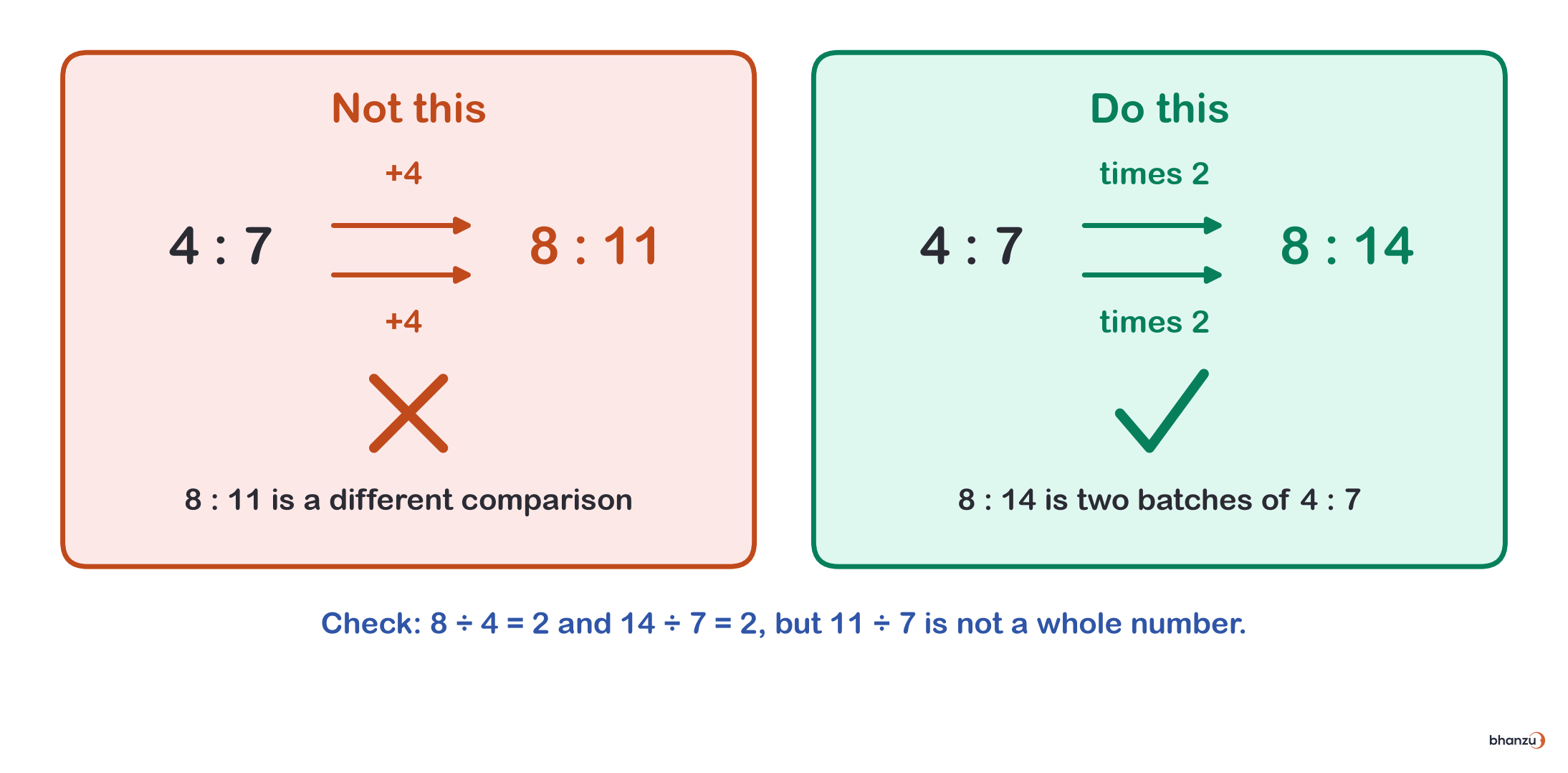
Growing a recipe sounds like adding more of everything, so adding is the move a child reaches for first. A 2016 article for teachers by Dougherty and colleagues describes a student who believed 2 to 3 equals 4 to 5 because 2 had been added to each number. Dividing each new part by its old part exposes the slip: and both give 2, but doesn't.
Mistake 2: Writing the ratio in the wrong order
Where it slips in: Missing-value problems that name the amounts in one order, like the chess club in Example 3.
Don't do this: Reading "cats to dogs is 4 to 9, with 36 dogs" as 9 cats to 4 dogs, which makes each box 9 and gives 81 cats.
The correct way: Keep the order of the words. The 9 dog boxes hold 36, so each box is 4 and the cats are .
The IES practice guide on fractions (2010) notes that students often flip the direction of a multiplicative relationship, and with no labels both 16 and 81 look believable. Writing "cats" and "dogs" above the numbers first fixes the order.
Mistake 3: Stopping before the simplest form
Where it slips in: Simplifying bigger numbers, as in Example 4.
Don't do this: Halving 18 to 24 into 9 to 12 and stopping there, or writing 12 to 3 as just 4.
The correct way: Divide by the greatest common factor, 6, to reach 3 to 4, and write 12 to 3 as 4 to 1.
Halving again and again stalls at 9 to 12, because 9 is odd and can't be halved into whole numbers. The shared factor 3 is easy to miss. A child who second-guesses a correct answer may erase 4 to 1 and write 4, since a single number looks more finished.
What most guides miss about equivalent ratios
Most guides jump to cross-multiplication and skip the ideas underneath it.
- Close is not equal. Five sizes on the 1959 flag list share one shape: 20 by 38, 10 by 19, 5 by 9.5, 3.5 by 6.65 and 3 by 5.7 feet. For each of them, length divided by height is exactly 1.9, while 8.95 by 17 and 2.37 by 4.5 feet come out near 1.899, a hair squarer.
- A simplified ratio keeps both numbers. A lone 4 has lost one of the two amounts being compared, which is why the OpenStax Prealgebra 2e textbook keeps a ratio as instead of simplifying it to 4.
- Every equivalent ratio is also a fact about equivalent fractions.
| Ratio (part to part) | Fraction form |
|---|---|
One distinction confuses adults too. In punch made of 2 cups of orange juice and 3 cups of pineapple juice, the part-to-part ratio is . Orange juice is only of the punch, since the whole is all 5 cups.
Sixth grade draws ratios before any shortcut, which matches the IES advice to use visual representations before cross-multiplication.
Key Takeaways
- Grow or shrink equivalent ratios only by multiplying or dividing, and treat "add the same number to both" as a warning sign.
- Put labels over the numbers before calculating, since the words decide which part comes first.
- Reach for simplest form whenever two ratios need a yes or no.
- Keep both numbers in a simplified ratio, even when one of them is 1.
- For more practice spotting the add-the-same-number trap with a teacher beside your child, explore Bhanzu's 6th grade math tutor or math classes for kids.
Read More
- Part-Part-Whole Ratio Problems
- Ratios on the Coordinate Plane
- Equations of Proportional Relationships
- Ratio Formula
- Why Are Fractions So Hard
Research Behind This Article
- Office of the Federal Register, National Archives, Executive Order 10834: The Flag of the United States (1959). archives.gov
- Marecek, Anthony-Smith and Honeycutt Mathis, OpenStax, Prealgebra 2e, 5.6 Ratios and Rate (2020). openstax.org
- Common Core State Standards Initiative, Ratios and Proportional Relationships, Grade 6 (2010). thecorestandards.org
- Project FeederWatch, Cornell Lab of Ornithology, Feeding Birds (2026). feederwatch.org
- Dougherty, Bryant, Bryant and Shin, Helping Students with Mathematics Difficulties Understand Ratios and Proportions, TEACHING Exceptional Children (2016). eric.ed.gov
- Institute of Education Sciences, What Works Clearinghouse, Developing Effective Fractions Instruction for Kindergarten Through 8th Grade (2010). ies.ed.gov
Quick Quiz: Check Yourself
Three levels, new numbers every time: fill in a missing number, use a tape diagram or simplest form, then fix a sugar-water mix or judge whether two ratios are equivalent.
Was this article helpful?
Your feedback helps us write better content
Frequently Asked Questions
How do you explain equivalent ratios to a child?
What do 6th graders learn about ratios?
How can I help my child with ratios at home?
Is 8 to 12 equivalent to 2 to 3?
Are equivalent ratios the same as a proportion?
Should my child use an equivalent ratios calculator?