Key Points
- Comparing and ordering rational numbers depends on position, because numbers increase from left to right on a number line, so .
- When both numbers are negative, the one closer to 0 is the greater number, so even though 8 is more than 3.
- A mixed list such as , and is easiest to order once every value is a decimal, giving .
- Common Core standard 6.NS.C.7 asks 6th graders to read inequalities as positions and to explain order in real contexts such as temperatures below zero.
A bigger digit, a smaller number
The greater than sign comes from an algebra book printed in 1631. The book carried Thomas Harriot's name but came out 10 years after he died, and the MacTutor History of Mathematics credits its editor, not Harriot, with the greater than symbols.
Nearly 400 years later, the sign still does the same job. In 6th grade the signs meet negative numbers, and something odd happens. Negative nine is less than negative two, even though 9 is bigger than 2. Weather forecasters ranking cold snaps, NASA scientists comparing day and night on the Moon and banks listing who owes more all depend on reading that order correctly.
What does comparing and ordering rational numbers mean?
Comparing and ordering rational numbers means using a number line to decide which number is greater, then listing a set from least to greatest or greatest to least. A rational number is any number you can write as a fraction of two integers (0, the counting numbers and their negatives), where is not 0. So , , and are all rational.
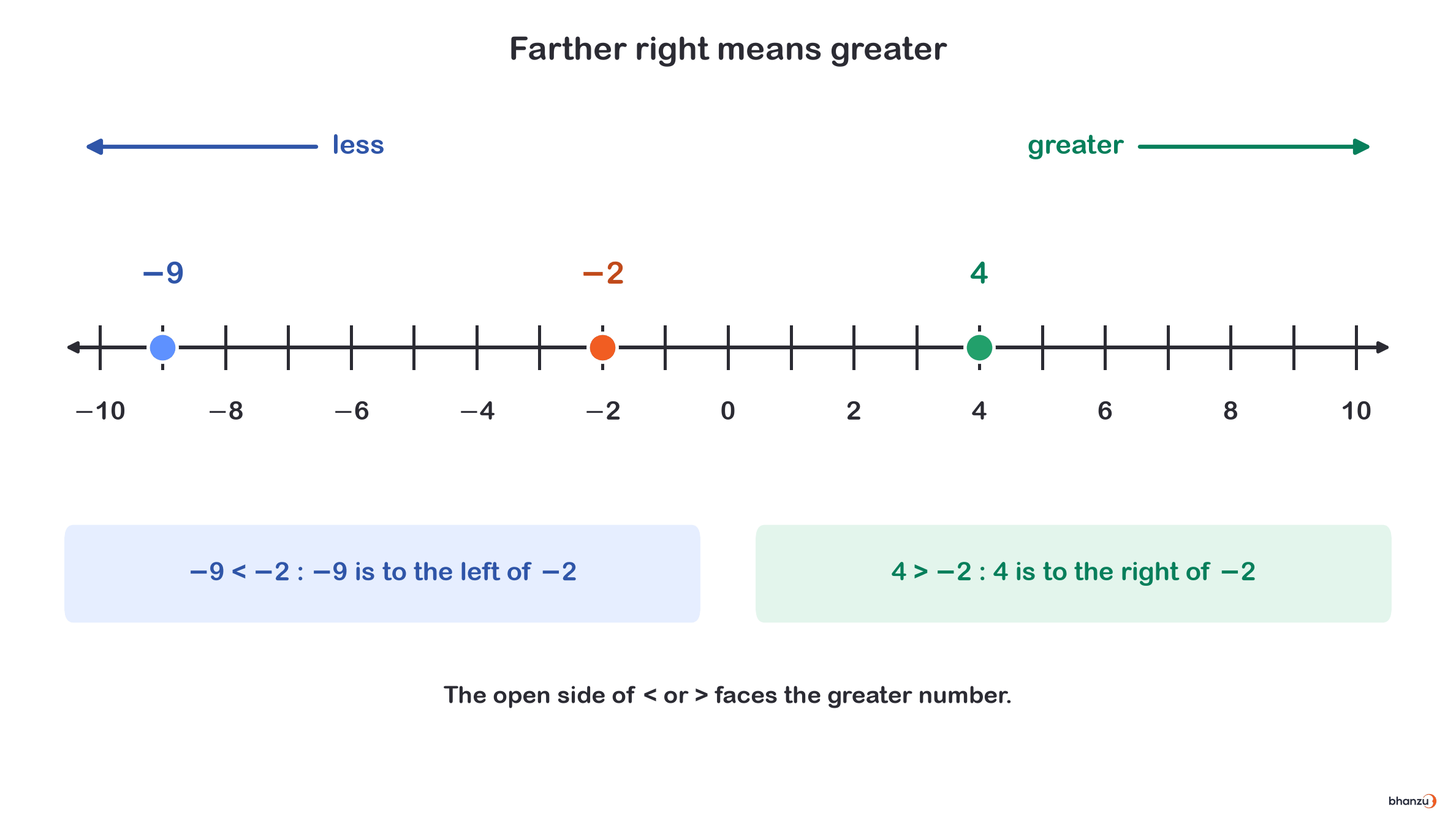
A number line marks 0, with positive numbers to its right and negative numbers to its left. OpenStax's Prealgebra textbook puts the rule in one line, that numbers increase in value as you move from left to right. A statement that compares two numbers with or is an inequality, and the open side of the sign faces the greater number.
| Sign | Read it as | Example |
|---|---|---|
| is less than | ||
| is greater than |
This is Common Core standard 6.NS.C.7. It asks 6th graders to read as a statement that sits to the right of , and to explain order in real situations such as temperature. Your child compared positive fractions in 4th grade and positive decimals in 4th and 5th grade, so the new step in 6th grade is putting negatives and mixed forms into one comparison.
How do you compare two rational numbers on a number line?
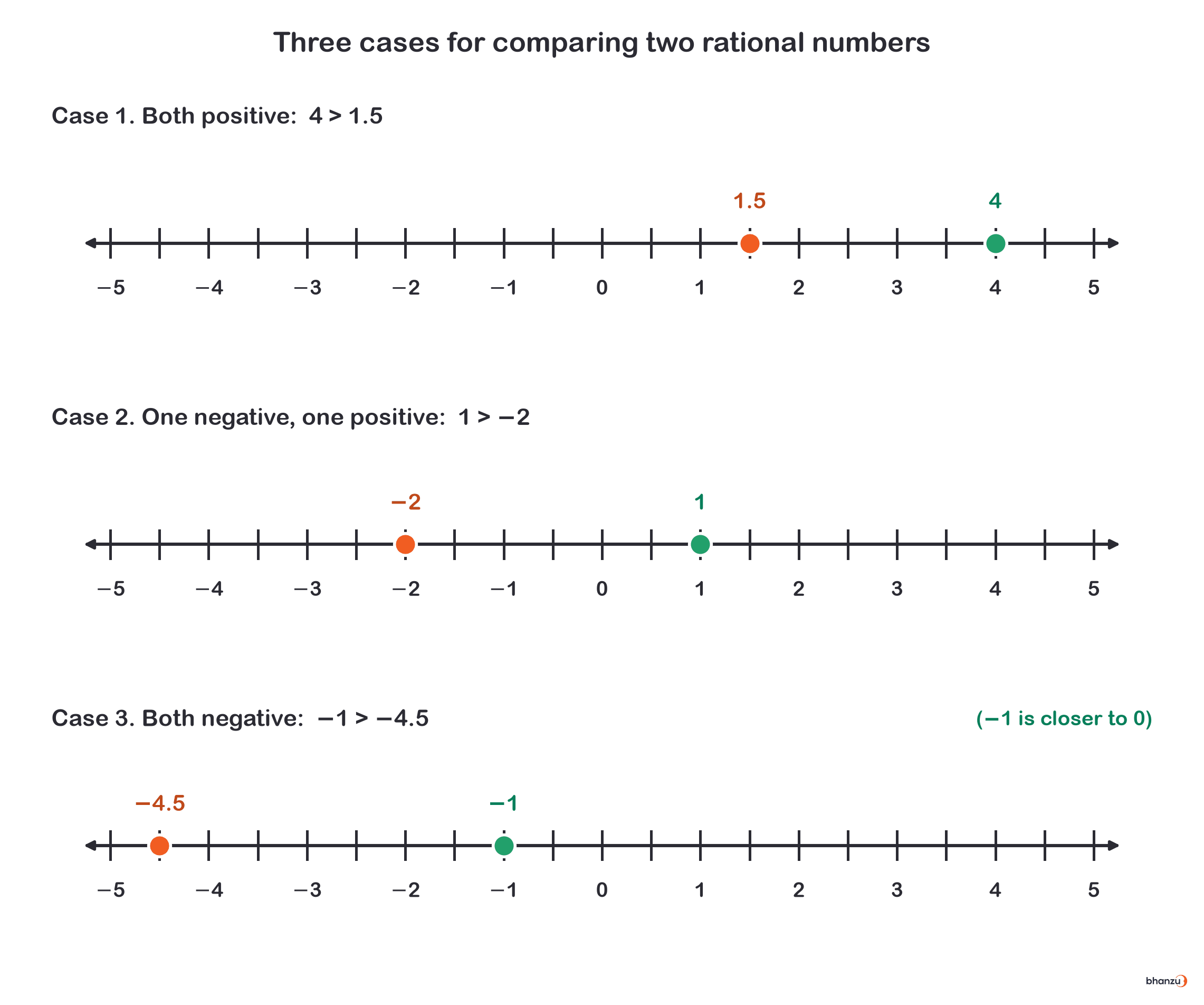
Find both numbers on the number line, and the one farther to the right is greater. Every pair of rational numbers falls into one of three cases.
- Both positive. Compare them as usual, so .
- One negative, one positive. The positive number is greater, because 0 sits between them, so .
- Both negative. The number closer to 0 is greater, so .
Zero fits the same picture, since it is greater than every negative number and less than every positive one.
An inequality is a sentence about position. Both statements below say that sits to the right of , one read from each side.
Is greater than ? Yes. The number is 3 units from 0 and is 5 units away, so sits farther right.
Children who have just met negative numbers often say is more than , because they hear "eight" and "three" before they notice the signs. Some write correctly, then erase it (8 still looks bigger). A ten-second number line sketch settles it.
How do you order fractions, decimals and negatives together?
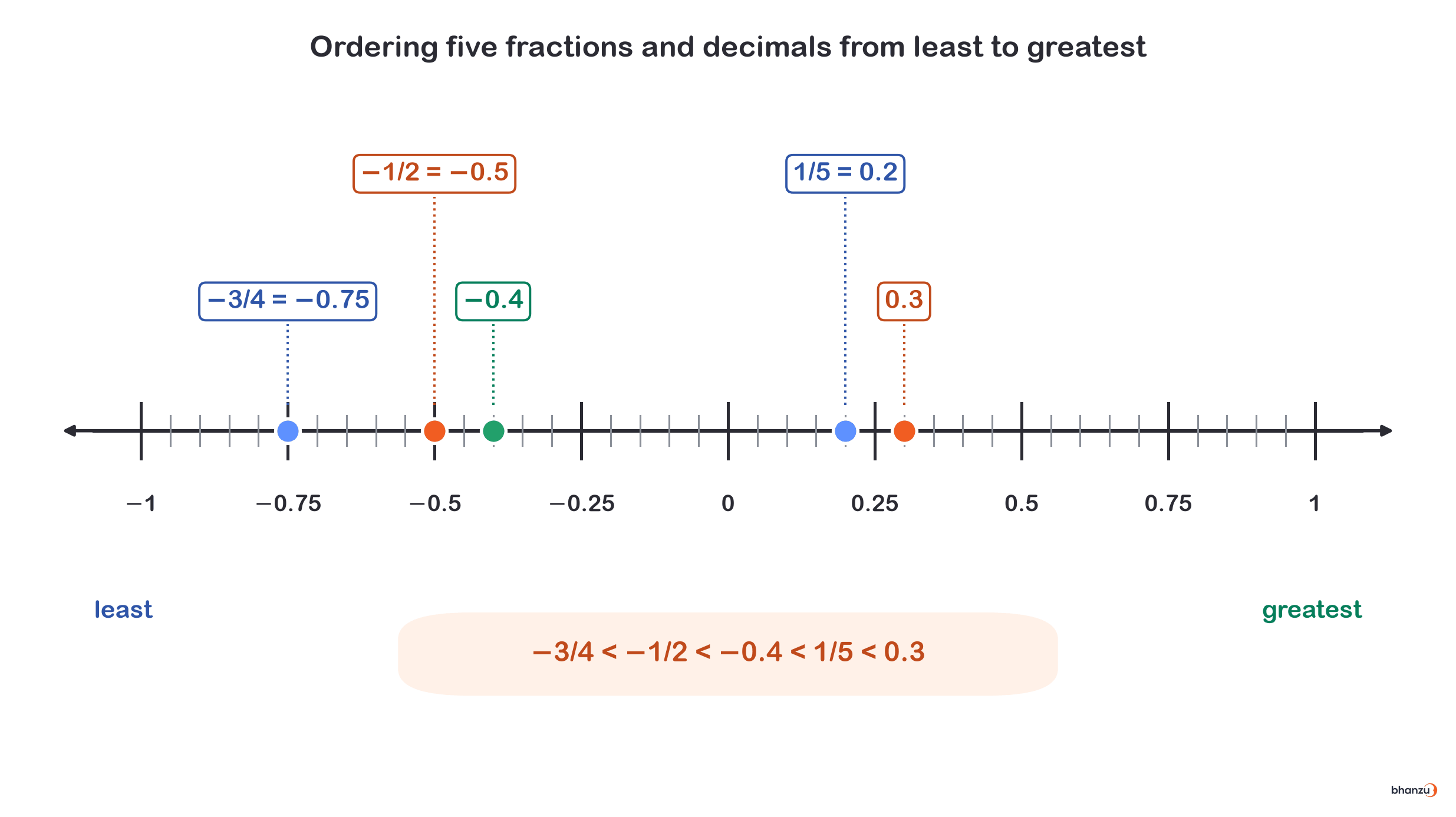
Put every number into the same form, then place the numbers and read them from left to right. Take the list , , , and .
- Write each number as a decimal by dividing the numerator by the denominator, so .
- Split the negatives from the positives, since every negative is less than every positive.
- Order the negatives by distance from 0, farthest first, giving , , .
- Order the positives place by place, as in comparing and ordering decimals, so .
- Write the list in its original forms with between each pair.
| Number as given | Same value in the other form | Side of 0 |
|---|---|---|
| right | ||
| left | ||
| left | ||
| right | ||
| left |
Read the chain backward for greatest to least (textbooks call least to greatest "ascending" and the reverse "descending").
Decimals get awkward with thirds and sixths, because never ends. Use common denominators there instead. With twelfths, and , so is closer to 0 and greater. When the denominators already match, compare the numerators with their signs, so .
How do you write and explain a statement of order?
Write the inequality with its units, then say in words what it means in the situation. Story words tell you which sign to use.
| Words in the problem | Math it means |
|---|---|
| is colder than | |
| A balance of $-$15-$10$ | |
| 60 feet below sea level is lower than 20 feet below sea level | |
| is warmer than |
NASA's Moon facts page, updated in February 2026, puts the Moon at about in full Sun and about in darkness. Both statements say the Moon is colder in darkness.
Notice that is the lesser number yet sits farther from 0 than 260 does (280 units against 260). Order and distance from 0 answer different questions, and the next part of standard 6.NS.C.7 treats distance on its own.
Try It Yourself
Drag each card's dot onto the number line, or tab to a dot and move it with the arrow keys. A dot turns green when it sits exactly at its value, and a hint tells you which way to move one that is off. Once all four dots sit in their right spots, the readout lists the numbers from least to greatest, and New set brings fresh fractions, decimals and negatives.
Where comparing and ordering rational numbers shows up in real life
Ordering exists so that everyone reading the same numbers reaches the same answer about which day was colder or which account owes more. A flipped sign gives the opposite answer.
- It ranks record cold. Montana's 2025 State Climate Summary gives at Rogers Pass in 1954 as the lowest temperature ever observed in the contiguous US. Minnesota's 2025 State Climate Summary lists at Tower on February 2, 1996, and since , Montana's record is colder.
- It reads account balances. A balance of $-$40-$25$, so the first account owes more.
- It compares depths. A diver at feet (12 feet below the surface) is deeper than a diver at feet, because .
The same skill later describes whole ranges, such as every temperature above , which is where inequalities on a number line begin later this year.
Examples of comparing and ordering rational numbers
Example 1
Compare and using or .
The number is left of 0, and is right of 0.
Example 2
Which is greater, or ?
Both are negative, and is 3 units from 0 while is 8 units from 0.
As a check, is warmer than .
Example 3
Which is greater, or ?
The tempting move treats the fractions as positive. Since is more than , it feels as if .
That cannot be right. Rewrite both numbers with the common denominator 12.
Nine twelfths left of 0 is farther left than eight twelfths, so is the lesser number.
The greater number is , and the decimals agree, because is left of on the number line.
Example 4
Order , , , and from least to greatest.
As decimals, the list is , , , and .
The negatives from farthest to closest to 0 are , , , and the positives in order are , .
Example 5
A freezer reads and a second freezer reads . Write an inequality and explain which freezer is colder.
On the number line, sits 3 units to the left of .
The first freezer is colder, and says the same fact from the warmer side.
Example 6
On a winter morning, Maya's thermometer reads , Leo's reads , Priya's reads and Sam's reads . List the readings from warmest to coldest, then compare the two coldest with an inequality.
As decimals, the readings are , , and . Warmest to coldest means greatest to least.
The order is Leo, Sam, Maya, then Priya. The two coldest compare as , so Priya's reading is colder than Maya's.
What most guides get wrong about comparing and ordering rational numbers
Most guides teach negative numbers with integers alone, and the trouble starts once fractions and decimals turn negative.
- Negative decimals need their own practice. In a 2011 study in the Journal of Mathematical Behavior, Widjaja, Stacey and Steinle asked 94 future primary teachers to place negative decimals on a number line. They found two main misconceptions about how the negative side is built. Their advice is to teach negatives with fractions and decimals alongside integers.
- The mirror pattern does the heavy lifting. Opposite numbers sit the same distance from 0 on opposite sides, so the order flips across 0, with but , and but .
- "Bigger" is the wrong word. Say "greater" and "less" for order and "farther from 0" for size, because a child can fairly call bigger than when thinking about size.
That last point is one spot where everyday English and math really do disagree, and adults mix it up too.
Comparing and ordering rational numbers: where intuition breaks
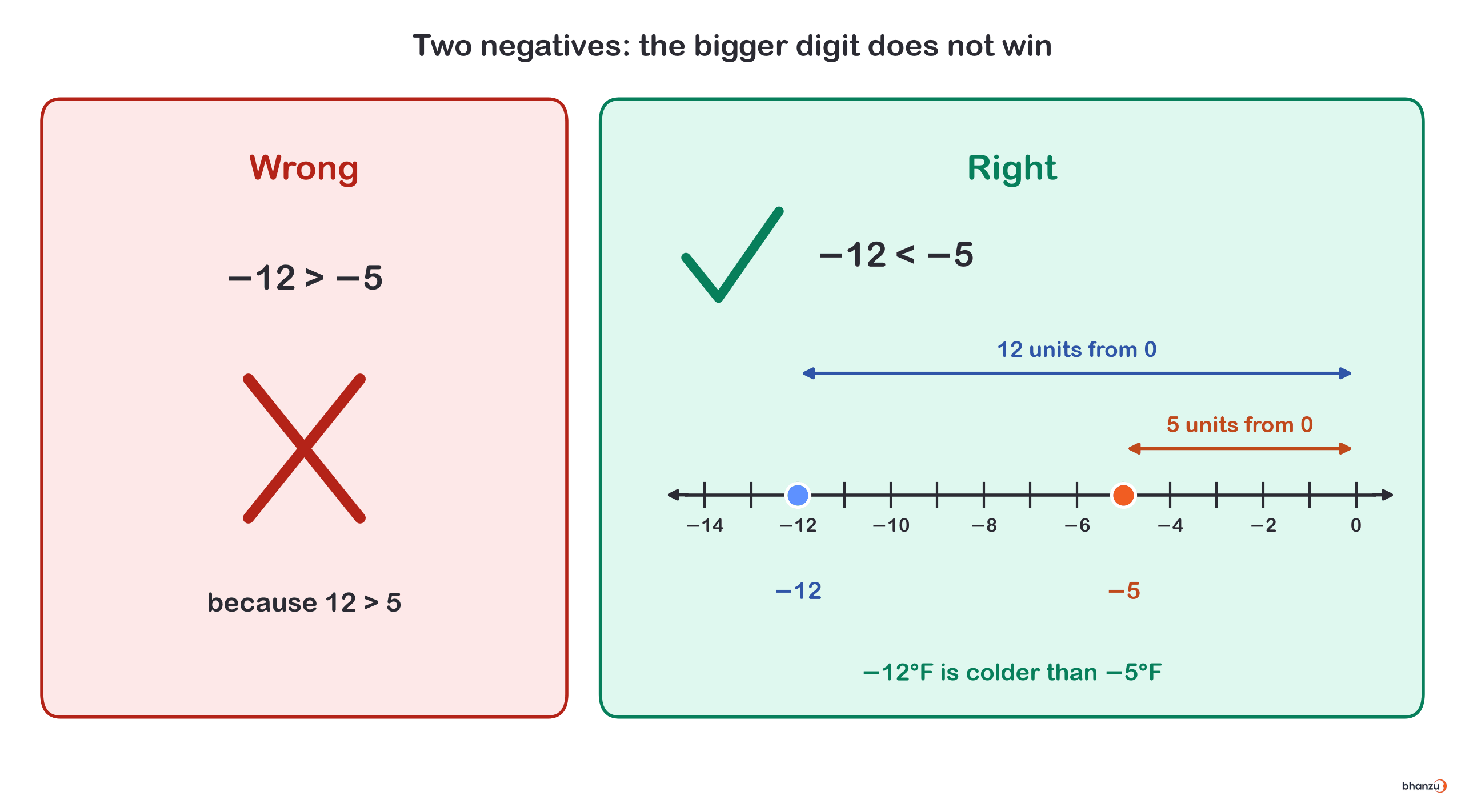
Mistake 1: Letting the bigger digit win with negatives
Where it slips in: Comparing two negative numbers, especially in temperature and money problems like Example 2. A child who rushes sees that 12 is more than 5 and moves on, because for years a bigger digit meant a bigger number.
Don't do this: Writing because .
The correct way: The number is 12 units left of 0 and is only 5 units left, so . A temperature of is colder than .
Mistake 2: Counting the decimal part the wrong way
Where it slips in: Marking a negative decimal such as on a number line, or ordering it against nearby integers.
Don't do this: Starting at , counting 3 tenths to the right and labeling that spot (that spot is really ).
The correct way: Start at and count 3 tenths to the left, toward . The number sits between and , much closer to , because it is 2.3 units from 0.
Children who place 2.3 by starting at 2 and counting right often copy that move on the negative side, starting at the left end of the gap. On the negative side, tenths count away from 0, which means to the left.
Mistake 3: Mixing up less than with smaller in size
Where it slips in: Money and temperature questions that ask which amount is less or which debt is larger. The word "more" pulls children toward the bigger amount of money.
Don't do this: Saying a balance of $-$45-$20$ because $45 is more money.
The correct way: As numbers, . The debt of $45 is still the larger debt, because is farther from 0, and that distance of 45 is its absolute value.
Common Core makes the same point in its own wording, noting that a balance less than dollars means a debt greater than 30 dollars.
Key Takeaways
- To compare any two rational numbers, find their spots on one number line and pick the one farther right.
- With two negatives, ask which one is closer to 0, since that one is greater.
- Before ordering a mixed list, rewrite every value as a decimal, or use common denominators when thirds or sixths would repeat forever.
- Comparing and ordering rational numbers in a story ends with a sentence that says what the inequality means, such as which freezer is colder.
- For more practice from a teacher who catches the habit of letting 12 beat 5 when both numbers are negative, explore Bhanzu's 6th grade math tutor or math classes for kids.
Read More
- Whole Numbers and Integers
- Ordering Rational Numbers and Expressions
- Comparing Fractions with Unlike Denominators
- Decimals on the Number Line
- Rational Number Word Problems
Research Behind This Article
- Common Core State Standards Initiative, Grade 6 The Number System (2010). thecorestandards.org
- OpenStax, Prealgebra 2e, 3.1 Introduction to Integers (2020). openstax.org
- NASA Science, Moon Facts (2026). science.nasa.gov
- North Carolina Institute for Climate Studies, 2025 State Climate Summaries for the United States: Montana (2026). statesummaries.ncics.org
- North Carolina Institute for Climate Studies, 2025 State Climate Summaries for the United States: Minnesota (2026). statesummaries.ncics.org
- Widjaja, W., Stacey, K. and Steinle, V., Locating Negative Decimals on the Number Line: Insights into the Thinking of Pre-Service Primary Teachers (2011). eric.ed.gov
Quick Quiz: Check Yourself
Three levels with new numbers: pick the greater of two integers, compare two negative fractions or find the least of three values, then name the warmest, second warmest or second coldest of four temperatures.
Was this article helpful?
Your feedback helps us write better content
Frequently Asked Questions
How do you compare fractions?
Is 0 bigger or smaller than ?
Is 0 a rational number?
What grade are negative numbers introduced?
How can my child practice comparing and ordering rational numbers at home?
Can you compare rational and irrational numbers?