Key Points
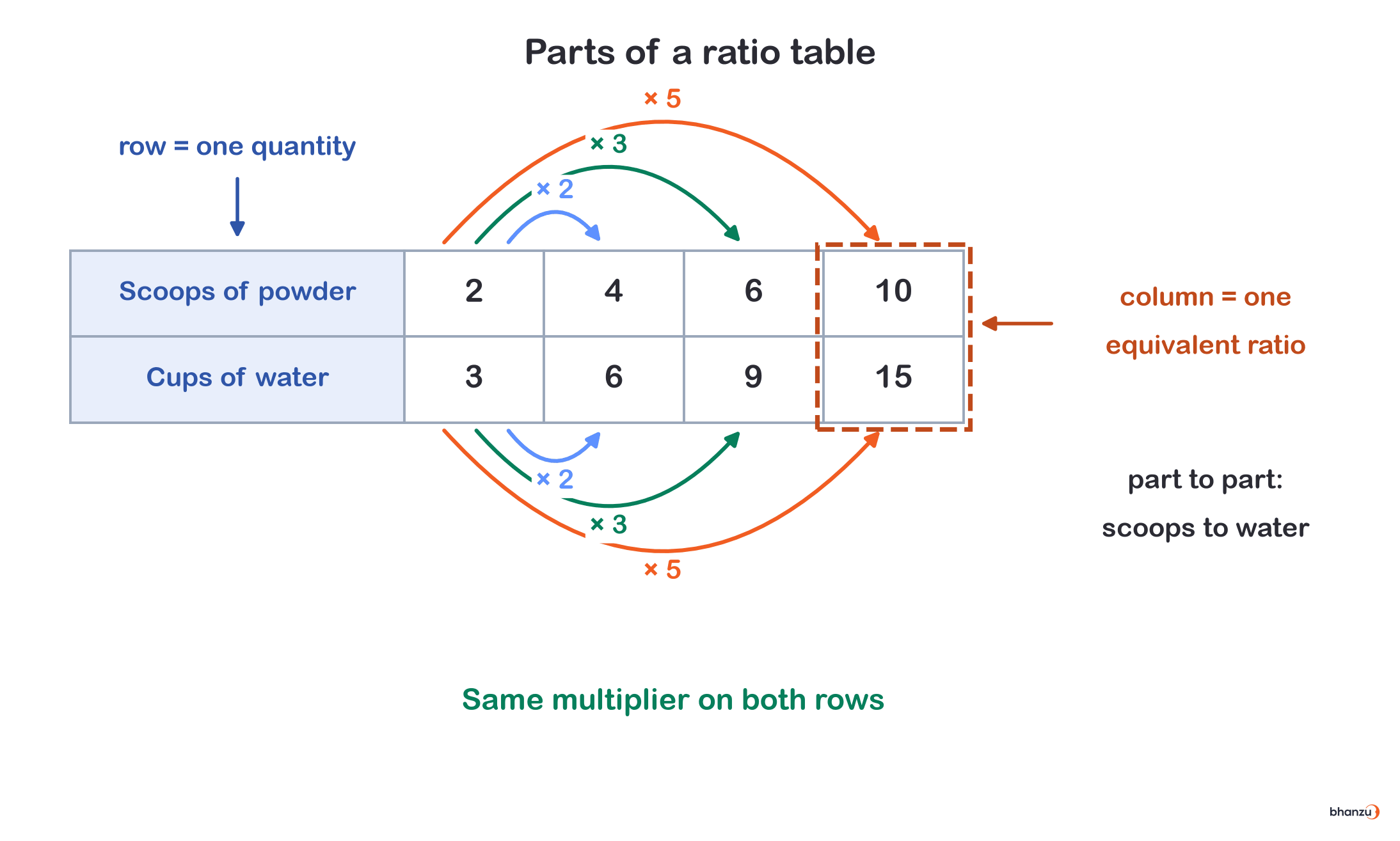
- Ratio tables put one quantity in each row and one equivalent ratio in each column, so 2 scoops to 3 cups sits beside 4 to 6.
- A missing value comes from doing one move to both rows, such as multiplying, dividing or adding two finished columns together.
- A common slip is adding the same number to both rows, which turns 3 to 5 into 6 to 8 instead of the correct 6 to 10.
- Common Core standard 6.RP.A.3.a asks 6th graders to complete ratio tables and compare ratios with them, and comparing works by stretching both tables until one row matches.
Sixteen laps of Earth in one day
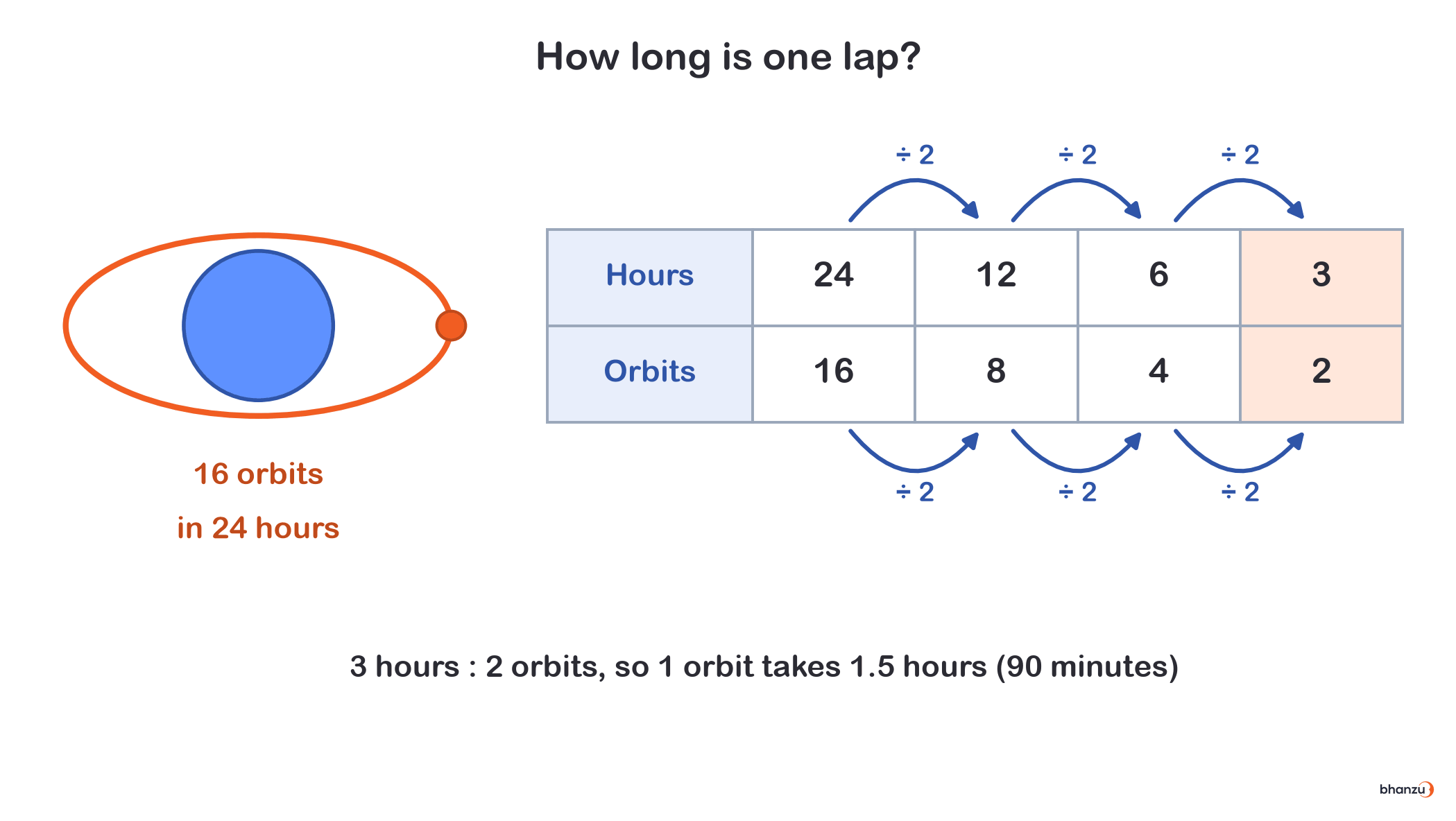
The space station laps Earth 16 times between one breakfast and the next. NASA lists it as 16 orbits in 24 hours, and those two numbers hide a puzzle about how long one lap takes. Long division isn't needed. Keep halving both numbers, and the pairs 24 and 16, 12 and 8, 6 and 4, and finally 3 and 2 appear.
Restaurant cooks use the same scaling to turn a 4-serving recipe into 40 servings, and mapmakers use it so 1 centimeter on paper stands for 5 kilometers of road. The tool that keeps those pairs in order is a ratio table.
What is a ratio table?
Ratio tables are grids of equivalent ratios, which are pairs of numbers that describe the same relationship at different sizes, with one quantity in each row and one pair in each column. A ratio compares two amounts, such as 2 scoops of lemonade powder for every 3 cups of water, and because both amounts are parts of the drink, it is a part to part ratio. Equivalent ratios such as 2 to 3 and 4 to 6 describe the same lemonade, one batch twice the size of the other.
| Scoops of powder (part) | 2 | 4 | 6 | 10 |
|---|---|---|---|---|
| Cups of water (part) | 3 | 6 | 9 | 15 |
Each column is the first one with both rows multiplied by the same number, 2 for the second column, 3 for the third and 5 for the last. A table can also run down the page, and then "both rows" means both columns.
NASA's space station facts (updated July 2024) give 16 orbits in 24 hours. Halving both numbers three times gives 2 orbits in 3 hours, or one orbit every 90 minutes, which matches NASA's own figure.
Your child meets this in Common Core standard 6.RP.A.3.a, which asks 6th graders to make tables of equivalent ratios with whole-number amounts and find missing values in them. The same standard adds comparing ratios with tables and plotting each pair on a coordinate plane.
How do you find missing values in a ratio table?
To find a missing value in a ratio table, work out what turns a known number into the target in one row, then do the same thing to the other row.
- Write the ratio you know as the first column, and label each row.
- In the row with the target, find what turns the start into it.
- Do the same thing to the other row.
- Check that bottom divided by top gives the same answer in every column.
A child who rushes often fills the whole top row first and then guesses the bottom row. Finishing each column, top and bottom, before starting the next one stops that.
Building up is where ratio tables get clever. From 4 pencils for $6, a few easy moves reach 48 pencils without ever multiplying by 12.
| Move on pencils and cost | Pencils | Cost |
|---|---|---|
| Start | 4 | $6 |
| Halve the start | 2 | $3 |
| Double the start | 8 | $12 |
| Multiply the start by 10 | 40 | $60 |
| Add the 40 and 8 columns | 48 | $72 |
Multiplying both quantities by 10 is multiplication as scaling applied to the whole order.
Building up gets slow when the target isn't a handy multiple, such as 7 pencils from 4. Go down to 1 first. Dividing both by 4 gives 1 pencil for $1.50, the unit rate (the amount for exactly one of something), and multiplying both by 7 gives $10.50. With several gaps, complete the easiest one first and use it as a stepping stone.
Try It Yourself
Set a starting ratio with the plus and minus buttons, then drag the slider to multiply both rows by the same number. The orange column and the double number line fill in together. Tap Add 3 to both, and a red column appears whose marks no longer line up.
How do you compare ratios using tables?
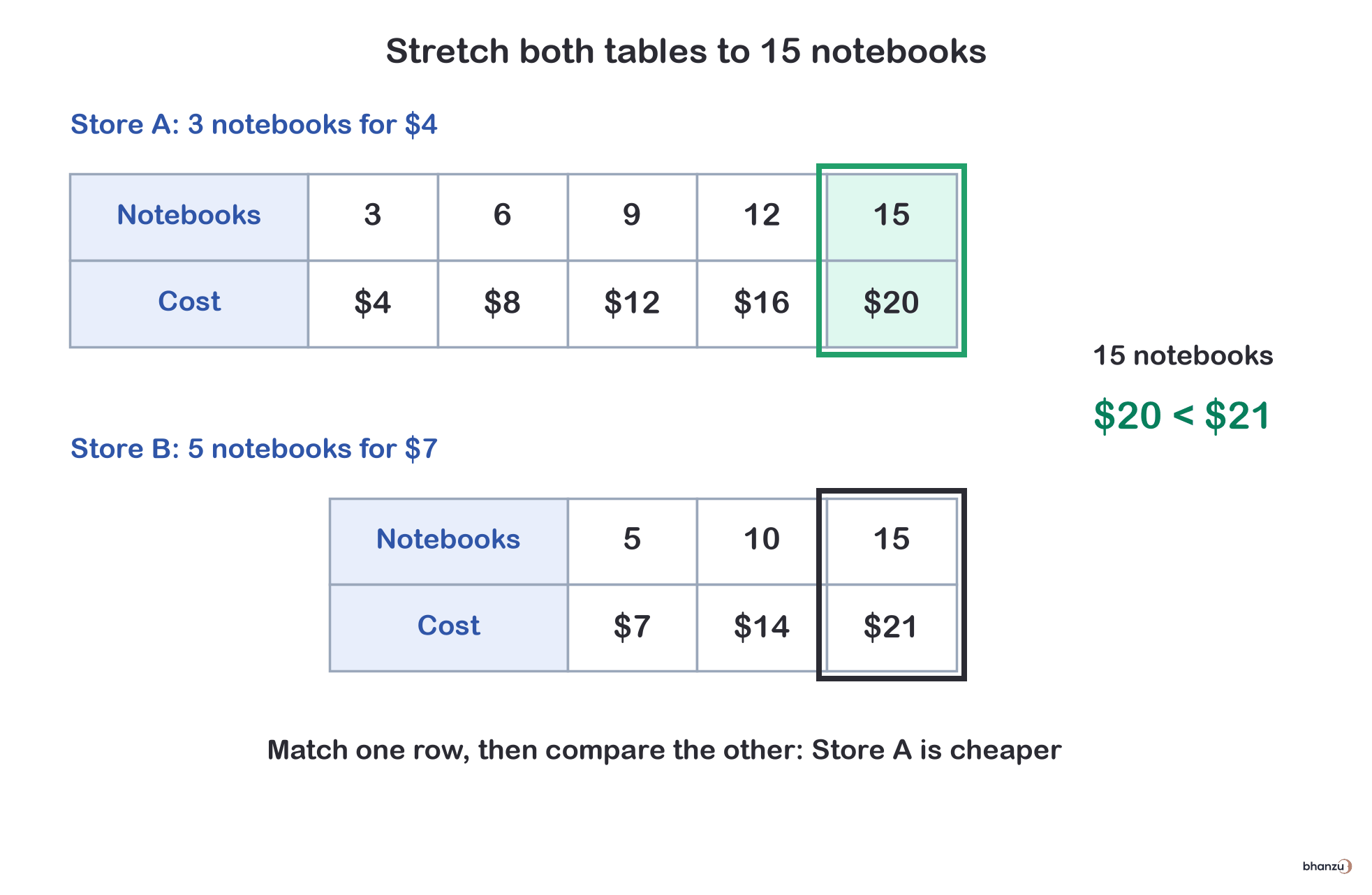
To compare two ratios with tables, stretch both tables until one row shows the same number, then compare the other row. Store A sells 3 notebooks for $4, and Store B sells 5 notebooks for $7. Both 3 and 5 multiply up to 15.
| Store | Starting ratio | Multiply both rows by | Notebooks | Cost |
|---|---|---|---|---|
| Store A | 3 for $4 | 5 | 15 | $20 |
| Store B | 5 for $7 | 3 | 15 | $21 |
Fifteen notebooks cost $20 at Store A and $21 at Store B, so Store A is cheaper. Matching a row makes the comparison fair.
Word problems hide these moves inside ordinary phrases.
| Words in the problem | Math it means |
|---|---|
| "3 notebooks for $4" | the ratio , notebooks to dollars |
| "the same shade" or "the same recipe" | an equivalent ratio (the same move on both rows) |
| "which store is cheaper" | stretch both tables to a shared row, then compare the other row |
| "flour comes in 5-cup bags" | divide the total cups of flour by 5 |
A double number line puts the same pairs on two lined-up number lines, with 3 notebooks above $4. Each column can also become a point such as (3, 4), which is where ratios on the coordinate plane begin.
Examples of ratio tables
Example 1
A lemonade mix uses 2 scoops of powder for every 3 cups of water. How many cups of water go with 14 scoops?
| Scoops of powder | 2 | 14 |
|---|---|---|
| Cups of water | 3 | ? |
The ? is the water for 14 scoops.
Multiply both rows by 7, since and .
14 scoops go with 21 cups of water.
Example 2
A paint shade uses 3 cups of blue for every 5 cups of white. How much white goes with 6 cups of blue?
The tempting move is to see that 3 + 3 = 6 and add 3 to the white row too, giving 5 + 3 = 8 cups of white.
That can't be right. Doubling the blue doubles the whole batch, and double 5 cups is 10, not 8, so 6 to 8 would come out a darker shade.
Multiply both rows by 2 instead, so blue becomes and white becomes .
6 cups of blue go with 10 cups of white.
Example 3
At a school store, 12 erasers cost $8. How many erasers can $10 buy at the same price?
| Move on erasers and cost | Erasers | Cost |
|---|---|---|
| Start | 12 | $8 |
| Divide both by 2 | 6 | $4 |
| Divide both by 2 again | 3 | $2 |
| Add the 12 and 3 columns | 15 | $10 |
$10 buys 15 erasers.
Example 4
NASA says the space station makes 16 orbits of Earth in 24 hours. How many orbits does it make in 9 hours?
| Move on hours and orbits | Hours | Orbits |
|---|---|---|
| Start | 24 | 16 |
| Divide both by 2 three times | 3 | 2 |
| Multiply both by 3 | 9 | ? |
The ? is the orbits in 9 hours.
After halving three times, multiply both by 3, since hours and orbits.
The station makes 6 orbits in 9 hours.
Example 5
Maya mixes 2 cups of orange juice with 5 cups of sparkling water. Leo mixes 3 cups of orange juice with 7 cups of sparkling water. Whose drink tastes more strongly of orange?
| Juice to water (part to part) | Maya | Leo |
|---|---|---|
| Multiply both rows by | 3 | 2 |
| Cups of juice | 6 | 6 |
| Cups of water | 15 | 14 |
With 6 cups of juice in each, Leo's 14 cups of water is less than Maya's 15, so Leo's drink tastes more strongly of orange.
Example 6
A recipe makes 12 muffins with 4 cups of flour. The class needs 30 muffins, and flour comes in 5-cup bags. How many bags are needed?
| Muffins | 12 | 6 | 30 |
|---|---|---|---|
| Cups of flour | 4 | 2 | ? |
The ? is the flour for 30 muffins.
Divide both rows by 2 to get 6 muffins for 2 cups.
Multiply both rows by 5 to get 30 muffins for 10 cups.
Divide the 10 cups by the 5 cups in each bag, so .
The class needs 2 bags of flour.
Check: each muffin uses cup, and cups.
Why do ratio tables work?
Ratio tables work because every column describes the same "for every" relationship at a different size. Multiplying or dividing both rows by one number (any number except 0) changes the size of the batch and leaves the mix alone.
- It keeps a recipe tasting the same. Doubling 2 scoops to 3 cups gives 4 to 6, and every glass matches the original.
- It converts units. The US standards agency NIST lists 1 inch as exactly 2.54 centimeters in its SI guide (updated August 2025), so a table starting at 1 to 2.54 reaches 50 inches for 127 centimeters.
- It sets up 7th grade. The multiplier shared by every column, from top row to bottom row, becomes in the equation .
Researchers who followed 315 children aged 5 to 8 found proportional reasoning starting at a very early age, in fair-sharing tasks, before school had taught it (Vanluydt, Verschaffel and Van Dooren, 2022). A ratio table gives that early sense of fair shares a tidy place to live.
The pattern hiding inside ratio tables
Add the 4 to 6 column to the 2 to 3 column and you get 6 to 9, which still belongs in the lemonade table. Columns in a ratio table can be added like that, but adding one number to both rows changes the mix (unless the two rows start equal, as in 4 to 4). The shared multiplier explains both facts: the 4 to 6 column is 2 to 3 times 2, and 6 to 9 is 2 to 3 times 3. Adding 3 to both rows of 2 to 3 gives 5 to 6 instead, where the water is 1.2 times the powder rather than 1.5 times.
Read top over bottom, each column is also an equivalent fractions fact.
| Column (scoops to cups, part to part) | As a fraction | Simplest form |
|---|---|---|
| 2 to 3 | ||
| 4 to 6 | ||
| 10 to 15 |
One distinction confuses even confident readers. The fraction compares scoops to water, so it does not mean two thirds of the glass is powder (the powder is 2 of the 5 parts).
Middleton and van den Heuvel-Panhuizen (1995) described the ratio table as an alternative to cross-multiplication that keeps track of the operations and their results. That record is the best case for learning the table before any shortcut.
Common errors when working with ratio tables
Mistake 1: Adding the same number to both rows
Where it slips in: Filling a new column when the top row seems to go up by a fixed amount, as in Example 2.
Don't do this: Turning 3 cups of blue to 5 cups of white into 6 to 8 by adding 3 to both rows.
The correct way: Multiply both rows by 2, so 3 to 5 becomes 6 to 10.
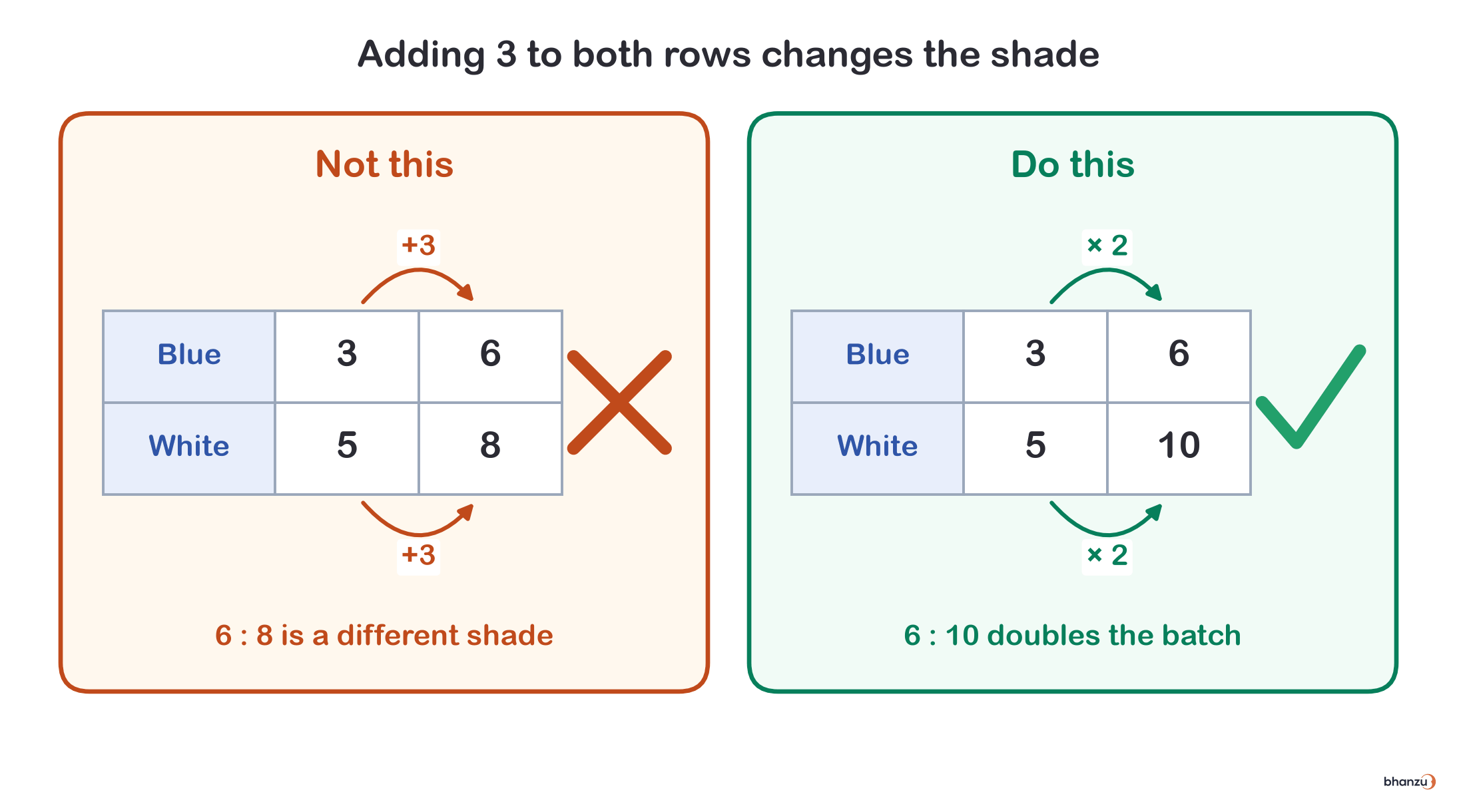
In the top row, 3 + 3 and both give 6, so the slip looks right until someone checks the bottom row. Adding is also the move children trust first. A 2018 study of 279 fifth and sixth graders found additive reasoning used more often than multiplicative reasoning, and more so in fifth grade.
The bottom-over-top check catches it, since 10 is of 6 (as 5 is of 3), but 8 is only of 6.
Mistake 2: Swapping which row is which
Where it slips in: Word problems that name the quantities in a new order, such as a recipe with 3 cups of water for every 2 scoops.
Don't do this: Writing scoops 3 and water 2, then answering 4 cups of water for 6 scoops.
The correct way: Label the rows from the sentence first, water 3 and scoops 2. Six scoops is 2 times 3, so the water is 3 times 3, or 9 cups.
A child who copies numbers in the order they appear can multiply perfectly and still answer the wrong question, because unlabeled numbers look reasonable. Row labels written before any number remove the problem.
Mistake 3: Comparing the bigger numbers instead of matching a row
Where it slips in: Deciding which mix is stronger or which deal is better, as in Example 5.
Don't do this: Saying Leo's drink must be weaker because his 7 cups of water is more than Maya's 5.
The correct way: Match the juice row first. At 6 cups of juice, Maya's table shows 15 cups of water and Leo's shows 14, so Leo's drink is stronger.
A bigger number feels like more of everything, and a child who second-guesses a correct comparison often swaps it here for the "bigger number wins" answer.
Key Takeaways
- Whatever you do to one row of a ratio table, do to the other row in the same column.
- Two whole columns may be added to make a new column, but adding one number to both rows creates a different mix unless the rows started equal.
- When two ratios need comparing, make one row match before you look at the other row.
- Write the row labels first, in the order the problem names the quantities.
- For more practice with ratio tables and the matching-row step for comparing deals, explore Bhanzu's 6th grade math curriculum or a middle school math tutor.
Read More
- Part-Part-Whole Ratio Problems
- Finding the Percent of a Number
- Equations of Proportional Relationships
- Ratio Formula
- Math Word Problems
Research Behind This Article
- NASA, Space Station Facts and Figures (2024). nasa.gov
- Common Core State Standards Initiative, Ratios and Proportional Relationships, 6.RP.A.3 (2010). thecorestandards.org
- National Institute of Standards and Technology, NIST Guide to the SI, Appendix B.9: Factors for Units Listed by Kind of Quantity or Field of Science (2025). nist.gov
- Vanluydt, Verschaffel and Van Dooren, The Early Development of Proportional Reasoning: A Longitudinal Study of 5- to 8-Year-Olds, Journal of Educational Psychology (2022). eric.ed.gov
- Middleton and van den Heuvel-Panhuizen, The Ratio Table, Mathematics Teaching in the Middle School (1995). eric.ed.gov
- Degrande, Van Hoof, Verschaffel and Van Dooren, Open Word Problems: Taking the Additive or the Multiplicative Road?, ZDM (2018). eric.ed.gov
Quick Quiz: Check Yourself
Three levels, new numbers every time: scale a ratio up to fill one missing value, divide down and multiply up to find a trickier one, then compare two deals or solve a two-step recipe problem.
Was this article helpful?
Your feedback helps us write better content
Frequently Asked Questions
How do you do ratio tables in 6th grade?
How do you teach ratio tables at home?
Should my child use a ratio table calculator?
Is a ratio table the same as a direct proportion?
Where can I find ratio table word problems with answers?