Key Points
- Finding the whole from a percent starts from two given numbers, a part and its percent, and belongs to Common Core standard 6.RP.A.3.c.
- The unit-percent chain divides down to 10% and multiplies up to 100%, so if 30% of a number is 12, then 10% is 4 and the whole is 40.
- The most common mistake is multiplying the part by the percent, which turns 18 students who are 60% of a class into 10.8 students, fewer than the part.
- Any whole can be checked by taking its percent, because 30% of 40 has to give back the part, 12.
A progress bar that hides the total
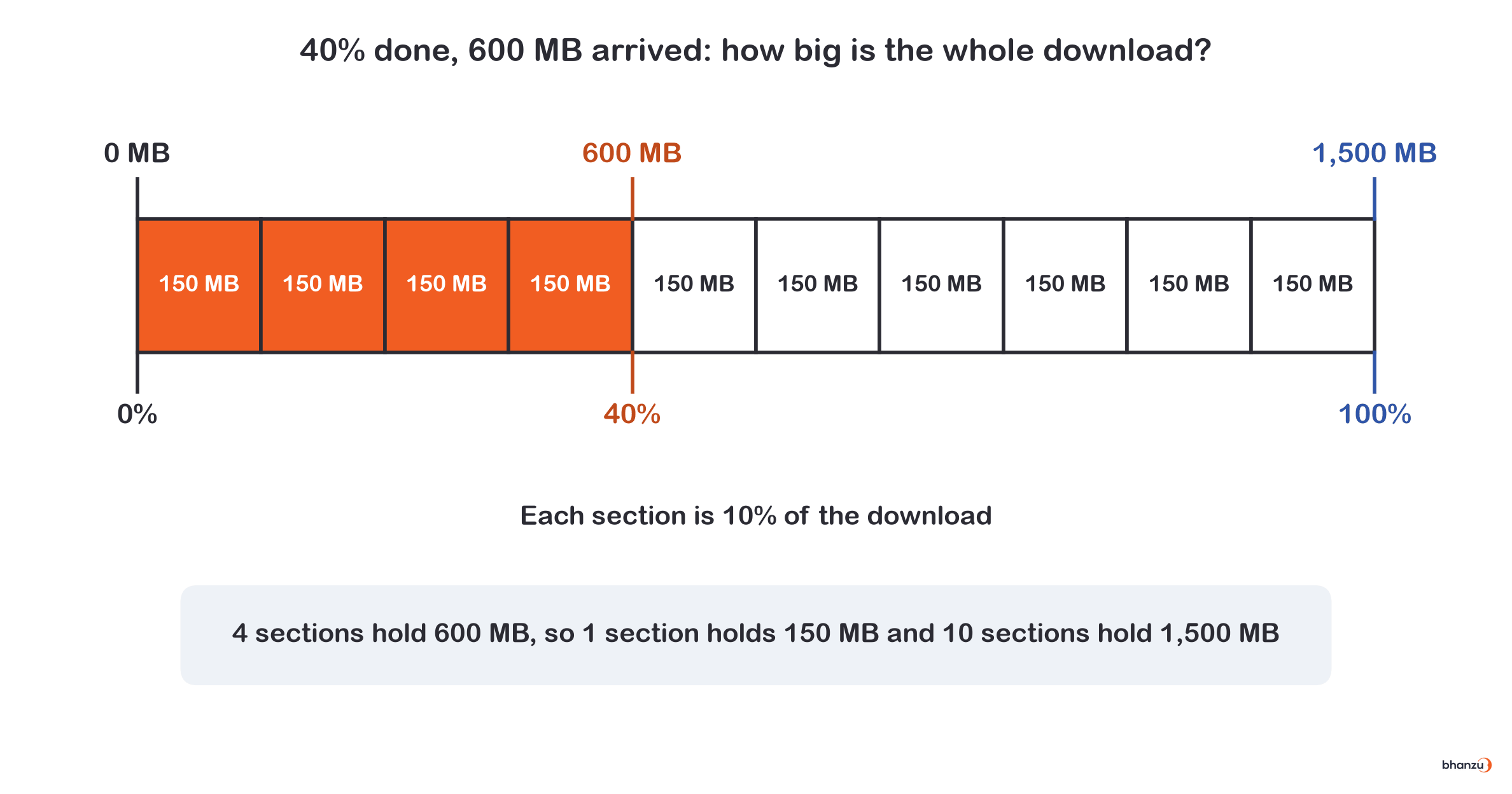
Your game update reads 40% done, and 600 megabytes have arrived. The bar never shows the full size of the download. Split it into 10 equal sections of 10%, and four sections hold 600 megabytes, so one holds 150 and all ten hold 1,500.
Working back from one known slice to a hidden total reaches far past video games. NOAA's National Ocean Service, on a page updated in September 2026, puts about 97 percent of Earth's water in the ocean, so a measured ocean leads to the planet's total. The same backward step reads a food label in reverse and turns a survey's percent back into the number of people asked.
How do you find the whole from a percent?
Finding the whole from a percent works by scaling a known part up to 100%, either through what 10% is worth or by dividing the part by the percent as a decimal. The part is the amount you are given, and the whole is the full amount, the 100%. A percent is a rate per 100, so 30% means 30 for every 100.
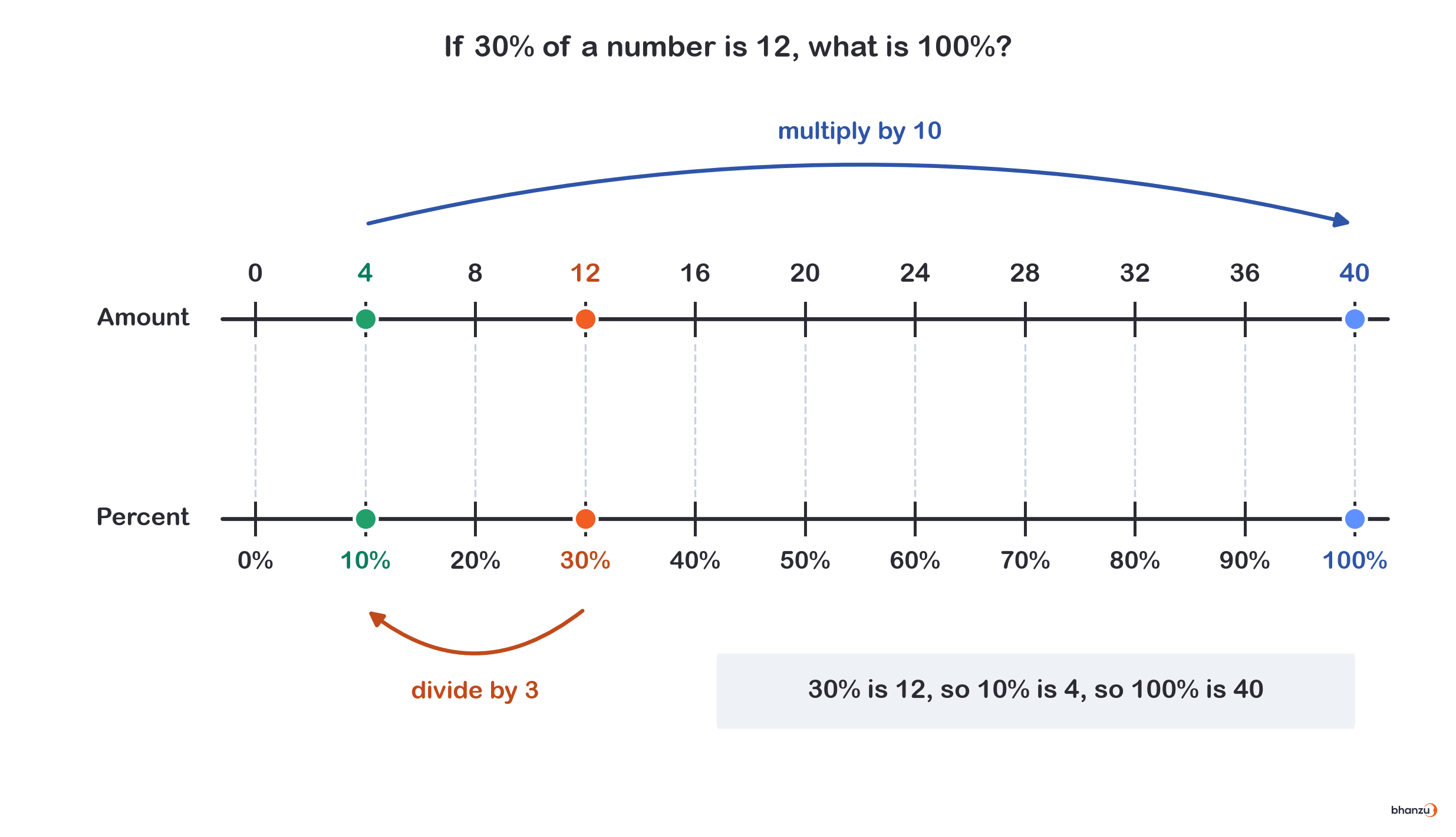
Suppose 30% of a number is 12. A ratio table walks down to 10% and back up to 100%.
| Percent (part to whole) | Amount |
|---|---|
| 30% | 12 |
| 10% | 4 |
| 100% | 40 |
Your child meets this skill in 6th grade. Common Core standard 6.RP.A.3.c asks students to "solve problems involving finding the whole, given a part and the percent" by reasoning with ratio tables, tape diagrams, double number lines or equations. The word percent means "per 100," from centum, the Latin word for hundred.
How does a double number line show the whole?
A double number line shows the whole by pairing every percent with its amount, so the amount sitting above the 100% tick is the answer. It is two number lines that share tick marks, with percents on the bottom and amounts on top.
- Label the bottom line 0% and 100%, and write 0 and a question mark at the ends of the top line.
- Mark the percent you know and write its part above it, here 30% and 12.
- Divide down to a friendly unit percent (usually 10%, 5% or 1%). Since 30% divided by 3 is 10%, divide 12 by 3 to get 4.
- Multiply up to 100%. Ten groups of 10% make 100%, so multiply 4 by 10 to get 40.
- Check by going forward, since , the part you started with.
A second case, 35% is 28, needs a different unit. Both 35 and 100 are multiples of 5, so use 5% as the unit. Dividing 35% by 7 gives 5%, and . Twenty groups of 5% make 100%, so the whole is .
Some percents turn the chain into one multiplication once you know their fraction form, which is where fractions, decimals and percentages meet.
| Percent | Fraction | Decimal | Multiply the part by |
|---|---|---|---|
| 10% | |||
| 20% | |||
| 25% | |||
| 50% | |||
| 75% |
This unit-percent chain, dividing down to a unit and multiplying up, gets slow for percents like 37% that share no friendly factor with 100. A tape diagram (one bar cut into equal boxes) works the same way, and the Common Core progressions document blends both models for percent problems. The What Works Clearinghouse guide for grades 4 through 8 backs teaching visual representations like these.
Try It Yourself
Drag the handle on the bottom line to pick a percent, then use the plus and minus buttons to change the part sitting above it. Predict the whole, press Show the whole, and watch the tick marks fill in up to 100% as the ratio table completes. Notice that the whole always lands farther along the top line than the part.
Which percent problem is this one?
A basic percent problem links three numbers, the part, the whole and the percent, and the question hides one of them. Spotting which one is missing comes before any arithmetic.
| What is missing | The question | Answer |
|---|---|---|
| The part | 30% of 40 is what number? | 12 |
| The whole | 30% of what number is 12? | 40 |
| The percent | What percent of 40 is 12? | 30% |
The first row is finding the percent of a number, which multiplies. The last row asks what percent one number is of another. Only the middle row asks for the whole.
A missing whole shows up as a percent and its matching amount, then a question about the total, the goal or the original number. A child who rushes to the answer tends to grab the two numbers in the story and multiply them before checking which one is missing.
| Words in the problem | Math it means |
|---|---|
| "is" | equals |
| "of" | times |
| "what number" or "how many in the class" | the unknown whole, |
| "goal", "full", "price" or "total" | the whole, 100% |
| "how many more" | subtract the part from the whole |
How do you find the whole with division?
To find the whole, divide the part by the percent written as a decimal.
| Symbol | Meaning | Units |
|---|---|---|
| part | the amount you know | same unit as the whole |
| the percent number, such as 30 for 30% | percent | |
| the percent as a decimal, such as 0.30 | no unit | |
| whole | the full amount, 100% | same unit as the part |
The rule works because "30% of the whole is 12" means , and division undoes multiplication.
The OpenStax Prealgebra 2e textbook writes percent problems as an equation with a letter for the unknown. Let stand for the whole.
Divide both sides by 0.30.
Moving both decimal points two places to the right turns into , the same move you use when dividing decimals, so . In 7th grade you'll solve two-step equations such as , which add one more step to this one.
A third method writes the ratios as a proportion, an equation that says two ratios are equal.
Since and , the whole is . Division handles any percent except 0%, so it is the method to fall back on.
Examples of finding the whole from a percent
Example 1
25% of a number is 9. What is the number?
25% is , so 9 is one of four equal parts of the whole.
The number is 36. Check that .
Example 2
18 students are 60% of a class. How many students are in the class?
The tempting move is to multiply the two numbers.
That answer cannot be right. A class cannot hold 10.8 students, and the whole class cannot be smaller than the 18 students who are part of it.
Work back from 60% instead. Dividing 60% by 6 gives 10%, so 10% of the class is students.
The class has 30 students. Check that .
Example 3
A water bottle is 35% full and holds 280 mL right now. How much does it hold when full?
Draw a tape of 20 equal boxes, each worth 5%. Then 35% is 7 boxes holding 280 mL.
Each box holds 40 mL, and the full bottle is 20 boxes.
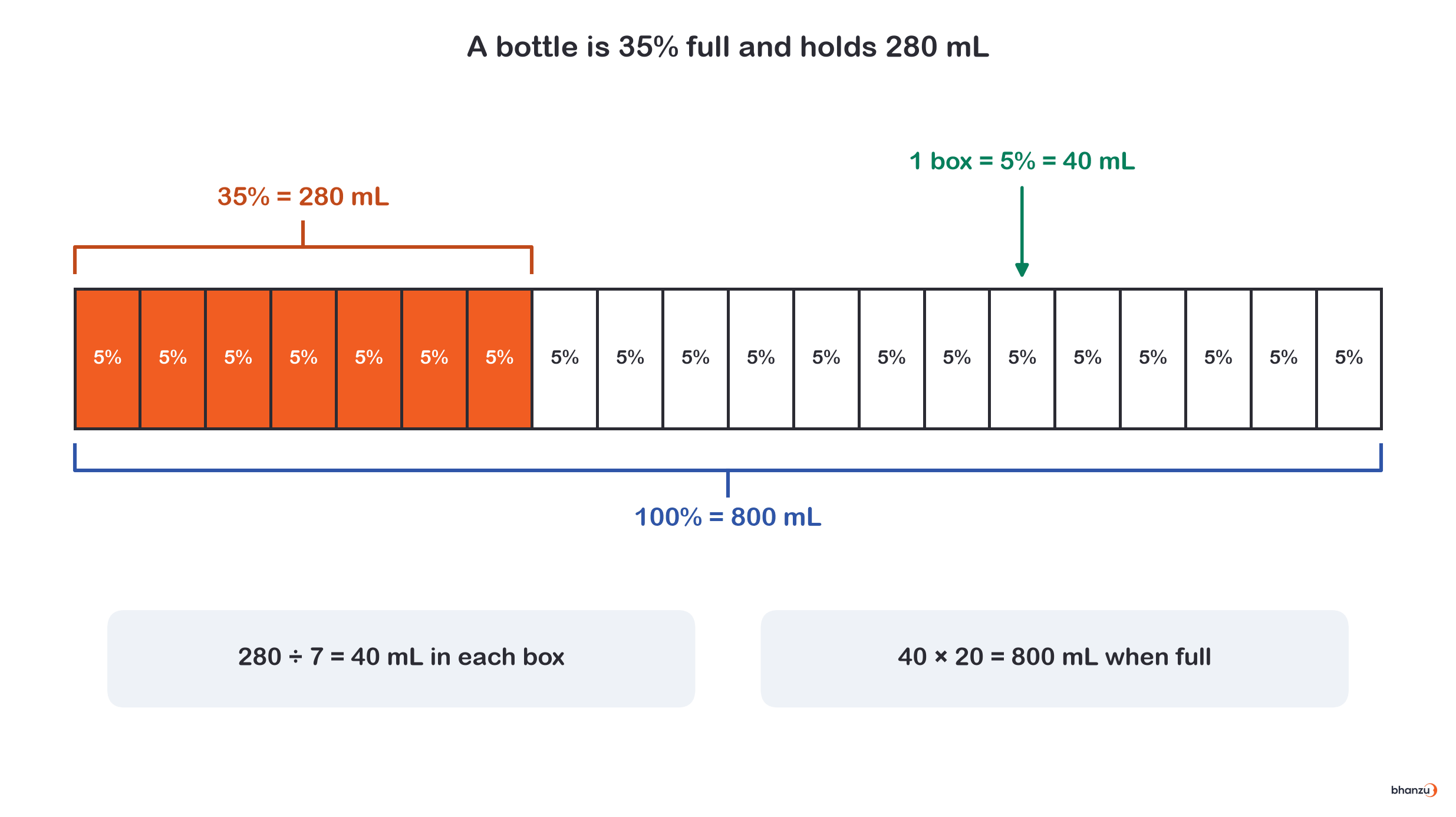
The full bottle holds 800 mL. Check that .
Example 4
Leo has saved $4.50, which is 15% of the price of a board game. What is the price?
Divide the part by the percent as a decimal.
The board game costs $30. Check that .
Example 5
Which is bigger, the number that 16 is 40% of or the number that 27 is 90% of?
The first whole, 40, is bigger, even though 27 is the bigger part. A smaller percent needs more copies of itself to reach 100%.
Example 6
A class collected 126 cans for a food drive, which is 84% of its goal. How many more cans does it need to reach the goal?
Let stand for the goal, the whole.
Divide both sides by 0.84.
Then subtract the 126 cans the class already collected from the goal.
The class needs 24 more cans. Check that 24 is the missing 16%, since .
Why dividing by the percent works
Dividing by the percent works because it undoes the multiplication that "percent of" stands for.
- It reverses "percent of" exactly. Taking 30% of a number multiplies it by 0.30, so getting the number back means dividing by 0.30.
- It makes the answer bigger, as it should. Dividing by a number less than 1 counts how many small pieces fit, so is larger than 12.
- It explains the divide-by-100 step. A percent is a rate per 100, so 30% becomes before you divide by it.
- It matches the picture. Dividing 12 by 0.30 gives the same 40 as dividing by 3 and multiplying by 10, the path on the double number line.
- It reads a food label backward. The FDA's Daily Value guide, current as of March 2024, sets the Daily Value for iron at 18 mg, and a cereal listing 3.6 mg of iron as 20% fits, since .
Every reason comes back to one idea, that "percent of" means times, so finding the whole means dividing. In 7th grade the same division recovers an original price after a discount.
What teachers watch for in finding the whole from a percent
Teachers watch for two things beyond the steps themselves, and the first is a two-second size check. Whenever the percent is under 100%, the whole has to be bigger than the part, so an answer smaller than the part means a multiplication that should have been a division. A child who second-guesses a right answer often does it here, because 40 looks too big next to the 12 and 30 in the problem.
The second is what a rounded percent does to the whole, which is genuinely confusing at first. NOAA puts the ocean at about 1,335,000,000 cubic kilometers of water, about 97 percent of Earth's water, so dividing by 0.97 estimates the total.
The US Geological Survey total quoted on the same NOAA page is over 1,386,000,000 cubic kilometers, about 10 million more. The gap comes from rounding (the ocean's real share is closer to 96.3%), so only an exact percent gives an exact whole.
Where to watch your step on finding the whole from a percent
Mistake 1: Multiplying instead of dividing
Where it slips in: Word problems where the whole is missing, such as Example 2, especially right after a unit on finding the percent of a number.
Don't do this: Answering "14 is 20% of what number" with .
The correct way: Divide, so , and check that .
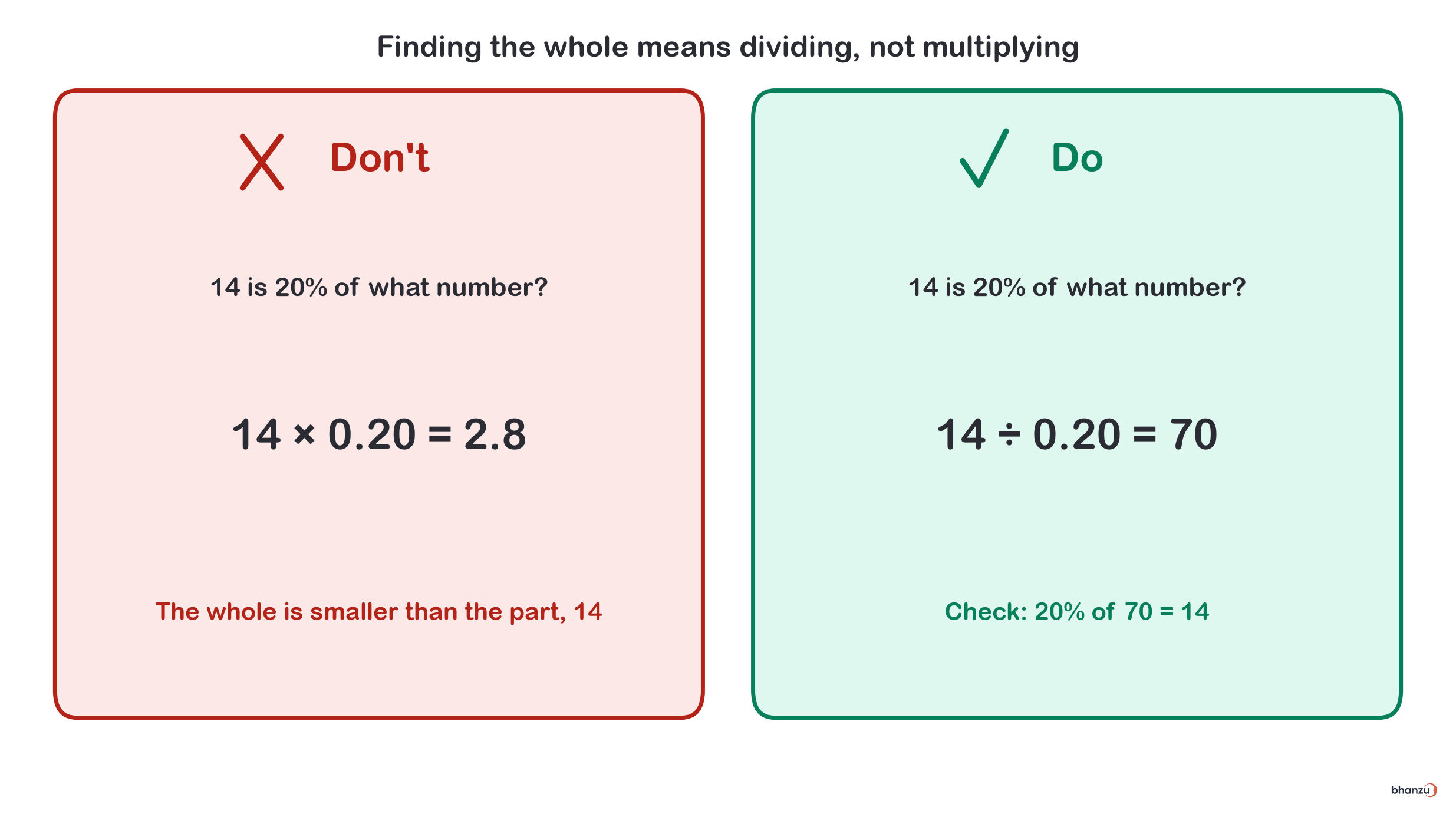
Children fresh from finding percents of numbers see the word "of" and write the multiplication before reading the question. The size check catches it, because 2.8 is smaller than the part, 14.
Mistake 2: Dividing by the percent as a whole number
Where it slips in: The division method, as soon as the percent gets copied without its % sign.
Don't do this: Answering "21 is 70% of what number" with .
The correct way: Turn 70% into 0.70 first, then .
A child who repeats steps without knowing why divides by 70, since the steps said "divide by the percent" and nothing said a percent is a rate per 100. A whole of 0.3 for a part of 21 fails the size check at once.
Mistake 3: Swapping the part and the percent
Where it slips in: Stories where the part is a smaller number than the percent, such as 27 seats making up 45% of a theater's seats.
Don't do this: Treating 45 as the part and 27 as the percent, so seats.
The correct way: The part is 27 seats, so seats, and .
Children often grab the bigger number as the part, because a whole feels like it should come from the bigger numbers. A seat count ending in .67 is the clue that the numbers swapped places.
Key Takeaways
- Name the part and the percent before any arithmetic, then confirm the question asks for the whole.
- For friendly percents, find what 10% or 5% is worth and scale up to 100%.
- For any other percent, finding the whole from a percent means dividing the part by the percent as a decimal.
- Trust a whole only when it is bigger than the part (for percents under 100%) and the forward check returns the part you started with.
- For more practice with whole-missing percent problems, and a teacher who spots the multiply-instead-of-divide habit early, explore Bhanzu's 6th grade math tutor or math classes for kids.
Read More
- Ratio Tables
- Equivalent Ratios
- Part-Part-Whole Ratio Problems
- What Is a Ratio
- How to Teach Percentages
Research Behind This Article
- NOAA National Ocean Service, How Much Water Is in the Ocean? (2026). oceanservice.noaa.gov
- NGA Center and CCSSO, Common Core State Standards for Mathematics, Grade 6, Ratios and Proportional Relationships (2010). thecorestandards.org
- Common Core Standards Writing Team, Progressions for the Common Core State Standards in Mathematics, 6-7 Ratios and Proportional Relationships (2011). math.arizona.edu
- IES What Works Clearinghouse, Improving Mathematical Problem Solving in Grades 4 Through 8 (2012). ies.ed.gov
- OpenStax, Prealgebra 2e, 6.2 Solve General Applications of Percent (2020). openstax.org
- US Food and Drug Administration, Daily Value on the Nutrition and Supplement Facts Labels (2024). fda.gov
Quick Quiz: Check Yourself
Three levels, new numbers every time: find the whole from 10%, 20%, 25% or 50%, work back through 5% in a short story, then solve a price or a how-many-more goal problem.
Was this article helpful?
Your feedback helps us write better content
Frequently Asked Questions
6 percent of what number would be 3?
If 20% is 120, what is 1%?
Can a percent be more than 100%?
What is the percent of whole formula?
What should my child know about wholes, parts and percents in 6th grade?
How can I help my child practice percent problems at home?