Key Points
- Double number lines put two quantities on parallel lines that share a 0, so 2 cans of blue paint to 5 cans of white also reads 4 to 10 and 6 to 15.
- Any value between tick marks comes from dividing both lines to reach 1, then multiplying, so 4 tickets for $18 means $4.50 each and $31.50 for 7.
- Uneven tick spacing breaks every later pair on the diagram, as when 8 cans of blue paint end up above 15 cans of white instead of 6.
- The diagram is a 6th grade ratio tool, and the same stacked pairs turn into points on a straight-line graph in 7th grade.
The shower that keeps two counts
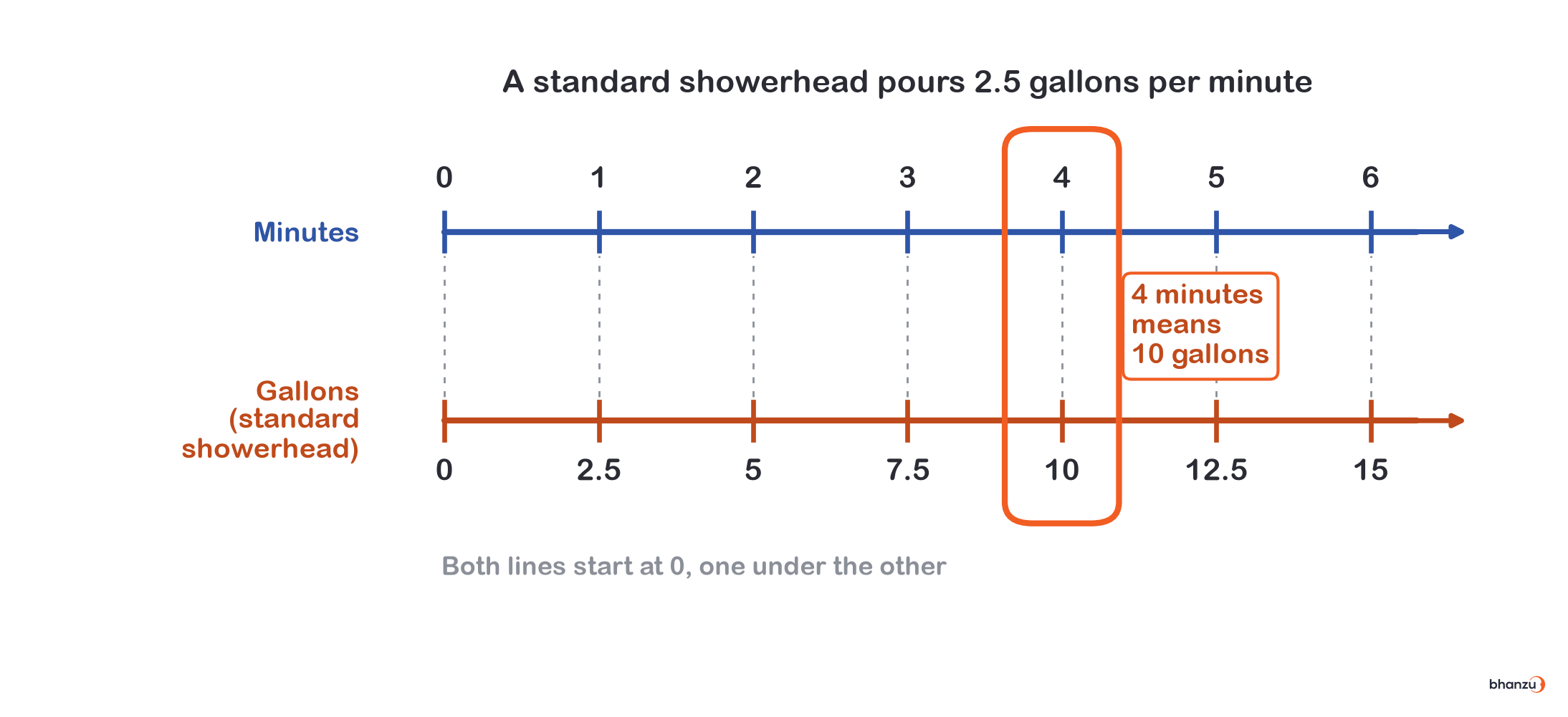
Every minute you spend in the shower, a second number climbs too. That number is gallons of water. Standard showerheads pour out 2.5 gallons a minute, while WaterSense showerheads must use no more than 2.0, according to the EPA page updated in March 2026.
Write minutes on one line and gallons on a second line right under it, both starting at 0, and the 4-minute mark lands directly above 10 gallons. Nurses use the same matching-pairs reasoning to scale a medicine dose to a patient's weight. Chefs use it to stretch a recipe for 4 into one for 40, and engineers lean on it whenever a drawing switches from inches to millimeters.
What are double number lines?
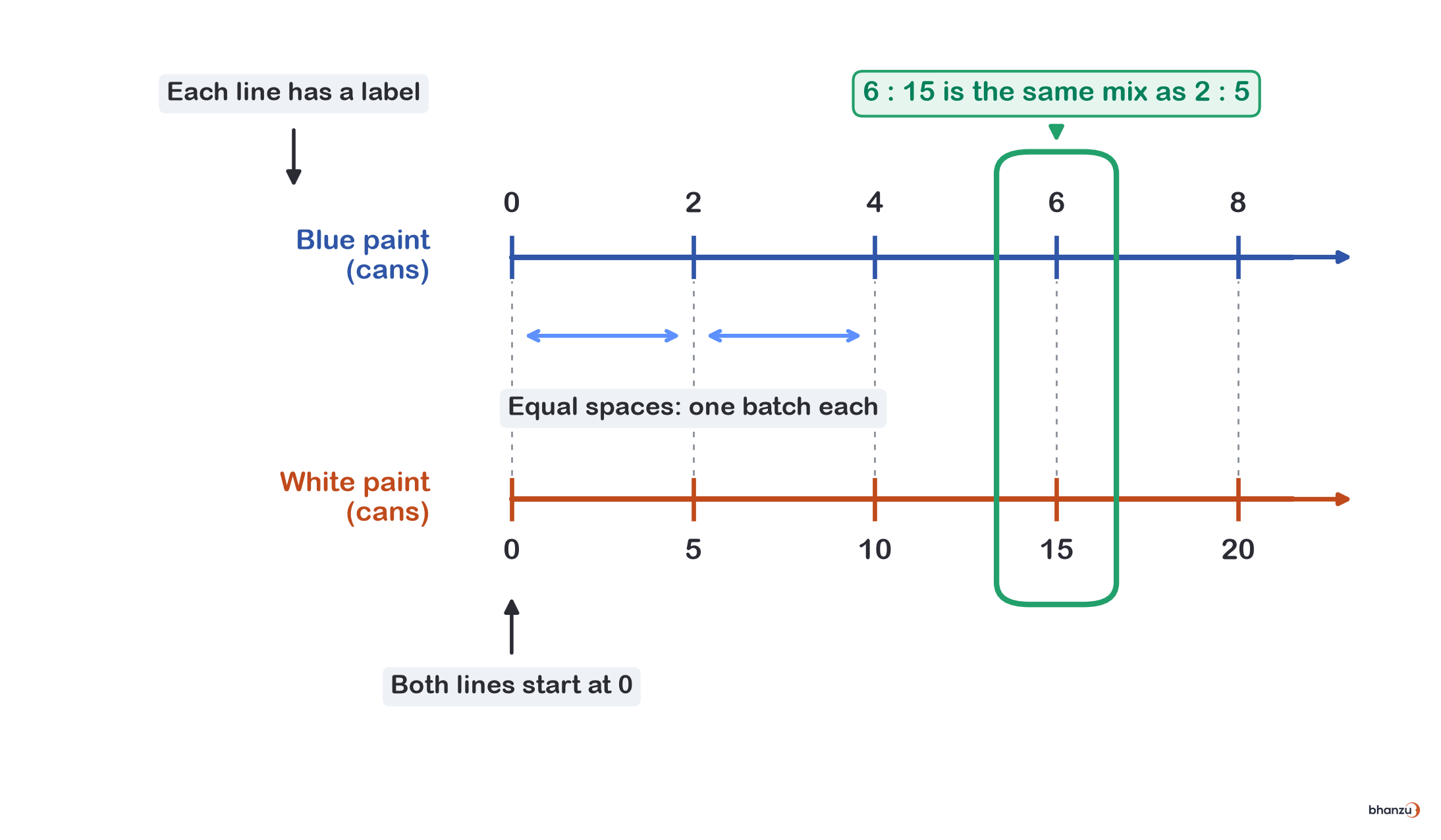
Double number lines are diagrams that give each of two quantities its own number line, stacked so that 0 sits under 0. Every tick mark (a short line marking a number) on the top line has a partner directly below it. The two numbers at any tick form a ratio, a comparison of two amounts such as 2 cans of blue paint for every 5 cans of white. Pairs that make the same mix are equivalent ratios, built by multiplying both amounts by the same number.
With blue paint on top and white below, one batch is 2 cans of blue with 5 of white, and the next ticks read 4 with 10, 6 with 15 and 8 with 20. Each pair makes the same light blue, so is the same ratio as .
Your child meets this diagram in 6th grade. Common Core standard 6.RP.A.3 names double number line diagrams as one tool for ratio and rate problems, alongside ratio tables, tape diagrams and equations. Homework may ask for the drawing itself (labels and all) before any division happens.
How do you draw a double number line?
Draw two parallel lines, start both at 0, and give every top tick a partner directly below it. The paint mix shows how.
- Draw two parallel lines of the same length.
- Write 0 at the left end of both lines, one under the other.
- Label each line with its quantity and unit, such as "Blue paint (cans)".
- Mark evenly spaced ticks in the same spots on both lines, one gap per batch.
- Write the multiples of each amount at the ticks.
- Read any pair straight down or straight up.
Step 4 is a measuring job as much as a ratio job. A 2014 study of five 6th graders by Pamela Beck and colleagues linked their grasp of length measurement to how they used double number lines. Ticks can land on decimals too, like 2.5 cans of white for 1 can of blue, which is where decimals on the number line from 5th grade comes back.
Children often skip-count the top line by its own amount and number the bottom line 1, 2, 3, 4, as if it counted batches instead of cans. A child in a hurry tends to sketch the ticks by eye and squeeze the last two together.
How do you find a value between the tick marks?
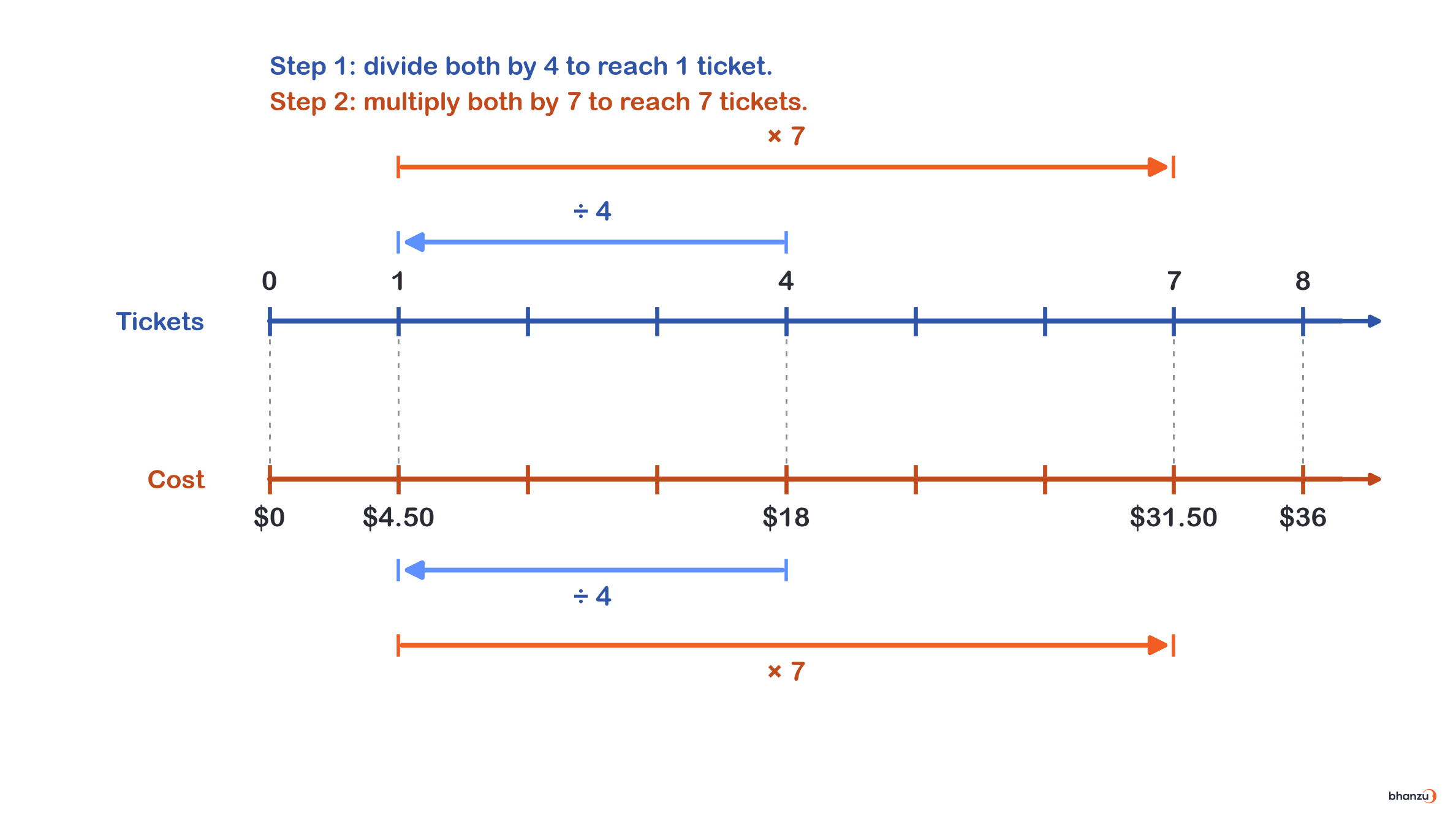
To find a value between two ticks, divide both lines by the same number until the top reads 1, then multiply both lines up to the amount you want. The number under 1 is the unit rate, the amount for one unit ("per" means "for each"). Four movie tickets cost $18, so divide both lines by 4 to reach 1 ticket, then multiply both by 7.
$$$18 \div 4 = $4.50$$
$$$4.50 \times 7 = $31.50$$
The same move covers other problem types. (In 7th grade, the number under 1 gets a new name, the constant of proportionality.)
- Halfway values. Halve both lines, so 2 tickets cost half of $18, or $9.
- Real prices. The US Bureau of Labor Statistics put the average price of a dozen eggs (grade A large, US city average) at $2.32 in October 2026, so 2 dozen pair with $4.64.
- Percents. A percent is a rate per 100, so 0% to 100% goes on top and 0 to the whole below. If 20% of a jar is 14 marbles, halve both lines to get 10% and 7, then multiply by 10 to get 100% and 70, the move behind finding the whole from a percent.
- Units. Since 1959 the inch has been exactly 2.54 centimeters, so 1, 2 and 3 inches pair with 2.54, 5.08 and 7.62 centimeters, and dividing by 2.54 goes back.
- Two rates. One minutes line can sit above two gallons lines, so 4 minutes matches 10 standard gallons and 8 WaterSense gallons.
Word problems tuck these moves inside everyday phrases.
| Words in the problem | Math it means |
|---|---|
| "3 cups of peanuts for every 2 cups of raisins" | the ratio , one batch |
| "12 pages every 3 minutes" | a rate, so divide both lines to reach 1 minute |
| "How many pages in 5 minutes?" | multiply the unit rate by 5 |
| "45 pages is 30% of the book" | 30% sits above 45 pages |
| "How much water does it save?" | subtract one reading from the other |
Double number lines get slow with big numbers. Scaling the paint mix to 1,000 cans of blue takes 500 ticks. A ratio table or the equation gives 2,500 cans of white in one step.
Double number line vs ratio table: what's the difference?
A double number line and a ratio table hold exactly the same pairs. The line also shows distance and order, while the table's columns can go in any order. As a ratio table, the paint mix is part to part, since blue and white are both parts of the paint.
| Blue paint (cans), part | 2 | 4 | 6 | 8 |
|---|---|---|---|---|
| White paint (cans), part | 5 | 10 | 15 | 20 |
The two tools split the work like this.
| What you need | Double number line | Ratio table |
|---|---|---|
| See how far apart pairs are | Yes, equal gaps show equal batches | No, columns carry no distance |
| Spot a halfway value | Halfway on one line is halfway on the other | Needs a new column |
| Jump to huge numbers | Slow, one tick per batch | Fast, one column holds 1,000 and 2,500 |
Start with the line to see the problem, and switch to the table once the numbers outrun your ticks.
Try It Yourself
Drag the orange dot along the bottom line until it sits under the marked number on the top line, or move it half a batch at a time with the arrow keys. Let go or press Enter, and the box says at once whether your pair matches the ratio and, if it doesn't, which pair you made instead. New ratio gives a fresh mix, and Reset starts the same one again.
Examples of double number lines
Example 1
Trail mix uses 3 cups of peanuts for every 2 cups of raisins. How many cups of raisins go with 12 cups of peanuts?
Peanuts go on top, 0, 3, 6, 9, 12, and raisins below, 0, 2, 4, 6, 8. The 12 cups of peanuts make 4 batches, so the raisins are 4 batches of 2.
The trail mix needs 8 cups of raisins.
Example 2
A printer prints 12 pages every 3 minutes. How many pages does it print in 5 minutes?
The tempting move divides minutes by pages, then scales up.
That gives 1.25 pages, which can't be right, because the 3-minute tick already sits above 12 pages. The 0.25 was minutes per page, not pages per minute.
Put minutes on top and pages below, then divide both lines by 3 to reach 1 minute.
That's 4 pages per minute, so multiply both lines by 5.
The printer prints 20 pages in 5 minutes. Check: 20 sits between 12 pages at 3 minutes and 24 at 6 minutes.
Example 3
At $2.32 a dozen, what do 3 dozen eggs cost, and how many dozen does $11.60 buy?
Dozens go on top, 0 to 5, and dollars below in steps of $2.32, up to $11.60. Multiply both lines by 3.
$$3 \times $2.32 = $6.96$$
For the second part, divide by the price of one dozen.
$$$11.60 \div $2.32 = 5$$
Three dozen cost $6.96, and $11.60 buys 5 dozen.
Example 4
Mia has read 45 pages, which is 30% of her book. How many pages are in the whole book?
Percent goes on top from 0% to 100% in steps of 10%, with pages below, so 30% sits above 45. Divide both lines by 3 to reach 10%.
Multiply both lines by 10 to reach 100%.
The book has 150 pages. Check: .
Example 5
A poster is 20 inches tall. How tall is it in centimeters?
Inches go on top, 0, 1, 2, 3, over 0, 2.54, 5.08, 7.62 centimeters. Multiply both lines by 10, then double them.
The poster is 50.8 centimeters tall.
Example 6
A standard showerhead uses 2.5 gallons per minute, and a WaterSense showerhead uses 2.0. How much water does the WaterSense head save in an 8-minute shower?
Draw one minutes line with a gallons line for each showerhead below it, and read both at 8 minutes.
Subtract one reading from the other.
The WaterSense showerhead saves 4 gallons.
Why lining up the tick marks works
Lining up the ticks works because every tick stands for one more batch of the same recipe, so both lines grow by the same multiplier. That's why a big bucket of paint comes out the same color as a small cup.
- Zero goes with zero. No batches means no blue and no white, so both lines begin together.
- Equal gaps mean equal batches. Each gap adds 2 more cans of blue and 5 more of white.
- Every pair hides the same unit rate. On the shower line, 5 gallons at 2 minutes and 15 gallons at 6 minutes both divide out to 2.5 gallons per minute.
- The pairs become a graph. In 7th grade, they turn into points on a straight line through 0 in graphs of proportional relationships.
Break the shared 0 or the even spacing, and the drawing still looks like two number lines, but its pairs stop describing the same mix.
Double number lines: where intuition breaks
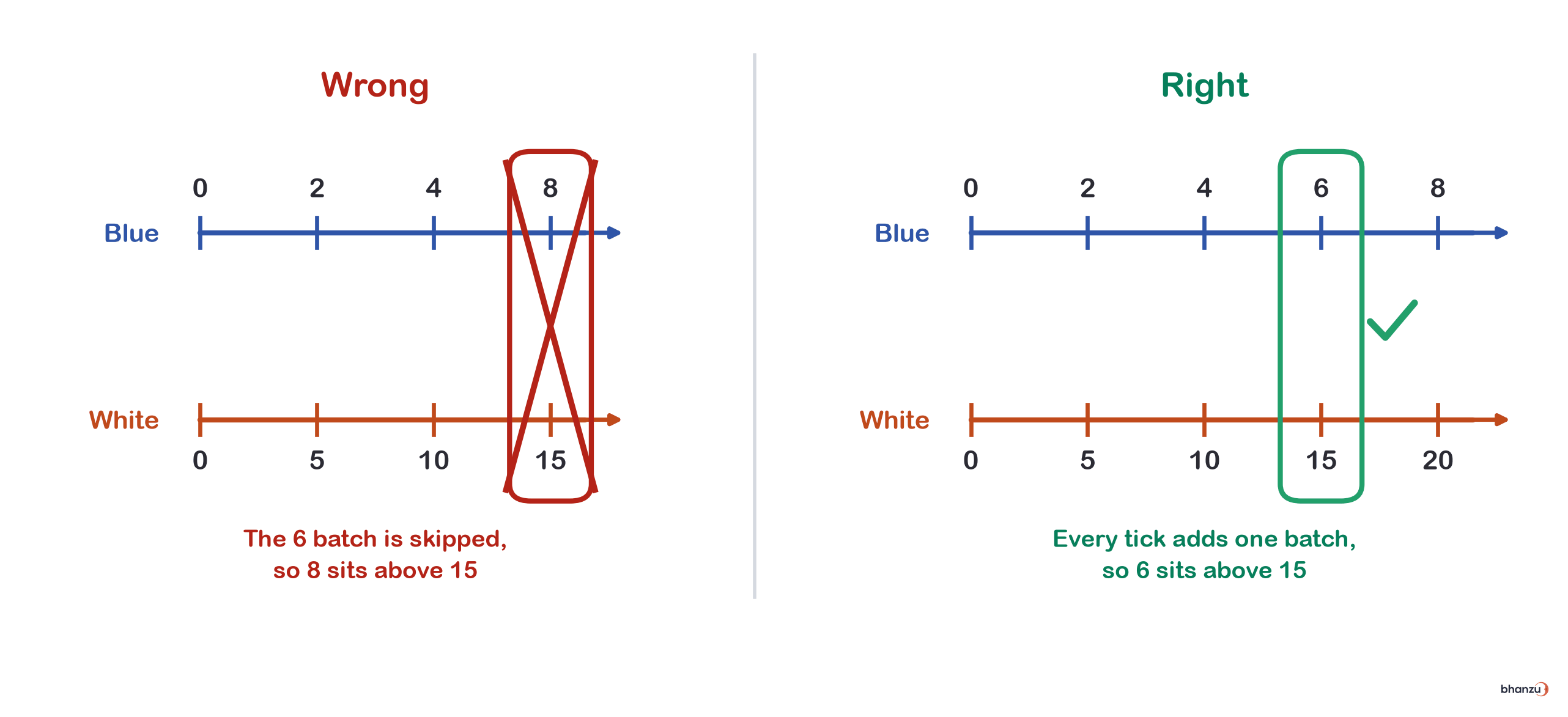
Mistake 1: Ticks that are not evenly spaced
Where it slips in: Drawing the bottom line by eye, or skipping a batch while writing the paint numbers.
Don't do this: Write blue 0, 2, 4, 8 above white 0, 5, 10, 15, which pairs 8 cans of blue with 15 of white, a darker mix.
The correct way: Give every tick one more batch, so blue 0, 2, 4, 6, 8 sits above white 0, 5, 10, 15, 20 and 6 goes with 15.
Children who jump straight to the numbers a problem asks about often skip the batch in between, and the pairs shift without anyone noticing.
Mistake 2: Lines that start at different numbers
Where it slips in: Problems like the trail mix in Example 1, because the first amount named feels like the starting point.
Don't do this: Start the raisins at 2, so peanuts 0, 3, 6, 9 sit above raisins 2, 4, 6, 8 and 6 cups of peanuts land on 6 cups of raisins.
The correct way: Put 0 under 0, then pair 3 with 2, 6 with 4 and 9 with 6.
Mistake 3: Adding the same amount to both lines
Where it slips in: Finding a value between two ticks. Adding works along a single line, so children carry it across.
Don't do this: 6 pencils cost $4, so 9 pencils, 3 more, cost $$4 + $3 = $7$.
The correct way: Halve both lines, so 3 pencils cost $2, and 9 pencils cost $3 \times $2 = $6$.
Children who skip-count both lines without a hitch often stall at the first in-between value, and adding feels like the fix. A size check catches it, since 9 pencils are 1.5 times 6, and 1.5 times $4 is $6.
What teachers watch for in double number lines
Teachers watch whether a student multiplies only along the lines or also across them, because the across number reaches values no tick touches.
| Direction | Multiply by | Paint mix example |
|---|---|---|
| Along a line | the number of batches | blue 2 to 6 is times 3, and white 5 to 15 is too |
| Across the lines | one fixed number, the unit rate | white is always 2.5 times blue, so |
A student who sees only the along multiplier gets stuck between ticks, since no whole batch lands on 3 cans of blue. The across multiplier lands anywhere, so 3 cans of blue need cans of white.
The two multipliers are easy to confuse, because both are "times something" and the drawing doesn't say which is which. Kazuhiko Nunokawa's 2012 study of a 5th grader learning proportion and percent found he used double number lines to hunt for several multiplying relationships in each problem. In 8th grade, the across number returns as the slope of a line.
Key Takeaways
- Draw the shared 0 and the evenly spaced ticks before writing any numbers.
- On double number lines, any in-between value comes from dividing both lines down to 1 and multiplying back up.
- Check that an answer lands between its neighbors, the way 20 pages fell between 12 and 24.
- Once the numbers run into the hundreds, a ratio table or an equation beats adding more ticks.
- For more practice finding in-between values with a teacher who catches the add-instead-of-multiply habit, explore Bhanzu's 6th grade math tutor or a middle school math tutor.
Read More
- Ratios on the Coordinate Plane
- Part-Part-Whole Ratio Problems
- Finding the Percent of a Number
- What Is a Proportion
- Scale Factor
Research Behind This Article
- US Environmental Protection Agency, WaterSense: Showerheads (2026). epa.gov
- Common Core State Standards Initiative, Ratios and Proportional Relationships, Grade 6 (2010). thecorestandards.org
- Beck, Eames, Cullen and colleagues, Linking Children's Knowledge of Length Measurement to Their Use of Double Number Lines (2014). eric.ed.gov
- US Bureau of Labor Statistics, Average Price Data: Eggs, Grade A, Large, per Dozen, U.S. City Average (2026). bls.gov
- National Institute of Standards and Technology, SI Units: Length (2025). nist.gov
- Nunokawa, Multi-Relation Strategy in Students' Use of a Representation for Proportional Reasoning (2012). eric.ed.gov
Quick Quiz: Check Yourself
Three levels, new numbers every time: read a matching value off a double number line, find a value between the tick marks, then find a whole from a percent or compare two rates.
Was this article helpful?
Your feedback helps us write better content
Frequently Asked Questions
What grade do kids learn double number lines?
How can I help my child practice at home?
Can you use double number lines for proportions?
Do double number lines work for inequalities?
Is there a double number line calculator?