Key Points
- Finding the percent of a number means multiplying the number by the percent written over 100, so 35% of 60 is 35 hundredths of 60, which equals 21.
- A double number line puts 0% to 100% on the top scale and 0 to the whole underneath, so on a line that ends at 60, every 10% jump is worth 6.
- The most common mistake is writing 5% as 0.5 instead of 0.05, which turns 5% of 80 into 40 when the correct answer is 4.
- Sixth graders learn this skill under the Common Core ratio standards, and it leads to finding the whole from a percent and, in 7th grade, to simple interest.
The 20% on a cereal label
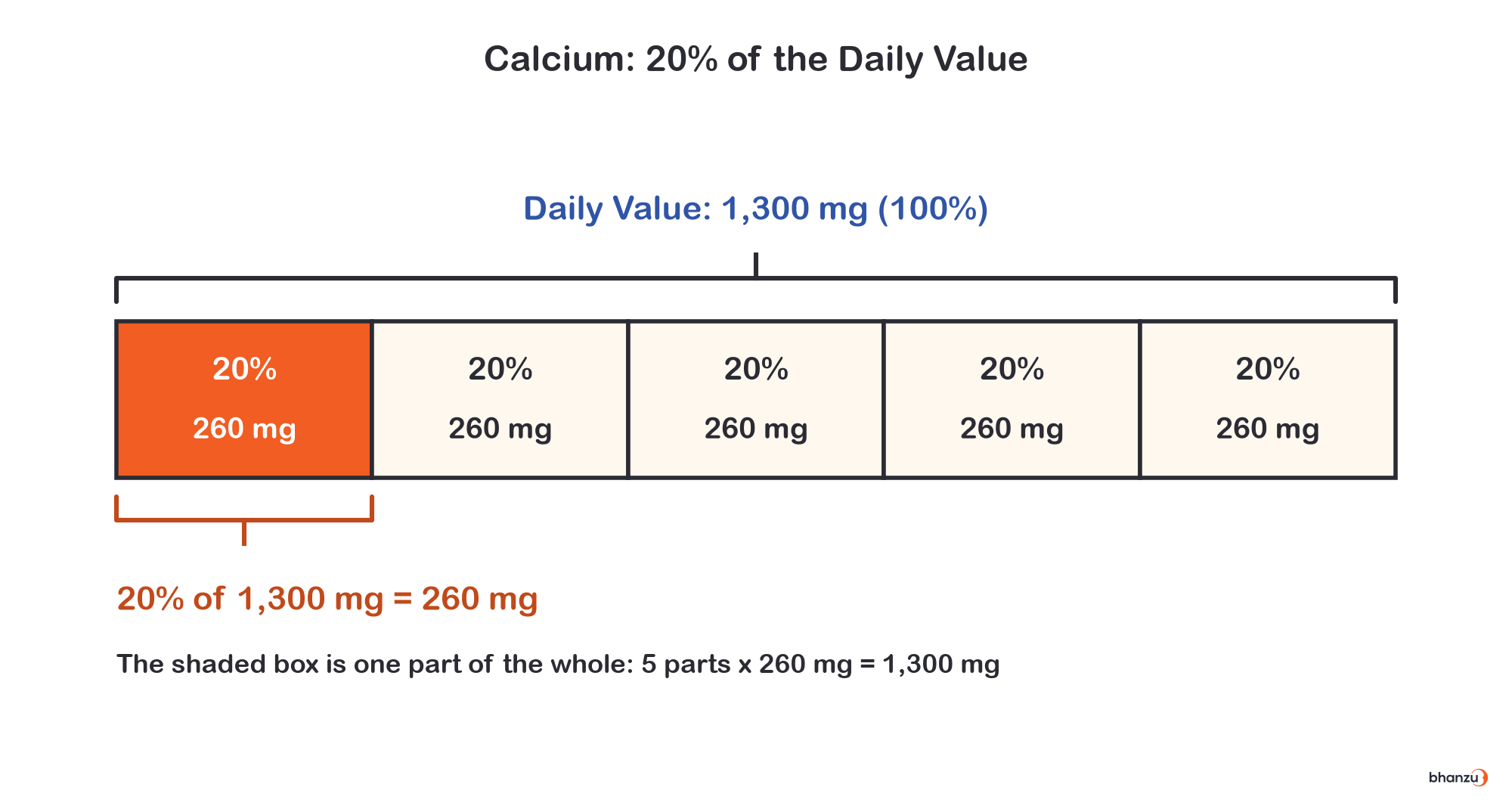
The 20% beside calcium on a cereal label is a percent of a number you can't see. That number is the Daily Value, the amount the US Food and Drug Administration uses as a reference for one day, and for calcium its 2024 list gives 1,300 mg. So a serving marked 20% holds 20% of 1,300 mg, which is 260 mg. The FDA counts 20% or more as high.
Turning that 20% back into milligrams is finding the percent of a number. Nutrition scientists use it to build food labels, population statisticians use it to describe a whole country, and atmospheric scientists use it to describe the air you're breathing right now.
What does finding the percent of a number mean?
Finding the percent of a number means finding the part of it that matches a rate per 100, which tells you how many to take out of every 100. A percent is that rate written with the % sign, so 30% means 30 out of every 100. On a grid of 100 squares, 30% is 30 shaded squares. Shrink the whole to 60 and keep the same share, and every 10 squares become 6, so 30% of 60 is 18.
Every percent can also be written as a fraction or a decimal, and switching between fractions, decimals and percentages makes the multiplication step quick.
| Percent | Fraction (simplest form) | Decimal |
|---|---|---|
| 1% | 0.01 | |
| 10% | 0.1 | |
| 25% | 0.25 | |
| 50% | 0.5 | |
| 75% | 0.75 | |
| 100% | 1 | |
| 150% | 1.5 |
Real measurements use the same rate. Near Earth's surface, air is 78% nitrogen and 21% oxygen, according to NASA's Earth facts page, last updated in 2025, so 200 liters of air holds about 42 liters of oxygen.
For parents, this is Common Core standard 6.RP.A.3.c, which asks your child to find a percent of a quantity as a rate per 100. The Grade 6 ratio standards name ratio tables, tape diagrams (bars cut into equal parts), double number lines and equations as tools.
Finding a percent on a double number line
A double number line is two number lines that share tick marks, percents on top and amounts underneath, so you read the part straight down from the percent. Finding 30% of 60 takes five steps.
- Draw two parallel lines that both start at 0.
- Write 100% at the right end of the top line and the whole, 60, directly under it.
- Cut both lines into ten equal jumps, so each jump is 10% on top and underneath.
- Count jumps along the top line until you reach 30%, which takes three jumps.
- Read the number right below 30%, which is .
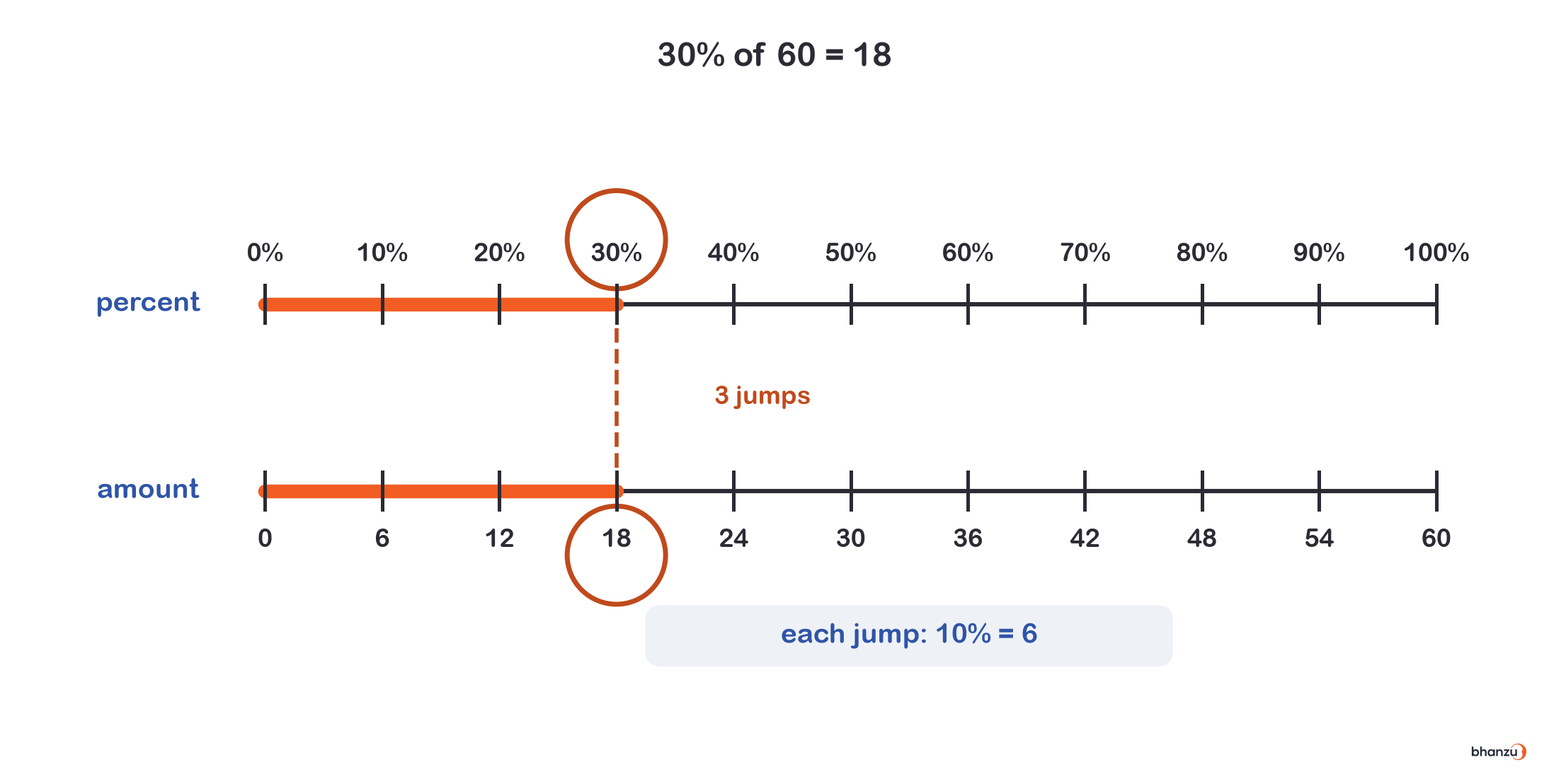
A percent that ends in 5 sits halfway between two ticks, so 35% of 60 is three jumps plus half a jump, or . Ten jumps start to feel slow for a percent like 37%, which needs a hundred tiny 1% ticks, and multiplication handles that case faster.
Children often swap the two scales, writing 60 at the end of the percent line and 100 under it, because both numbers sit at the right-hand end. Another habit is counting three jumps and writing 3 (the count is right, the question isn't), since each jump is worth 6.
Try It Yourself
Drag the orange marker along the percent line, or use the arrow keys, and change the whole with the minus 10 and plus 10 buttons. The amount line below lights up to match, and the readout counts your 10% jumps, so 30% of 60 shows as three jumps of 6, or 18. Push the marker past 100% and watch the answer grow bigger than the whole.
How do you find the percent of a number with multiplication?
Write the percent over 100 and multiply it by the whole, because "of" in a percent problem means times. The percent of a number formula puts that into one line.
| Symbol | Meaning | Units |
|---|---|---|
| The percent number | None | |
| The amount you start with | Any unit, such as mg or dollars | |
| The amount you find | The same unit as the whole |
The formula works because means hundredths, and taking hundredths of something is the same as multiplying it by .
- Write the percent as a fraction over 100, or as a decimal by moving the decimal point two places to the left, so 35% becomes 0.35 and 5% becomes 0.05.
- Multiply by the whole, using the same steps as multiplying multi-digit decimals.
- Check the size of the answer against the whole.
Can you find a percent of a number without using decimals? Yes: keep the fraction, multiply the top number by the whole, and divide by 100 at the end.
The size check in step 3 comes from multiplication as scaling, which you met in 5th grade. A percent under 100% is less than 1, so it shrinks the whole. A percent over 100% stretches it, so 150% of 18 is .
Word problems hide the formula inside ordinary words, so translate them before you multiply.
| Words in the problem | Math it means |
|---|---|
| "percent" or % | Out of 100 |
| "of" | Times, so 30% of $40 is $0.3 \times $40$ |
| "off" | Subtract the part from the whole |
| "is" | Equals |
| "Daily Value" | The whole on a food label |
Which percents can you find in your head?
The benchmark percents 50%, 25%, 10% and 1% come from halving or from dividing by 10 or 100, and every whole-number percent can be built from them. How do you calculate 10 percent of a number? Divide it by 10, which moves every digit one place to the right.
Here are the four benchmarks for 240.
- 50% is half of 240, which is 120.
- 25% is half of 50%, which is 60.
- 10% is .
- 1% is .
Other percents come from adding and doubling those. 20% is double 10%, so 20% of 240 is 48, and 5% is half of 10%, so it's 12. Then 15% is 10% plus 5%, which is (in 7th grade, this same build works out a tip).
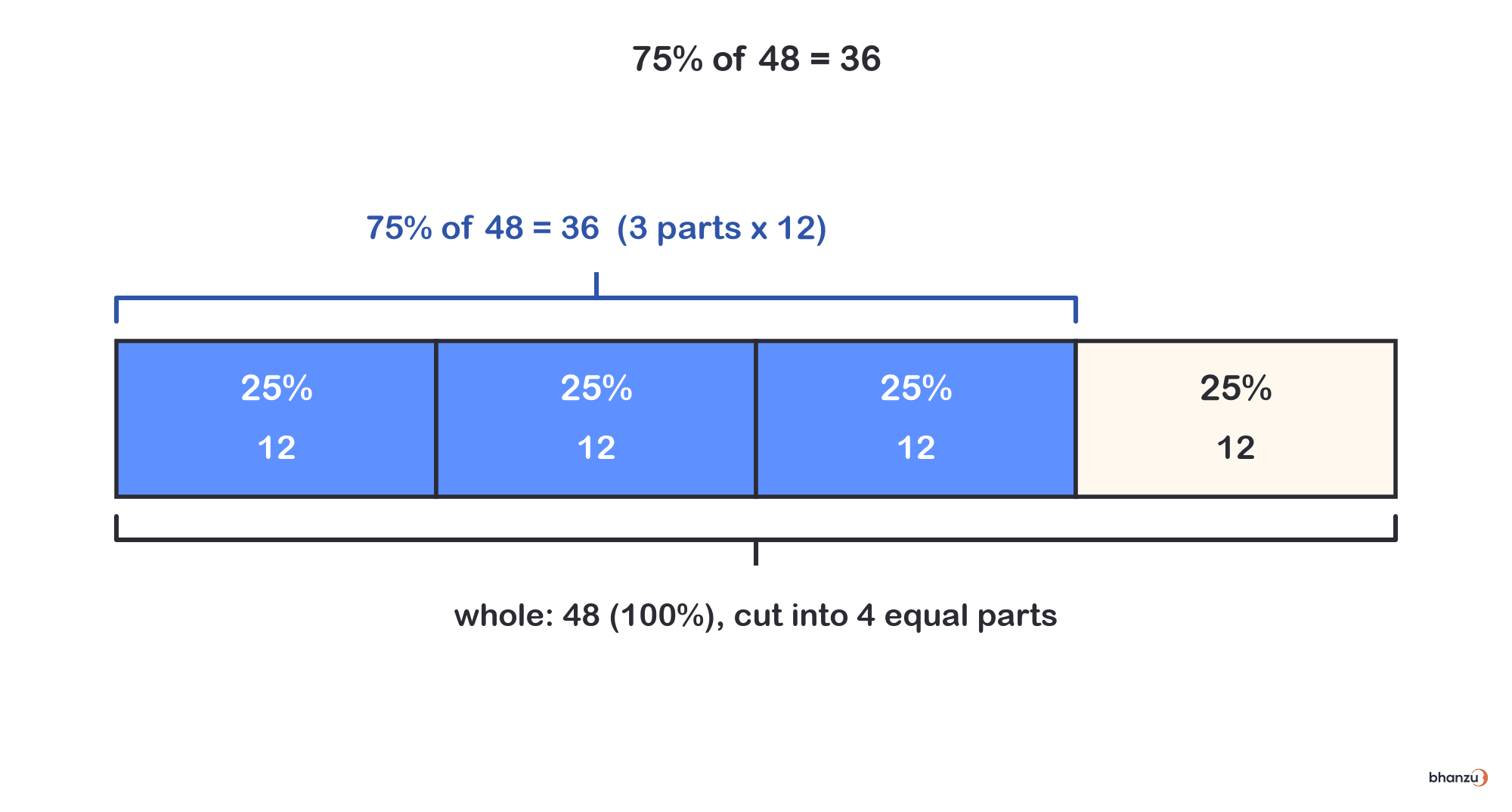
A tape diagram shows the same building with blocks. Cut a tape for 48 into four equal parts, and each part is 25%, or 12, so three parts make 75% of 48, which is 36.
Benchmarks also give you an estimate before any calculation. 35% sits between 25% and 50%, so 35% of 80 has to land between 20 and 40. An answer of 2.8 or 280 is out right away, and the real answer is 28.
Examples of finding the percent of a number
Example 1
What is 25% of 36?
25% is , so split 36 into 4 equal parts.
25% of 36 is 9.
Example 2
What is 15% of 40?
The tempting move is to multiply the two numbers you can see.
That gives 600, which is fifteen times bigger than 40 itself. 15% is less than all of 40, so the answer has to be smaller than 40, and 600 cannot be right. The missing piece is the 100 under the 15.
To check, 10% of 40 is 4 and 5% is 2, and . So 15% of 40 is 6.
Example 3
On a double number line, 100% lines up with 70. What number lines up with 35%?
Each 10% jump is , and three jumps reach 30%.
35% is half a jump further, and half of 7 is 3.5.
35% of 70 is 24.5, which matches .
Example 4
Is 120% of 45 more or less than 45? Find it.
120% is more than 100%, so the answer is more than 45.
120% of 45 is 54, the whole 45 plus 9 for the extra 20%.
Example 5
A cereal label says one serving has 15% of the Daily Value for calcium. The Daily Value for calcium is 1,300 mg. How many milligrams of calcium is that?
One serving has 195 mg of calcium.
Example 6
A hoodie costs $40 and is 30% off. Leo has $30. Can he buy it, and how much money will he have left?
Find the discount, the amount taken off the price.
$$0.3 \times $40 = $12$$
Subtract the discount from the price.
$$$40 - $12 = $28$$
Compare the sale price with Leo's money.
$$$30 - $28 = $2$$
Yes, Leo can buy the hoodie, and he will have $2 left.
Why does finding the percent of a number matter?
Percents put wholes of different sizes on the same scale of 100, and multiplying by the percent over 100 turns that scale back into an amount you can use.
- It compares groups of different sizes. The US Census Bureau reported in 2025 that children under 18 were 25.0% of the US population in 2004 and 21.5% in 2024. Each percent is a share of its own year's total, so the two years compare fairly.
- It turns a label into an amount. The FDA's Daily Value for sodium is 2,300 mg, so a snack marked 10% holds 230 mg.
- It measures what nobody can count one by one. Nobody counts the gas particles in a room, yet 78% of 200 liters of air means about 156 liters of nitrogen.
- It keeps a sale sign honest. 40% off a $35 backpack takes off $14, so the backpack costs $21.
The wholes change from a cereal serving to a whole country, and one multiplication by handles every one of them.
What most guides miss about finding the percent of a number
Two facts make percents easier and more honest, and most guides skip both.
- You can swap the numbers. 8% of 50 equals 50% of 8, which is 4, because both mean . When one order looks hard, flip it, so 4% of 75 becomes 75% of 4, which is 3.
- Published percents are rounded. The same Census release reports that in 2020, 31.3% of the nation's 3,144 counties had more older adults than children, and it gives the count as 983.
Multiply and you get , about 984, one more than the real count. This spot is genuinely confusing, since the multiplication is right and the answer is still off. The 31.3% was rounded from 983 out of 3,144, so the product is a close estimate, and the count wins.
The next skill runs the formula backward. In finding the whole from a percent, you know the part and the percent, and the whole is the unknown. In 7th grade, the same multiplication returns in percent increase, simple interest and longer markdown problems that build on the sale prices here.
The easy-to-make errors (and how to catch them)
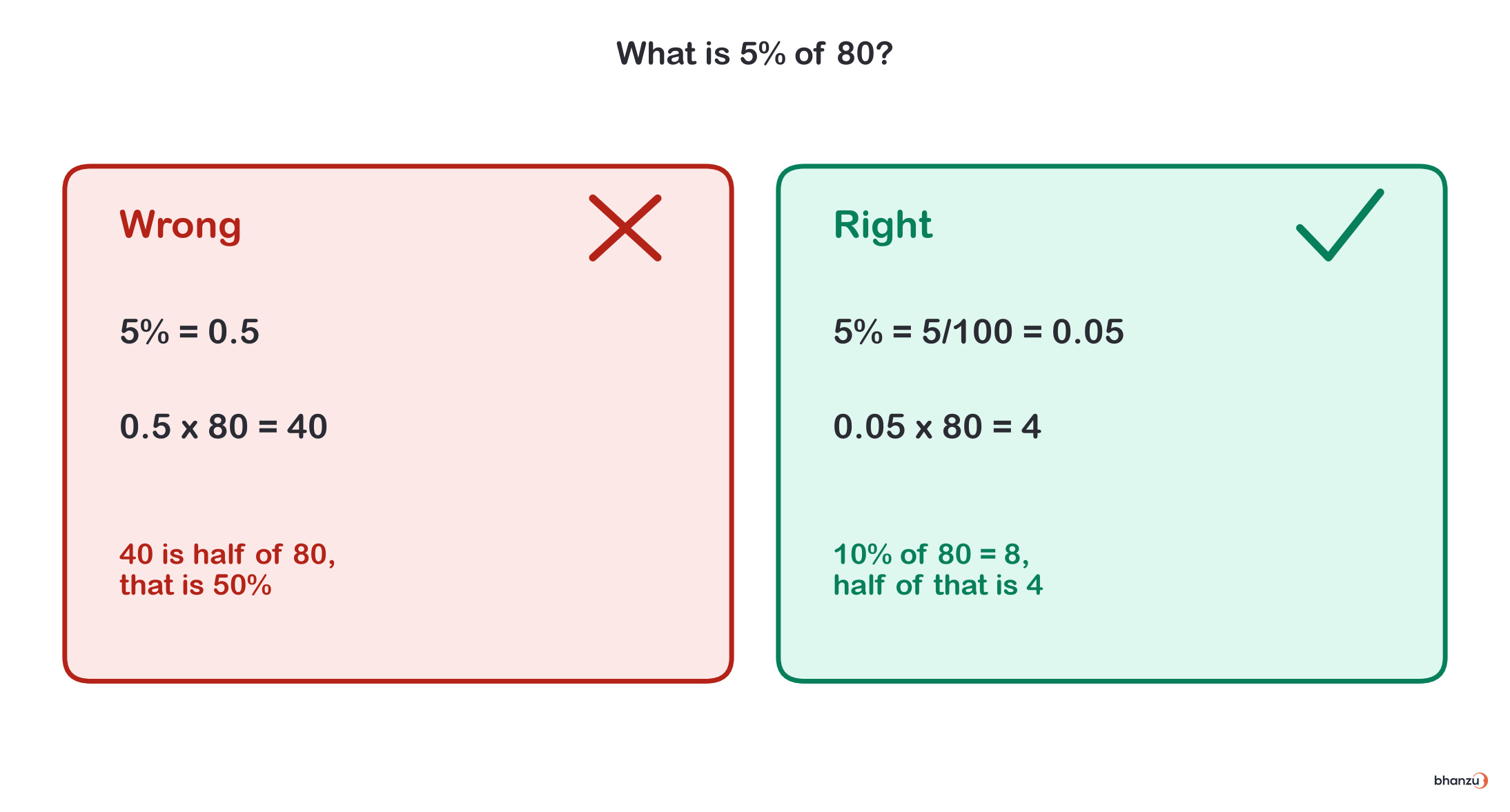
Mistake 1: Writing 5% as 0.5
Where it slips in: Turning a one-digit percent into a decimal, in step 1 of the multiplication method.
Don't do this: Writing 5% as 0.5, so 5% of 80 becomes .
The correct way: 5% is , which is 0.05, so 5% of 80 is . To check, 10% of 80 is 8, and 5% is half of that.
Children who make this mistake usually moved the decimal point one place, because a lone 5 looks like it belongs in the tenths. A child who rushes past the size check never notices that 40 is half of 80.
Mistake 2: Stopping at the amount taken off
Where it slips in: "Percent off" word problems such as Example 6, where the question asks for the new price. The words "off" and "of" look almost the same, and a quick reader sees only "of".
Don't do this: Finding 25% of a $24 game, which is $6, and giving $6 as the sale price.
The correct way: The $6 is the discount. Subtract it from the price, $$24 - $6 = $18$, or find 75% of $24 directly, which is also $18.
Mistake 3: Dividing the percent by the number
Where it slips in: Problems that give a percent and a whole, when a child who repeats steps without knowing why grabs the wrong percent formula.
Don't do this: Working out 20% of 50 as .
The correct way: Multiply instead, . The division answers a different question, what percent one number is of another, which here asks what percent 20 is of 50.
Key Takeaways
- Before multiplying, decide whether the part should come out smaller than the whole (under 100%) or bigger (over 100%).
- The part always comes down to the whole times , whether is 5, 35 or 150.
- For a percent that is a multiple of 5, jumps worth one tenth of the whole on a double number line, plus a half jump when the percent ends in 5, lead to the part.
- A part worked out from a rounded percent is an estimate, so an exact count wins.
- For more help finding the percent of a number, especially catching 5% written as 0.5, explore Bhanzu's 6th grade math tutor sessions or its Common Core math curriculum.
Read More
- Ratio Tables
- Equivalent Ratios
- Fractions With Denominators of 10 and 100
- Multiplying Fractions by Whole Numbers
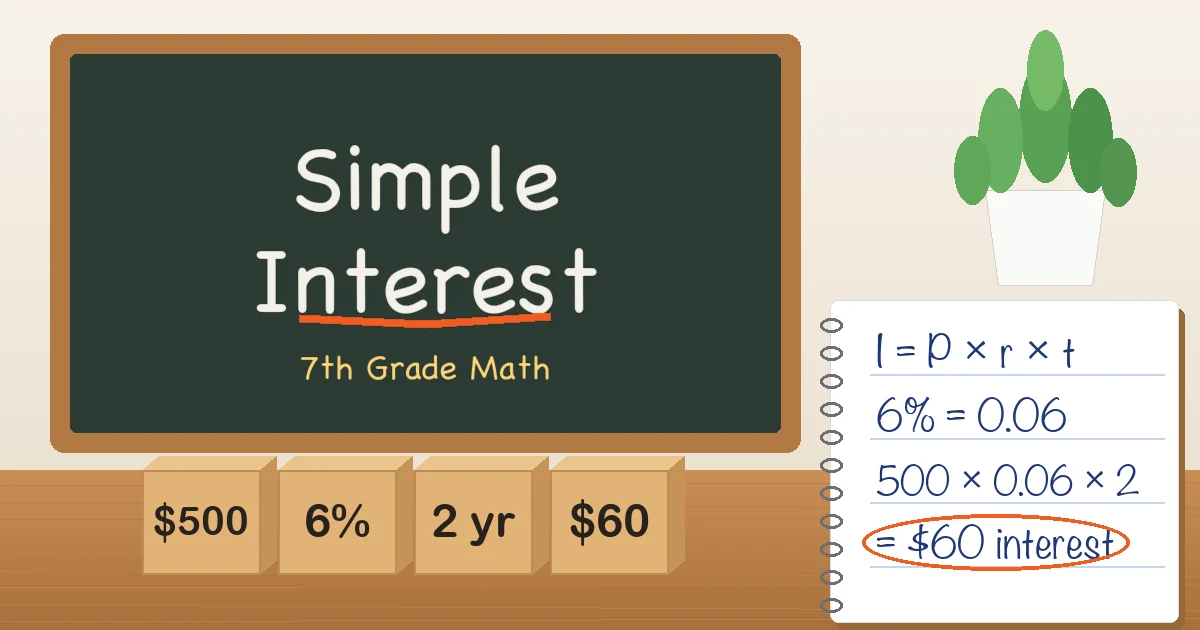
- Simple Interest
Research Behind This Article
- US Food and Drug Administration, Daily Value on the Nutrition and Supplement Facts Labels (2024). fda.gov
- OpenStax, Prealgebra 2e, 6.1 Understand Percent (2020). openstax.org
- NASA Science, Facts About Earth (2025). science.nasa.gov
- Common Core State Standards Initiative, Ratios and Proportional Relationships, Grade 6 (2010). thecorestandards.org
- OpenStax, Prealgebra 2e, 6.2 Solve General Applications of Percent (2020). openstax.org
- US Census Bureau, Older Adults Outnumber Children in 11 States and Nearly Half of U.S. Counties (2025). census.gov
Quick Quiz: Check Yourself
Three levels, new numbers every time: a benchmark percent such as 25% of 36, any percent including ones over 100%, then a sale price or food label word problem.
Was this article helpful?
Your feedback helps us write better content
Frequently Asked Questions
How do you find a percentage based on a decimal?
How do you calculate a percentage with a calculator?
How do you write percentages?
Is 35% the same as 0.35?
How do I explain percentages to my child?
How can I help my 6th grader with percentage word problems?