Key Points
- Simple interest is found with , which multiplies the principal by the yearly rate written as a decimal and then by the time in years.
- One year's interest works as a unit rate, so $1,000 at 4% has earned $40 after 1 year, $80 after 2 years and $120 after 3 years.
- A frequent wrong move is typing the percent as a whole number, which turns $800 at 5% for 3 years into $12,000 of interest instead of $120.
- Common Core places simple interest in 7th grade, listing it first among the multistep percent problems solved with proportional relationships.
Paying rent on borrowed money
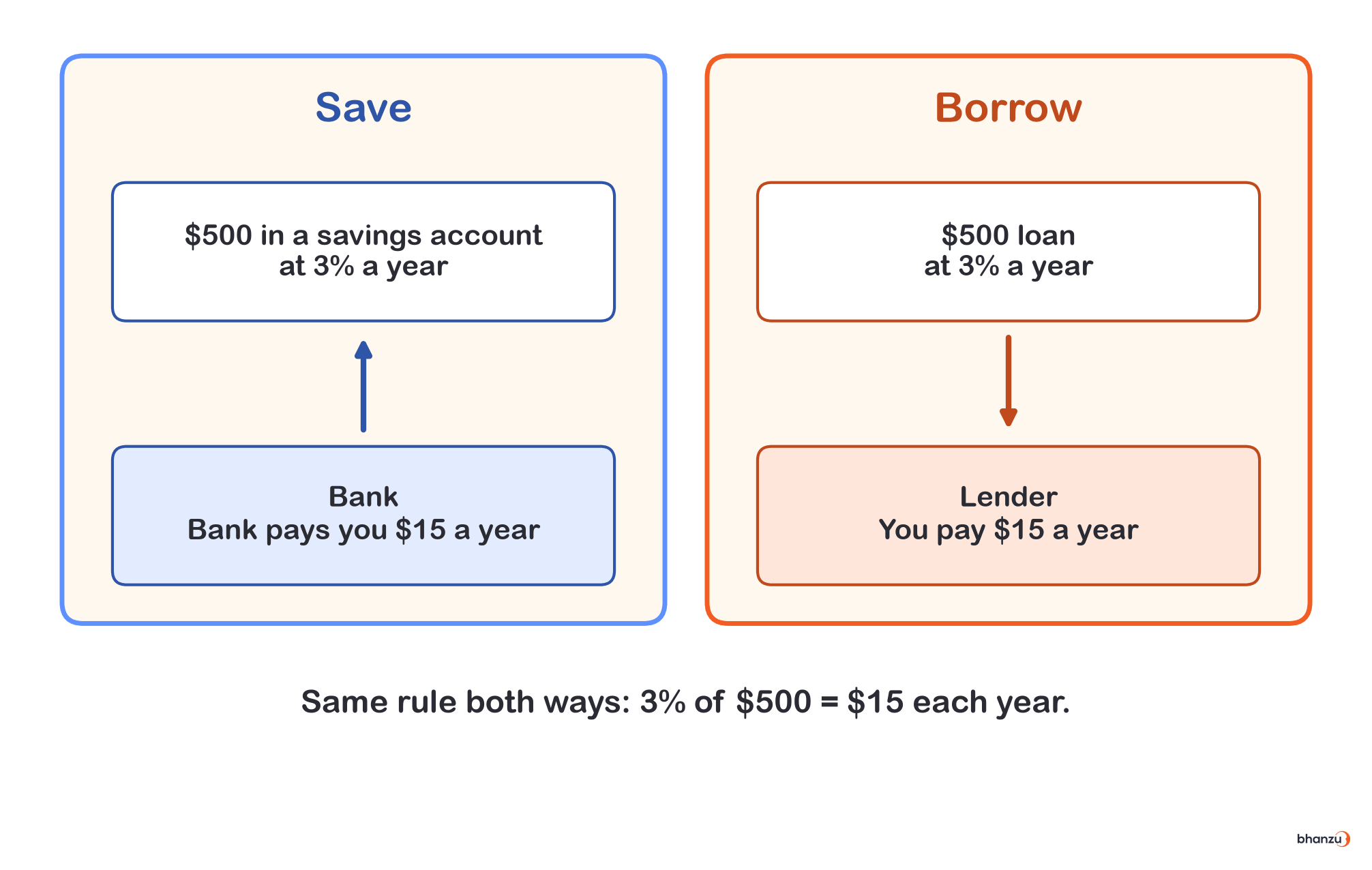
Borrowing money works like renting a bike, because you pay for the time you keep it. That rent is called interest. Put money in a bank and the roles flip, since the bank is now borrowing from you.
The idea appears in the laws of King Hammurabi of ancient Babylon. One law told an agent who had received a merchant's money to write a note for the interest and pay it on settling day. Today, bankers setting savings rates, business owners pricing short-term loans and families comparing loan offers all work out what time with money should cost. Simple interest is the plainest answer, because the rent stays the same every year.
What is simple interest?
Simple interest is the extra money paid for using someone else's money, worked out on the principal (the starting amount) alone and never on interest already earned. One formula finds it in dollars.
| Symbol | Meaning | Units |
|---|---|---|
| Interest, the extra money earned or owed | dollars | |
| Principal, the amount saved or borrowed | dollars | |
| Yearly interest rate, written as a decimal | per year | |
| Time the money stays saved or borrowed | years |
The formula works because is one year's interest, and each extra year adds that same amount again, so years add it times. Letters side by side mean multiply, as means 3 times .
The rate is a percent per year, so 4% means $4 of interest for every $100 of principal each year. A double number line shows what that does to $1,000, with years on top and dollars of interest underneath.
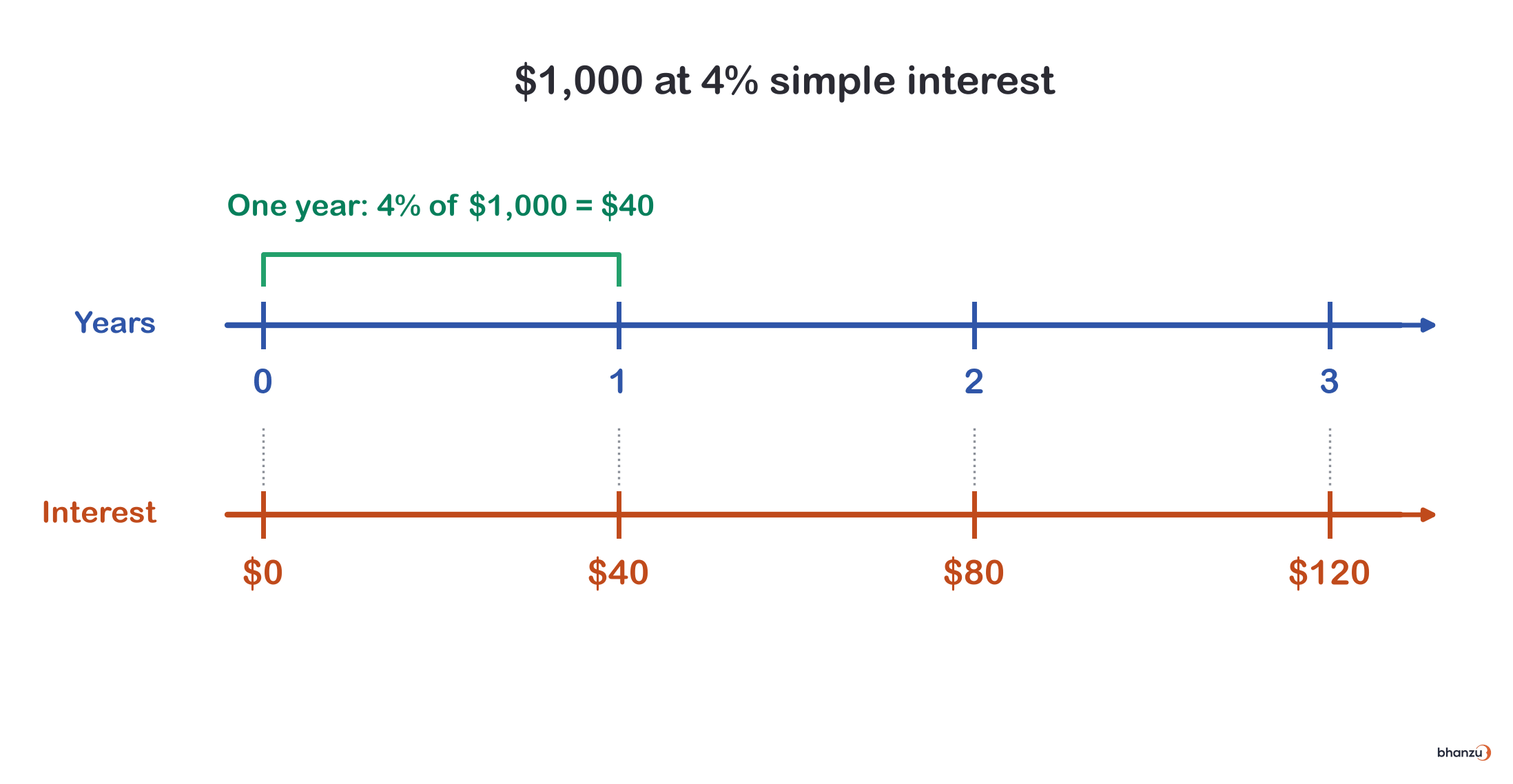
Each one-year jump on top matches a $40 jump below, so 3 years earn exactly 3 times one year's interest. Equal steps like these make a proportional relationship, the idea behind Common Core standard 7.RP.A.3. That standard asks seventh graders to solve multistep ratio and percent problems and names simple interest first among its examples. By the end of 7th grade, your child should be able to find the interest, the balance or any missing number, and explain why every year adds the same amount.
How do you use the simple interest formula?
To calculate simple interest, write the rate as a decimal and the time in years, then multiply.
- Change the percent to a decimal by dividing by 100, so 4% becomes 0.04. The OpenStax Prealgebra 2e textbook uses this decimal form in the formula too.
- Write the time in years, dividing any number of months by 12, so 18 months is 1.5 years.
- Multiply to get the interest.
- If the question asks for a total, balance or amount owed, add the interest to the principal, , where is the total amount.
| Percent | Fraction | Decimal |
|---|---|---|
| 4% | 0.04 | |
| 2.5% | 0.025 | |
| 0.39% | 0.0039 |
Rates under 1% trip people up, because 0.39% (less than half of one percent) becomes 0.0039. For one year, step 3 is the same move as finding the percent of a number, since 4% of $1,000 is dollars. A student who finds that $40 often writes it down and moves on, even when the question says 3 years and the answer is $120.
Real bank rates follow the same steps. The FDIC's national rates dated November 16, 2026 put the average savings account at 0.39% a year. The average 12-month CD (a certificate of deposit, which locks money in for a set time) paid 1.81%.
So $1,000 would earn about $3.90 in a year of savings and about $18.10 in the CD. Real accounts usually add interest to the balance as they go, so treat these as one-year estimates for practice, not advice on where to save.
Why does simple interest grow in a straight line?
Simple interest grows in a straight line because every year adds the same dollar amount, which is $40 a year for $1,000 at 4%.
| Years | Interest earned so far | Balance |
|---|---|---|
| 0 | $0 | $1,000 |
| 1 | $40 | $1,040 |
| 2 | $80 | $1,080 |
| 3 | $120 | $1,120 |
| 4 | $160 | $1,160 |
| 5 | $200 | $1,200 |
Plotting the interest column against the years puts every point on one straight line through (0, 0).
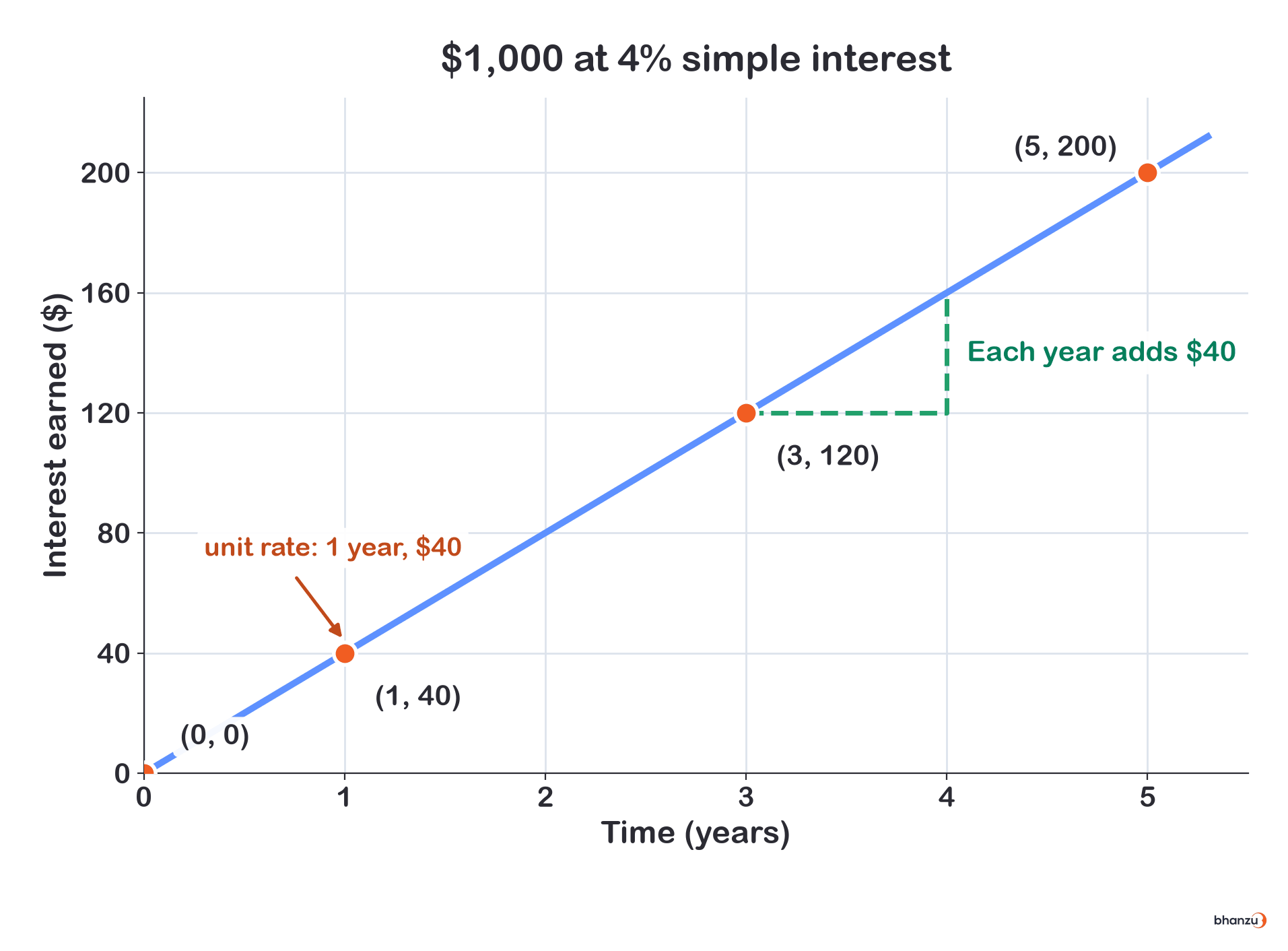
The constant of proportionality here is one year's interest, . So the interest follows , the same shape as other equations of proportional relationships. The point (1, 40) is the unit rate: 1 year, $40.
The straight line holds only while the interest stays out of the balance. Once a bank adds each year's interest to the principal and pays interest on the new total, the account is compounding, the graph curves upward, and no longer gives the answer.
Try It Yourself
Move the sliders for principal, rate and years, and watch the double number line add the same interest for each year. The table fills in one row per year, and the readout shows one year's interest, the total interest and the final balance. A time that ends in a half year shows up as 6 months.
How do you find the rate, time or principal?
Divide the interest by the product of the two numbers you already know. Getting one letter alone in is the skill high school algebra calls solving literal equations, where you undo a multiplication on both sides. You'll use the same rearranging again in 8th grade, when equations have letters on both sides.
To find the rate, divide both sides of by .
For the time, divide by instead.
To find the principal, the amount at the start, divide both sides of the formula by .
A faster route starts with one year's interest. If $500 earned $60 in 3 years, one year earned dollars, and , so the rate was 4%. Checking, .
| Words in the problem | Math it means |
|---|---|
| "deposits", "borrows" or "invests" $1,200 | |
| "at 4% a year" | |
| "for 18 months" | |
| "how much interest" | find |
| "total", "balance" or "amount owed" |
One distinction is genuinely confusing, even for adults. "Interest" and "interest rate" sound alike, yet the rate is a percent per year and the interest is dollars, so a question asking for the interest wants a dollar amount.
Examples of simple interest
Example 1
Maya keeps $300 in a savings account that pays 2% simple interest a year. How much interest does she earn in 1 year?
Change 2% to 0.02, then multiply.
Maya earns $6 of interest.
Example 2
Sam borrows $800 at 5% simple interest for 3 years. How much interest does he owe?
The tempting move is to put the 5 straight into the formula.
That says Sam owes $12,000 of interest on an $800 loan, which is 15 times the money he borrowed. Three years at 5% a year is only 15% of the loan, far less than the loan itself, so this answer cannot be right.
Write 5% as 0.05 and multiply again.
Sam owes $120 of interest, so he repays dollars in all.
Example 3
Ana deposits $1,200 at 3% simple interest for 18 months. What is her balance at the end?
Change the time to years.
Find the interest.
Add the interest to the principal.
Ana's balance is $1,254.
Example 4
Jordan's $2,500 earned $150 of simple interest in 4 years. What was the yearly rate?
Let be the yearly rate as a decimal. Divide both sides of by .
Checking, , so the rate was 0.015, or 1.5% a year.
Example 5
How many years will it take $640 at 2.5% simple interest to earn $96?
Let be the number of years. Find one year's interest first.
Divide the total interest by one year's interest.
It takes 6 years, and confirms it.
Example 6
Priya's grandparents want a savings account to earn $90 of simple interest in 3 years at 4% a year. How much must they deposit, and what will the account hold at the end?
Let be the deposit in dollars. Put the known numbers into .
Divide both sides by 0.12.
Then . They deposit $750, and the account holds $840 after 3 years.
Simple interest beyond the textbook
Simple interest exists because time with money has a price, and a lender and a borrower need to agree on that price before any money moves.
- It shows what savings really earn. At 0.39% a year, $100 earns 39 cents in a year, so the rate matters as much as the balance.
- It prices borrowing. The Federal Reserve's H.15 release listed the bank prime loan rate, one base rate banks use for short-term business loans, at 7.00% for November 13 to 19, 2026. As simple interest, $10,000 borrowed for 6 months at that rate would cost dollars.
- It sets up compound interest. Compound interest repeats the one-year step on a growing balance, so the simple and compound interest formulas make sense together once the first one does.
- It keeps both sides honest. A written rate and time let the borrower and lender check the same number, the job Hammurabi's note did.
Each of those uses depends on one fact from the double number line, that every year adds a fixed amount you can predict before calculating.
The pattern hiding inside simple interest
The interest is proportional to time, but the balance is not.
The balances climb by the same step every year. $1,000 at 4% gives $1,040, $1,080, $1,120 and so on, a list that high school algebra calls an arithmetic sequence, with a common difference of . The balance starts at $1,000 instead of zero, so doubling the time from 2 years to 4 doubles the interest ($80 to $160) but not the balance ($1,080 to $1,160). In 8th grade, you'll call that balance a linear function with a starting value.
The rate and the time can also trade places. $1,500 at 2% for 3 years and $1,500 at 3% for 2 years both earn $90, because and both equal 0.06. Compound interest breaks this swap, since its later years earn interest on interest.
Why kids get simple interest wrong (and the fix)
Mistake 1: Using months as if they were years
Where it slips in: Any problem that gives the time in months, as in Example 3. The formula has no slot labelled months, so a student who reads the number and skips the unit puts the 9 from "9 months" straight into .
Don't do this: $600 at 4% for 9 months worked as , or $216 of interest.
The correct way: Change 9 months to years first, then , so the interest is $18.
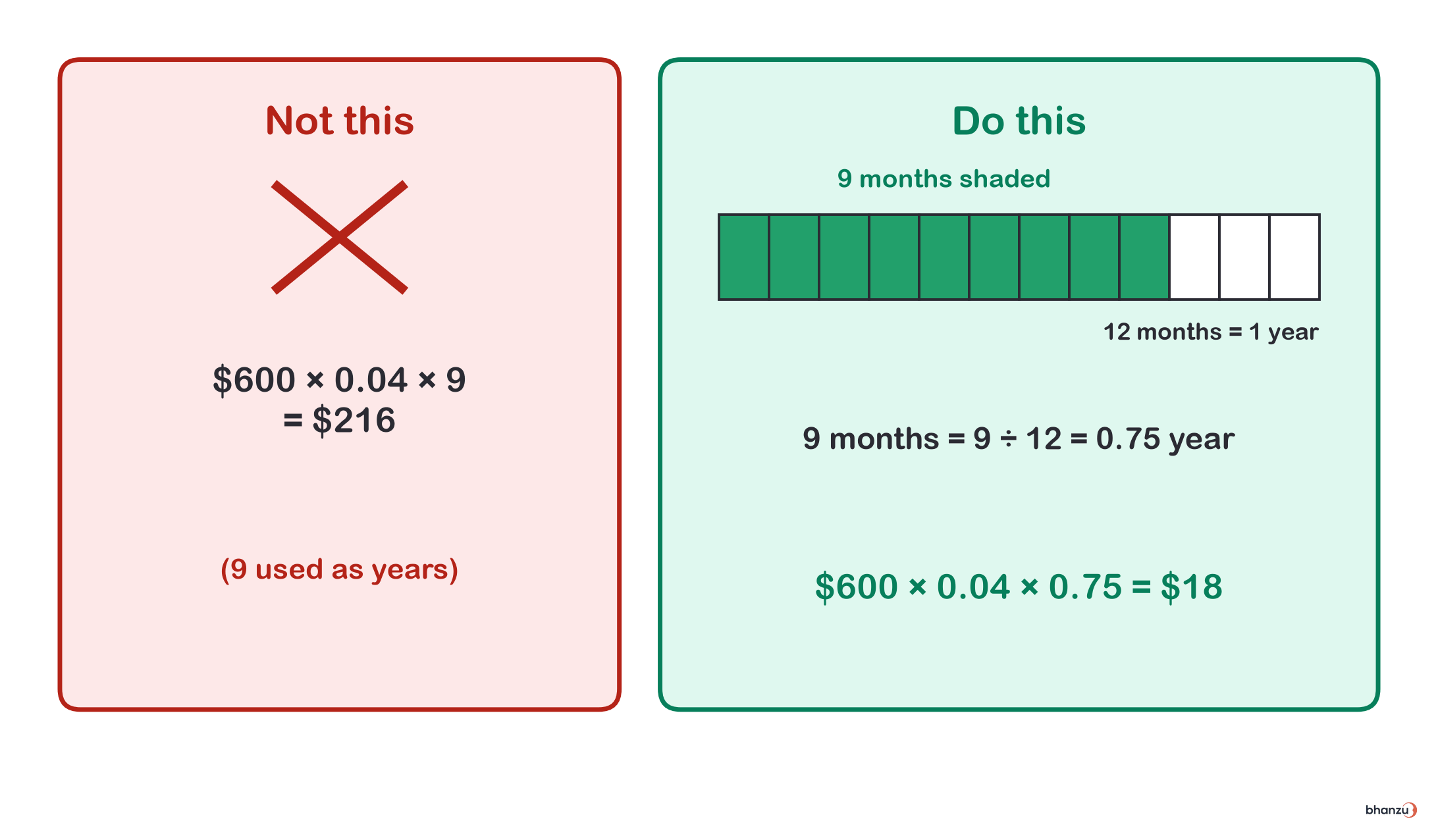
A size check catches it, since $216 is over a third of $600 for less than a year at 4%.
Mistake 2: Giving the interest when the question asks for the total
Where it slips in: Questions that say balance, total or amount owed. The formula stops at , and a student who trusts the formula stops right there too.
Don't do this: $350 at 3% for 4 years, with $42 given as the account balance.
The correct way: The interest is dollars, so the account holds dollars.
Mistake 3: Charging interest on last year's interest
Where it slips in: Year-by-year tables, especially after hearing about compound interest. Each new row seems to call for the newest balance, so the rate gets applied to it.
Don't do this: $2,000 at 5% for 3 years figured as $100, then 5% of $2,100 is $105, then 5% of $2,205 is $110.25, for $315.25 of interest.
The correct way: Simple interest uses the starting $2,000 every year, so and the interest is $300.
Compound interest earns interest on interest, and simple interest never does.
Key Takeaways
- Turn the percent into a decimal and any months into years before multiplying anything.
- Find one year's interest first, since each extra year of simple interest adds that same amount.
- To find a missing rate, time or principal, divide the interest by the other two numbers multiplied together.
- Add the principal back only when the question asks for a balance, a total or an amount owed.
- For help turning months into years and catching the 5 versus 0.05 mix-up with a teacher, explore Bhanzu's 7th grade math tutor or middle school math tutor.
Read More
- Graphs of Proportional Relationships
- Evaluating Expressions With Negative Numbers
- Finding the Whole From a Percent
- Multiplying Multi-Digit Decimals
- Comparing Linear Functions
- Fractions, Decimals and Percentages
Research Behind This Article
- Lillian Goldman Law Library, Yale Law School, The Code of Hammurabi, translated by L. W. King (2008). avalon.law.yale.edu
- NGA Center and CCSSO, Common Core State Standards for Mathematics, Grade 7, Ratios and Proportional Relationships (2010). thecorestandards.org
- OpenStax, Prealgebra 2e, 6.4 Solve Simple Interest Applications (2020). openstax.org
- Federal Deposit Insurance Corporation, National Rates and Rate Caps, November 16, 2026 (2026). fdic.gov
- Board of Governors of the Federal Reserve System, H.15 Selected Interest Rates, November 20, 2026 (2026). federalreserve.gov
- OpenStax, Contemporary Mathematics, 6.3 Simple Interest (2023). openstax.org
Quick Quiz: Check Yourself
Three levels, new numbers every time: find the interest for whole years, work with months and totals, then find a missing rate, time or principal.
Was this article helpful?
Your feedback helps us write better content
Frequently Asked Questions
Is simple interest monthly or yearly?
Is simple interest better than compound interest?
How do you calculate simple interest in days?
How long does it take money to become 4 times as much at 10% simple interest?
What grade do kids learn simple interest?
How can I help my child practice simple interest at home?