Key Points
- Evaluating expressions with negative numbers starts with one habit, writing every negative value inside parentheses, so with becomes .
- After substituting, the order of operations runs as usual (grouping, exponents, multiplication and division, then addition and subtraction), and subtracting a negative number becomes adding its opposite.
- The most common error is dropping the parentheses before squaring, because while , since the exponent in touches only the 6.
- In 7th grade the values include negative fractions and decimals as well as integers, and 8th grade equations lean on the same substitution skill when you check a solution.
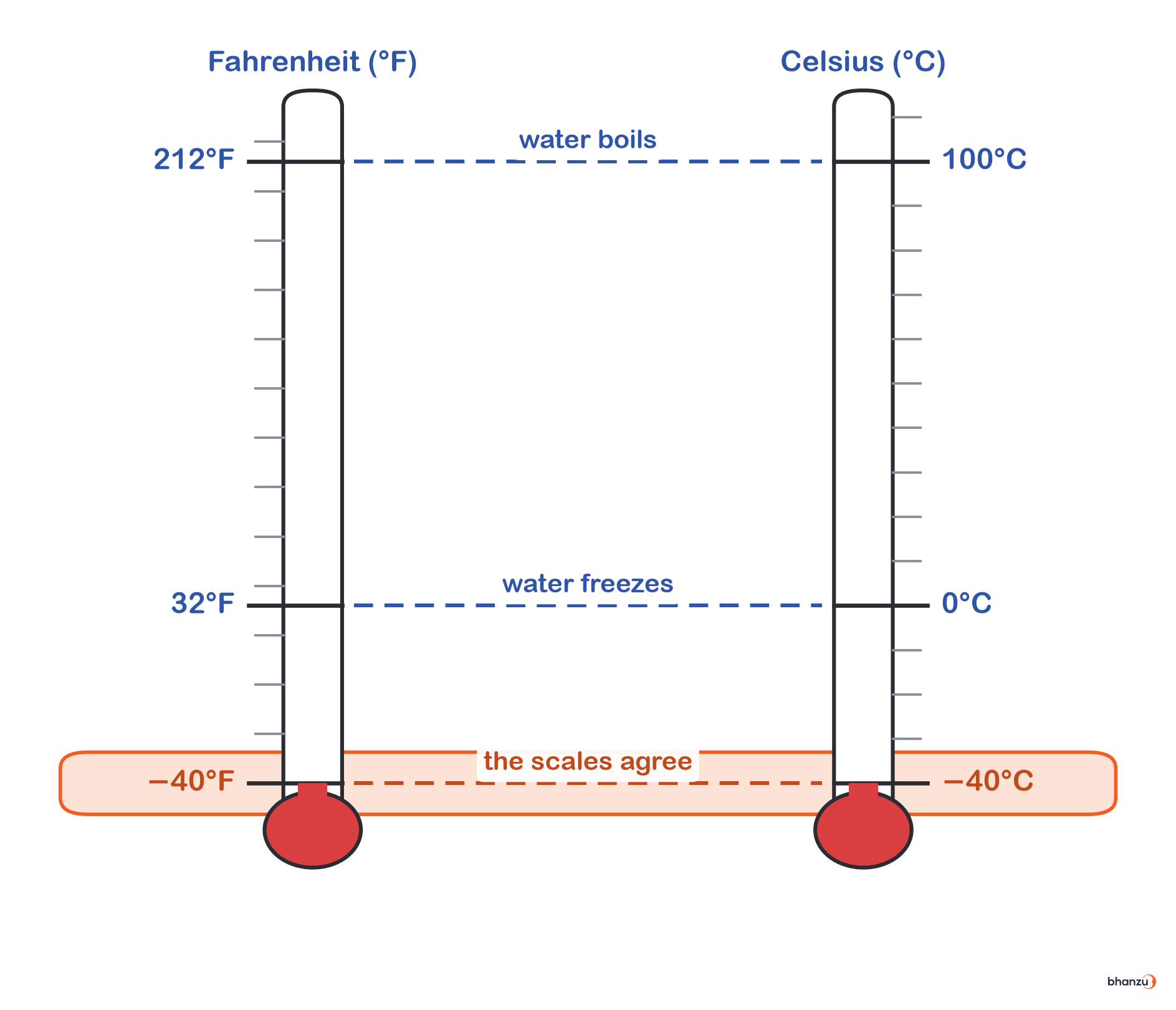
The temperature where two scales agree
At minus 40 degrees, a Fahrenheit and a Celsius thermometer agree. Every other reading splits apart: water freezes at 32 on one scale and 0 on the other. The rule that converts between them, listed by NIST (the US agency in charge of measurement standards), is an expression with a letter in it. Give that expression a reading below zero and you are already doing this skill, putting a negative value in place of a letter and working out what the expression equals.
Weather forecasters convert winter readings that fall below zero. Planetary scientists record moons hundreds of degrees colder than any freezer, and the spreadsheet formulas behind a bank account have to cope with the day the balance dips under zero.
How do you evaluate an expression with negative numbers?
Evaluating expressions with negative numbers takes four steps, and the second one, giving each negative value its own pair of parentheses, is the step that protects the signs. An algebraic expression is a math phrase built from numbers, letters and operations with no equals sign, such as . Each letter is a variable, a symbol that stands for a number that can change. A number written right before a variable is its coefficient, so means .
- Write the expression exactly as given.
- Replace each variable with its value, and put every negative value inside parentheses.
- Simplify using the order of operations with exponents, starting with grouping symbols such as parentheses and absolute value bars, then exponents, then multiplication and division from left to right, then addition and subtraction from left to right.
- Check the sign of the answer against a quick estimate.
Take when and . With two-color counters, where a yellow counter is worth and a red counter is worth , the term is two groups of three red counters, six red in all. Subtracting means taking away four red counters, which leaves two red counters, or . The symbols agree with the counters.
This is Common Core standard 7.EE.B.3, which asks for work with "positive and negative rational numbers in any form," meaning whole numbers, fractions and decimals. Your child met negative numbers on the number line in 6th grade, and 7th grade adds computing with them inside expressions, fractions and decimals included, then judging whether an answer is reasonable.
What happens when you subtract a negative?
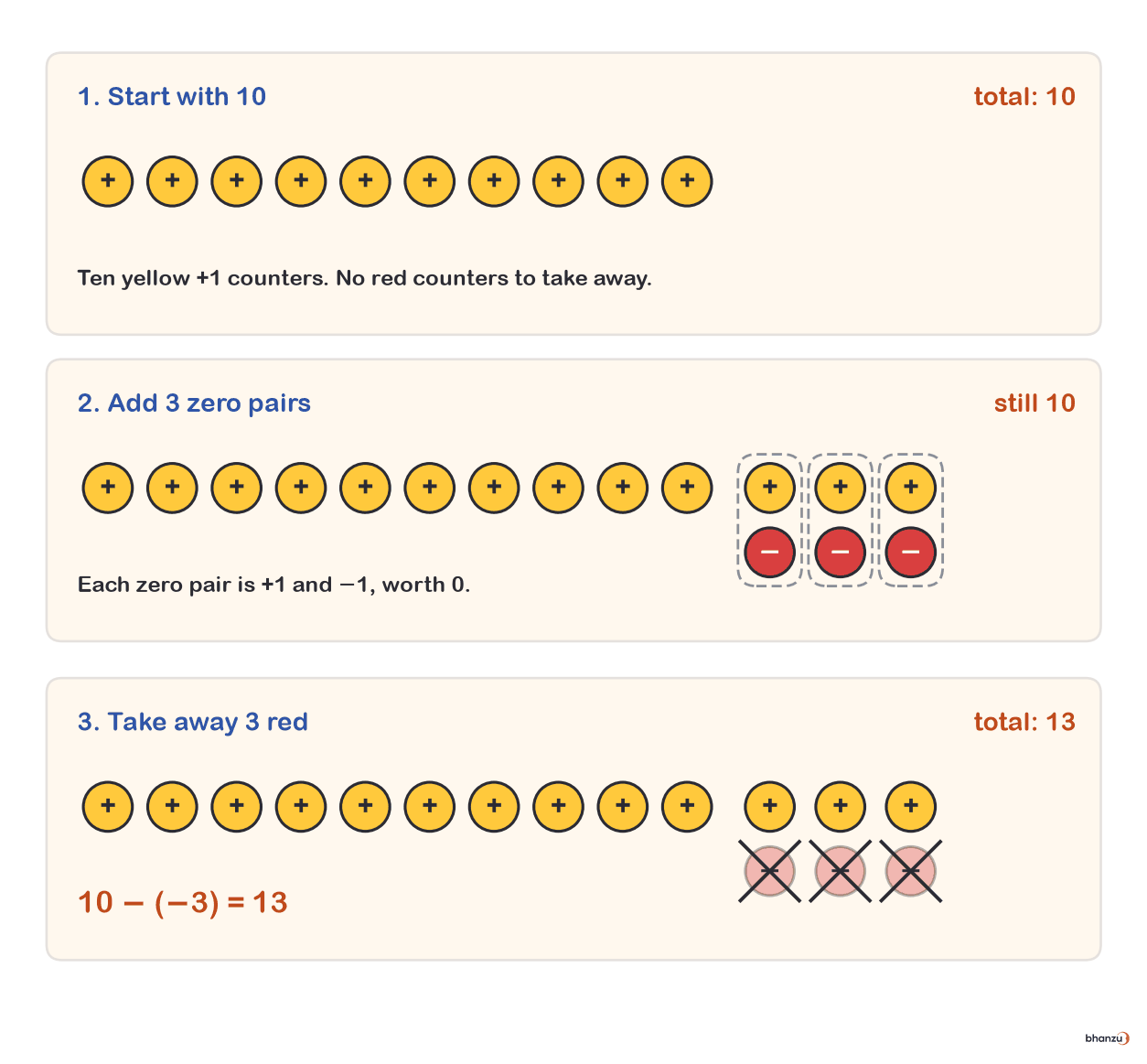
Subtracting a negative number gives the same result as adding its opposite, so . Two-color counters show why in three moves.
- Start with ten yellow counters for 10. There are no red counters to take away.
- Add three zero pairs. Each pair is one yellow and one red counter, worth 0 together, so the total is still 10.
- Take away the three red counters. Thirteen yellow counters are left.
In the table, the size of a number means its absolute value (its distance from 0).
| Operation | Example | What happens to the sign |
|---|---|---|
| Adding with different signs | Subtract the sizes and keep the sign of the larger size | |
| Subtracting a negative | Rewrite as adding the opposite, | |
| Multiplying two negatives | Same signs give a positive product | |
| Dividing with different signs | Different signs give a negative quotient |
OpenStax's free Prealgebra 2e textbook models subtraction with the same neutral pairs of counters, and it evaluates for to get . Counters stop being practical once the numbers pass about 20 or turn into fractions such as , and that is where the rule "subtract means add the opposite" takes over. A number line also works, since subtracting a negative is a hop to the right. Longer strings of signed numbers with no letters at all, like , are worked the same way in order of operations with rational numbers.
Try It Yourself
Pick , or , then slide below zero and watch the counters and the number line change together. With and a negative , zero pairs appear first, the red counters are taken away, and the hop on the number line goes right instead of left.
Is a negative number squared negative?
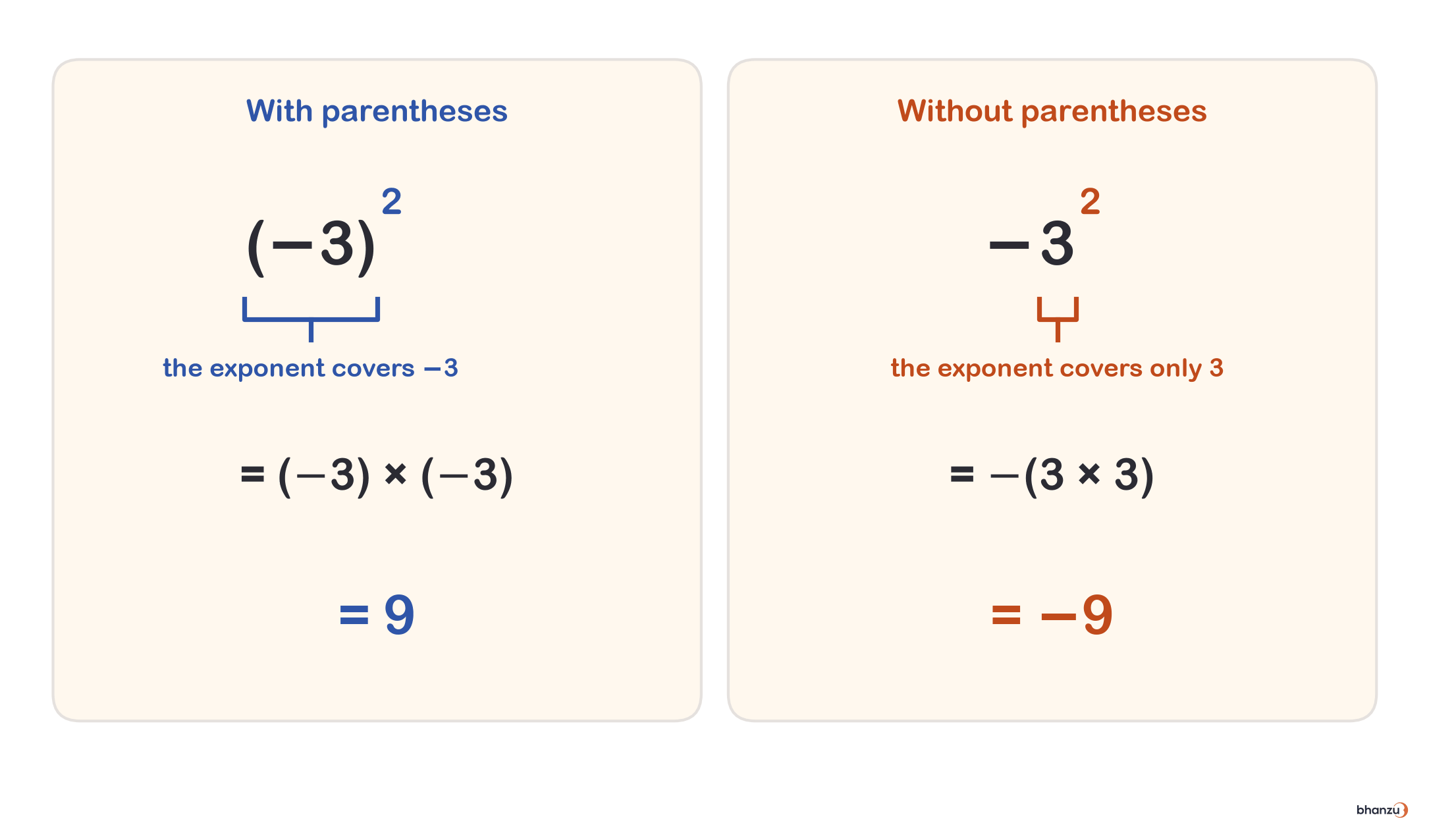
No. Squaring a negative number always gives a positive result, because two negative factors multiply to a positive, so . The confusion comes from notation. Written without parentheses, means the opposite of , because an exponent touches only the number right next to it, so .
Cubes keep the sign, because three negative factors give a negative product.
That is why the parentheses in step 2 matter at the exact moment you substitute. OpenStax's Prealgebra 2e makes the same point when it substitutes for , since the parentheses are what show the multiplication. The reverse error shows up right after a child learns that a negative squared is positive, and then printed in a problem gets answered as 36. The exponent there belongs to the 6 alone, so the value is .
The minus sign is genuinely confusing, because it does three different jobs and nothing on the page labels which one you are looking at.
- Subtract, as in .
- Negative, as in , a number below zero.
- The opposite of, as in .
What is negative when is already negative?
The expression means the opposite of , the number at the same distance from 0 on the other side, which is the idea behind opposite numbers. When , , so is a positive number whenever is negative.
How do you plug a negative into a formula?
A negative goes into a formula exactly the way it goes into any expression, in parentheses, followed by the order of operations. A formula is an expression whose letters stand for real quantities, like the Fahrenheit to Celsius rule from the hook.
| Symbol | Meaning | Units |
|---|---|---|
| Temperature on the Celsius scale | degrees Celsius | |
| Temperature on the Fahrenheit scale | degrees Fahrenheit | |
| Fahrenheit reading where water freezes | degrees Fahrenheit | |
| Celsius degrees in one Fahrenheit degree | none |
The formula has this shape for a reason. The NIST temperature reference page, updated in June 2026, lists water freezing at 32 degrees Fahrenheit or 0 degrees Celsius and boiling at 212 degrees Fahrenheit or 100 degrees Celsius. Subtracting 32 lines up the two freezing points, and since 180 Fahrenheit degrees cover the same gap as 100 Celsius degrees, each Fahrenheit degree is of a Celsius degree.
The hook's claim about minus 40 can now be checked by putting into the formula.
So minus 40 degrees Fahrenheit is also minus 40 degrees Celsius. Fraction and decimal inputs follow the same steps, as Examples 3 and 5 show, and other temperature conversion formulas, such as Celsius to Kelvin, are evaluated the same way.
Examples of evaluating expressions with negative numbers
Example 1
Evaluate when .
The value is 5.
Example 2
Evaluate when .
The tempting move is to drop straight in without parentheses.
That answer cannot be right. With negative, is positive, and is also positive (minus 3 times a negative number), so the total has to be positive.
Put the parentheses back and evaluate again.
The value is 28.
Example 3
Evaluate when .
The value is 17.
Example 4
When , which is greater, or ?
Since , the expression is greater, by 10.
Example 5
Evaluate when and .
The value is 10.
Example 6
Triton, Neptune's largest moon, has a surface temperature of around degrees Fahrenheit. Use to find it in Celsius.
Substitute .
Triton's surface is about degrees Celsius, the same figure given on NASA's Neptune facts page, updated in October 2026.
Why does substituting negative numbers matter?
A formula is a rule you can reuse, and the numbers that real situations feed into it do not stay above zero.
- It turns one rule into many answers. The temperature formula handles a winter morning in Chicago and the surface of Triton with the same four steps.
- It keeps money signs honest. An account that is $20 overdrawn has a balance of dollars, and after a $35 deposit the expression , with for the balance, gives dollars, not 55.
- It lets you check published numbers. Example 6 landed on NASA's own Celsius value, so both the method and the arithmetic held up.
- It opens the door to 8th grade algebra. Checking a solution to an equation means substituting it back in, and you will do that constantly with equations and functions next year.
Substitution keeps paying off past 7th grade. The 2024 Nation's Report Card mathematics assessment, taken by about 115,200 eighth graders between January and March 2024, measures algebra as one of its five content areas.
The pattern hiding inside every negative answer
The sign of many answers can be predicted before any arithmetic, and the prediction takes a moment. Three checks work on products, squares and opposites.
- Count the negative factors. In a product or quotient with no zero factors, an even number of negative factors gives a positive result and an odd number gives a negative one, so must be negative, and it is .
- Squares are never negative. The square is positive for every negative (and 0 when ), so a negative square means a parenthesis went missing.
- Opposites flip the sign. When is negative, is positive, and when is positive, is negative.
Example 2 caught its wrong answer with the second check. A wrong sign caught by a prediction costs a few seconds, while a wrong sign found in the answer key costs the whole problem.
Common errors when evaluating expressions with negative numbers
Mistake 1: Dropping the parentheses before squaring
Where it slips in: Squaring a substituted value, such as when . A child who rushes copies exactly as printed, and the exponent then grabs only the 6.
Don't do this: .
The correct way: .
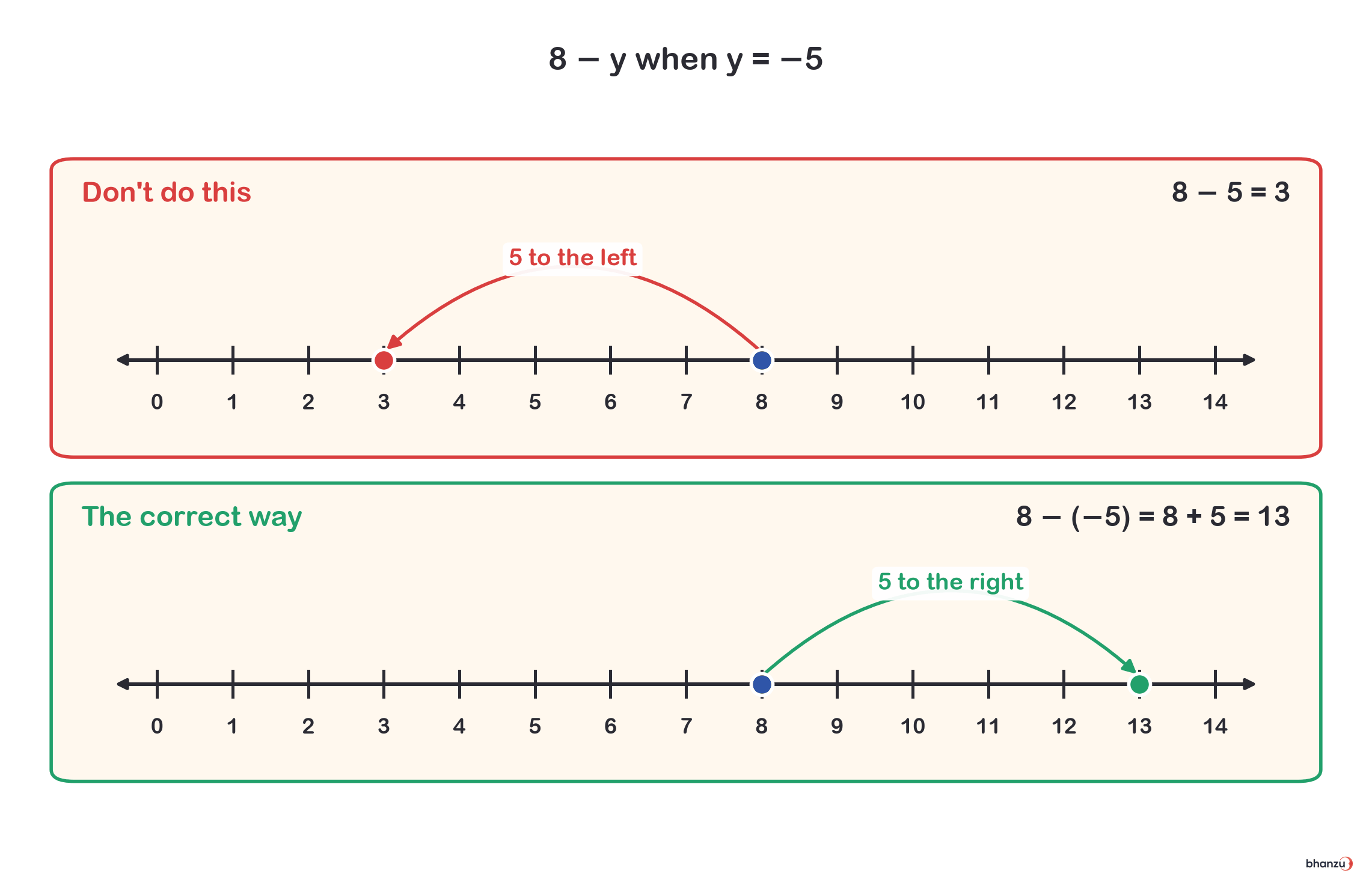
Mistake 2: Treating minus a negative as minus a positive
Where it slips in: Expressions like when , where the two minus signs sit side by side and look like a single one.
Don't do this: .
The correct way: . Reading it aloud as "8 minus negative 5" keeps both signs in play, and on a number line the hop goes to the right.
Mistake 3: Reading 4x as 4 minus a number
Where it slips in: A coefficient next to a negative value, such as when . Without parentheses the page shows 4 and side by side, and the minus sign in looks like subtraction.
Don't do this: .
The correct way: , because a coefficient multiplies.
Children who make this error usually know the multiplication rule perfectly well. The mistake comes from reading the symbols, and it disappears once the substitution line always shows .
Key Takeaways
- Write the parentheses first and the number second, so a square or a coefficient can never grab the wrong sign.
- When you see minus a negative, rewrite it as plus the opposite before you compute.
- Predict the sign before calculating, and treat a negative square as a signal to look for a lost parenthesis.
- Evaluating expressions with negative numbers works the same way for fractions, decimals and real formulas like the temperature rule.
- To practice keeping every substituted negative in parentheses with a teacher who spots a lost minus sign right away, explore Bhanzu's 7th grade math tutor sessions or an algebra tutor.
Read More
- Properties of Operations With Negative Numbers
- One-Step Equations With Negative Numbers
- Negative Number Word Problems
- Exponent Rules
- Absolute Value
- Simplifying Expressions
Research Behind This Article
- NIST, SI Units: Temperature (2026). nist.gov
- Common Core State Standards Initiative, Grade 7: Expressions and Equations (2010). thecorestandards.org
- OpenStax, Prealgebra 2e, 3.3 Subtract Integers (2020). openstax.org
- OpenStax, Prealgebra 2e, 3.4 Multiply and Divide Integers (2020). openstax.org
- NASA Science, Neptune: Facts (2026). science.nasa.gov
- National Center for Education Statistics, The Nation's Report Card: 2024 Mathematics Assessment, Grades 4 and 8 (2025). nationsreportcard.gov
Quick Quiz: Check Yourself
Three levels, new numbers every time: substitute one negative value, then square or subtract with a negative or decimal input, then evaluate with a fraction, two variables or the temperature formula.
Was this article helpful?
Your feedback helps us write better content
Frequently Asked Questions
Is evaluating expressions with exponents and negative numbers the same as working with negative exponents?
Why is a negative times a negative positive?
How do you combine like terms with negative numbers?
Where can my child practice evaluating expressions with negative numbers, with answers?
What rational number operations does a 7th grader need for this?
How can I help my child evaluate expressions at home?