Key Points
- Properties of operations include three rules shared by addition and multiplication, the commutative (order), associative (grouping) and identity (0 or 1) properties, and each holds for every number.
- Swapping and regrouping rewrite as , and putting one number in for in both expressions gives a quick check that they match.
- Subtraction and division have no commutative or associative property, since equals 10 while regrouping it as gives 14.
- Common Core says 3rd graders need not use formal names for these moves, and 6th grade applies the same properties to expressions with letters.
The swap rule that got its name in 1814
You were swapping numbers to make adding easier long before the move had a name. Adding the pair that makes ten first felt like a shortcut. It was a rule of arithmetic the whole time.
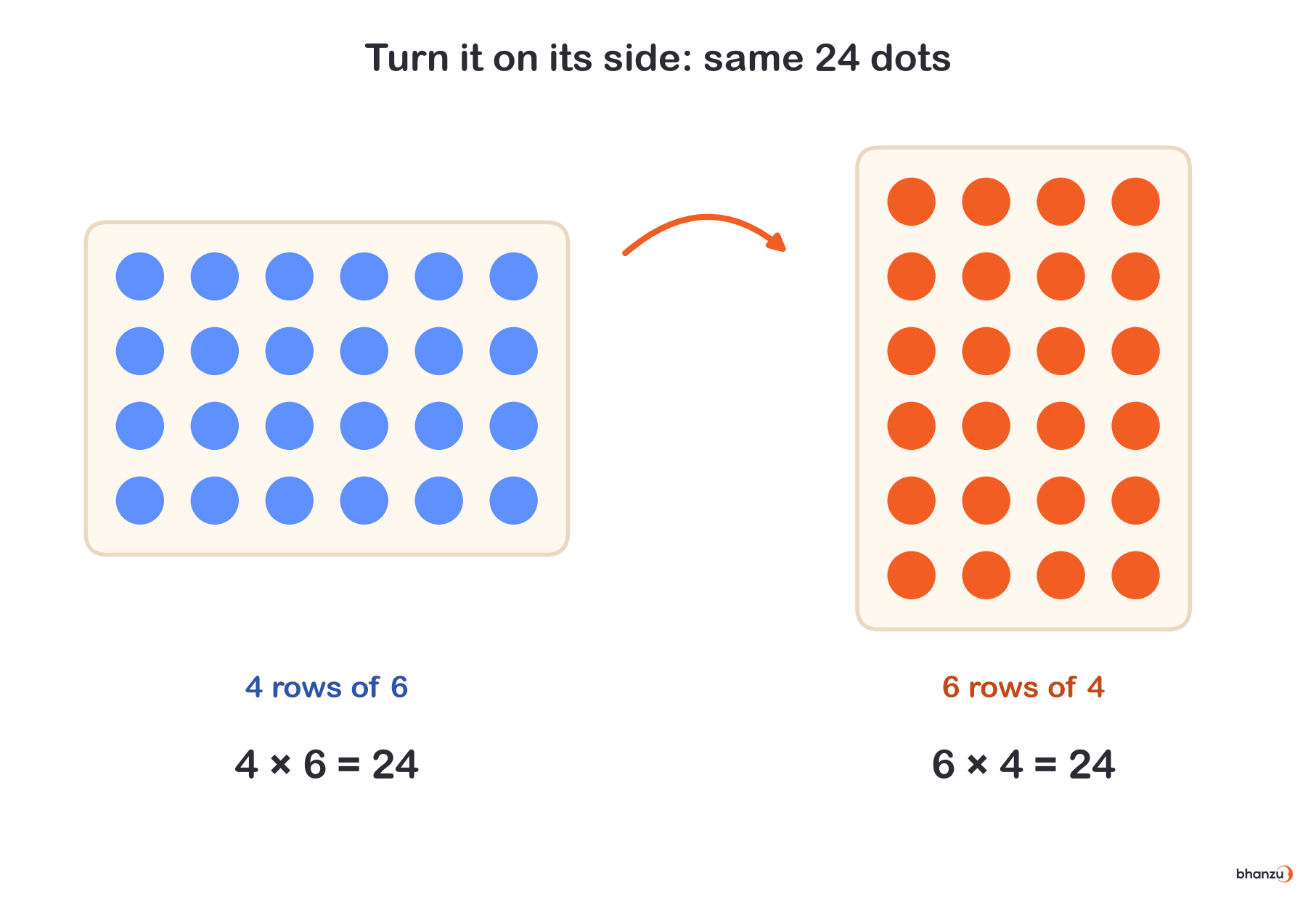
The name arrived in 1814, when the French mathematician François-Joseph Servois introduced the words "commutative" and "distributive" in a paper. Turn a grid of dots on its side and you can watch the commutative rule hold.
Outside school, a store clerk totals prices in the fastest order, and a builder counts floor tiles by rows or by columns and gets one answer.
What are the properties of operations?
Properties of operations are rules, such as the commutative, associative and identity properties, that hold for every number you add or multiply, so and must both equal 23. An operation is an action on numbers, such as adding. Numbers you add are addends and give a sum, while numbers you multiply are factors and give a product.
In 6th grade the properties appear in Common Core standard 6.EE.A.3, which asks you to apply them to write equivalent expressions, two expressions that name the same number. Your child has used these moves for years. Common Core's 3rd grade standard 3.OA.B.5 says students "need not use formal terms for these properties", so the names are optional early on. If grouping three factors still feels new, the 3rd grade lesson on the associative property of multiplication starts there.
The three properties addition and multiplication share
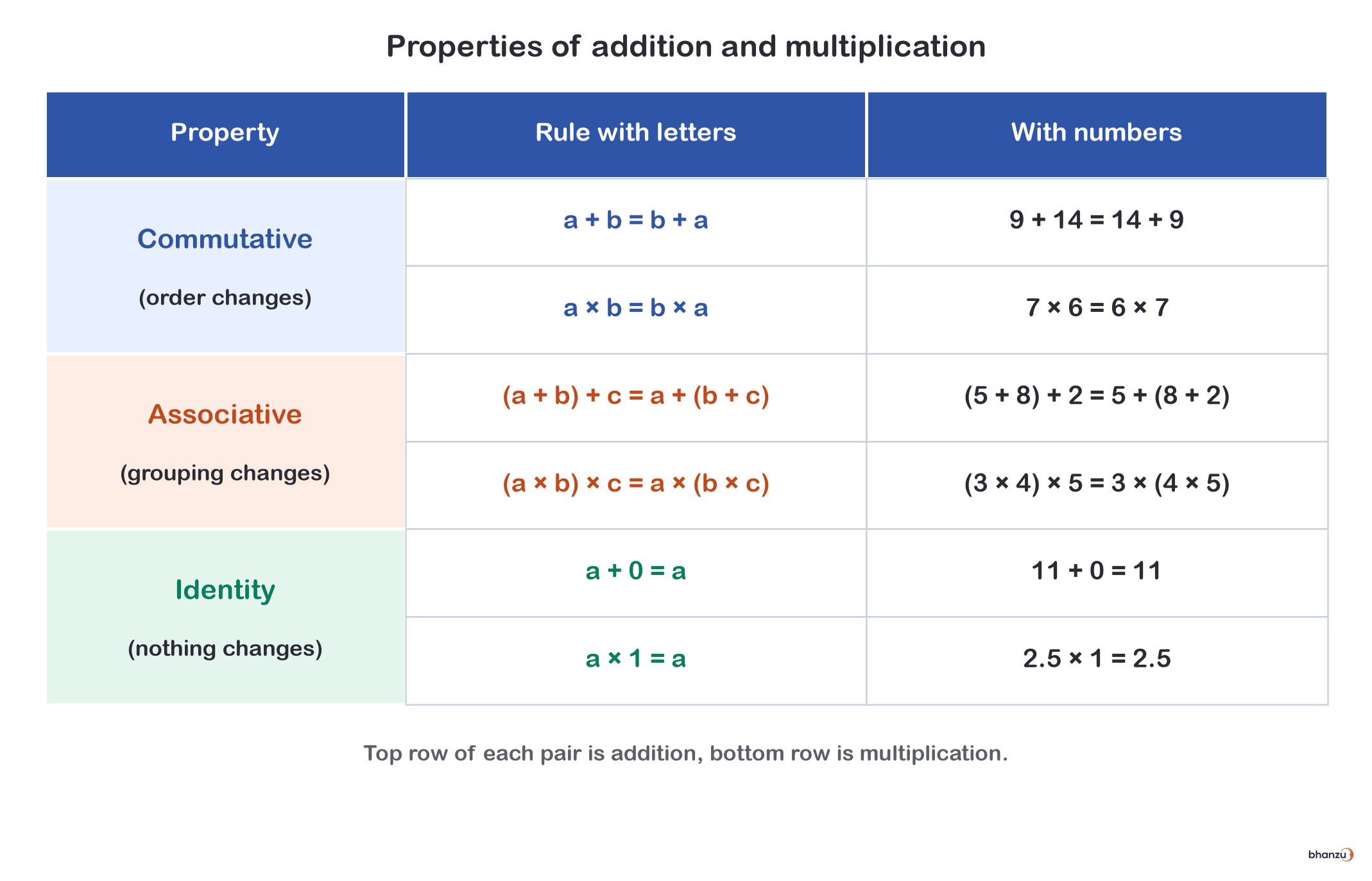
Addition and multiplication share three properties, and each names a change that leaves the answer alone.
- Commutative property. The order changes, as when two addends or two factors swap places.
- Associative property. The grouping changes, as when parentheses move among three addends or three factors that stay in order.
- Identity property. Nothing changes, because adding 0 or multiplying by 1 leaves a number as it was, so 0 is the additive identity and 1 the multiplicative identity.
| Property and operation | Rule with letters | With numbers |
|---|---|---|
| Commutative, addition | ||
| Commutative, multiplication | ||
| Associative, addition | ||
| Associative, multiplication | ||
| Identity, addition | ||
| Identity, multiplication |
In every rule, , and stand for any numbers, including fractions and decimals. A 4 by 6 array of dots turned on its side becomes 6 rows of 4 with no dot added or lost, so . Grouping only decides which two numbers meet first (the same amounts still land in the total).
Multiplying by 0 follows a separate rule, the zero property.
Swapping and regrouping together power mental math. For , move the 2 next to the 50 to make 100 (no pencil needed).
Children often add the first two numbers out of habit, even in , where grouping first turns the problem into .
Why don't subtraction and division follow the same rules?
Subtraction and division have no commutative or associative property, because changing the order or the grouping changes the answer. The free OpenStax Prealgebra 2e textbook from Rice University says plainly that subtraction and division are not commutative.
Is subtraction commutative? No. Taking 12 from 48 leaves 36, but taking 48 from 12 goes 36 below zero (where negative numbers live, also a 6th grade topic).
Is division associative? No again.
Swapping fails too, since but . One counterexample is enough to show a rule fails, while no pile of matching examples can show a rule always works.
Subtraction does allow one safe regroup, and the distinction is genuinely slippery. Taking away 12 and then 8 takes away 20 in all, so , with a plus sign inside the parentheses. In 7th grade, subtraction becomes adding the opposite and the swap rules return, as the lesson on properties of operations with negative numbers shows.
How do you write equivalent expressions with properties?
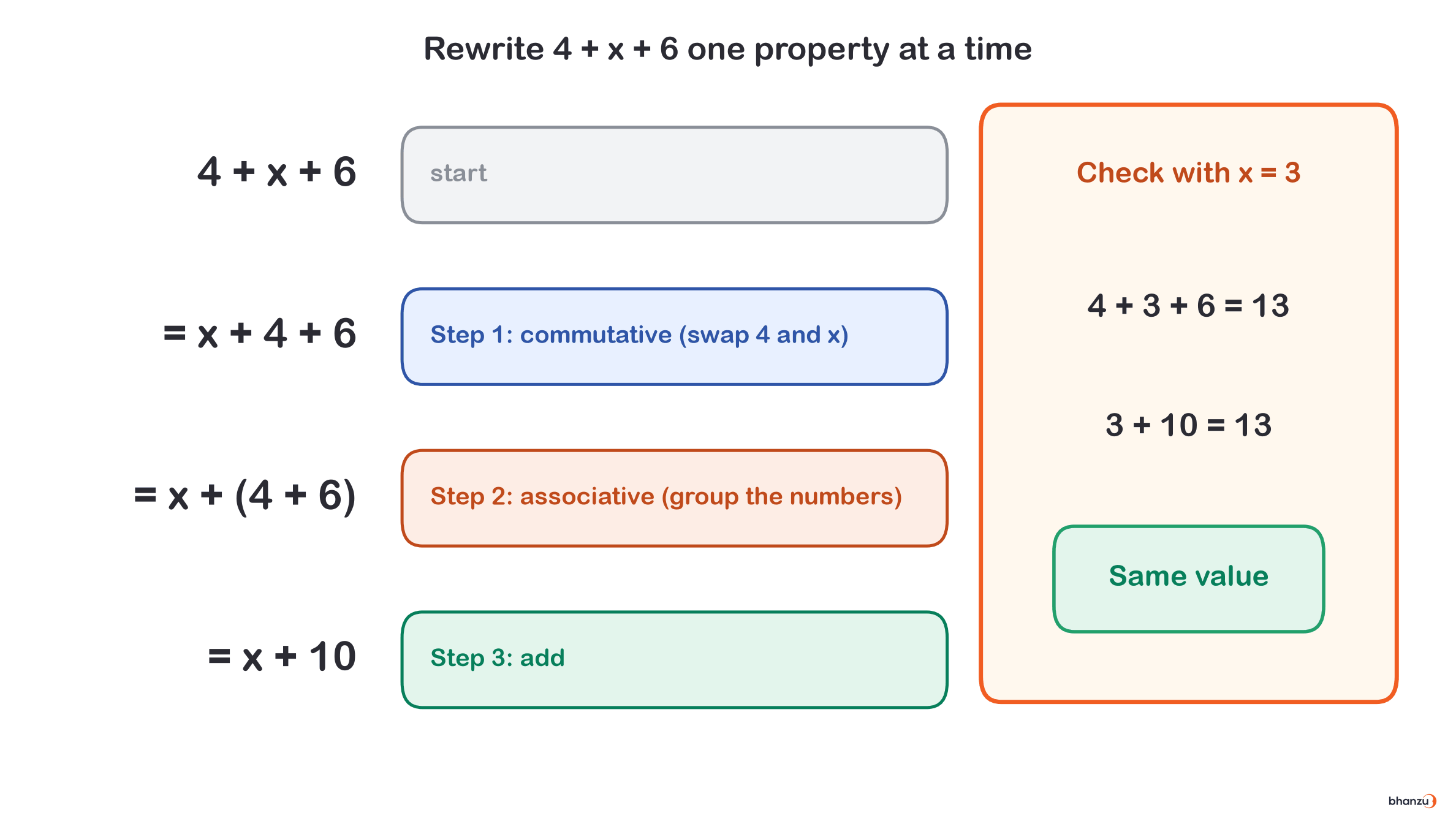
You write an equivalent expression by making one change at a time that a property allows, so the result names the same number whatever the letter stands for. An algebraic expression is a math phrase of numbers, letters and operations with no equals sign, such as , where stands for an unknown number.
- Swap 4 and with the commutative property, giving .
- Group the numbers with the associative property, giving .
- Add inside the parentheses, giving .
Products work the same way, so swapping and grouping turn into , which is , meaning 16 times . The standard's own example combines like terms, terms with the same letter, as . The same standard also uses a fourth rule, the distributive property, which turns into and has a lesson of its own.
To identify equivalent expressions, put the same number in for the letter in both. With , both give 13.
Common Core calls this skill 6.EE.A.4. The same check catches a bad rewrite such as , which gives 30 when , not 13. A match for one number is a check, not a proof (a lucky number can match by accident), and the properties are what prove two expressions always agree. In 8th grade the same moves gather letter terms before you solve equations.
Word problems use the same moves. Diego bikes 2.4 miles to school, then miles to practice, then 0.6 miles home, where stands for the miles from school to practice. Written as simply as possible, his total distance becomes , or miles.
| Words in the problem | Math it means |
|---|---|
| "then miles to practice" | add |
| "then 0.6 miles home" | add 0.6 |
| "total distance" | add every part, |
| "as simply as possible" | combine the numbers, |
Try It Yourself
Each step on the screen rewrites the expression, and you tap the property that allows it, Commutative, Associative or Identity. A wrong tap brings a hint about what changed. Then slide the number for the letter and watch the starting and final expressions give the same value.
Examples of properties of operations
Example 1
Which property does show? Find the product.
The factors stay in the order 8, 5, 3 and only the parentheses move, so this is the associative property of multiplication.
Both sides equal 120.
Example 2
Does equal ?
The tempting move treats subtraction like addition and works the last two numbers first, , then .
Working left to right, as written, gives , then .
The results disagree, . The 14 came from taking away 6 instead of 10 in all, because subtraction has no associative property.
The correct regroup puts a plus sign between the amounts taken away.
No, the expressions are not equal, and .
Example 3
Use properties of operations to find in your head.
Swap 13 and 4 (commutative), then group the pair that makes 100 (associative).
The product is 1,300.
Example 4
Find by choosing a friendly pair.
3.6 and 6.4 make a whole number, so move 6.4 next to 3.6 and group them.
The sum is 17.25.
Example 5
Are and equivalent? Explain with properties, then check with a number.
Here stands for any number.
- Swap 6 and (commutative), giving .
- Group the numbers (associative), giving .
- Swap once more to put the number first, giving .
With , and .
Yes, and are equivalent.
Example 6
Ava bikes 1.5 miles to the library, then miles to the park, then 2.5 miles home. Write her total distance as simply as possible, then find it when .
The letter stands for the miles from the library to the park.
Her total distance is miles, so when it is miles.
Check in the original order, .
What makes properties of operations worth learning?
The properties of operations matter because they let you pick the easiest path through a calculation and still be sure of the answer.
- It turns hard products into friendly ones. Pairing 25 with 4 makes 100, so a product that looks like long multiplication fits in your head.
- It makes work with letters possible. You can't add 4 to before you know , but you can move aside and add 4 and 6.
- It gives every sum a built-in check. Adding a column of prices from the top and then from the bottom must give one total.
- It is where algebra starts. The 2024 Nation's Report Card from the National Center for Education Statistics assessed 115,200 eighth graders and reported a national average Grade 8 algebra score of 281.7 on a 0 to 500 scale, down from 288.9 in 2019.
In those same results, 39% of eighth graders scored below NAEP Basic in math, so naming each move now, while the numbers are small, gives your child steady footing for the algebra ahead.
Tripping points to avoid with properties of operations
Mistake 1: Calling a regrouping a swap
Where it slips in: Naming the property in a line such as , where both sides look shuffled.
Don't do this: Label it commutative because the numbers seem to have moved.
The correct way: The order 6, 9, 1 is the same on both sides and only the parentheses moved, so the property is associative. Both sides equal 16, since and .
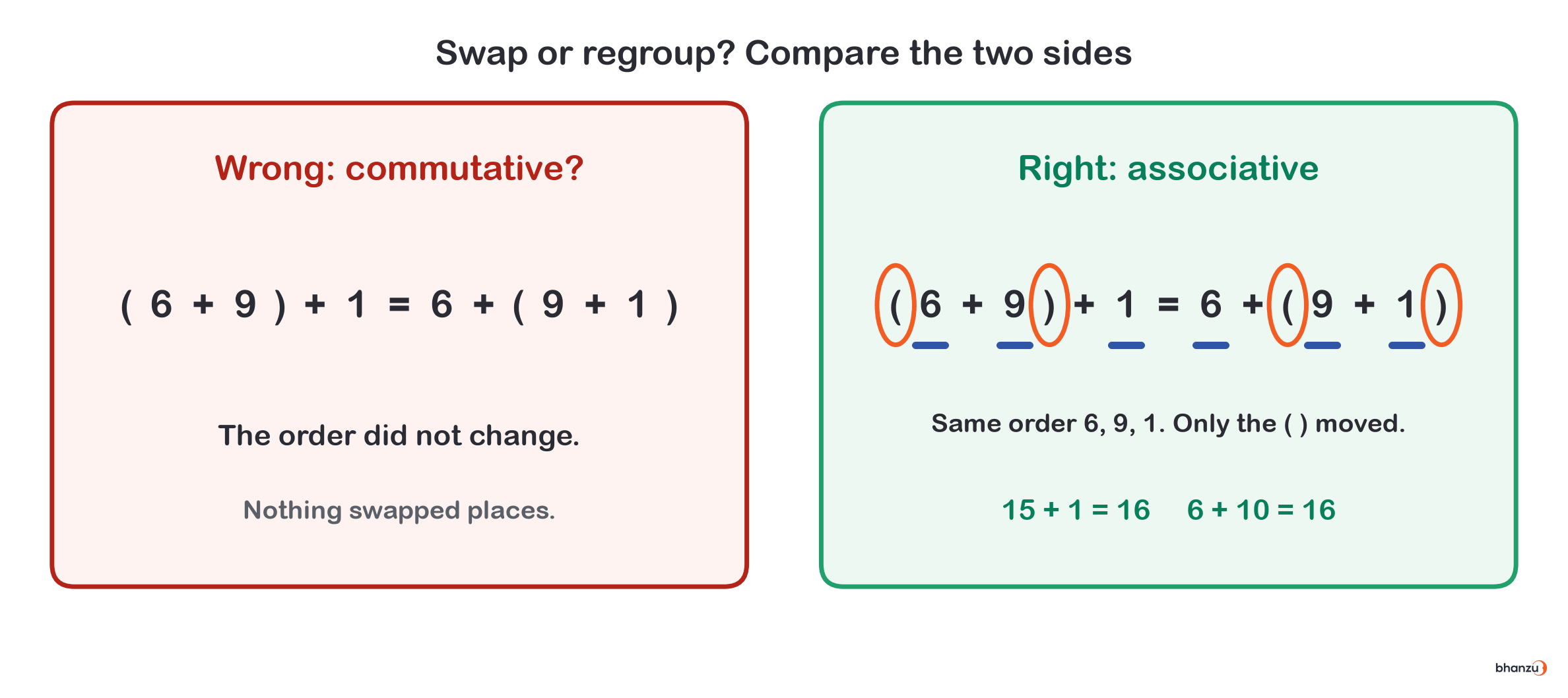
Children make this mistake because both properties keep the answer the same, so they look at the numbers instead of comparing the two sides position by position.
Mistake 2: Swapping or regrouping in subtraction and division
Where it slips in: Rewriting or to make it easier.
Don't do this: Write or .
The correct way: Work left to right, so and .
A child who rushes to the answer grabs the friendly pair here too, because swapping works so often in addition that it feels like a rule for everything.
Mistake 3: Mixing up the identity for multiplication with zero
Where it slips in: Problems that put a factor of 0 next to a factor of 1, such as and .
Don't do this: Write , thinking 0 changes nothing.
The correct way: For multiplication the identity is 1, so . Multiplying by 0 follows the zero property, so .
The mix-up starts in addition, where 0 really does change nothing, as in . The identity property keeps a number the same, while the zero property turns any product into 0.
What most guides get wrong about properties of operations
Most property charts pair each name with one example, which teaches the name but not how to spot the property in your own work. A property describes the change between two written expressions, so compare both versions before naming it.
- Order changed. The same numbers sit in a new order, so the move was commutative.
- Parentheses moved. The order stayed and only the grouping changed, so the move was associative.
- A 0 or 1 vanished. An added 0 or a factor of 1 was dropped or put in, so the move used the identity property.
One line of mental math can use two properties. Turning into swaps 48 and 63, then groups the pair that makes 100, so the honest label names both properties. A What Works Clearinghouse practice guide for grades 6 to 12 recommends teaching students to use the structure of algebraic representations, and comparing two lines is where that habit starts.
Key Takeaways
- Name a property by asking whether the order changed, the parentheses moved, or a 0 or 1 disappeared.
- The swap and regroup properties of operations belong to addition and multiplication, and one counterexample, against , rules out regrouping in subtraction.
- Moving the letter aside and grouping the numbers turns into .
- One number put in for the letter checks a rewrite, and a single mismatch proves two expressions differ.
- For more practice telling a swap from a regroup with a teacher who checks each property you name, explore Bhanzu's 6th grade math tutor or algebra classes.
Read More
- Equations With Tape and Hanger Diagrams
- Whole Numbers and Integers
- Simplifying Expressions
- Expression, Term, Factor and Coefficient
- Properties of Equality
Research Behind This Article
- J J O'Connor and E F Robertson, MacTutor History of Mathematics, François-Joseph Servois (2000). mathshistory.st-andrews.ac.uk
- NGA Center and CCSSO, Common Core State Standards for Mathematics: Grade 6 Expressions and Equations (2010). thecorestandards.org
- NGA Center and CCSSO, Common Core State Standards for Mathematics: Grade 3 Operations and Algebraic Thinking (2010). thecorestandards.org
- OpenStax (Marecek, Anthony-Smith and Honeycutt Mathis), Prealgebra 2e, 7.2 Commutative and Associative Properties (2020). openstax.org
- National Center for Education Statistics, The Nation's Report Card: 2024 Mathematics, Grades 4 and 8 (2025). nationsreportcard.gov
- Institute of Education Sciences, What Works Clearinghouse, Teaching Strategies for Improving Algebra Knowledge in Middle and High School Students (2015). ies.ed.gov
Quick Quiz: Check Yourself
Three levels, new numbers every time: fill in the missing number in a property, use the properties for mental math, then simplify a letter expression or use one to find a total distance.
Was this article helpful?
Your feedback helps us write better content
Frequently Asked Questions
How do I teach properties of operations at home?
Do kids learn properties of operations in grade 4?
Is there a properties of operations chart or cheat sheet?
What are algebraic operations?
Is there a list of properties in math beyond these three?