Key Points
- Inequalities on a number line use an open circle when the boundary number is not a solution, as in , and a closed circle when it is, as in .
- The shaded arrow points toward the solutions, and one number from the shading, put back into the inequality, confirms the direction.
- A letter on the right causes a common direction mistake, because means , so its arrow points left.
- In a real-world limit the words choose the circle, so "taller than 48 inches" is and "at least 48 inches" is .
The sign Thomas Harriot never wrote
The greater-than sign was introduced in an algebra book printed in 1631. The book carried the name of the English mathematician Thomas Harriot, who had died 10 years earlier. His MacTutor biography says the editor added the signs for "greater than" and that Harriot used different symbols (many sources still credit him).
The sign is useful because it can describe a whole stretch of numbers, such as every number greater than 3, where an equation usually names just one. Inequalities on a number line show that entire stretch in one drawing.
Engineers use the same idea for an elevator's maximum load, and game designers write rules such as "if the score is more than 100, open the next level" into their code. Pharmacists use it too, keeping each dose at or below a safe amount.
What is an inequality on a number line?
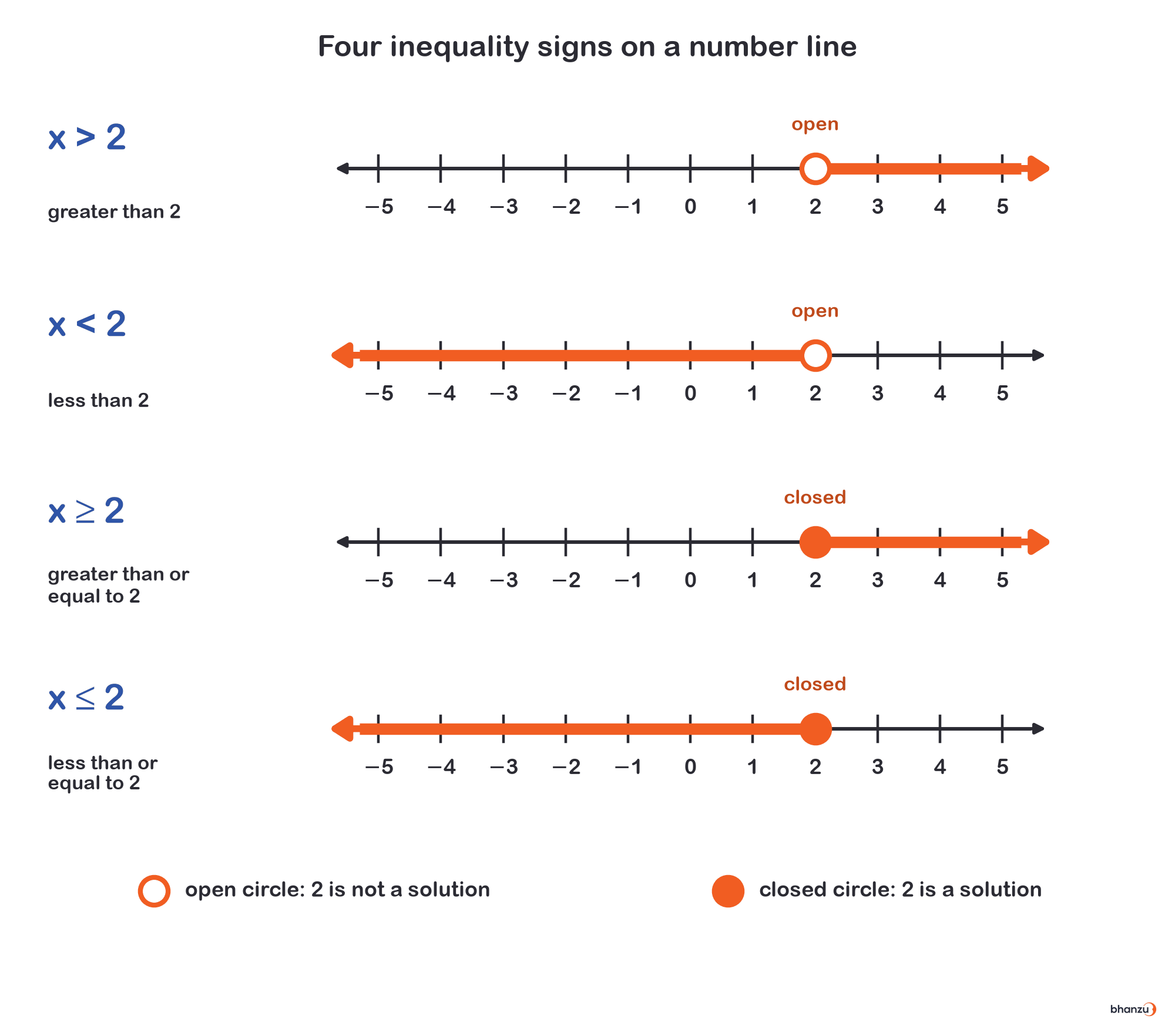
Inequalities on a number line are drawings of an inequality's solutions, the numbers that make it true when they replace the letter. Each drawing has a circle at the boundary number, where the solutions start, and a shaded arrow. An inequality is a math sentence that compares two amounts with , , or instead of an equals sign, and the inequalities in 6th grade compare a letter with one number.
Compare with . The equation has one solution, but the inequality has infinitely many, so the list never ends. Numbers such as 3.01, 3.5, 4, 6.25 and 1,000 all work, along with every decimal between 3 and 4 you learned to place with decimals on the number line.
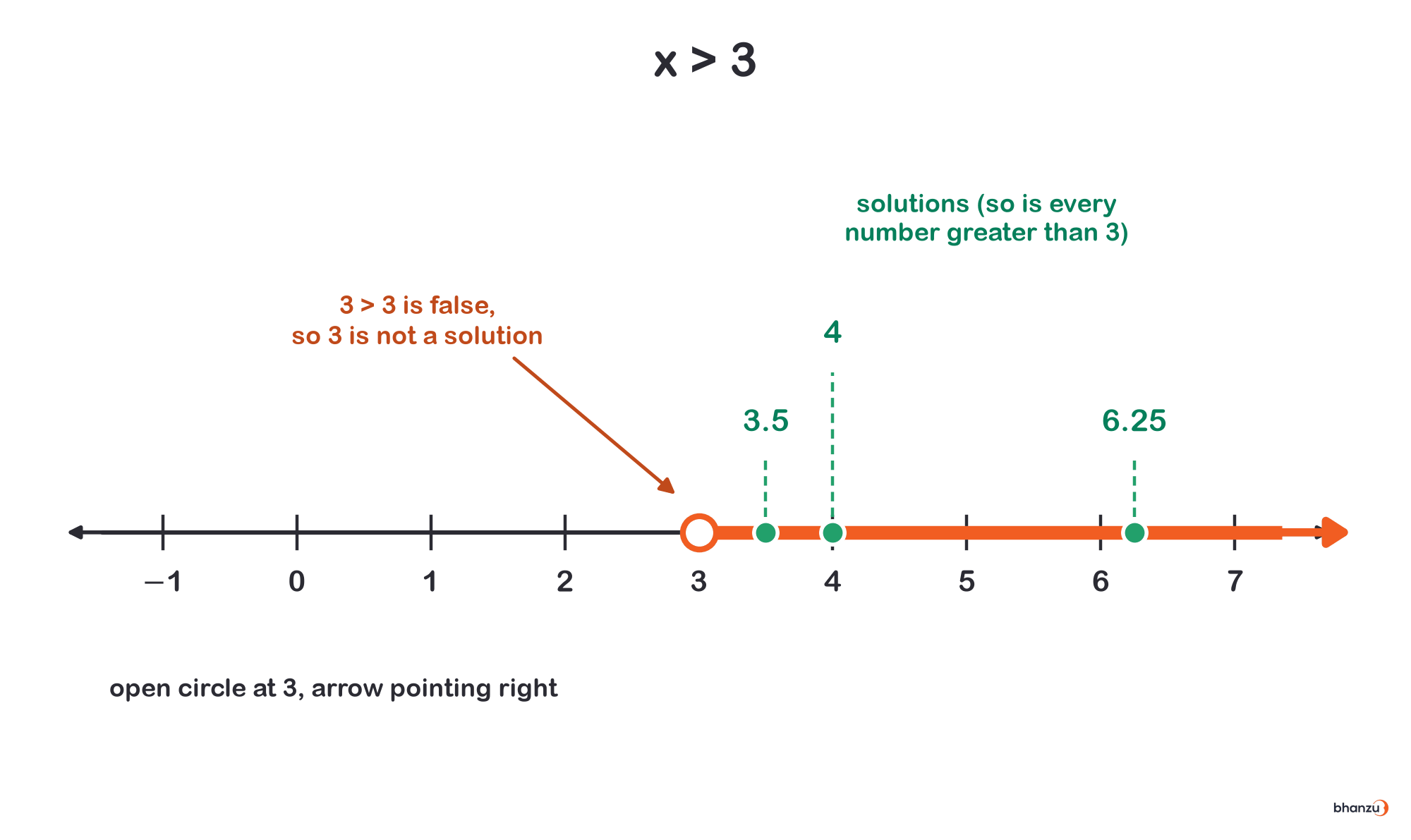
This is Common Core standard 6.EE.B.8, which asks you to write or for a real-world condition and see that it has infinitely many solutions on a number line. Standard 6.EE.B.5 adds substitution (putting a number in place of the letter) to check a value. The standard names only and , and and need just one change to the circle.
For your child, 6th grade is the first year a letter stands for a whole family of answers, so expect the circle and the direction to take a few rounds of practice.
How do you graph inequalities on a number line?
To graph an inequality, put the letter on the left, mark the boundary number with the right circle and shade toward the solutions.
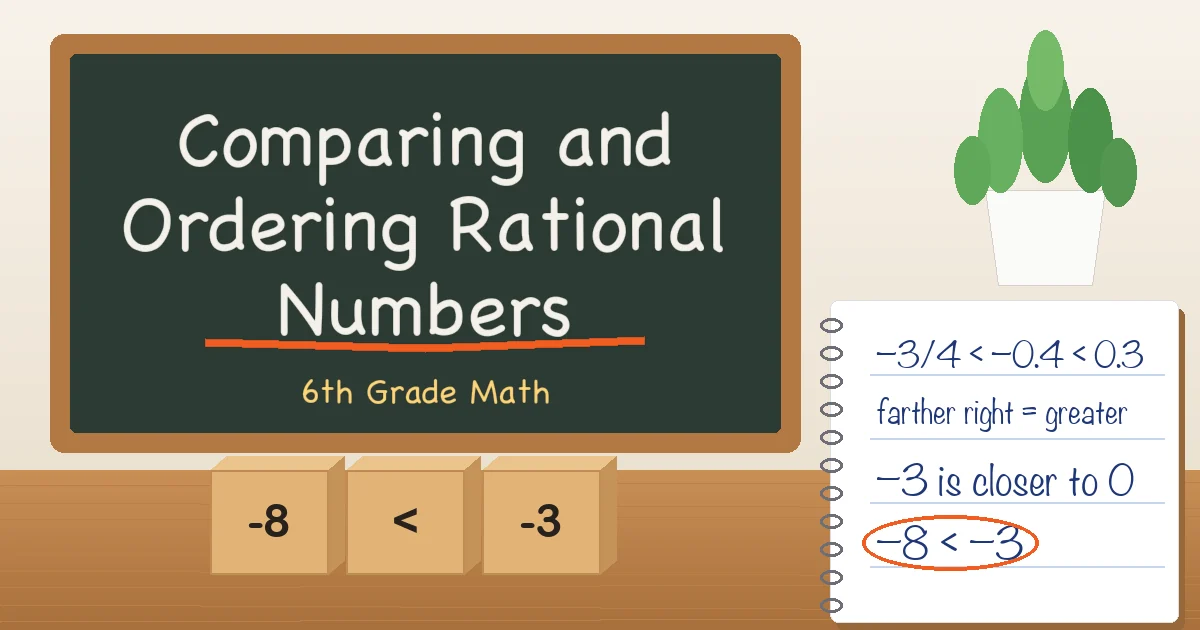
You already use these signs between two known numbers when comparing and ordering rational numbers, as in , and a letter runs that comparison for every point at once.
- Put the letter on the left, so becomes .
- Mark the boundary number.
- Draw an open circle for or , since the boundary is not a solution, and a closed (filled) circle for or , since it is.
- Shade toward the solutions with an arrow, right for "greater than" and left for "less than".
- Put one number from the shaded part in place of the letter and make sure the statement is true.
| Inequality | Circle at 2 | Arrow | Read it as |
|---|---|---|---|
| open | right | greater than 2 | |
| open | left | less than 2 | |
| closed | right | greater than or equal to 2 | |
| closed | left | less than or equal to 2 |
The circle records whether the boundary number is itself a solution. Since is false, gets an open circle, and since is true, gets a filled one. A child who draws that filled circle correctly sometimes second-guesses it, because "greater than" seems to leave 2 out. Reading the whole sign aloud settles it.
The one genuinely confusing case is a letter on the right. In the sign's point faces left, yet every solution lies to the right of 5, which is why step 1 comes first.
Open and closed circles are the usual US middle school convention. Some textbooks, including OpenStax's Elementary Algebra 2e, use a parenthesis and a bracket instead, a style you'll meet in high school.
Try It Yourself
Drag the circle to the boundary number, tap it to switch between open and closed, pick an arrow and press Check to see which parts match. Some inequalities put the letter on the right, so read them from the letter's side. Then drag the green point and watch the readout say whether that number, decimals included, makes the inequality true.
How do you write an inequality from a real-world limit?
Pick a letter for the quantity with a limit, say in words what it stands for, then let the limit words choose the sign. "More than 60 points" leaves 60 out, so it is , while "at least 60 points" lets 60 count, so it is .
Below, is points, is height, is people, is temperature, is weight and is the size of a liquid's container.
| Words in the problem | Math it means |
|---|---|
| more than 60 points | |
| at least 48 inches tall | |
| fewer than 20 people | |
| below degrees | |
| no more than 3.5 ounces | |
| 3.4 ounces or less |
That last row is a real rule. As of 2026, the TSA liquids rule limits each carry-on liquid to a container of 3.4 ounces (100 milliliters) or less. In symbols that is , with a closed circle at 3.4 and an arrow pointing left. A 3-ounce bottle fits because is true, and a 5-ounce bottle goes in checked baggage.
How do you find the inequality from a number line?
Work backward from the marks on the line, since each mark gives one part of the inequality.
- The number at the circle is the boundary number.
- An open circle means or , and a closed circle means or .
- An arrow to the right means greater, and an arrow to the left means less.
An open circle at 1.5 with an arrow pointing right gives , and the check number 1.6 confirms it because is true.
A boundary among the negative numbers works the same way, so an arrow pointing left from covers and , both less than .
Examples of inequalities on a number line
Example 1
Graph on a number line.
Putting 4 in for gives , which is false, so draw an open circle at 4.
"Greater than" sends the arrow right.
Check 6 from the shaded part, and is true.
The graph is an open circle at 4 with an arrow pointing right.
Example 2
Graph on a number line.
The tempting move follows the sign, whose point faces right, and draws an open circle at 2 with an arrow pointing right.
Check that graph with 5, which it shades. Putting 5 in gives , which is false, so the shading covers numbers that are not solutions.
Read it from the letter's side instead.
Since is false, the circle at 2 is open, and "less than" sends the arrow left. Both and are true, which confirms an open circle at 2 with an arrow pointing left.
Example 3
A number line has a closed circle at and an arrow pointing left. Write the inequality.
The closed circle means is a solution, so the sign includes "or equal to".
The arrow points left, toward smaller numbers, so the sign is "less than or equal to".
The inequality is .
Checking gives , which is true, and checking the unshaded 0 gives , which is false.
Example 4
Which of , , , and make true?
Put each number in place of .
| Statement | True or false |
|---|---|
| true | |
| true | |
| false | |
| false | |
| false |
The solutions from the list are and . The number fails because it sits to the right of .
Example 5
A seed packet says to plant when the soil is warmer than . Write and graph an inequality, then decide about 52.5 degrees and 50 degrees.
Let be the soil temperature in degrees Fahrenheit.
"Warmer than 50" leaves 50 out, so the inequality is , with an open circle at 50 and an arrow pointing right.
is true, so you can plant at 52.5 degrees.
is false, so at exactly 50 degrees you wait.
Example 6
A First-Class Mail letter can weigh no more than 3.5 ounces. Graph the rule and check letters of 2.8, 3.5 and 3.75 ounces.
As of 2026, the USPS Domestic Mail Manual sets 3.5 ounces as the letter limit.
Let be a letter's weight in ounces. "No more than 3.5" lets 3.5 count, so .
Draw a closed circle at 3.5 and shade left, stopping at 0, because no letter weighs less than 0 ounces.
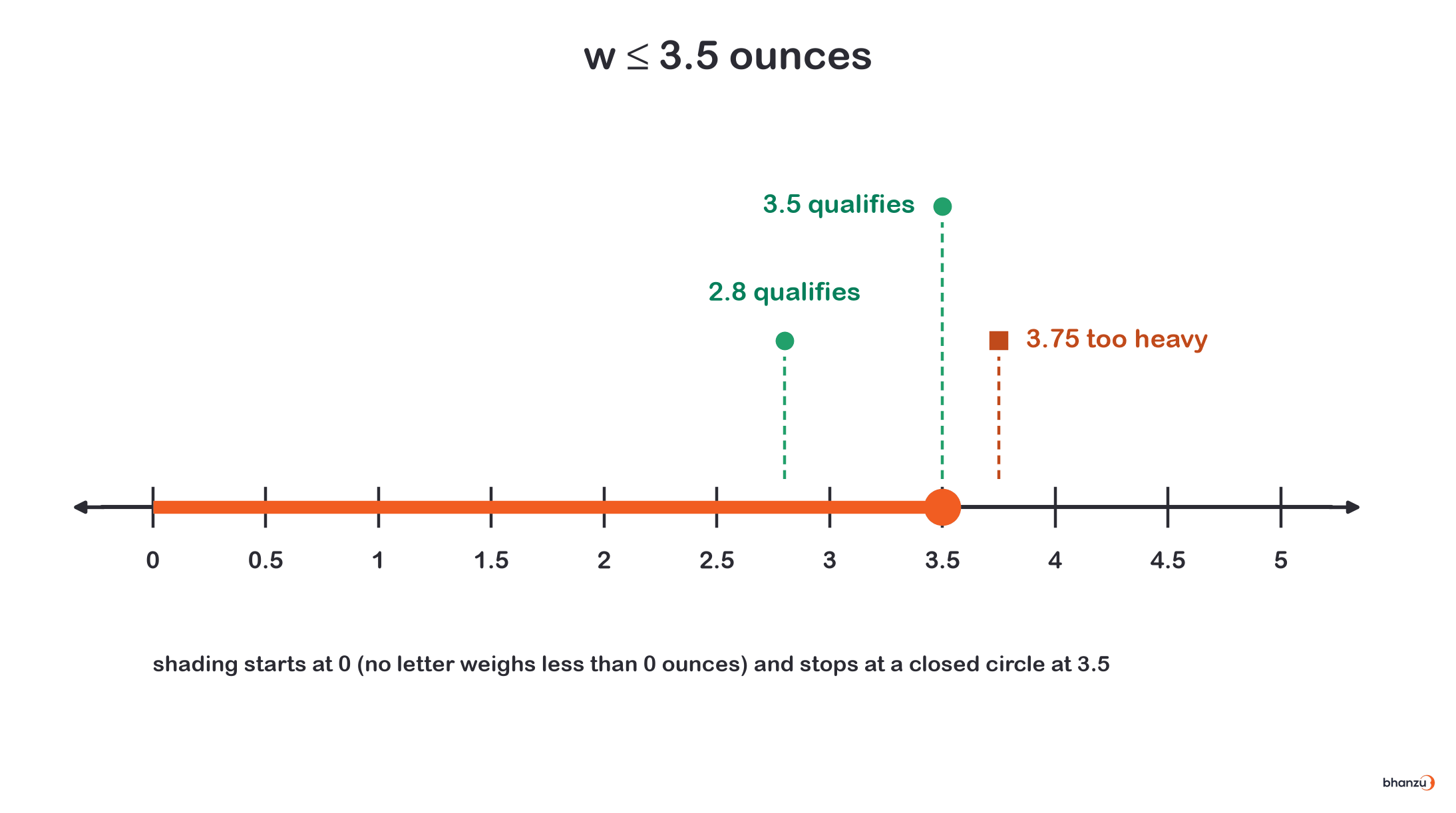
and are both true, so those two letters qualify.
is false, so the 3.75-ounce letter is charged as a large envelope, which USPS calls a flat.
Why the circle-and-arrow method works
Nobody could finish writing out the solutions of , because even between 3 and 4 the decimals never run out. The circle and the arrow draw the list instead.
- It makes the boundary decision visible. The circle shows at a glance whether "more than" or "at least" was meant, which decides whether a rider exactly 48 inches tall gets on.
- It lets you check any value by eye. A number under the shading is a solution, and a number outside it isn't.
- It lets two people compare readings. If two readers of the same mail rule draw different graphs, the circle or the arrow shows exactly where they disagree.
In 7th grade, Common Core standard 7.EE.B.4b brings the same drawing back after you solve an inequality such as to reach .
What most guides miss about inequalities on a number line
A real story can trim the graph, yet most guides draw the full arrow every time. Two kinds of quantities do the trimming.
- Amounts that can't go below 0. No letter weighs ounce, so the mail rule really means , a compound inequality with two limits at once.
- Amounts that come only in whole numbers. "Fewer than 20 people" gives , yet no room holds 12.5 people, so the sensible answers are the whole numbers 0 to 19 (an empty room counts), shown as 20 dots.
Reading the story for these trims is what turns a correct graph into a sensible one.
The mistakes kids make most often with inequalities on a number line
Mistake 1: Filling the circle for less than or greater than
Where it slips in: Step 3 of graphing, with . A child who copies the 6 onto the line as a dot is following a habit from earlier number lines, where a filled dot marked any number.
Don't do this: Draw a filled dot at 6 with an arrow pointing left, which claims is true.
The correct way: Since is false, the circle at 6 stays open. The filled circle belongs to , where is true.
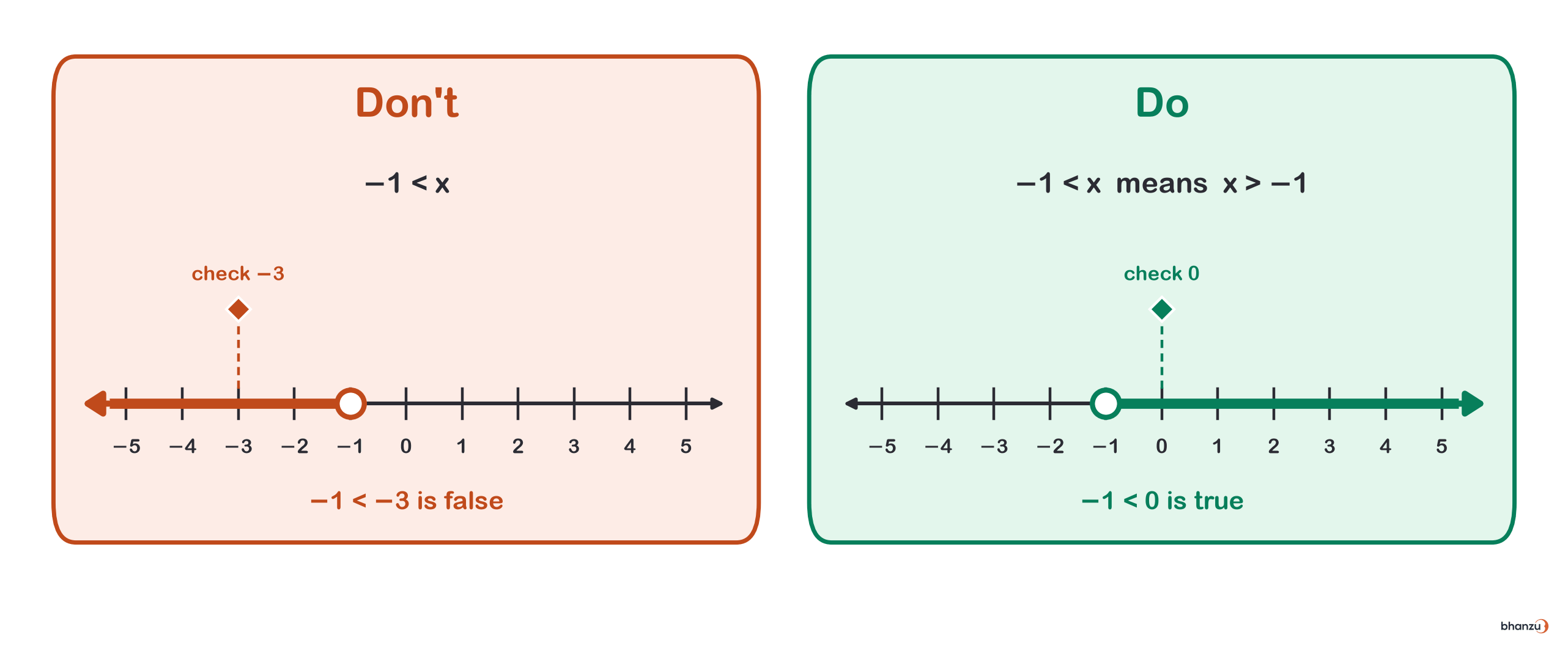
Mistake 2: Following the sign when the letter is on the right
Where it slips in: Inequalities like , as in Example 2. Children who learned "the arrow points the way the sign points" from skip checking which side the letter is on.
Don't do this: Draw an open circle at with the arrow pointing left. That shades , and is false.
The correct way: Read it as , keep the open circle at and point the arrow right. Checking 0 gives , which is true.
Mistake 3: Marking only whole numbers
Where it slips in: Graphing or listing its solutions. Children asked for solutions often name 4, 5 and 6 and stop, because their earlier number lines had marks only at whole numbers.
Don't do this: Draw dots at 4, 5 and 6 and call those the solutions.
The correct way: Numbers such as 3.2, and 250 also make true, so draw an open circle at 3 and a solid shaded ray. The arrow says the solutions keep going.
Key Takeaways
- Put the boundary number into the inequality before drawing, because a false result means an open circle.
- Move the letter to the left first, since and share one graph.
- Treat inequalities on a number line as finished only when a check number from the shading makes the statement true.
- In word problems, the limit words pick the circle and the story decides whether the shading stops at 0.
- For more practice reading flipped inequalities like , explore Bhanzu's 6th grade math tutor or algebra classes.
Read More
- Equations With Tape and Hanger Diagrams
- Polygons on the Coordinate Plane
- Opposite Numbers
- Whole Numbers and Integers
- Linear Inequalities
Research Behind This Article
- MacTutor History of Mathematics, University of St Andrews, Thomas Harriot biography (2000). mathshistory.st-andrews.ac.uk
- Common Core State Standards Initiative, Grade 6 Expressions and Equations (2010). thecorestandards.org
- OpenStax, Elementary Algebra 2e, 2.7 Solve Linear Inequalities (2020). openstax.org
- Transportation Security Administration, Liquids, Aerosols, and Gels Rule (2026). tsa.gov
- United States Postal Service, Domestic Mail Manual 101, Physical Standards (2026). pe.usps.com
- Common Core State Standards Initiative, Grade 7 Expressions and Equations (2010). thecorestandards.org
Quick Quiz: Check Yourself
Three levels, new numbers every time: pick the circle and arrow for an inequality, flip one with the letter on the right or check a value, then turn a real-world limit into an inequality.
Was this article helpful?
Your feedback helps us write better content
Frequently Asked Questions
Is x greater than 0 the same as x being positive?
How do you solve inequalities on a number line?
How do you graph inequalities with two points?
How do you graph an inequality on a coordinate plane?
How do I teach inequalities to my 6th grader?
How can I teach inequalities in a fun way?