Key Points
- A rational number word problem can use integers, fractions, decimals or percents, positive or negative, and its answer needs one or more of the four operations.
- Solving rational number word problems takes 5 steps: set the sign, estimate, pick one number form, write one expression, then compare the result with the estimate.
- A 2022 study of 747 released state math items found that keywords led to the right solution in under 10% of multi-step word problems.
- Common Core places this skill in 7th grade under 7.NS.A.3 and 7.EE.B.3, and 7.EE.B.3 also asks students to judge answers with mental math and estimation.
Forty-nine degrees in two minutes
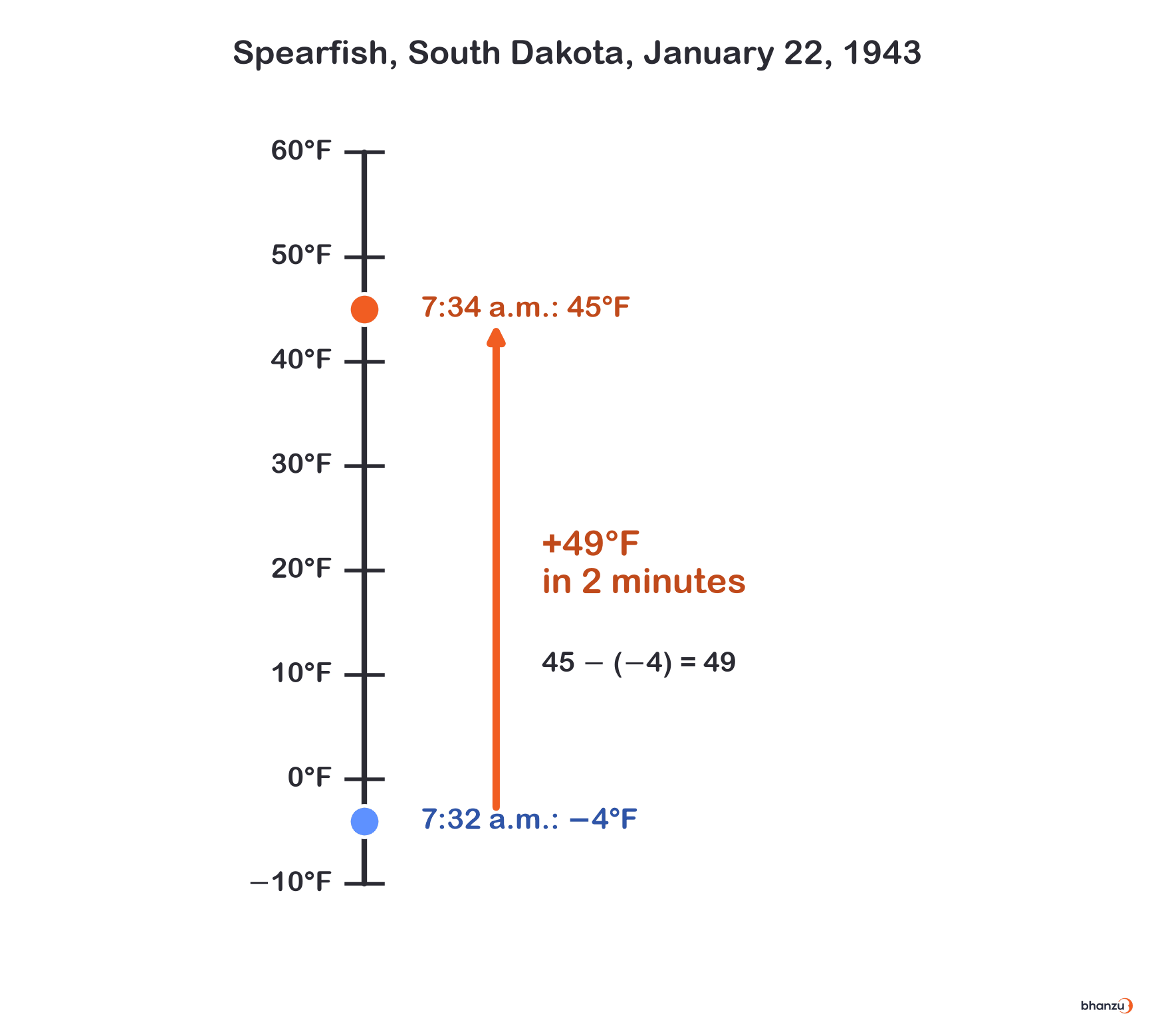
In Spearfish, South Dakota, the air once warmed 49 degrees in two minutes. The National Weather Service records the morning of January 22, 1943, when the thermometer read 4 degrees below zero at 7:32 a.m. and 45 degrees two minutes later. A couple of hours later, cold air rushed back and the temperature plunged from 54 degrees to 4 below zero in 27 minutes.
Every number in that story is rational. Some are negative, and working out how fast the air cooled takes a subtraction and a division, with a sign you can trust.
Weather forecasters work with rates like that one, banks track balances that dip below zero, and divers plan how many meters to descend each minute.
What is a rational number word problem?
Rational number word problems are real-life stories built on rational numbers, numbers you can write as a fraction of two integers, and solving them takes one or more of the four operations. The bottom of the fraction can't be zero.
A vertical number line, which works like a thermometer, is the model to reach for. Up is positive, down is negative, and each event in a story is an arrow. A freezer that cools 1.5 degrees an hour for 4 hours makes four downward arrows of 1.5, ending 6 degrees lower.
This skill sits in Common Core standards 7.NS.A.3 and 7.EE.B.3, and 7.EE.B.3 asks for multi-step problems "posed with positive and negative rational numbers in any form" and for estimates that check them. Compared with addition and subtraction word problems with negatives, the new parts are multiplication, division and several steps in one story. In 7th grade, your child is expected to work these problems in any number form and to judge whether an answer is reasonable before trusting it. That checking habit carries straight into science labs and real money decisions.
How do you solve rational number word problems?
Use five moves, in this order, and estimate before you calculate exactly.
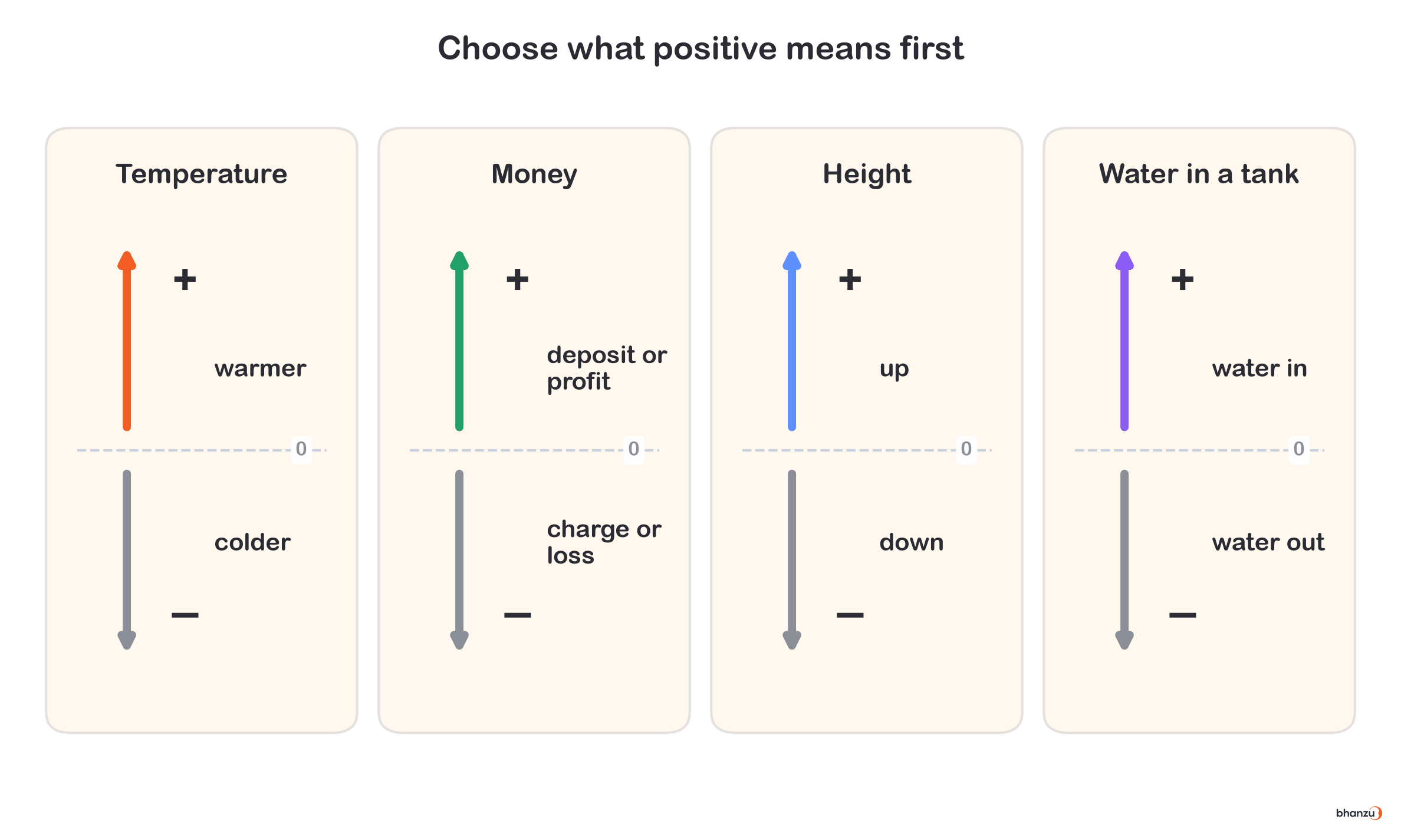
- Decide what positive and negative mean in this story (write the choice in the margin). Warmer, deposits, up and water flowing in are the usual picks for positive.
- Estimate with friendly numbers, rounding each value to one that's easy to work with. For , round to whole dollars and add .
- Choose one number form, usually decimals for money and fractions for thirds or eighths.
- Write one expression for the whole story (a running total, one line per event, also works but is slower to estimate), then evaluate it using the order of operations with rational numbers.
- Compare the exact answer with your estimate, then write it as a sentence with units and the right sign.
Gas prices show why step 2 matters. The Energy Information Administration put the US average for regular gasoline at $3.805 a gallon for the week of November 16, 2026, and three decimal places make the point easy to misplace.
So 12.5 gallons has to cost close to $48. An estimate catches a wrong sign or a misplaced point, but it won't catch written for , so for small digit errors, redo the last step. OpenStax's Prealgebra 2e ends its problem-solving strategy with the same two moves, a check that the answer makes sense and an answer in a complete sentence.
A student who rushes to the exact calculation usually skips step 2, the very step that catches the decimal point. Step 1 gets skipped too. Students who skip it often find a change as start minus end, , and call a cold snap a warming.
Try It Yourself
Read the story, decide whether the answer will be positive or negative, then choose the closest of three estimates. Type the exact answer and see whether it lands near your estimate, and tap Hint at any step to see the numbers to use. New problem gives you a fresh story with new numbers.
Which operation do word problems with rational numbers need?
The situation picks the operation, not one word in it. Each phrase works only inside its story.
| Words in the problem | Math it means |
|---|---|
| falls 1.5°F every hour for 4 hours | |
| fell from 54°F to 4 below zero | end minus start, |
| average change per minute over 27 minutes | change |
| leaks three-quarters of a gallon an hour for 8 hours | |
| 25% off | multiply by |
| a $4.50 coupon | subtract |
| how far did she descend | the size of the change, zero or more |
Repeated equal changes multiply, and a total shared across minutes or days divides. Both follow the sign rules for multiplying and dividing negative fractions: same signs give a positive result, different signs a negative one.
A rate such as degrees per minute is the idea 8th grade calls the slope of a line.
When should you switch between fractions, decimals and percents?
Switch to the form that keeps the arithmetic exact and short. Money and measured lengths usually stay as decimals, thirds stay as fractions, and a percent becomes a decimal right before you multiply.
Percents hold one genuinely confusing pair, and adults mix it up too. A sale of 25% off means you pay 75% of the price, and "of" means multiply, so $48 becomes . Percents joined fractions and decimals in 6th grade, and now switching between fractions, decimals and percentages becomes a choice made before calculating.
| Fraction | Decimal | Percent | Where it shows up |
|---|---|---|---|
| a leak per hour in Example 5 | |||
| what you pay after 25% off | |||
| price plus 6% tax | |||
| hose flow per hour | |||
| about | part of Example 4's average |
Every rational number has a decimal that stops or repeats forever. The bar in means the 6 never ends, so is exact and is rounded.
Are there negative fractions? Yes, and , and are the same number. Write the sign out in front, where nobody can miss it.
Examples of rational number word problems
Example 1
A freezer's temperature falls 1.5°F every hour for 4 hours. What is the total change in temperature?
Falling means negative, so each hour's change is .
The temperature changes by , so the freezer ends 6 degrees colder.
Example 2
Regular gas averaged $3.805 a gallon in the US for the week of November 16, 2026. What do 12.5 gallons cost?
The tempting move multiplies the digits, , and copies the decimal point from 3.805, one digit in from the left. That gives , about $4.76.
That can't be right, because the estimate puts the cost near $48, ten times more.
Count decimal places instead. 3.805 has 3 and 12.5 has 1, so the product needs 4.
Rounded to the nearest cent, 12.5 gallons cost $47.56, close to the estimate.
Example 3
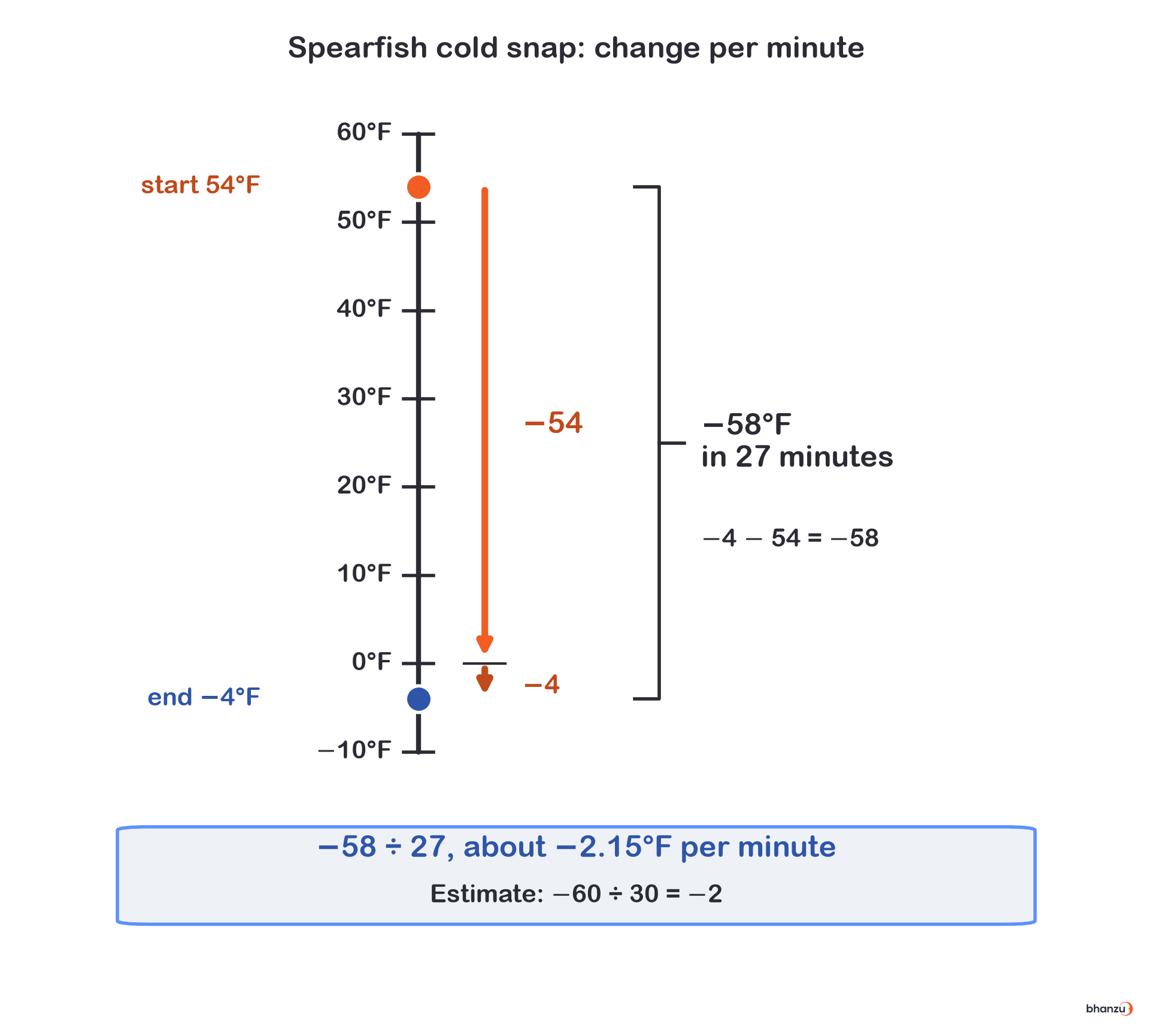
On January 22, 1943, the temperature in Spearfish, South Dakota fell from 54°F to 4 degrees below zero in 27 minutes. What was the average change in temperature per minute?
Change is end minus start.
Average change per minute is the change divided by the minutes.
Rounded to hundredths, the temperature changed by about per minute. The estimate agrees.
Example 4
A school snack stand lost $18.40 on Monday, made $46.25 on Tuesday and lost $7.85 on Wednesday. What was its average daily profit, and did it make or lose money in total?
Losses are negative.
The stand made $20.00 in total, an average profit of about $6.67 a day (exactly dollars).
Example 5
A 55-gallon rain barrel has 45 gallons of water in it. It leaks three-quarters of a gallon an hour for 8 hours, then a hose adds two and a half gallons an hour for 3 hours. How much water is in the barrel now?
The leak removes water.
The hose adds water.
Combine both with the starting amount.
The barrel holds gallons, a net change of gallons, still under its 55-gallon limit.
Example 6
A video game costs $48. A sale takes 25% off, then a $4.50 coupon comes off, then 6% sales tax is added. What is the final price, and how does it compare with $48?
Estimate first. Three-quarters of 48 is 36, minus about 5 is about 31, and a little tax brings it near 33.
You pay $33.39, a change of dollars from $48, so you spend $14.61 less.
Why estimating first works
An estimate fixes the size and the sign of an answer before any decimal point can move. It takes a few seconds of rounding and no calculator.
- It catches a slipped decimal point. The product can't be when .
- It checks the sign against the story. A cold snap must give a negative change, so a positive rate for Spearfish means a step went wrong.
- It keeps units in view. An estimate of about 33 dollars or about 46 gallons says what the answer measures.
- It matches how adults handle real numbers. A driver rounds $3.805 to $4 at the pump, and someone with $20 in the bank checks whether a $23.50 purchase would push the balance below zero.
The same habit began with multi-step word problems with whole numbers in 4th grade. Now it carries signs, fractions and decimals, and the 7th grade standard asks students to check answers with mental math and estimation.
What teachers watch for in rational number word problems
You choose which direction counts as positive, and a correct answer means the same thing either way. On an elevation line, a diver going from 3.5 m below the surface to 12 m below changes by m. Measure depth downward, with deeper as positive, and the same dive is m. Either sign is correct when the solution says which way is positive.
A negative answer is also often exactly right. A balance of dollars is a real debt. But a question that asks "how far" or "how much is owed" wants the size, the absolute value, so m. Strong solutions give two answers, the signed change and its size.
Where do kids trip up on rational number word problems?
Mistake 1: Letting one word choose the operation
Where it slips in: Rate stories that use "each" or "per", like a diver's steady descent.
Don't do this: A diver's depth changes by m each minute for 5 minutes, written as because "each" was learned as a divide word.
The correct way: Five equal changes of m make , so the diver ends 12 m deeper.
Keyword lists still appear on many worksheets, so children who have just learned "each means divide" write without reading the rest of the sentence. A 2022 study of 747 released state math items from Grades 3 to 8 found keywords led to the correct solution under 50% of the time in single-step problems. In multi-step problems, the match rate fell below 10%.
Mistake 2: Giving a negative answer to a "how far" question
Where it slips in: Depth, elevation and debt stories that ask "how far" or "how much".
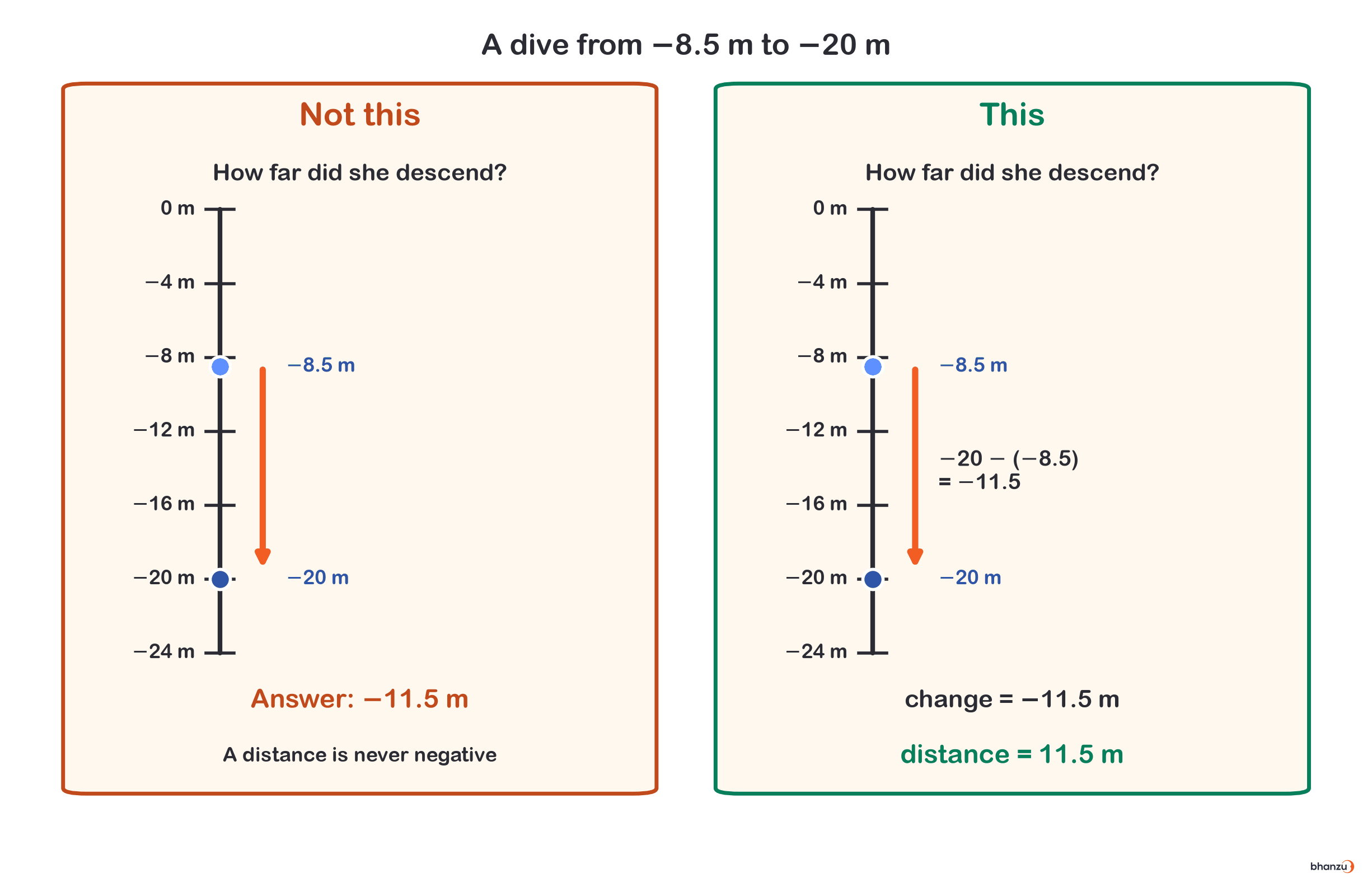
Don't do this: A diver goes from m to m, and the answer to "How far did she descend?" is written as m.
The correct way: The change is m, and the distance is its size, so she descended 11.5 m.
After weeks of sign rules, every answer seems to need a sign. A student who second-guesses a plain positive answer often adds the minus sign back.
Mistake 3: Adding lengths in different units
Where it slips in: Measurement stories that mix feet and inches, like a shelf with an add-on piece.
Don't do this: A ft shelf plus an 8 in. extension, written as ft.
The correct way: Since , 8 inches is ft, so add ft to the shelf, not 8.
In inches, the shelf is 30 in., so the total is 38 in., and agrees. The numbers look ready to add, and the eye reads digits before units.
Key Takeaways
- Choose what positive means before writing any number, since every sign in the answer depends on it.
- Trust an exact answer only after it lands near a friendly-number estimate.
- In rational number word problems, repeated equal changes multiply and a total shared over time divides, whatever words the story uses.
- A "how far" or "how much is owed" answer is a size, even when the change behind it is negative.
- To keep building the estimate-first habit and the two-answer check for "how far" questions, explore Bhanzu's 7th grade math curriculum or math programs for kids.
Read More
- Evaluating Expressions With Negative Numbers
- One-Step Equations With Negative Numbers
- Simple Interest
- Dividing Fractions Word Problems
- Negative Numbers
- Powers of 10 and Estimation
Research Behind This Article
- National Weather Service Rapid City, The Black Hills Remarkable Temperature Change of January 22, 1943 (n.d.). weather.gov
- Common Core State Standards Initiative, Grade 7 The Number System (2010). thecorestandards.org
- Common Core State Standards Initiative, Grade 7 Expressions and Equations (2010). thecorestandards.org
- US Energy Information Administration, Gasoline and Diesel Fuel Update (2026). eia.gov
- OpenStax, Prealgebra 2e, 9.1 Use a Problem Solving Strategy (2020). openstax.org
- Sarah R. Powell, Jessica M. Namkung and Xin Lin, An Investigation of Using Keywords to Solve Word Problems (2022). eric.ed.gov
Quick Quiz: Check Yourself
Three levels, new numbers every time: find one signed change, find an average rate or an average daily profit with negatives, then solve a three-step barrel or price problem.
Was this article helpful?
Your feedback helps us write better content
Frequently Asked Questions
Is 0 a rational number?
What is the difference between rational and irrational numbers?
Can you owe a negative amount of money?
How do I teach my child to solve multi-step word problems?
What if my child can do the math but freezes on word problems with rational numbers?
What are some real life examples of rational numbers?