Key Points
- When the divisor, the number you divide by, is a decimal, dividing decimals starts by shifting its decimal point and the other number's point by the same number of places until the divisor is whole.
- Shifting both points multiplies both numbers by the same power of 10, which keeps the quotient (the answer) the same, so and both equal 8.
- A quotient can need a placeholder zero, so is , not , because 12 does not fit into 2 tenths and the tenths digit must be 0.
- Common Core standard 6.NS.B.3 expects fluent decimal division in 6th grade, after 5th grade work that divides decimals to hundredths with models and drawings.
A 29-page booklet about tenths
In 1585, a 29-page booklet set out to make tenths an everyday tool. Simon Stevin, a Flemish mathematician, wrote La Thiende (The Tenth) for surveyors, carpet makers, coin makers at the mint and merchants of every kind. He did not invent decimals (Arab and Chinese mathematicians used them long before him), but his booklet brought them into European mathematics. Tenths let merchants split a price or a length with the same steps as whole-number division.
Dividing with tenths still runs real jobs. A pharmacist splits 7.5 milliliters of medicine into 2.5 milliliter doses and gets 3. A track coach turns 100 meters in 12.5 seconds into 8 meters per second, and a carpenter cuts a 2.4 meter board into 8 pieces of 0.3 meters. All three rest on one idea in the ladder below, where a decimal division becomes a whole-number one without its answer changing.
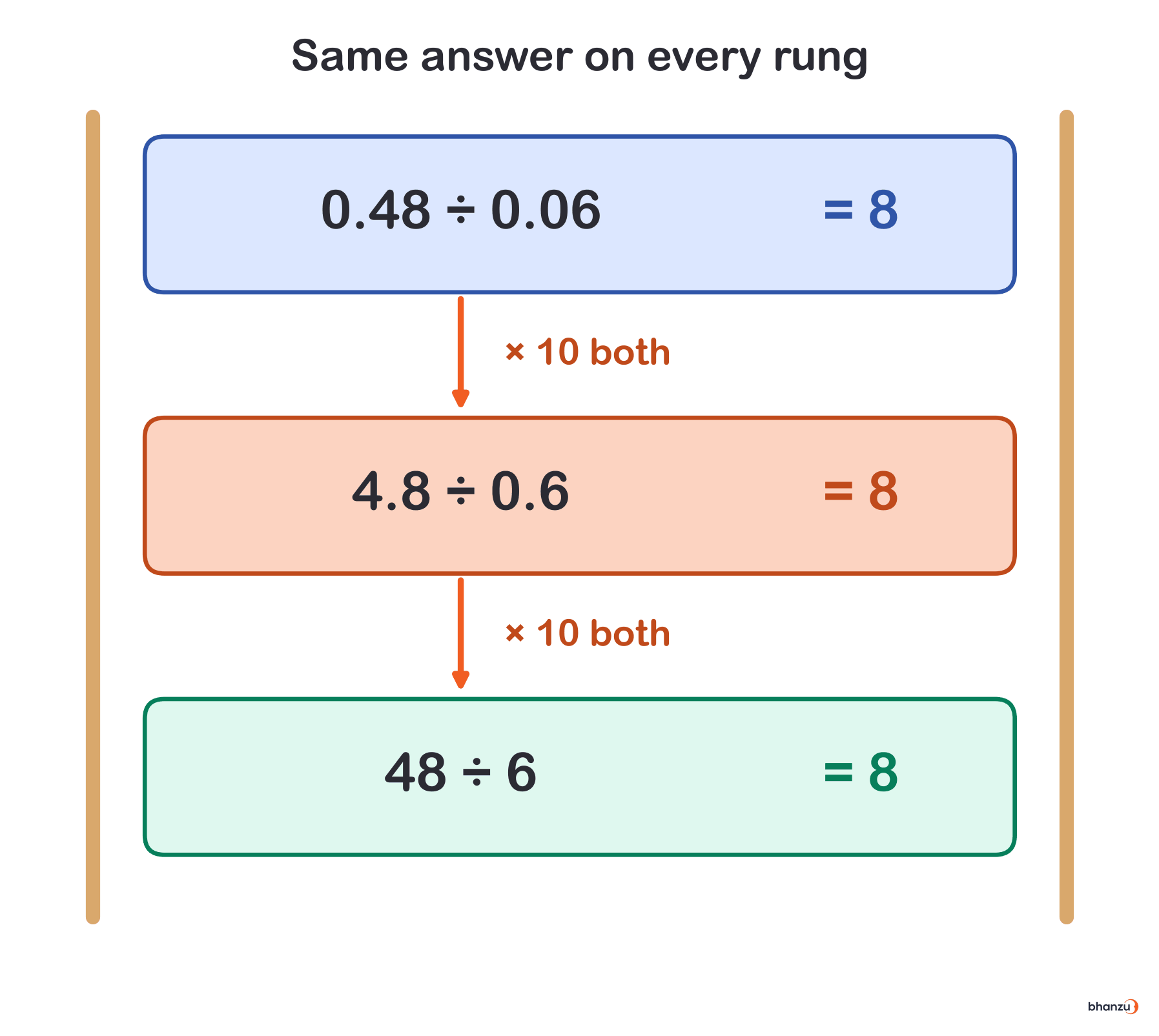
How do you divide decimals?
Dividing decimals is long division plus one extra move whenever the divisor (the number you divide by) is a decimal. Shift the decimal point in both the divisor and the dividend (the number being divided) to the right by the same number of places. Stop when the divisor is whole, then divide to find the quotient (the answer). The names dividend, divisor and quotient mean what they mean for whole numbers.
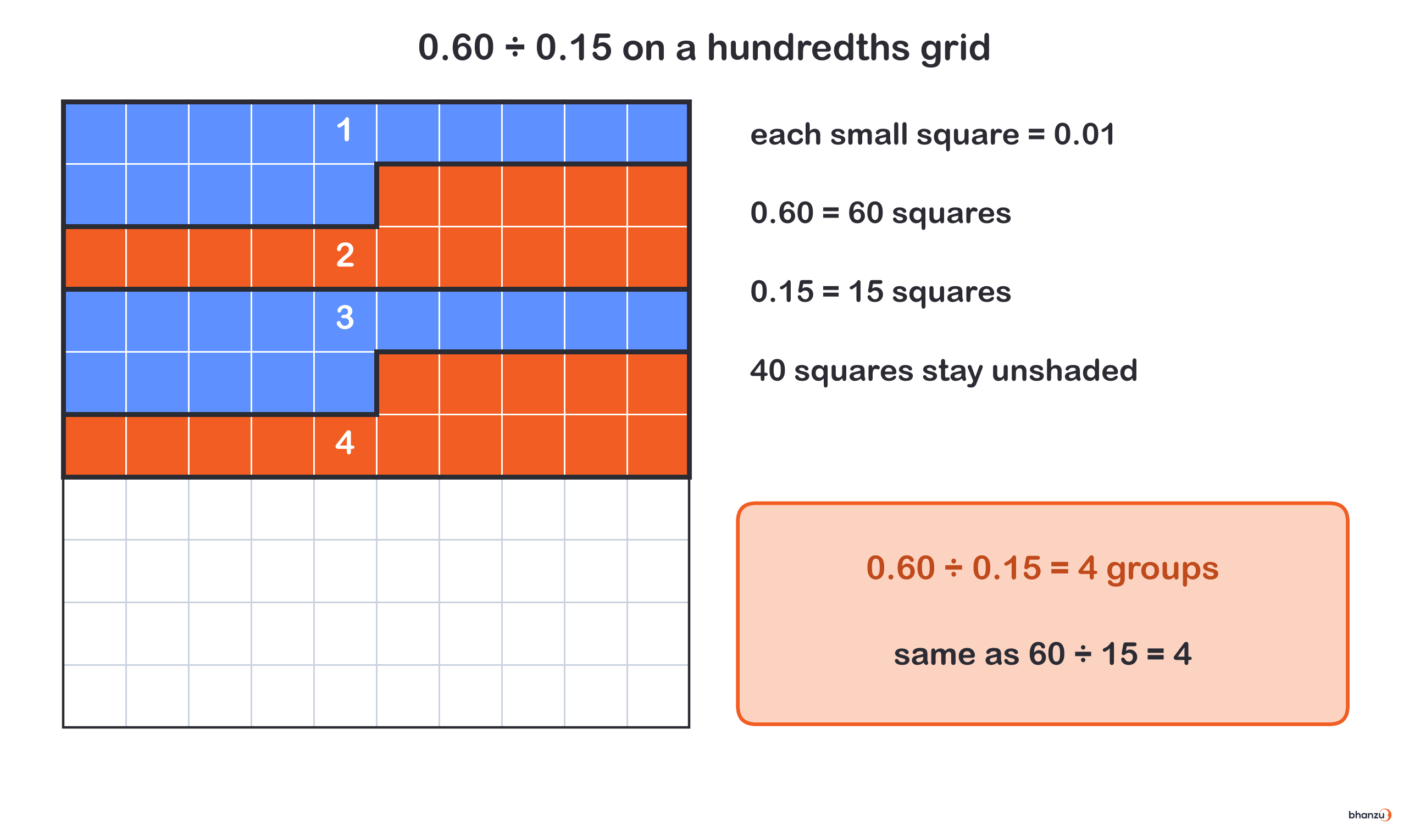
A hundredths grid shows why the shift is fair. Each small square in this 10 by 10 grid is 0.01, so 0.60 is 60 squares and 0.15 is a group of 15. Sixty squares make 4 groups of 15, so , exactly like .
Four steps handle any decimal division.
- Estimate the answer with friendly numbers.
- If the divisor is a decimal, shift its point right until it is whole, and shift the dividend's point the same number of places, adding zeros if needed.
- Long-divide, with the quotient's decimal point straight above the dividend's point.
- Check by multiplying the quotient by the original divisor.
Common Core standard 6.NS.B.3 asks 6th graders to divide multi-digit decimals fluently with the standard algorithm, and for division that algorithm is long division. In 5th grade, your child divided decimals to hundredths with models and drawings like this grid (standard 5.NBT.B.7), and 6th grade moves from drawing the groups to writing the long division.
How do you divide a decimal by a whole number?
To divide a decimal by a whole number, use long division as if the point were not there, then lift the decimal point straight up into the quotient. The quotient's point sits directly above the dividend's point, and it goes in before you write any digit to its right.
Here is .
- 6 fits into 9 once, with 3 left. Write 1 above the 9.
- Put the quotient's decimal point straight above the point in 9.3.
- Bring down the 3 tenths to make 33. 6 fits 5 times (30), with 3 left.
- Write a 0 after 9.3 (9.30 is the same number) and bring it down to make 30. 6 fits 5 times exactly.
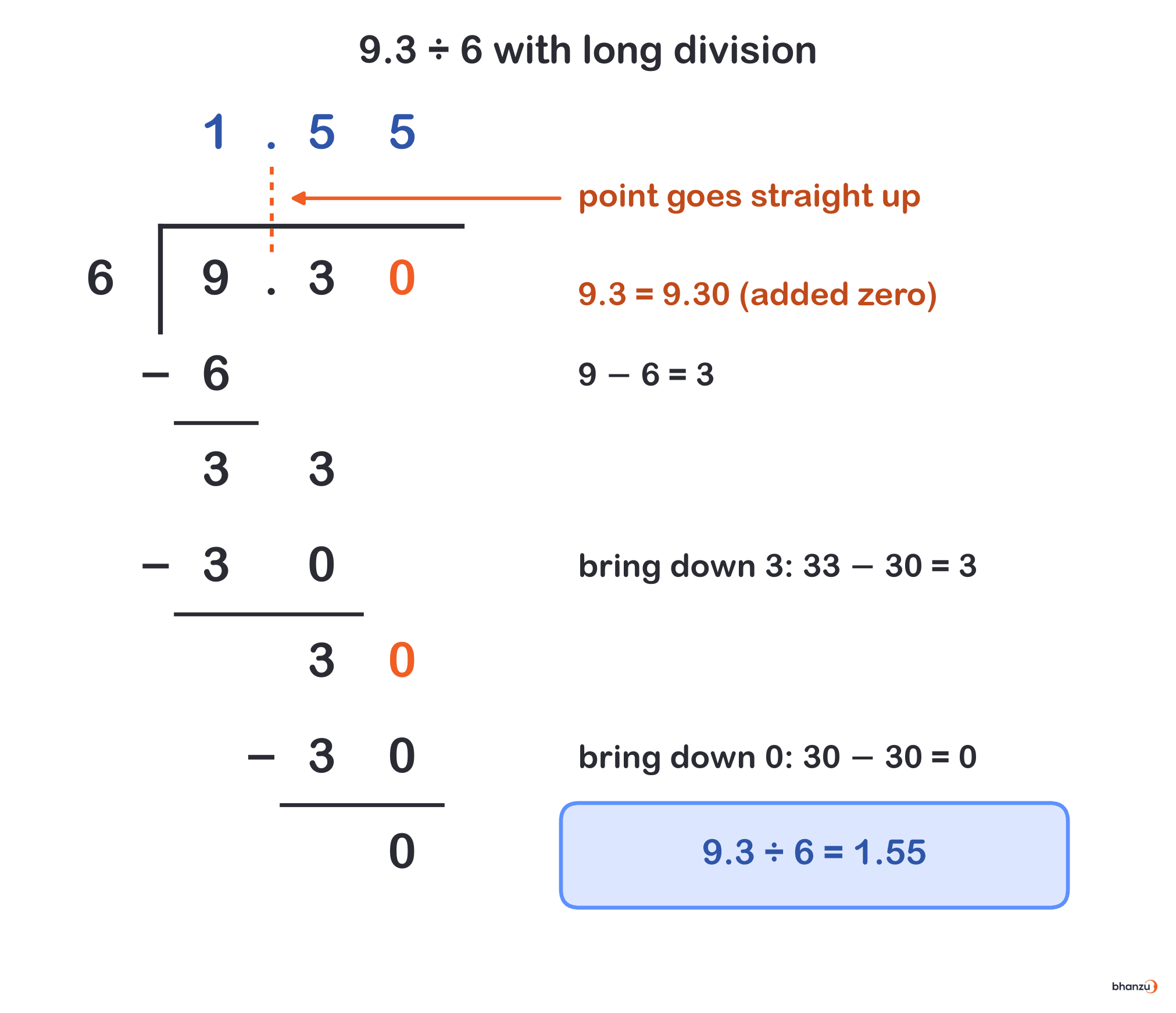
Once the decimal point is in place, every place to its right needs a digit, so a place where the divisor does not fit gets a 0. In , 6 does not fit into 4 tenths, so the tenths digit is 0, and 42 hundredths divided by 6 gives . Children who skip that zero tend to write 0.7, because putting down a 0 feels like writing nothing.
Turning the divisor into a whole number
When the divisor is a decimal, multiply both numbers by 10, 100 or 1,000, whichever makes the divisor whole. Multiplying by 10 shifts every digit one place left, so the decimal point seems to move one place right. The 5th grade lesson on multiplying and dividing by powers of 10 uses the same shift. So you do move the decimal when dividing, but in both numbers, never in the divisor alone.
A whole-number dividend gets zeros. For , the divisor needs two shifts, so 6 becomes 600.
The table shows why the answer never changes.
| Division | Both numbers multiplied by | Quotient |
|---|---|---|
| 1 | 8 | |
| 10 | 8 | |
| 100 | 8 |
As fractions, the reason matches equivalent fractions, since multiplying the top and bottom by the same number leaves the value alone.
A child who gets 8 for often second-guesses it, because division is supposed to make things smaller. When both numbers are positive and the divisor is less than 1, the quotient is always bigger than the dividend.
In 5th grade, dividing by decimals started with divisors like 0.1 and 0.01. The 6th grade version handles any decimal divisor, and scaling both numbers comes back when you divide fractions later this year.
When does the division keep going?
The division keeps going whenever the dividend runs out of digits before the remainder reaches 0, so you write zeros after the last decimal digit and continue. Zeros are allowed because 18 and 18.00 are the same number. Take , which becomes .
- 8 fits into 18 twice, with 2 left.
- Write 18.0 and bring down the 0 to make 20. 8 fits twice, with 4 left.
- Write another 0 to make 40. 8 fits 5 times exactly.
Some divisions never end. In October 2026, a dozen large eggs cost $2.320 on average in US cities, according to the US Bureau of Labor Statistics. One egg's share is , with the 3 repeating forever. So decide first how many places you need (two for cents), work one place further and round up if that digit is 5 or more.
Rounding up at 5 is the usual rule for prices, though other rounding rules exist. That gives about 19 cents an egg. In March 2025, the same dozen averaged $6.227, and , about 52 cents an egg. In 8th grade, you'll write repeating decimals like these as fractions.
When the question counts whole things, such as gallons you can afford, read what the quotient counts before you round.
Try It Yourself
Use the plus and minus buttons to choose a number to share out and a group size, and the hundredths grid shades that many squares in colored groups. Type how many groups you think fit and press Check. The readout turns the decimals into hundredths, so 0.60 divided by 0.15 becomes 60 divided by 15, and any leftover squares show part of a group.
Examples of dividing decimals
Example 1
Divide 25.56 by 6.
The divisor is already whole, so long-divide. 6 fits into 25 four times with 1 left, into 15 tenths twice with 3 left, and into 36 hundredths 6 times.
Multiplying back gives .
Example 2
Divide 0.252 by 12.
The tempting move is to divide 252 by 12, get 21 and write 0.21. Multiplying back exposes it.
That product is 2.52, ten times too big, so 0.21 cannot be right. Go place by place instead. 12 does not fit into 0 ones or 2 tenths, so the quotient gets 0 in both places. 12 fits into 25 hundredths twice with 1 left, and into 12 thousandths exactly once.
Multiplying back gives .
Example 3
Divide 17.28 by 0.36.
The divisor has two decimal places, so shift both points two places to the right.
36 fits into 172 four times, which is 144, leaving 28. Bring down the 8 to make 288, and 36 fits 8 times exactly.
Multiplying back gives .
Example 4
Find the missing number in .
A missing factor is found by division, so the box equals . Shift both points one place to get . 4 fits into 90 twenty-two times with 2 left, so write 90.0 and divide 20 by 4 to get 5.
The missing number is 22.5, and .
Example 5
Maya says is 3.5, and Leo says it is 35. Who is right?
Estimate first. 1.25 is a bit more than 1, so the quotient should be a two-digit number somewhat less than 43.75, which rules out 3.5. Shift both points two places and divide.
Leo is right, and .
Example 6
In October 2026, whole milk averaged $4.101 a gallon in US cities. How many whole gallons can a school club buy with $20.50 at that price?
Divide the money by the price of one gallon. Three decimal places in the divisor mean three shifts, so 4.101 becomes 4101 and 20.50 becomes 20500.
4101 fits into 20500 four times (16404), leaving 4096, so the quotient is just under 5. Rounding says 5. But 5 gallons would cost dollars, more than $20.50. The club can buy 4 whole gallons, with $4.096 left (about $4.10).
Where dividing decimals shows up in real life
Dividing decimals exists because real amounts are rarely whole numbers, and a "per one" answer is the fairest way to compare or share them.
- It turns a total into a price for one. A 2.5 pound bag of apples for $4.35 costs dollars a pound.
- It cuts a length into equal pieces. A 3.75 meter ribbon makes bows of 0.25 meters each.
- It shares money fairly. Four friends splitting a $38.60 bill each pay dollars, and shows nobody is short a cent.
- It turns two measurements into a rate. A car that drives 75 miles on 2.5 gallons gets miles per gallon.
Each answer is a per-one number, and per-one numbers are what people compare when they decide. Without decimal division, each answer would need the amounts rewritten in cents first.
Why kids get dividing decimals wrong (and the fix)
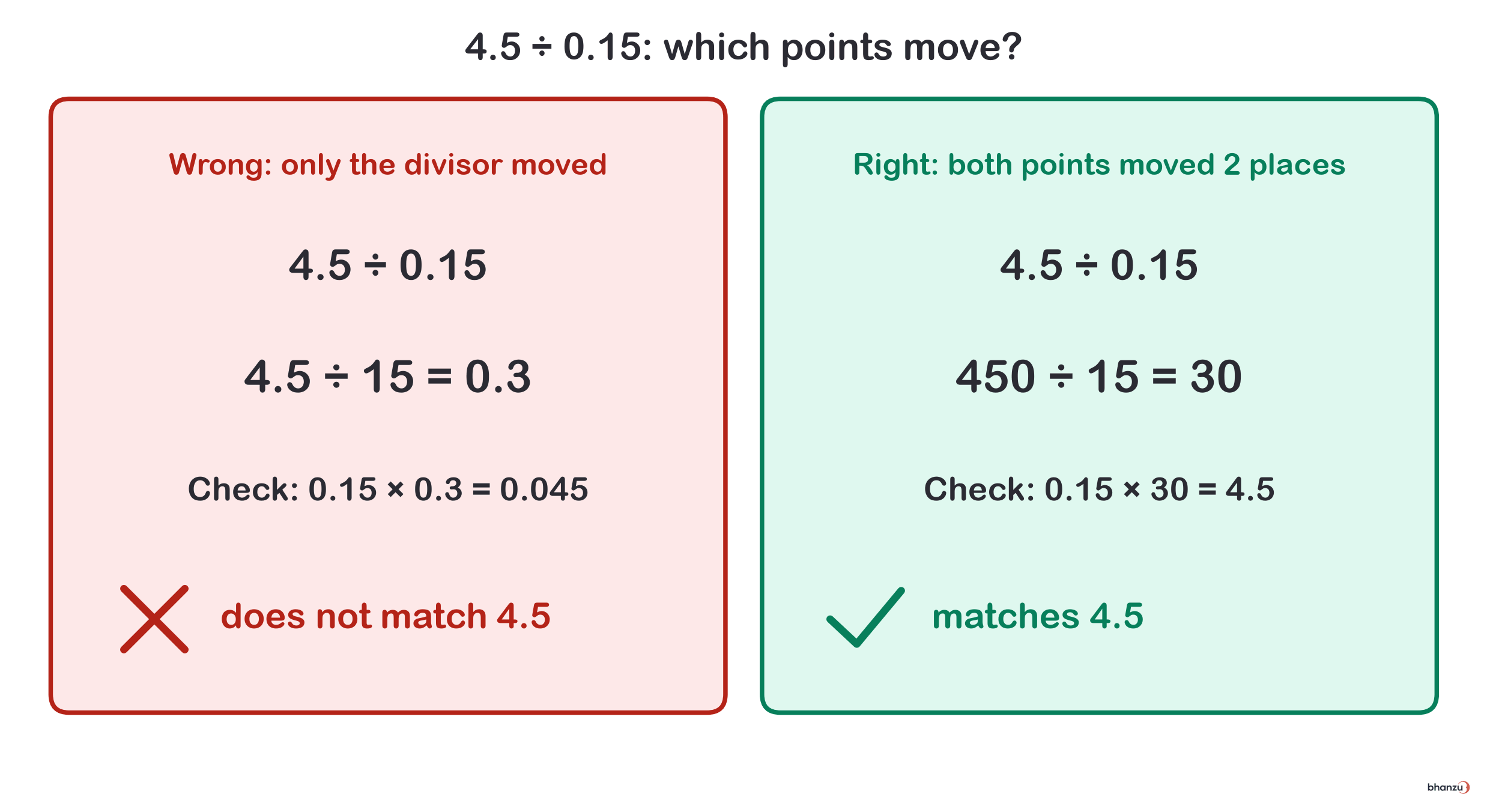
Mistake 1: Moving only the divisor's decimal point
Where it slips in: Any division with a decimal divisor, as in Example 3. A child who rushes to the long division often moves the divisor's point, sees a whole number and starts dividing, because the dividend already looks finished.
Don't do this: Turning into and getting . Multiplying back gives , nowhere near 4.5.
The correct way: Shift both points two places, so becomes , and checks out.
Mistake 2: Stopping at a remainder
Where it slips in: Divisions that don't come out even. Whole-number long division ended with a remainder, so children carry that habit over and write the remainder as the next digit.
Don't do this: Working as remainder 1, then writing 18.1 or "18 R 1".
The correct way: Write 73 as 73.00 and keep dividing, so , and .
Mistake 3: Swapping the divisor and the dividend
Where it slips in: Problems worded "divide 0.8 by 3.2", where the smaller number comes first. Children put the bigger number first out of whole-number habit.
Don't do this: Computing for "divide 0.8 by 3.2".
The correct way: Keep 0.8 as the dividend, then shift both points one place to get , and checks it.
A 2022 study of 37 future teachers in the US named reversing the divisor and dividend as one of four major error types with decimals, so adults make it too. Reading the problem as "how many 3.2s fit into 0.8?" helps before any digits go down, since the answer has to be less than 1.
What most guides get wrong about dividing decimals
Most guides teach "move the decimal point" as a rule, and the reason drops out. Shifting both points multiplies both numbers by the same power of 10, which is why the quotient stays the same and why division never asks you to count decimal places at the end. Multiplying multi-digit decimals works the other way round, since you multiply as if the points were not there and then count places. That distinction confuses adults too, because both methods sound like "move the point".
Guides also skip estimating first, which catches a misplaced point faster than any rule. For , the divisor is almost 1, so a quick round of estimating quotients puts the answer close to 29.4.
An answer of 3 or 300 would clash with that estimate at once.
Key Takeaways
- When the divisor is a decimal, scale both numbers by the same power of 10 before you start dividing.
- In dividing decimals by whole numbers, the point goes straight up and an empty place gets a 0.
- If the digits run out before the remainder hits 0, write zeros and keep going, then round money to the cent.
- Estimate first and multiply back last, because those two checks catch a point in the wrong place.
- To practice catching the divisor-only slip that turns 30 into 0.3, explore Bhanzu's 6th grade math tutor or middle school math tutor.
Read More
- Dividing Decimals by Whole Numbers
- Dividing Whole Numbers to Get a Decimal
- Rounding Decimals
- Dividing Mixed Numbers
- Fractions, Decimals and Percentages
Research Behind This Article
- MacTutor, J J O'Connor and E F Robertson, Simon Stevin (2004). mathshistory.st-andrews.ac.uk
- OpenStax, Lynn Marecek and others, Prealgebra 2e, 5.2 Decimal Operations (2020). openstax.org
- Common Core State Standards Initiative, Grade 6 The Number System (2010). thecorestandards.org
- Common Core State Standards Initiative, Grade 5 Number and Operations in Base Ten (2010). thecorestandards.org
- US Bureau of Labor Statistics, Average Price Data: Milk, Fresh, Whole, Fortified, per Gallon (2026). bls.gov
- Eunmi Joung and Young Rae Kim, Identifying Preservice Teachers' Concept-Based and Procedure-Based Error Patterns in Multiplying and Dividing Decimals (2022). eric.ed.gov
Quick Quiz: Check Yourself
Three levels, new numbers every time: divide by a whole number, divide by a decimal or place a zero, then round a price to the cent or count whole items.
Was this article helpful?
Your feedback helps us write better content
Frequently Asked Questions
Can you divide decimals without a calculator?
How do you divide decimals by 10, 100 or 1,000?
What grade do kids learn dividing decimals?
How can I help my child practice dividing decimals at home?
Is there a trick for dividing decimals?
What makes a decimal division problem hard?