Key Points
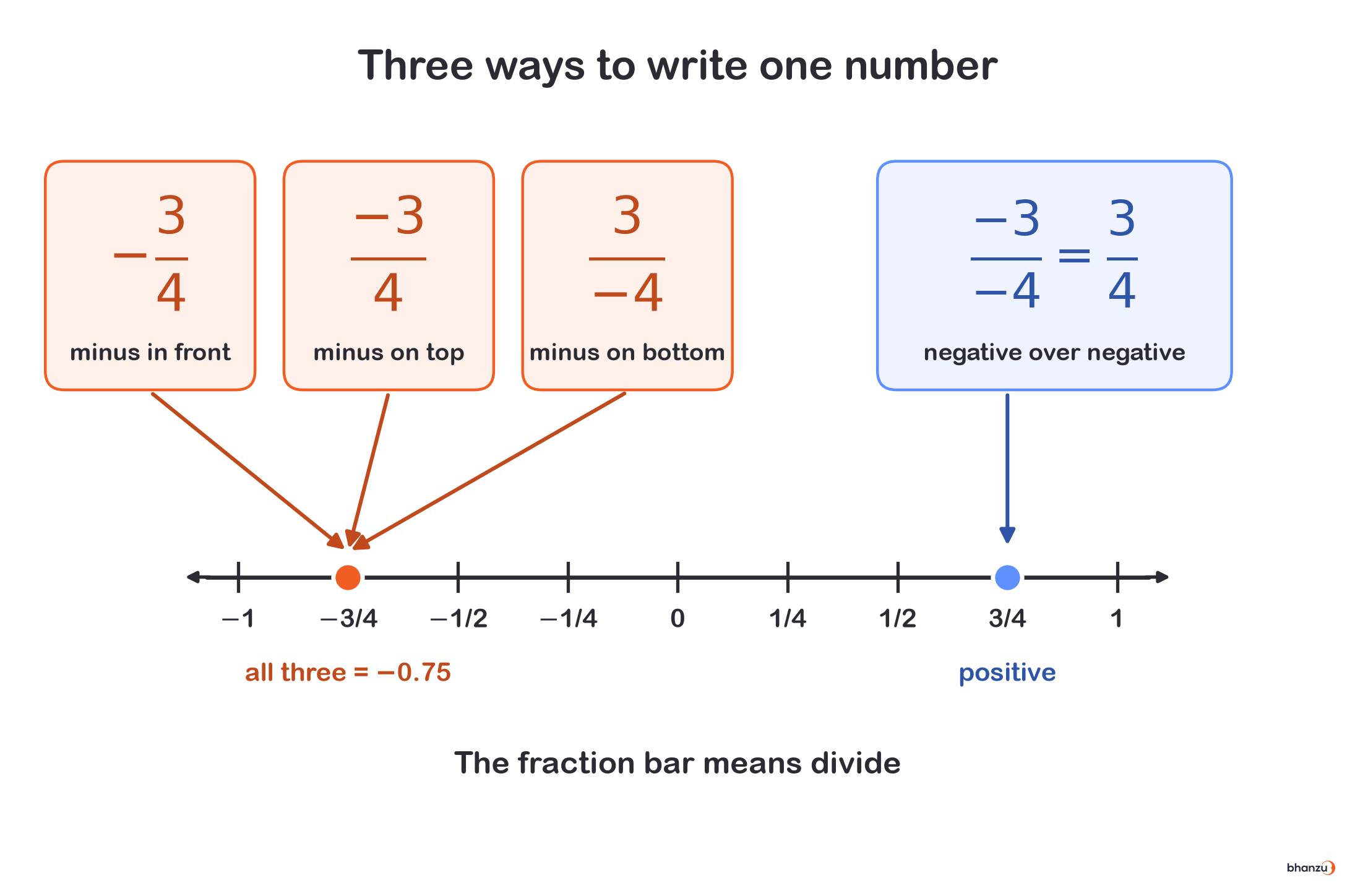
- A negative fraction keeps its value whether the minus sits in front, on the numerator or on the denominator, because the fraction bar means divide, so .
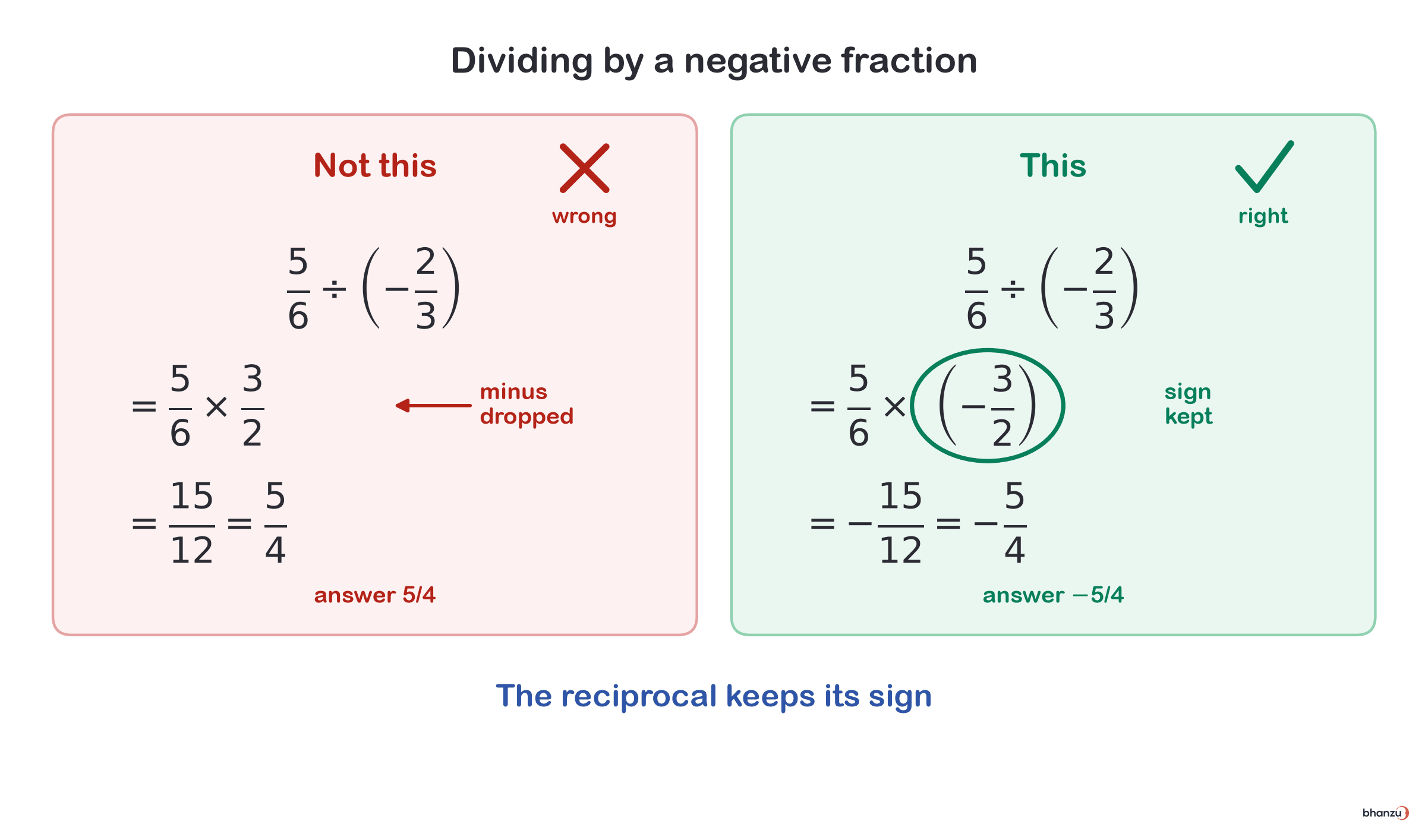
- The sign that is easiest to lose belongs to the divisor, since the reciprocal of is , and dropping that minus flips the sign of the whole answer.
- In multiplying and dividing negative fractions, a negative mixed number such as is one signed quantity, so it converts to , never to .
Every fraction hides a division sign
Every fraction bar is a division sign lying on its side. Three quarters means 3 divided by 4. So a minus sign has three places to sit (in front, on the 3 or on the 4), and all three name the same point.
A forecast of the temperature falling three eighths of a degree every hour describes a negative fraction per hour. Asking how long it takes to drop two and a quarter degrees is then a division of two negative fractions.
Beyond school, the same sign work turns up when an accountant splits a loss between partners, or when a pilot's instruments show a descent as negative feet per minute. The sign says which way things move.
How do you multiply and divide negative fractions?
Multiplying and dividing negative fractions comes down to two jobs, deciding the sign by counting negative signs, then finding the size with the fraction steps you already know. A negative fraction is any fraction less than zero, such as . It is a rational number, meaning it can be written as one integer over a non-zero integer.
The model below keeps those two jobs apart. On the left, an area model (a square cut into 3 columns and 4 rows) finds the size of . The overlap covers 6 of the 12 boxes, which is . On the right, a number line carries the sign, and one negative factor sends the product left of zero, to .
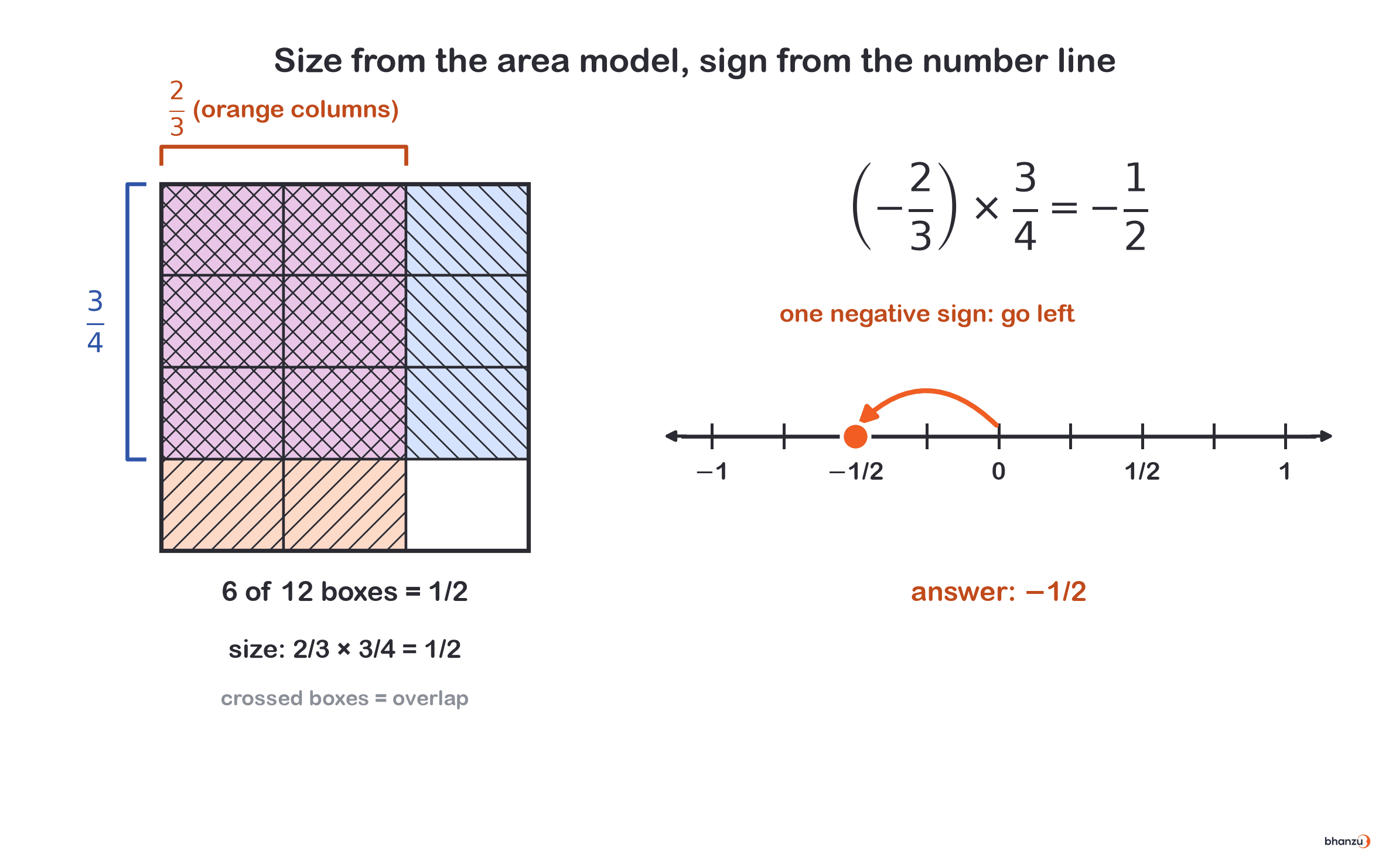
The picture also explains the multiply-across rule. For fractions and , the numerators and count shaded parts, and the denominators and count equal parts (neither can be zero).
The denominators cut the square into boxes, and the numerators shade of them. It's the rule you used for multiplying fractions in 5th grade, with the sign decided first.
This skill falls under Common Core standards 7.NS.A.2b and 7.NS.A.2c, which cover placing the sign in a quotient of integers and multiplying and dividing rational numbers. For a parent, the habit worth watching is whether your child decides the sign before the arithmetic or patches it on at the end, since that plan-first habit carries straight into algebra.
The method has five steps for either operation.
- Count every negative sign, including any inside a fraction.
- To divide, multiply by the reciprocal of the divisor, sign included.
- Cross-cancel shared factors.
- Multiply the numerators, then the denominators.
- Attach the sign (even count positive, odd count negative) and simplify.
| Signs | Answer | Example |
|---|---|---|
| both positive | positive | |
| first negative | negative | |
| second negative | negative | |
| both negative | positive |
The table holds for division because dividing means multiplying by a reciprocal with the same sign. Why a negative times a negative is positive comes from the distributive property, shown in properties of operations with negative numbers.
A student who rushes straight to multiplying often gets every digit right and the sign wrong. Sign counting works only for products and quotients, so in a sum such as the sign depends on which number is farther from zero.
Where do negative signs in fractions go?
Negative signs in fractions can sit in front, on the numerator or on the denominator without changing the value, because the fraction bar means divide. A negative divided by a positive is negative, and so is a positive divided by a negative. Standard 7.NS.A.2b writes it as one chain, for integers and with not .
The idea goes back to fractions as division in 5th grade, where first meant . Dividing each form out shows which ones match.
| Form | Division | Decimal |
|---|---|---|
A minus in front of the bar belongs to the whole fraction, never to both numbers. A negative over a negative is positive, so is plain . The OpenStax Prealgebra 2e textbook usually puts the sign in front.
Students who have only met the minus out front often decide that an answer key showing has a typo. It doesn't.
How do you divide by a negative fraction?
To divide by a negative fraction, multiply by its reciprocal and let the reciprocal keep the negative sign. A reciprocal is the number you multiply by to get , so the reciprocal of is . The sign stays because a number times its reciprocal must be positive , and two numbers with a positive product share a sign.
OpenStax's Prealgebra 2e says to "keep the same sign and invert the fraction." Zero has no reciprocal, since nothing times makes , which is why a divisor can never be zero.
Flipping works because division counts how many of the divisor fit. Two-thirds fits into 2 exactly 3 times, and also gives 3. Some classrooms call the routine keep, change, flip.
One negative sign makes the quotient negative. Cancelling the 3 with the 9 and the 5 with the 10 first skips the bigger numbers, which matters more as fractions grow.
Division also undoes multiplication, which is how you find a missing factor. If , the box holds .
What changes with negative mixed numbers?
The minus in front of a negative mixed number covers the whole number and the fraction together. Convert it to an improper fraction, one whose numerator is at least as big as its denominator, with the sign kept outside.
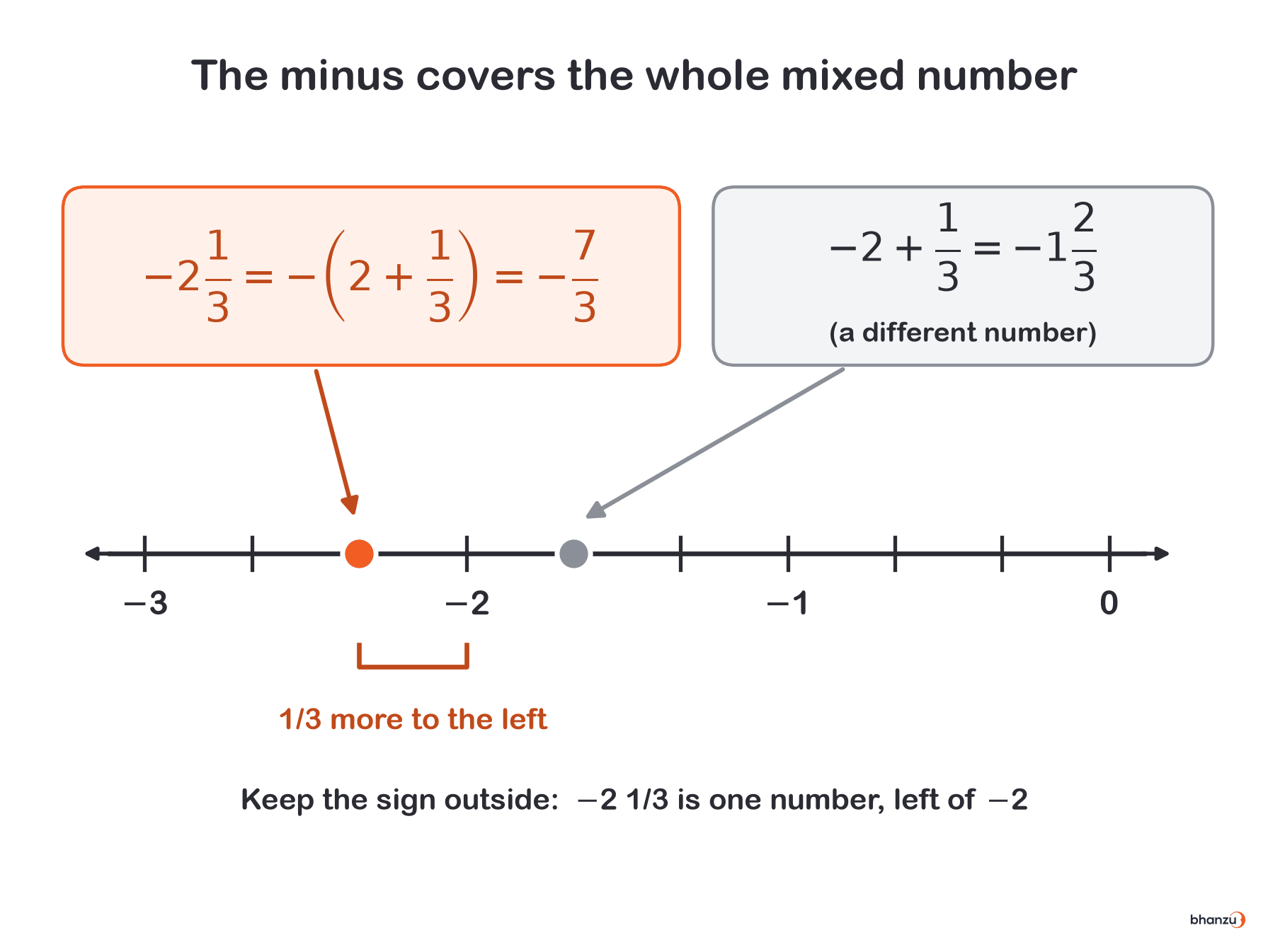
Splitting it lands somewhere else, because steps a third to the right of , to . This is the one spot where the notation misleads. The 2 and the third look like neighbors, yet the minus quietly covers both.
A sum like becomes the mixed number . After converting, multiplying negative mixed numbers uses the same five steps, and dividing mixed numbers works as it did in 6th grade once the sign is set. You'll meet negative mixed numbers again in 8th grade, inside equations with fraction coefficients.
Try It Yourself
Pick two fractions, give each a sign, choose multiply or divide, then shade the overlapping boxes to find the size of the answer. Predict positive or negative before you press Check, and the number line shows where the answer lands. In divide mode, watch the second fraction flip to its reciprocal and keep its sign.
Examples of multiplying and dividing negative fractions
Example 1
Find .
One negative sign means a negative product.
The answer is .
Example 2
Which of , and equal ?
Divide each one out.
The first two equal , and the third is positive.
Example 3
Find .
The tempting move is to flip the first fraction.
That can't be right. Nine tenths is bigger than three quarters, so it fits in less than once, and the answer's size must be under 1. Yet is more than 1.
Flip the divisor instead, sign and all. Two negative signs make the answer positive.
The answer is . Multiplying back confirms it.
Example 4
Find .
Convert both mixed numbers, keeping the sign outside.
One negative sign makes the product negative. Cancel the 4s, then divide the 9 and the 3 by 3.
The answer is .
Example 5
What fraction goes in the box in ?
The box stands for the missing fraction. Divide both sides by , which means multiplying by its reciprocal .
The missing fraction is , or . Multiplying back checks it.
Example 6
The temperature falls of a degree Fahrenheit every hour. How many hours does it take to change by degrees?
Divide the total change by the change per hour, degree.
Two negative signs make the quotient positive.
It takes 6 hours, and a positive answer makes sense because a count of hours can't be negative.
Negative fractions beyond the textbook
Negative fractions exist because real change often comes in parts of a unit and often heads downward. Multiplying or dividing them answers how much in total and how long.
- It measures change over time. A temperature falling of a degree per hour for hours changes by , or degrees.
- It shares a loss fairly. A penalty of of a point, spread evenly over 3 game rounds, changes the score by point per round.
- It is part of the math the country tracks at this age. In the 2025 NAEP Long-Term Trend results, the average math score of 13-year-olds showed no significant change from 2023 and stayed below 2020, with about 8,200 students assessed in math.
- It rests on fraction sense, which has needed attention for years. On the 2004 NAEP, 50% of 8th graders could not order three fractions from least to greatest, as the Institute of Education Sciences fractions practice guide reported in 2010.
In 8th grade, the same sign habits return when a downhill line has a negative slope such as . For a parent who wants a refresher first, this guide to negative numbers covers what the minus sign means before fractions join in.
Tripping points to avoid with negative fractions
Mistake 1: Losing the sign when you flip the divisor
Where it slips in: Any division by a negative fraction, such as . Students who repeat the flip step without knowing why build the reciprocal from the digits alone.
Don't do this: , with the minus gone.
The correct way: The reciprocal of is , so .
The wrong answer looks perfectly worked, which is why it survives a quick look. A problem with one negative sign can't give a positive answer, so counting signs first catches it.
Mistake 2: Splitting a negative mixed number
Where it slips in: Converting a negative mixed number, as in . A mixed number reads like "a whole plus a part," so the minus gets attached only to the whole.
Don't do this: , then .
The correct way: , so .
Mistake 3: Putting the minus on the top and the bottom
Where it slips in: Rewriting the first fraction in , because the minus beside the bar seems to touch both numbers.
Don't do this: Rewrite it as and get .
The correct way: Put the minus on one number, , so the product is . The form is positive , a different number.
What most guides get wrong about negative fractions
The part most guides skip is that a picture of fraction multiplication shows size, never sign.
- A model needs a partner. A shaded box can't be negative, so an area model shows for and never the minus. The Institute of Education Sciences fractions guide calls a negative part of a whole hard to grasp and recommends number lines for fractions below zero.
- Hidden signs still count. The product hides two negative signs, so it is positive .
- Size and sign move separately. Dividing by gives , further from zero than either fraction, so a student may second-guess a correct answer that looks too big. Check size and sign as two questions.
Key Takeaways
- Say the sign out loud before you touch the numbers, then work the fractions as if every sign were positive.
- When multiplying and dividing negative fractions, one minus sign anywhere in a fraction gives the same value, but minus signs on top and bottom cancel.
- Flip only the divisor, and let its sign come along for the ride.
- Treat a negative mixed number as one package, with the minus covering every part of it.
- To keep practicing sign-first fraction work, like keeping the divisor's minus when it flips, explore Bhanzu's 7th grade math tutor or math classes for kids.
Read More
- Order of Operations With Rational Numbers
- Rational Number Word Problems
- Multiplying Mixed Numbers
- Dividing Fractions Word Problems
- Opposite Numbers
- Why Are Fractions So Hard
Research Behind This Article
- NGA Center and CCSSO, Common Core State Standards for Mathematics, Grade 7, The Number System (2010). thecorestandards.org
- OpenStax, Prealgebra 2e, Section 4.3, Multiply and Divide Mixed Numbers and Complex Fractions (2020). openstax.org
- OpenStax, Prealgebra 2e, Section 4.2, Multiply and Divide Fractions (2020). openstax.org
- National Center for Education Statistics, NAEP Long-Term Trend Assessment Results, Reading and Mathematics, 2025 (2026). nationsreportcard.gov
- Institute of Education Sciences, Developing Effective Fractions Instruction for Kindergarten Through 8th Grade (2010). ies.ed.gov
Quick Quiz: Check Yourself
Three levels, new numbers every time: multiply signed fractions and match equal forms, then divide and find a missing factor, then handle negative mixed numbers and a temperature problem.
Was this article helpful?
Your feedback helps us write better content
Frequently Asked Questions
Can fractions be negative?
What is a negative fraction times a negative fraction?
Do negative fractions need common denominators to multiply or divide?
How do you turn a negative fraction positive?
What fractions do 7th graders learn?
Why are fractions taught before negative numbers?