Key Points
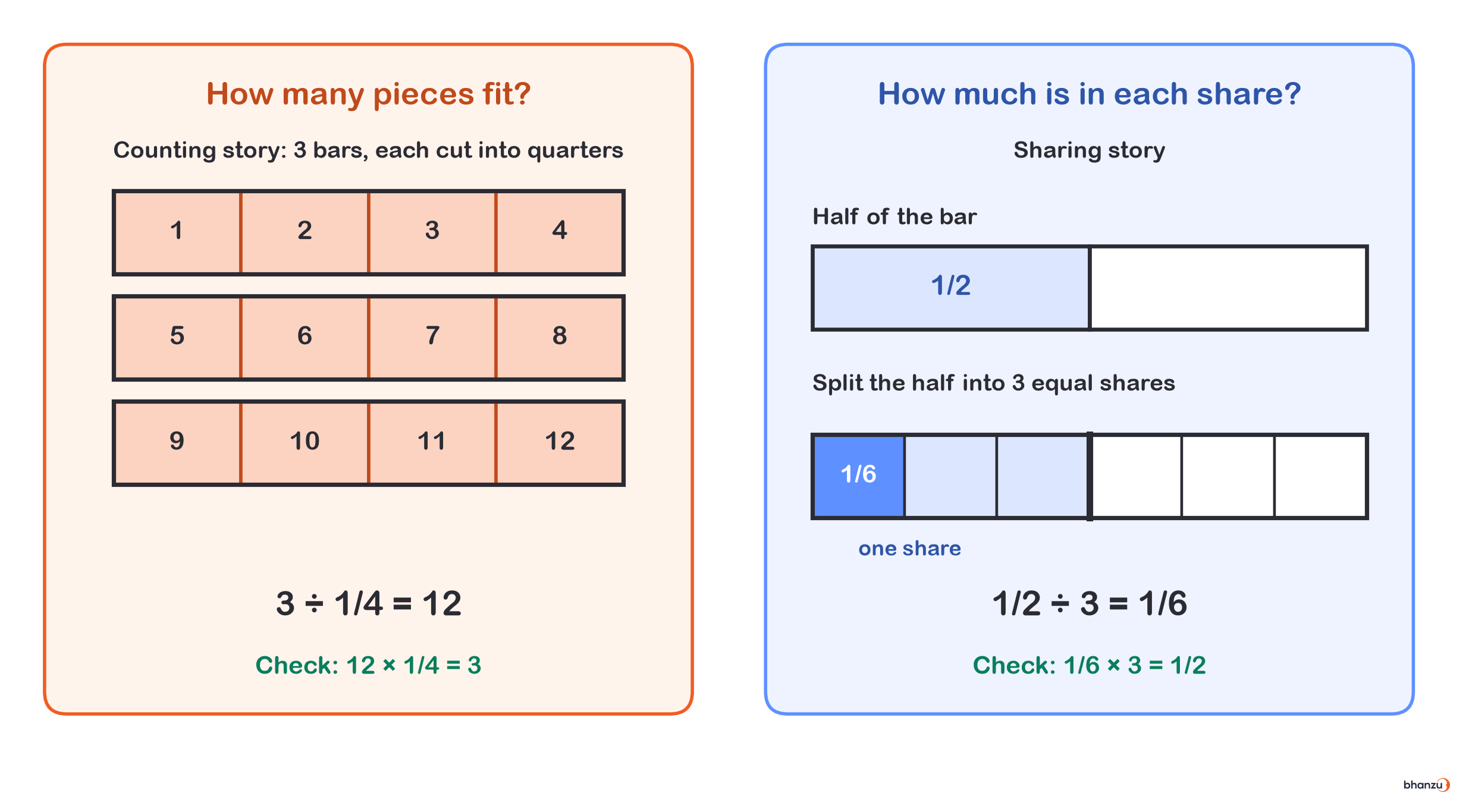
- Most dividing unit fractions word problems are counting stories, like 12 quarter-cup scoops in 3 cups, or sharing stories, like half a sandwich split among 3.
- A fraction bar shows both story types, and multiplying back checks the answer, because .
- A common error is writing numbers in story order, turning half a sandwich shared among 3 into instead of one sixth.
- Common Core standard 5.NF.B.7.c places these stories in 5th grade, and dividing a fraction by a fraction waits until 6th grade.
The scoop that makes the number grow
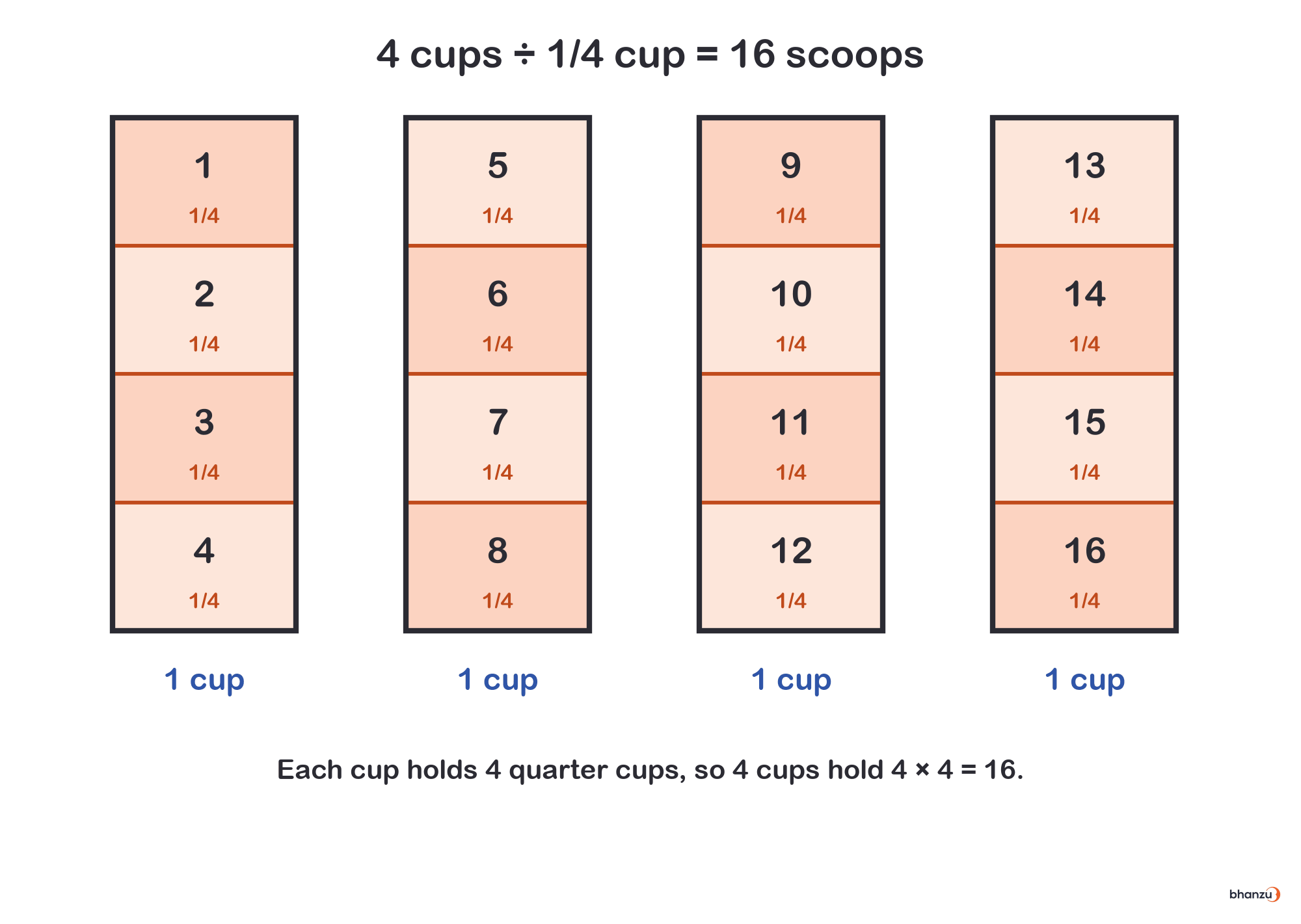
A quarter-cup scoop dips into 4 cups of rice exactly 16 times. Each cup holds 4 quarter cups, so 4 cups divided by a quarter cup gives 16, more than you started with.
Share half a sandwich among 3 friends, though, and each friend gets a sixth, a smaller piece than the half. One answer grew and the other shrank.
The story's question decides which way it goes, how many pieces fit or how much lands in each share. In 6th grade, you'll use those same two questions to divide any fraction by any fraction.
How do you solve dividing unit fractions word problems?
To solve dividing unit fractions word problems, decide whether the story asks how many pieces fit or how much is in each share, draw a fraction bar, then check by multiplying. A unit fraction has 1 on top, like , and its bottom number, the denominator, names the piece size. A fraction bar is a strip cut into equal parts, one type of visual fraction model.
This is Common Core standard 5.NF.B.7.c, which asks 5th graders to solve real-world problems that divide unit fractions by whole numbers and whole numbers by unit fractions. Your child is expected to show these stories with drawings and equations, while dividing a fraction by a fraction waits until 6th grade, so a drawing is the right tool this year.
- Find the whole, the amount the story starts with.
- Ask the question. "How many pieces fit?" puts the whole number first, and "How much is in each share?" puts the unit fraction first.
- Draw a fraction bar for the whole, cut it to match the story and count.
- Check by multiplying your answer back.
For 3 cups of rice and a quarter-cup scoop, each cup holds 4 scoops.
Under NIST's 2026 Handbook 44, a US measuring cup holds exactly 8 fluid ounces, so a quarter cup holds 2, and 3 cups hold 24 fluid ounces, or 12 quarter cups again.
Which way does the division go?
The story's question, not the order of its numbers, decides which way the division goes. In a counting story, the whole number is the dividend (the number being divided), because you count the pieces inside it. In a sharing story, the unit fraction is the dividend and the whole number is the divisor, the number you divide by.
| Words in the problem | Math it means |
|---|---|
| "How many 1/2-foot pieces can you cut from 5 feet?" | , counting |
| "Three friends share 1/4 of a pan equally" | , sharing |
| "18 bags with 1/6 pound in each" | |
| "8 pieces, each 1/4 of a bar" | , multiplying |
Children often write the numbers in the order they read them, so "share 1/2 among 3" becomes 3 divided by 1/2, and six whole sandwiches appear out of half of one. The wording can confuse adults too. Cutting 3 cups into quarter cups gives 12 pieces, but cutting 3 cups into 4 equal parts gives 3/4 cup each.
Dividing unit fractions by whole numbers greater than 1 always gives a smaller unit fraction. Stories that give a piece size and a count, like the last row of the table, are multiplying fractions word problems instead.
Try It Yourself
Pick How many pieces or Share equally, then use the plus and minus buttons to cut the bars until they match the story. Press Check my model to see the division and its multiplication check, or New story for a fresh one.
Why does the answer get bigger when you divide by a unit fraction?
Dividing by a unit fraction asks how many of those small pieces fit, and every whole holds several of them, so the count grows. Each whole holds 5 fifths, so 2 wholes hold 2 groups of 5.
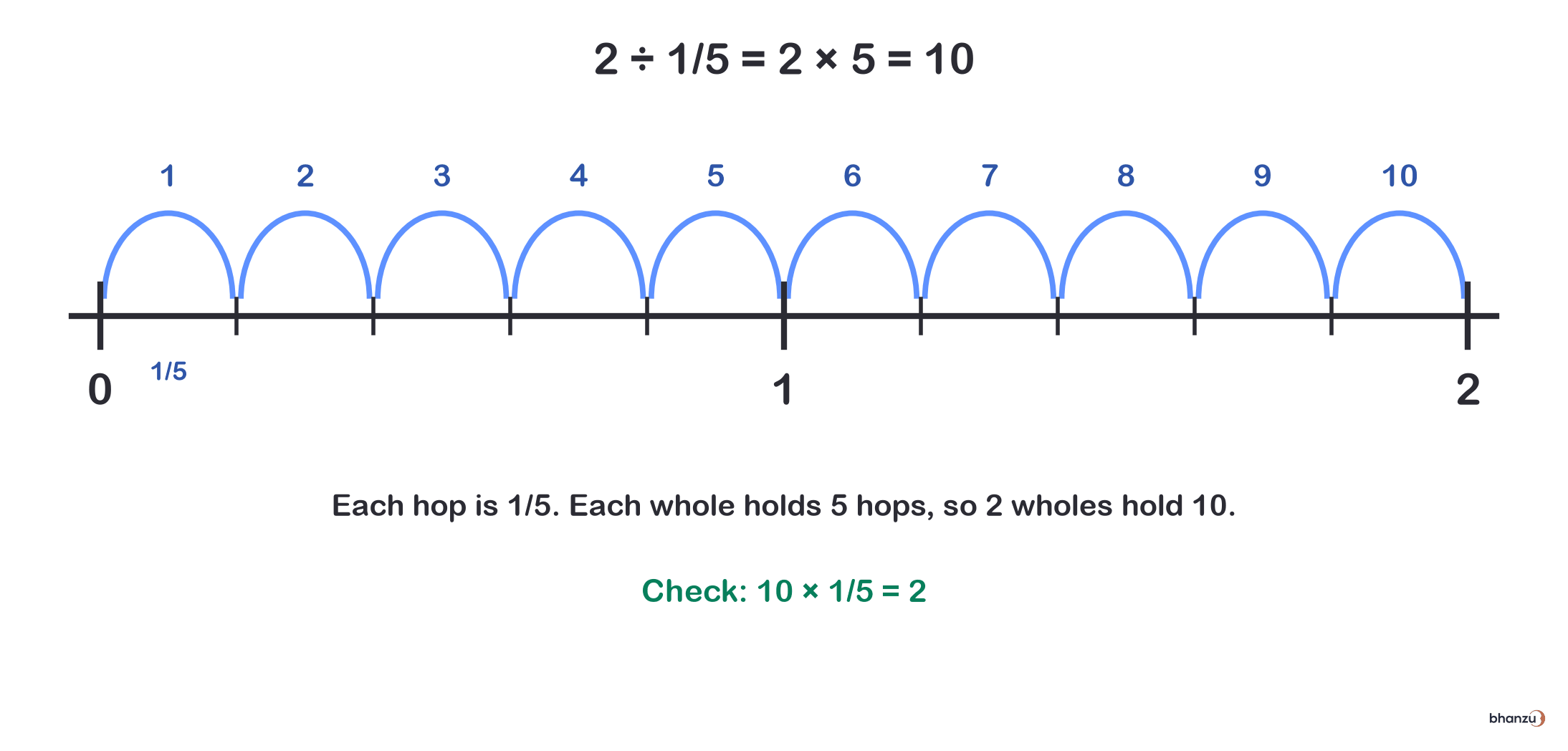
These are the same hops you used for fractions on a number line in 3rd grade. OpenStax's Prealgebra 2e textbook reads 2 divided by 1/4 as how many quarters fit in 2 dollars, which is 8. A cup holds four 1/4 cups for the same reason.
Sharing goes the other way. Splitting 1/2 into 3 equal parts cuts the whole into 6 parts, so each share is smaller than the half.
Drawing gets slow when the divisor is not a unit fraction, as in . In 6th grade, dividing fractions word problems handle that with the reciprocal, the fraction turned upside down, so dividing by 2/3 becomes multiplying by 3/2.
Examples of dividing unit fractions word problems
Example 1
A ribbon is 5 feet long. How many -foot pieces can you cut from it?
This is a counting story. Each foot holds 2 halves.
You can cut 10 pieces.
Example 2
Three friends share of a pan of brownies equally. What fraction of the whole pan does each friend get?
Dividing in story order is tempting.
That says each friend gets 12 pans, but there was only a quarter of one pan. A share can never be bigger than the amount being shared, so 12 cannot be right.
The quarter pan is what gets shared. Cut it into 3 equal parts, and the whole pan now has 12 equal parts.
Each friend gets one twelfth of the pan.
Example 3
Maya filled 18 bags with pound of trail mix each and used all of it. How many pounds did she start with?
The box stands for her starting pounds.
Multiply 18 by one sixth to undo the division.
Maya started with 3 pounds, and 3 pounds hold 18 sixths.
Example 4
Which is greater, or ? Explain.
Two wholes hold 6 thirds.
One third split into 2 equal parts makes sixths.
The first is greater. Counting pieces gave 6, but sharing gave one small piece, a sixth.
Example 5
A -gallon jug of juice is poured equally into 8 cups. What part of a gallon is in each cup?
The half gallon is shared. Cutting it into 8 parts gives the whole gallon 16 parts.
Each cup holds one sixteenth of a gallon.
A gallon is 128 fluid ounces, so that sixteenth is exactly one measuring cup.
Example 6
Ms. Ortiz has 6 yards of ribbon. She cuts it into -yard pieces, then cuts one piece into 2 equal parts for bows. How many -yard pieces does she cut first, and how long is each bow part?
Step 1 is a counting story.
Step 2 is a sharing story, one quarter yard split in 2.
She cuts 24 pieces first, and each bow part is one eighth of a yard long. Multiplying back checks both steps.
Why does dividing unit fractions matter?
Dividing unit fractions is how people split an amount they already have into fair portions, and the answer says whether there is enough.
- It counts servings. A gallon is 128 fluid ounces, or 16 cups, so a gallon of milk fills 64 quarter-cup servings, because 16 divided by 1/4 is 64.
- It makes sharing fair when the amount is already a piece. Half a pizza shared by 4 people gives each one an eighth, with no guessing.
- It gives every learner a picture to start from. In the 2024 NAEP mathematics results, 39 percent of US 4th graders scored at or above Proficient, 3 percentage points higher than in 2022. The other 61 percent are still working toward it, and a bar drawing gives each of them a way in.
Whatever the container or the crowd, a bar drawing answers both questions at every level.
The part of dividing unit fractions nobody explains
The part most guides skip is what the division means before the flip rule (keep, change, flip) arrives, and a rule learned without meaning breaks easily, even for adults. A 2010 practice guide from the Institute of Education Sciences reports a 1999 study where only 9 of 21 US teachers who tried got it right. All 72 teachers in the Chinese group did. That gap helps explain why fractions feel so hard for so many people.
The other skipped part is choosing the operation from the question, not the numbers. Six ribbon pieces, each 1/3 yard long, make 2 yards in all, and that is multiplication. Ask what the whole is and whether the question wants a count of pieces or the size of one. Writing a story for a division checks the same thing in reverse, the approach of a 2008 journal article by Barlow and Drake.
Tripping points to avoid with dividing unit fractions
Mistake 1: Flipping the wrong number
Where it slips in: Sharing stories like Example 2, often after a child has picked up "flip the fraction" from an older sibling or a video before knowing which number to flip.
Don't do this: Turning into .
The correct way: Cut the shared fifth into 2 equal parts, so the whole has 10 parts and .
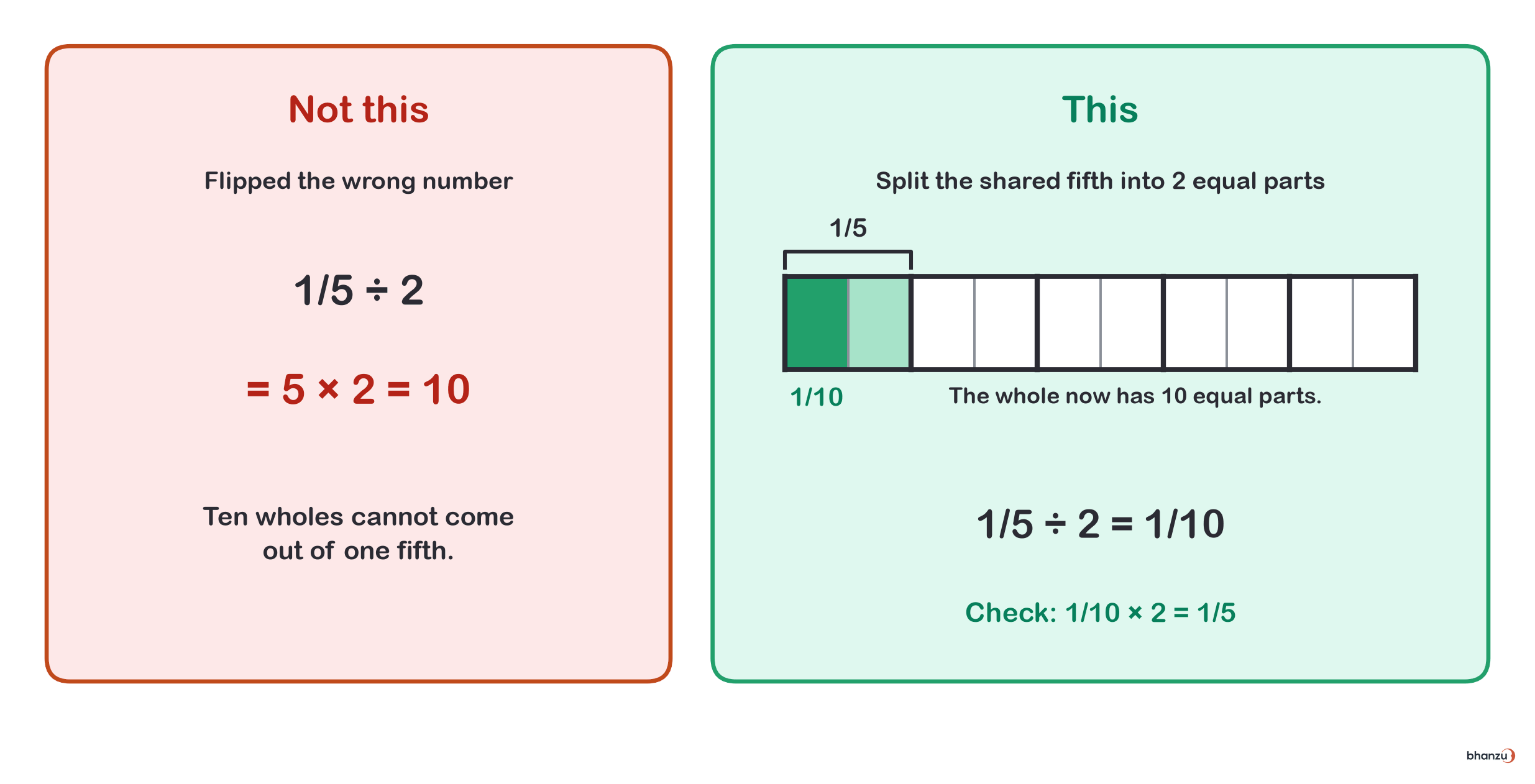
The 2010 IES guide lists flipping the wrong fraction as a common error. Ten wholes cannot come out of one fifth.
Mistake 2: Dividing when the story needs multiplying
Where it slips in: Stories that give a piece size and a count, such as 8 pieces that are each 1/4 of a granola bar. The word "pieces" sounds like division.
Don't do this: Writing bars.
The correct way: Eight quarters make bars, because the story asks how much 8 pieces make.
Mistake 3: Shrinking the answer when dividing whole numbers by unit fractions
Where it slips in: Counting stories such as the 3 cups of rice, when a child gets 12, doubts it and writes 3/4 instead.
Don't do this: Rewriting 12 scoops as of a scoop.
The correct way: Count 4 quarter cups in each of the 3 cups to get 12 scoops, then check that .
Division in 3rd and 4th grade nearly always made numbers smaller, so the idea felt like a rule. It only holds when you divide by a number greater than 1.
Key Takeaways
- Ask what the whole is before you choose to divide or multiply.
- A counting story puts the whole number first and ends with more pieces than that whole number.
- A sharing story puts the unit fraction first, and each share is a smaller unit fraction.
- Finish dividing unit fractions word problems by multiplying your answer back to the starting amount.
- For more help telling a sharing story from a counting story, with a teacher watching each bar you draw, explore Bhanzu's 5th grade math curriculum or math classes for kids.
Read More
- Fractions as Division
- Multiplying Decimals by Whole Numbers
- Dividing Mixed Numbers
- Math Word Problems
- Mental Math With Fractions
Research Behind This Article
- Common Core State Standards Initiative, Grade 5 Number and Operations, Fractions (2010). thecorestandards.org
- National Institute of Standards and Technology, NIST Handbook 44 (2026), Appendix C, General Tables of Units of Measurement (2025). nist.gov
- OpenStax, Prealgebra 2e, 4.2 Multiply and Divide Fractions (2020). openstax.org
- National Center for Education Statistics, NAEP Mathematics 2024, National Trends, Grade 4 (2025). nationsreportcard.gov
- Institute of Education Sciences, Developing Effective Fractions Instruction for Kindergarten Through 8th Grade (2010). ies.ed.gov
- Barlow, A. T., and Drake, J. M., Division by a Fraction: Assessing Understanding through Problem Writing (2008). eric.ed.gov
Quick Quiz: Check Yourself
Three levels, new numbers every time: count how many unit-fraction pieces fit in a whole number, find one equal share of a unit fraction or a missing number, then solve two-step stories that use both.
Was this article helpful?
Your feedback helps us write better content
Frequently Asked Questions
How can 2 divided by 1/2 be 4 in real life?
How many 1/4 cups are in 3/4 cup?
Is dividing fractions the same as multiplying?
Why do you flip the fraction when dividing?
How do I explain dividing fractions to a child?
Is dividing fractions taught in 5th grade or 6th grade?