Key Points
- Negative number word problems turn amounts below zero, below sea level or owed into negative values, then solve start plus change equals end for the missing amount.
- Subtracting a negative number adds its opposite, so , which two-color counters show by adding three zero pairs and removing three negative counters.
- A frequent mistake comes when a temperature already below zero falls further, since dropping 8 degrees ends at , not .
- Common Core places adding and subtracting signed numbers in real-world stories in 7th grade, and the same setup leads into one-step equations with negatives.
Sea level is the zero of the planet
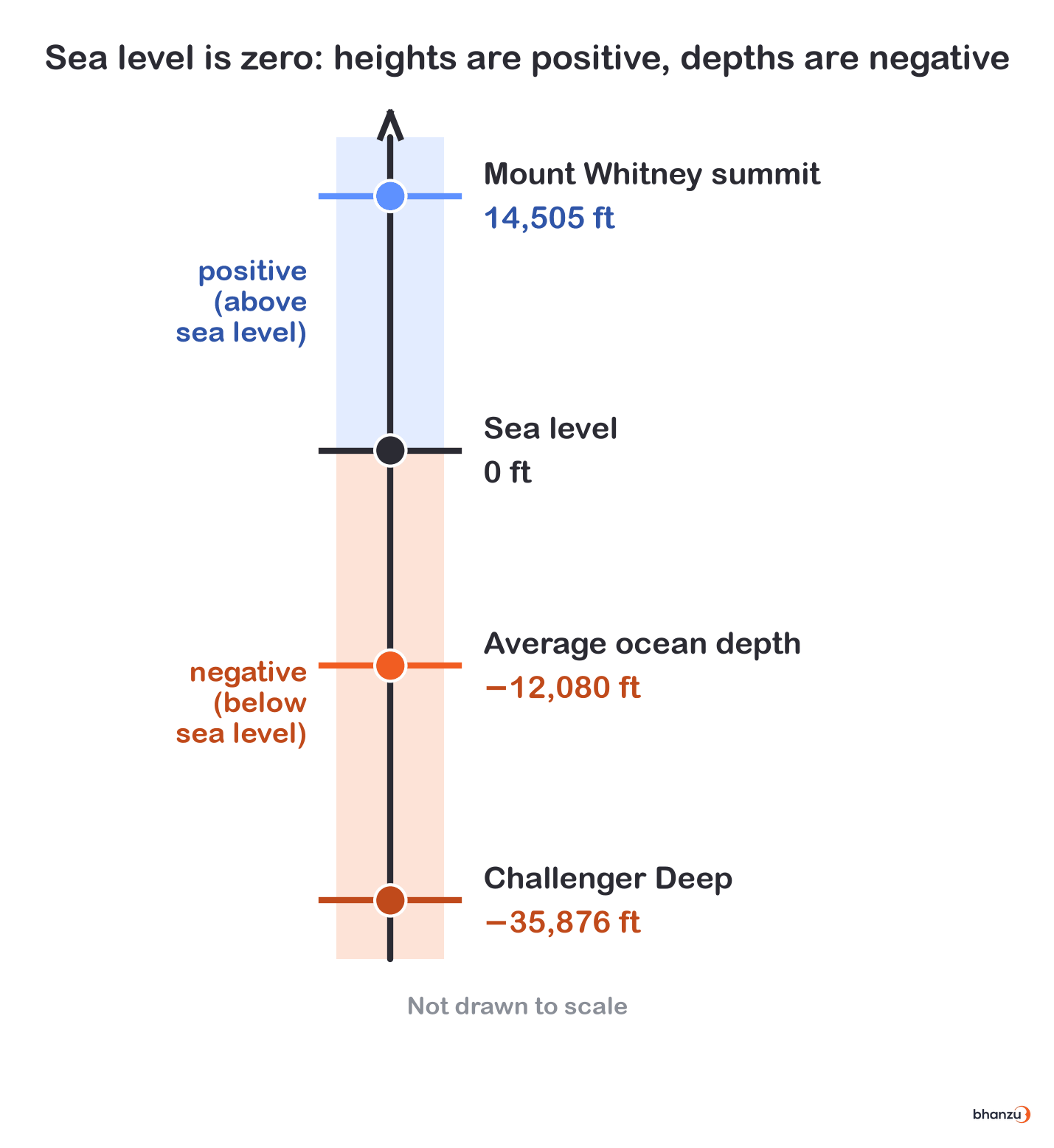
In 1875, the crew of HMS Challenger sounded the deepest trench on Earth. Sounding means measuring how far down the seafloor sits, and the deepest point in that trench now carries the ship's name, Challenger Deep. A NOAA fact page updated in 2026 puts its depth at about 35,876 feet, while the average ocean floor lies about 12,080 feet down.
Each depth is measured downward from sea level, so sea level acts like zero on a number line (a negative number is any number less than zero). A mountaintop above it gets a positive height, and the ocean floor below it gets a negative one. Ocean scientists log a submarine's depth this way, weather forecasters track cold snaps that push the temperature below zero, and bank apps show a balance that dips under zero when money is owed.
How do you solve negative number word problems?
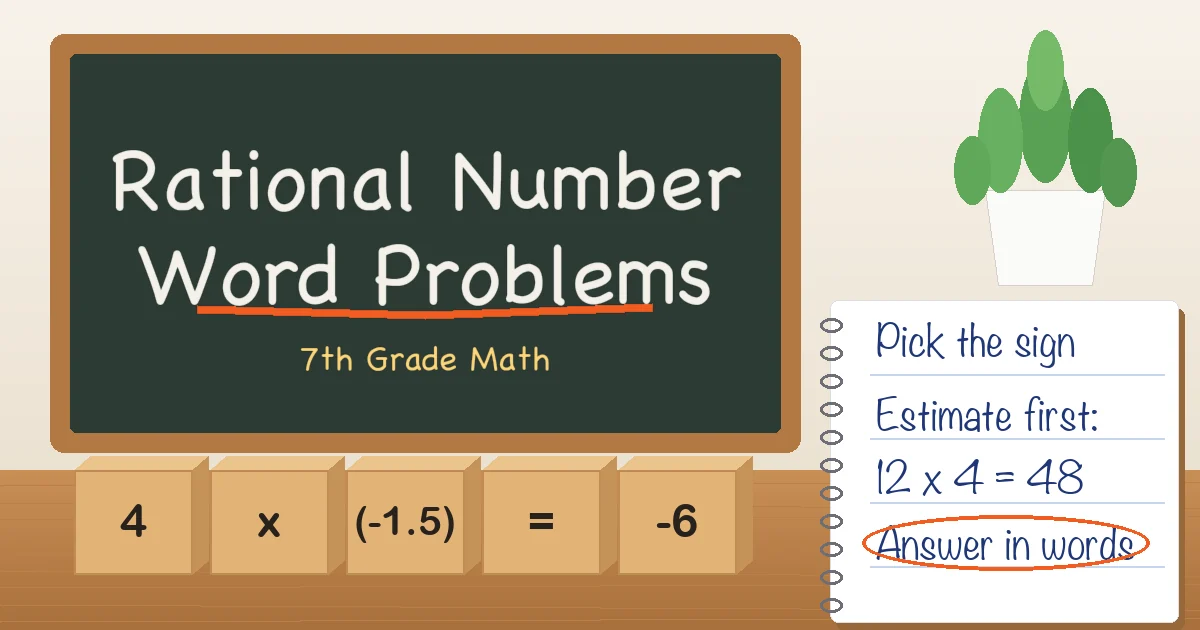
You solve negative number word problems by giving every amount a sign and fitting the story into one frame, where the start plus the change equals the end.
The amounts can be any rational numbers, meaning numbers you can write as a fraction of two integers (whole numbers and their opposites), such as , or . Your child meets these stories in Common Core standards 7.NS.A.1 and 7.NS.A.3. Those standards ask 7th graders to solve real-world problems with rational numbers and to show addition and subtraction on a horizontal or vertical number line.
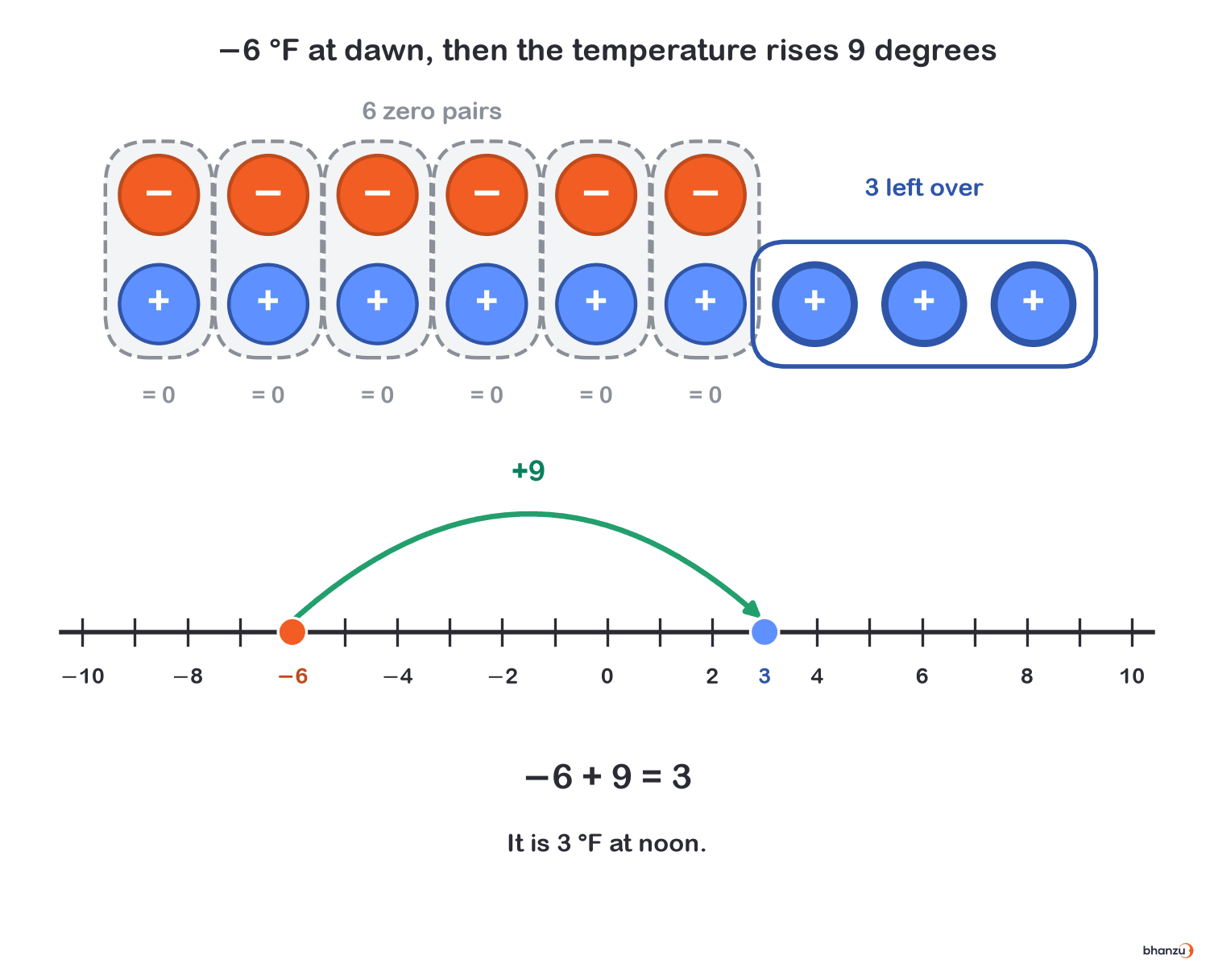
Two-color counters show the method first. Each blue counter is , each orange counter is , and one of each makes a zero pair worth . Say it is at dawn and the temperature rises 9 degrees by noon. Lay out 6 orange counters and 9 blue ones, remove the 6 zero pairs, and 3 blue counters remain.
On a number line, the same story is one hop of 9 to the right from , and the hop lands on , so it is at noon.
Five steps cover any story that asks where an amount ends up.
- Draw a number line with 0 marked, upright for temperature, height and depth.
- Write the start with its sign.
- Write the change with its sign, positive for up or gained and negative for down, lost or owed.
- Add the start and the change.
- Say the answer in words with its direction, such as "3 degrees above zero".
Which words in a story mean negative?
Words that mean below, down, lost, spent or owed give an amount a minus sign, and the question words tell you whether to add or subtract.
| Words in the problem | Math it means |
|---|---|
| "rises 9 degrees" | |
| "falls 8 degrees" | |
| "12 meters below the surface" | |
| "owes her brother $15" | $-$15$ |
| "deposits $25.00" | $+$25.00$ |
| "how much higher is A than B" | |
| "how much did it change" |
One habit catches children who know "two negatives make a positive" from multiplication. A diver at meters goes 3 meters deeper, they see two negatives in , and they write instead of . A child who rushes to the answer commits to that 7 before asking whether the diver went up or down.
When you help with math word problems at home, ask your child to read the story twice and say the start out loud, with its direction, before writing a number.
Why is subtracting a negative number adding?
Subtracting a negative number gives the same result as adding its opposite, because taking away something below zero leaves you higher than before.
Counters make the reason visible. Start with 2 blue counters for and try to take away 3 orange counters. There are no orange counters to take, so add 3 zero pairs first, which changes nothing because each pair is worth 0. Now remove the 3 orange counters, and 5 blue counters are left.
The rule leans on opposite numbers, two numbers the same distance from 0 on opposite sides, such as and , which add to . OpenStax's Prealgebra 2e textbook calls it the Subtraction Property, where is the starting amount and is the amount taken away.
A game score works the same way. Maya has 2 points, the referee cancels a penalty given by mistake, and her score becomes .
Try It Yourself
Pick a story about temperature, depth or money, then set where it starts and how much it changes. Watch the zero pairs fade as the arrow carries the dot along the vertical number line to the answer. Try a change that crosses 0, and read how the live sentence describes the new value.
How far apart are two signed values?
At 3 p.m. it is , and by midnight it is . The readings are 15 degrees apart, found by subtracting the lower value from the higher one.
Splitting the gap at zero shows why, with 9 degrees down to 0 and 6 more below it. The gap is the absolute value of the difference, a number's distance from 0 with no direction, so a distance is never negative.
A change has a direction. Since the start plus the change equals the end, subtracting the start from both sides gives the change rule.
For the same evening, the change is , a drop of 15 degrees. The difference between "how far apart" and "how much did it change" is genuinely confusing at first, because both use one subtraction and differ only in sign. The distance method drops direction, so it stops working once a question asks how something changed. In 8th grade, the same end-minus-start subtraction measures the rise between two points on a graph, and high school science writes changes the same way.
Examples of negative number word problems
These stories come from temperature, depth, elevation and money.
Example 1
A diver is 12 meters below the surface and swims up 5 meters. Where is she now?
The start is and the change is .
She is 7 meters below the surface, at meters.
Example 2
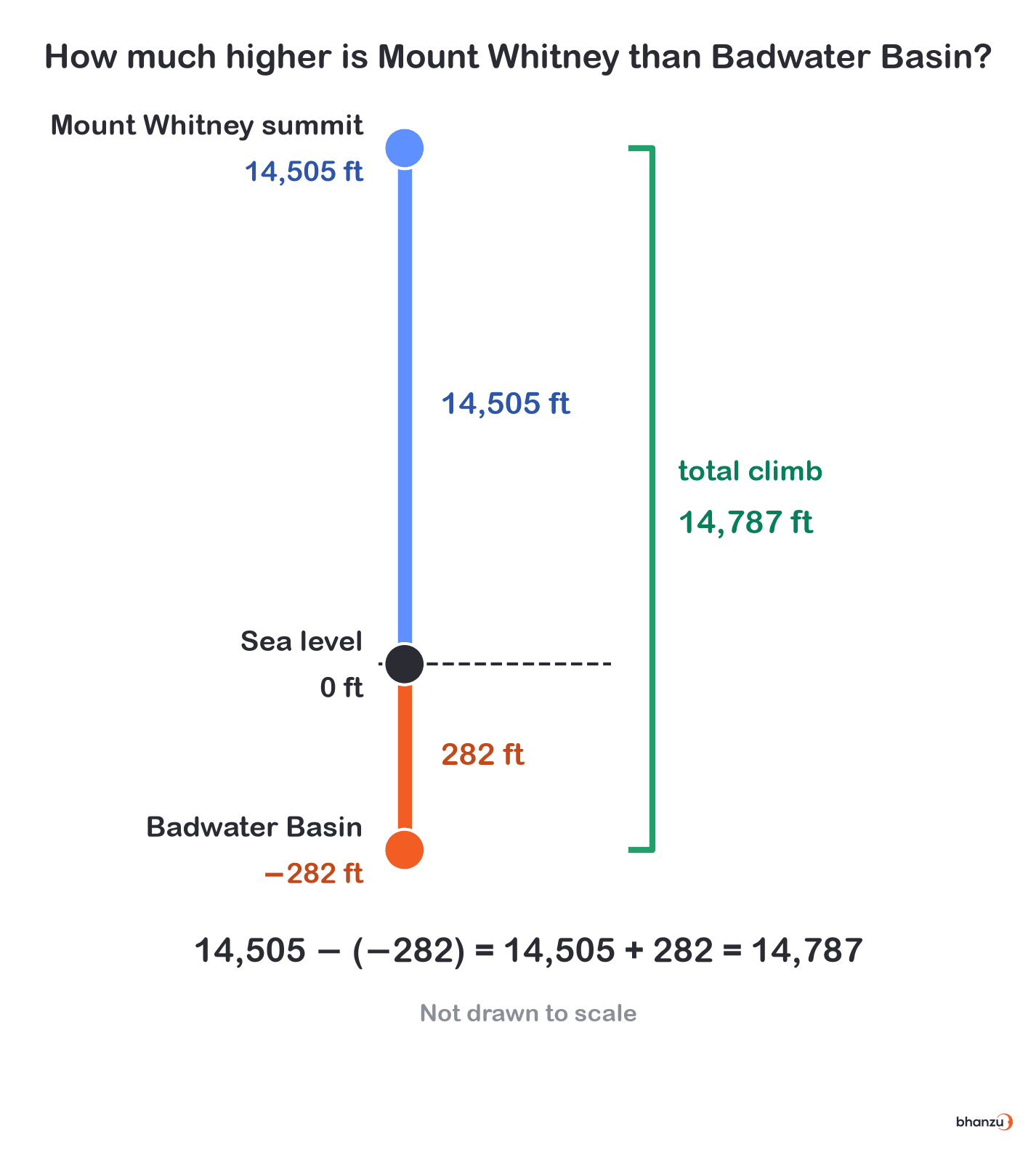
Badwater Basin is 282 feet below sea level, and Mount Whitney's summit is 14,505 feet above sea level. How much higher is the summit?
The National Park Service gives both heights, and its Badwater Basin page, updated in 2026, calls it the lowest point in North America. Its Mount Whitney page, updated in 2025, lists the summit at 14,505 feet.
The tempting move is to subtract the two sizes you see.
That answer cannot be right. Climbing from Badwater, you rise 282 feet just to reach sea level and then 14,505 feet more, so the gap has to be bigger than 14,505 feet. Subtract the lower elevation, sign included, from the higher one.
The summit is 14,787 feet higher than Badwater Basin.
Example 3
A submarine moves from 45.5 meters below the surface to 18.25 meters below the surface. What was the change in its position?
Let stand for the change in meters, with up counted as positive. The start is and the end is .
Add 45.5 to both sides.
The change is meters, so the submarine rose 27.25 meters.
Example 4
At 6 a.m., Town A is at and then falls 6.5 degrees. Town B is at and then rises 3 degrees. Which town is colder now, and by how much?
Town A ends at and Town B ends at . Since , Town B is colder.
Town B is colder by 1.5 degrees.
Example 5
A pond is inches below its normal level. Rain raises it inches, and then sunny days lower it inches. Where is the water now compared with normal?
Write each amount with its sign, then rename every fraction in eighths.
The water is inch above its normal level.
Example 6
Sam's school lunch account is at $-$4.60$. His mom deposits $25.00, and then he buys lunches costing $3.85, $4.10 and $2.95. What is the balance now?
Add the deposit first.
$$-$4.60 + $25.00 = $20.40$$
Then subtract each lunch.
$$$20.40 - $3.85 = $16.55$$
$$$16.55 - $4.10 = $12.45$$
$$$12.45 - $2.95 = $9.50$$
The balance is $9.50.
The real reason negative number word problems exist
Negative numbers let one number line hold amounts that run in two directions, such as above and below sea level, or earned and owed.
- It keeps direction inside the number. A depth of meters says how far and which way at once.
- It lets one rule replace several. Without signs, rising, falling and zero-crossing stories would each need a separate method.
- It makes a balance honest. A lunch account at $-$4.60$ tells a family exactly how much is owed.
- It puts extremes on one scale. Badwater Basin at feet and Challenger Deep at feet sit on the same line as Mount Whitney, so one subtraction compares any two of them.
The sign carries half of every story, and a word problem is practice in reading that half correctly.
What most guides miss about word problems with negative numbers
Two things usually go missing. First, every add-or-subtract story is start plus change equals end, with the missing number in one of three places.
| Missing amount | Story | Number sentence |
|---|---|---|
| End | A diver at meters swims up 5 meters (Example 1) | |
| Change | A submarine moves from to meters (Example 3) | |
| Start | A diver rises 7 meters and ends at meters |
Once you name the empty slot, the operation follows, and the same three-slot frame becomes a one-step equation with negatives later in 7th grade.
The second is reading the sign back into words. An answer of in a money story means owing $25, and in a depth story means 7 meters below the surface. A child who second-guesses a right answer often does it here, crossing out because a negative answer feels wrong, even though the story ended below zero. Stories that multiply or divide signed values, such as a temperature falling 4 degrees every hour, continue in rational number word problems.
Negative number word problems: common confusions cleared up
Mistake 1: Adding when the temperature falls below zero
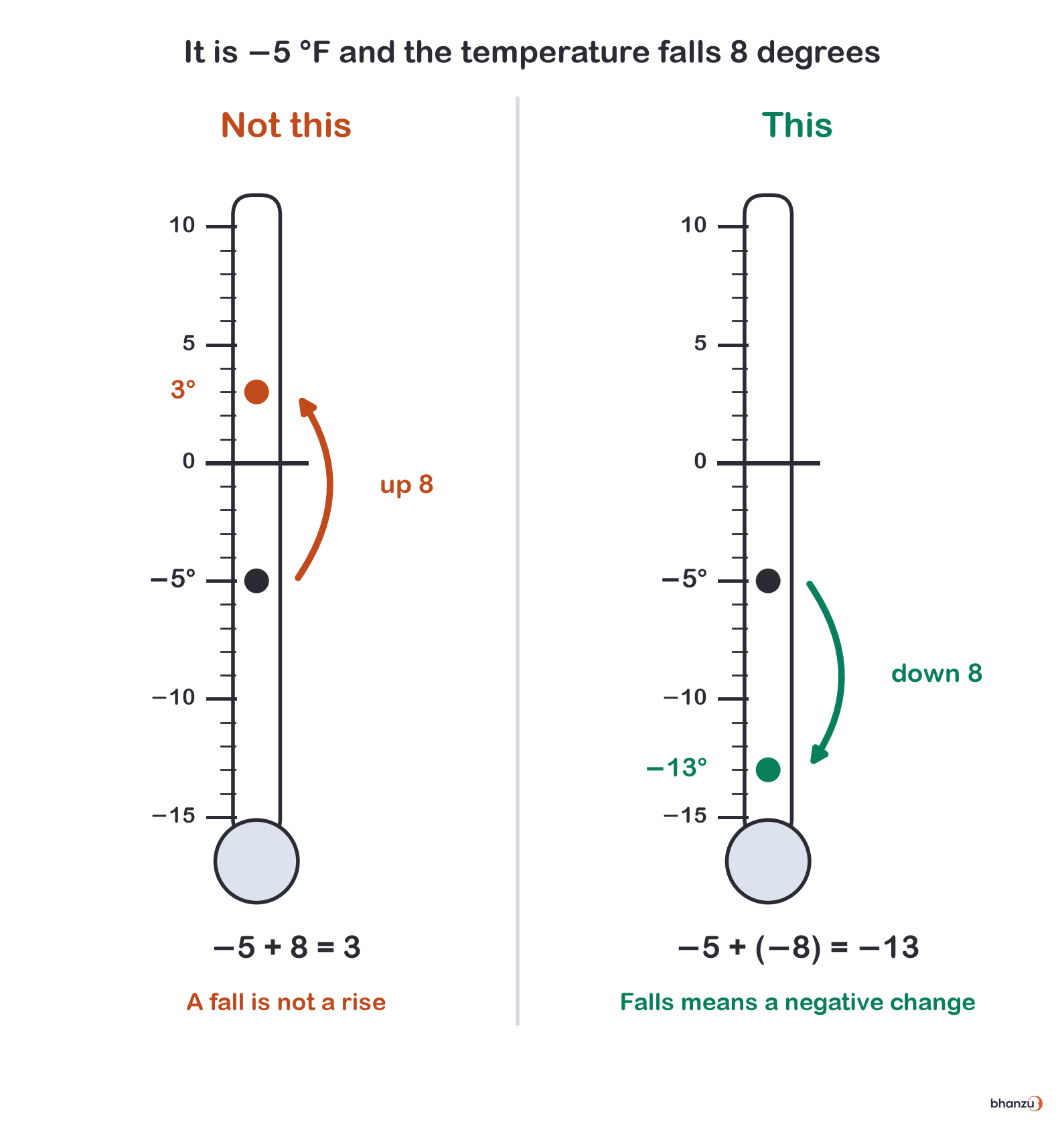
Where it slips in: Temperature or depth stories where a negative value drops further, like the "falls 8 degrees" row in the cue-word table.
Don't do this: It is and the temperature falls 8 degrees, so , or .
The correct way: A fall is a negative change, so , and the temperature is .
Children make this move because "8 degrees" is printed without a minus sign, and hopping up toward 0 is the direction they have practiced most. Saying "falls means minus" out loud before writing anything breaks the habit.
Mistake 2: Dropping the sign of a debt
Where it slips in: Money stories that start with owing, because the size of a debt is easy to read and its direction is easy to forget.
Don't do this: Ana owes her brother $15 and borrows $10 more, so and "she has $25".
The correct way: Owing is negative, so , and Ana owes her brother $25.
Mistake 3: Finding a change as start minus end
Where it slips in: "How much did the temperature change?" questions, where the larger number tends to get written first out of habit.
Don't do this: You step from indoors to outdoors, so , "a rise of 72 degrees".
The correct way: A change is end minus start, so , a drop of 72 degrees. The two places are 72 degrees apart, but the change is negative.
Key Takeaways
- Write every amount with its sign before any arithmetic, since words like "below" and "owes" are where the direction hides.
- In negative number word problems, a fall, a loss or a debt is a negative change even when no minus sign is printed.
- To subtract a negative, add its opposite, which is why a canceled penalty raises a score.
- Decide whether the question wants a distance or a change, because only a change can be negative.
- For practice with stories that drop below zero, guided by a teacher who catches the falls-means-plus mistake, explore Bhanzu's 7th grade math tutor or middle school math tutor pages.
Read More
- Properties of Operations With Negative Numbers
- Evaluating Expressions With Negative Numbers
- One-Step Equations With Negative Numbers
- Whole Numbers and Integers
- Negative Numbers
Research Behind This Article
- NOAA National Ocean Service, How Deep Is the Ocean? (2026). oceanservice.noaa.gov
- NGA Center and CCSSO, Common Core State Standards for Mathematics: Grade 7, The Number System (2010). thecorestandards.org
- OpenStax, Prealgebra 2e, Section 3.2: Add Integers (2020). openstax.org
- OpenStax, Prealgebra 2e, Section 3.3: Subtract Integers (2020). openstax.org
- National Park Service, Badwater Basin (2026). nps.gov
- National Park Service, Mt. Whitney (2025). nps.gov
Quick Quiz: Check Yourself
Three levels, new stories every time: find where a temperature, depth or score ends up, find a gap or change between two readings, then follow a lunch account through a deposit and purchases.
Was this article helpful?
Your feedback helps us write better content
Frequently Asked Questions
Do negative number word problems ever use multiplication?
What is a word problem for negative 6 minus negative 4?
What happens when you subtract a negative from a negative?
What grade learns adding and subtracting integers word problems?
What are real-life negative number questions I can ask my child?
How can I help my child with word problems with negative numbers at home?