Key Points
- Time conversion word problems mix hours, minutes, seconds and days in one story, so every time goes into one unit before any adding.
- A chain of conversions multiplies one link at a time, so 2 weeks becomes 14 days, then 336 hours, then 20,160 minutes.
- Decimal hours are parts of 60 minutes, so 0.1 hour is 6 minutes and a Mars rotation of 24.6 hours is 24 hours 36 minutes.
- In 5th grade, Common Core asks children to use unit conversions inside multi-step, real-world problems, such as a total of overnight sleep.
The 0.7 hours that hide 42 minutes
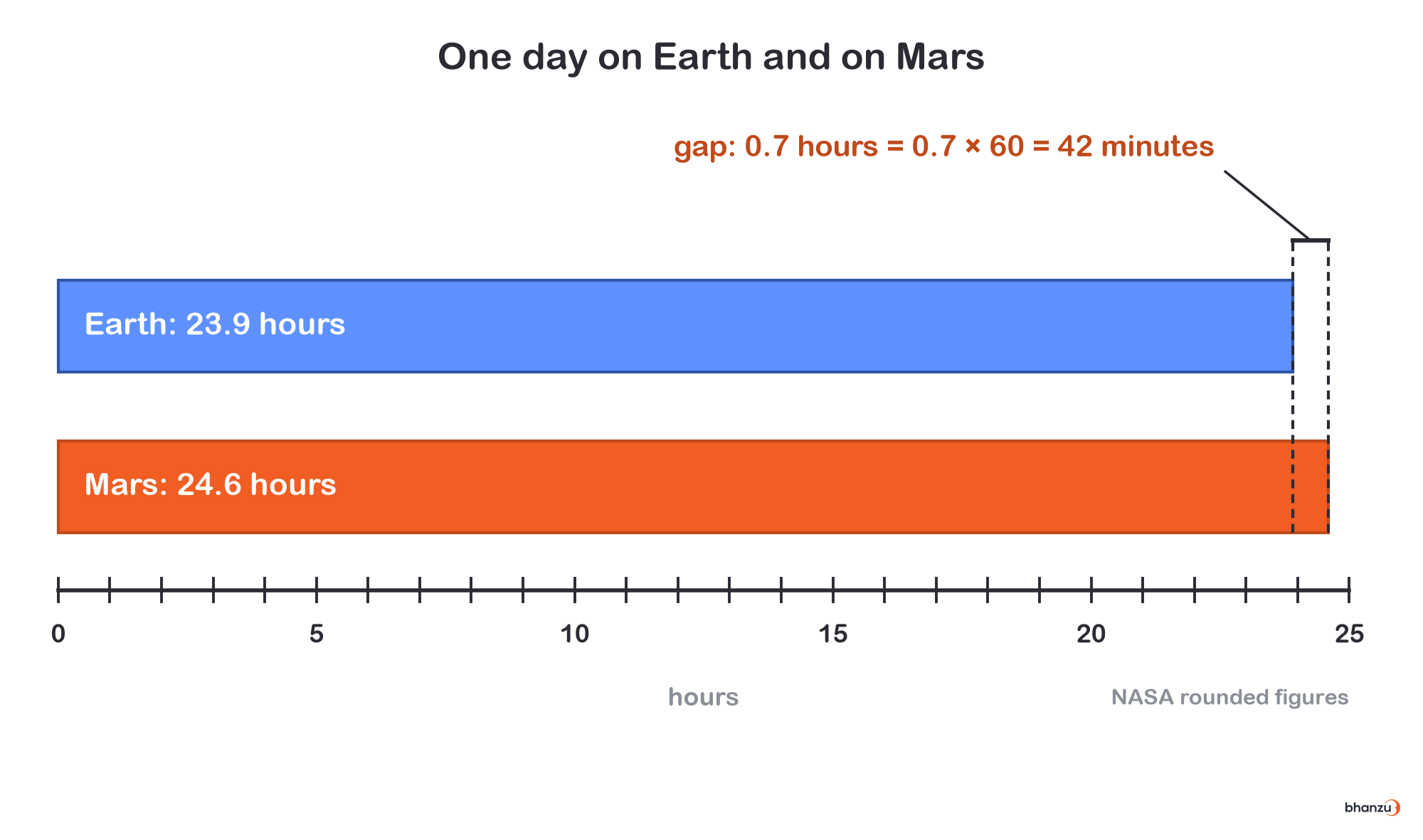
A day on Mars runs a little longer than a day on Earth. NASA's Mars facts put one rotation of Mars at 24.6 hours. One Earth day is 23.9 hours (one spin, a few minutes short of 24 hours).
With NASA's rounded figures, the gap looks like 0.7, which sounds tiny. It is 0.7 of an hour, though, and 0.7 of 60 minutes is 42 minutes. Hours with a decimal point hide minutes until you convert them.
In 6th grade, ratio tables will help you convert units and rates such as minutes per mile, using these same moves.
How do you solve time conversion word problems?
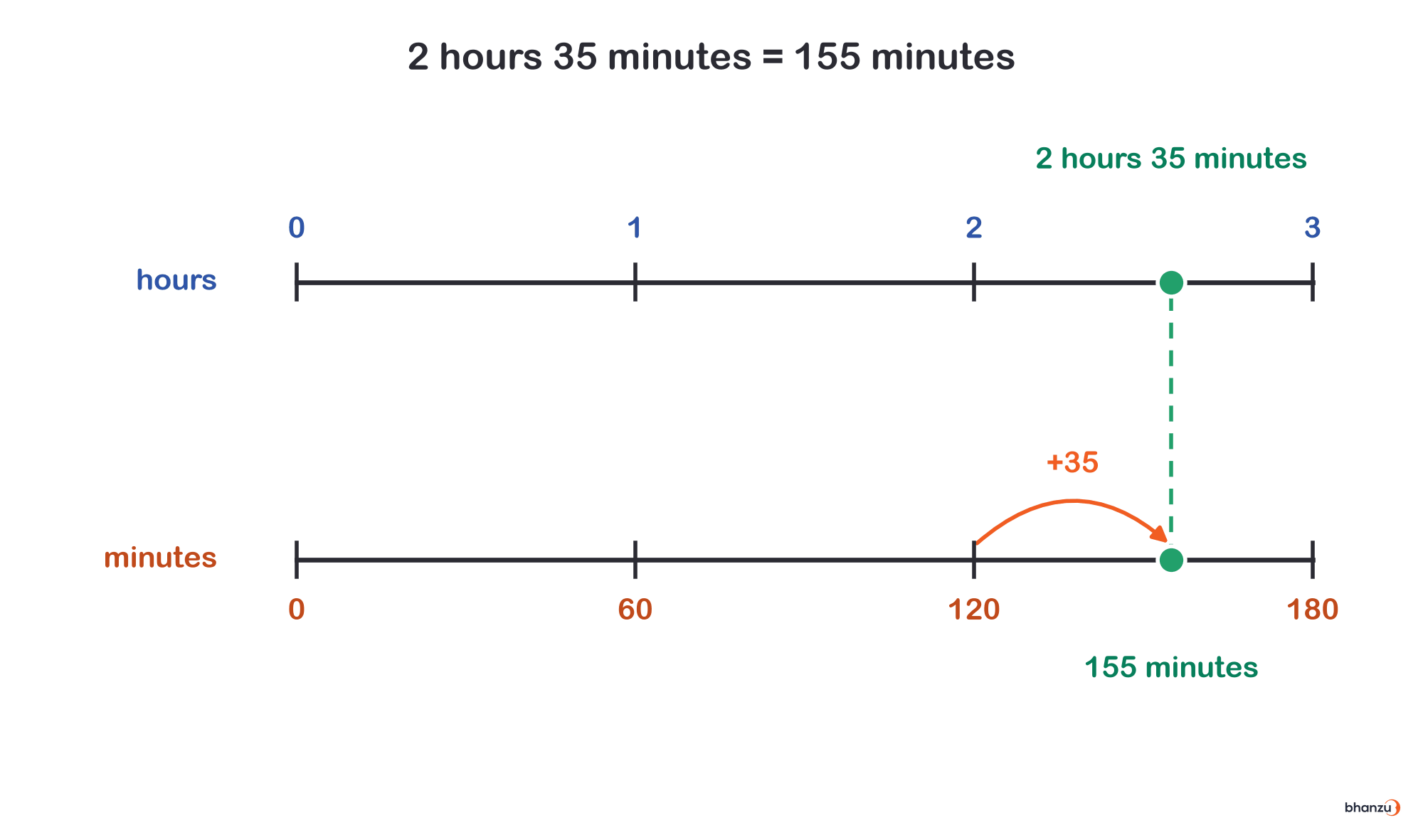
To solve time conversion word problems, write every time in the story in one unit first, so 2 hours 35 minutes becomes 155 minutes before you add or compare. A unit is the size you count time in, such as an hour.
A double number line shows where the 155 comes from. Hours run along the top and minutes run underneath, so 2 hours sits right above 120 minutes, and 35 more minutes carries you to 155.
Going from a bigger unit to a smaller one, multiply, because each big unit holds many small ones. Going back up, divide, which undoes the multiplying.
| Conversion fact | Multiply or divide by |
|---|---|
| 60 | |
| 60 | |
| 24 | |
| 7 |
Every story here follows four steps.
- Circle every time and its unit.
- Pick one shared unit, usually the smallest.
- Convert, then add, subtract, multiply or divide.
- Change the answer into the unit the question asks for, and check that its size makes sense.
Once the units match, the words name the operation.
| Words in the problem | Math it means |
|---|---|
| "40 minutes a day for 5 days" | Multiply, |
| "Who practiced longer, and by how much?" | Subtract |
| "Write the time in hours" | Divide the minutes by 60 |
| "every second for a whole day" | Multiply, |
Your child meets these stories in 5th grade because Common Core standard 5.MD.A.1 asks students to convert among different-sized units and use those conversions in multi-step, real-world problems. The 4th grade lesson on converting units of time covers the single swaps first.
How do you convert across several units at once?
Multiply one link at a time, walking down the chain from weeks to days to hours to minutes.
The middle link comes from the 24 times table, and the last one is a multi-digit multiplication with a zero on the end. One more link of 60 reaches 1,209,600 seconds. Going up the chain, divide in the reverse order.
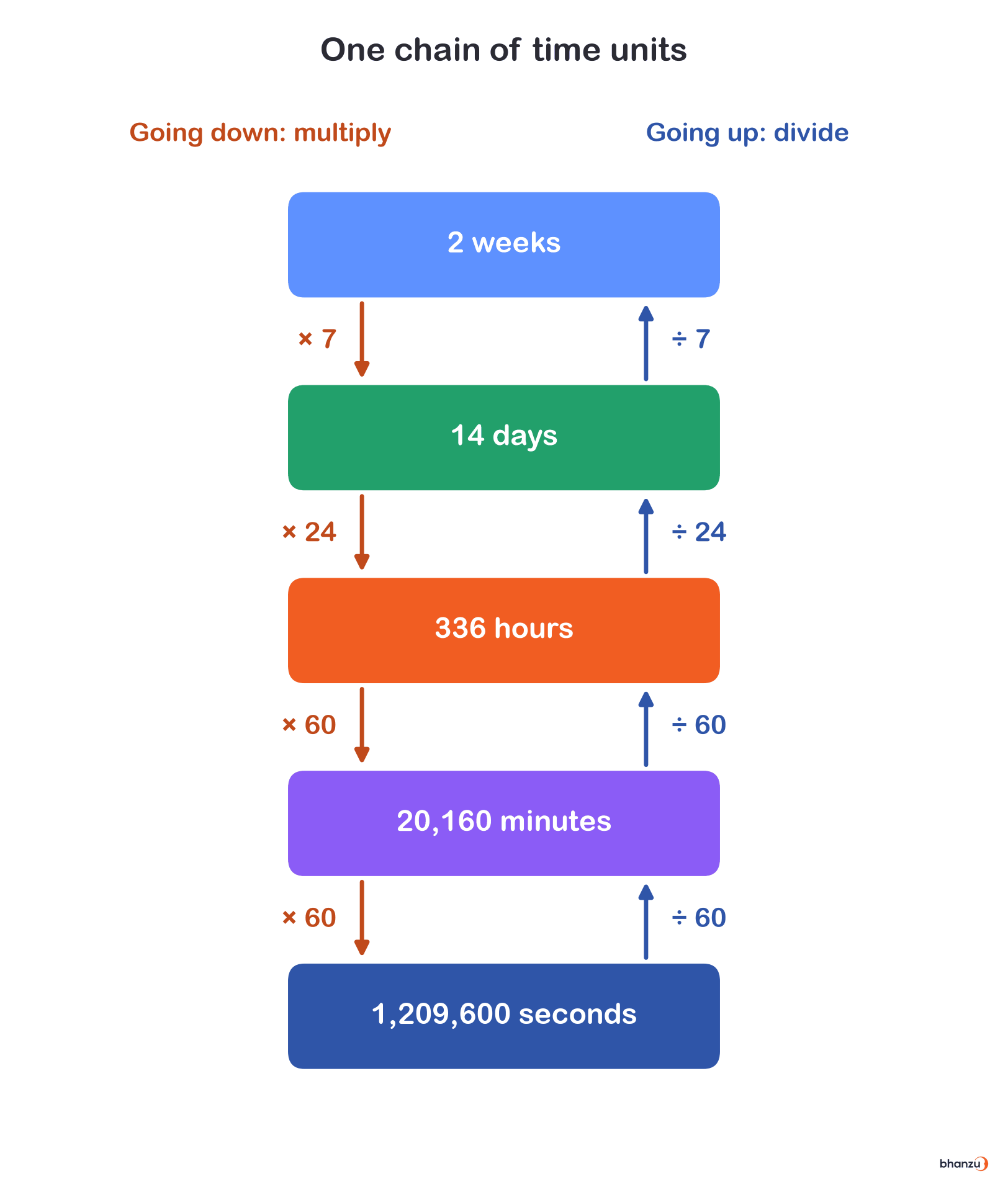
OpenStax's Prealgebra 2e calls each link a unit conversion factor, a fraction whose top and bottom name the same amount of time, so it equals 1.
Multiplying by 1 changes the unit and never the amount. Link by link gets slow for a jump such as weeks to seconds. There, multiply the factors once and reuse the result, since 604,800 seconds make one week.
In middle school science, the same chain turns kilometers per hour into meters per second.
How do you convert minutes to hours and minutes?
Divide by 60, then read the quotient as whole hours and the remainder (the amount left over) as extra minutes.
So 255 minutes is 4 hours 15 minutes. Those 15 minutes are one quarter of an hour, the same idea as fractions as division, so 255 minutes is also hours, or 4.25 hours.
Going the other way, multiply the decimal part by 60, which is multiplying decimals by whole numbers.
| Part of an hour (fraction) | Decimal | Minutes |
|---|---|---|
| 0.1 | 6 | |
| 0.2 | 12 | |
| 0.25 | 15 | |
| 0.5 | 30 | |
| 0.75 | 45 |
Reports give time as decimals, which are easy to average. In the 2025 American Time Use Survey, the US Bureau of Labor Statistics found that people age 15 and over averaged 5.2 hours of leisure a day. That figure comes from about 6,100 interviews, and 0.2 of 60 is 12, so it means 5 hours 12 minutes.
Children who check on a calculator often read the digits after the point as minutes, because money trains them to read 2.25 as "2 and 25." This trips up adults too. The times 4.25 hours and 4 hours 25 minutes look alike, yet they sit 10 minutes apart.
How do you find elapsed time across midnight?
Elapsed time is how much time passes from a start time to an end time. When the times sit on opposite sides of midnight (a.m. runs from midnight to noon, p.m. from noon to midnight), split the stretch at 12:00 midnight.
- Count from the start time to midnight.
- Count from midnight to the end time.
- Add the two parts, then convert.
From 10:40 p.m. to 7:05 a.m., the parts are 1 hour 20 minutes and 7 hours 5 minutes, which make 8 hours 25 minutes.
The CDC's 2024 sleep guidance gives 9 to 12 hours a day for children aged 6 to 12, so that night falls 35 minutes short. Crossing noon works the same way, as in the 4th grade lesson on elapsed time word problems.
Try It Yourself
Drag the bedtime and wake-up markers along the night timeline and watch the sleep time appear in hours and minutes, in total minutes and as a decimal number of hours. Change the number of nights to see the total for a whole school week. Press New challenge and set the markers (and the nights, if asked) until the sleep time matches.
Examples of time conversion word problems
Example 1
A science video lasts 15 minutes. How many seconds long is it?
Each minute is 60 seconds, so multiply by 60.
The video is 900 seconds long.
Example 2
Leo's bike ride takes 150 minutes. Write the time in hours as a mixed number and as a decimal.
Divide by 60.
The ride takes hours, which is 2.5 hours.
Example 3
NASA rounds one rotation of Mars to 24.6 hours. How many hours and minutes is that?
The tempting move is to read the 6 as minutes and write 24 hours 6 minutes.
That answer cannot be right. The decimal 0.6 is more than 0.5, and 0.5 hour is 30 minutes, so the leftover has to be more than 30 minutes. Six minutes is only 0.1 hour.
Multiply the decimal part by 60 instead.
One rotation of Mars is 24 hours 36 minutes.
Example 4
A weather camera takes one photo every second for a whole day. How many photos does it take?
That is 86,400 photos.
Example 5
Ava practiced the piano for hours this week. Priya practiced for 40 minutes a day for 5 days. Who practiced longer, and by how much?
Change Ava's time to minutes.
That makes 225 minutes for Ava. Priya's 40 minutes for 5 days takes a single multiplication.
Ava practiced longer, by 25 minutes.
Example 6
Maya sleeps from 8:45 p.m. to 6:15 a.m. How long is that each night, and over 5 school nights?
Split at midnight. The parts are 3 hours 15 minutes and 6 hours 15 minutes, so one night is 9 hours 30 minutes.
Maya sleeps 9 hours 30 minutes a night and 47 hours 30 minutes over 5 school nights.
The real reason time conversion exists
No single unit fits every job. Seconds are too small for a school year and days too big for a race, so stories mix units and conversion lets them meet.
- It makes different units comparable. Ava's hours and Priya's minutes a day became a fair contest once both were minutes.
- It turns a nightly habit into a weekly total. One night's sleep says little about a week until the minutes are added.
- It lets scientists set planets side by side. NASA gives both days in hours, so 24.6 and 23.9 can be compared directly.
- It keeps clocks in step with the spinning Earth. NIST lists 27 leap seconds added between June 30, 1972 and the end of 2016, and each one made the clock read 23:59:60, so that one minute had 61 seconds.
Every conversion names the same stretch of time with a different label. The amount stays put.
What do most guides get wrong about time conversion word problems?
Guides often list a dozen unit pairs as separate rules, when one idea covers every pair: a unit conversion factor equals 1.
Because 60 minutes over 1 hour equals 1, a chain from weeks to minutes is multiplying by 1 three times. That is why 2 weeks and 20,160 minutes are the same amount of time.
In decimal hours, every tenth of an hour is exactly 6 minutes, because 60 split into 10 equal parts makes parts of 6. So 0.9 hour is 54 minutes, never 9 or 90. Knowing that one fact catches the calculator trap before it starts.
The mistakes kids make most often with time conversion
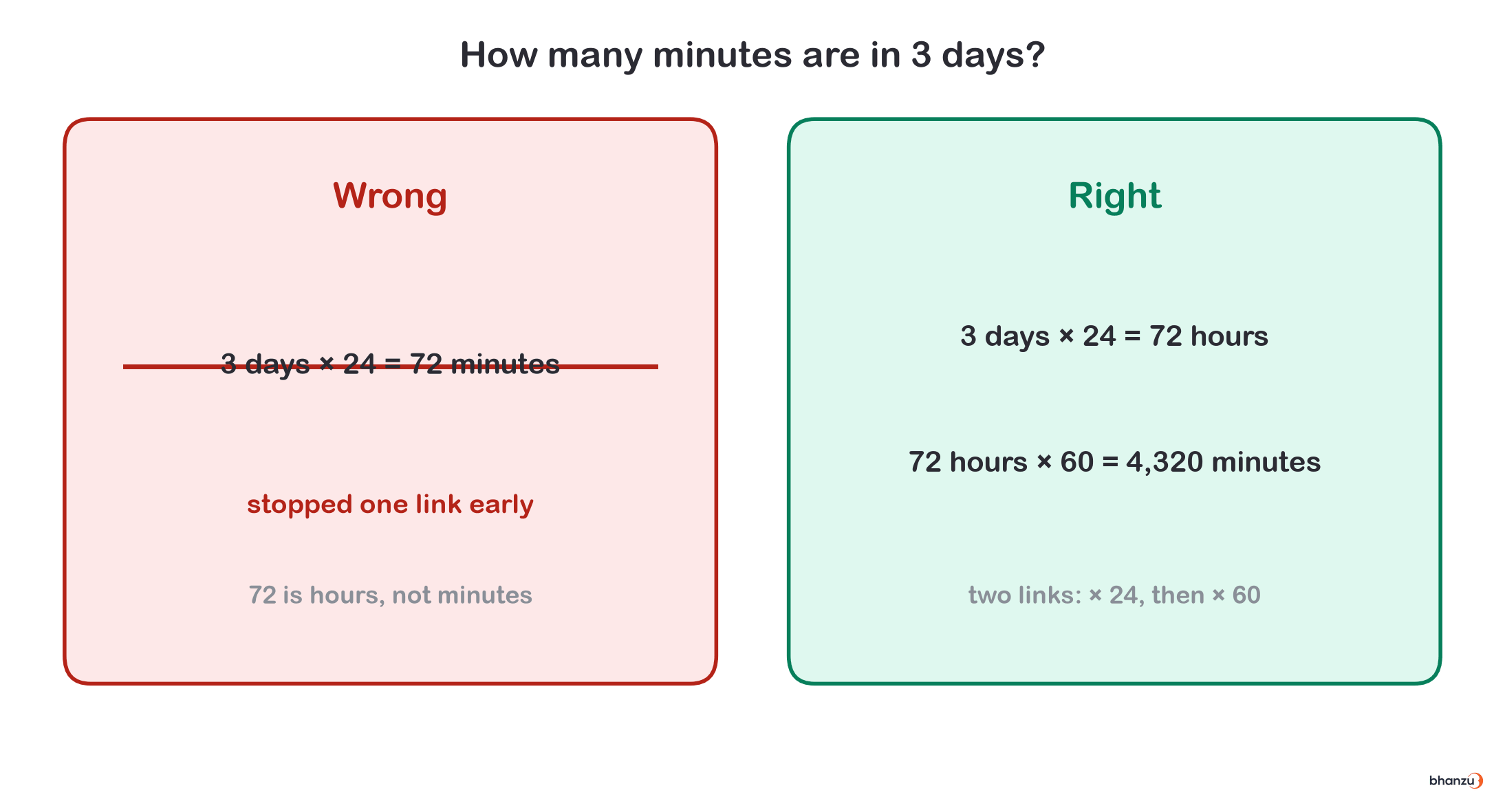
Mistake 1: Stopping a chain one link early
Where it slips in: Chains such as days to minutes. A child who stops after the first multiplication usually does it because that first answer already looks finished.
Don't do this: , so 3 days is 72 minutes.
The correct way: The 72 is hours, so one more link gives minutes. A size check catches it, since 72 minutes is just over an hour and far too short for 3 whole days.
Mistake 2: Combining numbers before the units match
Where it slips in: Stories that give a daily amount and a number of weeks.
Don't do this: Noah reads 20 minutes a day for 3 weeks, so minutes.
The correct way: First change 3 weeks to 21 days. Then minutes, which is 7 hours.
Children who know their conversion facts still write 20 times 3 here, because the two numbers sit side by side and "weeks" is easy to skim. Circling every unit first (step 1 of the plan) stops it.
Mistake 3: Answering in the wrong unit
Where it slips in: The last step, when the question asks for hours but the working ends in minutes. A child who hurries copies the unit word from the question.
Don't do this: A podcast season has 9 episodes of 40 minutes, so , written as 360 hours.
The correct way: The 360 is minutes, so hours. A 360-hour season would mean 15 full days of listening.
Key Takeaways
- Before you touch a number, circle every unit, because two times can only be added once they share a unit.
- Walk a chain one link at a time, since weeks to minutes takes three multiplications.
- Treat a decimal hour as part of 60 minutes and multiply that part by 60.
- Finish time conversion word problems in the unit the question names, then ask whether the size makes sense.
- For more practice with multi-step time stories, guided by a teacher who spots the decimal-hour trap, explore Bhanzu's 5th grade math tutor or math classes for kids.
Read More
- Ratio Tables
- Multiplying and Dividing by Powers of 10
- Dividing Whole Numbers to Get a Decimal
- Elapsed Time
- A.M. and P.M.
- Estimating and Choosing Units of Measurement
Research Behind This Article
- NASA Science, Mars Facts (2026). science.nasa.gov
- Common Core State Standards Initiative, Grade 5 Measurement and Data (2010). thecorestandards.org
- OpenStax, Prealgebra 2e, 7.5 Systems of Measurement (2020). openstax.org
- US Bureau of Labor Statistics, American Time Use Survey, 2025 Results (2026). bls.gov
- Centers for Disease Control and Prevention, About Sleep (2024). cdc.gov
- National Institute of Standards and Technology, Leap Second and UT1-UTC Information (2026). nist.gov
Quick Quiz: Check Yourself
Three levels, new numbers every time: convert to smaller units, switch between minutes and decimal hours, then solve sleep and practice stories across midnight or several days.
Was this article helpful?
Your feedback helps us write better content
Frequently Asked Questions
Is converting units of time taught in 5th grade?
How can I help my child with time word problems at home?
How many minutes is 2.5 hours?
How do you convert seconds into days, hours, minutes and seconds?
How many minutes are in a week?