Key Points
- Area with fractional side lengths is still length times width, so a rectangle inch by inch covers square inch.
- Tiling explains why multiplying works, since the top numbers multiply to count the tiles and the bottom numbers multiply to count how many fill one square unit.
- A half-inch square covers only square inch, because four of those squares fit inside one square inch.
- Common Core places area with fractional side lengths in 5th grade, after whole-number tiling in 3rd grade and before fraction-sized cubes in 6th grade.
A postcard covered in tiny tiles
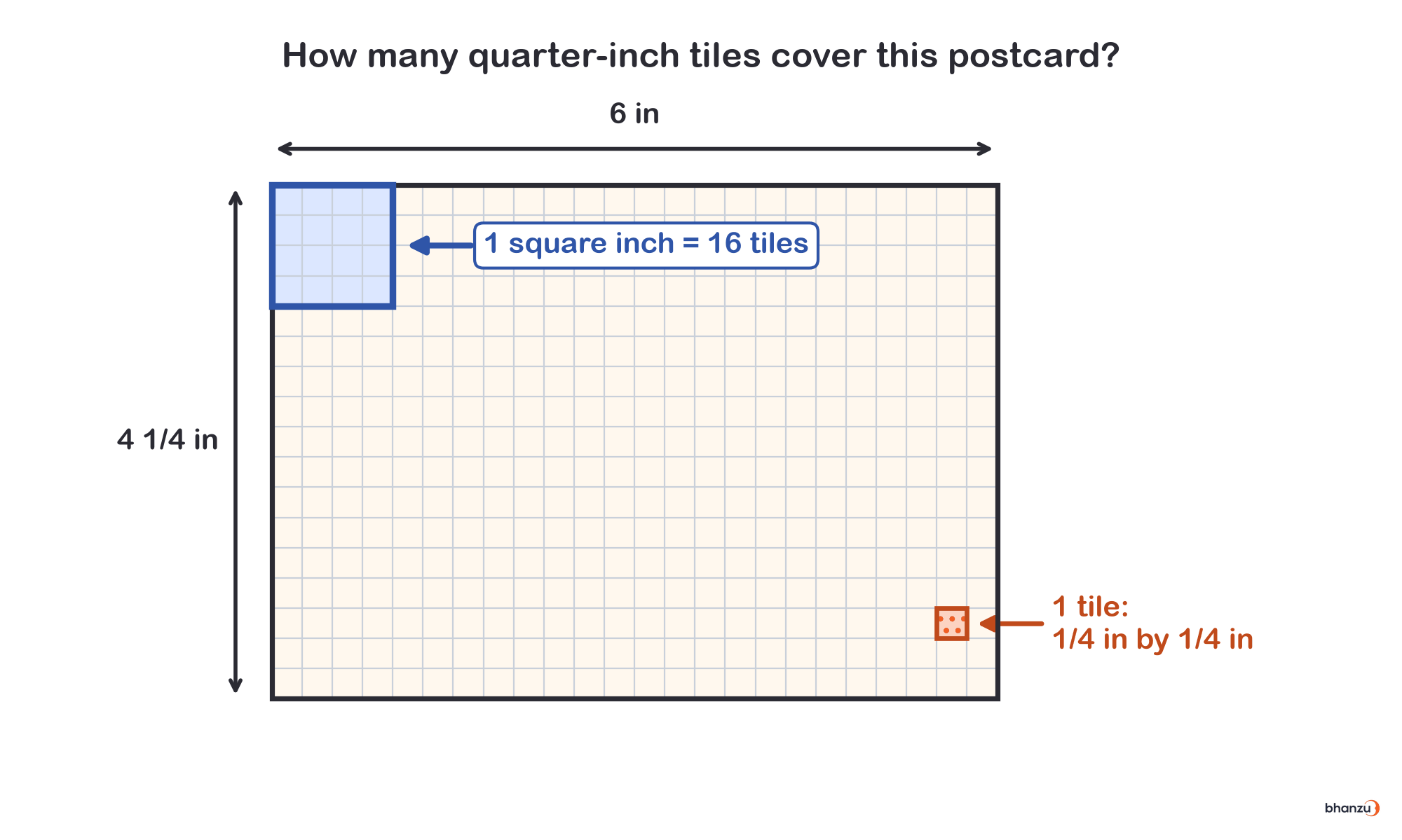
A quarter-inch tile covers just one sixteenth of a square inch. Four fit across an inch and four fit down, so 16 tiles fill one square inch.
Under the US Postal Service's mailing rules, the largest standard postcard is 4 1/4 inches tall and 6 inches long. Covering that card with quarter-inch tiles turns an area question into a counting question: how many tiles would it take?
Next year, you'll fill boxes with tiny cubes the same way to find their volume.
What is area with fractional side lengths?
Area with fractional side lengths is how many square units a rectangle covers when a side is a fraction of a unit, like a sticker inch by inch. Area is a 2D measure, the count of same-size squares that cover a flat shape with no gaps or overlaps, and squares make the unit because they fit edge to edge. You cover the sticker with tiles whose sides are unit fractions, fractions with 1 on top. Then you compare that count with how many tiles fill a unit square, a square 1 unit on each side.
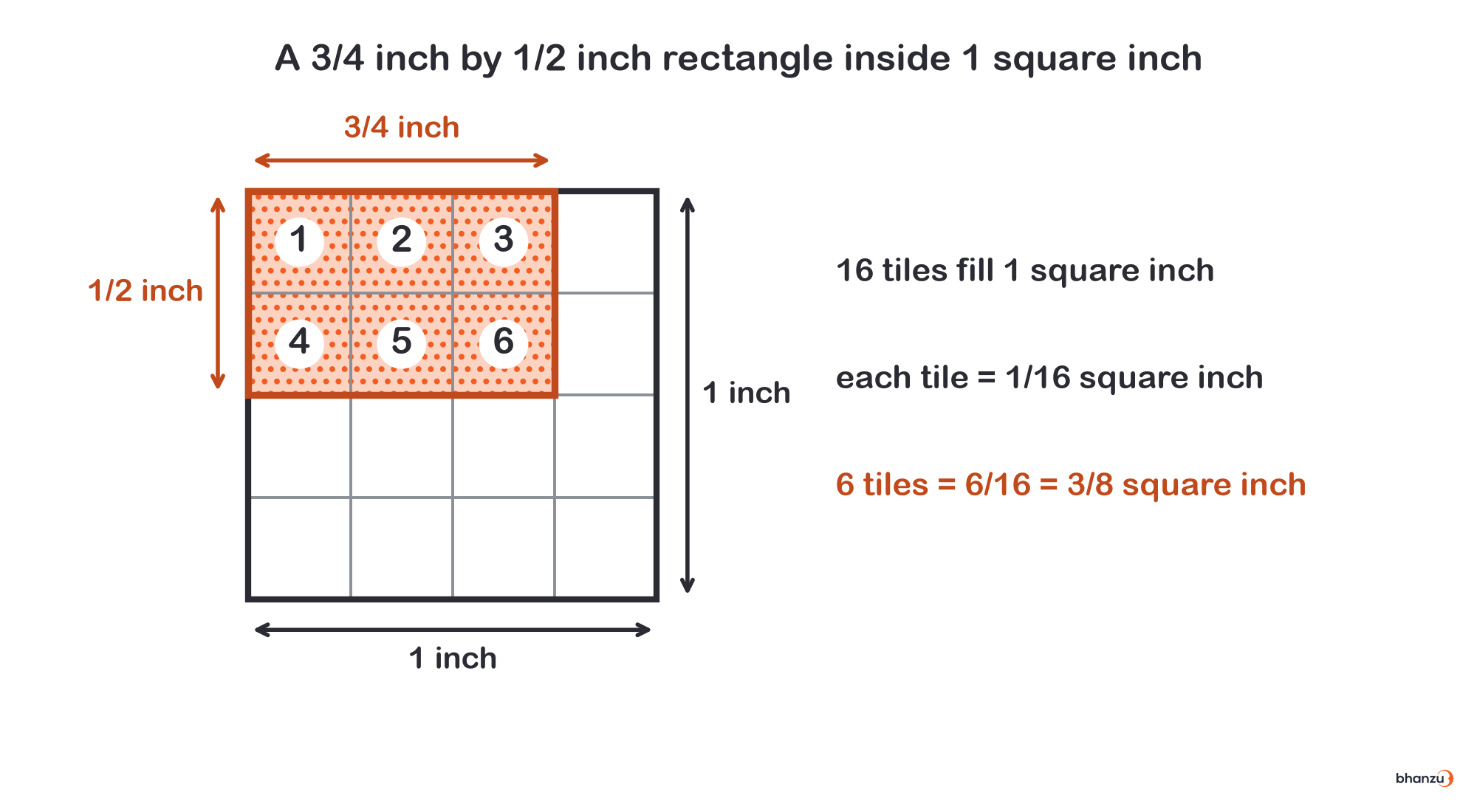
Common Core standard 5.NF.B.4.b asks 5th graders to tile with "unit squares of the appropriate unit fraction side lengths" and match the count to the product of the sides. Your child tiled whole-number rectangles in 3rd grade, so this year stretches that same counting to tiles smaller than one square unit.
On one released question from the 2024 Nation's Report Card, only 27% of 4th graders earned full credit. The task was to find a bulletin board's area from its whole-number sides, then use it. Tiling first and multiplying second gives your child two routes to the same area, so a slip in one route shows up as a mismatch with the other.
How do you find the area of a rectangle with fractions?
Pick a unit fraction tile that fits both sides, count the tiles, then multiply the count by one tile's area. On graph paper ruled 4 squares to the inch, each square is a -inch tile.
- Count along the sticker's sides: 3 tiles across the inch and 2 tiles down the inch.
- Multiply rows by columns, tiles.
- Size one tile. Since tiles fill a square inch, each tile is square inch.
- Write square inch, then use equivalent fractions to simplify it to square inch.
The tiled sticker is an area model. Multiplying its sides gives the same answer, and that shortcut is the area formula.
| Symbol | Meaning | Units |
|---|---|---|
| area | square units | |
| length | inches, feet, yards or meters | |
| width | the same unit as the length |
The formula works because tiles sit in rows and columns, so counting them is a multiplication. A child who counts tiles one at a time often loses track on a big rectangle, and rows times columns fixes that. Tiling gets slow when the bottom numbers grow (sevenths by ninths means 63 tiles in one square unit), so then multiply and keep the tiles for checking.
How do you choose the right tile size?
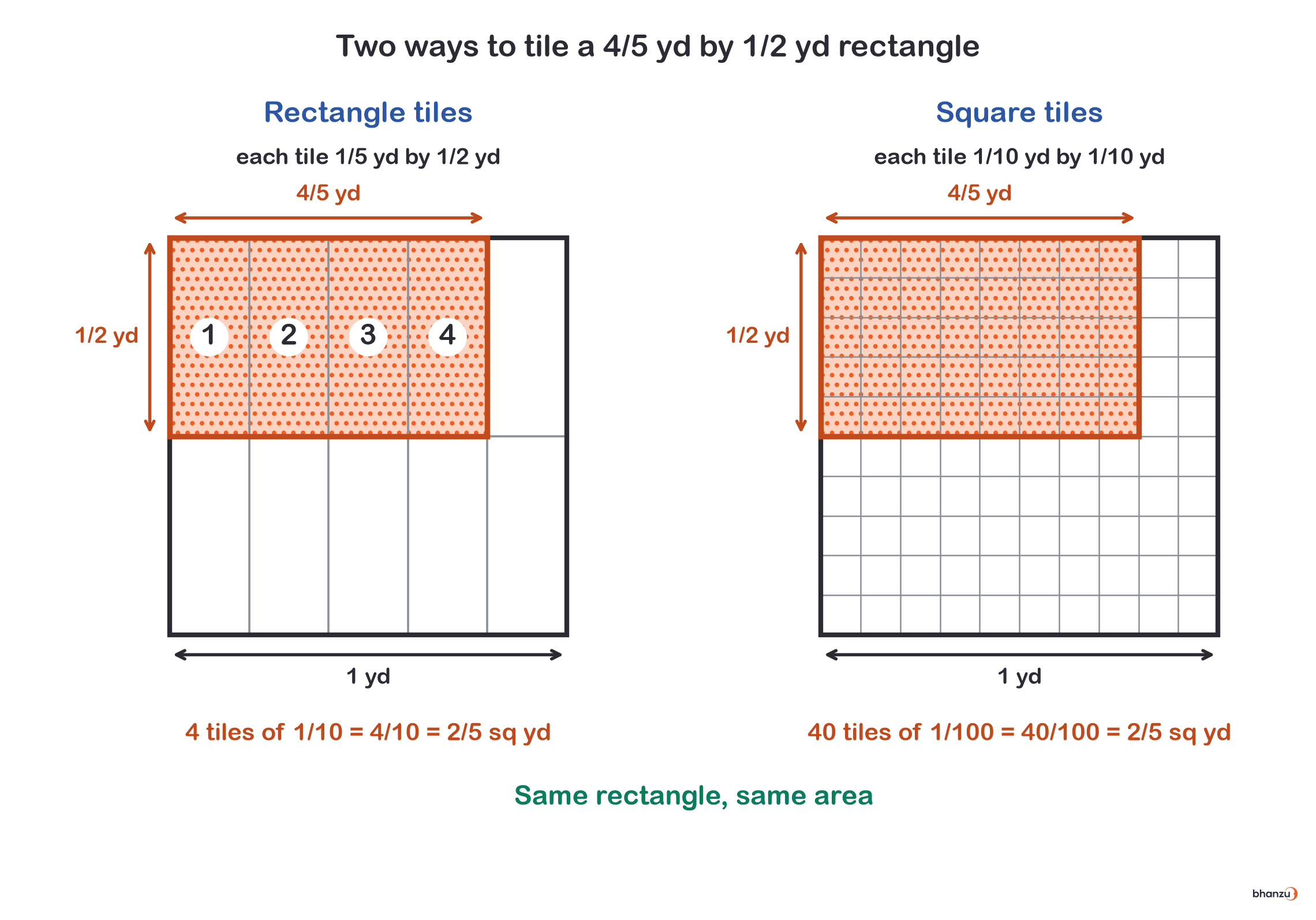
Choose a tile whose sides are unit fractions that fit a whole number of times along the rectangle's sides. Matching bottom numbers, like fifths and fifths, give square tiles at once. A rectangle yard by yard has two good choices.
- Rectangle tiles, yard by yard. Ten fill a square yard, and the rectangle holds 4 of them.
- Square tiles, yard on a side, the biggest squares that fit both fifths and halves. A hundred fill a square yard, and the rectangle holds of them.
Both tilings measure what part of one square yard the rectangle covers, so they have to agree.
Common Core's wording is genuinely confusing at first, because it says "unit squares" while many lesson pictures split the square into thin rectangles. Children cutting paper tiles often line them up along one side and only notice at the far edge that the last tile hangs over.
What if a side is longer than 1 unit?
Split a mixed-number side (a whole number plus a fraction) into its whole part and its fraction part, find both areas, then add. A bench cushion feet by foot splits into a 2-foot piece and a -foot piece.
The cushion covers square feet. Writing the side as an improper fraction (top bigger than bottom) gives the same area.
Splitting a side is the same move you used in 3rd grade for area and the distributive property. When both sides are mixed numbers, the rectangle breaks into four pieces, which is the job of multiplying mixed numbers.
Try It Yourself
Press the plus and minus buttons, or drag the orange rectangle's corner, to set its sides as fractions of one unit square. The readout counts the tiles inside it and the tiles in the whole square. Type the area, press Check, then switch on square tiles for an equivalent fraction.
Why does multiplying the side lengths work?
Area is a count of equal tiles, and multiplying the sides counts the tiles and names their size in one move. Take the sticker again, this time with tiles inch by inch.
- The top numbers count the tiles. Three fit across and one fits down, so tiles sit inside.
- The bottom numbers name the tile. Each denominator says how many tiles fit along one inch, so tiles fill a square inch.
- Together they make the fraction rule. Three tiles of make , exactly what the rule for multiplying fractions gives.
Because tiling and multiplying count the same pieces, the formula works for any fraction sides without laying a single tile.
Examples of area with fractional side lengths
Example 1
Find the area of a rectangle meter by meter.
The rectangle holds 3 of the 14 tiles in a square meter. Its area is square meter.
Example 2
A sticky label is inch by inch. What is its area in simplest form?
Divide the top and bottom by 2.
The label covers square inch.
Example 3
Noah tiles a rectangle foot by foot with squares foot on a side. Does that work?
Five squares fit along foot, but only one and a half fit along foot. Noah rounds up to 2 rows, counts 10 of the 36 squares in a square foot, and writes square foot.
That can't be right. The rectangle fits inside a strip 1 foot by foot, and Noah's area is bigger than the whole strip.
Squares foot on a side fit both sides, 10 along and 3 down, and a square foot holds 144 of them.
The area is square foot, which matches .
Example 4
Squares foot on a side cover a rectangle, 5 across and 4 down. What are its sides and its area?
The sides are foot and foot. The rectangle holds 20 of the 36 squares in a square foot.
The area is square foot.
Example 5
Priya covers the largest standard postcard, inches by 6 inches, with square tiles inch on a side. How many tiles does she need, and what area do they cover?
Along the short side, 17 tiles fit, 16 for the 4 inches and 1 for the last quarter inch. Along the 6-inch side, 24 fit.
Each tile is square inch.
Splitting the short side gives the same total.
Priya needs 408 tiles covering square inches.
The part of area with fractional side lengths nobody explains
An area can come out smaller than the sides that make it. A square foot on each side covers square foot. That feels backward until you notice that feet measure a line and square feet measure a surface. Any rectangle with both sides under 1 unit fits inside one unit square, so its area must be under 1 square unit.
Switching to a smaller unit gives a second check. A card foot by foot is 9 inches by 4 inches, or 36 of the 144 square inches in a square foot.
The easy-to-make errors (and how to catch them)
Mistake 1: Calling the side length the area
Where it slips in: Squares with fraction sides. A whole-number square's area is never smaller than its side, so a child may second-guess a correct .
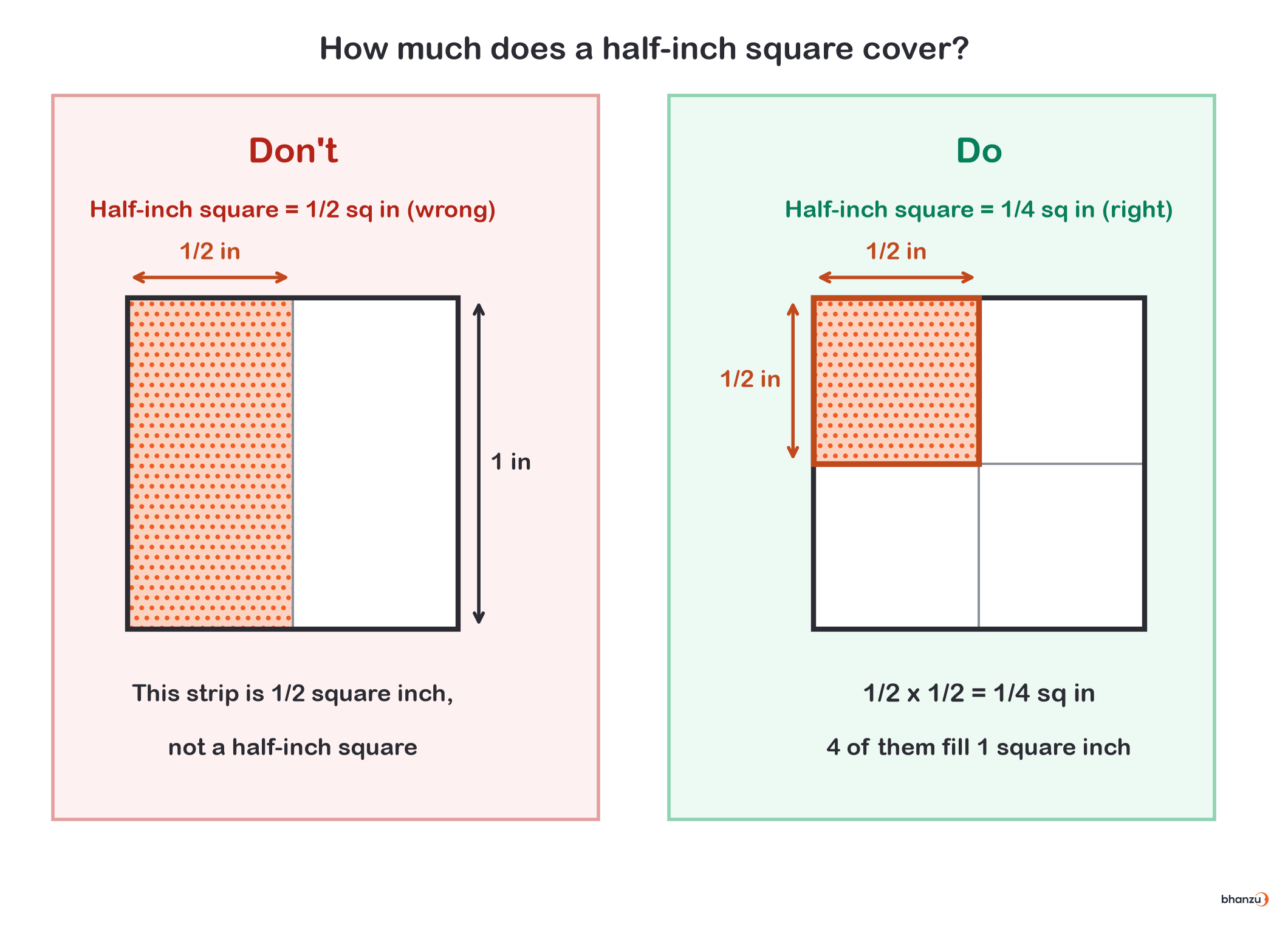
Don't do this: Saying a half-inch square covers square inch.
The correct way: Multiply, square inch, since four such squares fill one square inch.
Mistake 2: Counting tiles as whole square units
Where it slips in: Right after counting, as with a rug yard by yard tiled in fifths by fourths. Children who counted whole squares in 3rd grade often write the count as the area, since every tile back then was one square unit.
Don't do this: Counting 9 tiles and writing 9 square yards for a rug smaller than one square yard.
The correct way: A full square yard holds tiles, so the rug covers square yard.
A 2006 study by Constance Kamii and Judith Kysh interviewed 220 students in grades 4, 6, 8 and 9. Apart from 8th and 9th graders in advanced math classes, the students did not yet treat a square as the unit of area. Saying each tile's size out loud is worth the extra second.
Mistake 3: Adding the sides instead of multiplying
Where it slips in: A rushed answer that mixes up area with perimeter. A child sees two numbers on a picture of a board meter by meter and adds them.
Don't do this: Adding to get square meters, more than the square meter the board fits inside.
The correct way: Multiply, square meter.
Adding all four sides gives the perimeter instead, and area vs perimeter compares the two.
Key Takeaways
- Pick a tile that fits both sides a whole number of times before you start counting.
- Name a tile's size from how many fill one square unit.
- For area with fractional side lengths, length times width is the shortcut and the tile count is the proof.
- For more help choosing tiles and turning tile counts into square units, explore Bhanzu's 5th grade math tutor or Common Core math curriculum.
Read More
- Multiplying Fractions Word Problems
- Fraction Times a Whole Number
- Volume With Fractional Edge Lengths
- Area of Composite Shapes
- Why Are Fractions So Hard
Research Behind This Article
- NGA Center and CCSSO, Grade 5, Number and Operations: Fractions (2010). thecorestandards.org
- NGA Center and CCSSO, Common Core State Standards for Mathematics (2010). thecorestandards.org
- United States Postal Service, Domestic Mail Manual, 101 Physical Standards (2026). pe.usps.com
- National Center for Education Statistics, NAEP 2024 Mathematics, Grade 4 National Trends (2025). nationsreportcard.gov
- Kamii, C. and Kysh, J., The Difficulty of "Length x Width": Is a Square the Unit of Measurement? (2006). eric.ed.gov
Quick Quiz: Check Yourself
Three levels, new rectangles every time: multiply two fraction sides, then simplify an area, read a tiling or pick a tile, then work with a mixed-number side or count tiles on a card.
Was this article helpful?
Your feedback helps us write better content
Frequently Asked Questions
How do you find area and perimeter with fractions?
Can you find a side length from the area?
Is there an area of a rectangle with fractions worksheet?
How do I explain area and perimeter to my kid?
What area problems should a 5th grader be able to solve?