Key Points
- Multiplying decimals by whole numbers combines equal groups of tenths or hundredths, so three groups of 0.24 make 72 hundredths, or 0.72.
- The whole number adds no decimal places, so keeps the two places of 1.38 and gives 6.90, or 6.9.
- A common error with is crossing out the zero in 140 before placing the point, which gives 0.14 instead of 1.4.
- In 5th grade, multiplying by 0.1 or 0.01 takes one tenth or one hundredth of a number, so 45 becomes 4.5 or 0.45.
Ten dimes and four quarters on a scale
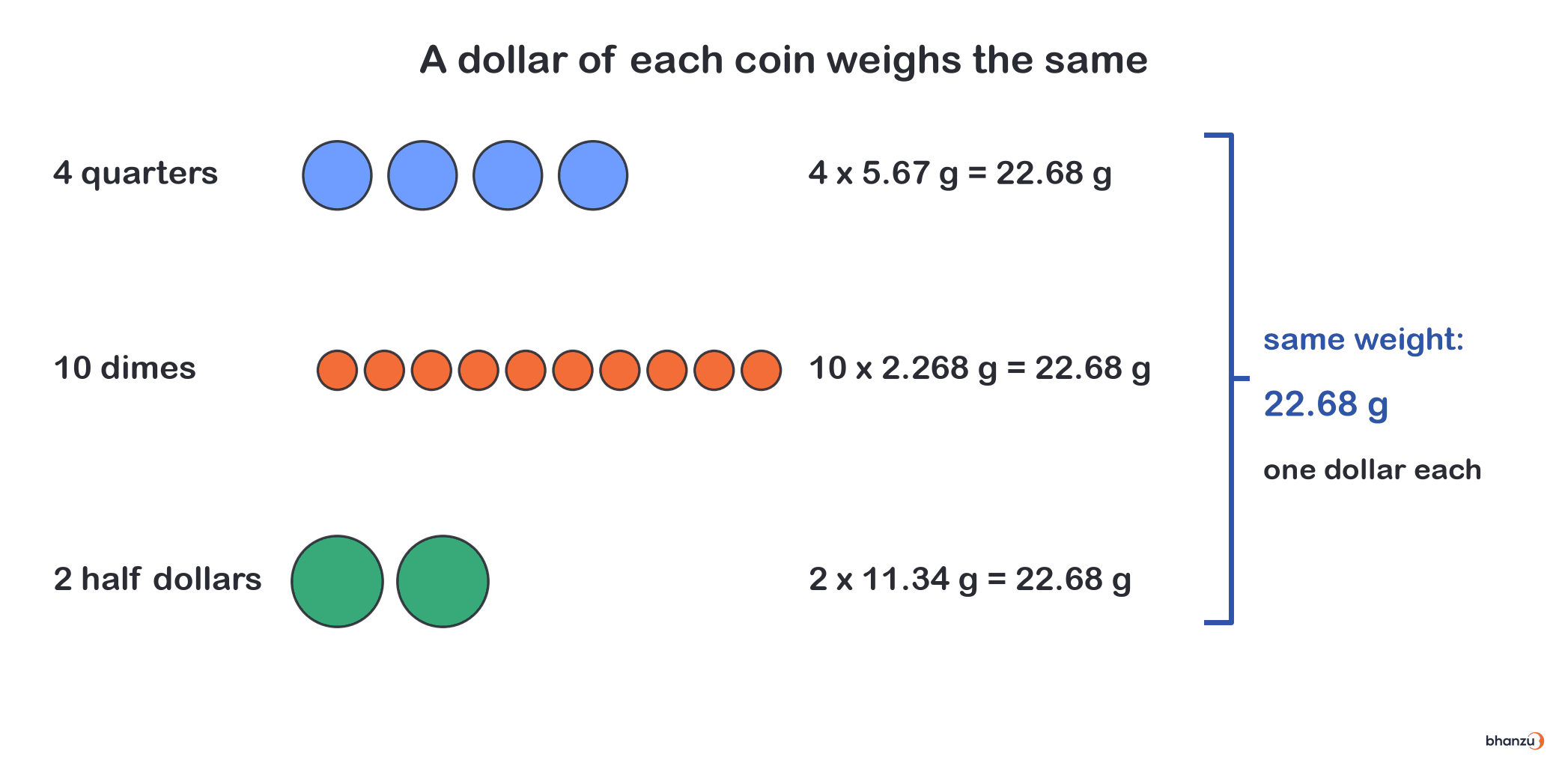
A dollar in dimes and a dollar in quarters weigh exactly the same. Ten coins against four sounds like an easy win for the dimes, yet the scale shows a tie. The weights are set by law. Under the 2023 edition of the United States Code, a quarter weighs 5.67 grams and a dime weighs 2.268 grams.
Four quarters come to 22.68 grams, and so do ten dimes (two half dollars, at 11.34 grams each, make it a three-way tie). Each total is a decimal times a whole number, and in 6th grade the same move handles longer decimals in prices and measurements.
How do you multiply decimals by whole numbers?
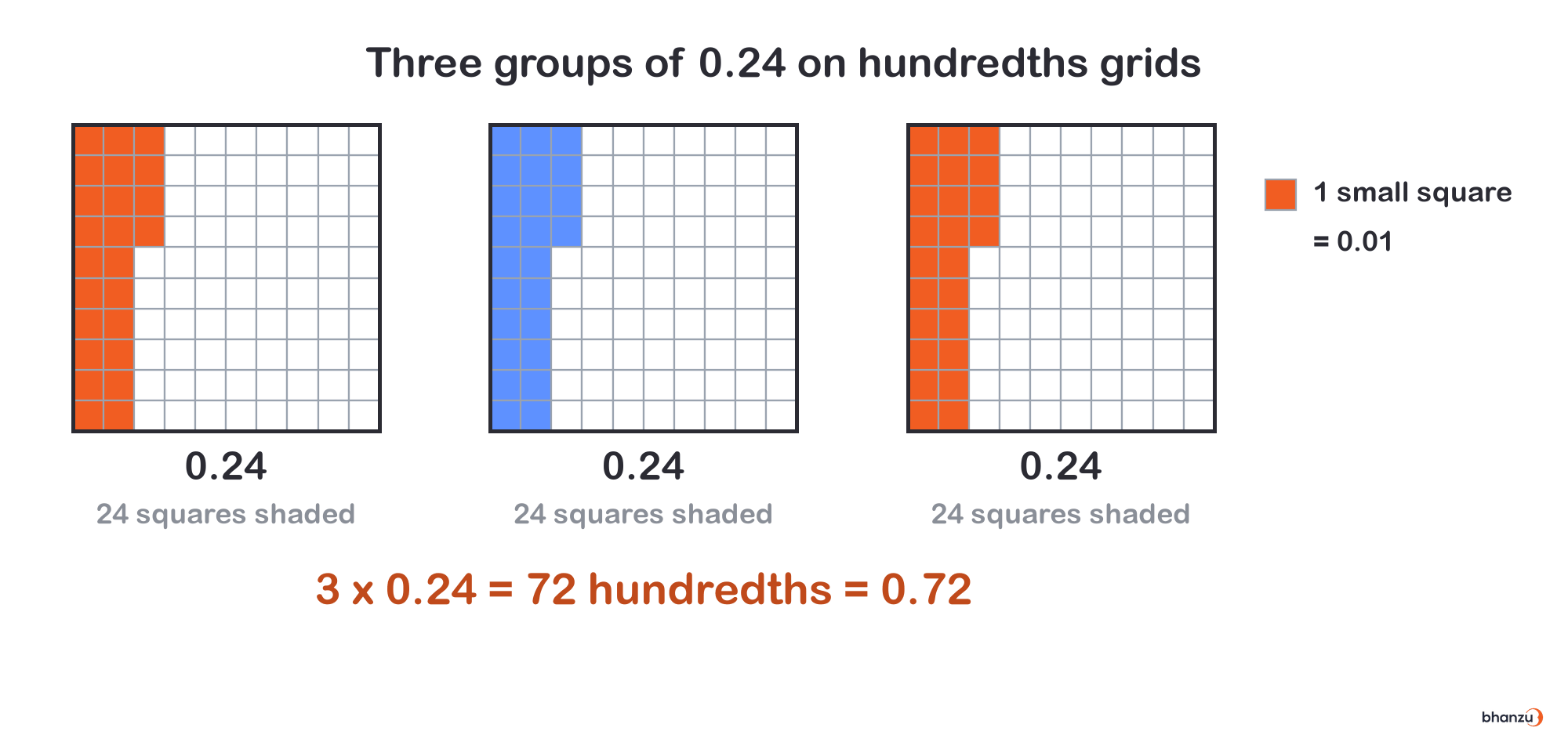
Multiplying decimals by whole numbers means adding equal groups of a decimal, so is three groups of 24 hundredths, where a hundredth is one of 100 equal parts of a whole. Those groups make 72 hundredths, so the product, the answer to a multiplication, is 0.72.
A hundredths grid shows it. Each grid is a square cut into 100 small squares, so one small square is 0.01. Shade 24 squares on each of three grids and 72 squares are shaded in all.
Times-table facts carry over to tenths, where a tenth is one of 10 equal parts, so is 48 tenths, or 4.8, because .
This is Common Core standard 5.NBT.B.7, which asks 5th graders to multiply decimals to hundredths with models or drawings and explain where the answer comes from. For a parent, that means your child should be able to shade on grids and say why the answer is 0.72 before speed matters.
Where does the decimal point go?
The decimal point goes where it gives the product as many decimal places, the digits to the right of the point, as the decimal had. The whole number only counts groups, so it adds no places. OpenStax Prealgebra states the general rule as adding the places of both factors, and a whole number brings zero. Take .
- Estimate. Rounding decimals to whole numbers puts 1.38 between 1 and 2, so the answer is between 5 and 10.
- Multiply as whole numbers, ignoring the point, so by ordinary multi-digit multiplication.
- Count the decimal places in 1.38. There are two.
- Count two places from the right of 690 and place the point, 6.90, writing zeros in front if digits run out. Only then can an end zero go, leaving 6.9.
- Check against the estimate. 6.9 is between 5 and 10.
Children who multiply the digits correctly often lose the point at the very last step, which is why the estimate comes first (a number written down before you start is harder to ignore). A two-digit whole number, as in , changes only step 2.
Breaking the decimal apart is a second method, built on the distributive property. Split 2.4 into 2 and 0.4, multiply each part by 3, then add.
Breaking apart is quick in your head for one whole part and one decimal part, but once a decimal like 12.47 splits into four parts, the five steps win.
What happens when you multiply by 0.1 or 0.01?
Multiplying by 0.1 takes one tenth of a number, and multiplying by 0.01 takes one hundredth of it. Every digit moves one or two places to the right, so the answer gets smaller.
is 45 tenths, and since 10 tenths make one whole, 40 tenths make 4 wholes with 5 tenths left, or 4.5. In the same way, 45 hundredths is 0.45.
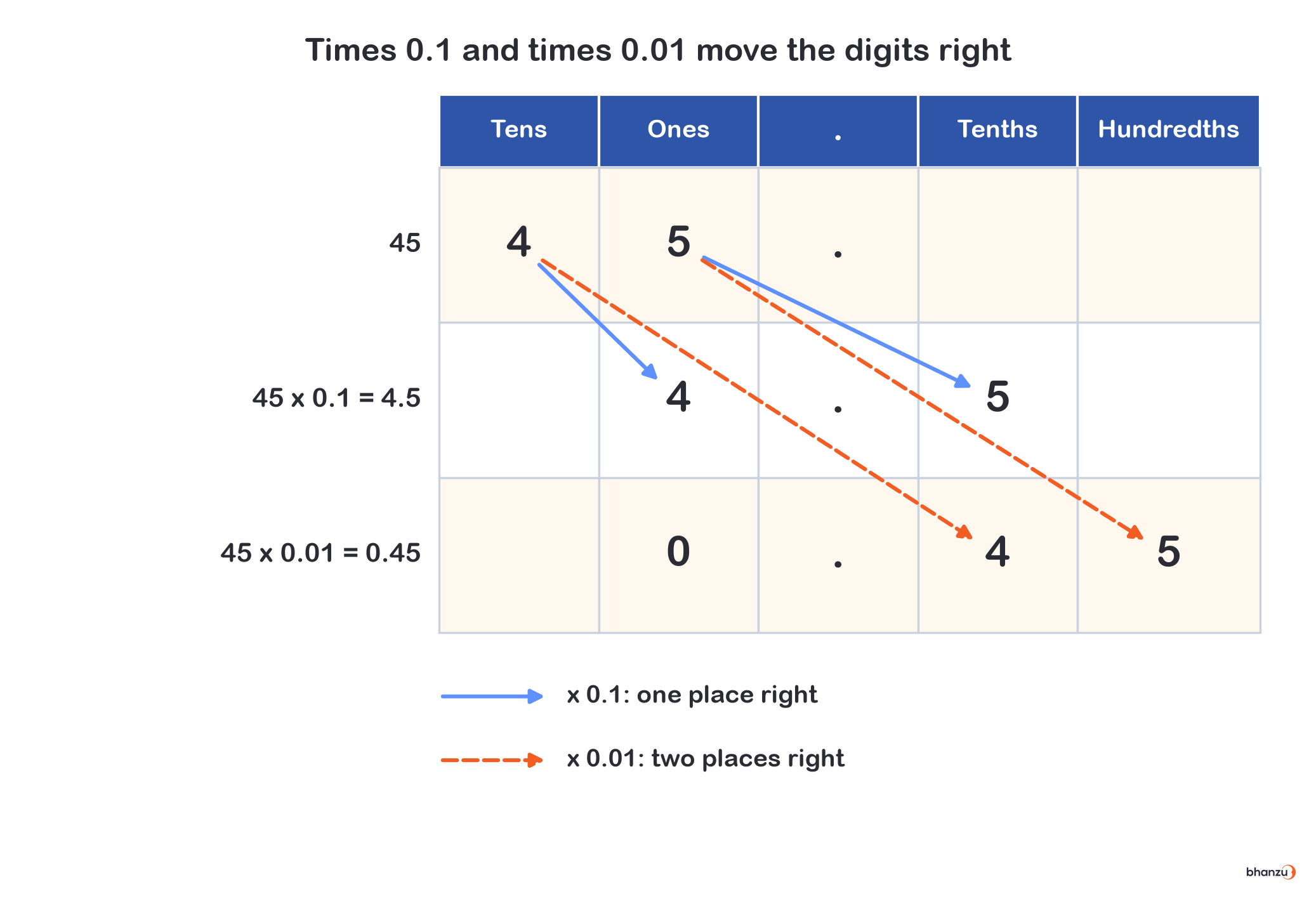
Times 10 moves the digits one place left instead, so , the start of multiplying and dividing by powers of 10. Later you'll meet 0.001, which moves every digit three places right.
The wording here is genuinely confusing, because "move the point left" and "move the digits right" describe the same change. On the place value chart the point stays put and the digits slide.
Try It Yourself
Build a decimal from tenths and hundredths with the plus and minus buttons, pick a whole number from 2 to 5, and watch that many hundredths grids fill in. Press Pack into wholes to turn every 100 shaded squares into one whole grid, then type the product and press Check.
Where does a decimal times a whole number show up in real life?
Prices and measurements often come in tenths, hundredths or thousandths, while people buy and measure in whole-number amounts. Multiplying one decimal by a whole number turns a single price or size into a total, and the same place-counting rule covers thousandths too, a step 6th grade practices.
- Filling a gas tank. In the US Energy Information Administration's weekly update for the week of November 16, 2026, regular gasoline averaged $3.805 a gallon. Gas is priced to a tenth of a cent, hence three decimal places, and 12 gallons cost $12 \times $3.805 = $45.66$.
- Buying fruit by the pound. The Bureau of Labor Statistics lists the October 2026 US city average price of bananas as $0.655 a pound, so 4 pounds cost $4 \times $0.655 = $2.62$.
- Switching rulers. The National Institute of Standards and Technology says an inch has been exactly 2.54 centimeters since July 1, 1959, so a 12-inch ruler is centimeters long.
Prices change week to week (the method doesn't), and an estimate of 12 gallons at about $4, or $48, shows at a glance that $45.66 is a sensible total.
Examples of multiplying decimals by whole numbers
Example 1
Find .
Three groups of 0.7 is a repeated addition.
In tenths, , so , less than because 0.7 is less than 1.
Example 2
Find .
A fast look reads 3.06 as 3.6, multiplies , and writes 25.2.
That can't be right. 3.06 is only a little more than 3, so the product must be only a little more than , and 25.2 is more than 4 away. That 25.2 answers a different problem, .
Keep the zero.
Two decimal places in 3.06 give two in the product.
21.42 is just over 21, as the estimate said.
Example 3
What whole number goes in the box, ?
0.01 is one hundredth, and 0.36 is 36 hundredths, so the box holds 36.
Check: one hundredth of 36 is 0.36.
Example 4
Without working out the exact answer, is more or less than 12?
1.95 is a little less than 2. Since , the product is a little less than 12.
The exact product agrees.
11.7 is 0.3 below 12, because each of the six groups is 0.05 short of 2.
Example 5
Find .
Estimate first, with .
Break 18 into 10 and 8.
The whole-number method agrees, since and two decimal places make 76.50. So , close to the estimate of 72.
Example 6
By law, a quarter weighs 5.67 grams and a half dollar weighs 11.34 grams. Maya stacks 40 quarters and Leo stacks 20 half dollars. Whose stack is heavier?
Estimate first. and , so both stacks are near 230 grams.
Multiply Maya's quarters as whole numbers, then place the point.
Leo's half dollars work the same way.
Neither stack is heavier. Both weigh 226.8 grams, and both are worth $10.
The pattern hiding inside the decimal places
The decimal places come out right because the whole number never changes the unit. 24 hundredths times 3 is 72 hundredths, the same way 24 apples times 3 is 72 apples, so the product stays in hundredths.
That one idea settles both zero cases. is 8 hundredths, written 0.08, and is 140 hundredths, written 1.40 and then 1.4.
| Decimal | Fraction | In words |
|---|---|---|
| 0.1 | one tenth | |
| 0.01 | one hundredth | |
| 0.24 | twenty-four hundredths | |
| 0.72 | seventy-two hundredths |
Each row names one amount in three forms, the idea behind fractions, decimals and percentages. In 4th grade, multiplying fractions by whole numbers gave , the same problem as .
Counting places is a shortcut for naming the unit. When both factors are decimals, the unit itself changes (tenths times tenths make hundredths), and that is the next lesson.
Where do kids trip up on multiplying decimals by whole numbers?
Mistake 1: Leaving out the zero in front
Where it slips in: Placing the point when the whole-number product has fewer digits than the places it needs, as in . Children see a single digit, 8, and give it a single place.
Don't do this: Writing 0.8, because .
The correct way: 0.02 is 2 hundredths, so four of them make 8 hundredths, written 0.08. An answer of 0.8 would be forty groups of 0.02.
Mistake 2: Crossing out the end zero too soon
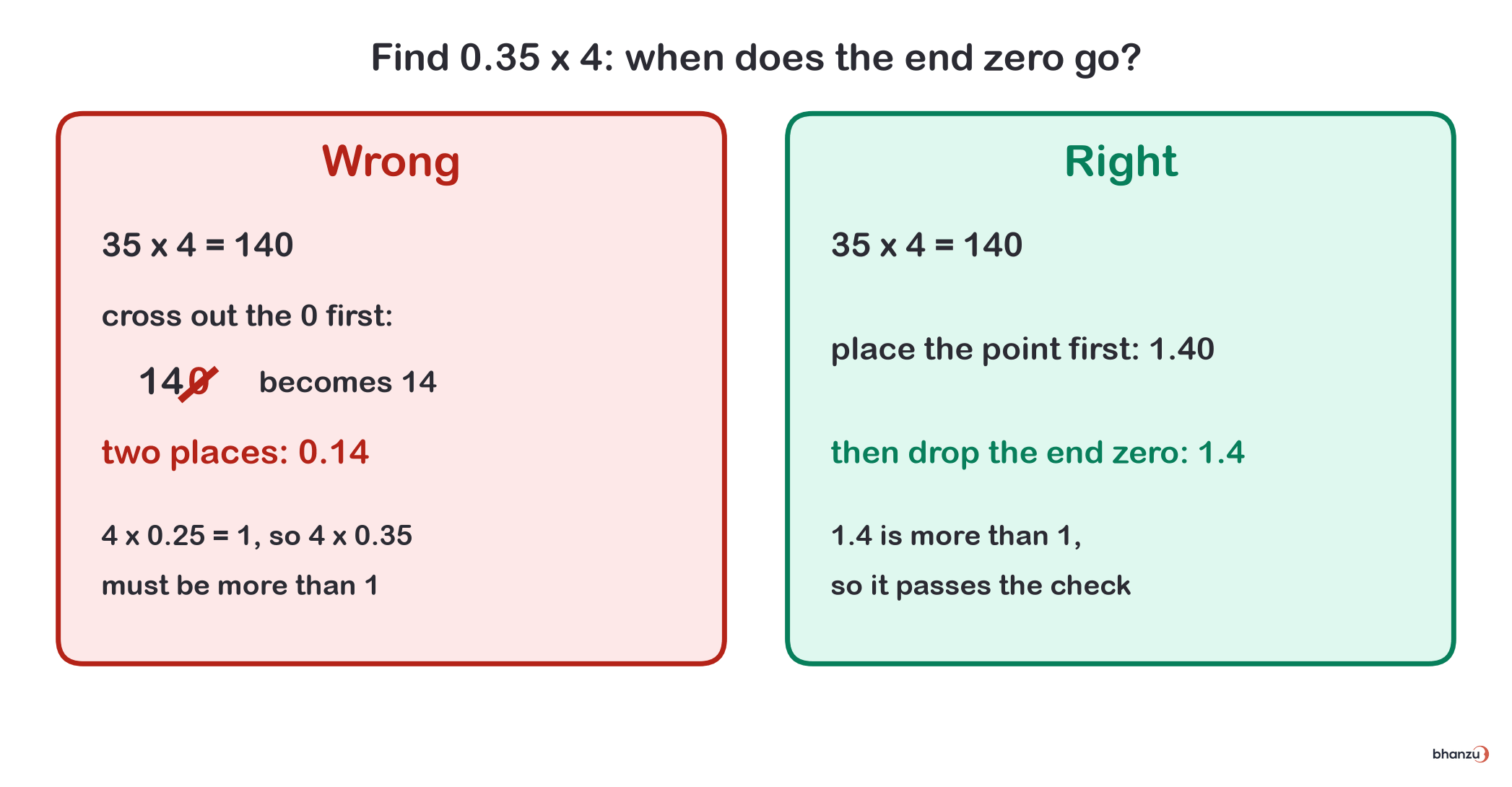
Where it slips in: Products like , where . Children who know end zeros can be dropped often cross the 0 out one step early, while 140 is still a whole number.
Don't do this: Turning 140 into 14, counting two places, and writing 0.14.
The correct way: Place the point first to get 1.40, then drop the end zero to get 1.4. Four groups of 0.25 make 1, the way four quarters make a dollar, so four groups of the larger 0.35 must make more than 1.
Mistake 3: Expecting the answer to get bigger
Where it slips in: Multiplying a whole number by 0.1 or 0.01. Every times fact from earlier grades with two whole numbers above 1 made the answer bigger, so a smaller answer feels wrong.
Don't do this: Writing 520 for , which is the answer to .
The correct way: is one tenth of 52, or 5.2, and is 0.52. A counting number times a decimal between 0 and 1 always comes out smaller than the counting number.
Key Takeaways
- Write an estimate before multiplying, so a point in the wrong place stands out at once.
- A whole number counts groups and adds no decimal places, so the product keeps the decimal's places until an end zero is dropped.
- Times 0.1 or 0.01 shrinks a number to a tenth or a hundredth of itself.
- For more practice multiplying decimals by whole numbers with a teacher who notices when an end zero gets crossed out too early, explore Bhanzu's 5th grade math curriculum or math programs for elementary students.
Read More
- Multiplying Decimals
- Dividing Decimals by Whole Numbers
- Adding Decimals
- Multiplying Multi-Digit Decimals
- What Are Whole Numbers
Research Behind This Article
- U.S. Government Publishing Office, United States Code, 2023 Edition, Title 31, Section 5112: Denominations, specifications, and design of coins (2023). govinfo.gov
- National Governors Association Center for Best Practices and Council of Chief State School Officers, Common Core State Standards for Mathematics: Grade 5, Number and Operations in Base Ten (2010). thecorestandards.org
- Lynn Marecek, MaryAnne Anthony-Smith and Andrea Honeycutt Mathis, OpenStax, Prealgebra 2e, 5.2 Decimal Operations (2020). openstax.org
- U.S. Energy Information Administration, Gasoline and Diesel Fuel Update (2026). eia.gov
- U.S. Bureau of Labor Statistics, Average Price Data: Bananas, per lb., U.S. City Average (2026). data.bls.gov
- National Institute of Standards and Technology, SI Units: Length (2025). nist.gov
Quick Quiz: Check Yourself
Three levels, new numbers every time: multiply tenths by a whole number, handle zeros and 0.1 or 0.01, then multiply by a two-digit number or solve a coin problem.
Was this article helpful?
Your feedback helps us write better content
Frequently Asked Questions
Do you line up the decimal points when multiplying?
How can I teach multiplying decimals at home?
What do 5th graders learn about multiplying decimals by whole numbers?
Is there a trick to multiplying decimals?
Can you multiply decimals with base ten blocks?