Key Points
- The order of operations 3rd grade students learn puts multiplying and dividing ahead of adding and subtracting unless parentheses mark a part to do first, so .
- Multiplying first keeps equal groups whole, because means , and adding those groups to 5 also gives 17.
- Going left to right can change an answer only when the first of two same-kind signs is minus or divide, so is 12, not 6.
- Common Core expects 3rd graders to use the usual order when no parentheses are given, and the same rule returns with brackets in 5th grade and exponents in 6th grade.
One plate of cupcakes, two answers
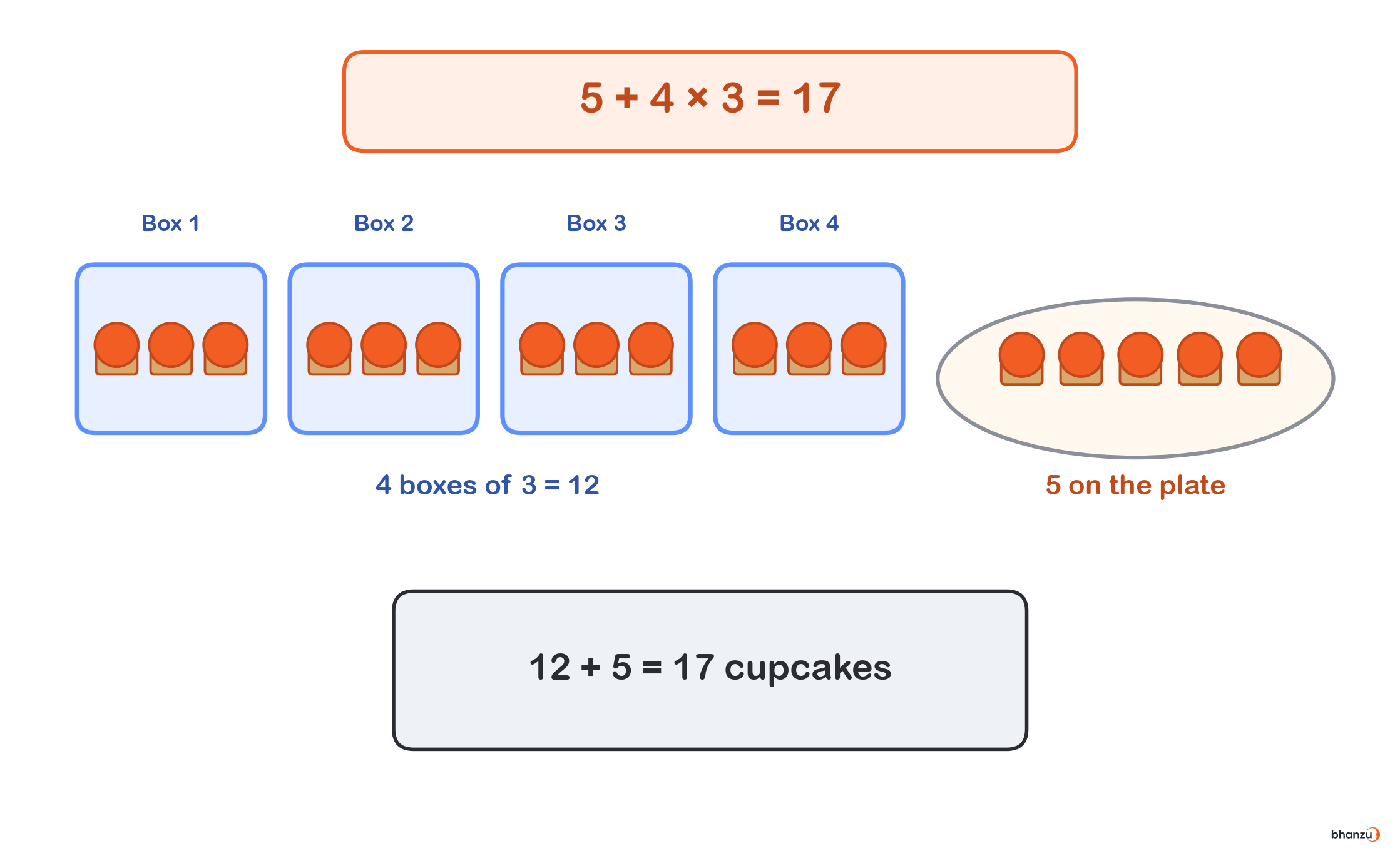
Four boxes of cupcakes sit on the bake sale table, 3 in each box. Five more wait on a plate beside them.
Maya writes the total as 5 plus 4 times 3 and gets 17. Leo reads the same line, adds 5 and 4 first, and gets 27. Neither one made an arithmetic error.
Counting the real cupcakes settles it at 17. A written line of math needs a rule that makes it mean 17 to every reader, and that rule is the order of operations. Next year, the same rule will sort out longer lines with three or more steps.
What is the order of operations in 3rd grade?
The order of operations 3rd grade students learn tells you which operation (add, subtract, multiply or divide) to do first. It matters whenever an expression, a math phrase made of numbers and operation signs with no equal sign, holds two different operations.
The bake sale table is the model. Each box is an equal group, so 4 boxes of 3 is , one amount to finish before the loose cupcakes join it.
- Work out anything inside parentheses, the curved marks that hold a part together, first.
- Multiply or divide next.
- Add or subtract last.
Steps on the same level, such as an addition and a subtraction, go from left to right. Do you multiply or add first? With no parentheses, you multiply first (the middle line of the chart shows it).
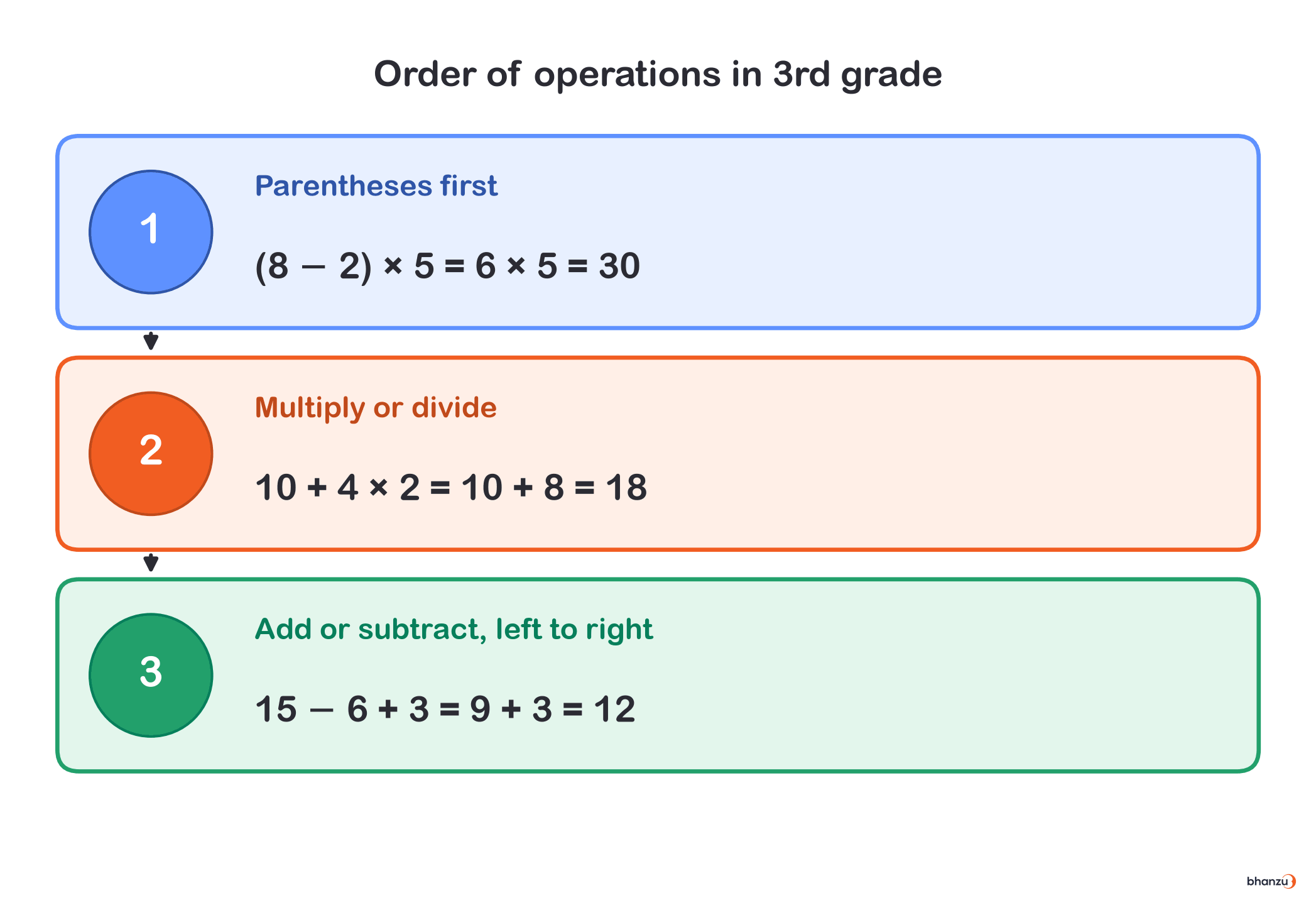
Common Core doesn't give the order of operations its own 3rd grade standard. It sits in a footnote to 3.OA.D.8, the standard for two-step word problems. The footnote asks students to work "in the conventional order when there are no parentheses to specify a particular order" with whole numbers.
Bay-Williams and Martinie (2015) note that Common Core introduces the order of operations in 3rd grade and uses it in every later grade, so your child will keep using this rule.
Why does multiplication come before addition?
Write the long way and the reason shows up. Four boxes of 3 cupcakes is , so the bake sale line becomes one long addition.
Common Core reads as "the total number of objects in 5 groups of 7 objects each," so a multiplication counts equal groups. It has to become one number before anything joins it. Adding 5 and 4 first turns the 5 loose cupcakes into 5 extra boxes of 3, which is exactly how Leo's 27 appears.
Division shares step 2, because every division asks for a missing factor, one of the numbers you multiply (the idea behind relating multiplication and division). To find , look for the number that makes 20 when you multiply it by 4.
Multiplying first holds whenever no parentheses say otherwise, and it matters most on lines that start by adding or subtracting. A 2019 study of 240 middle schoolers in Turkey shows the gap.
| Line | Where the multiplication sits | Students who got it right |
|---|---|---|
| second | 19% | |
| first | 85% |
On , reading left to right happens to match the rule. On it doesn't, and the study's sample wrong work adds first to get 22 instead of 16.
Children who know by heart often get the cupcake story right and still write 27 for the symbols. They read symbols like a sentence, left to right. A child who counted 17 cupcakes may switch to 27 when a friend says it loudly, but the count is the proof.
Order of operations with parentheses
Parentheses mean "do this part first," and they can change the answer. Same numbers, two stories.
Five loose cupcakes and 4 boxes of 3 make 17.
Five boxes of chocolate and 4 boxes of vanilla, with 3 cupcakes in every box, make 27.
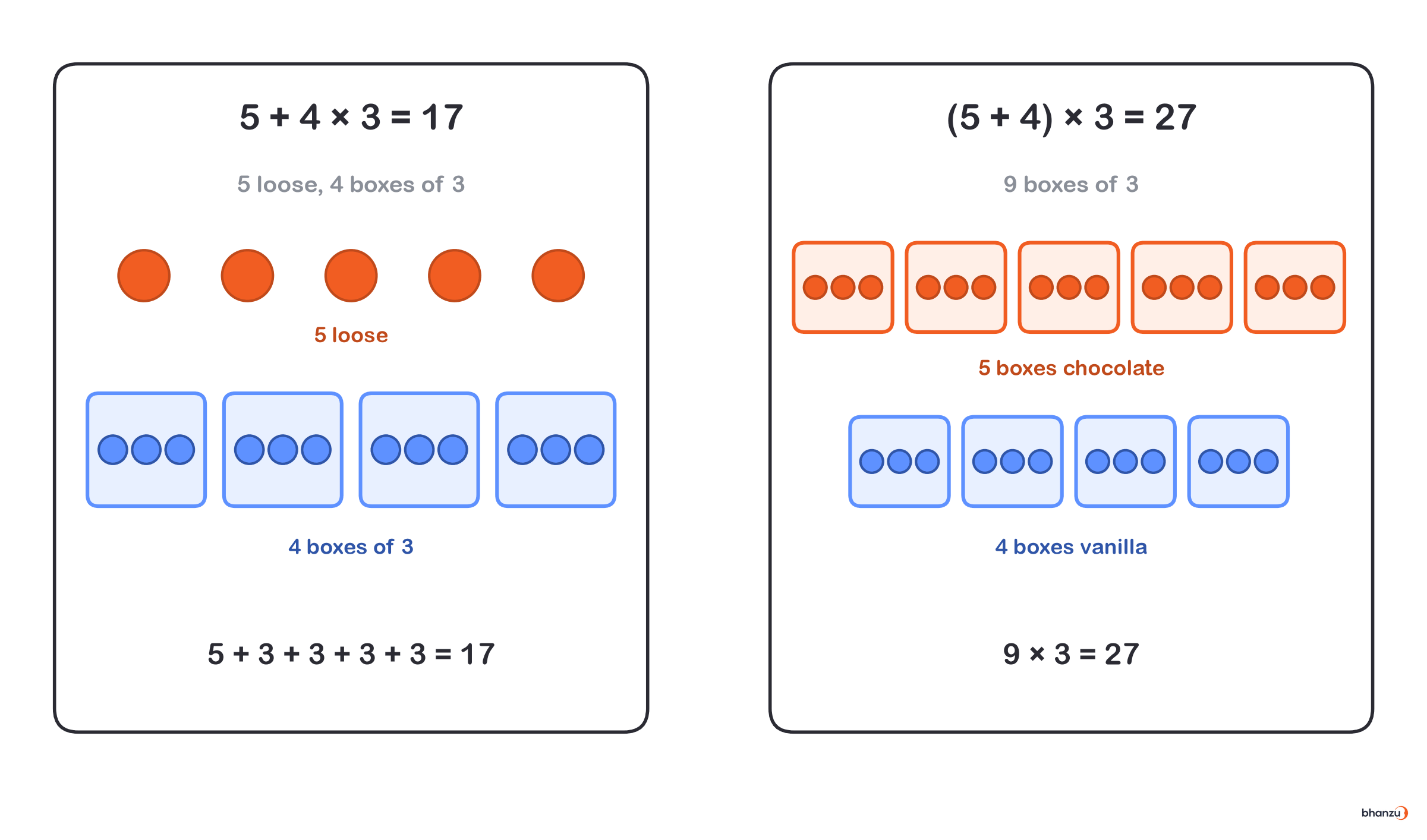
In the second story, counts boxes, so it has to be finished first. Parentheses around a multiplication, as in , are allowed but change nothing.
Counting the second story one flavor at a time is the distributive property at work.
Whenever one part of a story has to be added up before you can multiply, that addition belongs in parentheses.
| Words in the problem | Math it means |
|---|---|
| 4 boxes with 3 cupcakes in each | |
| 5 more on a plate | |
| each bag gets 3 cookies and 5 pretzels | in one bag |
| 4 bags like that |
Try It Yourself
Tap the sign you would work out first, and watch that part turn into one number. If you pick a step that has to wait, the box tells you which one goes first and why. Press Parentheses to see how they change the answer, or New expression for fresh numbers.
Examples of order of operations 3rd grade
Example 1
Find .
Multiply first.
Then add.
So .
Example 2
Find .
The tempting move is to start with the first pair you see.
That answer can't be right. The line starts at 18 and only takes something away, so the answer has to be less than 18, and 60 is more.
Multiply first instead.
So .
Example 3
Find and . Why are the answers different?
With parentheses, add first.
Without parentheses, multiply first.
The answers are 36 and 15. The parentheses make the first line 9 groups of 4, while the second is 7 plus only 2 groups of 4.
Example 4
Find .
Divide first.
Then subtract.
So .
Example 5
Put parentheses in so that it equals 20.
Without parentheses, the line multiplies first.
That gives 16, not 20. Group the addition instead.
The answer is .
Example 6
Leo packs 4 bags for the bake sale. Each bag gets 3 cookies and 5 pretzels. How many snacks does he pack in all? Write one expression, then solve it.
One bag holds snacks, so 4 bags hold .
Leo packs 32 snacks. Counting each kind gives the same total, .
The order of operations beyond the textbook
The order of operations exists so that one written line means one amount to everyone, even someone who never saw the story behind it. The OpenStax textbook Prealgebra 2e says the same expression should give the same result.
- It keeps a bill fair. A $1 lemonade and 2 cupcakes at $3 each cost dollars, but working left to right would charge $9.
- It keeps a game score honest. One free throw (worth 1 point) and 3 baskets worth 2 points each make points, not 8.
- It saves writing. Because multiplying comes first by agreement, Maya's line needs no parentheses, and only Leo's reading has to mark itself as .
Brackets and braces join parentheses in 5th grade, and exponents join in 6th grade. The agreement underneath stays the same.
What are the most common mistakes with the order of operations?
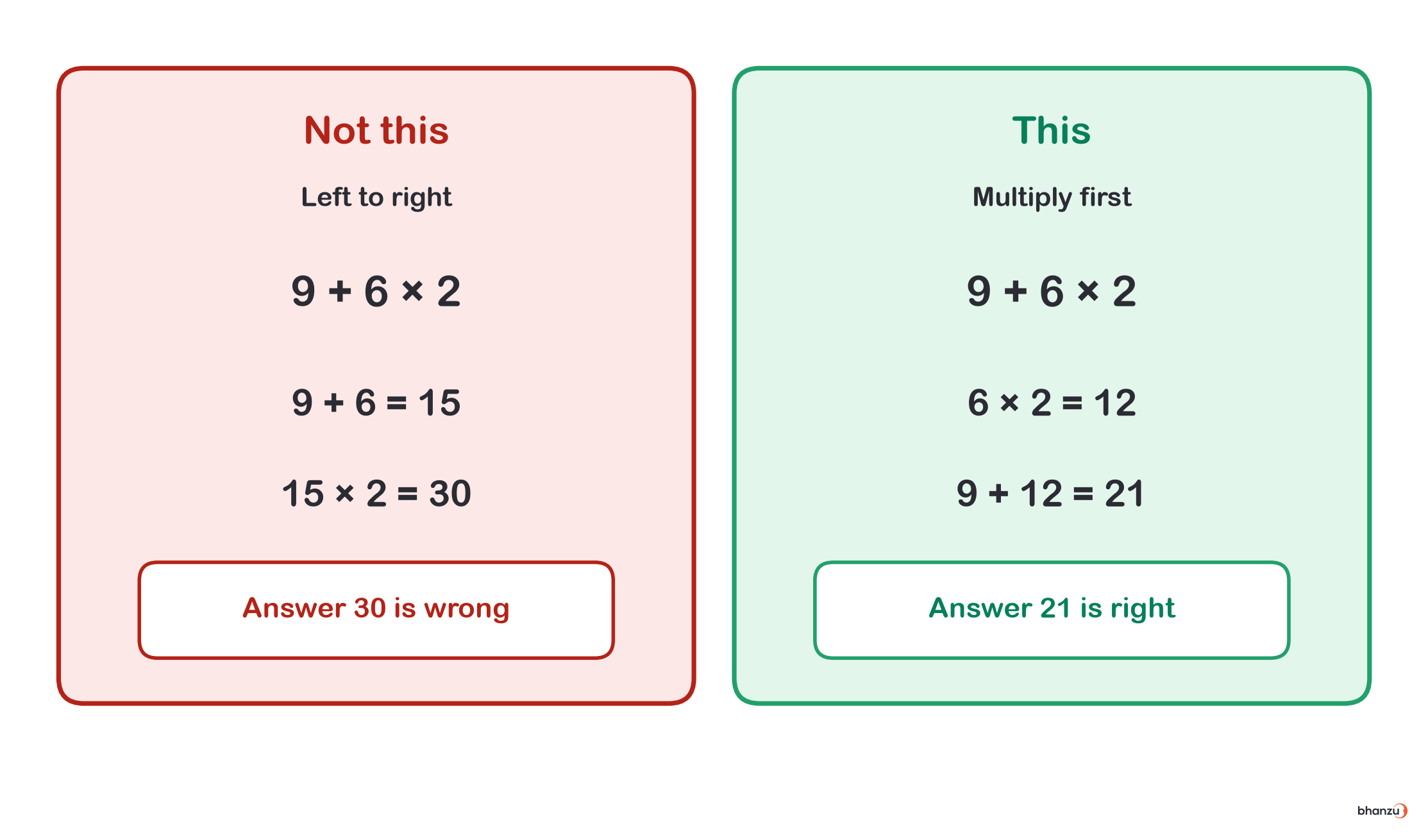
Mistake 1: Working straight left to right
Where it slips in: Lines where an addition or subtraction comes before the multiplication, such as . Every sentence a child reads runs left to right, so the first pair looks like the place to start.
Don't do this: , then .
The correct way: Scan the line for a times or divide sign first. Multiply, , then add, .
A child who rushes often says "nine plus six is fifteen" out loud before even reaching the times sign. The habit can last. In a 2024 study of 837 US 7th graders, 15% to 22% still worked left to right on lines that began with an addition.
Mistake 2: Adding before subtracting because A comes first
Where it slips in: Lines with only addition and subtraction, such as . It shows up after a child meets PEMDAS, a memory word whose letters list the steps, and reads those letters as a ranking.
Don't do this: , then .
The correct way: Go left to right. , then .
A child can recite "Please Excuse My Dear Aunt Sally" perfectly and still not know that A and S share one step. Grown-ups trip here too. In 2008, Glidden studied 381 college students training to be elementary, early childhood or special education teachers. Of those who multiplied first, 30.9% still added before subtracting.
Mistake 3: Leaving out the parentheses in a story
Where it slips in: Stories where each group holds two kinds of things, such as 5 bags, each with 2 red and 3 blue marbles. Children write the numbers in the order the story says them.
Don't do this: .
The correct way: One bag holds marbles, so write .
The part of the order of operations nobody explains
Going left to right only matters for two steps of the same kind. Even then, it can change the answer only when the first sign is a minus or a divide sign.
The sayings "work from left to right" and "you can add numbers in any order" sound like they fight. Bay-Williams and Martinie (2015) open a journal article with exactly that clash. Both are true, for different lines.
- is 18 whether you add first or subtract first.
- is 30 in either order, and Common Core uses this exact line as its 3rd grade example of the associative property of multiplication.
- is 12 left to right, but 6 if you add first.
Is order of operations left to right?
Only for steps on the same level. Adding and multiplying just put amounts together, so the grouping can't change the total. A minus sign takes away only the number right after it, so adding first wrongly takes away 9.
Key Takeaways
- Scan a line for a times or divide sign before you write anything, since that step goes first unless parentheses say otherwise.
- Finishing a multiplication first is how the order of operations 3rd grade students use keeps a written line matched to the real count.
- When part of a story has to be added up before you can multiply, put that addition in parentheses.
- Read strictly from the left, but a line of only additions or only multiplications can be grouped any way.
- For more practice catching the left-to-right habit in lines like , explore Bhanzu's 3rd grade math curriculum or math programs for elementary students.
Read More
- Area and the Distributive Property
- Order of Operations in 4th Grade
- Order of Operations with Parentheses and Brackets
- Order of Operations in Math for Parents
- Two-Step Word Problems Within 100
Research Behind This Article
- Common Core State Standards Initiative, Grade 3 Operations & Algebraic Thinking (2010). thecorestandards.org
- Jennifer M. Bay-Williams and Sherri L. Martinie, Order of Operations: The Myth and the Math (2015). eric.ed.gov
- Sanem Tabak, 6th, 7th and 8th Grade Students' Misconceptions about the Order of Operations (2019). eric.ed.gov
- OpenStax, Lynn Marecek, MaryAnne Anthony-Smith and Andrea Honeycutt Mathis, Prealgebra 2e, 2.1 Use the Language of Algebra (2020). openstax.org
- Jeffrey Kramer Bye and others, Perceiving Precedence: Order of Operations Errors Are Predicted by Perception of Equivalent Expressions (2024). eric.ed.gov
- Peter L. Glidden, Prospective Elementary Teachers' Understanding of Order of Operations (2008). eric.ed.gov
Quick Quiz: Check Yourself
Three levels, new numbers every time: multiply first, then use parentheses, division and left-to-right steps, then solve a two-step story.
Was this article helpful?
Your feedback helps us write better content
Frequently Asked Questions
Is the order of operations the same as BODMAS?
How do you remember the order of math operations?
What is the order of operations in a calculator?
How can I help my child with order of operations at home?
What should I teach my child after the order of operations?