Key Points
- The properties of operations with negative numbers hold for every integer and decimal, so can be reordered to , which is 23.
- Subtraction is not commutative, so a 7th grade student first rewrites as and then moves each term together with its sign.
- A frequent distributive error is multiplying only the first term, so becomes instead of the correct .
- Common Core places this skill in 7th grade under standards 7.NS.A.1d and 7.NS.A.2c, and the distributive property is the reason that .
A 1,400-year-old rule about debts
In 628, an Indian astronomer wrote down rules for working with debts. Brahmagupta called positive numbers fortunes and negative numbers debts, and one of his rules says the product of two debts is a fortune. You still use that sign rule about 1,400 years later.
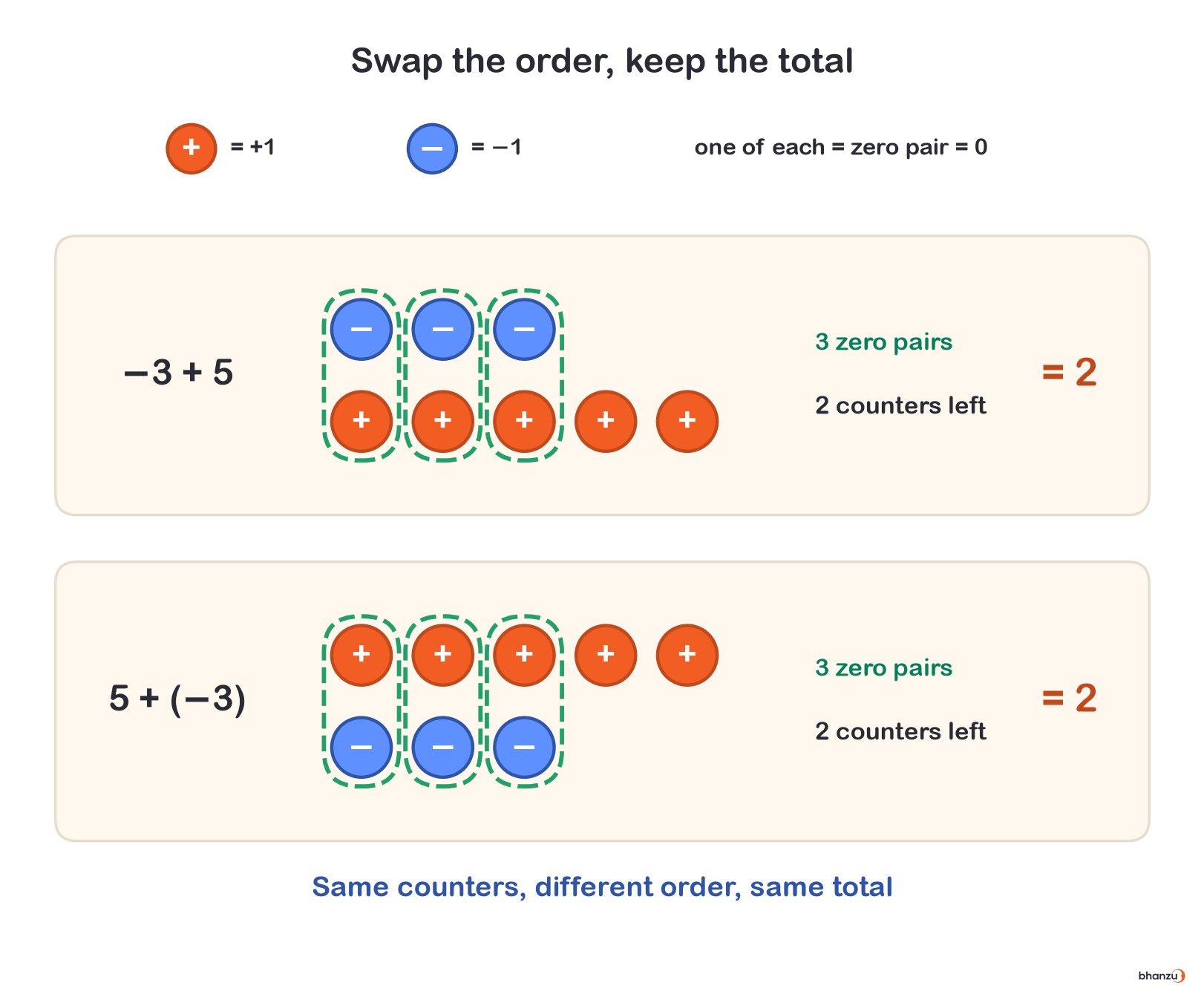
A game score runs on the same logic. Lose 3 points and win 5 points, in either order, and your score ends 2 points higher, just as the counters below show. Far from math class, engineers add forces that push in opposite directions, accountants total deposits and withdrawals in any order, and climate scientists average temperatures below zero.
What are the properties of operations with negative numbers?
The properties of operations with negative numbers are the rules that let you reorder or regroup signed numbers in a sum or product, or distribute a factor over a sum, without changing the result. They are the properties of operations from 6th grade, now applied to every integer (a whole number or its opposite, such as , or ) and to negative decimals and fractions.
Two of the names are easy to mix up. Commutative is about order (which number comes first), and associative is about grouping, meaning which pair you work out first. In the table, , and stand for any numbers.
| Property | What it says | With negative numbers |
|---|---|---|
| Commutative (addition) | ||
| Commutative (multiplication) | ||
| Associative (addition) | ||
| Associative (multiplication) | ||
| Distributive | ||
| Additive inverse |
Two-color counters show why these rules survive the jump to negatives. An orange plus counter is worth , a blue minus counter is worth , and one of each makes a zero pair worth 0. Sliding counters into a new order or group never adds or removes one, so the total cannot change.
This is Common Core standards 7.NS.A.1d and 7.NS.A.2c, which ask you to use properties as strategies with rational numbers (any number you can write as a fraction of two integers, negatives included). For your child, 7th grade adds no brand-new property, and the real growth is in choosing the property that turns a long string of signed numbers into a short, sure calculation.
How do you rearrange sums with negative numbers?
Rewrite every subtraction as adding the opposite, and then reorder freely. Addition is commutative and associative. Subtraction is not commutative, as OpenStax's Prealgebra 2e shows, and it is not associative either, since while .
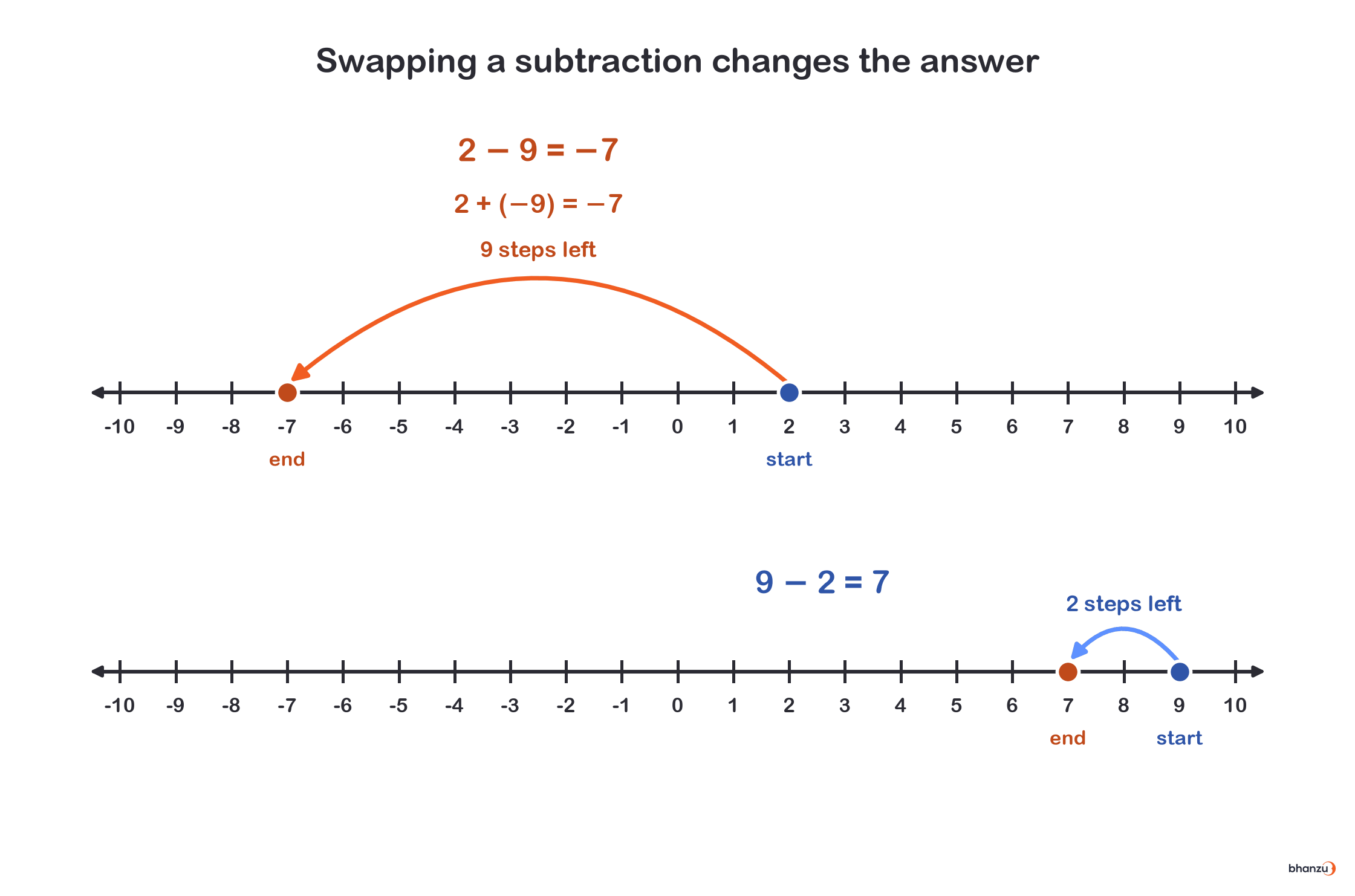
Here and are any numbers. The rule works because of opposite numbers, pairs like 9 and at the same distance from 0. Subtracting 9 and adding both move you 9 steps left on the number line.
Swapping a subtraction without rewriting it changes the answer. On the number line, starts at 2 and hops 9 left to , while starts at 9 and hops 2 left to . Negatives sit left of 0, so the answers land on opposite sides of zero.
To rearrange any sum of signed numbers, use four steps.
- Rewrite each subtraction as adding the opposite.
- Move each term together with its sign.
- Pair opposites that make 0, or numbers that make a friendly total such as 10.
- Add what is left.
A child who groups the numbers after a minus sign gets right, since is also 12. The same move on gives 3 instead of 7. The minus in can be read as "subtract 10" or as "negative 10," and books switch between the two without warning. Writing settles it, because every minus sign now belongs to a number.
Reordering pays off only when a pair makes 0, 10 or another friendly total. For , plain left to right, which gives 6 and then 2, is just as fast.
Try It Yourself
In Add mode, press Swap first two or Move brackets and watch the total, and the last dot on the number line, stay exactly where they were. Press Pair zero pairs to see each plus counter cancel a minus counter. In Subtract mode, Swap changes the answer, but after Rewrite as adding the opposite, a swap leaves the total alone.
Regrouping products that have negative factors
Work from left to right and you pass through before reaching 70. Multiplication of signed numbers is commutative and associative, so you can pair the two negative factors first.
You first regrouped factors with the associative property of multiplication in 3rd grade, and the only new piece is the sign. Look for factors that make 10 or 100, such as and . Multiplying by gives the opposite, so , which OpenStax's Prealgebra 2e writes as .
Each pair of negative factors multiplies to a positive. So, as long as no factor is 0, an even count of negatives gives a positive product and an odd count gives a negative one.
| Negative factors | Sign of the product | Example |
|---|---|---|
| 1 | negative | |
| 2 | positive | |
| 3 | negative |
You will meet this count again in 8th grade, when a power such as stacks three negative factors.
How does the distributive property work with negative numbers?
The distributive property says that multiplying a number by a sum gives the same result as multiplying each part and adding, for every sign.
Here is the number outside the parentheses, and and are the parts inside. The reason is area, since a rectangle tall and wide splits into two rectangles, and , that cover the same space. With negatives the area model is a bookkeeping grid (no side can be units long), but the pieces still add up.
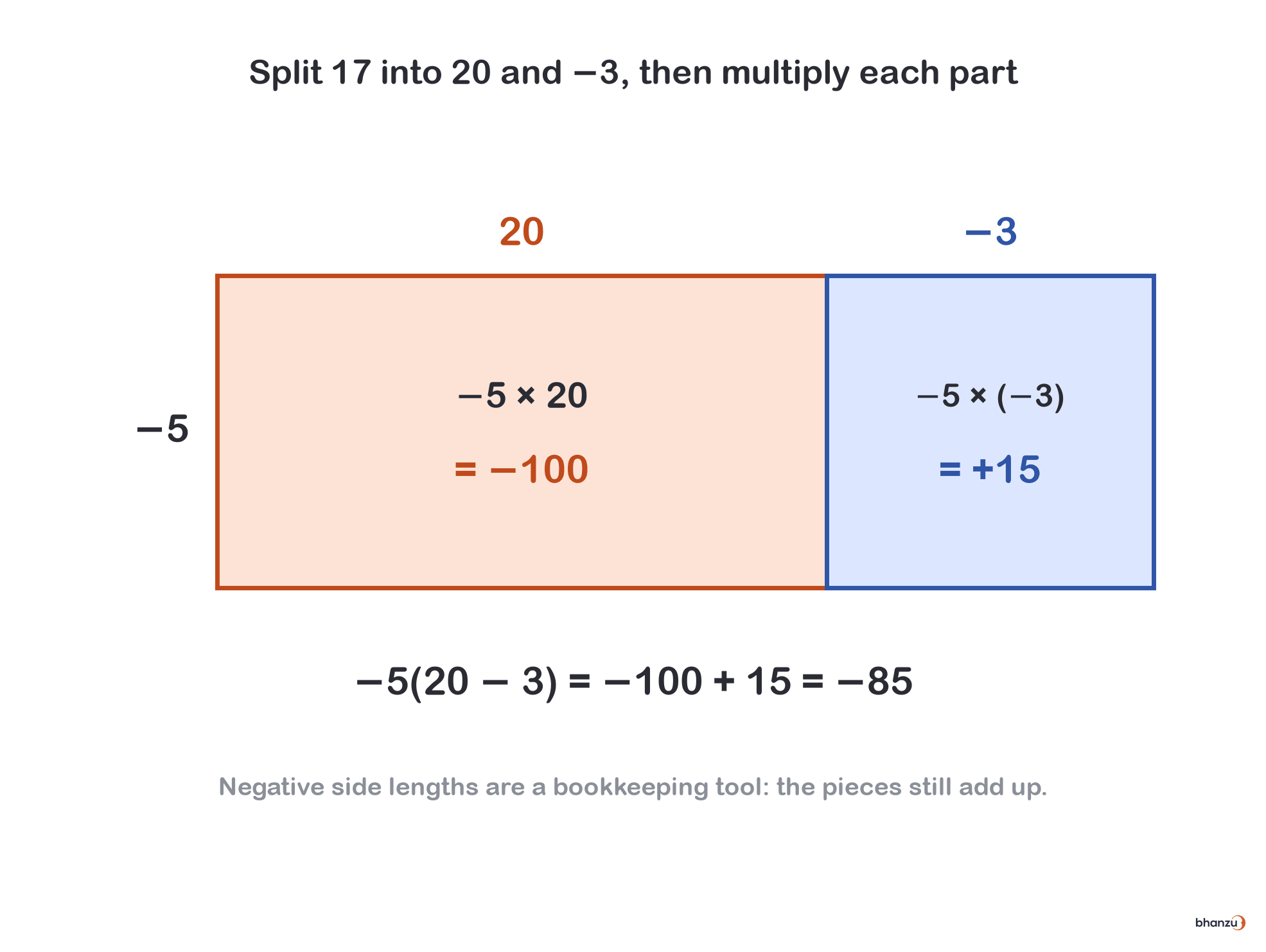
Splitting 17 into turns into two easy products.
The check is quick, since and one negative factor makes it . Distributing a negative number works the same way with a variable. In , stands for any number, and the multiplies both terms inside.
Substituting a small value is the fastest check, the same move you use when evaluating expressions with negative numbers. With , both sides equal 12, since and . OpenStax's Prealgebra 2e warns that distributing a negative needs extra care with signs, and the second term is where that care goes.
Read right to left, the property pulls out a common factor, so . That backwards move is called factoring, and you will use it on expressions with variables later this year.
Examples of properties of operations with negative numbers
Example 1
Find .
Reorder so the opposites sit together.
The sum is 23.
Example 2
Find .
The tempting move is to add the numbers after the minus sign, , then work out .
That answer cannot be right: going left to right, , and the last step adds 8, so the total must climb back to 0, not drop to .
Rewrite each subtraction as adding the opposite, then reorder.
The answer is 0.
Example 3
Find .
Regroup the two negative factors, since they multiply to 10.
The product is 37.
Example 4
Fill in the box in , then find the product.
Write 98 as and distribute the .
The box holds 12, and the product is .
Example 5
Which expression is equal to , or ?
Here stands for any number. Distribute the to both terms.
Combine and with the distributive property, .
Checking with gives and , so the equal expression is .
Example 6
In a card game, each red card is worth points and each black card is worth 6 points. Lena draws 4 red cards and 4 black cards. What is her score?
Both groups have 4 cards, so pull out the common factor 4.
Check by multiplying each part, since . Lena's score is points.
Why do properties of operations with negative numbers matter?
These properties exist so a long string of signed numbers can become short and sure, with a reason behind each step.
- It turns long lists into short ones. Zero pairs remove whole chunks of a sum, so is 61 before any adding starts.
- It makes mental math possible. You can work out in your head as .
- It keeps algebra honest. Distributing a negative is often the first step in solving an equation such as , which comes up later in 7th grade.
- It is the kind of number reasoning tracked nationally at this age. In the 2023 NAEP Long-Term Trend results, 13-year-olds' average math score fell 9 points compared with 2020 and 14 points compared with a decade earlier. The largest drops, 12 to 14 points, came among lower-performing students.
A parent who wants the longer view of how signed numbers build from 6th grade onward will find it in this guide to negative numbers for parents.
What most guides miss about negative number properties
The rule that a negative times a negative is positive is forced by the distributive property. Common Core's standard 7.NS.A.2a says as much, describing products such as as the result of keeping the properties of operations true.
- Any number times 0 is 0, so .
- Write 0 as , so .
- Distribute the to get .
- That is , and the only number that adds to to make 0 is 1.
So , and it could not be anything else unless the distributive property broke for negatives. Brahmagupta stated the rule in 628 as a rule about debts. Every other product of two negatives grows from , because the commutative and associative properties let you pull out the two factors.
Where students trip up on properties with negative numbers
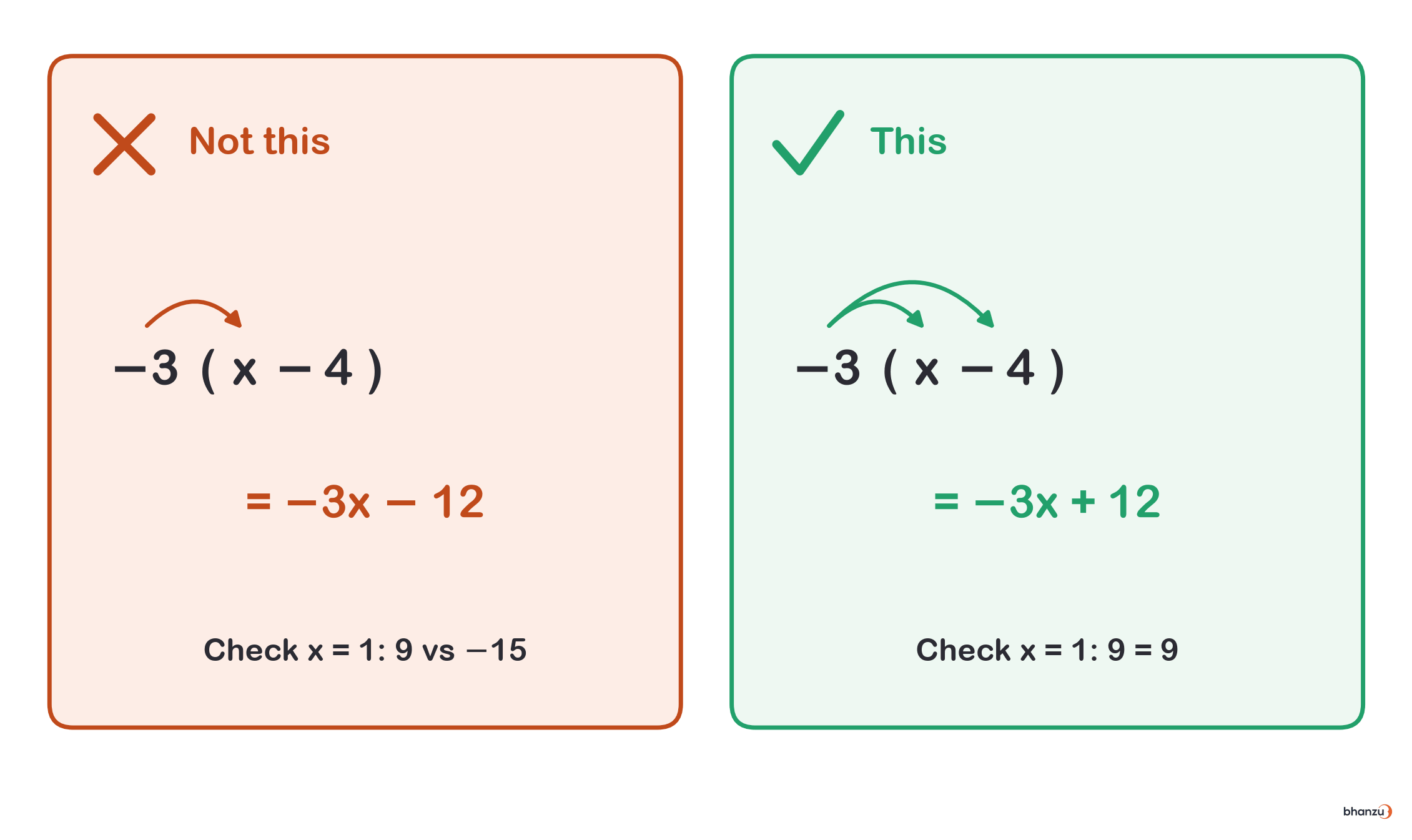
Mistake 1: Distributing the negative to only one term
Where it slips in: Simplifying expressions such as . A child multiplies by and then copies the just as it looks, because the second term seems finished.
Don't do this: .
The correct way: Multiply by both terms, so and , giving . With , the original is and , while the wrong form gives .
Mistake 2: Moving a number without its minus sign
Where it slips in: Reordering a list with subtraction, such as , because whole-number habits say order never matters when you add.
Don't do this: Swap the 4 and the 11 to get .
The correct way: Rewrite first as , then reorder to .
Mistake 3: Using "two negatives make a positive" everywhere
Where it slips in: Products with three negative factors, and sums of negatives. The slogan was learned for one product of two negatives, and a student who repeats it without the reason stretches it to every problem with two minus signs.
Don't do this: , or .
The correct way: , then , since three negative factors make an odd count. For the sum, , because two debts make a bigger debt.
Key Takeaways
- Before moving any term, turn each subtraction into an addition so the minus sign rides along with its number.
- Zero pairs and factors that make 10 or 100 are where properties of operations with negative numbers save the most work.
- With no zero factor, an even number of negative factors gives a positive product and an odd number gives a negative one.
- When a negative sits outside parentheses, multiply it into every term, then check with a small value such as 1.
- For more practice distributing a negative across both terms with a teacher who catches the dropped sign, explore Bhanzu's 7th grade math curriculum or its middle school math tutor sessions.
Read More
- Multiplying and Dividing Negative Fractions
- Order of Operations With Rational Numbers
- One-Step Equations With Negative Numbers
- Whole Numbers and Integers
- Area and the Distributive Property
- Absolute Value
Research Behind This Article
- MacTutor History of Mathematics, University of St Andrews, Brahmagupta (2000). mathshistory.st-andrews.ac.uk
- NGA Center and CCSSO, Common Core State Standards for Mathematics, Grade 7, The Number System (2010). thecorestandards.org
- OpenStax, Prealgebra 2e, Section 7.2, Commutative and Associative Properties (2020). openstax.org
- OpenStax, Prealgebra 2e, Section 3.4, Multiply and Divide Integers (2020). openstax.org
- OpenStax, Prealgebra 2e, Section 7.3, Distributive Property (2020). openstax.org
- National Center for Education Statistics, NAEP Long-Term Trend Highlights, Age 13, 2023 (2023). nationsreportcard.gov
Quick Quiz: Check Yourself
Three levels, new numbers every time: reorder sums with zero pairs and subtraction, regroup products and use distributive mental math, then distribute negatives in expressions and score a card game.
Was this article helpful?
Your feedback helps us write better content
Frequently Asked Questions
Are integers closed under subtraction and division?
What are the properties of division of integers?
What is the identity property of integers?
Why is subtraction not commutative if it is the same as adding the opposite?
Can you give an example that uses multiple properties of integers?
Are the properties of integers grade 7 math?
How do I teach operations with negative numbers at home?