Key Points
- Cross sections of 3D figures are flat 2D shapes, measured in square units, that appear where a flat plane cuts through a solid.
- Predicting a slice takes three checks: name the solid, name the direction of the cut, then count the faces the cut crosses.
- A square pyramid sliced parallel to its base halfway up gives a square with half the base side and a quarter of the base area.
- Slicing right rectangular prisms and pyramids is a 7th grade Common Core skill that leads to similar figures in 8th grade.
A Nobel Prize for slicing
Doctors can look inside your head without making a single cut. In 1979, Allan Cormack and Godfrey Hounsfield shared the Nobel Prize in Physiology or Medicine for developing computer assisted tomography, the technology behind CT scans.
A CT scanner shows a body the way a slicer shows a block of cheese, one thin flat layer at a time, except nothing gets cut. Each picture it makes is a cross section. Architects use the same idea to draw a building sliced open. Geologists use it to read rock layers where a highway cuts through a hill.
What is a cross section in math?
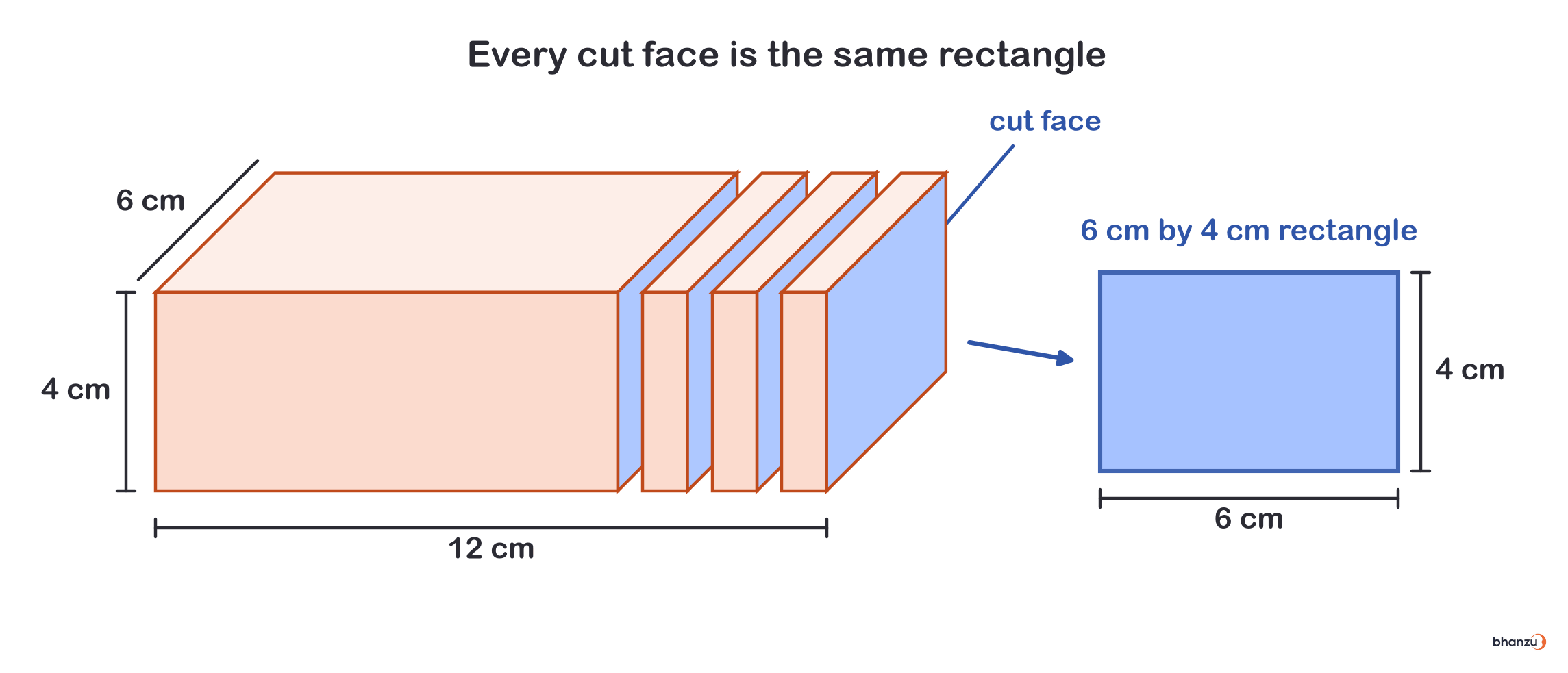
Cross sections of 3D figures are the shapes you see on the cut face when a plane, a perfectly flat surface that stretches forever in every direction, passes through a solid. The solid is 3D, with volume in cubic units. The cross section is 2D, so you measure its area in square units.
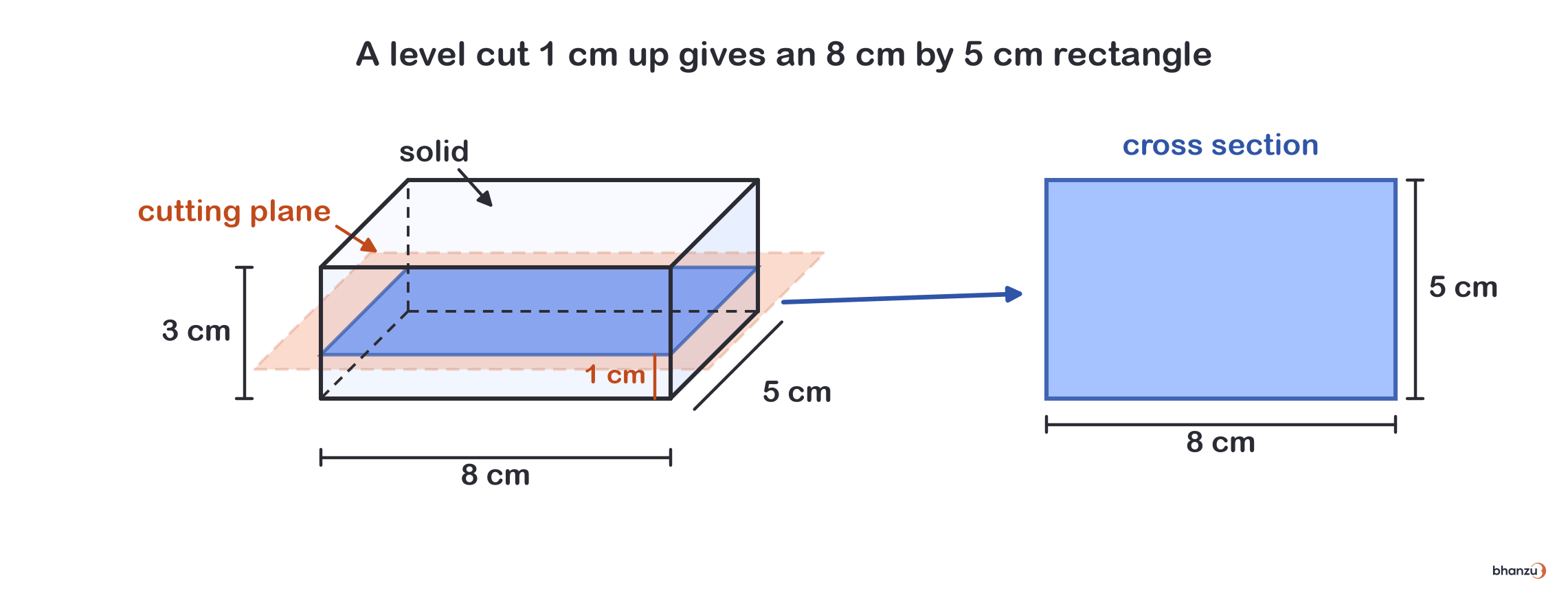
The knife-and-block model makes this concrete. The plane plays a knife with no thickness, and the solid plays the block.
- Touching only a corner leaves a point.
- Grazing only an edge leaves a line segment.
- Passing through the inside leaves a polygon, a flat shape with straight sides, which is the cross section.
Slicing solids is Common Core standard 7.G.A.3, which covers right rectangular prisms, or boxes, and right rectangular pyramids, whose point sits right above the center of a rectangle base. By the end of 7th grade, your child should be able to picture a cut through a box or a pyramid and describe the slice it makes. Its area uses 6th grade formulas.
Geometry gets its own score on the Nation's Report Card. On the geometry scale of the 2024 NAEP mathematics assessment, US public-school eighth graders averaged 269.6, down from 277.7 in 2019, so geometry practice like this is worth the time.
How do you know what shape a cross section will be?
Three checks, in order, predict almost any slice of a box or a pyramid.
- Name the solid, because boxes and pyramids behave differently.
- Name the direction of the cut. A parallel cut runs level with the base, a perpendicular cut goes straight down, and a slanted cut tilts.
- Count the faces the cut crosses, since each face crossed adds one straight side.
Counting faces also sets a ceiling. A box has 6 faces, so its slices have at most 6 sides, and a slanted cut crossing all six makes a hexagon.
| Direction of the cut | Right rectangular prism (box) | Right rectangular pyramid |
|---|---|---|
| Parallel to the base | Rectangle the same size as the base | Smaller rectangle, same shape as the base |
| Straight down, parallel to a base edge | Rectangle as tall as the box | Triangle through the apex, otherwise a trapezoid |
| Slanted | Triangle, quadrilateral, pentagon or hexagon | Triangle, quadrilateral or pentagon |
The checks are fastest for level and straight-down cuts. For a slanted cut, counting faces gives only the most sides possible, and finding the exact shape means tracing where the plane meets each edge, which is slow on paper.
What happens when you slice a rectangular prism?
A rectangular prism gives a rectangle for every cut that runs level with its base or straight down through it. Take a box 8 cm long, 5 cm wide and 3 cm tall.
- Level cuts. Each is an 8 cm by 5 cm rectangle (1 cm up or 2.5 cm up, it makes no difference), congruent to the base, meaning the same size and shape.
- Straight-down cuts. A cut parallel to the front face gives 8 cm by 3 cm, and one parallel to the end face gives 5 cm by 3 cm. An angled straight-down cut still gives a rectangle 3 cm tall, with a width set by where it crosses the base.
- Slanted cuts. A tilted cut may cross 3, 4, 5 or all 6 faces, so the rectangle can disappear.
A child who has only watched bread being sliced tends to picture the knife going straight down every time. The first triangle cut from a box then looks like an error, even when it is right.
What are the cross sections of a rectangular pyramid?
A rectangular pyramid has a rectangle for a base and four triangle faces that meet at one point, the apex. A level cut gives a smaller rectangle of the same shape. A straight-down cut through the apex gives a triangle, and a straight-down cut parallel to a base edge that misses the apex gives a trapezoid, a four-sided shape with two parallel sides.
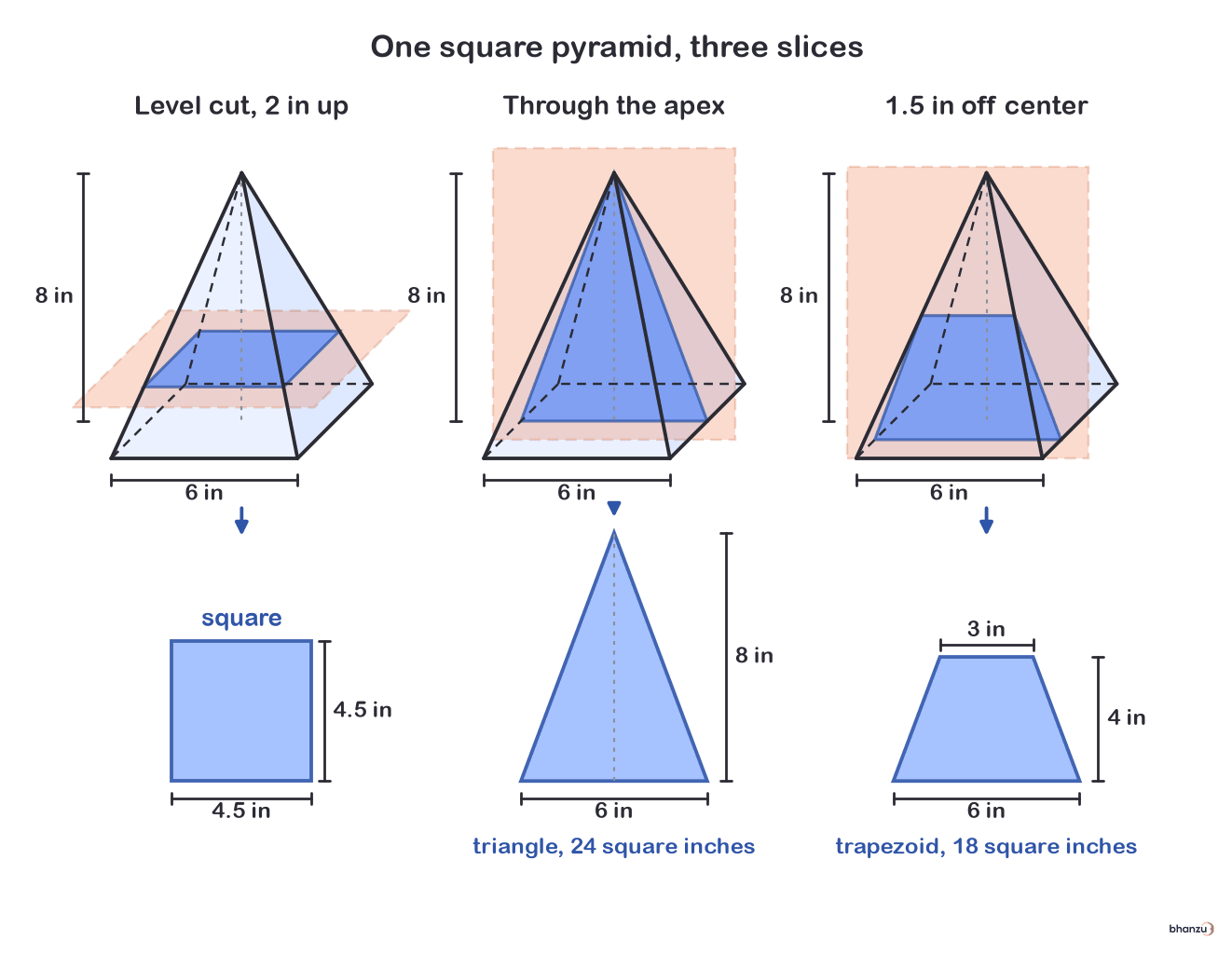
Take a square pyramid (a rectangular pyramid with a square base), 6 in on each side and 8 in tall. A level cut keeps the square shape but shrinks it by this rule.
| Symbol | Meaning | Units |
|---|---|---|
| side length of the base | in | |
| height of the pyramid | in | |
| height of the cut above the base | in | |
| side length of the slice | in |
The rule works because the sides shrink steadily to zero at the apex, so a slice keeps the same fraction of each side as the fraction of height above it. A cut 2 in up leaves 6 in above it.
The slice is a 4.5 in square, similar to the base, which means the same shape in a different size. You'll work with similar figures again in 8th grade.
A straight-down cut through the apex and the center of the base, parallel to a base edge, makes a triangle 6 in wide and 8 in tall. Its area is half of the 6 in by 8 in rectangle that fits around it.
Slide that cut 1.5 in off center and it misses the apex, so the triangle becomes a trapezoid with a 6 in bottom. Halfway up, 4 in above the base, the pyramid is 3 in wide and reaches exactly 1.5 in out from the center. The cut stops there, so the trapezoid is 4 in tall with a 3 in top. Its area is the average of the two parallel sides times the height.
Even adults find the jump from triangle to trapezoid slippery, since the two cuts sit only 1.5 in apart.
Try It Yourself
Pick the box or the square pyramid, then a level cut or a straight-down cut. Drag the knife and watch the flat slice beside the solid, with its side lengths and area. Box slices stay the same as the knife moves, while pyramid slices shrink, and the straight-down triangle turns into a trapezoid once the knife leaves the center.
The real reason cross sections exist
You can't see through a solid object, so a cross section is the next best thing, a view of the inside one flat layer at a time.
- It lets doctors see inside a body without surgery. CT slices are usually 1 to 10 millimeters thick, according to the National Institute of Biomedical Imaging and Bioengineering (2025), so a doctor can step through the body layer by layer.
- It explains the volume of a box. The 8 cm by 5 cm by 3 cm box is a stack of three 1 cm slices, each covering 8 rows of 5 one-centimeter squares, or 40 square centimeters, so its volume is 120 cubic centimeters. That stack is base area times height, the rule behind volume with fractional edge lengths in 6th grade.
- It leads to calculus. Later, you'll find volumes of curved solids by adding very thin slices, a method the OpenStax textbook Calculus Volume 1 calls determining volumes by slicing.
Doctors reading scans and students finding volumes start from the same move, deciding what shape a slice will be before anything gets cut.
Examples of cross sections of 3D figures
Example 1
A shoebox is 30 cm long, 18 cm wide and 12 cm tall. It is sliced parallel to its base, 5 cm above the bottom. Find the area of the cross section.
A level cut copies the base, a 30 cm by 18 cm rectangle.
Example 2
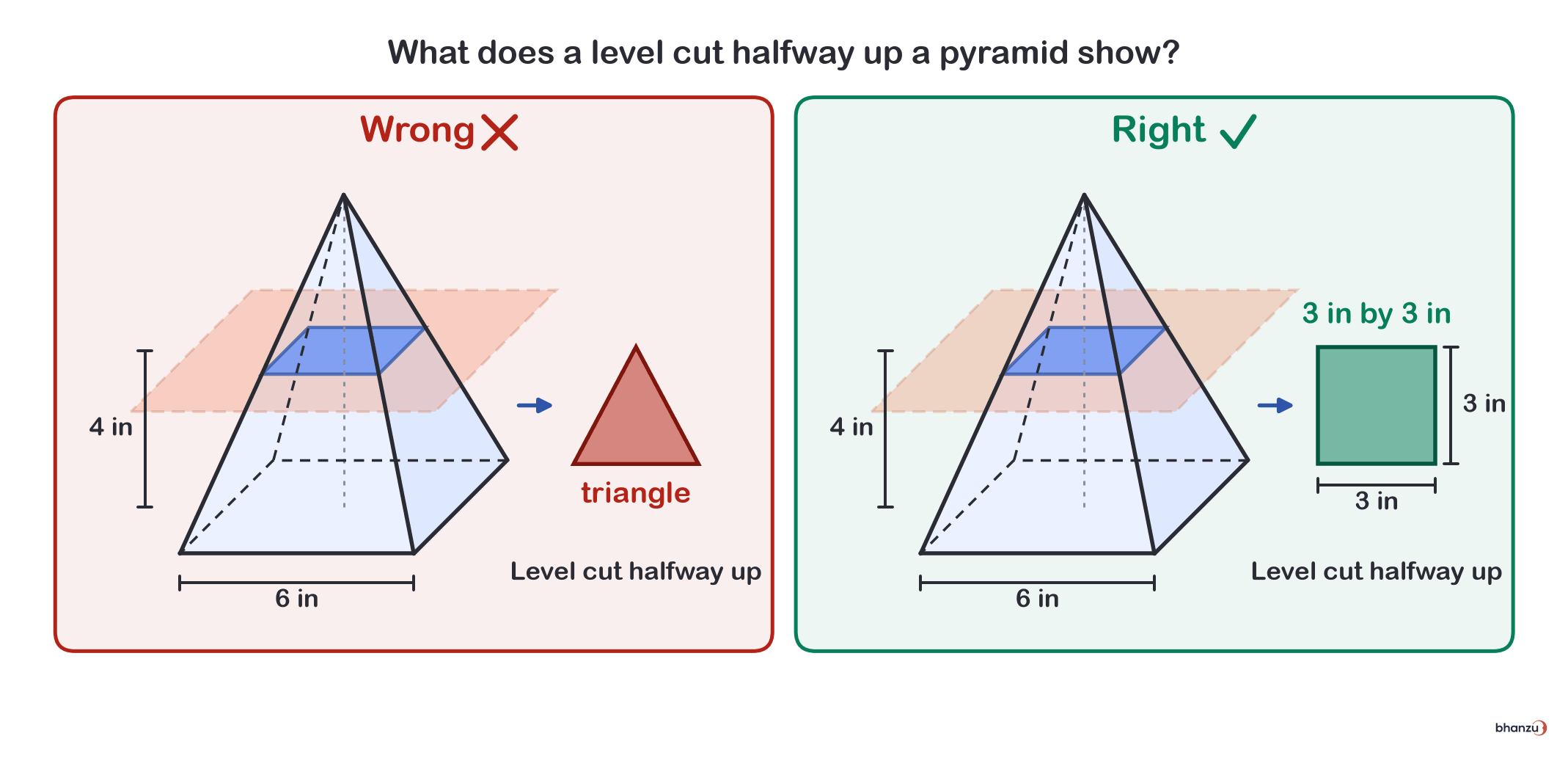
A square pyramid has a 6 in by 6 in base and is 8 in tall. It is sliced parallel to the base, halfway up. Find the area of the cross section.
The tempting move is to copy the base, as level slices of a box do, which gives 36 square inches.
That cannot be right. The pyramid narrows to a point at the apex, so a level slice above the base must be smaller than the base.
Use the shrinking rule with , which leaves 4 in above the cut.
The slice is a 3 in by 3 in square, just one quarter of the base's 36 square inches.
Example 3
A box is 9 cm long, 4 cm wide and 2.5 cm tall. Straight-down cuts run parallel to the 9 cm by 2.5 cm front and to the 4 cm by 2.5 cm end. Which slice is bigger, and by how much?
Each slice is a rectangle 2.5 cm tall.
The slice parallel to the front is bigger by 12.5 square centimeters.
Example 4
A rectangular pyramid has a 10 cm by 6 cm base and is 9 cm tall. A straight-down cut passes through the apex and the center of the base, parallel to the 10 cm edges. Name the cross section and find its area.
The cut makes a triangle with the full 10 cm edge as its base and the 9 cm height as its height.
Example 5
Mei says one flat cut through a square pyramid gave her a hexagon. Is that possible?
A square pyramid has 1 square base and 4 triangle faces, so 5 faces in all. Each face crossed adds one side, so a slice has at most 5 sides.
A hexagon needs 6 sides, so no. The most a square pyramid allows is a pentagon.
Example 6
Diego cuts a cheese block 12 cm long, 6 cm wide and 4 cm tall into 0.5 cm slices, parallel to the 6 cm by 4 cm end. Find the area of each cut face and the number of slices.
Each cut face copies the end, a 6 cm by 4 cm rectangle.
Check with volume.
What most guides miss about cross sections
Most explanations list the shapes a box makes and stop, but the reason behind that list covers pyramids too. For solids with flat faces and no dents, a flat cut meets each face it crosses along one straight line, so the number of faces caps the number of sides.
- A box, with 6 faces, can give a hexagon.
- A square pyramid, with 5 faces, stops at a pentagon.
Can a cross section of a cube be a triangle? Yes. Cut a 4 cm cube through the three points 2 cm from one corner along its edges, and the slice crosses 3 faces to make a triangle with three equal sides.
Pyramid slices also lose area faster than width. Halfway up, a level slice keeps half of each side but a quarter of the area. Three quarters of the way up, it keeps a quarter of each side and one sixteenth of the area.
Cross sections: where intuition breaks
Mistake 1: Calling every pyramid slice a triangle
Where it slips in: Level cuts through a pyramid, as in Example 2, when a child answers from the solid's name alone ("pyramid, so triangle") because its side faces are triangles.
Don't do this: Say the 6 in square pyramid, cut level halfway up, shows a triangle.
The correct way: That level cut gives a 3 in by 3 in square. A triangle needs a cut crossing exactly 3 faces, such as a straight-down cut through the apex.
Mistake 2: Drawing the net instead of the slice
Where it slips in: Right after 6th grade nets of 3D figures, while unfolding is still fresh.
Don't do this: Sketch six unfolded rectangles for the 8 cm by 5 cm by 3 cm box sliced level with its base.
The correct way: Draw one 8 cm by 5 cm rectangle. A net unfolds the outside surface of a solid, while a cross section shows one flat cut through its inside.
Children who have just finished nets often draw all six faces when asked for one slice, because both tasks turn a solid into flat shapes.
Mistake 3: Assuming every slice of a box is a rectangle
Where it slips in: Slanted cuts through a box, especially a cut that clips off one corner.
Don't do this: Call the corner slice of the 8 cm by 5 cm by 3 cm box a small rectangle.
The correct way: That cut crosses only the 3 faces meeting at the corner, so it leaves a triangle. Slanted cuts through a box leave 3, 4, 5 or 6 sides.
Habit causes this one. Every face of a box is a rectangle, so a rectangle feels like the only shape a box can hold.
Key Takeaways
- Check the direction of the cut before naming a slice, because one pyramid can give a square, a triangle or a trapezoid.
- Count the faces a cut crosses to find the most sides its slice can have.
- For a level pyramid slice, multiply each base side by the fraction of the height above the cut.
- Cross sections of 3D figures are always flat, so you measure them in square units.
- For more practice measuring pyramid slices with a teacher who catches the "every pyramid slice is a triangle" mix-up, explore Bhanzu's 7th grade math tutor sessions or a geometry tutor.
Read More
- Rational Number Word Problems
- Angle-Angle Similarity
- Visualizing Solid Shapes
- Square Pyramid
- Triangular Prism
Research Behind This Article
- Nobel Prize Outreach, Godfrey N. Hounsfield: Facts, The Nobel Prize in Physiology or Medicine 1979 (2026). nobelprize.org
- NGA Center and CCSSO, Common Core State Standards for Mathematics: Grade 7 Geometry (2010). thecorestandards.org
- National Center for Education Statistics, The Nation's Report Card: 2024 Mathematics, Grades 4 and 8 (2025). nationsreportcard.gov
- National Center for Education Statistics, NAEP Data Service API Documentation (2026). nationsreportcard.gov
- National Institute of Biomedical Imaging and Bioengineering, Computed Tomography (CT) (2025). nibib.nih.gov
- OpenStax, Gilbert Strang and Edwin Herman, Calculus Volume 1, 6.2 Determining Volumes by Slicing (2016). openstax.org
Quick Quiz: Check Yourself
Three levels, new numbers every time: find a box slice's area, measure a pyramid slice, then count a block's slices or decide whether a slice shape is possible.
Was this article helpful?
Your feedback helps us write better content
Frequently Asked Questions
What is the cross section of a cube?
How do you find the cross section of a rectangular prism?
Is the cross section of a sphere and a cylinder the same?
What grade learns cross sections of 3D figures?
How can I help my child with cross sections of 3D shapes at home?