Key Points
- Whole numbers are 0, 1, 2, 3 and onward with no end, and integers are those whole numbers together with the negatives , , and onward.
- Every whole number is also an integer, and every integer is also a rational number, meaning a number you can write as a fraction of integers, such as .
- A frequent mistake with whole numbers and integers is judging a number by how it looks, so 18/3 gets called a fraction even though it equals 6.
- Sixth graders sort numbers into these sets under Common Core cluster 6.NS.C, and adding and subtracting integers follows in 7th grade.
Debts that turned into numbers
In 628, a mathematician named Brahmagupta wrote rules for numbers below zero. He called them debts, and he called positive numbers fortunes. One of his rules says that taking a debt away from zero leaves a fortune, and negative numbers still behave exactly that way.
Owing five dollars and having five dollars are opposite situations, so they need different numbers. Ordinary counting could never show the difference. Brahmagupta's debts could.
The split between kinds of numbers matters far from school. Weather forecasters report temperatures below zero, and mapmakers record land that lies below sea level. Programmers decide whether a computer stores a value as an integer or as a decimal, because the machine saves the two in different ways.
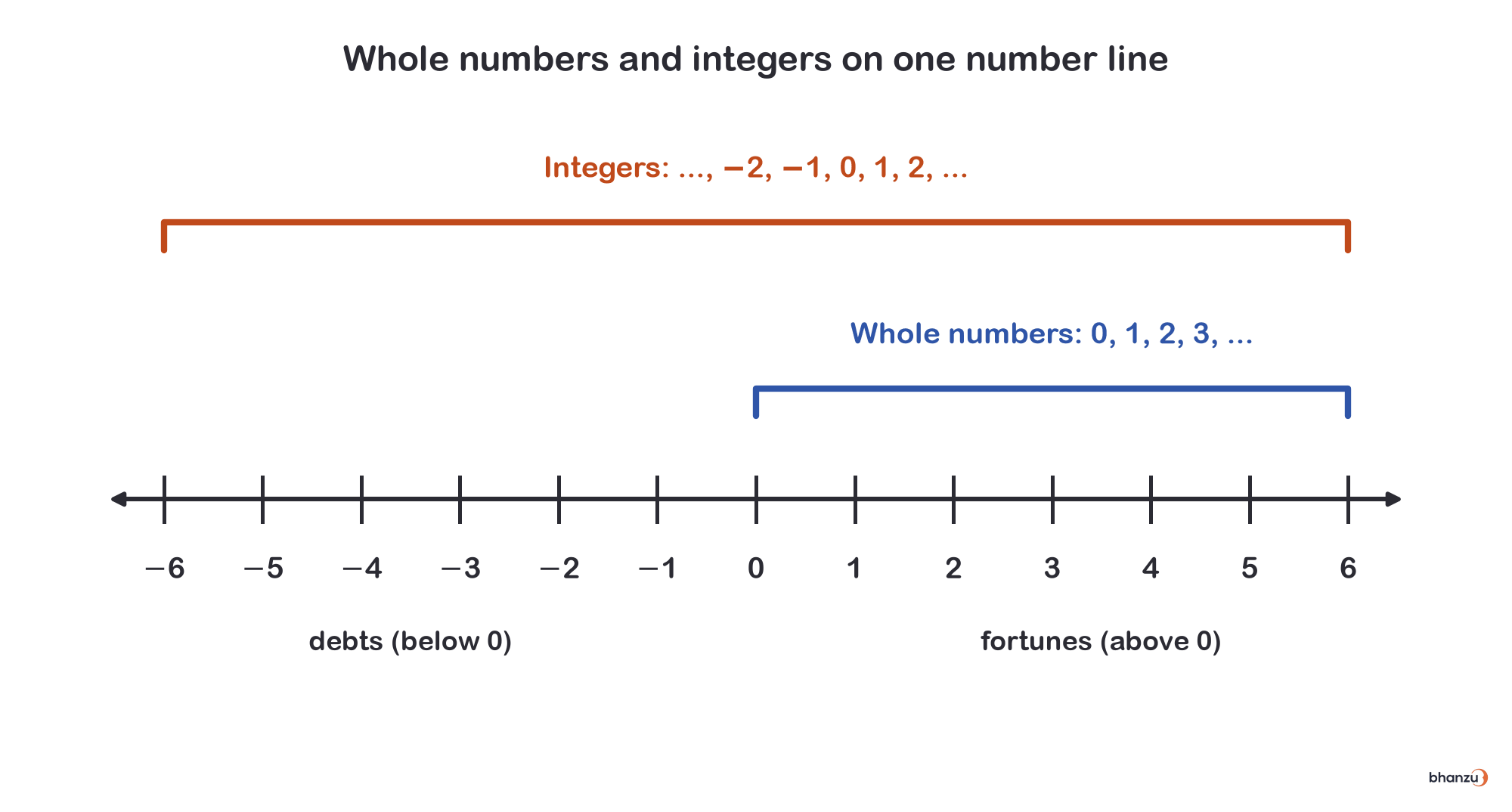
What are whole numbers and integers?
Whole numbers and integers are the numbers that land exactly on the tick marks of a number line marked in ones. The whole numbers are 0, 1, 2, 3 and so on to the right. The integers add their opposite numbers (the same distance from 0 on the other side), so they also run left through , , and beyond.
Whole numbers are never negative. Every whole number except 0 is positive, and 0 is neither positive nor negative, because it separates the two sides. The difference between whole numbers and integers is one group, the negative integers.
| Set | Where it starts | Includes negatives? | Examples |
|---|---|---|---|
| Whole numbers | 0 | No | 0, 4, 19, 250 |
| Integers | No starting point | Yes | , , 0, 7 |
Between two integers next to each other, such as 2 and 3, there are no integers at all. Numbers in that gap, such as 2.5, are the ones you placed with decimals on the number line in 5th grade.
Your child has used whole numbers since kindergarten, so the new work in 6th grade is placing negative numbers on the same line and deciding which set each number belongs to.
How do whole numbers, integers and rational numbers fit together?
Whole numbers, integers and rational numbers fit together like rings inside rings, where each bigger set holds every number from the sets inside it. From the innermost ring outward, there are four sets.
- Counting numbers. The numbers 1, 2, 3, 4 and so on that you use to count objects, also called natural numbers.
- Whole numbers. The counting numbers plus 0.
- Integers. The whole numbers plus their negatives, such as and .
- Rational numbers. Every number you can write as a fraction , where and are integers and is not 0, such as 2.5 (which is ) and .
Every integer is rational too, because it can be written over 1, as in . Drawn as a picture, the rational numbers and the rings inside them make a Venn diagram with each circle completely inside the next. This sorting work belongs to Common Core cluster 6.NS.C, and standard 6.NS.C.6.c asks 6th graders to "find and position integers and other rational numbers" on a number line.
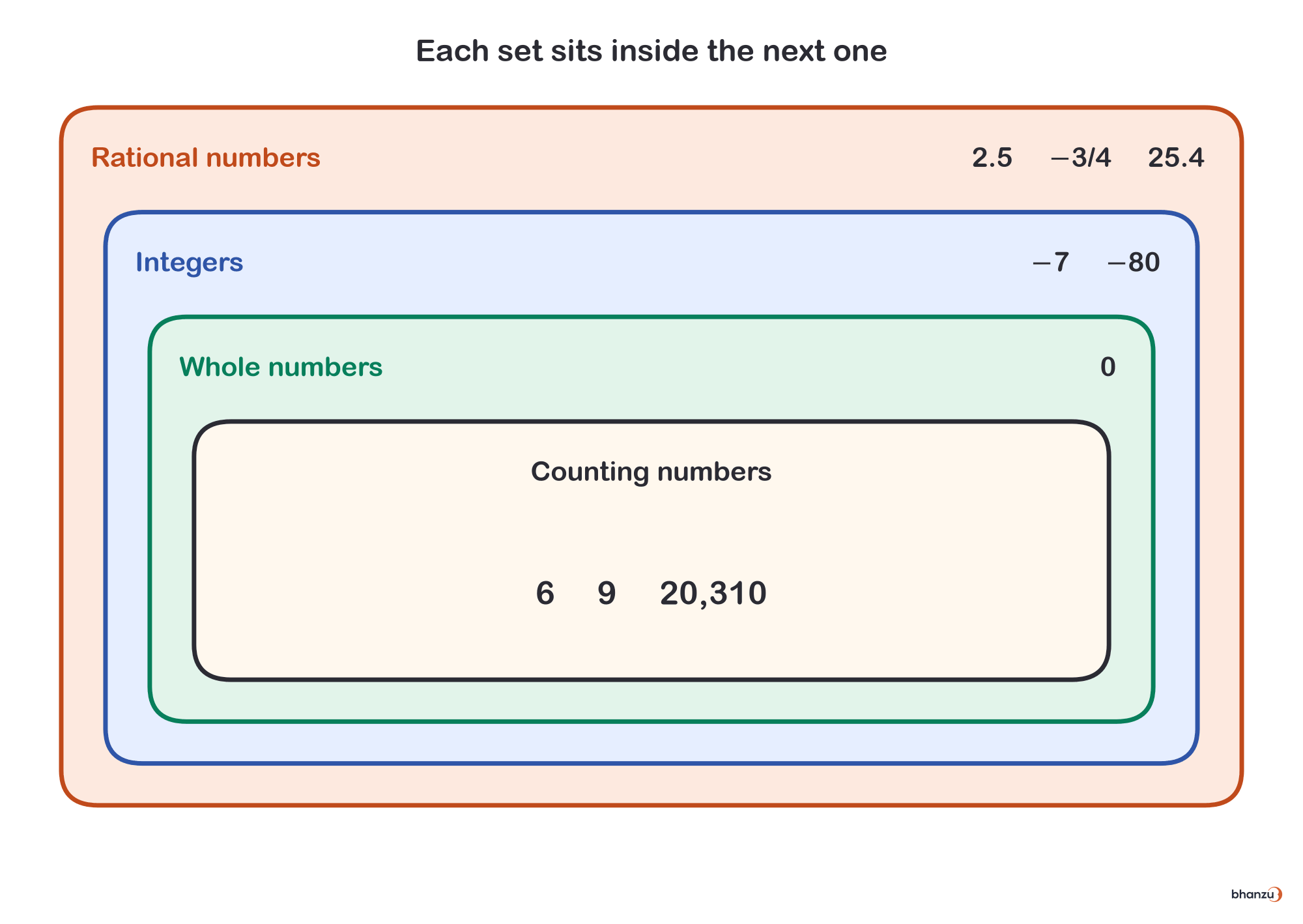
Are all whole numbers integers? Yes. Every whole number lives inside the integer ring, but shows that the reverse fails, because it is an integer and not a whole number.
Books disagree about one ring, and the word "natural" gives no clue whether 0 belongs, which makes it one of the more confusing names in school math. US textbooks such as OpenStax Prealgebra start the counting numbers at 1 and the whole numbers at 0, and that is the convention used here.
How do you classify a number?
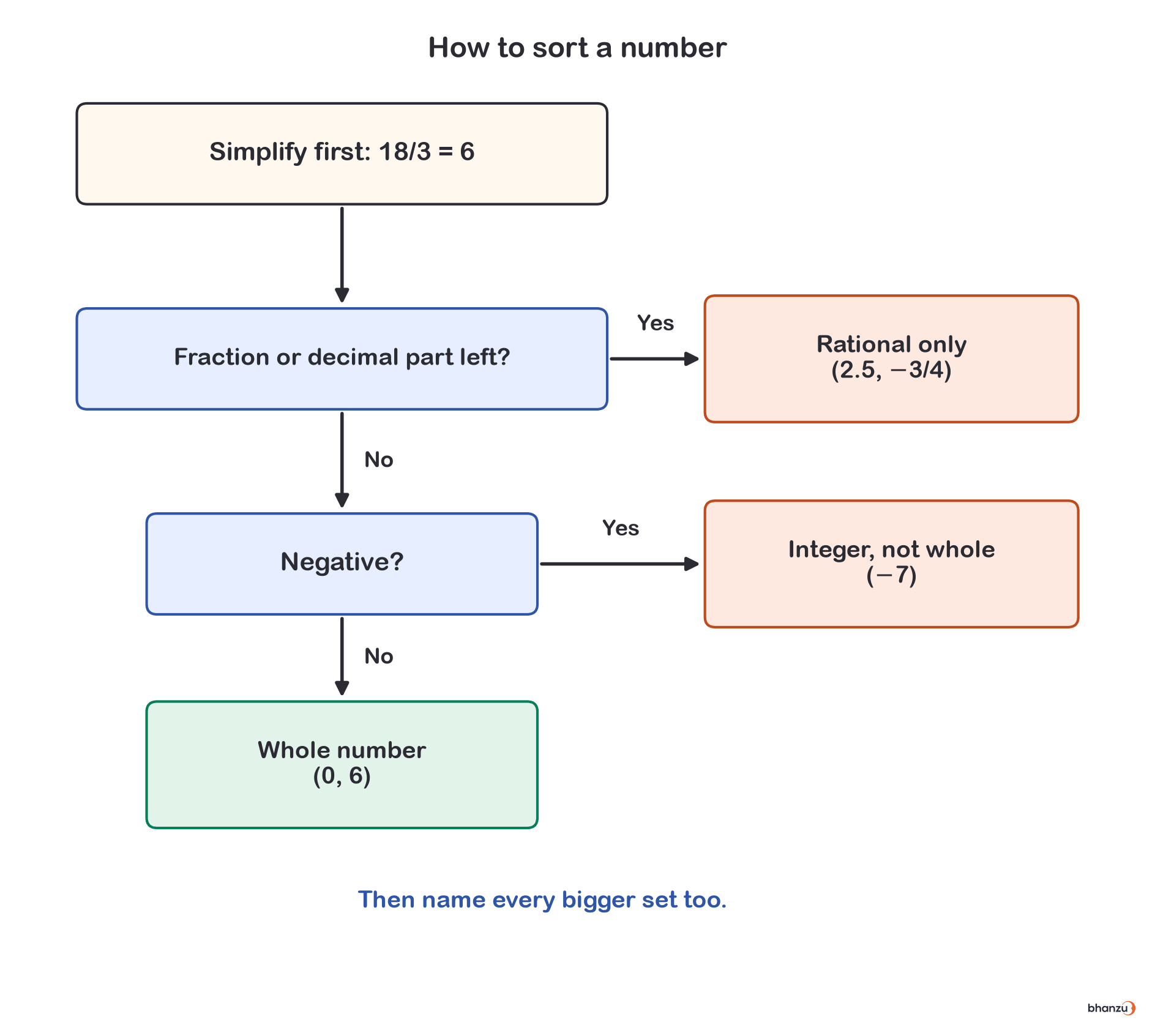
To classify a number, find its simplest value first, and only then check its sign and anything left over. These five steps sort any fraction or decimal you meet in 6th grade.
- Simplify or divide first, so becomes 6, 4.0 becomes 4 and becomes .
- Look for a part left over. If a fraction or decimal part remains, as in 2.5 or , the number is rational but not an integer.
- Check the sign. A negative number with nothing left over, such as , is an integer but not a whole number.
- Call everything else a whole number, such as 0 and 6.
- Name every set the number belongs to, from the smallest ring outward, so 6 is a whole number, an integer and a rational number.
Exact measurements can land between tick marks too. Since July 1, 1959, the inch has been exactly 25.4 millimeters, a definition that NIST's page on length units still lists in its 2025 update.
So 25.4 is rational but not an integer, even though nothing about it is rounded. The opposite trap catches a child who spots the decimal point in 4.0 and writes "rational only" without seeing that nothing comes after the point. In this table, every answer depends on the value, not on how it is written.
| Number | Same value written another way | Whole number? | Integer? | Rational? |
|---|---|---|---|---|
| 4 | and 4.0 | Yes | Yes | Yes |
| No | Yes | Yes | ||
| 2.5 | and | No | No | Yes |
| 0 | Yes | Yes | Yes | |
| No | No | Yes |
Is 0 a whole number? Yes, it is the smallest one, and it is also an integer and a rational number.
Do integers include fractions? Only fractions that simplify to an integer, like , so stays outside the integer ring. The five steps stop working at numbers like , which no fraction of integers can equal. Those irrational numbers arrive in 8th grade.
Try It Yourself
Drag the dot along the number line (or use the arrow keys) and watch which rings light up. A dot on 0 or a positive numbered mark lights all three rings, a negative numbered mark lights two, and a small half mark between them lights only the rational ring. Press the fraction button to rewrite the number, and notice that the rings stay the same.
Examples of whole numbers and integers
Example 1
Classify as a whole number, an integer, a rational number or more than one of these.
is negative with nothing left over, so it is an integer but not a whole number.
Written over 1, it is also rational. So is an integer and a rational number.
Example 2
Is an integer?
The tempting answer is no, because has a fraction bar, and fractions feel like the opposite of integers.
That answer cannot be right. Dividing gives , and 6 sits on a tick mark, exactly where integers live. Simplify first, then classify.
So is a whole number, an integer and a rational number.
Example 3
Sort , 0, 9, and by the smallest set each number belongs to.
None of them needs simplifying.
| Smallest set | Numbers |
|---|---|
| Whole numbers | 0 and 9 |
| Integers, not whole | |
| Rational, not integers | and |
Example 4
How many integers lie between and , and how many of those are whole numbers?
The integers between them are , , 0, 1, 2 and 3, which makes 6 integers.
The whole numbers among them are 0, 1, 2 and 3, which makes 4 whole numbers.
Example 5
Is each statement true or false? (a) Every integer is a whole number. (b) Every whole number is a rational number.
(a) False, because is an integer but not a whole number.
(b) True, because any whole number can be written as , such as .
Example 6
Diego wrote down five temperatures in degrees Fahrenheit during a cold week, , 0, 2.5, and 6. One night the temperature fell 9 degrees in 3 hours, a change of degrees per hour. Which of the six numbers are integers, and which are whole numbers?
Simplify the fraction first.
The integers are , 0, , 6 and , which is 5 numbers. The whole numbers among them are 0 and 6. The reading 2.5 is rational but not an integer.
Whole numbers and integers beyond the textbook
Each set exists because people kept meeting amounts that a smaller set could not record. A count, a height, a temperature and a measurement can each need a different ring.
- Whole numbers count what you can hold. You can own 0 pencils or 12 pencils but never pencils.
- Whole numbers often record heights above sea level. The tallest peak in North America, in Alaska's Denali National Park, rises 20,310 feet, according to the National Park Service's Denali page, updated in October 2026.
- Negative integers often record cold below zero. Alaska's lowest recorded temperature is , measured at Prospect Creek on January 23, 1971, according to a 2026 state climate summary from NC State University's climate institute.
- Negative integers track money owed. A debt of $12 can be written as dollars, the same idea Brahmagupta called a debt in 628.
- Rational numbers measure between the marks. A pencil 5.5 inches long ends halfway between two inch marks on a ruler.
Without negative integers, that 1971 reading at Prospect Creek could only be described in words, never written as a number.
Where do kids trip up on whole numbers and integers?
Mistake 1: Judging a fraction by its fraction bar
Where it slips in: Fractions that divide evenly, such as or . Children who have spent several school years on fractions read the fraction bar as the label and stop there.
Don't do this: Saying that is a fraction, so it is not an integer.
The correct way: Divide first, , so is a whole number, an integer and a rational number.
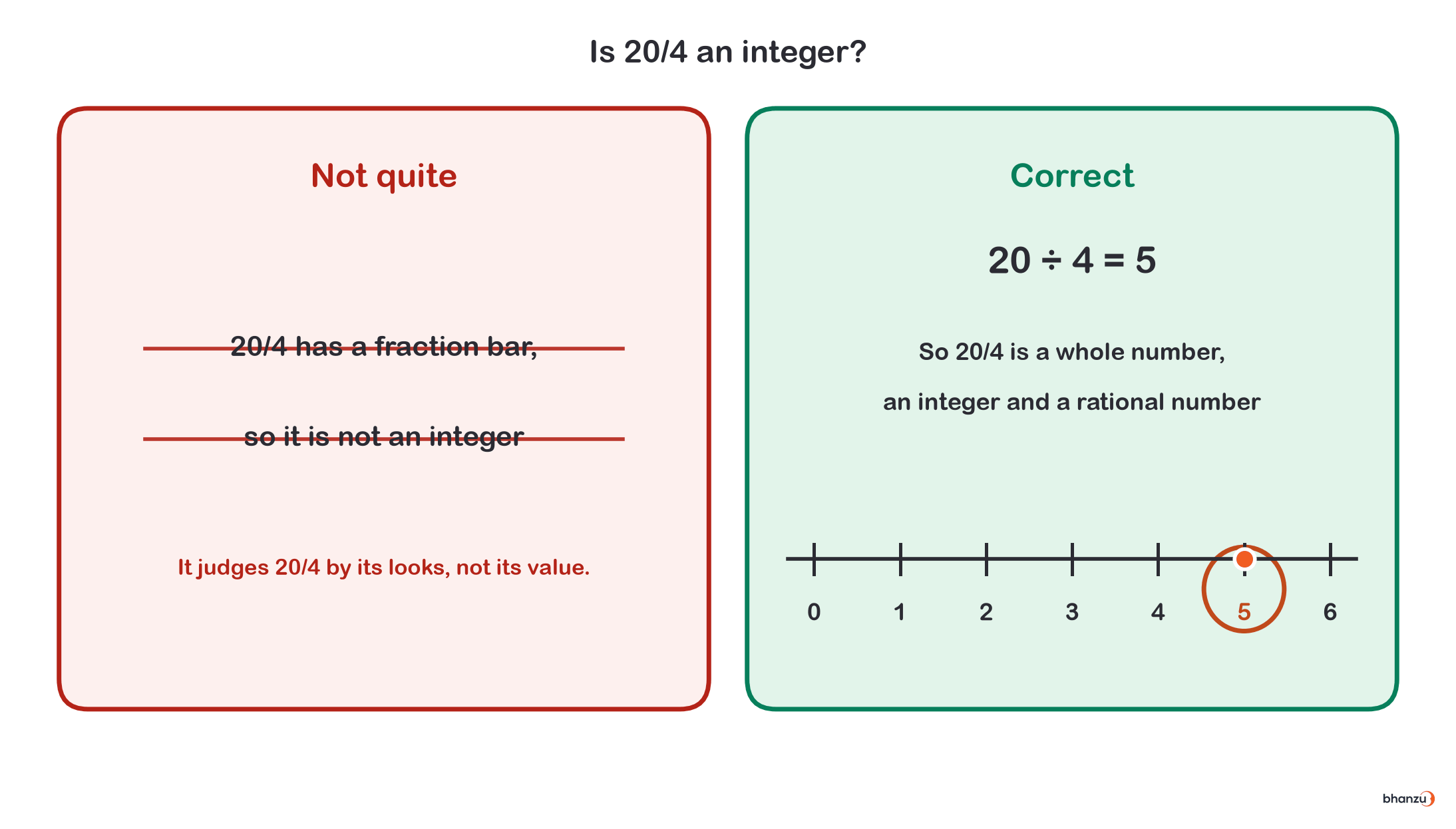
A child who rushes to sort by looks can make this mistake one problem after dividing correctly, because glancing at the form is faster than finding the value.
Mistake 2: Leaving 0 out of the whole numbers
Where it slips in: Writing out the whole numbers, or sorting 0 in Example 3. Counting starts at 1, and books disagree about 0 in the natural numbers, so the starting point blurs.
Don't do this: Writing "the whole numbers are 1, 2, 3 and so on" or calling 0 a positive whole number.
The correct way: Start the whole numbers at 0. The counting numbers are the set that starts at 1, and 0 is neither positive nor negative.
Mistake 3: Calling negative integers whole numbers
Where it slips in: Numbers such as , which have no decimal part. In everyday talk "whole" means not broken into pieces, so feels as if it should count.
Don't do this: Calling a whole number because it has no fraction part.
The correct way: Call an integer, not a whole number, because integers include the negatives and whole numbers do not. The reverse trap is real too, since is negative but not an integer.
What most guides miss about whole numbers and integers
A number has one value but can carry several labels at once, and every label comes from the value, never from how the number is written. That idea changes two habits.
- "Integer or whole number?" is often the wrong question. For 6 the answer is both, and rational as well, because each set is a subset of the next, meaning every member of the smaller set also belongs to the bigger one. A child who has written "whole number" next to 6 will sometimes cross out "integer", sure that a number fits only one set.
- The minus sign never decides alone. is an integer while is not, because the sign only tells you which side of 0 a number is on.
In 7th grade you will add, subtract, multiply and divide integers and other rational numbers, so the labels you practice now name the numbers those rules work on.
Key Takeaways
- Divide or simplify before you label a number, since and 6 carry the same labels.
- Whole numbers and integers agree on every number from 0 upward, so only the negatives tell them apart.
- A negative number with a decimal part, such as , is rational but not an integer.
- Zero belongs to all three sets even though it is neither positive nor negative.
- For more practice spotting fractions like that are really integers, with a teacher who catches the fraction-bar mistake, explore Bhanzu's 6th grade math curriculum or the Common Core math curriculum.
Read More
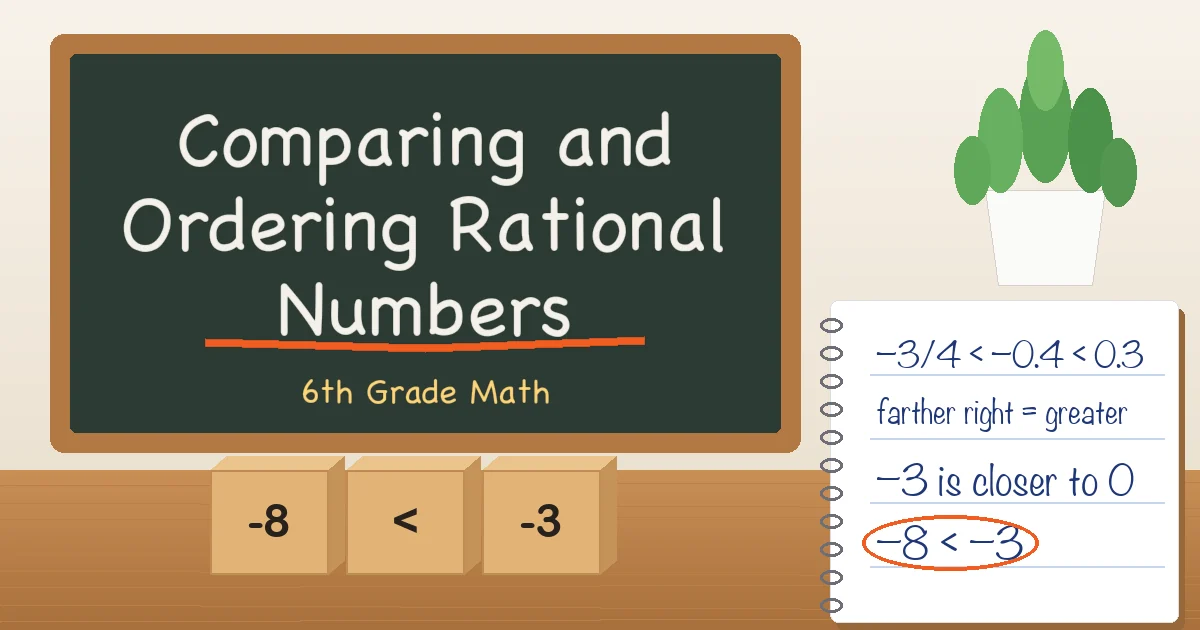
- Comparing and Ordering Rational Numbers
- Properties of Operations
- Whole Numbers
- Integers
- Real Numbers
- Negative Numbers
Research Behind This Article
- MacTutor History of Mathematics (University of St Andrews), Brahmagupta (2000). mathshistory.st-andrews.ac.uk
- Common Core State Standards Initiative, Grade 6 The Number System (2010). thecorestandards.org
- OpenStax, Prealgebra 2e, 7.1 Rational and Irrational Numbers (2020). openstax.org
- National Institute of Standards and Technology, SI Units: Length (2025). nist.gov
- National Park Service, Denali National Park and Preserve (2026). nps.gov
- North Carolina Institute for Climate Studies, 2025 State Climate Summaries for the United States: Alaska (2026). statesummaries.ncics.org
Quick Quiz: Check Yourself
Three levels, new numbers every time: name the smallest set for a single number, sort a fraction after simplifying it, then count the integers or whole numbers in a range or a list.
Was this article helpful?
Your feedback helps us write better content
Frequently Asked Questions
What is the difference between natural numbers and integers?
Are all integers real numbers?
Is every number an integer?
Is a negative fraction an integer?
How do I teach integers to my child at home?
What should a 6th grader know about whole numbers and integers?