Key Points
- Two numbers are opposites when each one is the same number of units from 0 but on a different side, so 7 and are opposite numbers.
- To find the opposite of a number, change its sign, so the opposite of is 2.5, while 0 stays its own opposite.
- A mistake to watch for is reading as extra negative and writing , when the opposite of is 8, since two flips over 0 land back at the start.
- A number and its opposite always add to 0, which two-color counters show as zero pairs, and Common Core places opposite numbers in 6th grade under standard 6.NS.C.6.a.
A desert floor below sea level
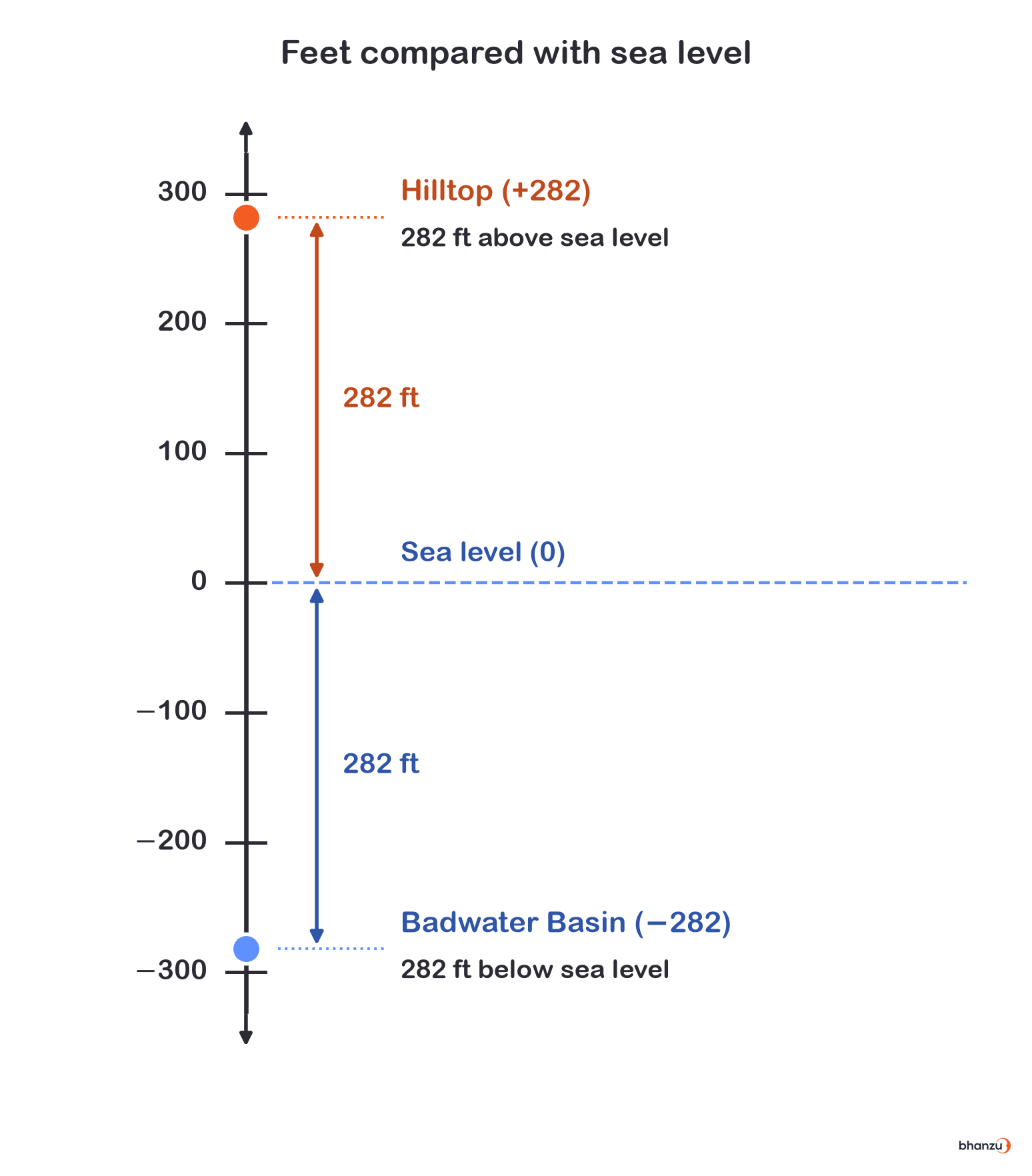
The lowest point in North America sits 282 feet below sea level. It's Badwater Basin in Death Valley, California, and the National Park Service gives that depth on a page it updated in January 2026. Call sea level 0. Then Badwater Basin sits at negative 282 feet, and a hilltop 282 feet above the sea would sit at positive 282.
Those two heights are the same distance from 0, one on each side, which makes them a pair of opposite numbers. Ocean scientists use numbers above and below 0 to map trenches far below sea level, and weather forecasters use them for winter temperatures below zero. Space scientists use them to compare the warmest and coldest temperatures on Mars.
What are opposite numbers?
Opposite numbers are a pair of numbers at equal distances from 0 on a number line, one to the right of 0 and one to the left, such as 5 and . Zero acts like a mirror in the middle of the line. A positive number, written with a plus sign or with no sign at all, sits to the right of 0, and a negative number, written with a minus sign, sits to the left. The counting numbers, their opposites and 0 together form the integers.
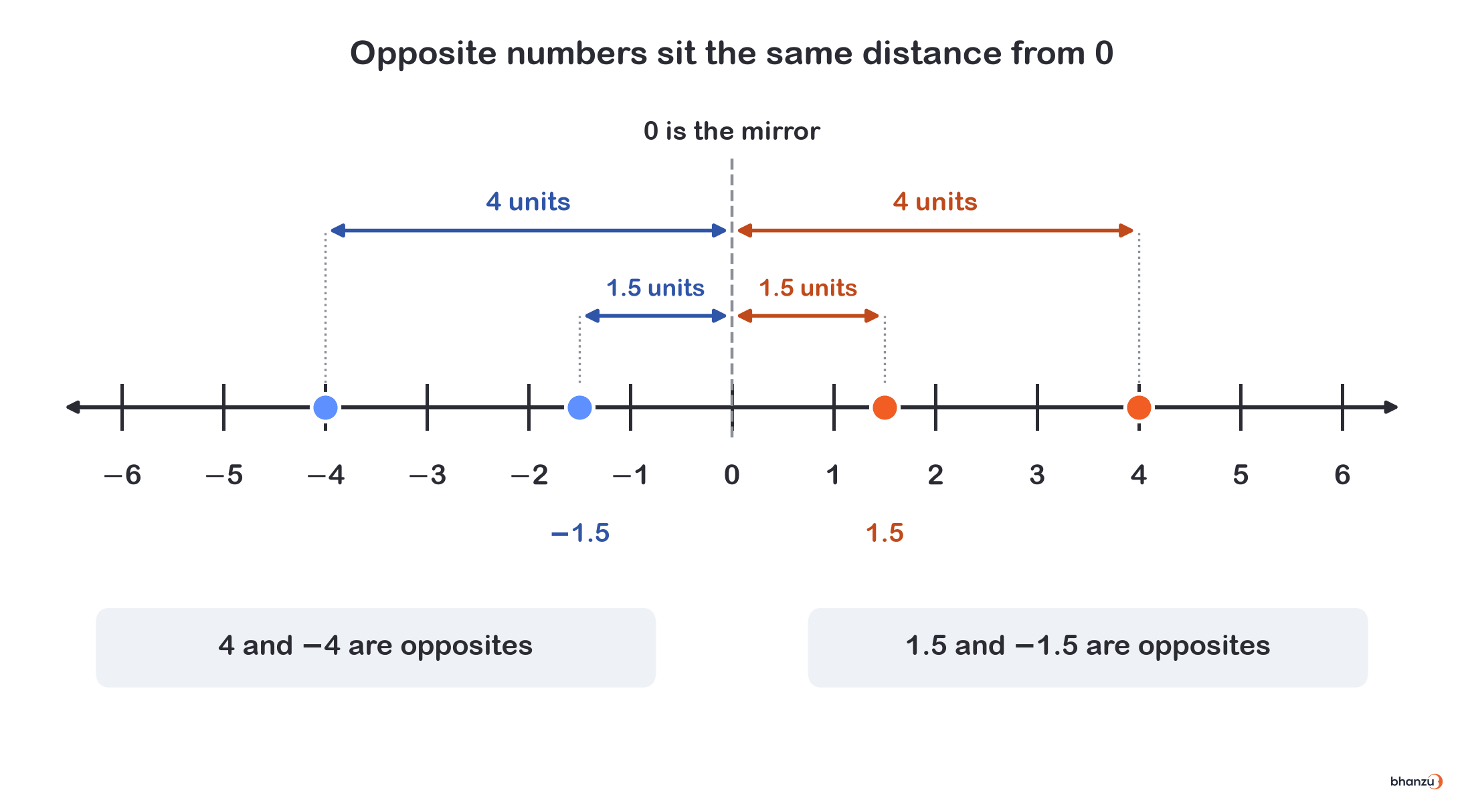
Common Core standard 6.NS.C.6.a asks 6th graders to read opposite signs as locations on opposite sides of 0. The same standard adds that the opposite of the opposite of a number is the number itself, and that 0 is its own opposite. By the end of 6th grade, your child should be able to place any number and its opposite on a number line and explain why equals 3 in plain words.
How do you find the opposite of a number?
To find the opposite of a number, keep its digits and change its sign. A positive number becomes negative, and a negative number becomes positive, so the opposite of is 9. On a number line, the same move is a jump over 0.
- Find how far the number is from 0. For , that's 9 units.
- Jump the same distance on the other side of 0. Nine units to the right of 0 is 9.
- Check that the two numbers are the same distance from 0, one on each side.
What is the opposite of 0? Zero is its own opposite. It is 0 units from 0, so there is no other side to jump to.
Fractions and decimals follow the same rule. The number 2.5 sits halfway between 2 and 3, the way you place decimals on the number line, so its opposite sits halfway between and .
| Number | Opposite | Distance from 0 (each) |
|---|---|---|
The last column is each number's absolute value, its distance from 0, and both numbers in a pair share it. That's why a number and its opposite are twice that distance apart, so 2.5 and are 5 units apart. The jump over 0 gets slow for a number like (you'd need a very long line), so changing the sign is the everyday method.
What does the opposite of the opposite mean?
The opposite of the opposite of a number is the number itself, so . Read the outside minus sign as the words "the opposite of" and the puzzle disappears, because becomes the opposite of negative 3. On a number line, that takes two flips over 0.
- Start at 3.
- Take the opposite and land on , which is 3 units left of 0.
- Take the opposite again and land back on 3.
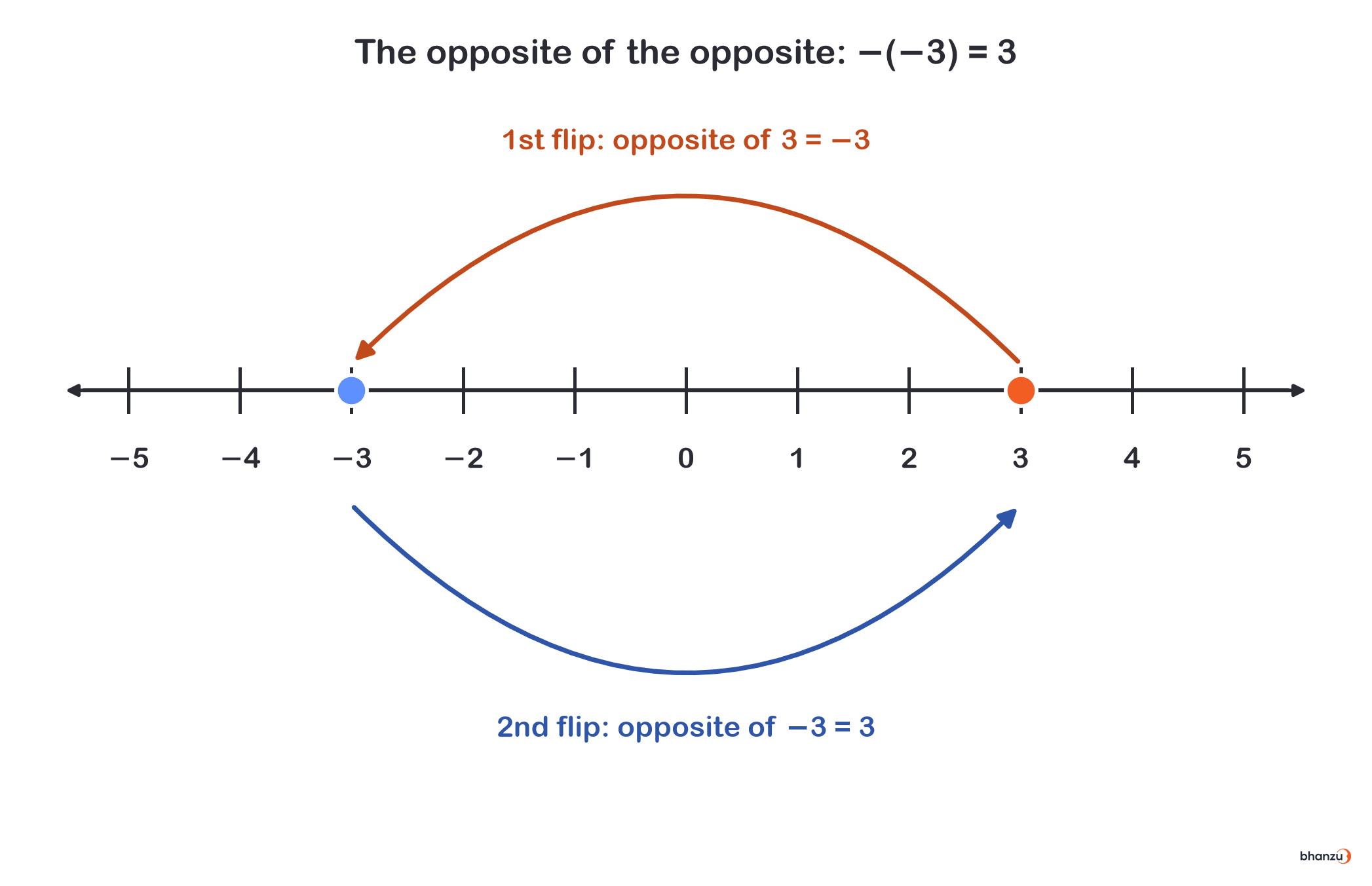
Why is the negative of a negative number positive? Two flips over the same mirror put you back where you began. A third flip sends you across again.
Count the "opposite of" signs in front of a number. An even count leaves the number where it started, and an odd count moves it to the other side of 0. The same reading works on a letter. If , then is the opposite of , which is 6, so can be positive even though it starts with a minus sign.
Children reading aloud often say "minus minus three" and then lose track of which sign belongs to the number. Saying "the opposite of negative three" keeps the two signs apart, and a child who second-guesses the positive answer can check it with two flips on the line.
What happens when you add opposite numbers?
A number plus its opposite always equals 0, and two-color counters show why. Let an orange counter stand for and a blue counter stand for , so one orange and one blue together make 0, a zero pair (the OpenStax Prealgebra textbook calls it a neutral pair).
With 4 orange counters for 4 and 4 blue counters for , four zero pairs form and nothing is left over.
The number line tells the same story. Walk 4 units right from 0, then 4 units left, and you're standing on 0 again.
Mathematicians call a number's opposite its additive inverse, the number you add to it to make 0. Any number works this way, since adding walks the same distance back to 0.
So and . In 7th grade, these zero pairs become the main tool for adding and subtracting negative numbers.
Try It Yourself
Drag the orange dot along the number line, and its blue opposite jumps to the matching spot on the other side of 0. Each orange counter below the line pairs with a blue one, so a number and its opposite always add to 0. Tap Flip twice to take the opposite of the opposite and watch the dot land back where it started.
Examples of opposite numbers
Example 1
What is the opposite of ?
The number is 14 units to the left of 0.
Jump 14 units to the right of 0 instead.
The opposite of is 14. Check with the sum, .
Example 2
Simplify .
Two minus signs in a row look extra negative, so a fast answer is .
That answer can't be right. Taking an opposite moves a number to the other side of 0 (only 0 stays put), but is exactly where the number inside the brackets already was. A number and its opposite must also add to 0, and 8 blue counters with 8 more blue counters make no zero pairs at all.
Read the outside sign as "the opposite of" instead, so the expression means the opposite of . Since is 8 units left of 0, its opposite is 8 units right of 0.
Check with the sum, .
Example 3
Point A is at on a number line, and point B is the opposite of point A. Where is point B, and how far apart are the two points?
Point A is 3.5 units left of 0, so point B is 3.5 units right of 0, at 3.5.
From A to 0 is 3.5 units, and from 0 to B is another 3.5 units.
The two points are 7 units apart.
Example 4
When , is positive or negative? Find its value.
Read as "the opposite of ."
The opposite of is 13.
So , which is positive.
Example 5
Simplify .
Start inside, with .
The opposite of is .
Taking the opposite once more moves back across 0 to .
Check by counting signs. Three minus signs make an odd count, so the answer sits left of 0.
Example 6
Leo's bank balance is $-$35$ because he owes $35. What deposit brings it to $0? His sister Priya's balance is the opposite of Leo's, so how many dollars apart are their balances?
The opposite of is 35, and , so a $35 deposit does it.
Priya has the opposite of $-$35$, which is $35, so Leo is 35 dollars below 0 and Priya is 35 dollars above 0.
Their balances are $70 apart.
The real reason opposite numbers exist
A signed number packs two facts into one symbol, how far it is from a starting point and in which direction. Its opposite is the same trip, taken the other way.
- It measures the deep ocean. NOAA's National Ocean Service, on a page updated in September 2026, says Challenger Deep is about 35,876 feet deep, so its elevation is about feet. The trench is almost three times as deep as the ocean's average depth of about 12,080 feet.
- It compares extremes fairly. NASA's Mars facts page, updated in July 2026, says Mars can warm to 70 degrees Fahrenheit or drop to about degrees Fahrenheit. The opposite of is 225, more than three times 70, so the cold end sits much farther from 0 than the warm end.
- It makes undoing easy to see. A $20 deposit is and a $20 withdrawal is , and together they leave a balance exactly where it started.
Next comes comparing and ordering rational numbers, where opposites turn the order around, so 5 is greater than 2 but is less than .
What most guides miss about opposite numbers
The minus sign does three different jobs, and opposite numbers depend on the third one. That is genuinely confusing, because all three jobs share one short dash.
- Subtract. In , the sign tells you to take 4 away from 9.
- Name a negative number. In , the sign is part of the number, the spot 4 units left of 0.
- Take the opposite. In or , the sign means "the opposite of" whatever comes next.
In a 2004 study in the journal Learning and Instruction, Joelle Vlassis interviewed twelve students working at an 8th-grade level about what the minus sign meant to them. She reports that one kind of change in their thinking grew from a wider, more flexible use of the sign.
What is the opposite number for ? It is , read "the opposite of ," and it is positive whenever is negative. If , then
A child who repeats "two negatives make a positive" without knowing why may apply it to two debts, yet owing $3 and then owing $5 more is still owing $8. In 6th grade, the slogan fits only "opposite of" signs stacked on one number (multiplying negatives comes in 7th grade).
Opposite numbers: common confusions cleared up
Mistake 1: Mixing up the opposite with the reciprocal
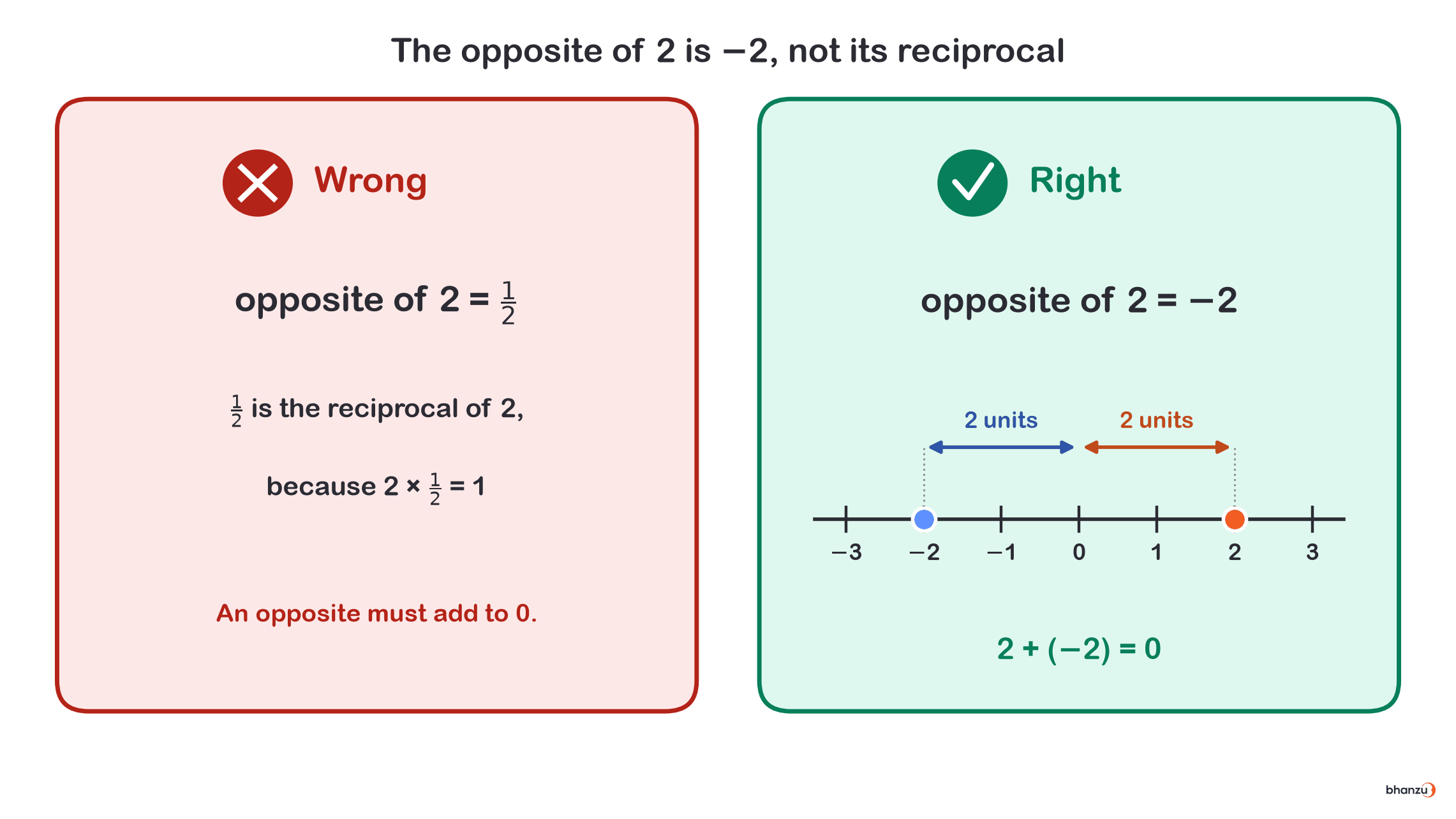
Where it slips in: Questions that ask for the "opposite" or "inverse" of a whole number like 2 or 5. In everyday English, "opposite" means turned around, and flipping a fraction upside down feels like turning a number around.
Don't do this: Writing the opposite of 2 as .
The correct way: The opposite of 2 is , the same 2 units from 0 on the other side. The number is the reciprocal of 2, which multiplies with 2 to make 1, while adds with 2 to make 0.
Mistake 2: Thinking the opposite is always negative
Where it slips in: Finding the opposite of a negative number, or simplifying an expression like , as in Example 2.
Don't do this: Writing the opposite of as , or as something "more negative" like .
The correct way: The opposite of is 4. Both numbers are 4 units from 0, and .
The words "opposite" and "minus" show up together so often that a child who rushes attaches a minus sign by habit, even when the number already has one. Asking "which side of 0 am I on now?" before writing the answer catches it.
Mistake 3: Treating the opposite and the absolute value as the same thing
Where it slips in: Problems that show both ideas, such as "the opposite of 5" next to . Both ideas talk about distance from 0, so they blur together.
Don't do this: Calling the opposite of 5 just 5, because opposites share a distance from 0.
The correct way: The opposite of 5 is , while is a distance and is never negative. The opposite switches the sign, and the absolute value drops it.
Key Takeaways
- Before naming an opposite, ask how far the number sits from 0, then go that far on the other side.
- Opposite numbers cancel, so 2.5 and add to 0 just like a zero pair of counters.
- When a problem mixes opposites and absolute values, decide first whether it wants a sign change or a distance.
- For more practice reading the minus sign as "the opposite of," so that never turns into again, explore Bhanzu's 6th grade math tutor or math programs for kids.
Read More
- Inequalities on a Number Line
- Negative Number Word Problems
- Evaluating Expressions with Negative Numbers
- Integers Formula
- Fractions on a Number Line
Research Behind This Article
- National Park Service, Badwater Basin (2026). nps.gov
- OpenStax, Prealgebra 2e, 3.1 Introduction to Integers (2020). openstax.org
- Common Core State Standards Initiative, Grade 6 The Number System (2010). thecorestandards.org
- OpenStax, Prealgebra 2e, 3.2 Add Integers (2020). openstax.org
- NOAA National Ocean Service, How deep is the ocean? (2026). oceanservice.noaa.gov
- Vlassis, J., Making Sense of the Minus Sign or Becoming Flexible in "Negativity", Learning and Instruction (2004). eric.ed.gov
Quick Quiz: Check Yourself
Three levels, new numbers every time: find an opposite, simplify opposites of opposites or for a negative , then solve number line, temperature and money stories.
Was this article helpful?
Your feedback helps us write better content
Frequently Asked Questions
Which pair of numbers are opposites?
Is 0 positive or negative?
Is finding the opposite of a number the same as multiplying by negative 1?
Are opposite numbers multiplicative inverses?
What grade are negative numbers introduced?
How do I explain negative numbers to a child?