Key Points
- The order of operations with rational numbers keeps the whole-number steps and applies them to negatives, fractions and decimals, with each sign rule used inside its own step.
- Multiplication and division share one step worked left to right, addition and subtraction come last, and a fraction bar groups its whole top and whole bottom.
- An exponent touches only the number it sits on, so equals while equals 25, and squaring the minus sign as well is the slip to watch for.
- Common Core places this skill in 7th grade, a year after exponents join the order, and it leads straight into multi-step rational number word problems.
The minus sign that started as a shortfall
The first printed minus sign, in 1489, marked boxes that came up short. Johannes Widman's arithmetic book, printed in Leipzig, used the little dash for the amount a box or bale weighed below what it should, and a plus for the extra. Neither sign meant add or subtract yet.
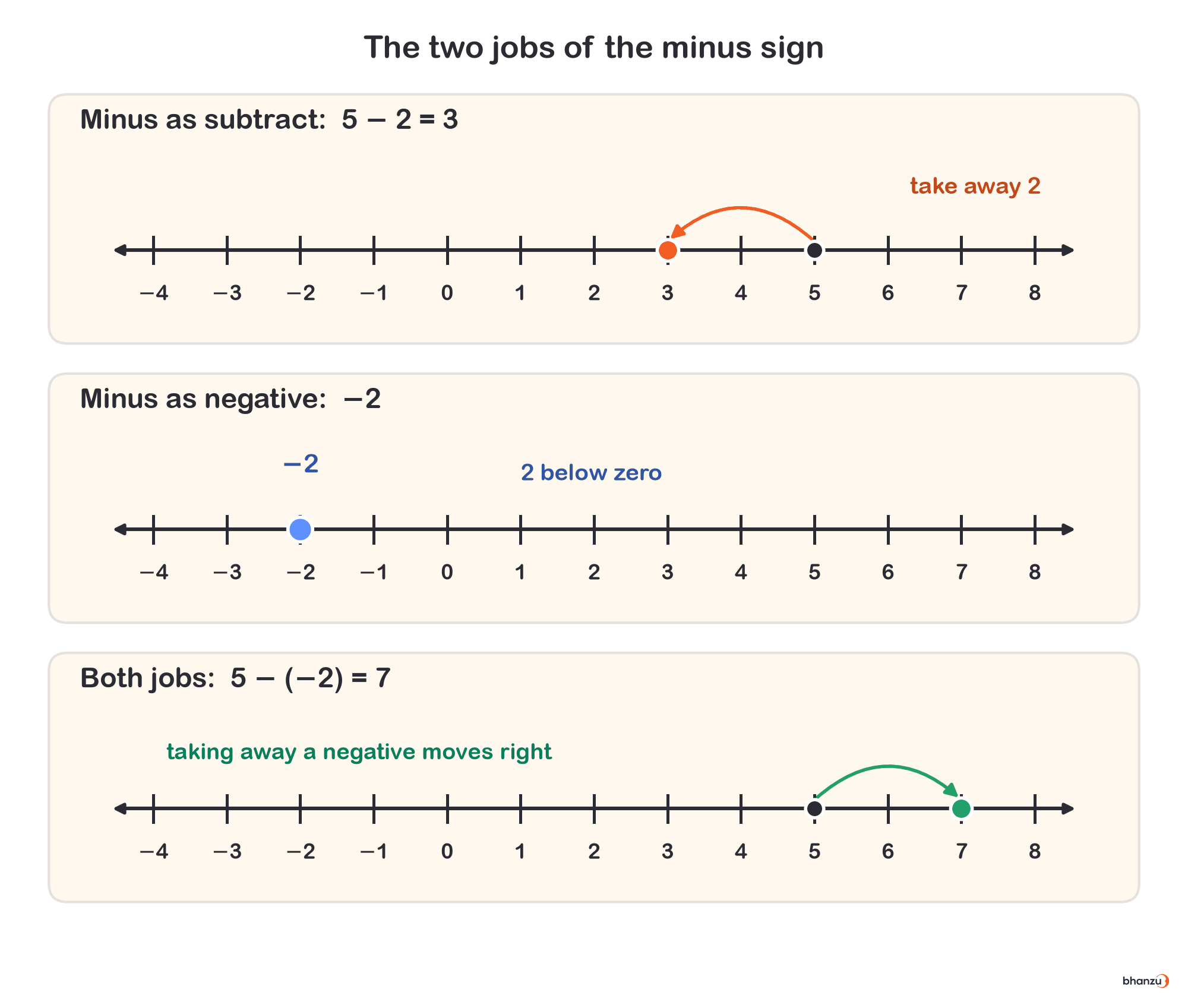
More than five centuries later, the same short dash does two jobs, take away and below zero, and a single line of math can use it both ways at once. Keeping those jobs straight is most of what order of operations with rational numbers asks of you. The same agreed order runs real work beyond school, too, when weather scientists average readings that dip below zero, accountants total gains and losses in one spreadsheet, and game designers subtract penalty points from scores.
What is the order of operations with rational numbers?
The order of operations with rational numbers carries the ranking you already know from whole numbers over to negatives, fractions and decimals, and applies each sign rule in the step where its operation happens. So turns into during the multiplication step, and turns into only when subtraction gets its turn.
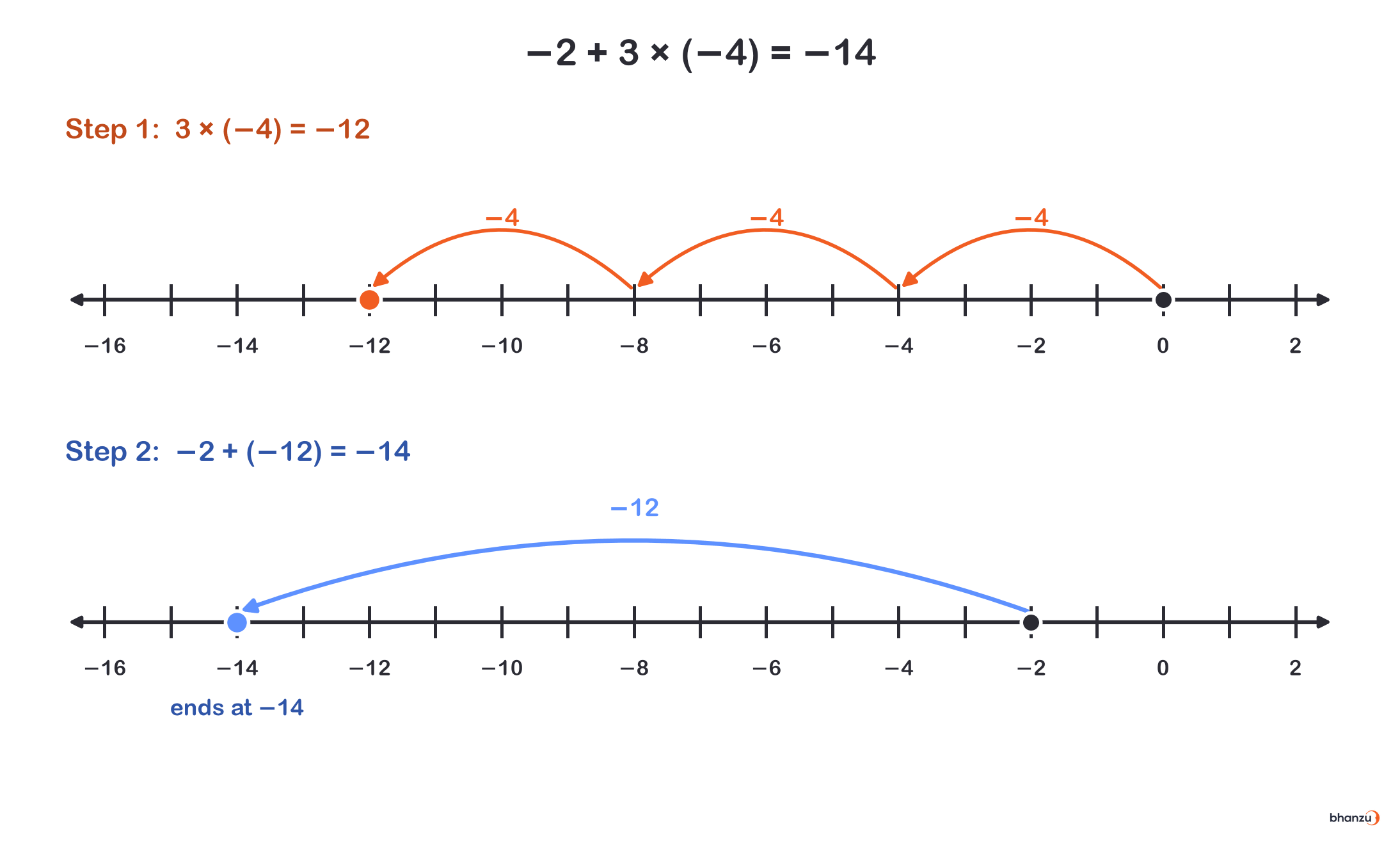
A rational number is any number you can write as a fraction of two integers (whole numbers and their opposites) with a bottom that isn't zero, so , and all count. On a number line, takes two moves. The product comes first, three jumps of from 0 to . Then the sum starts at and moves 12 more to the left, to .
This is Common Core standard 7.NS.A.3, which asks you to solve real-world and mathematical problems involving the four operations with rational numbers. Its partner, 7.NS.A.2c, adds using properties of operations as strategies when you multiply and divide.
For your child, the new part in 7th grade is the sign work. The 6th grade version, order of operations with exponents, worked with positive numbers and zero, so negative bases, minus signs that mean "below zero" and fraction bars over signed numbers all arrive this year. In a 2024 study of 837 US 7th graders who used a math game in the 2020 to 2021 school year, 47% tried an out-of-order move on at least one of six game problems. That makes a slip here ordinary, and writing one operation per line is the habit that catches it.
How do you use the order of operations with negative numbers?
Work the order of operations with negative numbers in four steps, and let each sign rule wait for the step that owns it. PEMDAS is the memory word many US classrooms use for these same steps.
- Grouping symbols come first, innermost pair first. Parentheses, brackets and fraction bars all group, which is why but .
- Exponents come next. An exponent (the small raised number that counts repeated factors) touches only the number it sits on.
- Multiplication and division form one step, worked left to right. The M before the D in PEMDAS does not rank them.
- Addition and subtraction form the last step, also left to right. Rewrite "minus a negative" as "plus" when its turn comes.
In , the division goes before the addition.
A minus sign between two numbers subtracts. A minus sign at the very start, or right after another operation sign or an opening parenthesis, means "the opposite of," so is one of the negative numbers, a value below zero. Parentheses keep the two jobs apart, and a number touching a parenthesis means multiply.
Children who read a line the way they read a sentence often see as "eight minus two," work out 6, and multiply by to get . The product belongs first, so and .
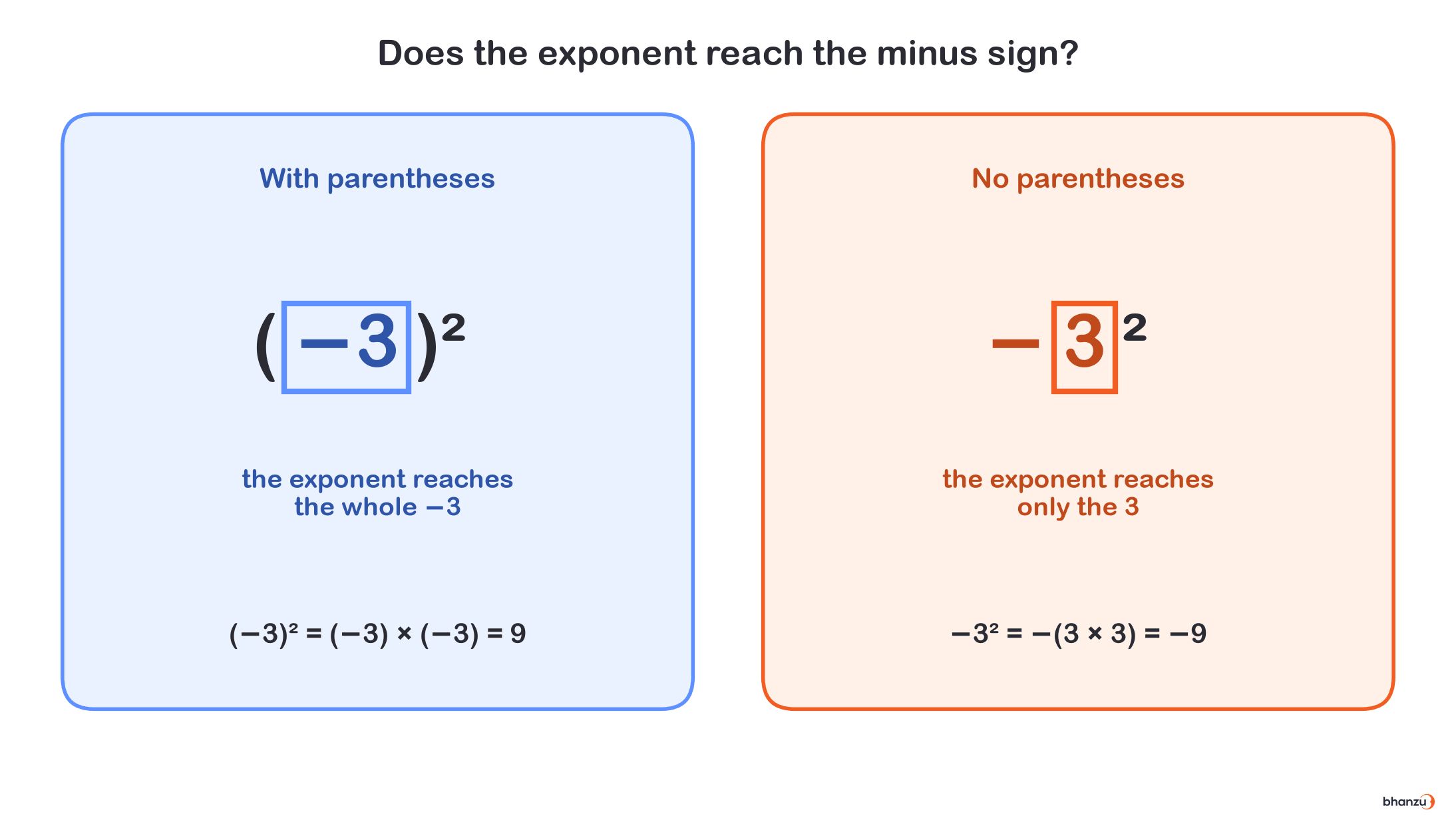
Is a negative number squared positive or negative? It depends on the parentheses, because they decide whether the exponent reaches the minus sign or only the number beside it.
In the parentheses put the whole under the exponent. In the exponent reaches only the 3, and the minus sign applies afterward.
How do you do order of operations with fractions and decimals?
A fraction bar is a grouping symbol, so finish everything above it and everything below it before you divide. The bar works like invisible parentheses.
A complex fraction, a fraction with fractions in its top or bottom, follows the same rule.
A faster route multiplies the top and the bottom by 4, the common denominator. That makes an equivalent fraction with no small fractions left inside. The top becomes , the bottom becomes , and .
Dividing by a fraction means multiplying by its reciprocal, the fraction flipped over, so dividing by is the same as multiplying by . The sign of a quotient follows the rule for products, the same one used in multiplying and dividing negative fractions, so two negatives give a positive and one negative gives a negative. Mixed lines go faster when you pick one form before you start.
| Fraction | Decimal | Easier form for the job |
|---|---|---|
| Either one, since both are short | ||
| Decimal when the line is about money | ||
| Decimal for a measurement such as a temperature | ||
| Fraction, because the decimal repeats forever |
Thirds and sevenths are the usual reason to switch to fractions. In , writing as gives , or , with no endless decimal to round. Repeating decimals come back in 8th grade, when you sort numbers into rational and irrational.
Try It Yourself
Tap the part of the expression you would work out first. A right move turns into its value and writes the new line underneath, while a wrong move stays put and shows a hint about which step comes first. Press New expression for fresh numbers, or Reset to start the same one again.
Why the order of operations works
Without an agreed order, could fairly mean 4 or . The order of operations works because it keeps every product and every power in one piece until it has a value, so two people reading the same line get the same number.
- It keeps groups whole. is three groups of , a single amount of , and that amount has to exist before anything else joins it.
- It keeps the sign rules consistent. The distributive property multiplies each part of a sum, and it is one of the properties of operations with negative numbers behind the sign rules. It forces , since is 0, and distributing turns it into , which equals 0 only if .
- It lets you regroup safely. Multiplication can be reordered, so becomes , which is .
- It lets screens and people agree. A scoreboard that adds two penalties of to a score of 10 shows 4 on any device that follows the agreed order.
The same ranking will run every linear equation you solve in 8th grade, where letters and these signed numbers share one line.
Examples of order of operations with rational numbers
Example 1
Evaluate .
The value is .
Example 2
Evaluate .
The tempting move is to work left to right from the start, as if every operation had the same rank.
That answer cannot be right. The line subtracts , a negative amount, and taking away a negative amount always pushes the result above 5, so is impossible.
Multiplication comes before subtraction.
The value is 17, which sits above 5 as it should.
Example 3
Evaluate .
The value is .
Example 4
Evaluate .
Write as so the whole line is in fractions.
The value is , which is or . A decimal check agrees: and .
Example 5
Place one pair of parentheses in so that its value is 12.
Without new parentheses, the multiplication goes first.
Grouping the sum makes it go first instead.
The answer is .
Example 6
At 6 a.m. a mountain town read . The temperature rose each hour for 3 hours, then fell each hour for 2 hours. Write one expression for the final temperature and evaluate it.
The start is , the rise is , and the fall is , since .
The final temperature is , half a degree below zero.
The pattern hiding inside order of operations with rational numbers
Every plus or minus sign between two numbers and outside all grouping symbols splits a line into chunks called terms. Each term can be finished on its own before the terms are combined. Take , which splits at its two outside signs.
- The first term, , is already finished.
- The second term, , is worth , since taking away adds 6.
- The third term, , is worth .
The line is now . Bye and colleagues' 2024 study found that 7th graders who were better at spotting equivalent expressions, two lines with the same structure written differently, made fewer order errors. Splitting a line into terms is one way to train that eye for structure.
Tools follow their own agreements, too. As of 2026, Microsoft's precedence table for Excel ranks negation, a leading minus, above exponentiation, so typing =-3^2 into a cell returns 9, while the classroom convention gives . The leading minus is the one genuinely slippery spot in the whole order, since it doesn't sit between two numbers, yet classroom math treats it like multiplying by , which waits until after the exponent. Parentheses end the argument: type (-3)^2 when you mean 9 and -(3^2) when you mean .
Why kids get order of operations with rational numbers wrong (and the fix)
Mistake 1: Squaring the minus sign too
Where it slips in: An exponent on a negative number with no parentheses around it, such as .
Don't do this: .
The correct way: , so . Only equals 25.
Children who have just learned that two negatives make a positive reach for that rule here, but holds only one negative sign. The 5 being multiplied by itself is positive both times.
Mistake 2: Splitting a fraction bar too early
Where it slips in: A sum or difference sitting over a fraction bar, as in Example 3, or a fraction copied onto one line.
Don't do this: Treating as , which gives .
The correct way: Finish the top first, , then divide, .
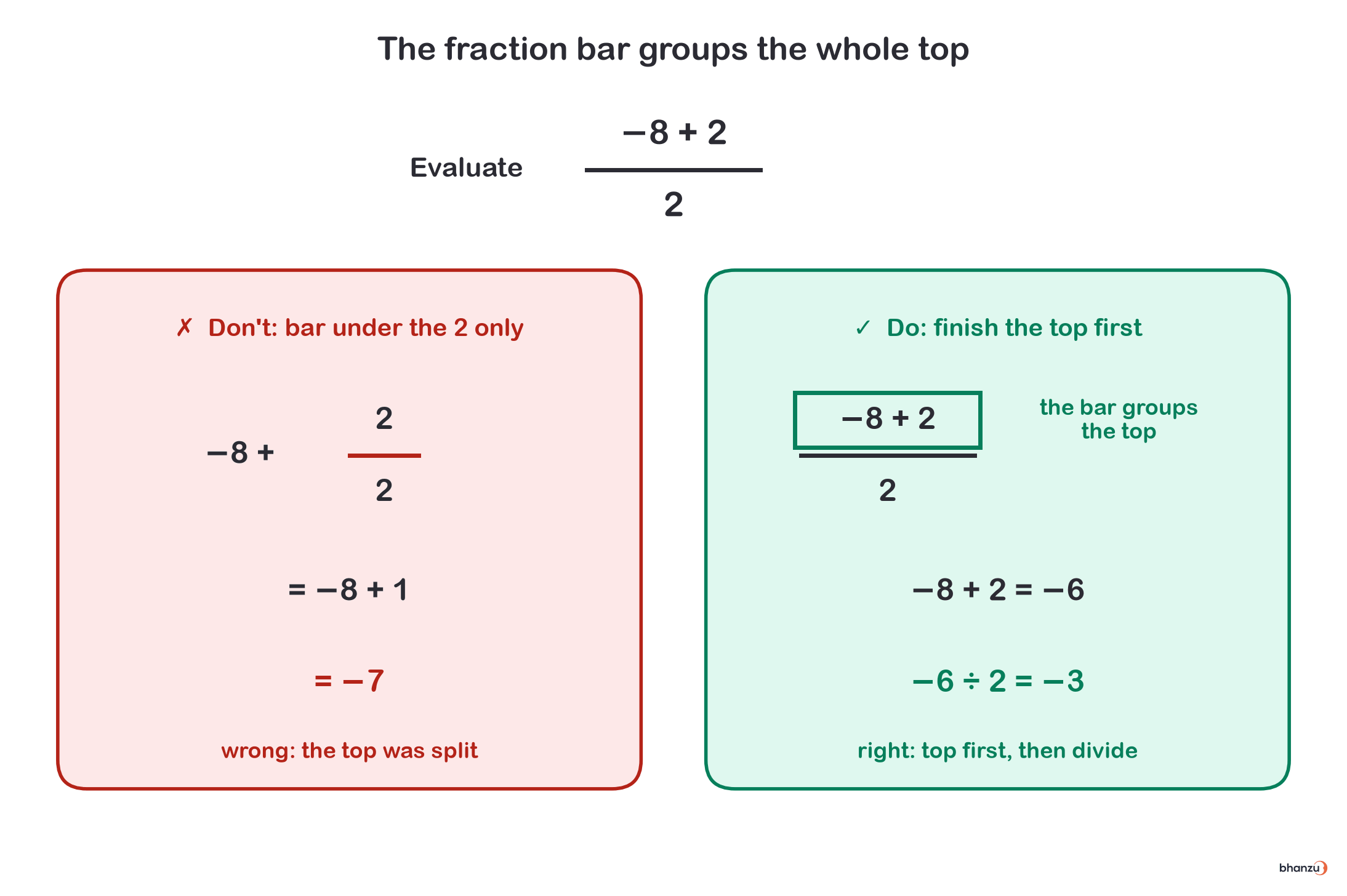
The bar looks like a short line under the last number only. Written on one line, the same problem needs parentheses, , because means something else.
Mistake 3: Multiplying before dividing
Where it slips in: A line that mixes multiplication and division with negatives, such as .
Don't do this: Multiplying first, , then .
The correct way: Work left to right, , then .
A child who recites PEMDAS letter by letter puts the M ahead of the D simply because it comes first in the word. The letters suggest a ranking the rule never had.
Key Takeaways
- Before adding or subtracting anything, finish each product, quotient and power so it becomes a single number.
- A minus sign between two numbers subtracts, while a minus at the start or after an opening parenthesis means "the opposite of" the number after it.
- Put parentheses around a negative base whenever the whole negative number should be squared.
- In order of operations with rational numbers, treat a fraction bar as parentheses around its top and around its bottom.
- For more practice catching the sign slip with a teacher who checks every line, explore Bhanzu's 7th grade math tutor or the Common Core math curriculum.
Read More
- Rational Number Word Problems
- Evaluating Expressions With Negative Numbers
- Comparing and Ordering Rational Numbers
- Order of Operations With Parentheses and Brackets
- Order of Operations in Math
Research Behind This Article
- Jeff Miller, MacTutor History of Mathematics, Earliest Uses of Symbols of Operation (n.d.). mathshistory.st-andrews.ac.uk
- Common Core State Standards Initiative, Grade 7 The Number System (2010). thecorestandards.org
- Jeffrey Kramer Bye and others, Perceiving Precedence: Order of Operations Errors Are Predicted by Perception of Equivalent Expressions (2024). eric.ed.gov
- OpenStax, Prealgebra 2e, 3.4 Multiply and Divide Integers (2020). openstax.org
- OpenStax, Prealgebra 2e, 4.3 Multiply and Divide Mixed Numbers and Complex Fractions (2020). openstax.org
- Microsoft Support, Calculation operators and precedence in Excel (n.d.). support.microsoft.com
Quick Quiz: Check Yourself
Three levels, new numbers every time: evaluate a short line with negatives, then a negative square or a fraction bar, then a longer line that mixes fractions and decimals or a temperature problem.
Was this article helpful?
Your feedback helps us write better content
Frequently Asked Questions
Does the order of operations with decimals work the same way?
How does absolute value fit into the order of operations?
Can a calculator do PEMDAS with negative numbers?
When is order of operations taught?
How can I help my child with order of operations with negative numbers at home?
What are fun ways to teach order of operations?
What are operations with rational numbers?