Key Points
- Order of operations with exponents runs parentheses first, exponents second, multiplication and division from left to right third, and addition and subtraction from left to right last.
- An exponent counts repeated factors, so in the 3 is squared to 9 before any multiplying, and the value is 36.
- An exponent outside parentheses applies to the whole result inside them, so is , never .
- Common Core places exponents in the order of operations in 6th grade, under standard 6.EE.A.2.c, which includes the cube formulas and .
A rule that started as a deal
In 1913, an algebra textbook called the order of operations an agreement. Its authors, Webster Wells and Walter Hart, wrote that it "is agreed" that work inside grouping symbols comes first. The rule that exponents go before multiplication is older still, used in the earliest books that printed exponents, according to Jeff Miller's history of the earliest uses of symbols of operation.
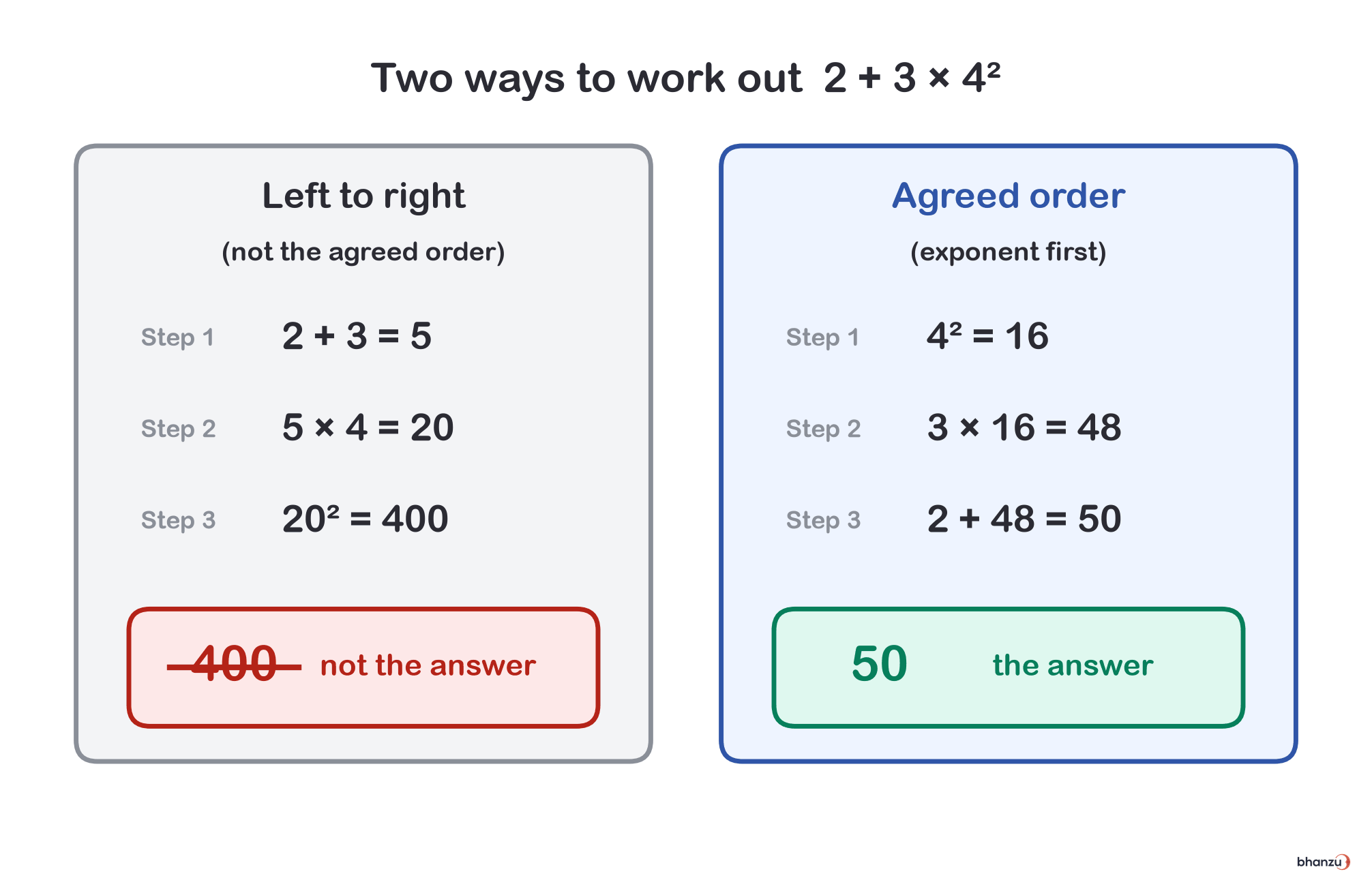
The deal was needed because one line of math can be read more than one way. Take 2 plus 3 times 4 squared. Left to right gives 400, the agreed order gives 50, and only one can be right.
Engineers sizing a cube-shaped water tank, biologists tracking bacteria that double and programmers building calculator apps all lean on this same order. That shared order is why a formula written in Texas means the same thing in Tokyo.
What is the order of operations with exponents?
The order of operations with exponents is the agreed sequence for evaluating, or finding the value of, an expression, with exponents worked right after parentheses and before multiplication and division. Parentheses, brackets and fraction bars are all grouping symbols. In , the big 4 is the base, the number being multiplied, and the small raised 3 is the exponent, which tells you how many times to use the base as a factor.
So , and the whole expression is called a power, read as 4 to the third power or 4 cubed. With an exponent of 2, is read as 5 squared.
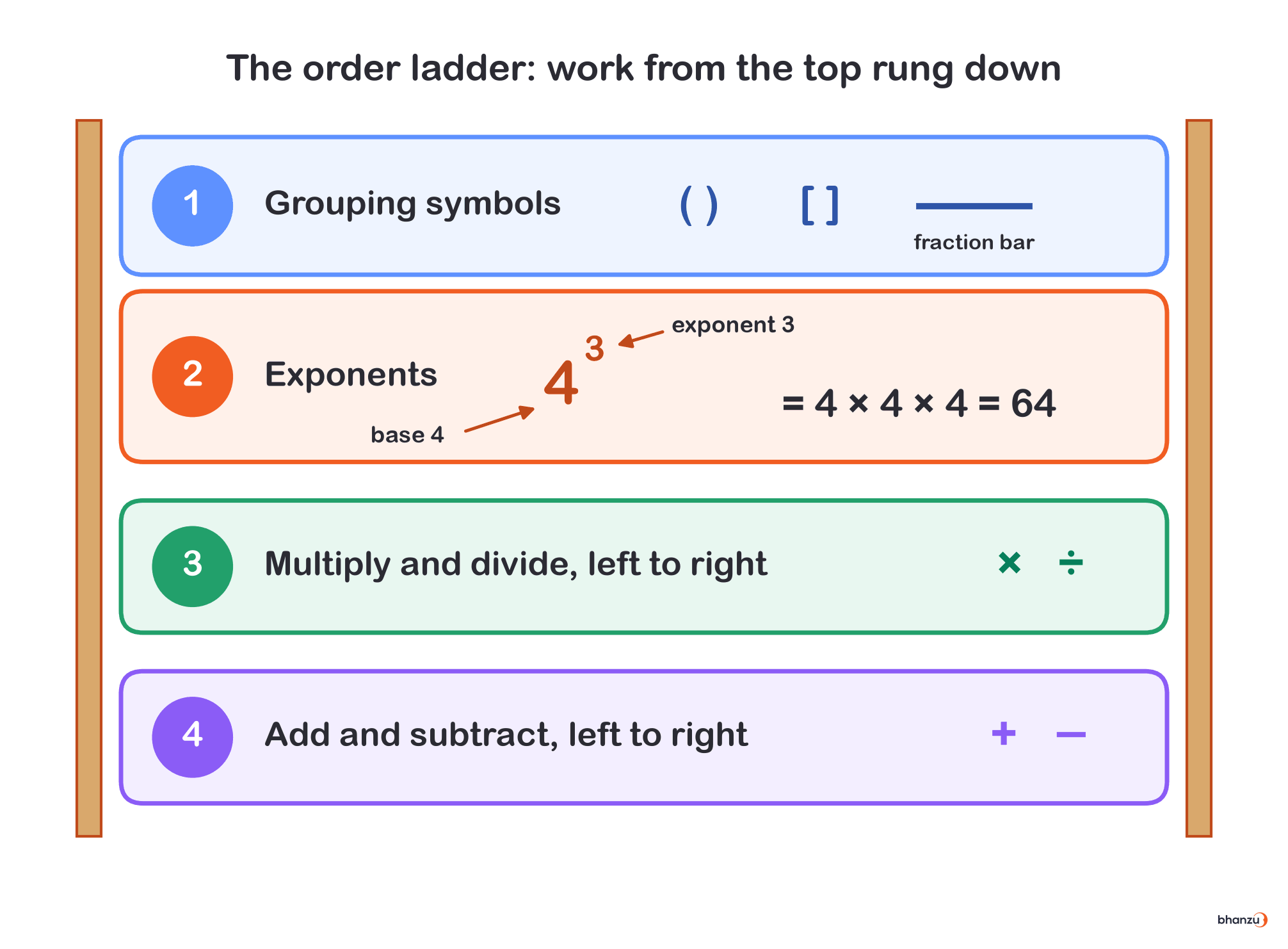
Common Core, released in 2010, adds exponents to this order in 6th grade, in standard 6.EE.A.2.c and its partner standard 6.EE.A.1. Your child already used the order of operations with brackets in 5th grade, so exponents are the one new rung on the ladder. By the end of 6th grade, your child should evaluate expressions that mix powers with all four operations, including powers of fractions and decimals.
How do you evaluate an expression with exponents step by step?
Work down the ladder one rung at a time, and rewrite the whole expression after every step.
- Grouping symbols. Work inside parentheses, brackets or a fraction bar first, using these same steps inside.
- Exponents. Replace every power with its value.
- Multiplication and division, in the order they appear from left to right.
- Addition and subtraction, in the order they appear from left to right.
Do you do exponents or multiplication first? Exponents first, because an exponent is shorthand for multiplying one base by itself, and that has to finish before the base joins anything else.
Here is , one step per line.
- , so the expression becomes .
- Multiplication comes first from the left, so leaves .
- leaves .
- .
Skipping the rewrite is where long expressions go wrong. A child who holds two half-finished steps in their head can easily drop a number (the 18 shows up twice here), while a fresh line keeps every number in sight.
What if the exponent is inside the parentheses? The parentheses still go first, and inside them the exponent still beats the subtraction.
The OpenStax Prealgebra textbook teaches the order with the sentence "Please Excuse My Dear Aunt Sally," whose first letters spell PEMDAS, one letter per operation. My and Dear share a rung, and so do Aunt and Sally, so PEMDAS with exponents is four steps, not six.
PEMDAS gets slow on long expressions with a fraction bar, the grouping symbol that is easiest to miss. Circle each group first and work it as a small separate problem.
Try It Yourself
Pick an expression, then use the plus and minus buttons to change the base and the power and watch the value of the power grow. Tap the part of the expression you would work out next, and a correct choice shrinks into its value while a wrong one tells you which rule comes first.
How do you apply an exponent to a result?
Put the result in parentheses and write the exponent outside them. The parentheses make the exponent wait until everything inside has become one number.
Without the parentheses, the exponent grabs only the 4, so . An exponent applies to the single number or parenthesized group right before it, which is why but .
A fraction bar groups too, so finish everything above it and everything below it before you divide.
Bases can be fractions or decimals as well. , and . Both answers come out smaller than the base, because multiplying by a number less than 1 shrinks it. Children who square 0.3 often write 0.9, but two decimal places in the factors make two in the product.
Squares of whole numbers, such as 1, 4, 9, 16 and 25, are called perfect squares, since each is the area of a square with whole-number sides. In word problems, "the sum of" before "squared" is your cue to write parentheses.
| Words in the problem | Math it means |
|---|---|
| 5 squared | |
| 2 cubed | |
| the sum of 2 and 3, squared | |
| 2 plus 3 squared | |
| 4 times 3 squared |
Where do exponents show up in 6th grade formulas?
The clearest place is the cube, a box shape whose 6 faces are identical squares. The letter stands for the length of one edge.
| Symbol | Meaning | Units |
|---|---|---|
| Volume, the space inside the cube | Cubic units, such as cubic feet | |
| Surface area, the total area of all 6 faces | Square units, such as square feet | |
| Length of one edge | Units of length, such as feet |
The volume formula works because a cube holds layers, each with rows of unit cubes, the same layer idea used for volume with fractional edge lengths. The surface area formula works because each of the 6 faces is a square of area , and the surface area formula adds the faces together. Volume measures 3D space in cubic units, while surface area adds 2D faces in square units.
Inside , the exponent goes first and the 6 waits. For , the volume is cubic units and the surface area is square units. Squaring the 6 too would give (six times too big).
Examples of order of operations with exponents
Example 1
Evaluate .
Find the power first, , then add, .
The value is 14.
Example 2
Evaluate .
The tempting move is to multiply the two numbers you see first, , and then square, .
That result cannot be right. is only , and 4 groups of 9 come nowhere near 144. The exponent belongs to the 3 alone, so it goes first.
The value is 36.
Example 3
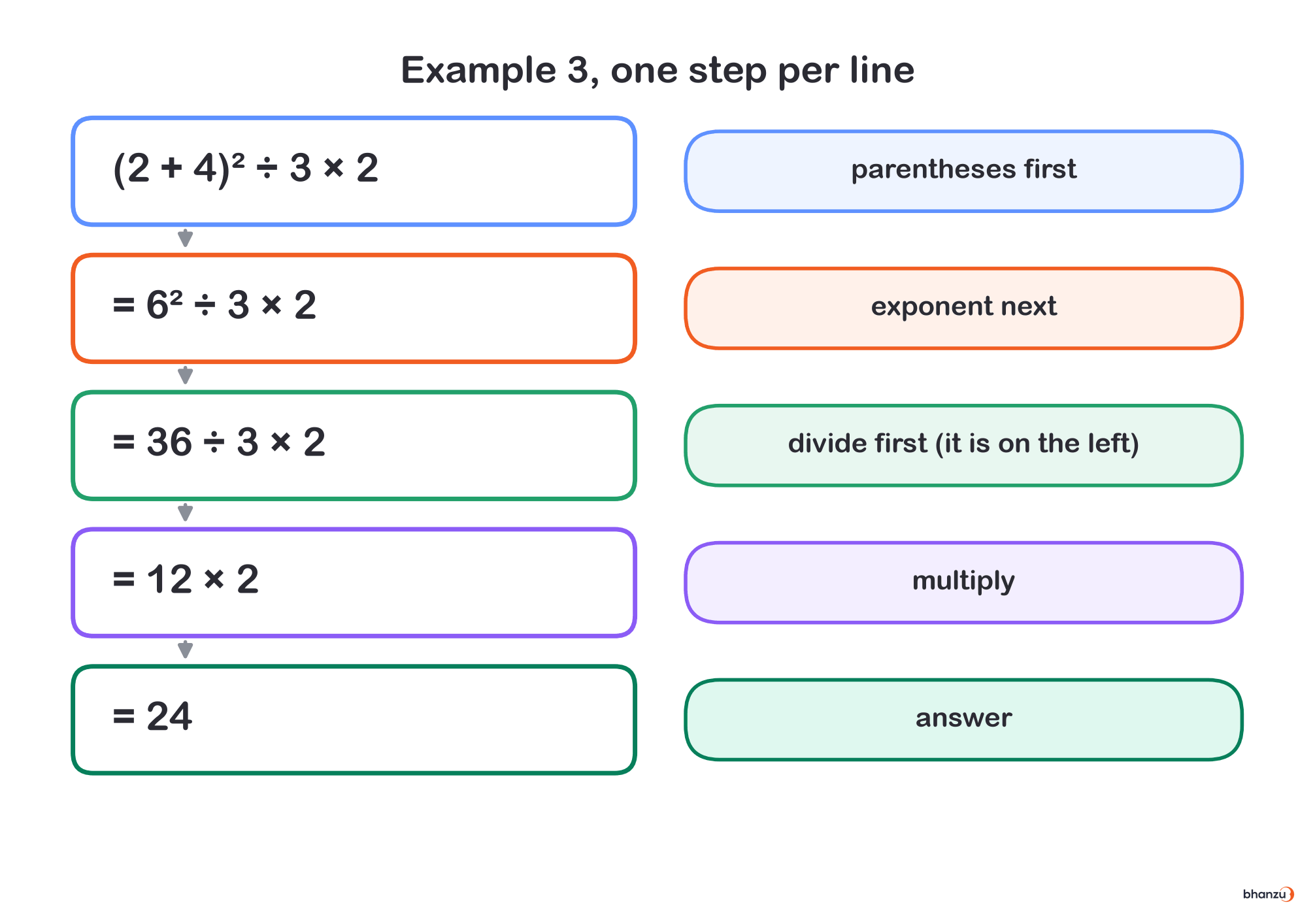
Evaluate .
- Parentheses first. , so the expression is now .
- Exponent next. , which leaves .
- Division is on the left, so it goes first. , which leaves .
- .
The value is 24.
Example 4
Evaluate .
- .
- .
- .
The value is 11.
Example 5
Place one pair of parentheses in so that its value is 32.
With no parentheses, .
Grouping gives , still short.
Grouping makes the exponent apply to the sum, so .
The answer is .
Example 6
Maya's cube-shaped gift box has edges foot long. Use and to find its volume and surface area.
Here .
The box has a volume of cubic foot and a surface area of square feet.
Why does order of operations with exponents matter?
The agreed order exists so that one written expression stands for exactly one number, no matter who reads it.
- It gives every expression a single value. Read in the agreed order, is 50 for everyone, instead of 50 for some readers and 400 for others.
- It lets formulas travel. means "square the edge, then multiply by 6" in every textbook, so two people measuring the same box get the same surface area.
- It opens the door to algebra. Next year the same order meets negative numbers in order of operations with rational numbers, and 8th grade adds rules for combining powers, such as .
In the 2024 Nation's Report Card, 28% of US 8th graders scored at or above NAEP Proficient in math, 2 points higher than in 2022 and 6 points lower than in 2019. NAEP notes that its Proficient level does not represent grade-level proficiency as state assessments define it, and the 8th grade algebra it measures builds on expressions like these.
The part of order of operations with exponents nobody explains
Exponents come before multiplication because an exponent is packed multiplication, the same way multiplication is packed addition.
- packs into .
- packs into .
Unpack the most tightly packed operation first. In , the package holds only the 3, so the expression means , never .
The other half of the story is that the order is a convention, a choice people agreed on, so parentheses can always override it. Even the left-to-right rule for multiplication and division took time to settle. A 1907 high school algebra book (by Slaught and Lennes) told students to do every multiplication before any division, and by 1912 Wells and Hart printed the left-to-right rule used in classrooms today. This corner of the rules really is confusing, and a century ago even textbook authors disagreed about it.
Order of operations with exponents: spot the trap before you fall in
Mistake 1: Multiplying the base by the exponent
Where it slips in: The first power in an expression, such as . Years of multiplying pairs make a small 3 beside a 2 look like one more pair, so a child who rushes writes 6.
Don't do this: and .
The correct way: and .
Saying the power out loud as "2 times 2 times 2" before writing catches this error, because the spoken version has three 2s and no 3.
Mistake 2: Squaring each part of a sum
Where it slips in: An exponent outside parentheses, as in , which seems to reach inside and touch each number.
Don't do this: .
The correct way: .
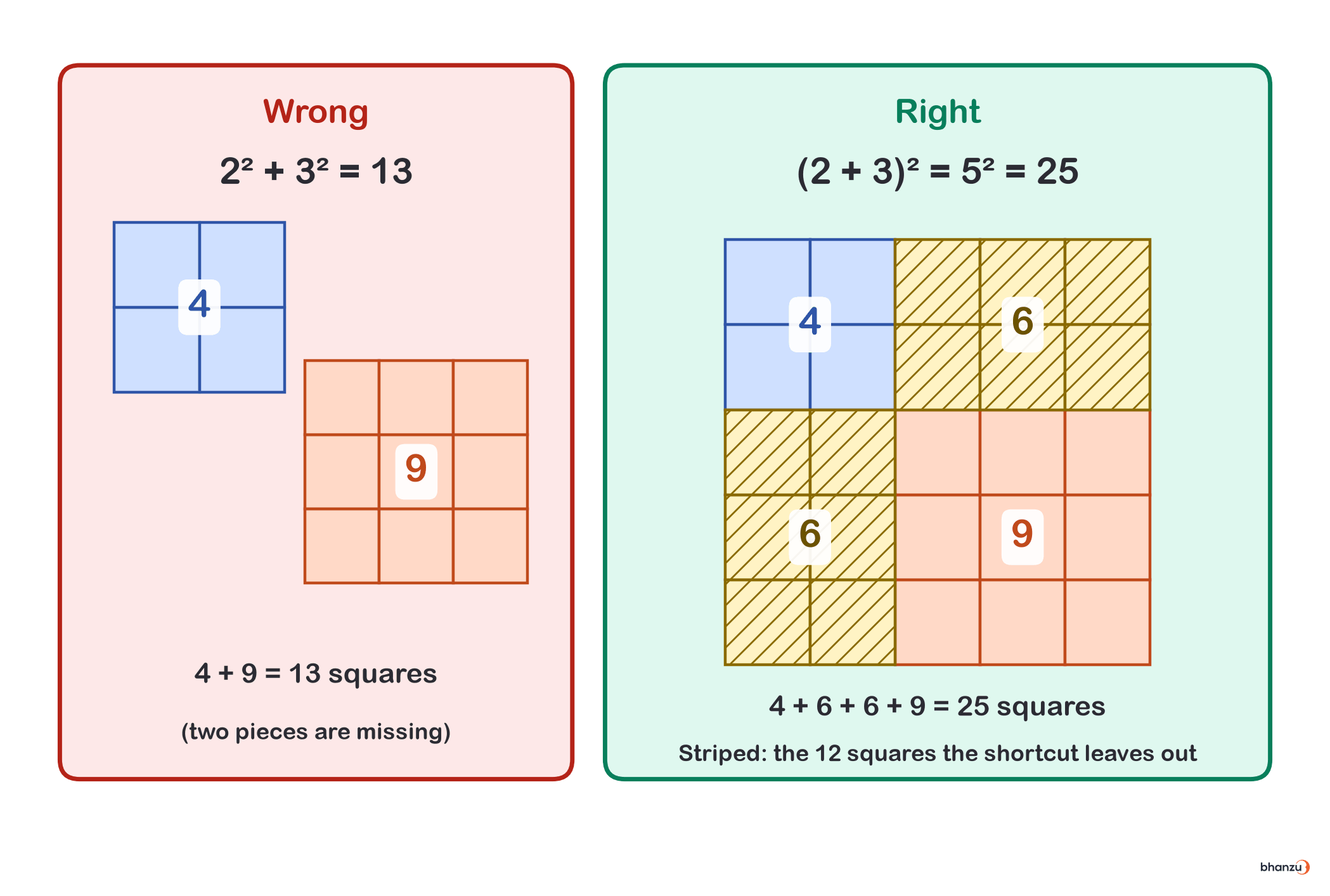
The shortcut leaves out the two 2 by 3 rectangles in the picture, and their 12 unit squares are exactly the gap between 13 and 25.
Mistake 3: Always multiplying before dividing
Where it slips in: After the powers are done, when division sits left of multiplication, as in . PEMDAS lists M before D, so a child who recites it perfectly can still read it as a strict order.
Don't do this: .
The correct way: , then , then . Division is on the left, so it goes first.
A 2019 study of 240 students in grades 6 to 8 in Turkey found ordering mistakes in all three grades. Students worked expressions straight from left to right, or treated brackets as the only part that comes first.
Key Takeaways
- Scan for small raised numbers before you multiply anything, and turn each power into its value.
- Treat multiplication and division as one step, and addition and subtraction as another, then sweep each from left to right.
- A sum that needs squaring must sit inside parentheses, with the exponent outside.
- In the order of operations with exponents, squares only the edge length, never the 6.
- For more practice turning into 36 instead of 144, explore Bhanzu's 6th grade math curriculum or work with an algebra tutor.
Read More
- Order of Operations in Math
- Properties of Operations
- Order of Operations for 4th Grade
- Exponent Rules
- What Percent One Number Is of Another
- Opposite Numbers
Research Behind This Article
- Jeff Miller, MacTutor History of Mathematics, Earliest Uses of Symbols of Operation (n.d.). mathshistory.st-andrews.ac.uk
- Common Core State Standards Initiative, Common Core State Standards for Mathematics (2010). thecorestandards.org
- OpenStax (Marecek, Anthony-Smith and Mathis), Prealgebra 2e, 2.1 Use the Language of Algebra (2020). openstax.org
- National Center for Education Statistics, NAEP Mathematics 2024: Grades 4 and 8 Results (2025). nationsreportcard.gov
- Tabak, S., International Journal of Educational Methodology, 6th, 7th and 8th Grade Students' Misconceptions about the Order of Operations (2019). eric.ed.gov
- IES What Works Clearinghouse, Teaching Strategies for Improving Algebra Knowledge in Middle and High School Students (2015, revised 2019). ies.ed.gov
Quick Quiz: Check Yourself
Three levels, new numbers every time: one power and one more step, then parentheses and left-to-right division with a power, then decimal bases and the cube volume and surface area formulas.
Was this article helpful?
Your feedback helps us write better content
Frequently Asked Questions
Is PEMDAS with exponents the same as BODMAS?
Is PEMDAS left to right?
Does a calculator follow the order of operations with exponents?
What do 6th graders learn about exponents?
How can I help my child practice order of operations with exponents at home?
Where can my child find operations with exponents practice problems?