Key Points
- Volume with fractional edge lengths measures the space inside a right rectangular prism whose edges are fractions, mixed numbers or decimals, in cubic units.
- A cube with half-inch edges holds one eighth of a cubic inch, because 8 of those cubes fill a 1-inch cube.
- Multiplying the whole parts and the fraction parts of mixed-number edges separately gives too small a volume, so change each mixed number to an improper fraction first.
- Common Core standard 6.G.A.2 sets this skill in 6th grade, in the same cluster that goes on to nets and the surface area of 3D figures.
A satellite built from 10 cm boxes
Some satellites are sized by counting cubes 10 centimeters on a side. NASA's guide to CubeSats calls one such cube a "1U" CubeSat, a standard first developed in 1999 by Cal Poly San Luis Obispo and Stanford University. Its list of sizes also includes 1.5U (one and a half units), and once an edge stops being a whole number of units, counting whole cubes stops working.
That problem reaches far past school. Space engineers fit parts inside those satellites, and packaging designers size boxes with sides of eight and a half inches. Even a nurse reading a syringe in milliliters is reading cubic centimeters. It all rests on one strange fact: cut a 1-inch cube in half along its length, width and height, and you get 8 small cubes, not 2.
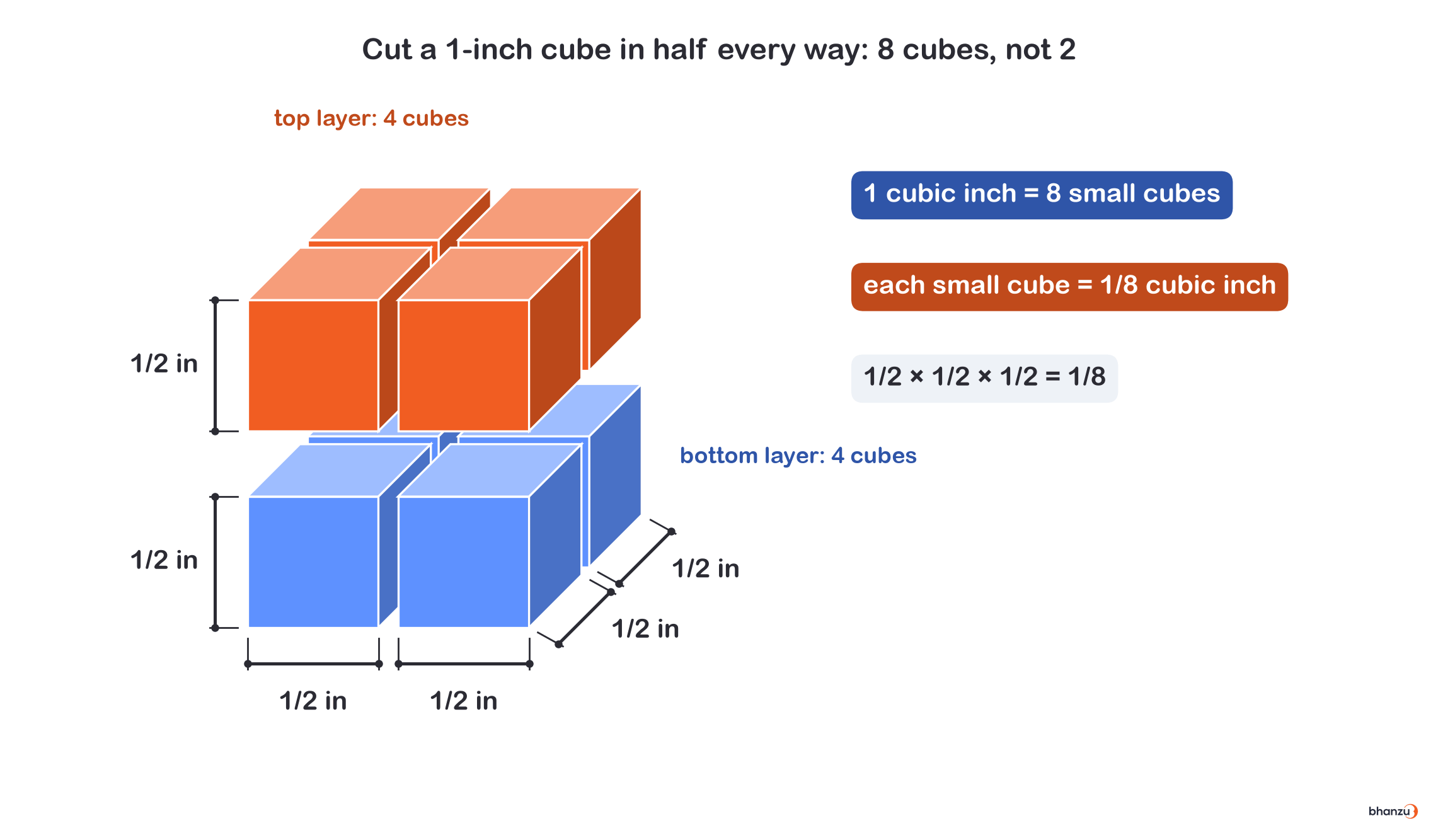
What is volume with fractional edge lengths?
Volume with fractional edge lengths is the amount of space inside a right rectangular prism whose edges are fractions, mixed numbers or decimals, counted in cubic units. A right rectangular prism is a box with six rectangle faces that meet at square corners. A fractional edge length is any edge that is not a whole number of units, such as inches or centimeters.
Volume is a 3D measure, so its unit is a cube, such as a cubic inch () or a cubic centimeter (), while area is 2D and counts squares. Cubic units also measure capacity. The National Institute of Standards and Technology gives the milliliter as another name for the cubic centimeter and sets 1,000 cubic centimeters equal to 1 liter. So a cube 10 cm on each edge, the 1U CubeSat size, has a volume of exactly 1 liter.
This is Common Core standard 6.G.A.2. Your child is expected to pack a prism with small fraction-sized cubes, show that the count matches multiplying the edge lengths, and then use both volume formulas on real problems.
How do you find volume by packing unit fraction cubes?
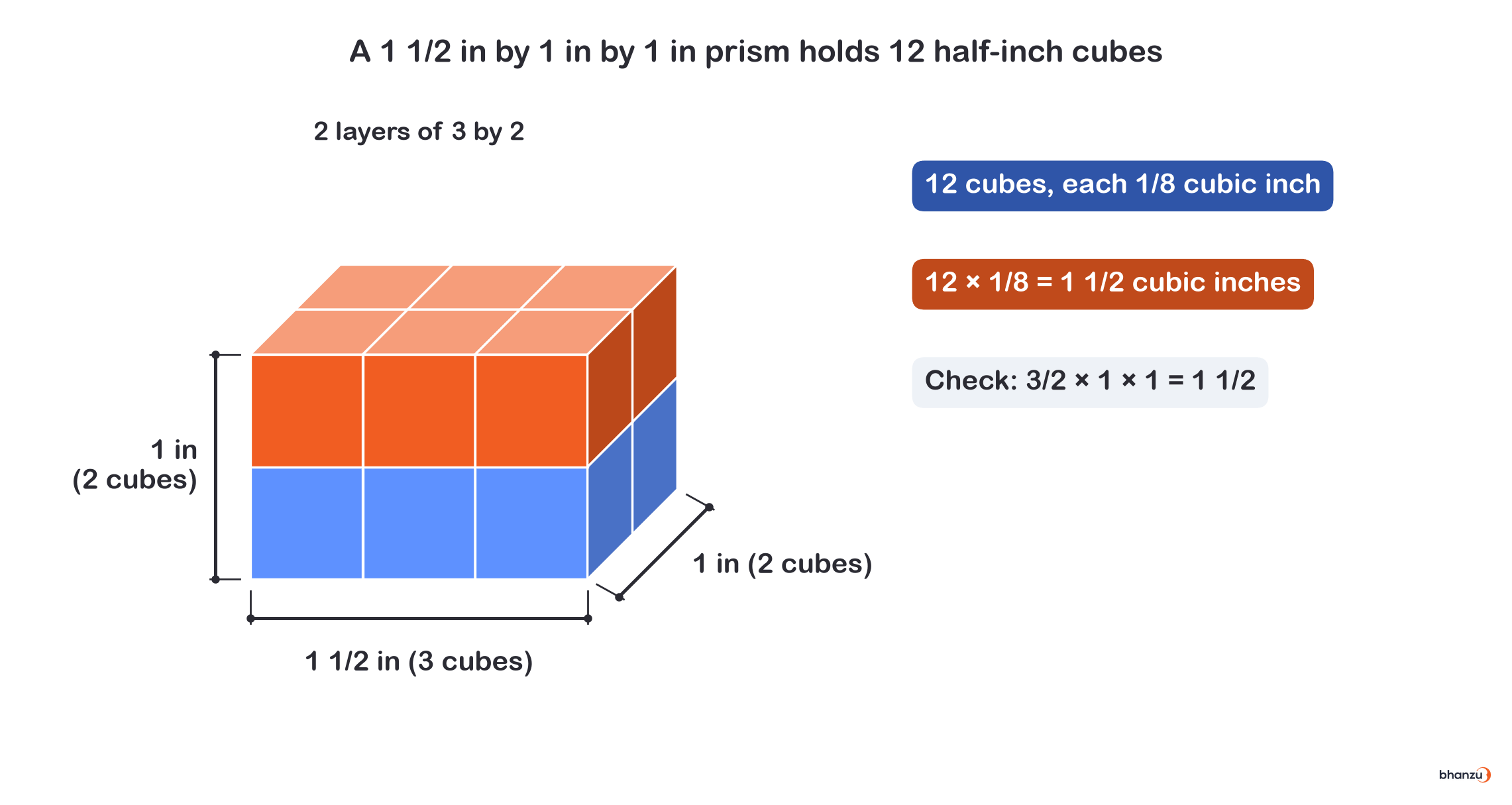
To find volume by packing, fill the prism with equal small cubes whose edge is a unit fraction, count them, and multiply the count by the volume of one small cube. A unit fraction has 1 as its numerator, such as , or . The prism in the picture, inches by 1 inch by 1 inch, works like this.
- Choose the cube size. Half-inch cubes fit, since every edge is a whole number of halves.
- Count the cubes along each edge. The -inch length holds 3, and the width and height hold 2 each.
- Count one layer, then stack the layers. One layer has cubes, and 2 layers make 12.
- Find the volume of one small cube, cubic inch.
- Multiply the count by that volume.
Multiplying the edges gives the same answer, since . A child who counts every cube one at a time also reaches 12 (just more slowly). In area with fractional side lengths, 4 half-unit squares covered one square unit, so children who reuse that 4 when finding one small cube's volume get an answer twice the real one.
The word "unit" does double duty here, and it confuses adults too. A unit cube measures 1 by 1 by 1, while a unit fraction cube has an edge like . Edges that mix halves and quarters need the smaller cube. A box by by 1 inch takes quarter-inch cubes, 6 by 3 by 4 of them.
Packing gets slow with tiny cubes. An edge of inches needs eighth-inch cubes, 19 along that edge alone, so the formula is the better tool there.
How do you find volume with fractions using the formula?
To find volume with fractions, multiply the length by the width by the height, or multiply the area of the base by the height.
| Symbol | Meaning | Units |
|---|---|---|
| Volume | cubic units () | |
| Length of the base | inches or centimeters | |
| Width of the base | same unit as | |
| Height (number of layers) | same unit as | |
| Base area, | square units () |
The formula works because one layer of cubes on the base holds of them, which is , and the height counts the layers. OpenStax's Prealgebra 2e textbook builds it the same way, from layers of cubic units. With mixed numbers, follow four steps.
- Change each mixed number to an improper fraction, one whose numerator is at least as big as its denominator, such as .
- Multiply the numerators together and the denominators together, the same rule as multiplying fractions in 5th grade.
- Simplify, and change back to a mixed number if you like.
- Write the answer in cubic units.
Decimal edges use the same formula, with the rules for multiplying multi-digit decimals. You'll meet base times height again in 8th grade, when the base of a solid becomes a circle.
The prism in the next picture has a base inches by 2 inches and stands inch tall.
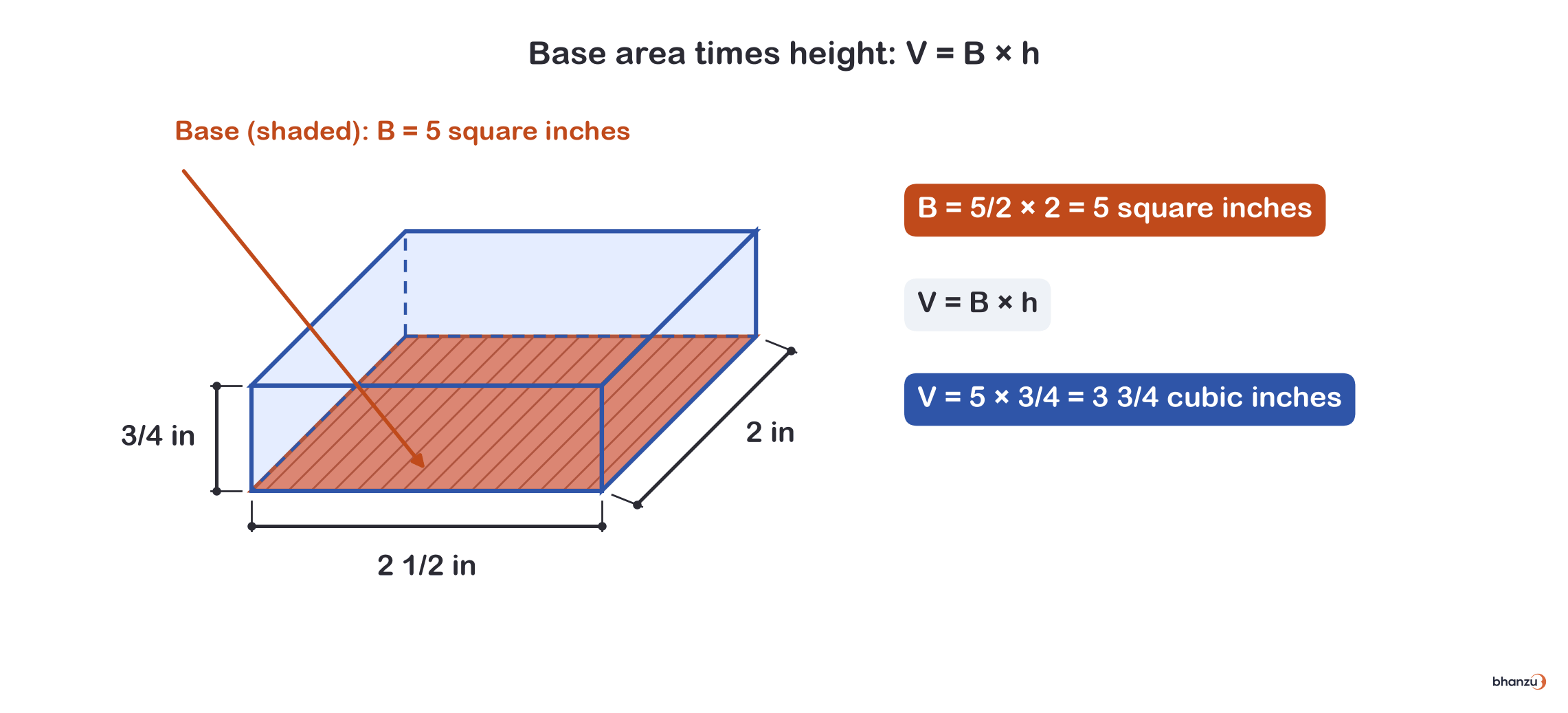
Working backward finds a missing edge, because division undoes multiplication. Divide the volume by the base area, so this prism's height is inch.
Try It Yourself
Pick a cube size of one half, one third or one quarter unit, and set how many cubes run along each edge. Press Add a layer to fill the prism one layer at a time while the readout tracks the edges, the cubes placed and the volume so far. When the box is full, check that the count times one small cube's volume matches length times width times height.
Examples of volume with fractional edge lengths
Example 1
Find the volume of a box 6 inches long, 2 inches wide and inch tall.
The box holds 9 cubic inches.
Example 2
A prism is packed with half-inch cubes, 4 along the length, 2 along the width and 3 up the height. What is its volume?
It holds cubes, each cubic inch.
The edges are 2 in, 1 in and in, and , so counting and multiplying agree.
Example 3
A toy chest is feet long, feet wide and 2 feet tall. Find its volume.
The tempting move splits each mixed number. Whole parts give , fraction parts give , and the answer comes out as cubic feet.
Packing shows that cannot be right. Half-foot cubes fit 5 by 3 by 4, so the chest holds of them. Eight make one cubic foot, so the volume is cubic feet. The split method threw away the cross pieces: every whole part times a fraction part, such as .
Change the mixed numbers to improper fractions first.
The toy chest holds cubic feet.
Example 4
A wooden block has a base 2.5 cm by 4 cm and a height of 1.2 cm. Use to find its volume.
The block's volume is 12 cubic centimeters, the same space as 12 mL of water.
Example 5
A box holds 10 cubic inches. Its base is 4 inches by 2 inches. How tall is the box?
Check by multiplying back, . The box is inches tall.
Example 6
A shipping box measures 11 in by in by in inside. Find its volume and how many half-inch cubes fill it.
Those numbers are real. The Postal Service lists them as the inside size of its top-loading Medium Flat Rate Box on its Priority Mail page, as listed in November 2026.
Half-inch cubes fit 22 along the length (twice 11), 17 along the width and 11 up the height.
Since , the count matches. The box holds cubic inches, or 4,114 half-inch cubes.
Why multiplying the edge lengths works
Multiplying the edge lengths is a fast way of counting cubes. Fraction edges change only the size of the cube being counted, never the counting.
- It counts a whole layer at once. One layer holds length times width cubes, and the height stacks every layer in one step.
- It works for any cube size. Half, third and quarter-unit cubes follow one rule, because a small cube's volume is its edge used as a factor three times.
- It keeps the units honest. Inches times inches times inches gives cubic inches, which is why a volume answer carries a small 3.
- It sizes real containers. A shipper who knows the Priority Mail box holds cubic inches can tell what fits before packing anything.
Measurement and geometry are two of the five content areas in the Nation's Report Card 2024 mathematics assessment, given to 115,200 eighth graders. Fractional volume draws on both, plus fraction multiplication, and the same 6th grade cluster then moves on to nets and surface area.
Where to watch your step on volume with fractional edge lengths
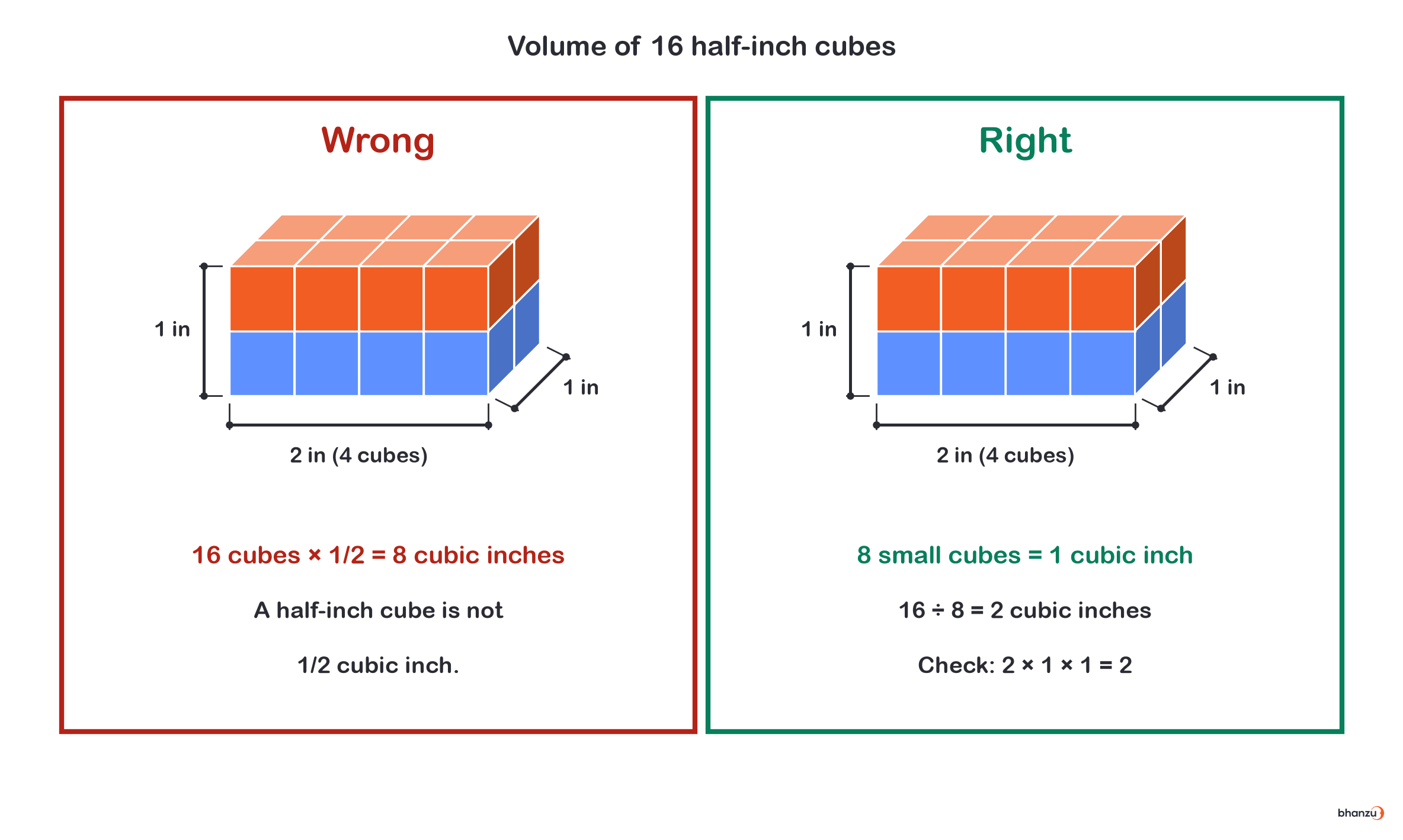
Mistake 1: Treating a half-inch cube as half a cubic inch
Where it slips in: Packing problems, because the word "half" in "half-inch cube" sounds like half of a cubic inch. A child who rushes may also write the number of cubes as the volume.
Don't do this: A prism of half-inch cubes 4 long, 2 wide and 2 tall holds 16 cubes. Counting each as half a cubic inch gives cubic inches (or, in a rush, 16 cubic inches).
The correct way: Eight half-inch cubes fill one cubic inch, so the volume is cubic inches. Check with the edges: 2 by 1 by 1 inches, and .
Mistake 2: Using an edge length as the base area
Where it slips in: Problems that use , as in Example 4. The formula shows only two letters, so it looks as if it needs only two numbers.
Don't do this: For a base inches by 4 inches and a height of 2 inches, writing cubic inches.
The correct way: Find the base area first, square inches, then cubic inches.
Mistake 3: Writing square units for a volume
Where it slips in: Final answers right after a unit on area, when the hand is used to writing a small 2.
Don't do this: Ending Example 1 with .
The correct way: Write , because a volume counts cubes.
The pattern hiding inside volume with fractional edge lengths
A cube with an edge of unit has a volume of cubic unit. That holds for any whole number greater than 0, because such cubes fit along each edge of one unit cube.
| Small cube edge | Cubes that fill 1 unit cube | Volume of one small cube |
|---|---|---|
| cubic unit | ||
| cubic unit | ||
| cubic unit |
The counts 8, 27 and 64 are perfect cubes, each a whole number used as a factor three times. The same pattern gives the volume of a cube with fractions. A cube with -inch edges holds 27 quarter-inch cubes, so its volume is cubic inch, which exponents write as a cube.
That volume is smaller than the edge, since , and a child who spots this often second-guesses a correct answer. Multiplying by numbers less than 1 shrinks a product (and a length and a volume measure different things anyway).
Doubling every edge multiplies the volume by , and halving every edge divides it by 8. The 3-cubic-inch box from Example 2, doubled to 4 by 2 by 3 inches, holds 24 cubic inches, which is .
Key Takeaways
- Check any volume with fractional edge lengths two ways, by counting unit fraction cubes and by multiplying the edges, and expect a match.
- Turn each mixed number into an improper fraction before multiplying, so no piece of the box goes missing.
- Find the base area before using , then multiply by the height.
- Label every volume in cubic units, since three lengths were multiplied.
- For more practice with the one-eighth step that trips up half-inch cube problems, explore Bhanzu's 6th grade math curriculum or a middle school math tutor.
Read More
- Nets of 3D Figures
- Polygons on the Coordinate Plane
- Volume of Composite Figures
- Cross Sections of 3D Figures
- Volume Formula
- Order of Operations with Exponents
Research Behind This Article
- NASA, What are SmallSats and CubeSats? (2026). nasa.gov
- National Institute of Standards and Technology, SI Units: Volume (2026). nist.gov
- National Governors Association Center and CCSSO, Common Core State Standards for Mathematics, Grade 6 Geometry (2010). thecorestandards.org
- OpenStax, Prealgebra 2e, 9.6 Solve Geometry Applications: Volume and Surface Area (2020). openstax.org
- United States Postal Service, Priority Mail (2026). usps.com
- National Center for Education Statistics, NAEP Mathematics: 2024 Results for Grades 4 and 8 (2025). nationsreportcard.gov
Quick Quiz: Check Yourself
Three levels, new numbers every time: count half-inch cubes or multiply one fraction edge, then multiply mixed-number and decimal edges, then find a missing height or count the half-inch cubes that fill a bigger box.
Was this article helpful?
Your feedback helps us write better content
Frequently Asked Questions
How can I help my child practice volume with fractional edge lengths at home?
Are there volume with fractional edge lengths worksheets with answers?
What is the difference between volume and surface area?
Does the base times height formula work for a triangular prism with fractions?
How are volume and capacity related?