Key Points
- The order of operations with brackets works parentheses, brackets and braces from the innermost pair outward, so .
- Inside every group the usual order still holds, so you multiply and divide left to right, then add and subtract left to right.
- In a 2023 study of 528 students, children needed 3.68 problems on average to get three right in a row when the multiplication came first, but 5.60 when it came last.
Same four numbers, three different answers
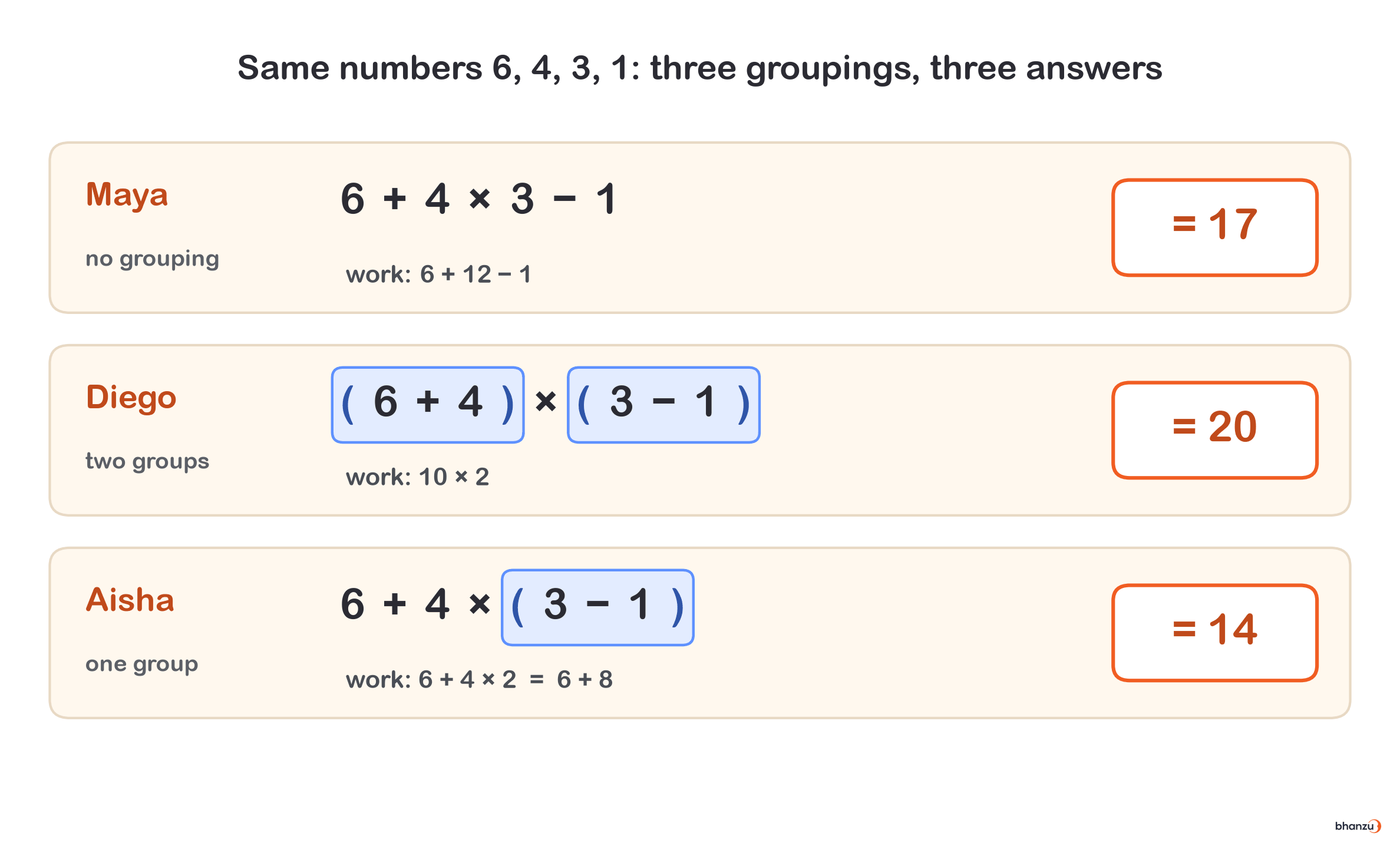
Three friends heard the same line of math and got three different answers. The line was six plus four times three minus one, read aloud with no pauses. Maya used no grouping and got 17, while Diego put six plus four in one pair of parentheses and three minus one in another, and got 20.
Aisha grouped only three minus one and got 14. Spoken words carry no grouping marks, so each friend chose where the groups went. The numbers never changed. Only the grouping did, and in 6th grade this same inside-out habit carries straight into exponents and then into algebra with letters.
What is the order of operations with brackets?
The order of operations with brackets is the agreed plan for evaluating (finding the value of) a numerical expression, numbers and operation signs with no equal sign, that contains grouping symbols. Grouping symbols wrap part of a line, and they come in three shapes, parentheses , brackets and braces , packed like boxes inside boxes.
- Finish every grouping symbol, starting with the innermost pair.
- Multiply and divide from left to right.
- Add and subtract from left to right.
This is Common Core standard 5.OA.A.1, which asks you to use parentheses, brackets, or braces in numerical expressions and evaluate expressions with these symbols. Your child met the order of operations with parentheses alone in earlier grades, and 5th grade adds brackets and braces so one group can sit inside another.
Brackets count as parentheses in PEMDAS, the memory word for Parentheses, Exponents, Multiplication and Division, Addition and Subtraction. The OpenStax Prealgebra textbook calls that first step "Parentheses and other Grouping Symbols." Children who learned PEMDAS as a word often ask whether square brackets count, because the letter names only one shape. BODMAS says the same thing, with B for brackets.
How do you solve order of operations with brackets and braces?
Work from the innermost pair outward. A group sitting inside another group is nested, and the innermost group is the one buried deepest.
| Symbol | Name | Usual place |
|---|---|---|
| parentheses | innermost | |
| brackets | around parentheses | |
| braces | outermost |
- Circle the pair that has no other grouping symbol inside it.
- Simplify inside that pair using the usual order.
- Replace the whole group, symbols included, with its value, and rewrite the entire line with only that one change.
- Repeat until no grouping symbols are left, then finish the line.
One change per line looks like this.
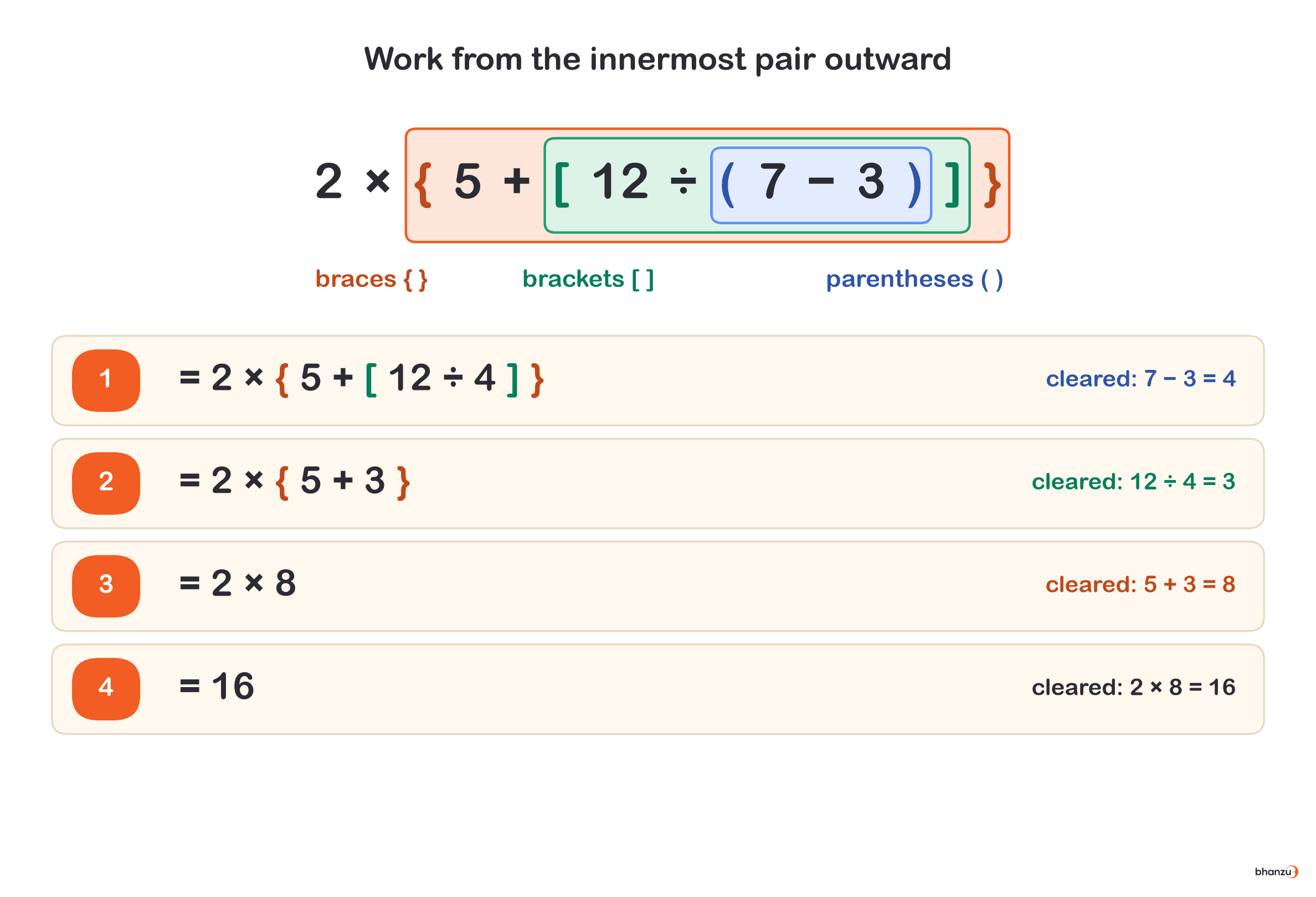
All three shapes mean "finish me first." Different shapes just make each pair easy to match, since a closing brace can only belong to an opening brace. (Some books nest parentheses inside parentheses instead, with the same rule.)
Inside-out always reaches the right value, but it gets slow when a group gives an awkward number. For , the distributive property lets you multiply each part instead, , which matches .
Which comes first, multiplication or division?
Neither one always comes first. Multiplication and division are partners, so you work whichever appears first reading left to right, and addition and subtraction are partners in the same way. Inside a group, the same order holds.
| Line | Work it left to right | Value |
|---|---|---|
| , then | ||
| , then | ||
| , then , then |
Admittedly, the memory word makes this confusing. PEMDAS puts M before D, so the letters look like a ranking, yet they only remind you which operations travel together.
The pull to work in reading order is strong. In a 2023 study of 528 students from 24 US middle school classrooms, the problems were built on 5th grade Common Core content. Students needed 3.68 problems on average to get three right in a row when the multiplication came first () and 5.60 when it came last (). A child who reads math like a sentence does whatever shows up first, which works on the first line and fails on the second.
How do you write words as an expression with brackets?
Put a group around any part that has to be finished as one amount before the next step can use it. The Common Core example for the next standard, 5.OA.A.2, turns "add 8 and 7, then multiply by 2" into , which equals . The parentheses hold the sum together until the multiplying starts. Where you put the group decides the value, so parentheses around in change it from 17 to 14.
Before writing a group, say in words what it stands for. When Priya pays for 3 packs of markers at $4.50 each and a $2.25 notebook with a $20 bill, her total cost is one amount, so it goes in a bracket.
| Words in the problem | Math it means |
|---|---|
| 3 packs at $4.50 each | |
| and a $2.25 notebook | |
| her total cost, as one amount | |
| her change from a $20 bill |
Finding inside that bracket is multiplying decimals by whole numbers, another 5th grade skill.
Try It Yourself
Tap the operation you would do next, and watch those two numbers shrink into one on a new line of work. If that step has to wait, the message tells you what goes first and why. Press Hint to light up the innermost pair, or New expression for fresh numbers.
The real reason brackets exist
Brackets exist so one written line can show which part is a single amount, and everyone who reads it reaches the same answer. Without them, Maya, Diego and Aisha would have no way to agree on what their line meant.
- They mark one amount. Priya's packs and notebook form a single cost, and her change only makes sense once that cost is finished.
- They let groups sit inside groups. Three different shapes show which closing mark matches which opening mark, even three levels deep.
- They're older than any memory word. Brackets appear in Rafael Bombelli's handwritten algebra book from about 1550, and braces in François Viète's Zetetica in 1593. The earliest book historian Florian Cajori names with round parentheses is Niccolò Tartaglia's, from 1556.
In middle school, the same inside-out habit is how you'll handle simplifying expressions with letters.
Examples of order of operations with brackets
Example 1
Evaluate .
Example 2
Evaluate .
Reading straight across and ignoring the groups gives , then , then .
That answer can't be right. The line starts at 40 and only ever takes something away, so its value has to be less than 40. Start inside the parentheses instead.
The value is , safely under 40.
Example 3
Find and . Why are the answers different?
Without parentheses, divide first.
With parentheses, finish both groups first.
The parentheses make and single amounts before any dividing, so the answers are 17 and 3.
Example 4
Evaluate .
The value is 40.
Example 5
Place one pair of parentheses in so the value is 30.
With no parentheses, comes first, and .
Group the first two numbers.
Every other single placement gives 21 or 13, so this is the only one that works.
Example 6
Priya buys 3 packs of markers at $4.50 each and one notebook for $2.25. She pays with a $20 bill. Write one expression for her change, then find it.
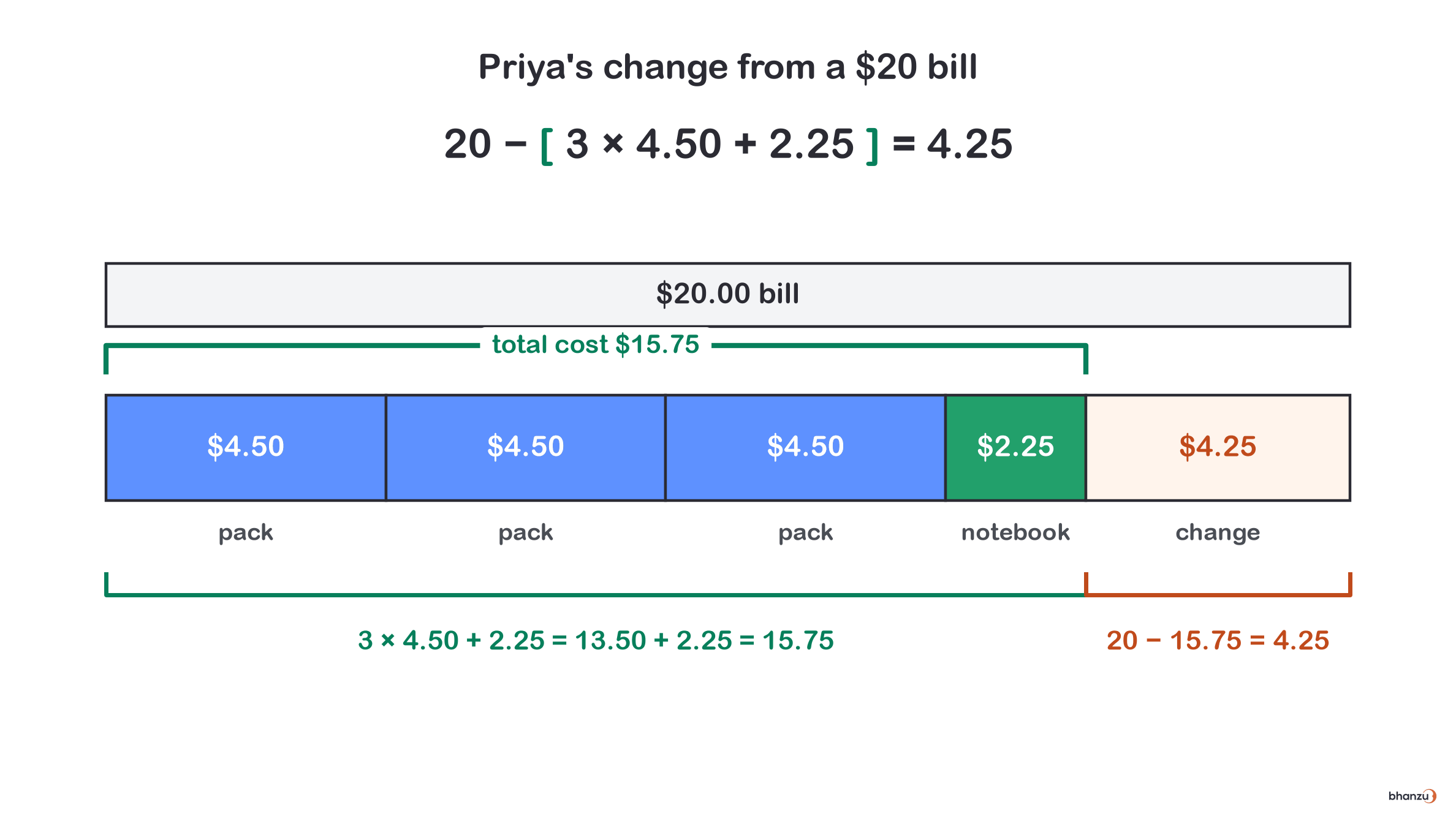
Priya gets $4.25 in change.
What most guides miss about order of operations with brackets
Brackets can help even when they change nothing. Extra brackets (a pair around a step that would come first anyway) act like a pencil circle that tells your eyes where to start, and two studies give a clearer picture of when that helps.
- In the 2023 study of 528 students, brackets around a middle multiplication, as in , cut the average from 5.17 problems to 3.66.
- A 2016 study of 169 students in Sweden, aged 12 to 13 and given a lesson of about 7 minutes, did not find that extra brackets helped them learn the rule.
So treat extra brackets as a short-term support. When you practice, pencil a light bracket around a multiplication that hides in the middle of a line, then redo the line a day later without it. The goal is to see the group with nothing drawn.
Order of operations with brackets: common confusions cleared up
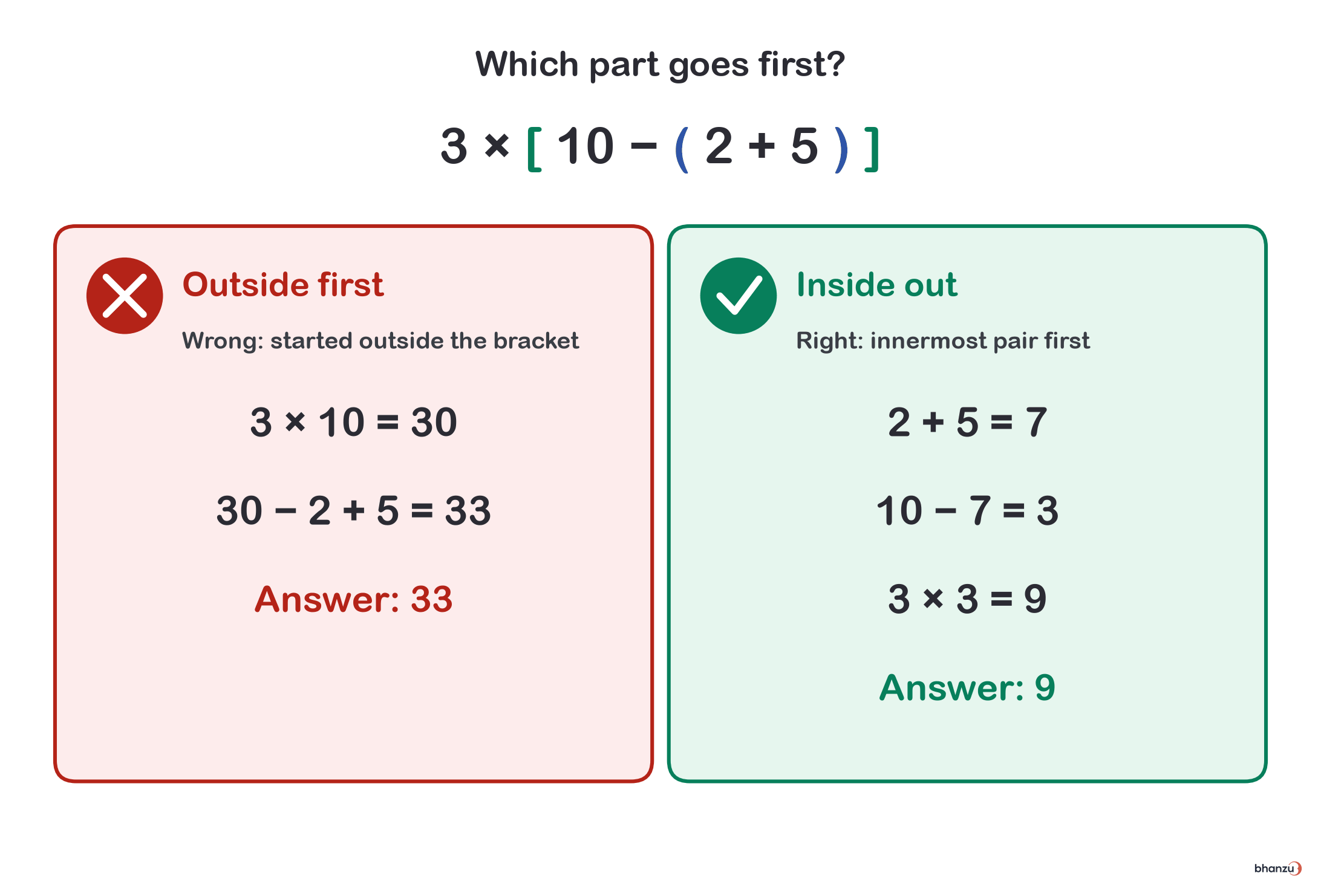
Mistake 1: Starting with the outside group
Where it slips in: Lines with a group inside a group, such as , because children tend to start wherever their eyes land first.
Don't do this: Multiply straight away, then finish .
The correct way: Start inside the parentheses, . Then finish the bracket, . Last, .
Mistake 2: Reading a bracket from left to right
Where it slips in: A bracket holding two operations, such as . After hunting down the innermost group, children often treat what's inside as a fresh line and work it in reading order.
Don't do this: , then , then .
The correct way: Multiply inside the bracket first, . Then , and .
Mistake 3: Multiplying first because M comes before D
Where it slips in: A multiplication and a division side by side, such as . PEMDAS lists M before D, so a child who checks the memory word instead of the line reads it as a ranking.
Don't do this: Finish the parentheses to get 6, then work and , giving .
The correct way: After , divide first because the division sits on the left, . Then , and .
Key Takeaways
- Before writing any answer, circle the pair with no other group inside it, because that group goes first.
- Once the groups are gone, multiply and divide in reading order, then add and subtract in reading order.
- In a word problem, an amount that must be finished before the next step uses it belongs inside a group.
- A size check, like noticing that a line starting at 40 only subtracts, catches order of operations with brackets done backward.
- For more practice with nested brackets alongside a teacher who catches the outside-first habit, explore Bhanzu's 5th grade math curriculum or its elementary math tutor sessions.
Read More
- Order of Operations in 2-Step Expressions
- Multi-Digit Multiplication
- Order of Operations with Exponents
- Order of Operations with Rational Numbers
- Order of Operations in Math
Research Behind This Article
- Common Core State Standards Initiative, Common Core State Standards for Mathematics (2010). thecorestandards.org
- OpenStax, Prealgebra 2e, 2.1 Use the Language of Algebra (2020). openstax.org
- Vy Ngo, Luisa Perez Lacera, Avery Harrison Closser and Erin Ottmar, The Effects of Operator Position and Superfluous Brackets on Student Performance in Simple Arithmetic (2023). eric.ed.gov
- MacTutor History of Mathematics, University of St Andrews, Earliest Uses of Grouping Symbols (n.d.). mathshistory.st-andrews.ac.uk
- Robert Gunnarsson, Wang Wei Sönnerhed and Bernt Hernell, Does It Help to Use Mathematically Superfluous Brackets When Teaching the Rules for the Order of Operations? (2016). eric.ed.gov
Quick Quiz: Check Yourself
Three levels, new numbers every time: clear one pair of parentheses, then a bracket holding a group or a divide-and-multiply pair, then braces three levels deep or a shopping change story.
Was this article helpful?
Your feedback helps us write better content
Frequently Asked Questions
Do brackets change the order of operations?
What grade do you learn order of operations?
Where do exponents go in the order of operations with brackets?
Does the order of operations matter with just addition and subtraction?
How can I teach order of operations with brackets at home?
How do you do order of operations with fractions?