Key Points
- Multiplying multi-digit decimals uses the standard algorithm on the digits alone, and the product takes the sum of the factors' decimal places, so .
- The decimal place count works because 4.27 is 427 hundredths and 3.6 is 36 tenths, and a hundredth times a tenth is always a thousandth, three places.
- Lining up the decimal points as in adding turns into 1,489.60, while an estimate near 15 shows the true product is 14.896.
- Sixth graders are expected to multiply long decimals fluently on paper, and 6th grade percent problems, such as finding 15% of $48.60, depend on that skill.
A gas price with three decimal places
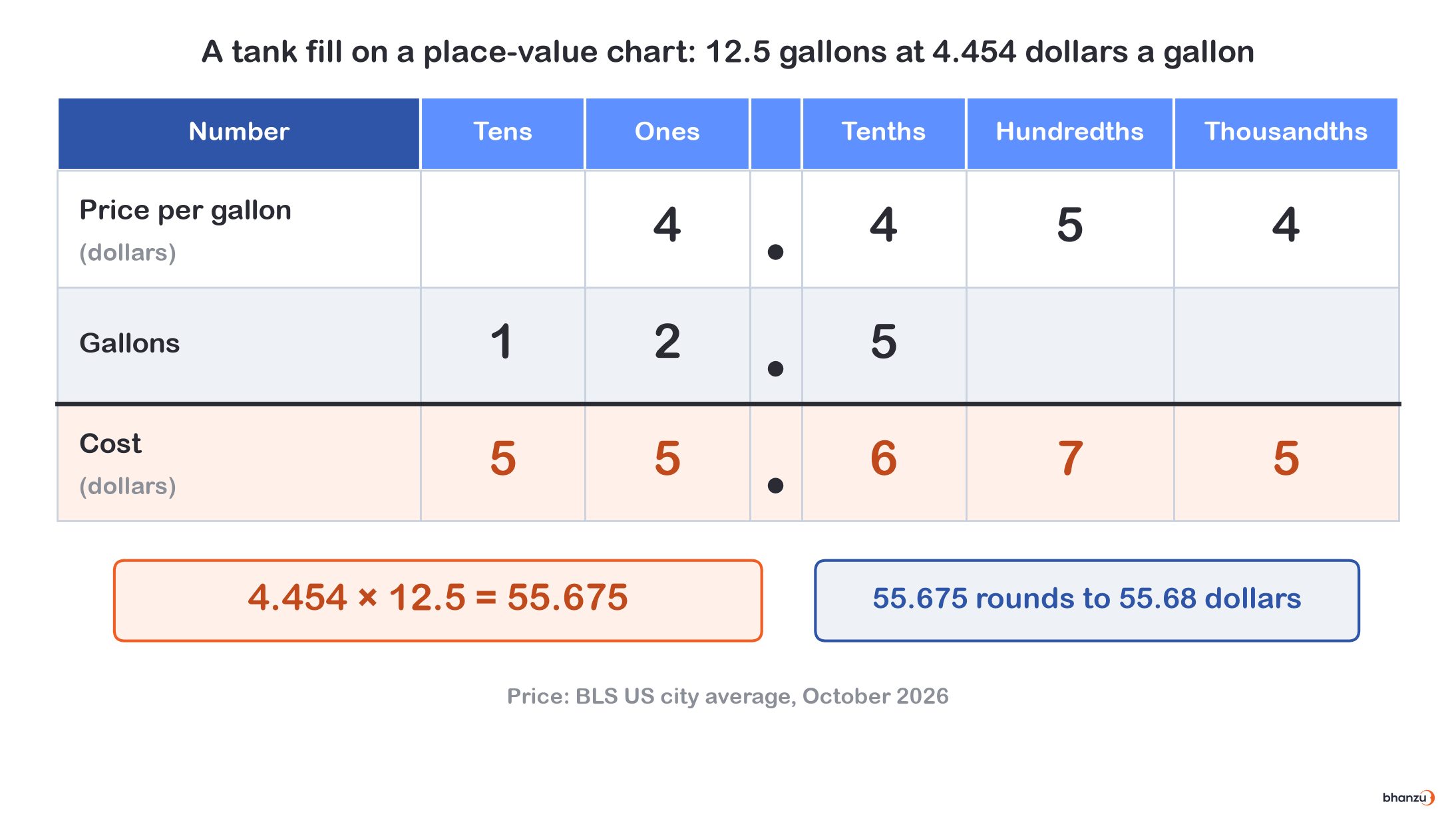
The average gallon of regular gas cost $4.454 in October 2026. That figure comes from the US Bureau of Labor Statistics, which publishes a US city average every month, and the figure's third decimal place is a tenth of a cent.
Filling a 12.5-gallon tank at that price means multiplying 12.5 by 4.454. The exact cost is 55.675 dollars, which rounds up to $55.68 at the nearest cent. Pharmacists use the same move to scale a medicine dose to a body weight in kilograms. Engineers use it to turn inches into centimeters, and none of them reach for a new method when the numbers get long.
How do you multiply multi-digit decimals?
Multiplying multi-digit decimals starts with a whole-number product, so 4.27 times 3.6 begins as 427 times 36. The answer then gets as many decimal places (digits to the right of the decimal point) as the two factors have together, which is here.
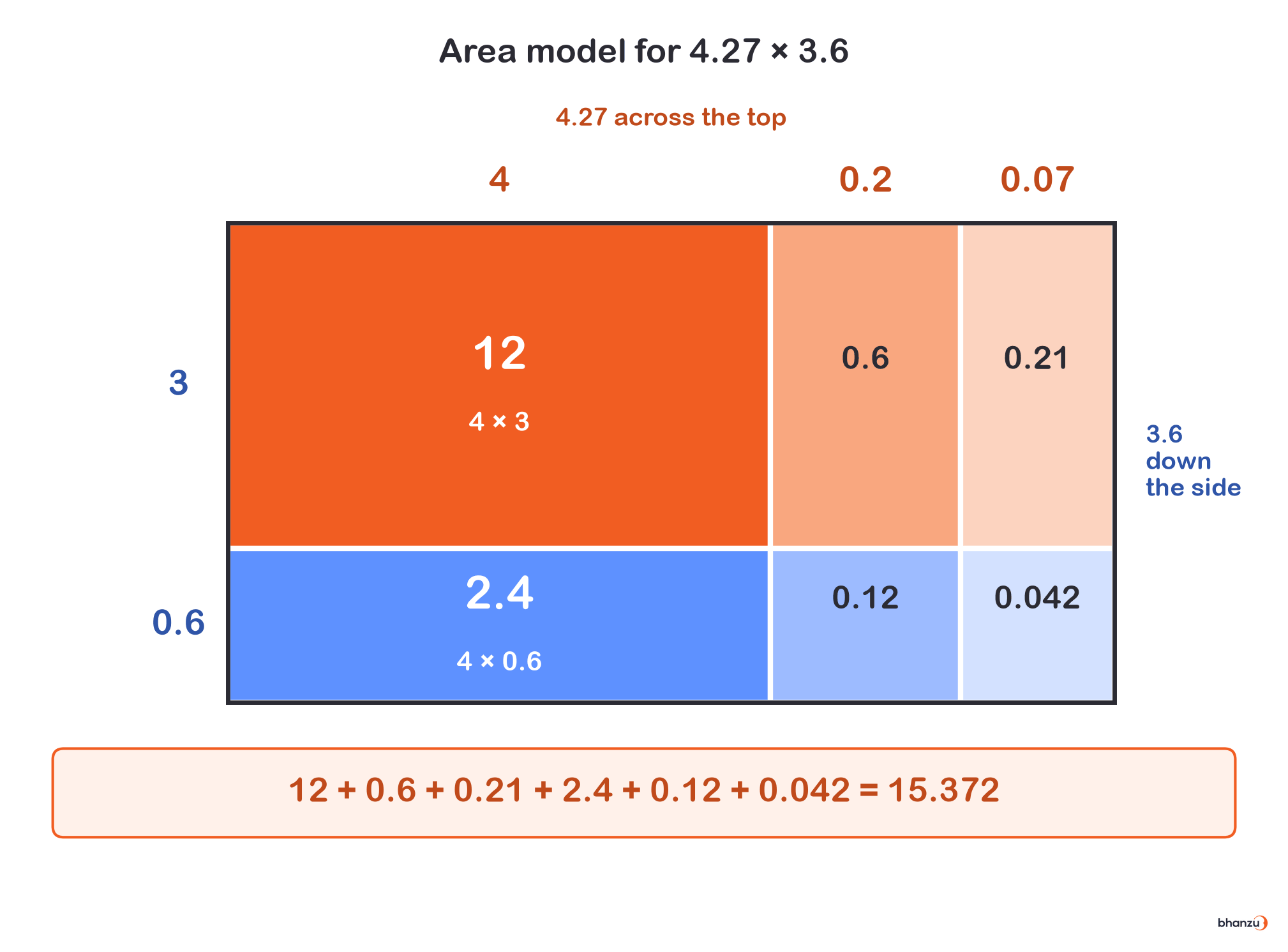
An area model shows why the answer lands at 15.372. The model is a rectangle with its sides split by place value, so 4.27 becomes 4, 0.2 and 0.07 across the top, and 3.6 becomes 3 and 0.6 down the side. Each of the six small rectangles has an area in square units (the model is 2D), and each area is a partial product, one piece of the full answer.
Splitting a factor into parts and multiplying each part is the distributive property at work. The standard algorithm, the column method you already use for whole numbers, does the same job in fewer rows.
This is Common Core standard 6.NS.B.3, which asks 6th graders to multiply multi-digit decimals fluently with the standard algorithm. The 5th grade lesson on multiplying decimals works with tenths and hundredths on grids. In 6th grade, your child carries that same idea to longer numbers worked on paper, so the new part is length and fluency rather than a new idea.
How does the standard algorithm handle the decimal point?
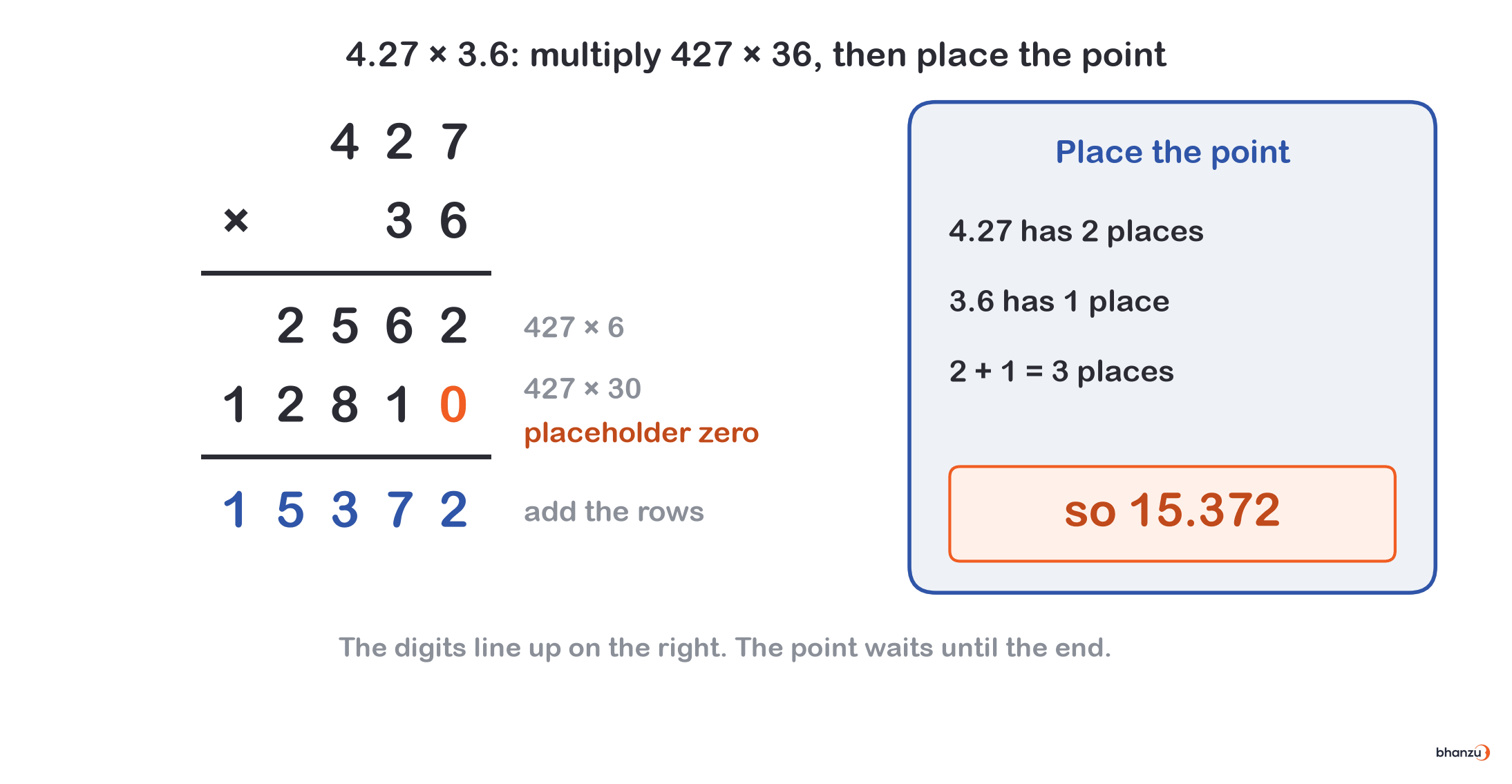
The standard algorithm ignores the decimal point until the very last step. Every algorithm is a fixed list of steps that gives the right answer each time you follow it, and this one is the same multi-digit multiplication you did with whole numbers. Here it is on 4.27 times 3.6.
- Write 4.27 above 3.6 with the last digits lined up on the right.
- Multiply 427 by the 6 in the ones place to get the first row, .
- Start the second row with a placeholder zero (a 0 that holds the ones place, because the 3 in 36 is really 3 tens), so the row is .
- Add the rows to get .
- Count decimal places from the right of 15,372 and place the point to get 15.372.
Do you line up decimals when multiplying?
No. In multiplication the digits line up on the right and the point waits until the end, while lining up the points is the habit from adding and subtracting, where tenths sit over tenths. Children who have just practiced adding decimals often stack 4.27 over 3.6 with the points lined up, so the 6 ends up under the 2 instead of the 7. The lined-up points then tempt them to bring the point straight down.
Why does counting decimal places work?
Counting decimal places works because each decimal here is a whole number of small units. The number 4.27 is 427 hundredths, and 3.6 is 36 tenths. A hundredth times a tenth is a thousandth, since , so 427 hundredths times 36 tenths is 15,372 thousandths.
Writing each decimal as a fraction with a denominator of 10, 100 or 1,000 makes those units visible, the same move you use when switching between fractions, decimals and percentages.
| Number | As a fraction | Decimal places |
|---|---|---|
| 4.27 | 2 | |
| 3.6 | 1 | |
| 15.372 | 3 |
A second view uses multiplying and dividing by powers of 10. Multiplying 4.27 by 100 and 3.6 by 10 turns both into whole numbers, so 427 times 36 is times too big. Dividing 15,372 by 1,000 undoes that scaling and moves the point 3 places left. In 8th grade, scientific notation multiplies very large and very small numbers with this same powers-of-10 idea.
The two views can feel like they disagree, since one shrinks the units and the other scales the numbers up and back down. Both land on 15.372 for the same reason. The OpenStax Prealgebra 2e textbook states the rule plainly: the number of decimal places in a product is the sum of the decimal places in its factors.
How do you check where the decimal point goes?
Estimate first, then count. Round each factor to the nearest whole number and multiply, the same skill as estimating multi-digit products. For 4.27 times 3.6, the estimate is , so 15.372 fits, while 153.72 and 1.5372 do not.
Rounding to whole numbers stops helping when both factors are less than 1, because 0.048 times 0.15 rounds to 0 times 0. Here the place count is the dependable check. The digits give , and the factors have places, but 720 has only 3 digits.
Two placeholder zeros go in front so the count can reach 5 places, and the end zero is dropped only after the point is in place. A child who gets 0.0072 often second-guesses it because it looks too small. Yet the product of two positive numbers less than 1 is always smaller than either factor, so a tiny answer is exactly what to expect. In 7th grade, the same place count keeps working when negative decimals join the problem.
Try It Yourself
Drag the decimal point along the digits of the product, or use the arrow keys, until the number matches your estimate. Press Check to see whether your place count agrees, then tap Show area model to see the six partial products that add up to the same answer. New problem gives you fresh factors to place.
The real reason multiplying multi-digit decimals exists
Measurements and prices rarely land on whole numbers, and decimals let you multiply parts of a unit with the column method you already trust. Each use below is a whole-number product plus a place count.
- It grew from a push to make long calculations easier. MacTutor's biography of John Napier credits him with introducing decimal notation for fractions, and his book Rabdologiae (1617) described multiplying with "numbering rods".
- It converts units exactly. The National Institute of Standards and Technology lists as an exact factor, so a board 15.6 inches long measures .
- It measures area. A rug 2.45 meters long and 1.6 meters wide covers square meters, because and the factors have 3 places.
- It leads straight into percents. Finding 15% of $48.60 means multiplying 0.15 by 48.60, and with 4 places gives $7.29.
Take decimal multiplication away and each of these needs a separate trick. One paper method covers all four.
Examples of multiplying multi-digit decimals
Example 1
Multiply 5.23 by 1.7.
Multiply the digits as whole numbers.
The factors have decimal places, so count 3 places from the right.
The estimate is close to 8.891.
Example 2
Multiply 6.08 by 2.45.
The tempting move is to stack the numbers with the decimal points lined up, as in adding, and multiply the digits.
Bringing the point straight down from the factors leaves 2 places in the answer, which gives 1,489.60. That answer cannot be right. The estimate puts the product near 15, and 1,489.60 is about 100 times too big.
The factors have decimal places, so count 4 places from the right of 148,960.
The zero inside 6.08 is a real digit, so it stays in 608.
Example 3
The product 375 times 48 is 18,000. Use it to find 3.75 times 0.48.
The factors have decimal places. Count 4 places from the right across all five digits of 18,000.
The estimate is close to 1.8.
Example 4
Multiply 0.065 by 0.32.
The factors have decimal places, but 2,080 has only 4 digits. Write one placeholder zero in front so the count reaches 5 places, then drop the end zero.
Example 5
Is 18.4 times 2.06 closer to 36 or to 38?
Split 2.06 into 2 and 0.06, then find the two partial products and add them.
The product 37.904 is 0.096 away from 38 and 1.904 away from 36, so it is closer to 38. The standard algorithm agrees, since and places give 37.904.
Example 6
Two posters are each 23.5 inches wide. With 2.54 centimeters in every inch, will they fit side by side in a space 120 centimeters wide?
Find the width of one poster in centimeters first.
The factors have decimal places, so the product is 59.690, which is 59.69.
Two posters side by side take up double that width.
The posters fit with 0.62 centimeters to spare. An estimate of centimeters per poster agrees with 59.69, but 2 times 60 lands right on 120, so only the exact product can settle the fit.
What teachers watch for in multiplying multi-digit decimals
Teachers watch whether a child can say why the point goes where it does, because a rule without a reason breaks the first time a zero shows up. In a 2022 study, Eunmi Joung and Young Rae Kim gave 37 preservice teachers in the US (adults training to become teachers) decimal multiplication and division problems. Errors that came from misunderstanding place value and equal values outnumbered errors in the steps themselves. The authors add that these place-value errors overlap with ones elementary school students make, so a child who only repeats "count the places" has nothing to fall back on when the count looks wrong.
One question at home shows whether your child has the reason or only the rule: ask how many thousandths 15.372 is. A child who answers 15,372 thousandths is reading the place value behind the count.
Tripping points to avoid with multiplying multi-digit decimals
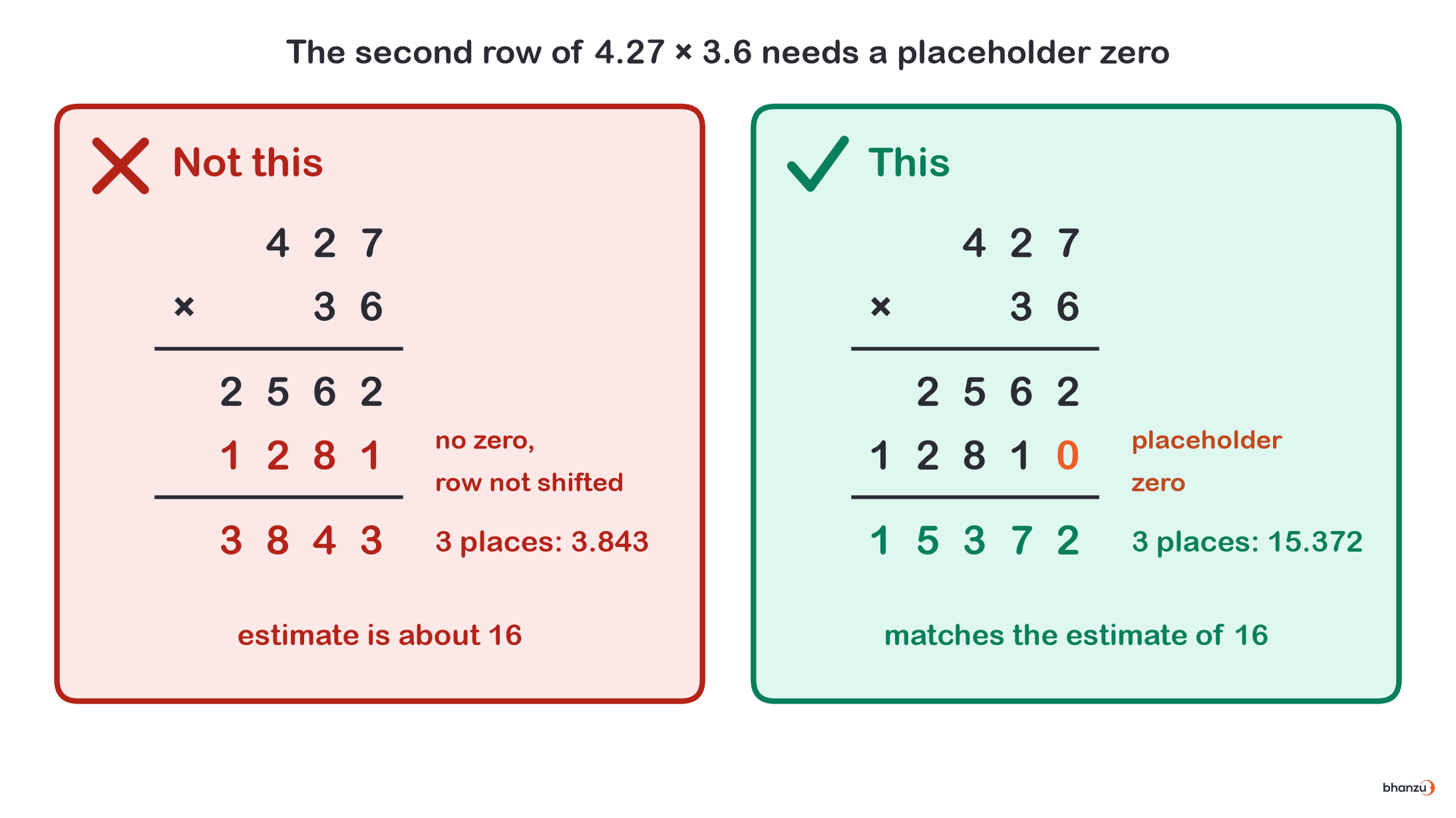
Mistake 1: Skipping the placeholder zero in the second row
Where it slips in: The second partial product of the standard algorithm, as in 4.27 times 3.6. Attention jumps ahead to the decimal points, the row shift drops out, and a child who rushes to the answer writes 1,281 straight under 2,562.
Don't do this: Add and count 3 places to get 3.843.
The correct way: Write the placeholder zero first, so the second row is . Then , and 3 places give 15.372, which matches the estimate of 16.
Mistake 2: Dropping end zeros before placing the point
Where it slips in: Products that end in zeros, such as 2.5 times 0.84, where . Children know that 2.100 equals 2.1, so they tidy the zeros one step too early.
Don't do this: Cross out the zeros, keep 21 and count 3 places to get 0.021.
The correct way: Count 3 places on all of 2,100 to get 2.100, then drop the end zeros to get 2.1. The estimate agrees.
Mistake 3: Counting places from the left
Where it slips in: Long products such as 7.25 times 1.8, where . The count of 3 is right, but reading goes left to right, so the child starts counting at the wrong end.
Don't do this: Count 3 digits from the left of 13,050 and write 130.50.
The correct way: Count 3 places from the right to get 13.050, which is 13.05. The estimate agrees.
Key Takeaways
- Estimate first by rounding to whole numbers, which catches 153.72 for 4.27 times 3.6, and trust the place count when both factors are below 1.
- When multiplying multi-digit decimals, line the digits up on the right and leave the point for the last step.
- The second row of the standard algorithm begins with a placeholder zero, whatever decimals you are multiplying.
- Reading a long product in its smallest unit, such as 15,372 thousandths, shows why the place count works.
- For more practice placing the point in long products, with a teacher who notices a missing placeholder zero, explore Bhanzu's 6th grade math curriculum or math classes for kids.
Read More
- Dividing Decimals
- Finding the Percent of a Number
- Properties of Operations
- Multiplying Decimals by Whole Numbers
- Rounding Decimals
Research Behind This Article
- US Bureau of Labor Statistics, Average Price Data: Gasoline, unleaded regular, per gallon, U.S. city average (2026). data.bls.gov
- Common Core State Standards Initiative, Grade 6 The Number System (2010). thecorestandards.org
- Lynn Marecek, MaryAnne Anthony-Smith and Andrea Honeycutt Mathis, OpenStax, Prealgebra 2e, 5.2 Decimal Operations (2020). openstax.org
- J J O'Connor and E F Robertson, MacTutor, John Napier (1998). mathshistory.st-andrews.ac.uk
- National Institute of Standards and Technology, NIST Guide to the SI, Appendix B.8: Factors for Units Listed Alphabetically (2025). nist.gov
- Eunmi Joung and Young Rae Kim, Identifying Preservice Teachers' Concept-Based and Procedure-Based Error Patterns in Multiplying and Dividing Decimals (2022). eric.ed.gov
Quick Quiz: Check Yourself
Three levels, with new numbers each time, ask you to multiply two decimals, place the point from a given whole-number product or multiply two small decimals, then solve a conversion or gas-cost word problem.
Was this article helpful?
Your feedback helps us write better content
Frequently Asked Questions
How many decimal places is a thousandth?
What should my child know about multiplying decimals in 6th grade?
Are there different ways to multiply decimals?
How do you go about multiplying decimals by 2-digit whole numbers?
What kinds of multiplying decimals word problems come up in grade 6?
How can I help my child with multiplying multi-digit decimals at home?