Key Points
- Multiplying decimals starts with whole-number multiplication, then the decimal places in both factors are added to place the point, so .
- On a 10 by 10 grid, 3 tenths across and 4 tenths down overlap in 12 small squares, each one hundredth.
- A child who lines up the points as in adding turns into 9.0, but the true product is 0.9, smaller than 1.5 because 0.6 is less than 1.
The ribbon that gets shorter when you multiply
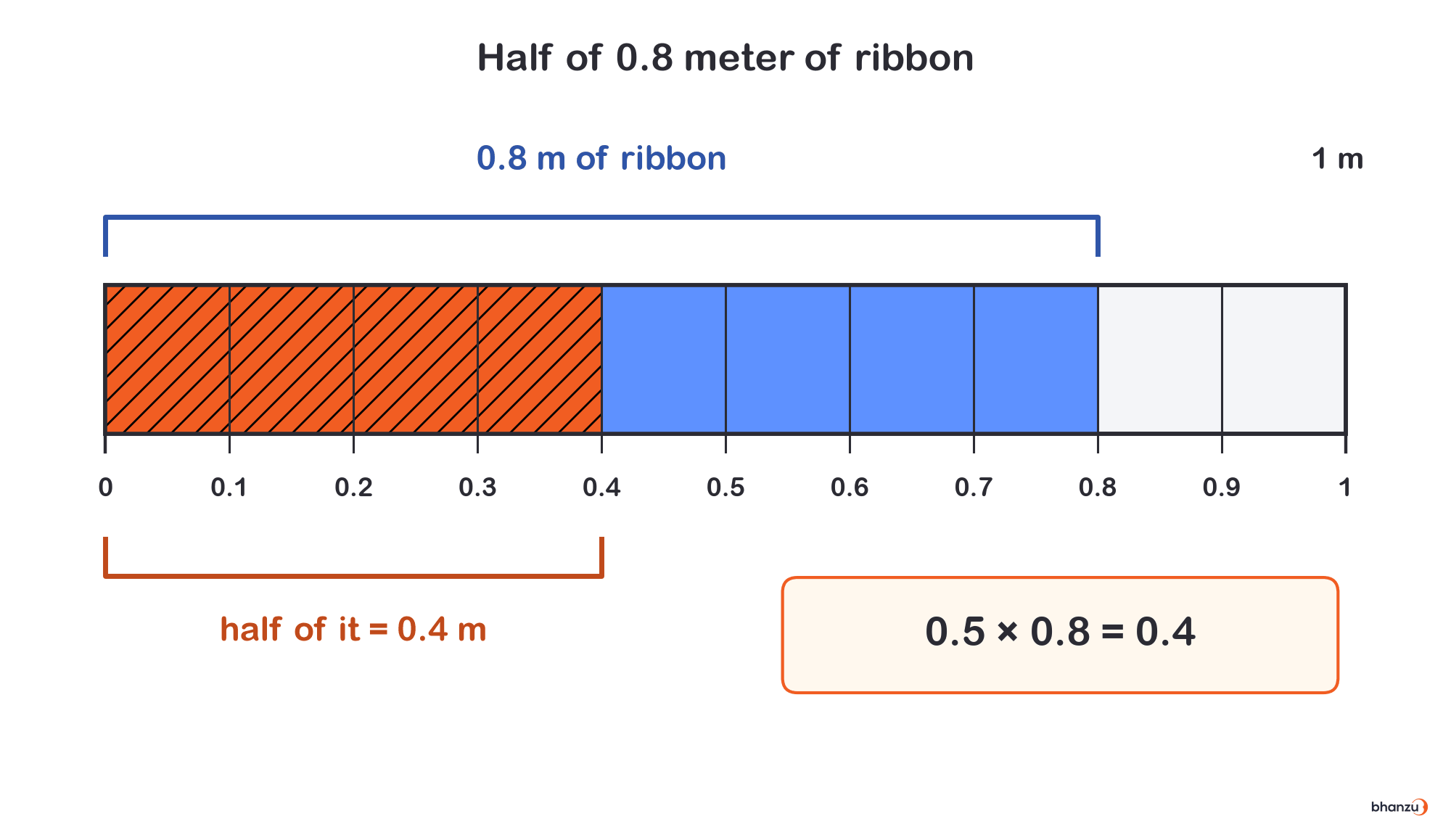
You have 0.8 meter of ribbon and use half of it for a bow. Half of 0.8 meter is 0.4 meter, and "half of" is a multiplication, 0.5 times 0.8. (In math, "of" often means times.)
Something odd just happened. You multiplied two numbers and got 0.4, smaller than both 0.5 and 0.8. Whole numbers bigger than 1 never do that, and a grid of 100 small squares shows why. In 6th grade, you'll use the same counting idea for multiplying multi-digit decimals such as 12.75 times 3.4.
How do you multiply decimals?
When multiplying decimals, multiply the digits as if the points were not there, then count the decimal places (digits to the right of the point) in both factors and give the product that many. The numbers you multiply are the factors, and the answer is the product.
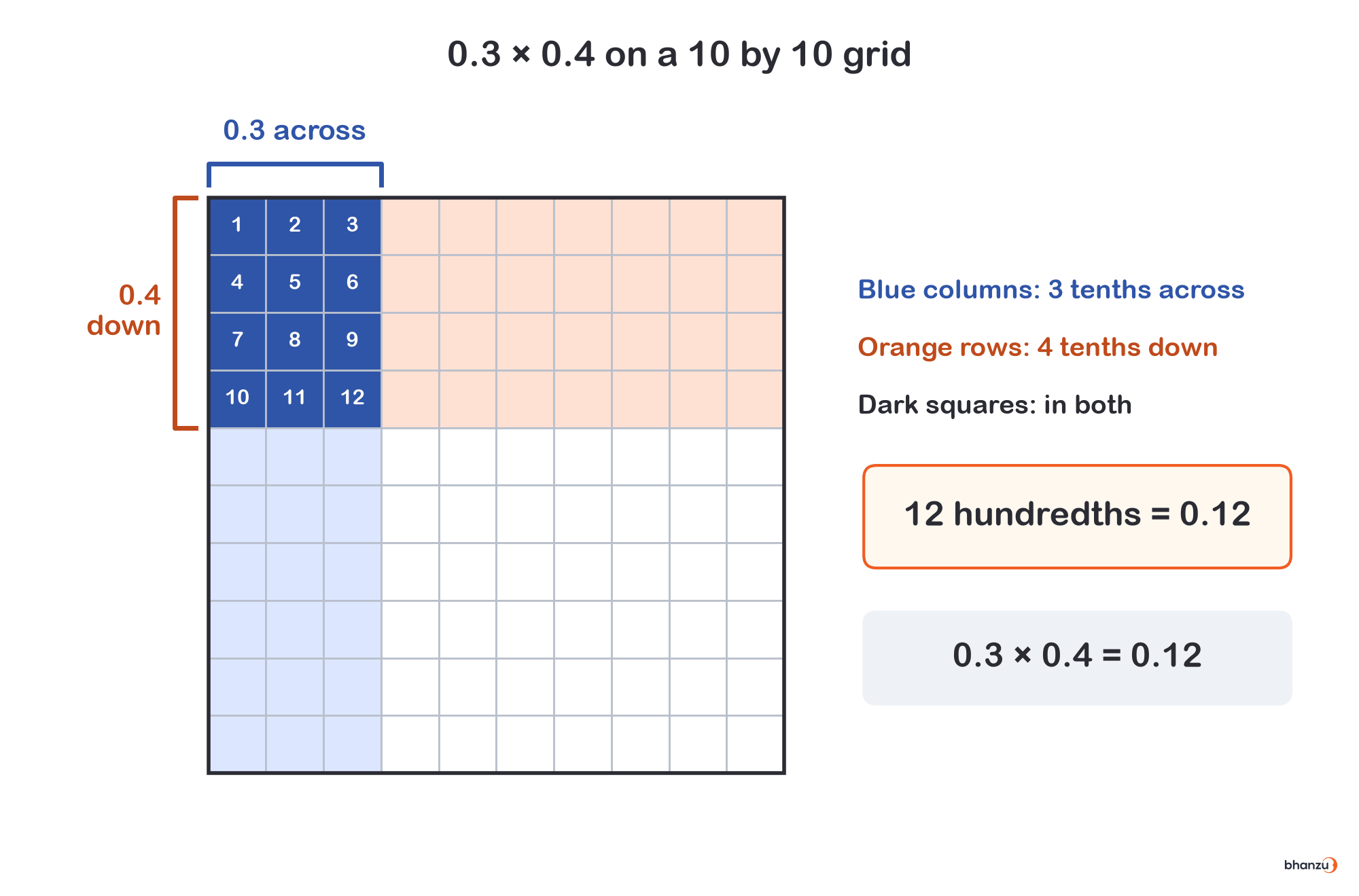
A 10 by 10 grid, a square cut into 100 equal small squares, shows why. Shade 3 columns for 0.3 and 4 rows for 0.4, and the shadings overlap in 12 small squares, or 12 hundredths.
- Multiply the digits as whole numbers, as in multi-digit multiplication, so .
- Add the decimal places in the two factors, so 1 place plus 1 place makes 2.
- Count that many places from the right end of the product and put the point, writing a zero in front as a placeholder if digits run out, so 12 becomes 0.12.
Where does the decimal go when multiplying? Count from the right end of the product, never by lining up the points first. That switch is the genuinely confusing part, because adding decimals needs lined-up points while multiplying ignores them until the end.
This is Common Core standard 5.NBT.B.7, which asks 5th graders to multiply decimals to hundredths with models and place value, relate that work to a written method and explain the reasoning. Your child has likely met multiplying decimals by whole numbers already, so the new step is a second decimal factor.
Why does tenths times tenths make hundredths?
A tenth of a tenth is a hundredth, because one tenth of the grid's width and one tenth of its height share exactly 1 of the 100 small squares. Every decimal to hundredths is also a fraction with a denominator of 10 or 100, which is how fractions, decimals and percentages connect, so the grid is really multiplying fractions.
| Decimals | As fractions | Product as a fraction | Product as a decimal |
|---|---|---|---|
Ten times 10 is 100, so tenths times tenths always lands on hundredths, and 1 place plus 1 place makes 2. OpenStax Prealgebra states the same rule for any decimals.
A child who learned "count the places" as a bare rule often counts one factor only and writes 1.2 for . The grid settles it, because the overlap sits inside one whole square and 1.2 is more than one whole.
Try It Yourself
Drag the blue handle to shade tenths across and the orange handle to shade tenths down, and watch the overlap count up in hundredths. A place-value chart next to the grid shows each digit of the product. Press Challenge, set two factors that make the target product, and tap Check.
Multiplying decimals using area models
An area model splits each factor into ones and tenths, multiplies every part by every part, and adds the partial products. The model handles factors bigger than 1, which one 10 by 10 grid cannot hold. It works because the area of a rectangle is length times width (count the unit squares row by row), a 2D measure in square units.
- Split each factor into ones and tenths, so 2.4 becomes 2 and 0.4, and 1.3 becomes 1 and 0.3.
- Multiply every part of one factor by every part of the other.
- Add the four partial products.
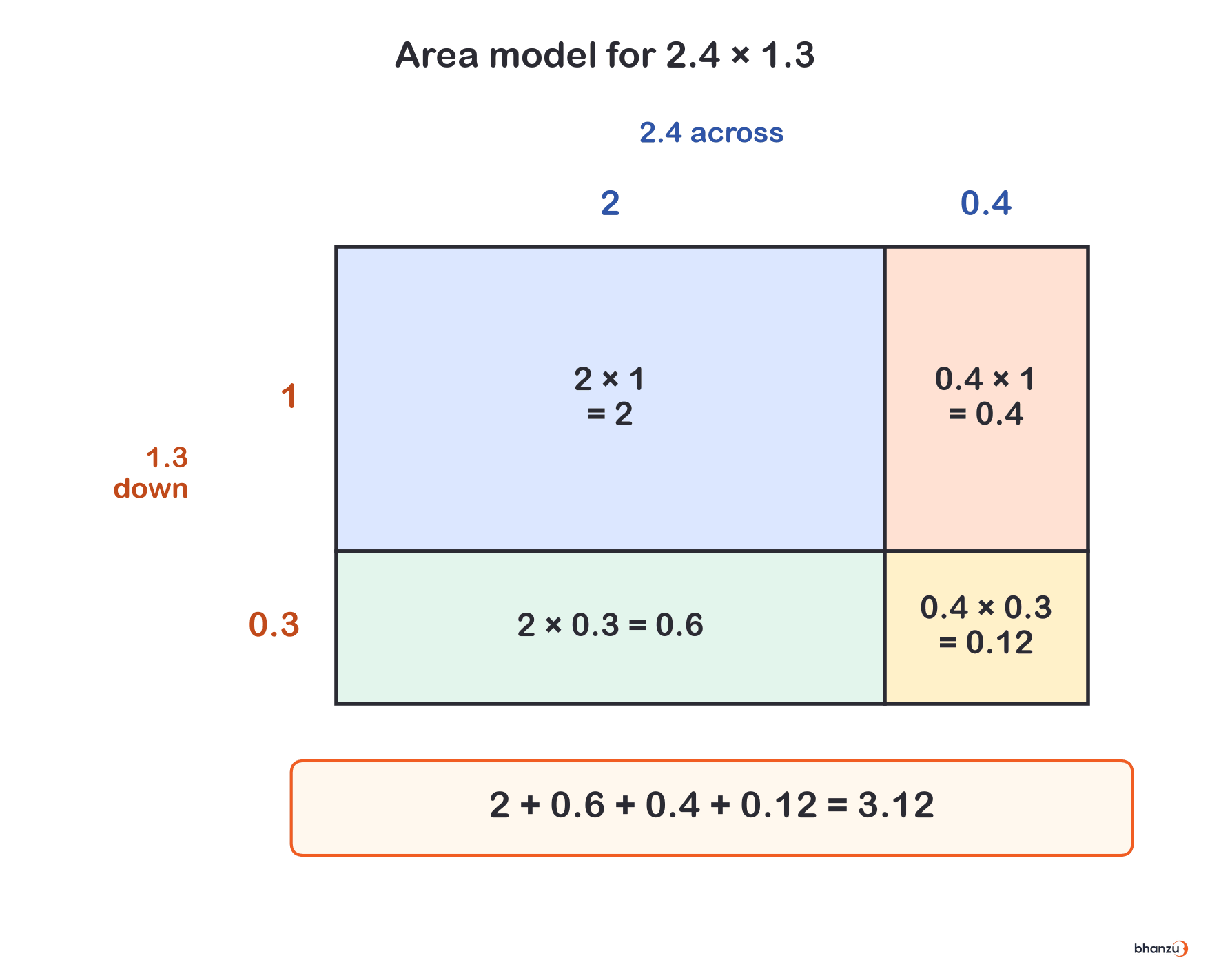
The place-count rule agrees. In a column, , and two places make 3.12.
The area model gets slow with more digits, such as 12.75, because the rectangle breaks into many pieces. In 6th grade, the standard algorithm (the usual column method) takes over.
Can a product be smaller than both factors?
Yes, when both factors are between 0 and 1, because you take part of a part, as in . Comparing each factor with 1 tells you which way the product moves.
- Both below 1. The product is smaller than both, as in .
- One above 1 and one below. The product lands between them, as in .
- Both above 1. The product is bigger than both, as in .
Hugues Lortie-Forgues and Robert Siegler ran two studies with 55 and 54 middle school students, published in a 2017 paper. Most students predicted wrongly whether multiplying by a decimal below 1 makes a number bigger or smaller. Even students who did the steps correctly made that error.
A quick estimate catches a misplaced point. Rounding decimals to the nearest whole number turns into , so 3.12 is sensible and 31.2 is not.
Examples of multiplying decimals
Example 1
What is 0.7 times 0.2?
Each factor has one decimal place, so the product needs two.
On the grid, 7 columns and 2 rows overlap in 14 hundredths.
Example 2
What is 1.5 times 0.6?
The tempting move lines up the points as in adding. Then , and bringing the point straight down gives 9.0.
That cannot be right. Since 0.6 is less than 1, the product must be less than 1.5, and 9.0 is six times 1.5.
Use the place count instead.
One place plus one place makes two, so the product is 0.90, the same number as 0.9.
Example 3
Some number times 0.8 makes 0.24. Find the missing factor.
The product 0.24 has two decimal places and 0.8 has one, so the missing factor has one.
The digit times 8 must make 24.
The missing factor is 0.3.
Example 4
Use an area model to multiply 2.3 by 1.4.
Split 2.3 into 2 and 0.3, and 1.4 into 1 and 0.4, then find the four partial products.
The place count agrees, since and two places make 3.22.
Example 5
Which is bigger, 0.8 times 0.9 or 0.8? Explain without multiplying first.
Because 0.9 is less than 1, 0.8 times 0.9 is only part of 0.8, so 0.8 is bigger.
Multiplying confirms it. , so the product is 0.72, which is less than 0.8.
Example 6
Maya buys 1.5 pounds of grapes at $2.40 a pound and pays with a $5 bill. How much change does she get?
The price $2.40 is 2.4 dollars, so the cost is dollars.
Two decimal places make 3.60, so the cost is $3.60.
Maya gets $1.40 in change. The cost is sensible, because 1.5 pounds at about $2 a pound is $3.
Why does multiplying decimals matter?
Decimals let people handle parts of a unit as easily as whole numbers, and multiplying them turns a price per pound into a total.
- It was written for people who measure and trade. In 1585, Simon Stevin published a 29-page booklet on decimals for surveyors, carpet-makers, mint-masters and merchants.
- It shaped American money. A 1608 English translation, titled Disme, inspired Thomas Jefferson to propose a decimal currency, and a tenth of a dollar is still called a dime.
- It turns prices into totals. The US Bureau of Labor Statistics reported an average banana price of $0.655 a pound in October 2026, about 66 cents, so 2.5 pounds cost about dollars.
The banana total comes from a whole-number product and a counted point. In 6th grade, 25% of a price works the same way.
The pattern hiding inside multiplying decimals
When a 5 at the end of one factor meets an even digit at the end of the other, the whole-number product ends in 0. That zero must be counted before it is dropped. The ribbon followed this pattern, since and two places make 0.40, or 0.4.
Dropping the zero first leaves 3, and two places from 3 gives 0.03, ten times too small. Half of 0.6 is 0.3, so an estimate settles the zero question at once.
The place count also has a reason that even textbooks for teachers can skip. Jia He's 2025 review of 11 US textbooks for future elementary teachers found that only about half explain why the decimal places are added.
Where do students trip up on multiplying decimals?
Mistake 1: Making the product bigger on purpose
Where it slips in: Two decimals below 1, such as , because whole-number products with factors above 1 always grew. A child who gets 0.42 may second-guess it because it looks too small.
Don't do this: Multiply , decide 0.42 is too small, and move the point to write 4.2.
The correct way: Keep 42 hundredths, so , less than both factors because it is part of a part.
Mistake 2: Forgetting the placeholder zero
Where it slips in: Products where the digits run out before the places do, such as , where needs two places.
Don't do this: Write 0.8 and stop.
The correct way: Put a zero in front of the 8, so , which is 8 small squares on the grid, not 8 strips.
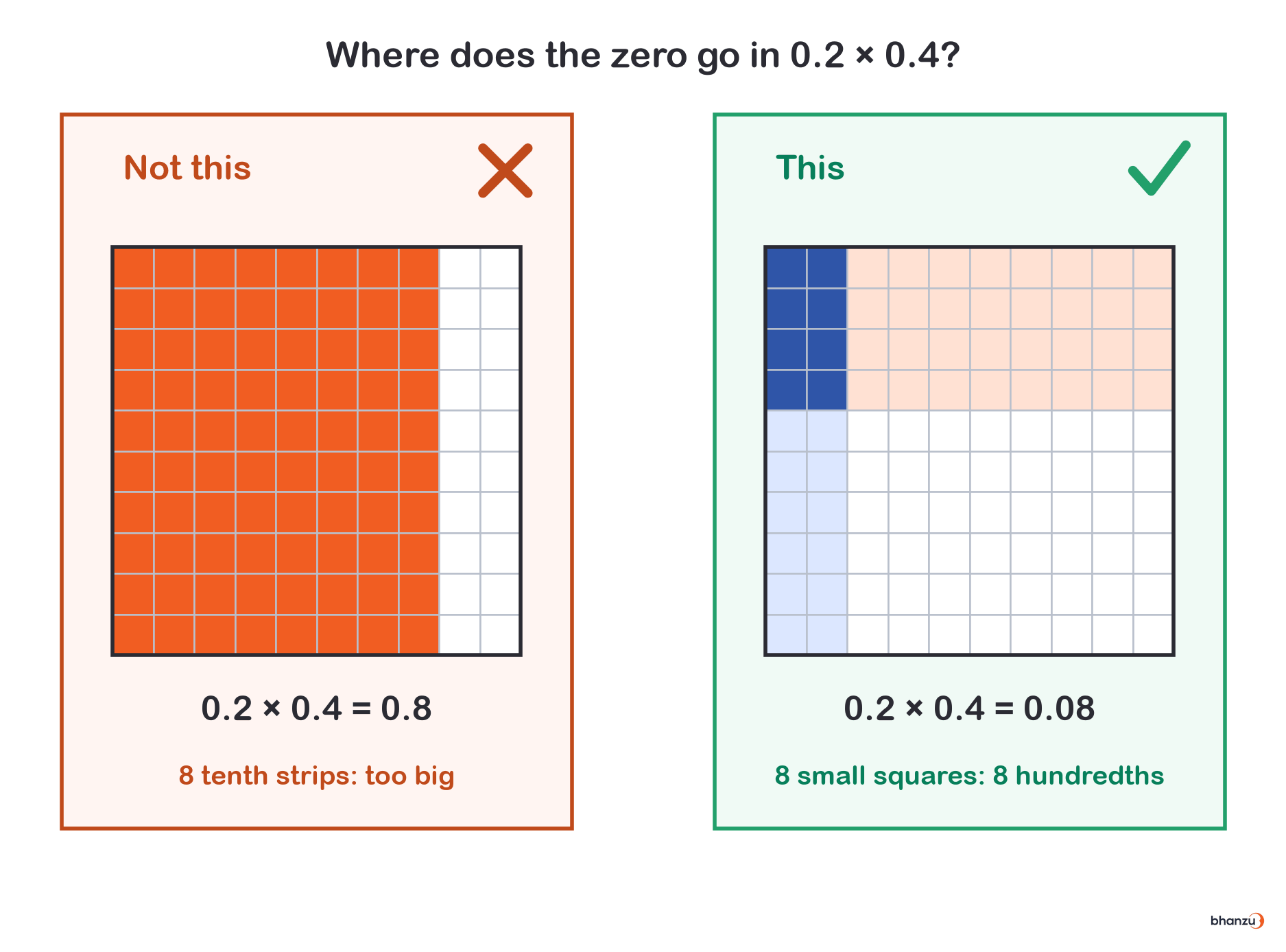
The digit 8 looks finished, so a child who rushes to the answer stops before counting the second place.
Mistake 3: Dropping the end zero before counting
Where it slips in: Products that end in 0, such as , where . Children know 0.20 equals 0.2 and use that fact one step too early.
Don't do this: Cross out the 0 in 20, count two places from the 2, and write 0.02.
The correct way: Count two places on all of 20 to get 0.20, then drop the end zero, so .
Key Takeaways
- Before placing the point, ask whether each factor is more or less than 1, so you know if the product should shrink or grow.
- In multiplying decimals, the point's position comes from counting places, not from lining up the points in the factors.
- When the digits run out, a zero goes in front, which is why is 0.08.
- An area model splits ones from tenths, so becomes four small products.
- For more practice placing the point and catching the missing zero, explore Bhanzu's 5th grade math tutor or elementary math programs.
Read More
- Dividing Whole Numbers to Get a Decimal
- Multiplying and Dividing by Powers of 10
- Multiplication as Scaling
- Adding Decimals
- Comparing Decimals
Research Behind This Article
- Common Core State Standards Initiative, Grade 5 Number and Operations in Base Ten (2010). thecorestandards.org
- Lynn Marecek, MaryAnne Anthony-Smith and Andrea Honeycutt Mathis, OpenStax, Prealgebra 2e, 5.2 Decimal Operations (2020). openstax.org
- Hugues Lortie-Forgues and Robert S. Siegler, Conceptual Knowledge of Decimal Arithmetic, Journal of Educational Psychology (2017). eric.ed.gov
- J J O'Connor and E F Robertson, MacTutor, Simon Stevin (2004). mathshistory.st-andrews.ac.uk
- US Bureau of Labor Statistics, Average Price Data: Bananas, per lb., U.S. city average (2026). data.bls.gov
- Jia He, Decimal Multiplication and Division in Mathematics Textbooks for Prospective Elementary Teachers, International Electronic Journal of Mathematics Education (2025). eric.ed.gov
Quick Quiz: Check Yourself
Three levels, new numbers every time: multiply tenths by tenths, then multiply a decimal above 1 by tenths or find a missing factor, then solve an area or price word problem with two decimals.
Was this article helpful?
Your feedback helps us write better content
Frequently Asked Questions
What is 0.1 times 0.1?
When multiplying decimals, do you line them up?
What is the difference between multiplying whole numbers and decimals?
Is multiplying decimals 5th grade or 6th grade math?
How do I teach multiplying decimals at home?