Key Points
- Dividing decimals by whole numbers splits a decimal amount into equal groups, so 0.84 divided by 4 is 0.21, or 2 tenths and 1 hundredth per group.
- With a whole-number divisor, the decimal point in the quotient sits straight above the point in the dividend, because sharing tenths still leaves tenths.
- Skipping the placeholder zero turns 6.24 divided by 6 into 1.4 instead of 1.04, and multiplying back catches it, since 1.4 times 6 is 8.4.
- Common Core places this skill in 5th grade as standard 5.NBT.B.7, dividing decimals to hundredths with models, place value and a written method.
Four friends, one jar of savings
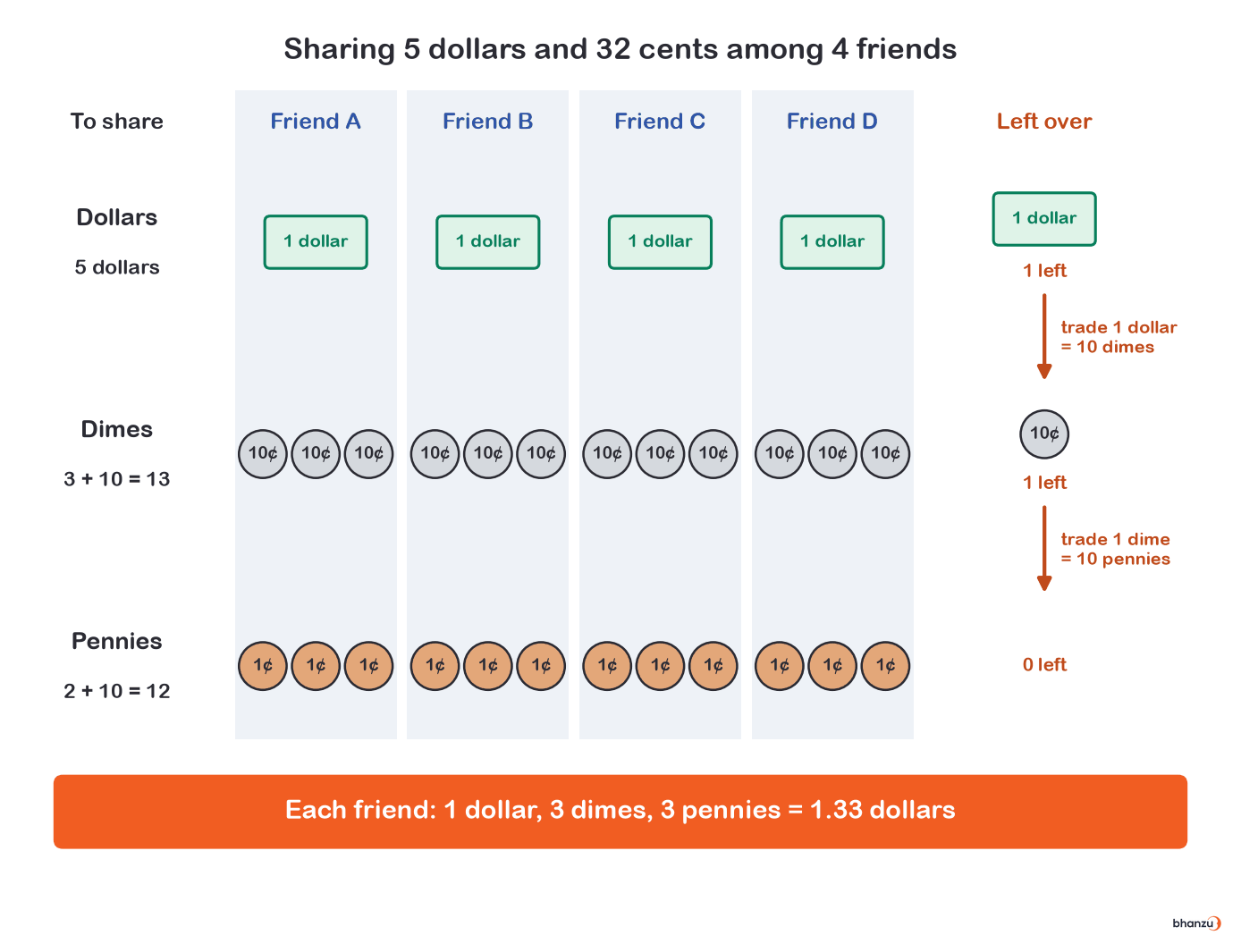
Four friends tip out a jar and count 5 dollars and 32 cents. That's 5 one-dollar bills, 3 dimes and 2 pennies, to be split four equal ways.
Each friend takes a bill, and the 1 dollar left over gets traded for 10 dimes, since nobody can tear a dollar into four fair pieces. That makes 13 dimes, 3 each with 1 left, and the last dime becomes 10 pennies, so everyone takes 3 of the 12. Each friend gets 1 dollar and 33 cents. Soon the same trades will help you split a lunch bill or find what one granola bar in a box costs.
What does dividing decimals by whole numbers mean?
Dividing decimals by whole numbers is fair sharing done place by place, with any piece that won't split traded for 10 of the next smaller piece. The amount shared is the dividend, the number of groups is the divisor, and one group's share is the quotient, the same dividend, divisor and quotient from whole-number division.
A hundredths grid, a square cut into 100 tiny squares, shows the idea before any digits do. One column is a tenth and one tiny square is a hundredth, so 0.84 fills 8 columns and 4 squares. Four groups get 2 columns and 1 square each.
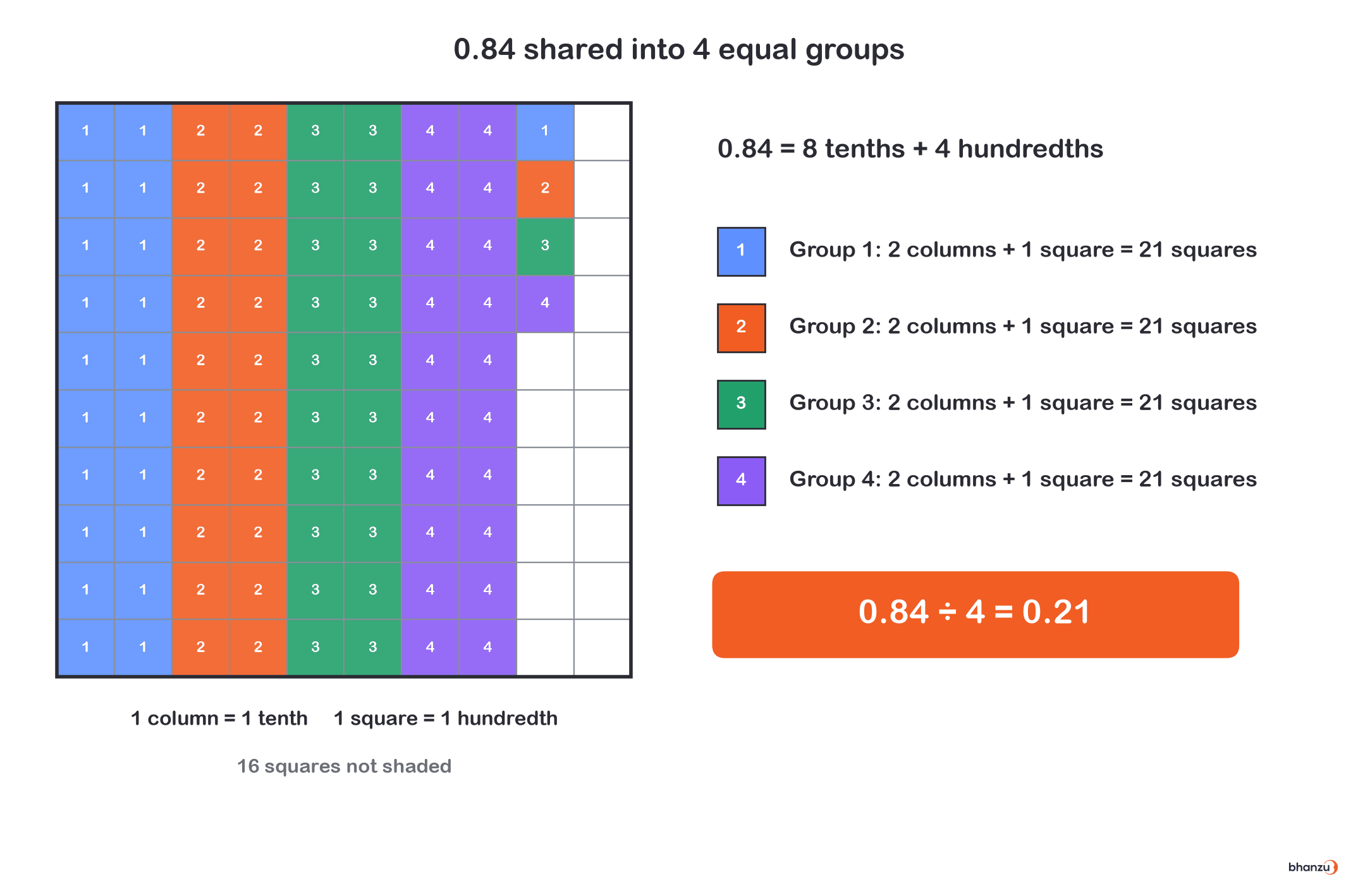
Dividing decimals by whole numbers is Common Core standard 5.NBT.B.7, which asks 5th graders to divide decimals to hundredths with models or drawings and place-value strategies, then connect that work to a written method. Your child should be able to show why 0.21 makes sense on a grid or a place-value chart, as well as write the digits.
How do you share tenths and hundredths fairly?
Share the biggest place first, trade whatever is left for 10 of the next smaller piece, and keep sharing. That trade is regrouping decimals at work, since 1 one equals 10 tenths and 1 tenth equals 10 hundredths.
Take . Two ones can't make 3 groups of whole ones, so the ones place gets a 0. Trading the 2 ones for 20 tenths gives 27 tenths, which is 9 tenths per group. The 6 hundredths split into 2 each.
| Step | Ones | Tenths | Hundredths |
|---|---|---|---|
| Start with 2.76 | 2 | 7 | 6 |
| Trade 2 ones for 20 tenths | 0 | 27 | 6 |
| Each of the 3 groups gets | 0 | 9 | 2 |
| Left over | 0 | 0 | 0 |
So .
Children who see 2 ones and 3 groups often write "can't do it" and stop, because whole-number division taught them to start with a digit that fits. Others erase a correct 0.92, sure that no answer starts with 0 (it must, since 3 groups can't each get a whole one from 2).
Try It Yourself
Press Next step to share the amount one place at a time, and watch any leftover one or tenth get traded for 10 smaller pieces. Pick a different number of groups or press New amount to get a fresh decimal. When the sharing is done, type what one group gets and press Check.
Where does the decimal go when dividing?
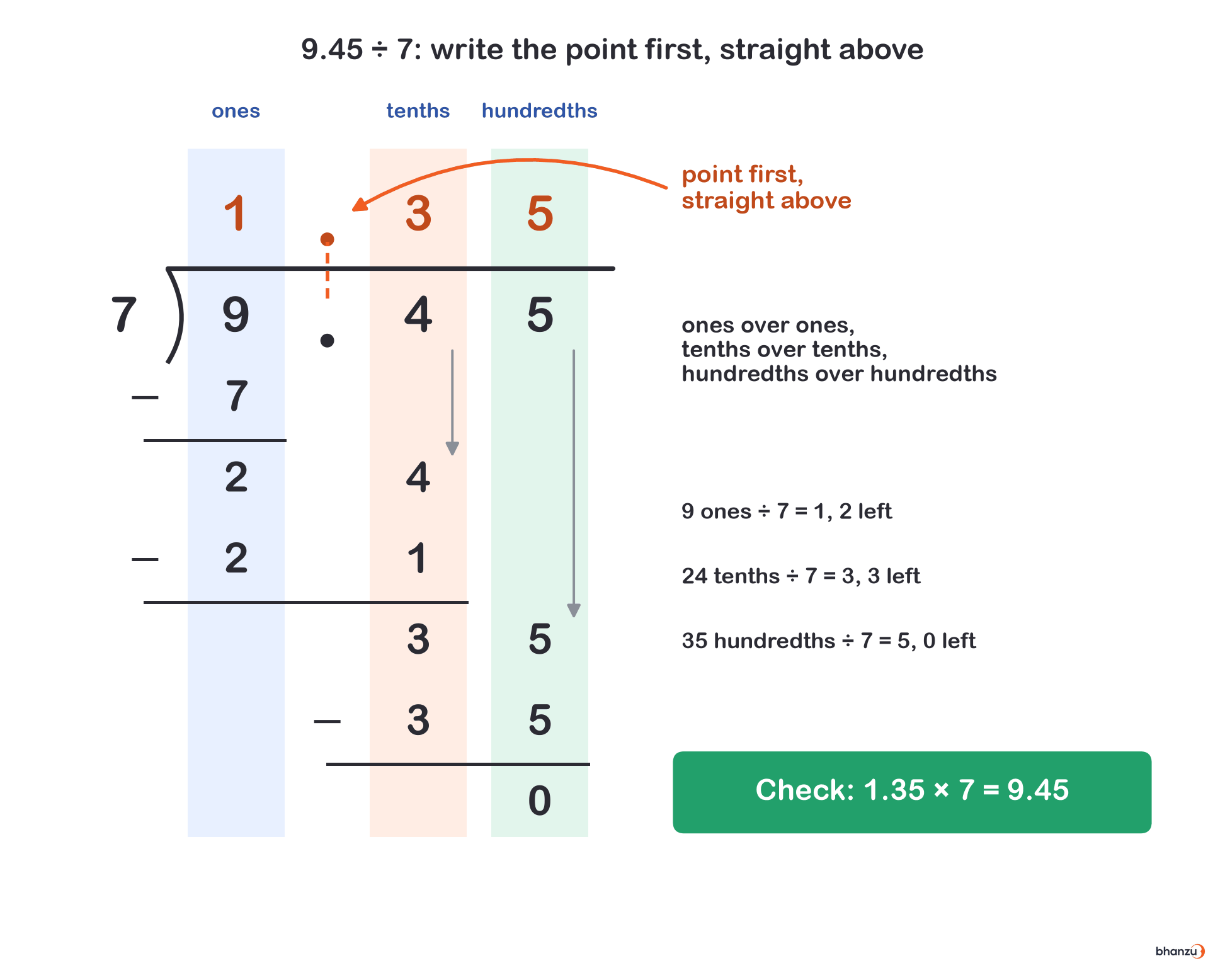
When the divisor is a whole number, the decimal point in the quotient goes straight above the decimal point in the dividend.
- Estimate by rounding decimals to a nearby whole number.
- Set up long division and write the quotient's point first.
- Divide place by place, bringing down one digit at a time.
- If the divisor doesn't fit, write a placeholder zero (a 0 that holds the empty place) in the quotient.
- If something is left after the last digit, write a 0 at the end of the dividend and keep going, as in dividing whole numbers to get a decimal.
- Check by multiplying decimals by whole numbers, since the quotient times the divisor gives back the dividend.
Try , which should come out a little more than 1.
- 9 ones shared by 7 gives 1 each, with 2 ones left.
- Bring down the 4 for 24 tenths, 3 each, with 3 left.
- Bring down the 5 for 35 hundredths, 5 each, with nothing left.
The quotient is 1.35, and . OpenStax's free Prealgebra 2e textbook uses the same layout, zeros as placeholders included.
Dividing decimals by 2-digit whole numbers
Only the guessing changes with a 2-digit divisor. For , expect about 2.5, since 30 divided by 12 is 2.5.
- 12 goes into 30 twice, with 6 left.
- Bring down the 7 for 67 tenths, which holds 12 five times, with 7 left.
- Bring down the 2 for 72 hundredths, which holds 12 exactly 6 times.
The quotient is 2.56, and . Big divisors are where the method slows down, so round the divisor to guess each digit. Treating 12 as 10 suggests 6 tenths, but is more than 67, so the digit is 5.
Examples of dividing decimals by whole numbers
Example 1
Divide 0.96 by 3.
Share 9 tenths among 3 for 3 tenths each, then 6 hundredths for 2 hundredths each.
Example 2
Divide 15.6 by 4.
A tempting shortcut splits the number at the point, dividing 15 by 4 to get 3 and 6 by 4 to get 1, for an answer of 3.1. Multiplying back exposes the problem.
That isn't 15.6, because the 3 ones left over from 15 and the 2 tenths left over from 6 were never shared. Trade them for 30 tenths, add the 6 tenths to make 36 tenths, and each group gets 9 tenths.
Example 3
A number divided by 6 equals 0.45. What is the number?
The box is the amount before sharing, so 6 groups of 0.45 rebuild it.
The missing number is 2.7.
Example 4
Is 34.8 divided by 8 more or less than 4?
Four in each of 8 groups uses , and 34.8 is more than 32, so the quotient is more than 4. The exact answer agrees.
Example 5
A rope 47.25 meters long is cut into 15 equal pieces. How long is each piece?
The estimate is meters. Then 15 goes into 47 three times with 2 left, into 22 tenths once with 7 left, and into 75 hundredths exactly 5 times.
Each piece is 3.15 meters long.
Example 6
A book of 20 letter stamps costs $16.40, and Maya uses 6 of them on birthday cards. How much did those 6 stamps cost?
Find one stamp first. The ones place gets a 0, then 164 tenths shared by 20 gives 8 with 4 left, and 40 hundredths gives 2.
$$$16.40 \div 20 = $0.82$$
Six stamps cost six times as much.
$$6 \times $0.82 = $4.92$$
The 6 stamps cost $4.92, and 82 cents matches the starting price the US Postal Service lists for letter stamps in November 2026.
Dividing decimals by whole numbers beyond the textbook
Prices and measurements come in tenths and hundredths, so sharing one or finding the cost of a single item means dividing a decimal by a whole number.
- It finds the price of one. A 16-ounce box of cereal at $4.48 costs $$4.48 \div 16 = $0.28$ an ounce, the unit price printed on many shelf tags.
- It explains the cents on the tag. The National Institute of Standards and Technology's Unit Pricing Guide, updated in June 2025, shows unit prices of a dollar or more to the nearest cent, and smaller ones to the nearest cent or tenth of a cent.
- It tells you when to stop. Prices you pay end at whole cents, so an uneven share gets rounded (the guide rounds 13.5 cents up to 14).
Real amounts rarely arrive as whole numbers, and a shelf tag only helps a shopper who understands the division behind it.
The part of dividing decimals by whole numbers nobody explains
When you divide by a whole number, the decimal point doesn't move at all, and most guides never say why. They hand over "bring the point straight up" as a rule, often mixed with dividing by a decimal, where both numbers do get shifted.
The reason fits in one line. The decimal 9.45 is 945 hundredths, so sharing it means sharing hundredths.
The answer is counted in the same unit as the amount shared, so its point lines up with the dividend's.
A size check comes free. Dividing by a whole number bigger than 1 leaves each group with less than the whole, so 13.5 can't be the answer to , even before any long division. In 6th grade you'll run the same long division on longer decimals, and this check still works.
The easy-to-make errors (and how to catch them)
Mistake 1: Skipping the placeholder zero
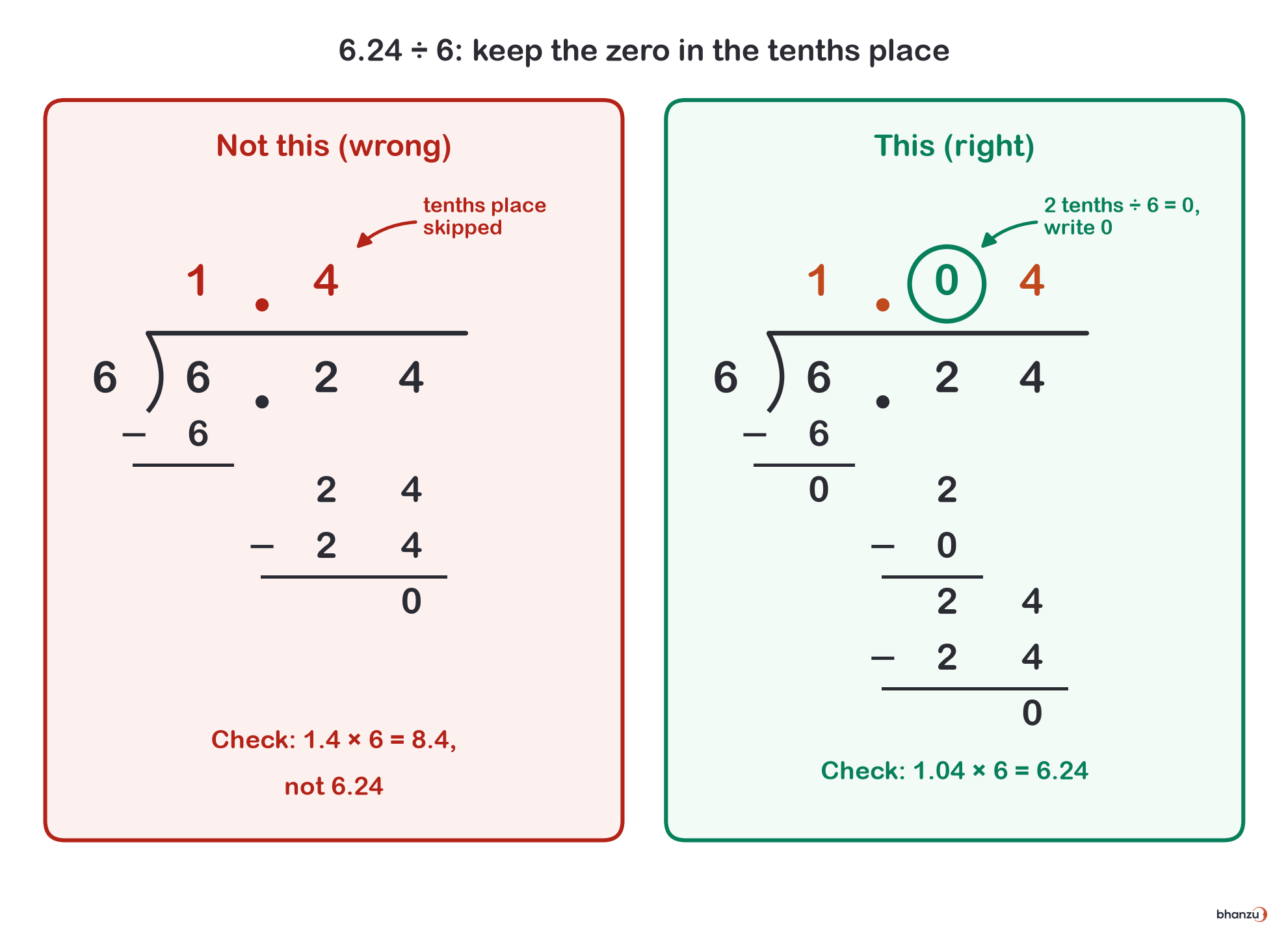
Where it slips in: The tenths place of . A child rushing along thinks "6 doesn't go into 2, so move on" and writes nothing.
Don't do this: Write 1 for the ones, jump to 24 hundredths, write 4, and get 1.4.
The correct way: After the 1, 2 tenths shared by 6 gives 0 tenths, so write 0. Then 24 hundredths gives 4, for 1.04. Multiplying back, , while .
Naming each place out loud (ones, tenths, hundredths) keeps an empty place from vanishing.
Mistake 2: Putting the point where multiplication would
Where it slips in: Problems that need a 0 written at the end, such as . Children who just learned to count decimal places when multiplying often try that count when dividing, and land one place off.
Don't do this: Write 6.6 as 6.60, ignore the point, divide 660 by 4 to get 165, then count one decimal place because 6.6 has one, and write 16.5.
The correct way: Place the point above the point in 6.6 first. Then 6 ones give 1 with 2 left, 26 tenths give 6 with 2 left, and 20 hundredths give 5, for 1.65. An answer of 16.5 is bigger than 6.6 itself, so it was never possible.
Mistake 3: Stopping with a remainder
Where it slips in: Anything left after the last digit, as in . Years of whole-number division taught children to write "R" and stop.
Don't do this: Write .
The correct way: Write 3.7 as 3.70. The leftover tenth becomes 10 hundredths, which gives 5 hundredths each, so the answer is 1.85, and .
The two zeros are genuinely confusing. The 0 that turns 3.7 into 3.70 changes nothing, while the 0 inside 1.04 changes the whole answer.
Key Takeaways
- Write the quotient's point above the dividend's point before any digits, since a whole-number divisor never moves it.
- Every leftover piece becomes 10 of the next smaller piece, so a remainder turns into tenths or hundredths instead of an R.
- Name each place as you divide so an empty place still gets its zero.
- Finish dividing decimals by whole numbers with a multiply-back check to catch a missing zero or a misplaced point.
- For more practice with the zero hiding inside answers like 1.04, explore Bhanzu's 5th grade math curriculum or math classes for kids.
Read More
- Dividing by Decimals
- Fractions as Division
- Dividing Decimals
- Dividing Multiples of 10, 100 and 1,000
- Fractions, Decimals and Percentages
Research Behind This Article
- NGA Center and CCSSO, Common Core State Standards for Mathematics: Grade 5, Number and Operations in Base Ten (2010). thecorestandards.org
- OpenStax, Prealgebra 2e, 5.2 Decimal Operations (2020). openstax.org
- United States Postal Service, Postage Rates and Prices (2026). usps.com
- National Institute of Standards and Technology, Unit Pricing Guide: A Best Practice Approach to Unit Pricing, NIST SP 1181e2025 (2025). nist.gov
- NGA Center and CCSSO, Common Core State Standards for Mathematics: Grade 6, The Number System (2010). thecorestandards.org
Quick Quiz: Check Yourself
Three levels, new numbers every time: share a decimal by a small whole number, then handle trades, zeros and missing numbers, then solve two-digit divisor and money problems.
Was this article helpful?
Your feedback helps us write better content
Frequently Asked Questions
What grade do kids learn to divide decimals?
How do you divide decimals with zeros?
Where do you stop when dividing decimals?
How do you divide decimals by 10 or 100?
Is dividing decimals by decimals different?
How can I help my child practice dividing decimals at home?