Key Points
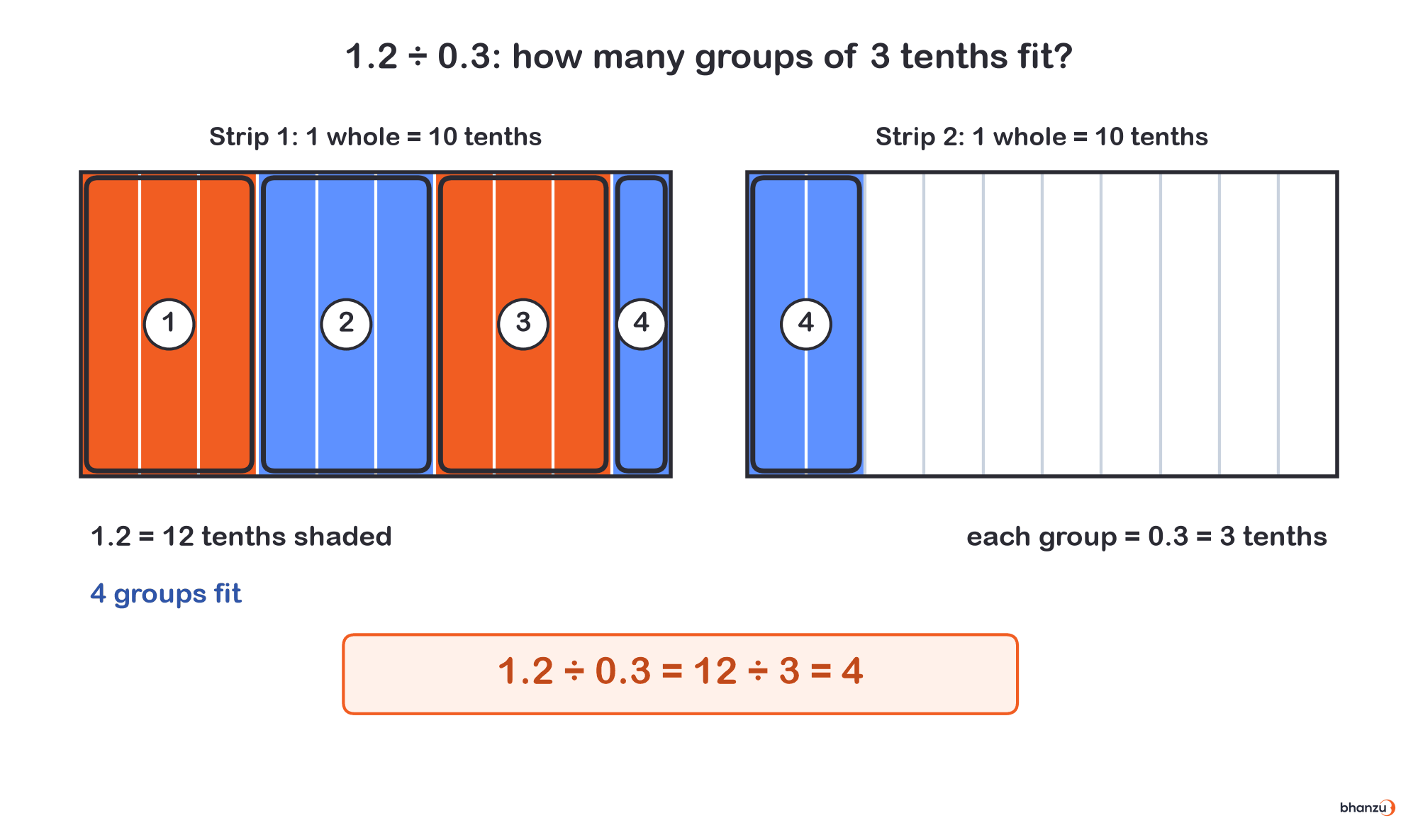
- Dividing by decimals counts groups, so because 12 tenths split into exactly 4 groups of 3 tenths on a decimal grid.
- Multiplying both numbers by the same 10 or 100 until the number you divide by is whole keeps the answer unchanged, so becomes .
- The most common mistake is moving the decimal point in only one number, which turns into and gives 0.4 instead of 4.
- In 5th grade, students divide decimals to hundredths with models and place value, and dividing by 0.1 or 0.01 shifts each digit one or two places left.
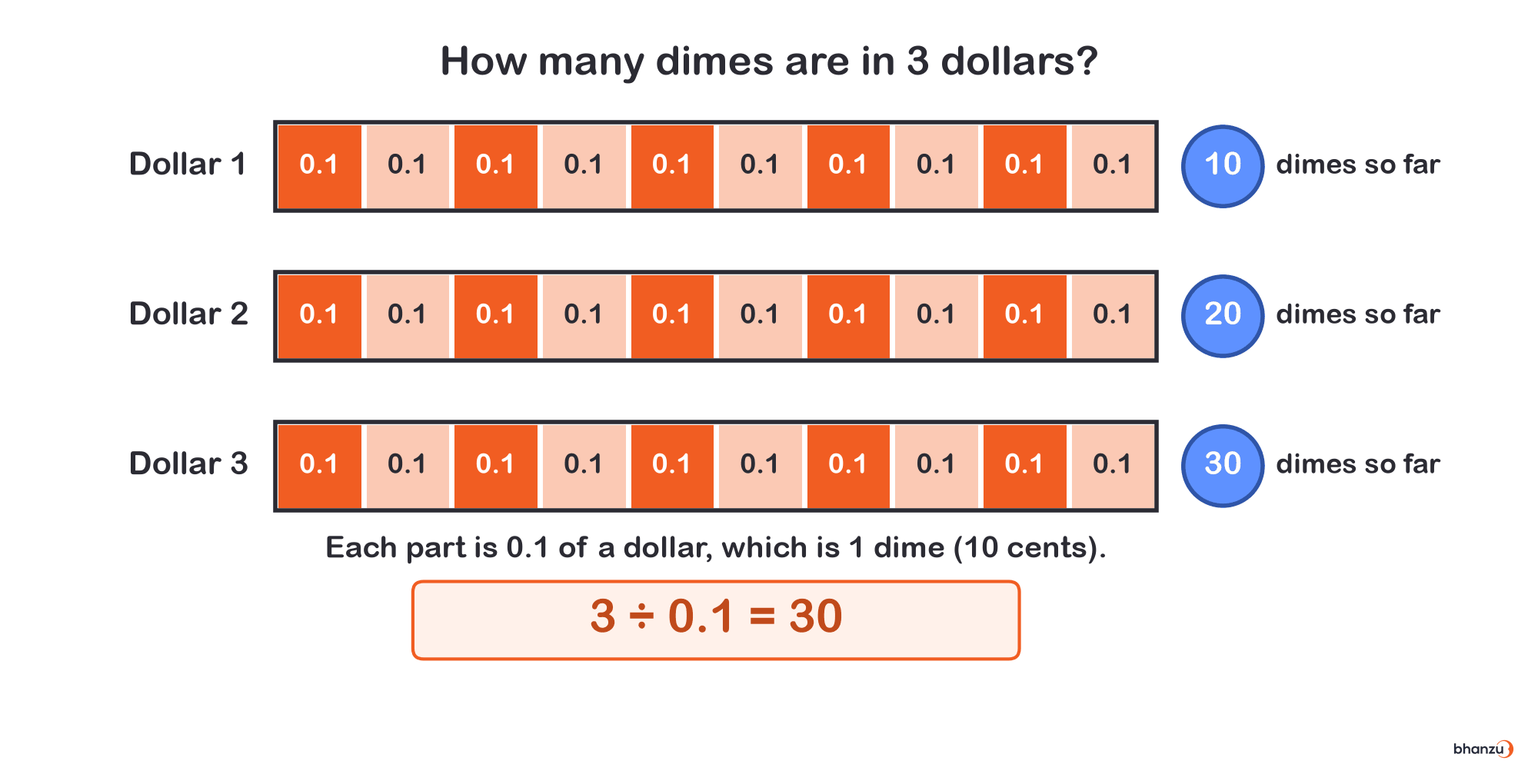
Thirty dimes inside three dollars
Trade three dollars for dimes and you walk away with 30 coins. Each dime is one tenth of a dollar, so every dollar breaks into 10 of them. Counting the dimes in three dollars is the same as working out 3 divided by 0.1, and the answer, 30, is ten times bigger than the 3 you started with.
Division that makes a number grow sounds backward. It stops feeling strange once you see what is being counted. Soon you'll use the same idea to find how many 0.25-meter pieces a ribbon makes, or how many half-liter cups a 3-liter jug fills.
How do you divide by a decimal?
Dividing by decimals works by counting how many groups the size of the divisor (the number you divide by) fit into the dividend (the number you start with). That count is the quotient. The dividend, divisor and quotient play the same roles as in whole-number division, only now the groups are tenths or hundredths.
On a decimal grid, each column is one tenth of a whole. The number 1.2 fills one whole strip plus 2 more columns, which makes 12 tenths. Circle groups of 3 tenths and exactly 4 groups appear, so .
In 5th grade, your child is expected to divide decimals to hundredths "using concrete models or drawings and strategies based on place value," under Common Core standard 5.NBT.B.7. The grid is the model, and moving decimal points is the written method that matches it.
Moving both decimal points, step by step
The written method makes the divisor a whole number and moves the dividend's decimal point the same number of places, writing zeros when needed. It beats the grid on problems like , which would need 3,600 hundredth squares.
- Estimate. A divisor between 0 and 1 means the quotient will be bigger than the dividend.
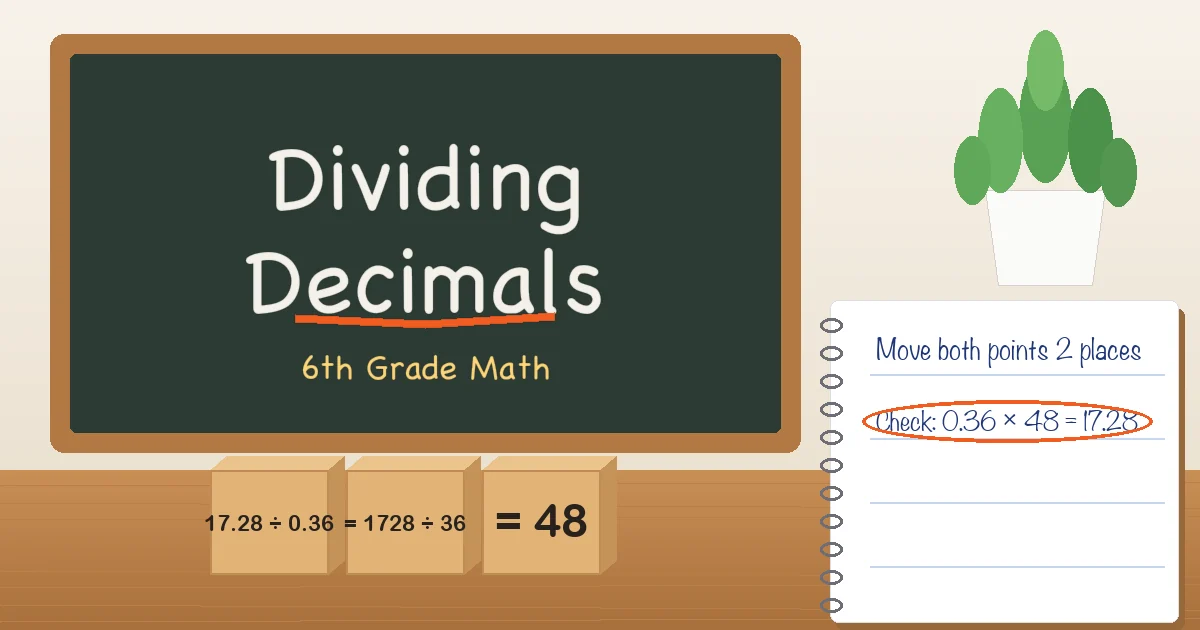
- Multiply both numbers by the same 10 or 100 until the divisor is whole. For , multiply by 100 and write two zeros after the 6 to get .
- Divide as usual. The scaled problem is whole-number division or dividing decimals by whole numbers, with long division for bigger numbers. Here .
- Check by multiplying the quotient by the original divisor, since .
Where does the decimal go when dividing?
After scaling, the quotient's decimal point sits straight above the new dividend's point. For , multiply both by 10 to get , so the answer is 2.1.
How do you divide by 0.1 and 0.01?
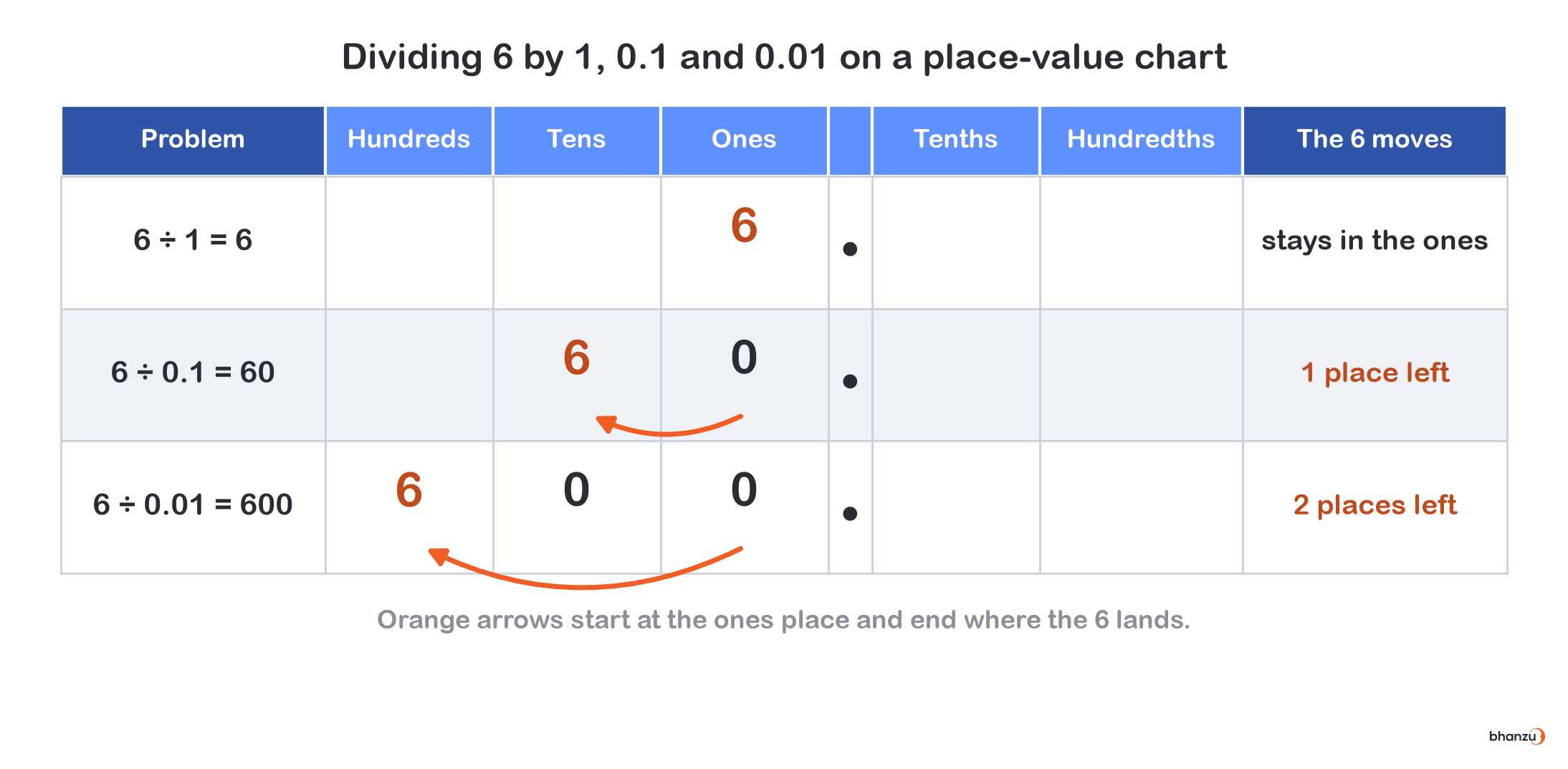
To divide by 0.1, count the tenths in the number. Each whole holds 10 tenths, so . To divide by 0.01, count hundredths, and since each whole holds 100 of them, .
| Division | Quotient | Where the 6 moves |
|---|---|---|
| 6 | stays in the ones | |
| 60 | one place left, into the tens | |
| 600 | two places left, into the hundreds |
Decimals follow the same pattern. The number 0.35 is 35 hundredths, so .
The easiest pair to mix up is dividing by 10 and dividing by 0.1. In dividing by powers of 10, and the digit moves right, but moves it left. Dividing by 0.1 gives the same answer as multiplying by 10, and dividing by 0.01 matches multiplying by 100.
Why does dividing by a decimal make the answer bigger?
A divisor between 0 and 1 makes each group smaller than one whole, so more groups fit and the quotient grows past the dividend (as long as the dividend is above 0). Follow 4 as the divisor shrinks.
| Divisor | 4 divided by the divisor | Compared with 4 |
|---|---|---|
| 2 | 2 | smaller |
| 1 | 4 | the same |
| 0.5 | 8 | bigger |
| 0.1 | 40 | bigger |
A decimal bigger than 1 still shrinks the answer, so , which is less than 4.8.
A child who gets 60 for and then erases it, because division "should" make numbers smaller, is using a whole-number habit. That habit holds only for divisors bigger than 1. You'll use the same "how many fit" question again when you divide one fraction by another.
Try It Yourself
Tap Make a group to shade one group the size of the divisor on the decimal grid, and keep tapping until the dividend is used up. The count of groups is the quotient. The readout matches it to the same problem scaled by 10 or 100, and New problem lets you compare how many groups fit for different divisors.
Examples of dividing by decimals
Example 1
What is 5 divided by 0.1?
Each whole holds 10 tenths, so 5 wholes hold 50 tenths.
Multiplying back, .
Example 2
Divide 2.4 by 0.6.
The tempting move is to turn 0.6 into 6 and leave 2.4 alone.
That can't be right. Dividing by 0.6, which is less than 1, must give more than 2.4, and , not 2.4.
Multiply both numbers by 10 instead.
Since , the answer is 4.
Example 3
Use hundredths to find 0.72 divided by 0.08.
The number 0.72 is 72 hundredths and 0.08 is 8 hundredths, so count groups of 8 hundredths.
Multiplying back, .
Example 4
2.8 divided by what number equals 280?
The answer 280 is 100 times 2.8, and dividing by 0.01 makes a number 100 times bigger.
The missing divisor is 0.01.
Example 5
Which is bigger, 6 divided by 0.2 or 6 divided by 0.3?
Multiply each pair by 10.
So 6 divided by 0.2 is bigger, because groups of 0.2 are smaller and more of them fit in 6.
Example 6
Maya has 6.5 meters of ribbon. She cuts it into pieces 0.25 meters long and uses 10 pieces for bows. How many pieces are left?
Multiply both numbers by 100, writing a zero after 65.
Multiplying back, . Then subtract the 10 pieces she used.
Maya has 16 pieces left.
Why does moving both decimal points work?
Multiplying both numbers by the same 10 or 100 changes the size of the units you count in, but never how many groups fit.
- It keeps the count the same. The divisions , and all equal 4, since 12 tenths in groups of 3 tenths is the same count as 12 ones in groups of 3.
- It matches the fraction view. By fractions as division, is , and multiplying top and bottom by 10 gives the equivalent fraction .
- It turns a new problem into a familiar one. Once the divisor is whole, you are back to division you know.
- It works on real measurements. The inch has been exactly 25.4 millimeters, or 2.54 centimeters, since July 1, 1959, according to NIST, so a square sticky note 7.62 centimeters wide is inches wide.
A 2010 What Works Clearinghouse practice guide recommends helping students understand why procedures for fraction computations make sense. Decimals to hundredths are fractions with denominators of 10 and 100, so that advice fits the move-both-points rule too.
Dividing by decimals: where intuition breaks
Mistake 1: Moving the point in only one number
Where it slips in: Step 2 of the method. A child who rushes to make the divisor whole forgets that the dividend has to move too.
Don't do this: Rewrite as and get 0.9.
The correct way: Multiply both by 10, so , and .
Mistake 2: Expecting the answer to shrink
Where it slips in: Dividing by 0.1 or 0.01, especially right after multiplying decimals by whole numbers, where does shrink the number.
Don't do this: Write .
The correct way: Count tenths. Seven wholes hold 70 tenths, so .
Children who have just practiced multiplying by 0.1 carry the "gets smaller" rule into division, because the two problems differ by one symbol. Asking out loud how many tenths fit in 7 brings the right picture back.
Mistake 3: Moving the points different distances
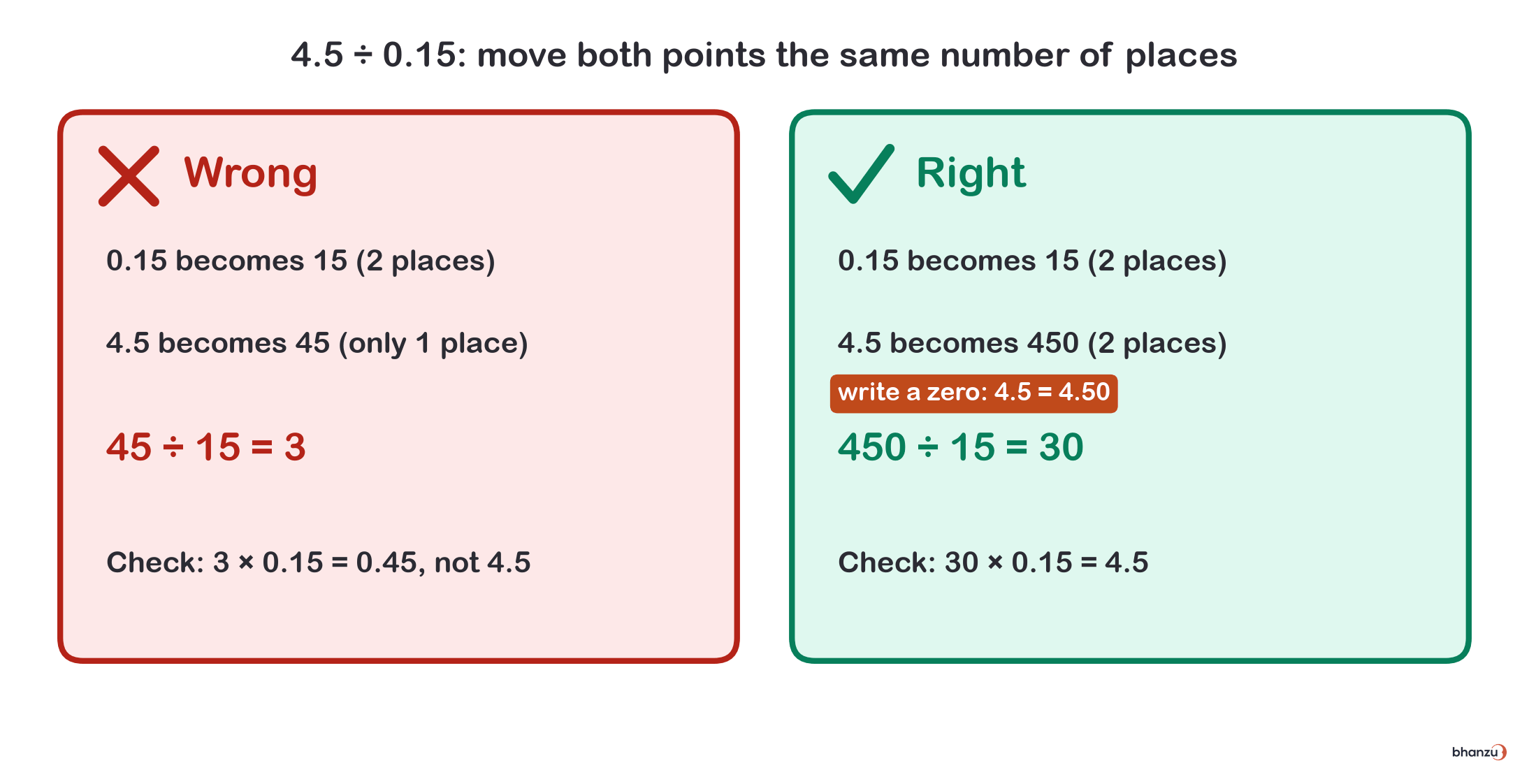
Where it slips in: Problems where the divisor has more decimal places than the dividend, such as . Writing a zero feels like changing the number, so children stop when the dividend's digits run out.
Don't do this: Move 0.15 two places to get 15 but 4.5 only one place to get 45, so .
The correct way: Move both points two places. Writing a zero turns 4.5 into 450, so , and .
What do most guides miss about dividing by decimals?
Most guides skip the size check, even though the divisor tells you how big the answer will be before you divide. The divisors 0.5, 0.25, 0.2 and 0.1 are unit fractions in disguise, and each fraction's bottom number is how many copies fit in 1.
| Divisor | As a fraction | How many fit in 1 |
|---|---|---|
| 0.5 | 2 | |
| 0.25 | 4 | |
| 0.2 | 5 | |
| 0.1 | 10 |
Four quarters fit in every dollar, so has to be before you write a step. You'll meet 0.25 again as 25 percent when you study percents.
In 1585, Simon Stevin published La Thiende, a 29-page booklet explaining decimal fractions, according to MacTutor. Its 1608 English translation, titled Disme, inspired Thomas Jefferson to propose decimal money for the United States, and one tenth of a dollar is still called a dime.
Key Takeaways
- Look at the divisor before you divide, since a divisor between 0 and 1 gives an answer bigger than the dividend.
- Whatever you multiply the divisor by, do to the dividend too, writing zeros if its digits run out.
- For a divisor of 0.1 or 0.01, count tenths or hundredths instead of moving points.
- Every dividing by decimals answer can be checked by multiplying it by the original divisor.
- For practice dividing by decimals with someone who catches a point moved in only one number, explore Bhanzu's 5th grade math tutor or the Common Core math curriculum.
Read More
- Dividing Decimals in 6th Grade
- Multiplying Decimals
- Dividing Whole Numbers to Get a Decimal
- Decimals on the Number Line
- Fractions, Decimals and Percentages
Research Behind This Article
- Common Core State Standards Initiative, Grade 5 Number and Operations in Base Ten (2010). thecorestandards.org
- OpenStax, Prealgebra 2e, 5.2 Decimal Operations (2020). openstax.org
- National Institute of Standards and Technology, SI Units: Length (2025). nist.gov
- Institute of Education Sciences, What Works Clearinghouse, Developing Effective Fractions Instruction for Kindergarten Through 8th Grade (2010). ies.ed.gov
- J J O'Connor and E F Robertson, MacTutor History of Mathematics, University of St Andrews, Simon Stevin (2004). mathshistory.st-andrews.ac.uk
- Common Core State Standards Initiative, Grade 6 The Number System (2010). thecorestandards.org
Quick Quiz: Check Yourself
Three levels, new numbers every time: divide by 0.1 or 0.01, divide one decimal by another or find a missing divisor, then solve a ribbon, rope or coin word problem.
Was this article helpful?
Your feedback helps us write better content
Frequently Asked Questions
What grade do students learn to divide decimals?
How can I help my child practice dividing by decimals at home?
How do you divide by a decimal without a calculator?
Why do you add a zero when dividing decimals?
What is the difference between multiplying and dividing decimals?
Is there a trick for dividing decimals?
What is 1 divided by 0.01?