Key Points
- In 5th grade, a composite figure is a solid made of rectangular prisms that don't overlap, and students find the volume of composite figures by adding the parts.
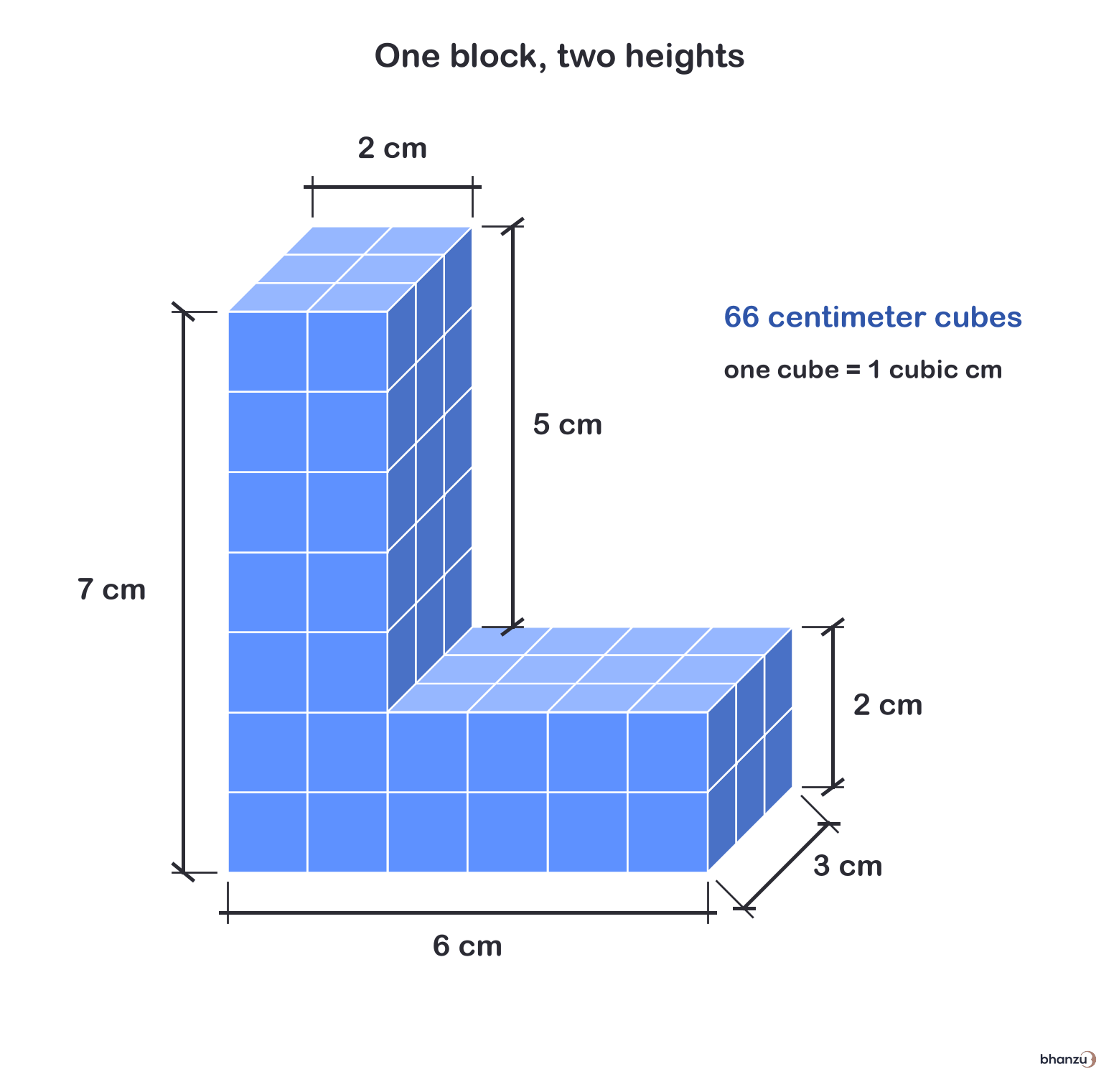
- Adding works because each unit cube sits in exactly one part, so a 36-cube base and a 30-cube tower make a 66-cube step block.
- One tempting wrong move multiplies a step block's outside edges as if it were one box, which for a 12 by 10 by 9 inch outline counts 350 cubic inches of empty space.
- Composite figures in 5th grade use whole-number edges, and fraction edges such as half an inch come in 6th grade.
A block with no single height
An L-shaped block has no single length, width and height to multiply. Build one from 66 centimeter cubes, with a base 6 long, 3 wide and 2 tall and a tower 2 long and 3 wide on the left end that rises to 7.
The box formula needs one height, and this block has two. One cut where the height changes turns it into two boxes you already know how to measure. In 6th grade the same habit works on boxes with fraction edges, and it's how people find the water in an L-shaped pool.
What is the volume of composite figures?
The volume of composite figures is the number of unit cubes (cubes 1 unit long on every edge) that fill a solid made of two or more boxes. You find it by adding the volume of each box.
A composite figure is a shape built by joining simpler shapes. In volume problems it's a solid, and in 5th grade its parts are rectangular prisms, boxes with 6 rectangle faces. A cube counts too, since each of its square faces is a rectangle.
Volume is the 3D space a solid takes up, counted in cubic units, while area is a 2D measure of a flat surface in square units. A National Institute of Standards and Technology page updated in March 2026 says a milliliter is a cubic centimeter. It lists a juice box at 200 mL, which is 200 cubic centimeters of space.
This is Common Core standard 5.MD.C.5.c, which asks students to "recognize volume as additive" and add the volumes of two non-overlapping boxes. By the end of 5th grade your child is expected to do this with whole-number edges, the same move they used in 3rd grade for the area of composite shapes.
How do you find the volume of a composite figure?
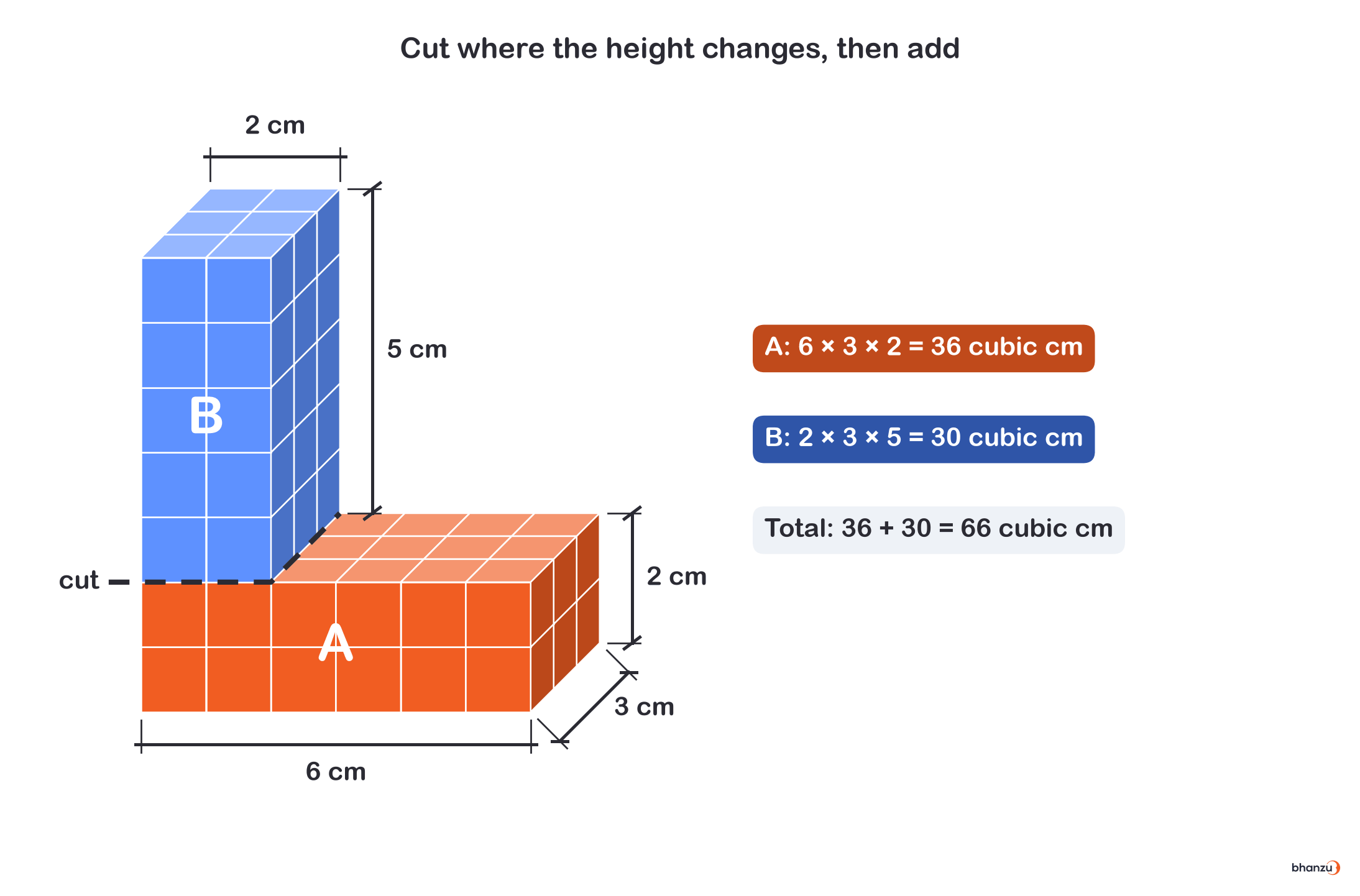
To find the volume of a composite figure, cut it into boxes that don't overlap, find each box's volume, then add.
- Cut where the height or the length changes, so both parts are boxes.
- Label each part's length, width and height, working out any hidden edge.
- Multiply the three edges inside each part.
- Add the two volumes and write the answer in cubic units.
A child who rushes often skips step 1 and multiplies the outside length, width and height as if the block were one box, .
For a box with length , width and height , the volume formula is
and the parts of a composite figure add.
| Symbol | Meaning | Units |
|---|---|---|
| volume | cubic units | |
| , , | length, width, height | units |
| base area, | square units | |
| , | volumes of parts A and B | cubic units |
The formula counts layers. The base's bottom layer holds cubes, and 2 layers make 36, so the rule is also written . OpenStax's Prealgebra 2e textbook counts layers the same way.
The associative property of multiplication lets you group the edges either way, so and both give 36. Bigger blocks just need multi-digit multiplication.
Finding a hidden edge
Subtract lengths that line up. The step block's tower reaches 7 cm above the table, but the base fills the bottom 2 cm.
The tower is 2 cm long, so the base past the tower is cm long. Use the labels, not a ruler, because textbook drawings are often not to scale.
L-shapes seen from above work the same way. If an L fits in a 7 ft by 5 ft rectangle with arms 2 ft wide, its short arm sticks out past the long arm by
Does it matter where you cut?
No. Any cut that leaves two boxes with no gap and no overlap gives the same total, because the cubes don't change.
| Way | Parts | Total |
|---|---|---|
| Flat cut | and | |
| Upright cut | and | |
| Box minus gap | and |
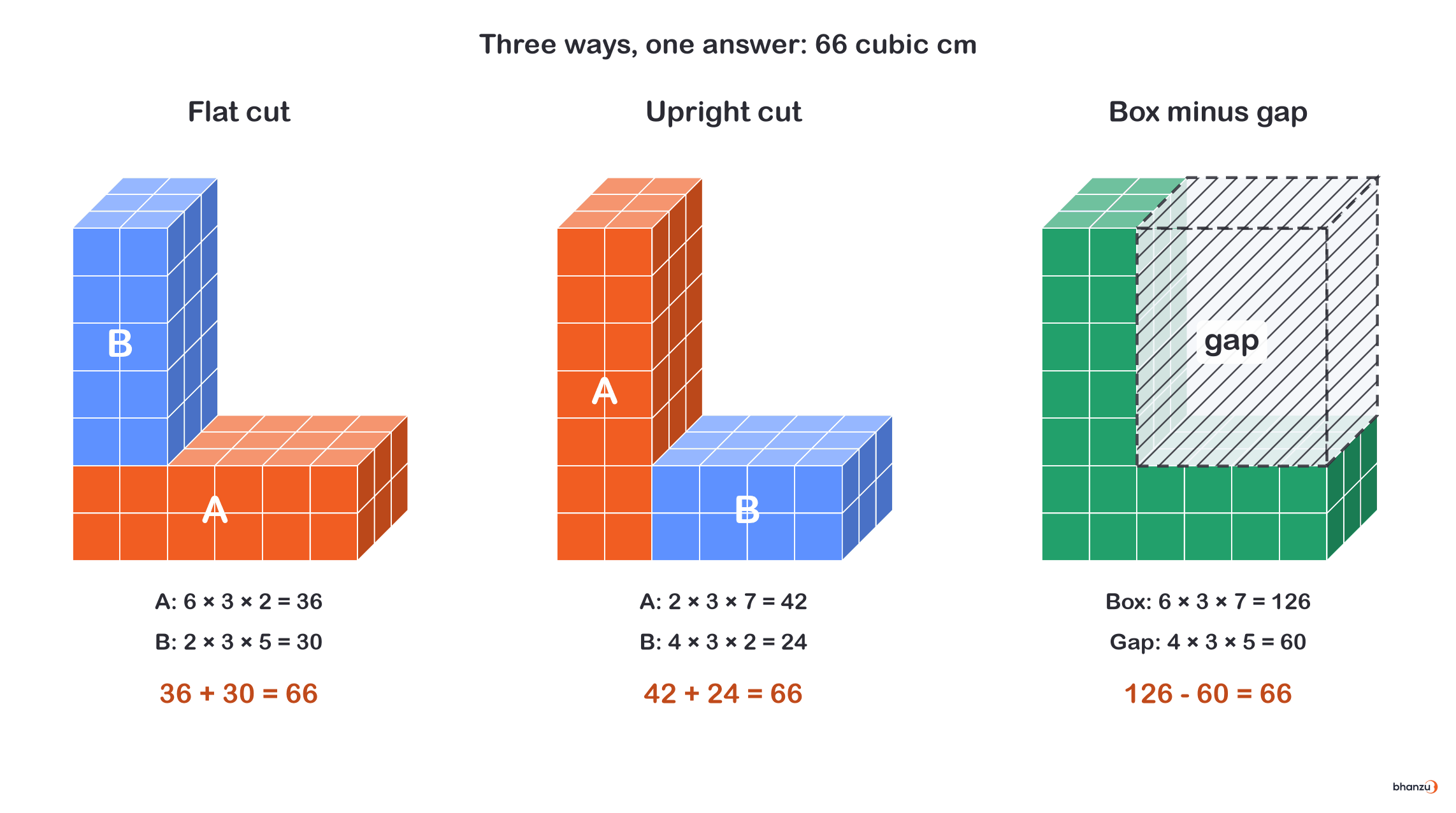
Box minus gap finds the full box and takes away the empty space, which is faster when a big box has one small notch cut out of a corner.
A child whose parts come out as 42 and 24 often crosses out a right answer after seeing a friend's 36 and 30. Drawings make cutting genuinely confusing (a hidden back edge is sometimes dashed and sometimes missing).
Try It Yourself
Tap Flat cut, Upright cut or Box minus gap, and watch the colored parts change while the total stays the same. Then resize the block with the plus and minus buttons and check that the total always matches the cubes counted one by one.
Examples of volume of composite figures
Example 1
A bookend joins a flat block 5 inches long, 2 wide and 2 tall to an upright block 2 inches long, 2 wide and 4 tall. What is its volume?
The bookend holds cubic inches.
Example 2
A foam step block is 12 inches long and 10 inches wide. Its bottom step is 4 inches tall, and its top step is 5 inches long and rises to 9 inches. What is its volume?
The tempting move multiplies the outside edges.
That's too big. A 12 by 10 by 9 box also fills the empty space above the bottom step, which is inches long, 10 wide and tall.
Cut where the height changes instead.
The block holds cubic inches, and agrees.
Example 3
A clay step is 10 cm long and 4 cm wide. Its bottom part is 3 cm tall, and a 4 cm long top part on one end reaches 8 cm above the table. What is its volume?
Find the hidden height first.
The clay step holds cubic centimeters.
Example 4
An L-shaped part of a pool is 4 ft deep and, from above, fits in an 8 ft by 5 ft rectangle with arms 3 ft wide. Diego cuts off the 8 ft arm first and Mei the 5 ft arm. Do they get the same volume?
Diego's leftover piece is ft long.
Mei's leftover piece is ft long.
Both make 120 cubic feet, so both cuts work.
Example 5
Noah builds two space-station modules from 1-inch cubes and joins them without overlapping, one 6 by 4 by 4 inches and one 10 by 3 by 3 inches. He has 200 cubes. Does he have enough, and how many are left over?
Each cube fills 1 cubic inch, so Noah needs 186 cubes and has left over.
Why does adding the parts work?
Volume is additive, which means the volume of a whole solid equals the volumes of its non-overlapping parts added together. Each unit cube belongs to exactly one part.
- It counts every cube once. The step block's 66 cubes are 36 in the base and 30 in the tower, none skipped and none doubled.
- It turns an odd shape into easy ones. No single length times width times height fits an L-shape, but every box has one.
- It works on giant things built in pieces. NASA pages updated in 2024 and 2025 count 42 assembly launches for the International Space Station. The space inside the station is the space in its joined modules, added up.
Without additivity, every new shape would need a formula of its own.
Where do kids trip up on volume of composite figures?
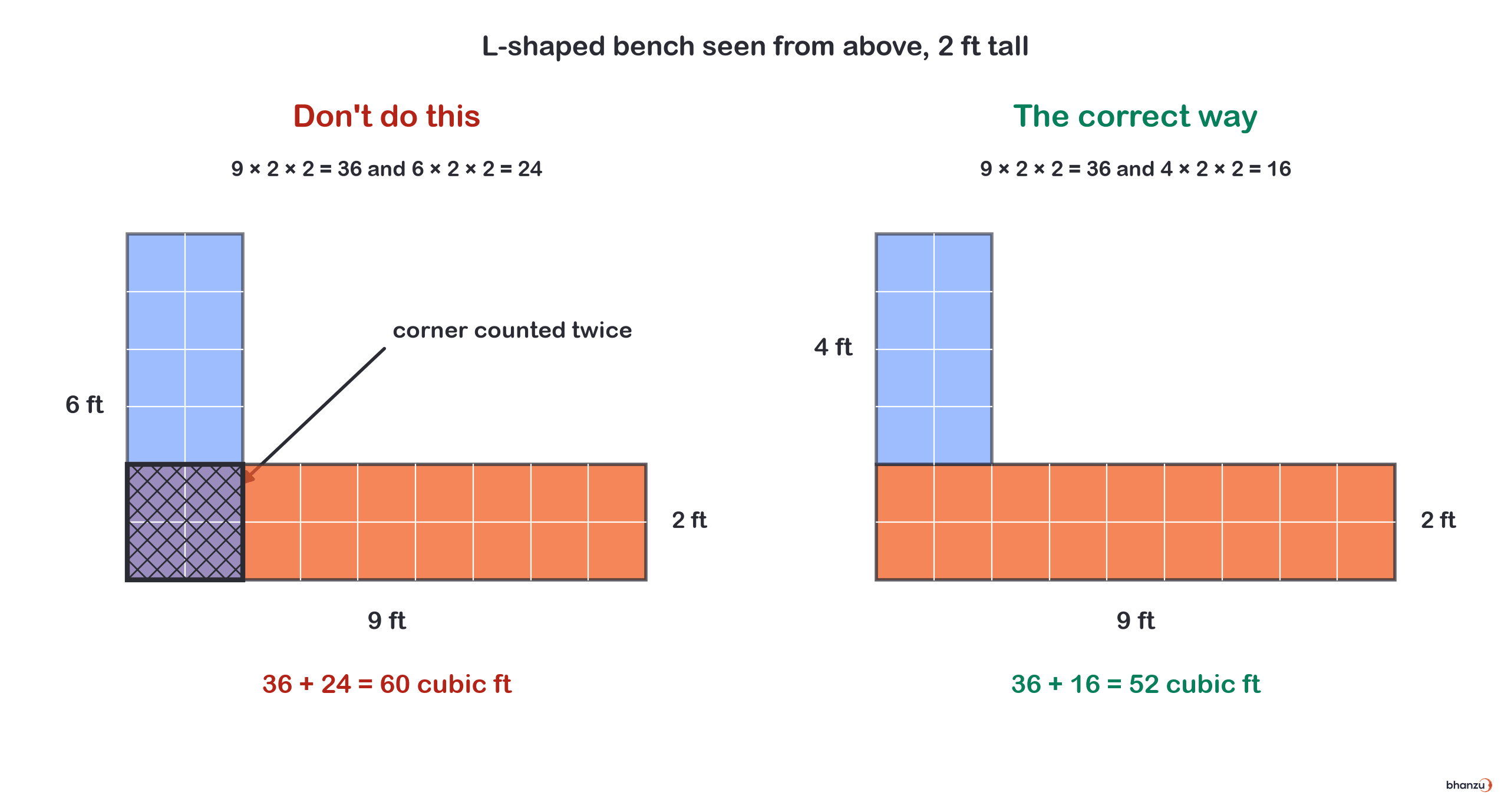
Mistake 1: Counting the corner twice
Where it slips in: L-shapes seen from above, like a bench 2 ft tall that fits in a 9 ft by 6 ft rectangle, with arms 2 ft wide. Both arm lengths run along the outside edges, so each looks like a whole arm.
Don't do this: Adding and to get 60 cubic feet, which counts the 2 by 2 by 2 corner twice.
The correct way: Shorten one arm to ft, so it holds and the bench is cubic feet.
Mistake 2: Using the total height for the top part
Where it slips in: Step blocks where the top part's height is measured from the floor, as in Example 3. Take a block with a 9 by 5 by 3 inch bottom part and a 4 by 5 inch top part labeled 10 inches from the floor.
Don't do this: Using the 10 inch label as the top part's height, so it holds . With the bottom part, that totals 335 cubic inches.
The correct way: The top part is inches tall, so it holds . The block holds cubic inches.
A child who copies the number printed nearest a part, without asking what it measures, lands here. Drawings often print that 10 right beside the top block (and it's the biggest number there).
Mistake 3: Writing square units
Where it slips in: The last line of the answer.
Don't do this: Writing 66 square centimeters for the step block.
The correct way: Write 66 cubic centimeters (each unit is a 1 cm cube). If a drawing mixes feet and inches, NIST advises putting every edge in the same unit first.
Kids who spent 3rd grade on the area of L-shaped rooms often write square centimeters, because the drawing is flat even though the block is not.
What do teachers watch for in volume of composite figures?
Teachers watch two habits, because many wrong answers here come from the setup, not the multiplying.
- The cut line comes first. A child who colors each part before multiplying will spot a corner counted twice, since each cube can get only one color. That habit fits a 2012 What Works Clearinghouse guide for grades 4 through 8, whose five recommendations include teaching visual representations.
- A second route checks the first. If two routes disagree, one part has a wrong edge or a multiplying mistake, and your child can find it without an answer key.
For your child, the 5th-grade target is two boxes with whole-number edges. Other right prisms join in 7th grade, and cylinders, cones and spheres in 8th grade.
Key Takeaways
- Before you multiply anything, find where the height or the length changes and draw the cut there.
- Hidden edges come from subtracting lengths that line up, like 7 minus 2 for the tower.
- When two different cuts agree and every edge matches its label, your answer for the volume of composite figures is almost certainly right.
- Volume answers end in cubic units, because the thing being counted is cubes.
- For more practice splitting step blocks and catching the corner that gets counted twice, explore Bhanzu's 5th grade math curriculum or work with an elementary math tutor.
Read More
- Multiplying and Dividing by Powers of 10
- Order of Operations With Parentheses and Brackets
- Volume With Fractional Edge Lengths
- Surface Area
- 3D Shapes
Research Behind This Article
- Common Core State Standards Initiative, Common Core State Standards for Mathematics (2010). thecorestandards.org
- OpenStax, Prealgebra 2e, 9.6 Solve Geometry Applications: Volume and Surface Area (2020). openstax.org
- NASA, International Space Station Facts and Figures (2024). nasa.gov
- National Institute of Standards and Technology, Circumference, Area and Volume (2026). nist.gov
- Institute of Education Sciences, What Works Clearinghouse, Improving Mathematical Problem Solving in Grades 4 Through 8 (2012). ies.ed.gov
Quick Quiz: Check Yourself
Three levels, new numbers every time: add the volumes of two boxes, find a hidden height or an L-shape's volume before adding, then solve a cube-count word problem.
Was this article helpful?
Your feedback helps us write better content
Frequently Asked Questions
How do you teach volume of composite figures in 5th grade?
How can I help my child with volume of composite figures homework?
Is volume adding or multiplying?
What is an example of a composite figure?
Can a calculator find the volume of composite figures?