What Line Symmetry Means
Line symmetry is the property of a figure that can be divided by a straight line into two halves that are exact mirror images of each other. The dividing line is called the line of symmetry, and it is also known as mirror symmetry or reflection symmetry because one half is the reflection of the other across that line.
A figure has line symmetry if you can fold it along some line and the two parts land precisely on top of one another, with no overhang. A figure can have one line of symmetry, several, infinitely many, or none at all. The line itself can run vertically, horizontally, or at a slant — what matters is that the fold produces matching halves.
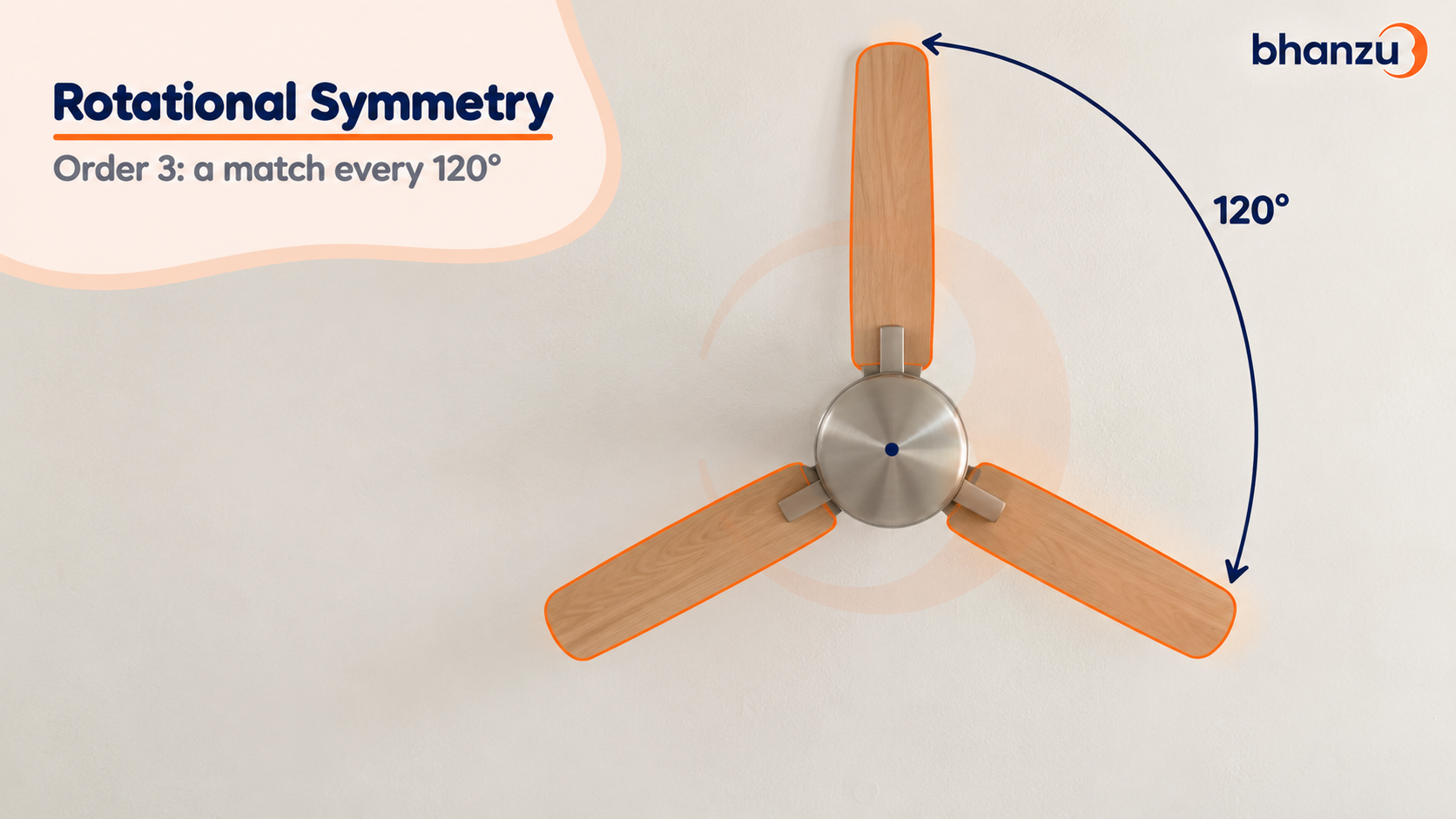
In coordinate geometry, the same idea is the axis of symmetry: reflecting every point across the line maps the figure back onto itself. Line symmetry is closely tied to the broader idea of symmetry in geometry, which also includes rotational symmetry — turning a shape about a point so it looks unchanged.
Examples of Line Symmetry
Each example below builds from a simple fold test to counting and locating multiple lines. Work through them in order.
Example 1
Does the capital letter A have line symmetry, and where is the line?
Imagine folding the letter A down the middle, top to bottom.
The left stroke folds onto the right stroke.
The left half of the crossbar folds onto the right half.
The two halves match exactly, so A has one vertical line of symmetry through its peak and the centre of the crossbar.
[IMAGE PROMPT: The capital letter "A" in a bold sans-serif font with a dashed vertical line drawn from the apex straight down through the centre of the crossbar to the baseline. Shade the left half pale blue and the right half pale green to show they are mirror images. Caption: "The letter A has one vertical line of symmetry." Alt text: Capital letter A with a dashed vertical line of symmetry, halves shaded to show mirroring.]
Example 2
How many lines of symmetry does a rectangle have?
A common first guess is that a rectangle, like a square, has 4 lines of symmetry, including its two diagonals.
Test the diagonal fold on a rectangle that is 6 cm by 3 cm. Fold along a diagonal: the long side tries to land on the short side, and they are different lengths, so the halves do not match. The diagonal fails the fold test.
Now fold along the vertical centre line (splitting the length) and the horizontal centre line (splitting the width). Each of these folds produces two matching halves.
So a rectangle has exactly 2 lines of symmetry — one vertical, one horizontal — and its diagonals are not lines of symmetry. (A square's diagonals do work, because all four of its sides are equal.) The full case is worked out in lines of symmetry in a rectangle.
Example 3
How many lines of symmetry does a square have, and where are they?
A square has four equal sides and four right angles, so more folds succeed.
Fold top to bottom (horizontal line through the midpoints of the vertical sides): halves match.
Fold left to right (vertical line through the midpoints of the horizontal sides): halves match.
Fold along each diagonal: because all sides are equal, both diagonal folds also match.
That gives 4 lines of symmetry for a square: 1 vertical, 1 horizontal, and 2 diagonal
Example 4
How many lines of symmetry does an equilateral triangle have?
An equilateral triangle has three equal sides and three equal angles. Through each vertex, draw a line to the midpoint of the opposite side. Folding along any one of these lines makes the two halves match.
There are three such lines, so an equilateral triangle has 3 lines of symmetry. By contrast, an isosceles triangle (two equal sides) has just 1, and a scalene triangle (all sides different) has 0.
Example 5
How many lines of symmetry does a circle have?
Any straight line through the centre of a circle (a diameter) splits it into two identical half-circles, and folding along it makes the halves match.
You can draw a diameter in infinitely many directions, so a circle has an infinite number of lines of symmetry, every one passing through its centre.
Example 6
Identify the lines of symmetry in a regular hexagon.
A regular hexagon has six equal sides and six equal angles. Two kinds of fold work:
Three lines joining opposite vertices.
Three lines joining the midpoints of opposite sides.
That is 6 lines of symmetry in total. A useful pattern emerges: a regular polygon with sides has exactly lines of symmetry. A regular pentagon has 5, a regular octagon has 8, and so on.
Why We Care Where a Shape Folds
The word symmetry comes from the Greek summetria, meaning "measured together" or "due proportion." For the Greeks it described balance and harmony, and the idea of a mirror line was central to how they built temples and reasoned about shapes.
Line symmetry is not only decorative. It does real work:
Engineering and design — a bridge or an aircraft is built symmetric about a centre line so that loads balance on each side. An asymmetric load is exactly the kind of imbalance engineers design against.
Biology — most animals show bilateral (mirror) symmetry, which is why a face, a leaf, or a beetle reads as "balanced." Spotting the mirror line is how a biologist classifies body plans.
Solving equations — the axis of symmetry of a parabola is a line of symmetry of its graph; finding it instantly locates the vertex and halves the work of sketching the curve.
The reason symmetry is so useful is economy: if you know one half of a symmetric figure, you know the other half for free. That is why testing for a line of symmetry is often the fastest first move in a geometry problem — and why it links directly to reflections and other transformations, where a reflection across a mirror line is the formal version of folding.
Common Mistakes With Line Symmetry
Mistake 1: Assuming every diagonal is a line of symmetry
Where it slips in: Counting lines of symmetry for a rectangle, parallelogram, or non-square rhombus.
Don't do this: Drawing a diagonal and calling it a line of symmetry because it "splits the shape in two." A diagonal of a rectangle splits it into two triangles of equal area, but the two pieces are not mirror images across that diagonal — one points up-left, the other down-right.
The correct way: Apply the fold test. Fold the shape along the candidate line; only call it a line of symmetry if the two halves land exactly on top of each other. For a rectangle, the diagonal fails this test, so a rectangle has 2 lines of symmetry, not 4.
Mistake 2: Confusing "two equal halves" with "mirror halves"
Where it slips in: Any shape where a line divides equal areas but not mirror images — the rusher who counts area instead of reflection trips here.
Don't do this: Treating a line that cuts a parallelogram into two congruent triangles as a line of symmetry. Equal area is not enough.
The correct way: Check reflection, not area. Pick a point on one half, reflect it across the line, and see whether it lands on the figure's boundary on the other side. A parallelogram (that is not a rectangle or rhombus) has no lines of symmetry — every fold leaves an overhang, even though many lines split it into equal areas.
Mistake 3: Forgetting that the line of symmetry can be slanted
Where it slips in: Letters and tilted shapes — the student who only ever checks vertical and horizontal folds.
Don't do this: Declaring a shape has no symmetry just because the vertical and horizontal folds fail. A diagonal or slanted fold may still work.
The correct way: Test all orientations. The diagonals of a square are slanted lines of symmetry; the letter "N" has none, but the equilateral triangle's lines run at angles. Rotate the page and try folds in several directions before concluding "no symmetry."
Key Takeaways
Line symmetry means a figure folds along a straight line into two halves that are exact mirror images; that line is the line of symmetry.
Test any candidate line with the fold test — matching halves, not just equal areas.
Line counts to remember: square 4, rectangle 2, equilateral triangle 3, isosceles triangle 1, scalene triangle 0, regular hexagon 6, circle infinite, parallelogram 0.
A regular polygon with sides has exactly lines of symmetry.
A line of symmetry can be vertical, horizontal, or slanted — always check several orientations.
To build this skill with a teacher who can check your folds and reasoning live, explore Bhanzu's geometry tutor, our middle school math tutor program, or math classes online.
A Practical Next Step
Practice these problems to solidify your understanding. For each shape, draw it, then test folds in every direction and count the lines of symmetry:
A regular octagon (Answer to Question 1: 8 lines).
A non-square rhombus (Answer to Question 2: 2 lines — its diagonals).
The capital letter H (Answer to Question 3: 2 lines — one vertical, one horizontal).
A scalene triangle (Answer to Question 4: 0 lines).
If you get stuck on a slanted fold, return to Example 6 and the regular-polygon pattern. Want your child to build this with a live trainer who diagnoses exactly where the fold test breaks down? Try a free Bhanzu class.
Read More
Pentagon Shape — a regular polygon with five lines of symmetry.
Properties of a Rectangle — sides, angles, and diagonals of the rectangle.
Quadrilaterals — the four-sided shapes and their symmetry.
Rhombus — the all-equal-sided shape with two lines of symmetry.
Height of an Equilateral Triangle — the three-line-of-symmetry triangle in detail.
Was this article helpful?
Your feedback helps us write better content
Frequently Asked Questions
What is line symmetry in simple words?
How many lines of symmetry does a rectangle have?
Do lines of symmetry have to be straight?
Is the line of symmetry the same as the axis of symmetry?
Which shape has the most lines of symmetry?