What Is a Transversal and Which Angles Does It Create?
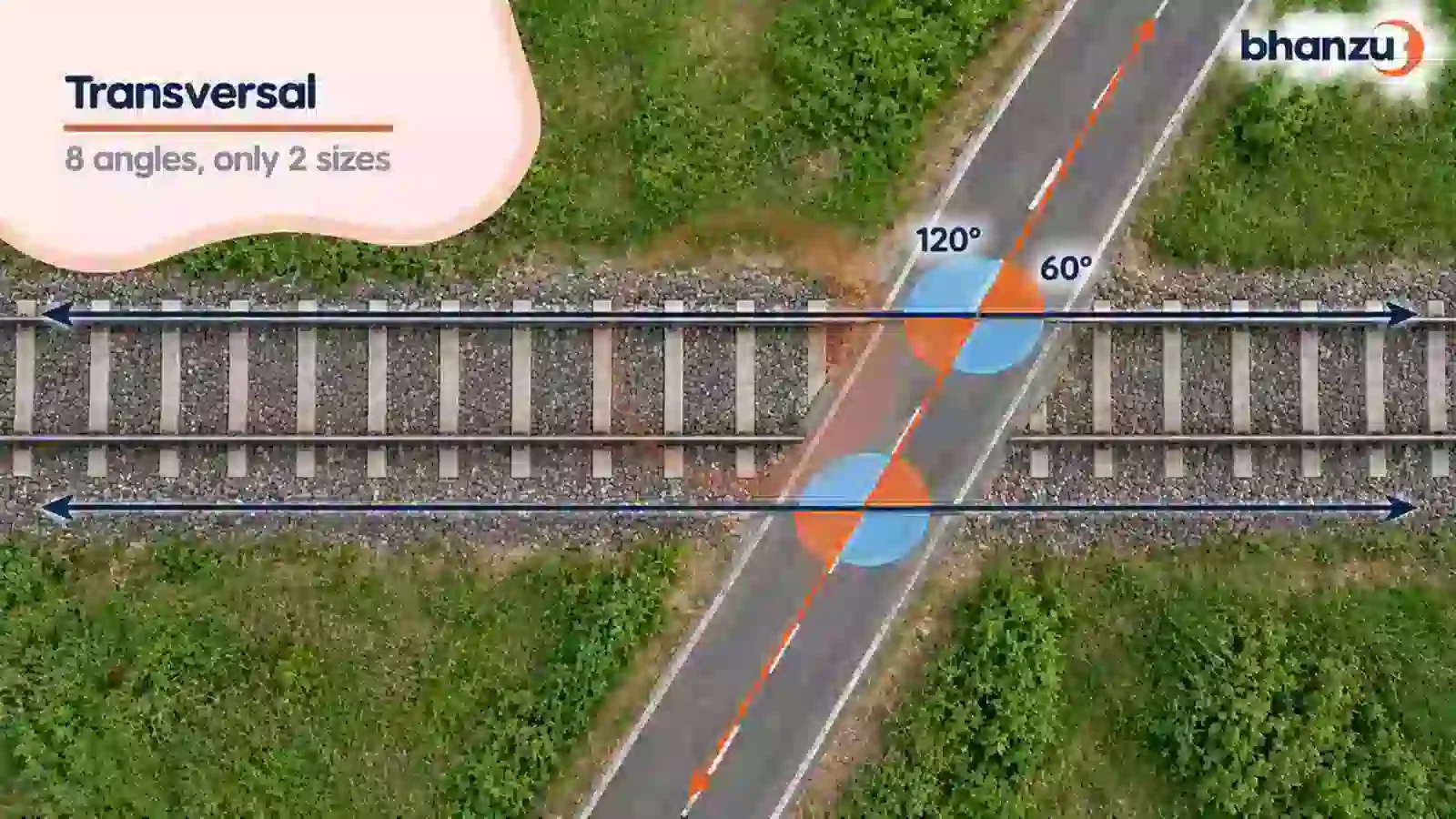
A transversal is a straight line that intersects two or more coplanar lines at distinct points. At each intersection point it forms four angles, so crossing two lines produces eight angles in total. Those eight angles are not independent; they pair up into relationships you can name and use.
Four of the eight sit between the two crossed lines. These are the interior angles. The other four sit outside the pair of lines, and these are the exterior angles. Whether a related pair turns out equal or supplementary depends on two things only: which side of the transversal each angle is on, and whether they are interior or exterior. Get comfortable reading those two facts off a diagram and every rule below follows.
The lines being crossed do not have to be parallel for a transversal to exist. When they are parallel lines, though, the angle pairs snap into the clean equalities that make transversals so useful in proofs.
What Are the Types of Angles Formed by a Transversal?
There are five named relationships. The first four are the pairs a transversal creates; the fifth is the pair each intersection creates on its own.
Corresponding angles. Same corner position at each intersection, on the same side of the transversal. In the figure, ∠1 and ∠5 correspond. When the lines are parallel, corresponding angles are equal.
Alternate interior angles. Between the two lines, on opposite sides of the transversal, such as ∠3 and ∠6. When the lines are parallel, alternate interior angles are equal.
Alternate exterior angles. Outside the two lines, on opposite sides of the transversal, such as ∠1 and ∠8. When the lines are parallel, these are equal.
Co-interior angles. Between the two lines, on the same side of the transversal, such as ∠3 and ∠5. Also called consecutive interior or same-side interior angles. When the lines are parallel, co-interior angles are supplementary, summing to 180°.
Vertically opposite angles. The pair directly across from each other at a single intersection, such as ∠1 and ∠3. Vertical angles are always equal, parallel lines or not.
How Do You Find a Missing Angle Using a Transversal?
How do you know whether to use "equal" or "180 minus the angle"? Read the side of the transversal first. If the two angles sit on opposite sides of the transversal, they are equal. If they sit on the same side, they are supplementary. That single question resolves almost every missing-angle problem before you touch any arithmetic.
The procedure is short:
Confirm the two crossed lines are parallel. If they are not, only the vertically-opposite and linear-pair relationships hold.
Name the pair the two angles belong to (corresponding, alternate, or co-interior).
Apply the rule: alternate and corresponding pairs are equal; co-interior pairs sum to 180°.
Solve, then sanity-check that an obtuse angle came out obtuse and an acute one acute.
These relationships are the toolkit behind parallel lines cut by a transversal, and they are exactly what lets you prove two lines are parallel by measuring angles rather than chasing the lines to infinity.
What Are the Properties of Transversal Angles?
The behaviour of the eight angles is governed by a compact set of properties, and every one of them is a two-way street: parallel lines force the angle equalities, and the angle equalities prove the lines parallel (the converse).
Equal pairs (parallel case): corresponding, alternate interior, and alternate exterior angles are each equal.
Supplementary pair (parallel case): co-interior angles sum to 180°.
Always true (any two lines): vertically opposite angles are equal, and each straight-line pair (a linear pair) sums to 180°.
The converse holds: if any corresponding pair is equal, or any alternate pair is equal, or any co-interior pair sums to 180°, then the two crossed lines must be parallel.
Non-parallel lines: when the crossed lines meet somewhere, none of the equal/supplementary pair-rules apply, only the single-intersection facts (vertical angles, linear pairs) survive.
The converse is the property that does the heavy lifting in geometry. It turns a measurement into a proof.
Examples of Transversals and Related Angles
The examples move from a single named pair to a full multi-step angle chase, with one deliberately wrong start in the middle.
Example 1
A transversal cuts two parallel lines, and one corresponding angle measures 65°. Find its corresponding partner.
Corresponding angles on parallel lines are equal.
Final answer: the corresponding angle is 65°.
Example 2
Two parallel lines are cut by a transversal. One co-interior angle is 110°. Find the other co-interior angle.
The tempting first move is to say co-interior angles are alternate-style angles and set them equal, giving 110°.
Check that against the picture. Both co-interior angles sit on the same side of the transversal, between the parallel lines. Two angles hugging the same side of a slanted line, both leaning inward, cannot both be 110°; together they would overshoot a straight line. So "equal" is wrong here.
Co-interior angles are supplementary:
Final answer: the other co-interior angle is 70°.
Example 3
Lines l and m are parallel. A transversal makes an alternate interior angle of with l and its alternate partner measures with m. Find x.
Alternate interior angles on parallel lines are equal:
Final answer: , so each alternate interior angle is .
Example 4
At one intersection, a transversal makes an angle of 125°. Find the vertically opposite angle and the angle forming a linear pair with the 125° angle.
Vertically opposite angles are equal, so one partner is 125°.
The linear-pair partner sits on the same straight line:
Final answer: the vertical angle is 125°; the linear-pair angle is 55°.
Example 5
A transversal crosses two parallel lines. A corresponding angle at the top is and a co-interior angle at the bottom paired with it is . Find both angles.
The corresponding angle equals the top angle of the co-interior pair, so the co-interior pair is and , and they are supplementary:
Substitute back: and .
Final answer: the angles are 96° and 84° (and , so they check).
Example 6
Two lines are cut by a transversal. A pair of alternate interior angles measure and . Are the two lines parallel?
Use the converse. Alternate interior angles are equal only when the lines are parallel. Here 70° does not equal 68°.
Final answer: the lines are not parallel; they would meet if extended.
Why Do Transversal Angles Matter Beyond the Classroom?
"Two lines that never meet, proven without ever extending them."
Before transversals, deciding whether two lines were truly parallel meant extending them and hoping they never crossed, which is impossible to check over infinite length. The insight that saved geometry is that you can settle the question locally: cut both lines with one transversal, measure a single pair of angles, and the converse rules tell you the global truth. This is Euclid's parallel reasoning in the Elements, and it is why the fifth postulate is stated in terms of angles a transversal makes rather than the lines meeting.
The idea did not stay on the page. Where it shows up:
Structural engineering. Roof trusses and bridge members must stay parallel under load; inspectors verify parallelism by measuring transversal angles on a drawing, not by extending beams into the sky.
Road and rail design. Lane markings and rail tracks are checked for parallelism using the corresponding-angle rule against a survey line acting as the transversal.
Computer graphics and CAD. Snapping lines to "parallel" relies on the same angle equalities coded into the software.
An interactive parallel-line tool makes the point fastest: drag the transversal and watch which pairs stay locked together and which drift apart the instant the lines stop being parallel.
What Are the Most Common Mistakes With Transversal Angles?
Mistake 1: Setting co-interior angles equal instead of supplementary
Where it slips in: any problem where a co-interior pair appears alongside several equal pairs, so the reader assumes every relationship is an equality.
Don't do this: writing for two same-side interior angles.
The correct way: co-interior angles sum to 180°, so use . The first instinct is almost always to reach for "equal" because so many transversal pairs are equal; the fix is to read the side of the transversal before naming the relationship, because same-side is the one case that turns supplementary.
Mistake 2: Applying the equal/supplementary rules to non-parallel lines
Where it slips in: diagrams that look "close enough" to parallel but carry no parallel-arrow marks.
Don't do this: assuming alternate interior angles are equal on lines that are not marked parallel.
The correct way: only vertically opposite angles and linear pairs are guaranteed on any two crossed lines. The equal-or-supplementary pair-rules need the parallel marks. The memorizer, who has the rules letter-perfect, is exactly the reader who applies them to a figure with no parallel marks and gets a confident wrong answer.
Mistake 3: Confusing alternate interior with alternate exterior
Where it slips in: eight-angle diagrams where the interior region is crowded.
Don't do this: pairing an inside angle with an outside angle and calling it "alternate."
The correct way: alternate pairs must both be interior or both be exterior; only then does "opposite side of the transversal" make them equal. A crossed pair with one angle inside and one outside is neither alternate type.
Conclusion
A transversal crosses two or more lines and forms eight angles at two intersection points, grouped into five named relationships.
On parallel lines, corresponding, alternate interior, and alternate exterior pairs are equal, while co-interior pairs are supplementary.
The deciding question is the side of the transversal: opposite sides give equal angles, the same side gives supplementary angles.
The converse of each rule proves two lines are parallel from a single angle measurement.
Vertically opposite angles and linear pairs hold for any two crossed lines, parallel or not.
To take transversals and related angles further with a teacher, explore Bhanzu's geometry tutor or high school math tutor, or see the full range of math classes online.
Practice the six examples above until you can name each pair on sight, then try building your own eight-angle diagram and labelling every relationship. If you get stuck deciding equal versus supplementary, come back to the side-of-the-transversal rule. To work through this with a live Bhanzu trainer, book a free demo class.
Read More
Was this article helpful?
Your feedback helps us write better content